

The best privileged access management solutions help teams control administrative permissions, reduce unauthorized access risks, and protect sensitive systems from internal and external threats. These tools make it easier to enforce least-privilege policies, monitor high-risk activity, and secure credentials across distributed environments.
When misconfigurations expose critical systems, manual approval processes slow urgent work, or privileged accounts go untracked, organizations face increased security gaps and greater operational risk. These issues make it harder for security and IT teams to maintain visibility, support audits, and respond quickly to suspicious behavior.
With over 20 years in the industry as a Chief Technology Officer, I’ve tested and reviewed dozens of privileged access management solutions across real-world environments to evaluate their security controls, audit features, and integration quality. This guide highlights the top privileged access management solutions. Each review covers features, pros and cons, and best-fit use cases to help you choose the right tool.
Why Trust Our Software Recommendations
6,700+
Reviews
20
Industry experts
16+
Evaluation factors
14
Years
Our team has been testing and reviewing software since 2012. As tech leaders ourselves, we know how difficult—and important—it is to choose the right software.
For this guide, we evaluated tools using hands-on testing and independent research, scoring tools using our selection criteria.
Our reviews reflect our human editorial judgment, not a sales pitch.
Expert reviewers:
- Paulo Gardini MiguelTech Director
 Tim FisherVP of AI
 Gabriel RosasTech Lead & Software Architect
 Christhian GruhnTech Lead & Platform Architect

Best Privileged Access Management Solutions Summary
This comparison chart summarizes pricing details for my top privileged access management solutions selections to help you find the best one for your budget and business needs.
| Tool | Best For | Trial Info | Price | ||
|---|---|---|---|---|---|
| 1 | Best with built-in dark web breach monitoring | 14-day free trial | Pricing upon request | Website | |
| 2 | Best for smart privilege elevation | Free trial + free demo available | Pricing upon request | Website | |
| 3 | Best for secure password vault | Free trial + demo available | From $3.33/month (billed annually) | Website | |
| 4 | Best for compliance with data regulations | Free trial + free demo available | Pricing upon request | Website | |
| 5 | Best for agentless PAM approach | 30-day free trial | From $2/user/month | Website | |
| 6 | Best for enterprise-level integration | Free demo available | Pricing upon request | Website | |
| 7 | Best for privileged access without blind spots | 30-day free trial | From $3/user/month (billed annually) | Website | |
| 8 | Best for small to medium businesses | Free demo available | Pricing upon request | Website | |
| 9 | Best for scalability across industries | Pricing upon request | Website | ||
| 10 | Best for seamless third-party integrations | Free trial available | From $35/month | Website |


Best Privileged Access Management Solution Reviews
Below are my detailed summaries of the best privileged access management solutions that made it onto my shortlist. My reviews offer a detailed look at the key features, pros & cons, integrations, and ideal use cases of each tool to help you find the best one for you.
 Best with built-in dark web breach monitoring
- 14-day free trial
- Pricing upon request
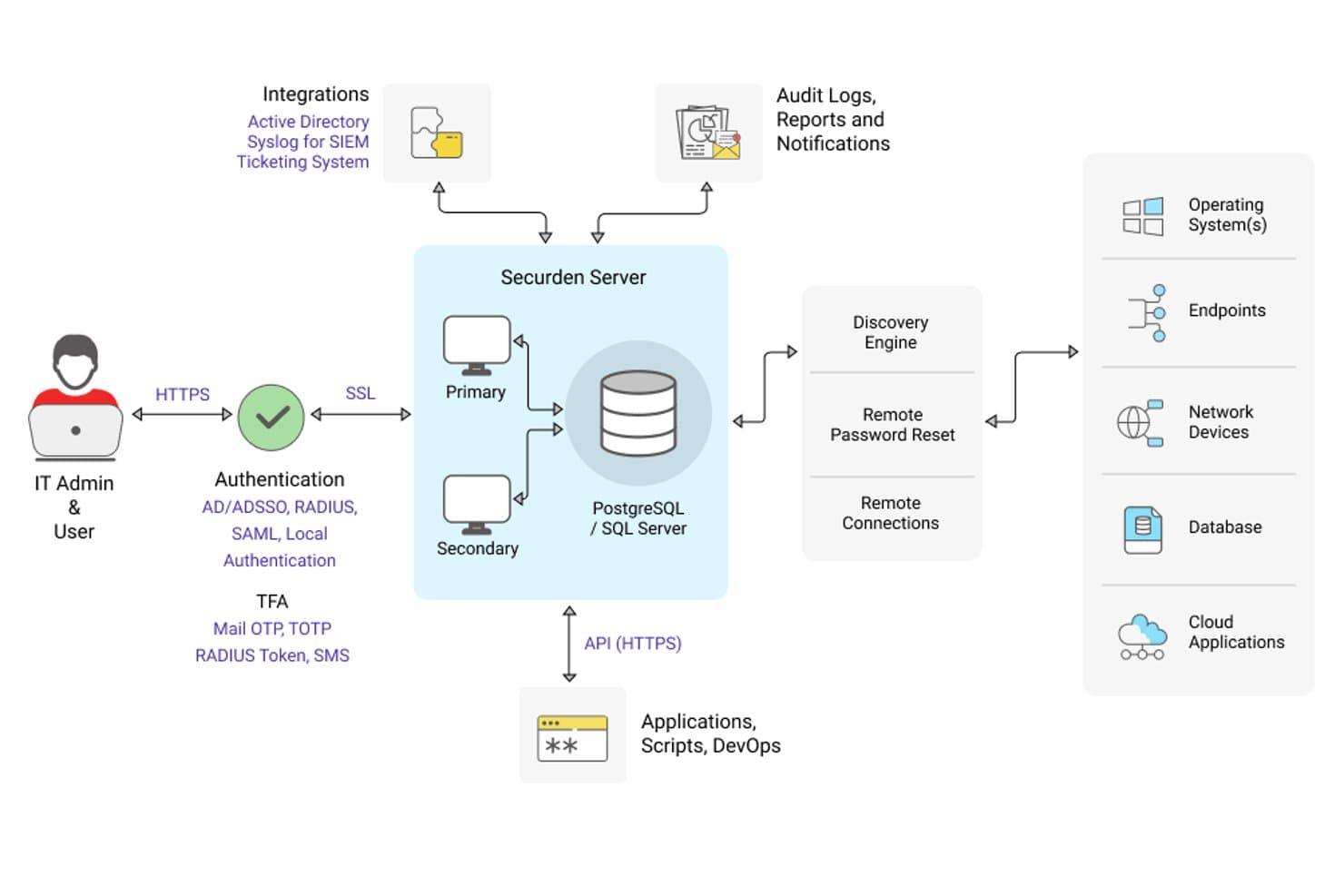
Securden Unified PAM offers a comprehensive architecture diagram showing server components, authentication methods, integrations, and target system connections. Securden Unified PAM is a privileged access management platform that combines credential vaulting, session monitoring, endpoint privilege control, and just-in-time access management across on-prem, cloud, and hybrid environments.
Who Is Securden Unified PAM Best For?
IT security and compliance teams that need a full PAM stack without the complexity or cost of legacy enterprise vendors.
Why I Picked Securden Unified PAM
I picked Securden Unified PAM as one of the best because of its built-in dark web breach monitoring, which flags compromised credentials stored in the vault before attackers can exploit them. Unlike tools that need third-party add-ons for breach intelligence, Securden checks partial password hashes against breached databases and fires instant alerts. I also like how this pairs with automated password rotation, so a flagged credential gets cycled out immediately rather than just flagged and forgotten.
Securden Unified PAM Key Features
- Automated privileged account discovery: Scans endpoints, servers, databases, and cloud platforms to identify and onboard privileged accounts.
- Endpoint privilege management: Removes local admin rights with policy-based elevation for approved applications and tasks.
- Built-in compliance reporting: Generates audit-ready reports mapped to major regulations like HIPAA, PCI DSS, and NIST frameworks.
- SIEM and ITSM integration: Connects with solutions like IBM QRadar and ServiceNow for centralized monitoring and workflow automation.
Securden Unified PAM Integrations
Securden Unified PAM offers native integrations with ServiceNow, IBM QRadar, AWS, Google Cloud Platform, Microsoft Entra ID, Okta, OneLogin, Duo, YubiKey, RADIUS, and Freshservice, and provides an API for custom integrations.
Pros and Cons
Pros:
- Endpoint privilege management included natively
- Covers on-prem, cloud, and hybrid deployments
- Built-in dark web breach monitoring included
Cons:
- Advanced reporting requires significant manual customization
- UI feels dated compared to competitors
Learn more about Securden Unified PAM: Best for smart privilege elevation
- Free trial + free demo available
- Pricing upon request

Heimdal dashboard showing centralized monitoring of privileged activity, access controls, and threat insights. In the realm of privileged access management solutions, Heimdal stands out by addressing the unique security challenges faced by various industries, including healthcare, government, and education. Designed for organizations that prioritize compliance and data governance, it offers a robust framework for managing access to sensitive accounts and systems. By eliminating shared admin passwords and blocking unauthorized software installs, Heimdal provides your team with the tools needed to maintain a secure and compliant IT environment.
Why I Picked Heimdal
I picked Heimdal for its innovative approach to privileged access management, specifically its Smart Privilege Elevation and Delegation Management feature. This tool automates admin requests, allowing you to grant temporary admin rights that automatically expire, reducing the risk of privilege creep. Additionally, Heimdal's Application Control with AppFencing blocks unauthorized software installations, ensuring only approved applications run on your network. These features collectively help your organization maintain security without compromising on efficiency.
Heimdal Key Features
In addition to its standout privilege management tools, I also found several other features that enhance its value:
- Privileged Account & Session Management: This feature records and audits all privileged sessions, providing a clear trail for compliance and security audits.
- Just-in-Time Access: Offers temporary access to critical systems only when necessary, reducing the risk of privilege abuse.
- Mobile Approvals: Allows administrators to approve requests on the go, ensuring that your team maintains control over access even when they're away from their desks.
- Instant Compliance Reporting: Generates detailed reports to help your organization meet various regulatory standards, such as ISO 27001 and HIPAA.
Heimdal Integrations
Integrations include ConnectWise RMM, Autotask PSA, and other third-party cybersecurity tools. Additionally, Heimdal offers an API for custom integrations, allowing you to tailor the solution to fit your specific needs.
Pros and Cons
Pros:
- Comprehensive session monitoring logs
- Smart privilege elevation automation
- Granular role-based access controls
Cons:
- Pricing not publicly disclosed
- Interface may feel complex
Learn more about Heimdal: Best for secure password vault
- Free trial + demo available
- From $3.33/month (billed annually)
Visit WebsiteCustomer Rating:4.7/5This rating combines scores from multiple user review sites to reflect overall customer sentiment about the product.
With Keeper Security you can secure file and password sharing. Keeper Security is a password management and privileged access management solution designed for businesses and individuals. It focuses on securing passwords and sensitive data, providing features that enhance security and compliance.
Why I picked Keeper Security: Its secure password vault differentiates Keeper Security from other solutions. The platform uses zero-trust and zero-knowledge architecture, ensuring end-to-end encryption for user data. Features like password sharing and secrets management enhance security for your team. Keeper Security is FedRAMP authorized, meeting stringent government standards, making it ideal for high-security environments.
Standout features & integrations:
Features include password sharing, secrets management, and secure file sharing. Your team can benefit from passwordless authentication, reducing the risk of breaches. Keeper Security also offers compliance with certifications like HIPAA, GDPR, and PCI DSS.
Integrations include Microsoft Azure, Active Directory, LDAP, SSO, SAML, Google Workspace, Okta, Duo Security, Slack, and Splunk.
Pros and Cons
Pros:
- Passwordless authentication
- FedRAMP authorized
- Zero-knowledge architecture
Cons:
- Limited customization options
- May be complex for small teams
Learn more about Keeper Security: Best for compliance with data regulations
- Free trial + free demo available
- Pricing upon request
Visit WebsiteCustomer Rating:4.6/5This rating combines scores from multiple user review sites to reflect overall customer sentiment about the product.
This is CyberArk's view of its identity security intelligence. Cyberark is a leading provider of identity security and privileged access management solutions, serving industries like banking, healthcare, and government. It focuses on securing privileged access and enhancing security through features like single sign-on and multi-factor authentication.
Why I picked Cyberark: It excels in compliance with data regulations, making it a top choice for regulated industries. Cyberark's Identity Security Platform offers intelligent privilege controls and secrets management to meet stringent compliance requirements. It provides robust security measures without compromising productivity. The platform's emphasis on compliance ensures your team can meet regulatory standards effectively.
Standout features & integrations:
Features include single sign-on, multi-factor authentication, and secrets management. Your team can benefit from endpoint identity security to protect devices. Cyberark also offers machine identity security to safeguard automated processes.
Integrations include Splunk, ServiceNow, SailPoint, Okta, Microsoft Azure, AWS, Google Cloud, SAP, Oracle, and IBM.
Pros and Cons
Pros:
- Extensive industry coverage
- Machine identity security
- Strong compliance support
Cons:
- Requires technical expertise
- High resource requirements
Learn more about Cyberark: Best for agentless PAM approach
- 30-day free trial
- From $2/user/month
Visit WebsiteCustomer Rating:4.5/5This rating combines scores from multiple user review sites to reflect overall customer sentiment about the product.
miniOrange PAM dashboard showing real-time session overview, user counts, and privileged resource activity from a centralized admin console. miniOrange PAM is a modern, identity-first privileged access management solution built for organizations that require strong privileged security controls. It is well-suited for regulated industries such as finance, healthcare, manufacturing, and government, where protecting sensitive data and meeting compliance requirements are essential. With capabilities like password vaulting, session monitoring, and just-in-time access, miniOrange PAM helps reduce risk and protect privileged accounts from evolving cyber threats.
Why I Picked miniOrange PAM
I picked miniOrange PAM because it offers modern, mature PAM capabilities with a strong identity-first foundation. It is a cloud-first solution that also supports on-premises and hybrid environments, giving you flexibility across infrastructure models. I value its advanced features such as just-in-time access management, privileged session monitoring and recording, granular access controls, password vaulting, and automated credential rotation. These capabilities support real-time auditing of privileged activity and allow temporary elevation of privileges based on verified needs, aligning with the principle of least privilege. Its agentless PAM architecture also makes deployment simpler and more scalable, which can be especially helpful if you want to strengthen privileged security without managing endpoint agents.
miniOrange PAM Key Features
In addition to its robust privileged access management capabilities, I also found several key features that enhance its value:
- Session Monitoring and Control: Provides real-time tracking and recording of privileged sessions, allowing intervention if unauthorized or risky activity is detected.
- Strong Identity-Based Authentication: Enforces access using native SSO and identity-level MFA, incorporating device trust, location, and risk signals to strengthen verification.
- Just-In-Time Privileged Access and EPM: Grants time-bound privileged access through approval workflows and automatically revokes rights after expiration, while Endpoint Privilege Management removes unnecessary admin rights and enforces least privilege on endpoints.
- AI-Driven Threat Detection: Uses anomaly detection, automated responses, and continuous learning to identify suspicious behaviour and improve privileged account protection.
miniOrange PAM Integrations
Integrations include Salesforce, Google Workspace, Microsoft 365, AWS, Azure, Slack, Jira, ServiceNow, Zoom, Dropbox, SSH, RDP, and VPN and VDI solutions. An API is also available to support custom integrations.
Pros and Cons
Pros:
- Solid endpoint privilege management
- Agentless PAM simplifies deployment
- Cloud-first and hybrid flexibility
Cons:
- Legacy migrations may need planning
- Complex setups may need specialists
Learn more about miniOrange: Best for enterprise-level integration
- Free demo available
- Pricing upon request
Visit WebsiteCustomer Rating:4.3/5This rating combines scores from multiple user review sites to reflect overall customer sentiment about the product.
Here is a view of BeyondTrust's PRA real-time dashboard. BeyondTrust is a privileged access management solution tailored for large enterprises. It focuses on securing and managing access across complex IT environments, providing tools that enhance control and compliance.
Why I picked BeyondTrust: It excels in enterprise-level integration, making it ideal for large organizations with diverse systems. Features like session monitoring and real-time threat analytics help you maintain oversight and security. BeyondTrust's ability to integrate with various enterprise systems ensures smooth operations. The tool offers granular access controls, enhancing security for your team.
Standout features & integrations:
Features include session monitoring, real-time threat analytics, and granular access controls. Your team can use vulnerability management to identify and address potential risks. BeyondTrust also provides detailed audit trails for compliance purposes.
Integrations include Microsoft Active Directory, LDAP, ServiceNow, Splunk, SailPoint, CyberArk, Okta, Duo Security, RSA, and Google Workspace.
Pros and Cons
Pros:
- Strong enterprise-level integration
- Real-time threat analytics
- Detailed audit trails
Cons:
- Complex for small businesses
- Initial setup can be time-consuming
Learn more about BeyondTrust: Best for privileged access without blind spots
- 30-day free trial
- From $3/user/month (billed annually)
Visit WebsiteCustomer Rating:4.9/5This rating combines scores from multiple user review sites to reflect overall customer sentiment about the product.
Zygon’s app inventory dashboard showing approved apps, access sources, contract types, and renewal timelines. Zygon is a modern identity governance platform that helps IT and security teams control user identities, manage access, and detect shadow IT. It combines identity lifecycle management, access reviews, and governance workflows to strengthen security across SaaS environments.
Why I picked Zygon: I picked Zygon because it gives you fast, automated visibility into all apps and user identities, which is crucial for reducing access sprawl. You can build a consolidated inventory of cloud accounts quickly, even across shadow IT, helping you secure privileged access without blind spots. Zygon also automates deprovisioning, access reviews, and compliance workflows, making it a solid option for teams aiming to save time while staying audit-ready.
Standout features & integrations:
Features include a real-time cloud identity inventory, agentless and SCIM-less deprovisioning, and bulk access reviews. Zygon also offers a browser extension for managing apps without API connections and an Auto-Provisioning Atlas to track authentication methods.
Integrations include Google Workspace, Microsoft 365, Entra ID, Okta, n8n, Make, Slack, and Microsoft Teams.
Pros and Cons
Pros:
- Bulk access reviews
- Browser extension for non-API apps
- Agentless and SCIM-less deprovisioning
Cons:
- Smaller integration library
- Limited advanced reporting
Learn more about Zygon: Best for small to medium businesses
- Free demo available
- Pricing upon request
Visit WebsiteCustomer Rating:4.2/5This rating combines scores from multiple user review sites to reflect overall customer sentiment about the product.
Here is a screenshot of ManageEngine PAM360's password dashboard. ManageEngine PAM360 is a privileged access management solution designed for small to medium-sized businesses. It provides centralized control over IT infrastructure, helping manage and secure privileged accounts effectively.
Why I picked ManageEngine PAM360: Its suitability for small to medium businesses sets it apart. The tool offers comprehensive password management and session monitoring, making it accessible for teams with limited IT resources. It also provides automated compliance reporting to keep your business aligned with regulations. The intuitive dashboard simplifies management, allowing your team to focus on core tasks without getting bogged down in complex processes.
Standout features & integrations:
Features include automated compliance reporting, session monitoring, and an intuitive dashboard. Your team can benefit from real-time alerts to identify potential security threats. ManageEngine PAM360 also offers audit trails to track user activities and ensure accountability.
Integrations include Microsoft Active Directory, LDAP, ServiceNow, Jira, Azure, AWS, Google Cloud, Oracle, VMware, and SAP.
Pros and Cons
Pros:
- Intuitive user interface
- Automated compliance reporting
- Suitable for small businesses
Cons:
- Limited advanced features
- Basic reporting capabilities
Learn more about ManageEngine PAM360:

This is a view of Broadcom's software for Symantec privileged access management (pam) overview. Broadcom is a privileged access management solution catering to enterprises across various industries. It focuses on providing scalable security solutions to manage and protect privileged accounts effectively.
Why I picked Broadcom: Its scalability across industries makes it versatile for different enterprise environments. Broadcom offers centralized policy management and access controls, ensuring consistent security measures. It provides automated threat detection to identify and respond to potential risks. The platform's flexibility allows it to adapt to your organization's specific needs, making it suitable for diverse operational requirements.
Standout features & integrations:
Features include centralized policy management, automated threat detection, and flexible access controls. Your team can use detailed audit logs to track user activities. Broadcom also offers real-time analytics to monitor security events.
Integrations include Microsoft Active Directory, LDAP, ServiceNow, SAP, Oracle, IBM, AWS, Azure, Google Cloud, and Splunk.
Pros and Cons
Pros:
- Centralized policy management
- Automated threat detection
- Flexible access controls
Cons:
- Complex initial setup
- Ongoing maintenance needed
Learn more about Broadcom:

Auth0 offers simple tools to manage user identities and admin tasks. Auth0 is an identity management platform aimed at developers and IT teams. It provides authentication and authorization services, helping businesses secure user access and manage identities efficiently.
Why I picked Auth0: It excels in seamless third-party integrations, making it versatile for various applications. Auth0's extensive integration options allow your team to connect with existing systems effortlessly. The platform supports multiple authentication methods, enhancing security without complicating the user experience. Its comprehensive API support ensures flexibility, allowing you to tailor the solution to your specific needs.
Standout features & integrations:
Features include multiple authentication methods, comprehensive API support, and customizable login screens. Your team can benefit from real-time security monitoring to detect potential threats. Auth0 also provides detailed analytics to track user activity and improve security measures.
Integrations include Microsoft Azure, AWS, Google Cloud Platform, Salesforce, Slack, Twilio, Zendesk, GitHub, Zoom, and Dropbox.
Pros and Cons
Pros:
- Extensive third-party integrations
- Multiple authentication methods
- Comprehensive API support
Cons:
- Can be resource-intensive
- May have a steep learning curve
Learn more about Auth0:
Other Privileged Access Management Solutions
- 11SailPointBest for identity governance
- 12One IdentityBest for cloud-based solutions
- 13WallixBest for managing remote access
- 14CakewalkBest for user-friendly interface
- 15Rippling ITBest for automated app provisioning
- 16JumpCloudBest for comprehensive device management across different operating systems
- 17OktaBest for identity management in large organizations
- 18WorkatoBest for workflow automation
- 19Microsoft Entra Verified IDBest for verifying digital identities
- 20StrongDMBest for privileged session management
- 21SilverfortBest for adaptive multi-factor authentication
- 22DuoBest for user-friendly two-factor authentication
- 23DelineaBest for efficient privilege management
- 24SafeNet Trusted AccessBest for managing remote access
- 25NokiaBest for large-scale network environments
- 26IBM Security Verify PrivilegeBest for hybrid cloud integration
- 27Azure AD (Microsoft Entra ID)Best for seamless integration with Microsoft services
- 28EkranBest for insider threat detection
- 29IdencyBest for on-premise deployments
- 30PrivXBest for cloud-native environments
How I Evaluate Privileged Access Management Solutions
I split my evaluation into two layers: the baseline requirements—credential vaulting, session recording, and JIT access—a tool must meet, and the differentiators that set the best tools apart.
Core Functionality (Table Stakes For This List)
When I'm selecting tools for my list, I rank each one on a scale from 0 (does not offer the functionality) to 5 (excels in this area) for each core functionality listed below. Then, I calculate the tool's total score into a percentage. Each tool needs to achieve a minimum total score of 65% to be considered for inclusion.
- Privileged Credential Vaulting: I check whether the vault handles automated rotation for passwords, SSH keys, and API tokens—not just stores them—across platforms like Active Directory, Linux servers, and databases.
- Session Management & Monitoring: Real-time session recording and live monitoring matter here, especially the ability to terminate a suspicious RDP or SSH session mid-stream before damage is done.
- Least-Privilege & JIT Access: I evaluate how each tool handles time-bound privilege elevation, like granting a DBA temporary access to a production database through an approval workflow rather than standing permissions.
- Multi-Factor Authentication: Each tool should integrate with major identity providers for MFA at the point of privileged access, not just at initial login, including step-up authentication for sensitive actions.
- Audit Logging & Compliance Reporting: I look for tamper-proof audit trails paired with prebuilt report templates mapped to frameworks like SOX, PCI-DSS, and HIPAA that compliance teams can pull without custom queries.
- Privileged Account Discovery: Automated scanning across endpoints, cloud environments, and directories is what I evaluate here—tools should find orphaned and unmanaged accounts, not rely on manual entry alone.
Once I have a list of tools that meet this criteria, I consider what sets each platform apart.
Differentiating Factors (What Sets Vendors Apart)
Here's how I compare and contrast different vendors:
Standout Features
Secrets management for DevOps is a key differentiator—I look for tools that inject credentials into CI/CD pipelines and Kubernetes without hardcoding them in scripts. Endpoint privilege management matters too, especially for teams that need to strip local admin rights while still letting users elevate permissions for approved tasks. Remote vendor access is another factor I evaluate, since granting a contractor temporary, audited access without a VPN or shared credentials is a common need across IT teams.
Beyond Features
Integration ecosystem is a big one—I check whether a tool connects natively with your SIEM (Splunk, Sentinel) and ITSM platforms like ServiceNow so alerts flow into existing incident workflows. Compliance certifications also carry weight; SOC 2 Type II and FedRAMP authorization signal that a vendor meets strict audit standards your compliance team will ask about. Deployment model matters too, since some organizations require self-hosted or air-gapped options while others prefer SaaS for faster rollouts.
How to Choose Privileged Access Management Solution
It’s easy to get bogged down in long feature lists and complex pricing structures. To help you stay focused as you work through your unique software selection process, here’s a checklist of factors to keep in mind:
| Factor | What to Consider |
| Scalability | Ensure the solution can grow with your organization. Consider if it can handle increased users and data without performance loss. |
| Integrations | Check if it integrates with existing systems like Active Directory, cloud services, and other user provisioning software your team uses. |
| Customizability | Look for options to tailor the solution to fit your specific workflows and security policies. |
| Ease of Use | Evaluate if the interface is intuitive for your team, minimizing training time and user errors. |
| Budget | Assess if the pricing aligns with your financial constraints, including potential hidden costs for add-ons or upgrades. |
| Security Safeguards | Verify the solution offers strong encryption management (PKI software), multi-factor authentication, and compliance with standards like GDPR. |
| Support Services | Consider the availability of customer support, including live chat, phone, and email, to assist when issues arise. |
| Performance Monitoring | Ensure the tool provides real-time insights into system performance and user activities to quickly address potential issues. |
Trends in Privileged Access Management Solution
In my research, I sourced countless product updates, press releases, and release logs from different privileged access management solutions vendors. Here are some of the emerging trends I’m keeping an eye on:
- Zero Trust Architecture: More vendors are adopting zero trust models, which assume that threats could be both external and internal. This approach requires continuous verification of users and devices, enhancing security. Solutions like CyberArk have incorporated this into their offerings.
- Behavioral Analytics: Vendors are integrating behavioral analytics to monitor user actions and detect anomalies. This helps in identifying suspicious activities early. For example, Ekran uses behavioral analytics to enhance security monitoring.
- Cloud-native Solutions: There's a shift towards cloud-native architectures, which offer flexibility and scalability. These solutions are designed to work seamlessly in cloud environments, as seen with providers like PrivX.
- Passwordless Authentication: The move towards passwordless authentication methods is gaining traction. This trend reduces the risk of credential theft and improves user experience. Vendors like BeyondTrust are exploring passwordless options in their solutions.
- Unified Endpoint Management: Vendors are focusing on managing all endpoints through a single platform, which simplifies security management. This trend is evident in the best portal software that offer centralized control and monitoring, such as those provided by One Identity.
What Are Privileged Access Management Solutions?
Privileged access management solutions secure and manage privileged accounts within an organization. IT administrators, security professionals, and compliance officers typically use these tools to protect sensitive information and maintain regulatory compliance.
Features like zero trust architecture, behavioral analytics, and passwordless authentication help with securing access, detecting anomalies, and improving user experience. Overall, these tools ensure that only authorized users have access to critical systems, reducing the risk of data breaches.
Features of Privileged Access Management Solutions
When selecting privileged access management solutions, keep an eye out for the following key features:
- Zero trust architecture: Requires continuous verification of users and devices, enhancing security by assuming threats could be both external and internal.
- Behavioral analytics: Monitors user actions to detect anomalies, helping identify suspicious activities early on.
- Passwordless authentication: Reduces the risk of credential theft and improves user experience by eliminating the need for passwords.
- Role-based access controls: Ensures users have the appropriate access levels, enhancing security and compliance.
- Automated compliance reporting: Streamlines the process of generating reports to ensure your organization meets regulatory standards.
- Session monitoring: Tracks user sessions in real-time to maintain oversight and detect unauthorized activities.
- Cloud-native architecture: Offers flexibility and scalability, making it ideal for environments that rely on cloud services.
- Unified endpoint management: Provides centralized control and monitoring of all endpoints, simplifying security management.
- Access certification: Regularly reviews and certifies access rights to maintain security and compliance.
- Real-time threat detection: Identifies potential security threats as they occur, allowing for swift response and mitigation.
Benefits of Privileged Access Management Solutions
Implementing privileged access management solutions provides several benefits for your team and your business. Here are a few you can look forward to:
- Enhanced security: By using zero trust architecture and behavioral analytics, these tools reduce the risk of unauthorized access and data breaches.
- Regulatory compliance: Automated compliance reporting and access certification help ensure your organization meets industry standards and regulations.
- Improved user experience: Passwordless authentication and role-based access controls make it easier for users to access the systems they need without compromising security.
- Operational efficiency: Automated provisioning and session monitoring streamline processes, reducing the workload on IT teams while maintaining oversight.
- Scalability: Cloud-native architectures and unified endpoint management allow your organization to grow without sacrificing security or performance.
- Real-time response: Real-time threat detection enables swift identification and mitigation of potential security threats, minimizing impact on your business.
- Centralized control: Unified management of identities and access across various environments simplifies security management and enhances overall governance.
Costs and Pricing of Privileged Access Management Solutions
Selecting privileged access management solutions requires an understanding of the various pricing models and plans available. Costs vary based on features, team size, add-ons, and more. The table below summarizes common plans, their average prices, and typical features included in privileged access management solutions:
Plan Comparison Table for Privileged Access Management Solutions
| Plan Type | Average Price | Common Features |
| Free Plan | $0 | Basic access control, limited user management, and basic reporting. |
| Personal Plan | $5-$25 /user /month | Single-user access, password management, and basic security features. |
| Business Plan | $25-$50 /user /month | Multi-user support, session monitoring, role-based access, and compliance reporting. |
| Enterprise Plan | $50-$100 /user /month | Advanced security analytics, integration with other systems, unlimited users, and dedicated support. |
Privileged Access Management Solution FAQs
Here are some answers to common questions about privileged access management solutions:
How does a PAM solution work?
PAM solutions secure privileged account credentials by storing them in a secure vault. Administrators must go through the PAM system to access these credentials, ensuring authentication and logging each access. This process helps protect sensitive accounts from unauthorized use.
What is the difference between ZTNA and PAM?
PAM focuses on securing and managing access to critical systems, while ZTNA enforces strict access controls across entire networks. Both are vital for cybersecurity, but they address different security needs. PAM manages privileged access, whereas ZTNA continuously verifies users’ access across networks.
What are the requirements for privileged access management?
Effective PAM requires multifactor authentication, automated security measures, and removal of endpoint user access. Establishing baselines and monitoring deviations are also crucial for maintaining security. These practices help prevent unauthorized access and ensure compliance.
What is the risk of privileged access management?
Neglecting PAM can lead to data breaches, privilege escalation, and insider threats. Attackers may exploit elevated access rights, causing operational and financial damage. Implementing PAM mitigates these risks by securing sensitive accounts and monitoring access.
How does PAM reduce insider threats?
PAM reduces insider threats by limiting access to sensitive accounts and monitoring user activities. It enforces strict controls over who can access what resources, helping prevent misuse of privileges. By recording all access, PAM deters potential malicious actions.
Can PAM solutions integrate with existing security systems?
Yes, PAM solutions often integrate with existing security systems like IAM, SIEM, and other IT tools. This integration enhances overall security by providing a unified approach to managing access and monitoring activities across different platforms.
What's Next?
Boost your SaaS growth and leadership skills. Subscribe to our newsletter for the latest insights from CTOs and aspiring tech leaders. We'll help you scale smarter and lead stronger with guides, resources, and strategies from top experts!