

10 Best Cloud Integration Platforms Reviewed In 2026

10 Best Cloud Integration Platforms Shortlist


Cloud integration platforms are valuable assets for any company. With the right software, teams can improve data connectivity and enhance workflow efficiency. However, finding the right cloud integration platform can be challenging, especially with many available options.
Using my experience with revenue operations software, I tested and compared several of the top cloud integration platforms available. From there, I compiled my results into detailed reviews to help you find the best software for your needs.
Why Trust Our Software Recommendations
Our team has been testing and reviewing software since 2012. As tech leaders ourselves, we know how difficult—and important—it is to choose the right software.
For this guide, we evaluated tools using hands-on testing and independent research, scoring tools using our selection criteria.
Our reviews reflect our human editorial judgment, not a sales pitch.
Expert reviewers:
Best Cloud Integration Platform Summary
This comparison chart summarizes pricing details for my top cloud integration platform selections, helping you find the best one for your budget and business needs.
| Tool | Best For | Trial Info | Price | ||
|---|---|---|---|---|---|
| 1 | Best for governed self-service data integration | Free demo available | Pricing upon request | Website | |
| 2 | Best for NetSuite users | 30-day free trial | Pricing upon request | Website | |
| 3 | Best for supply chain orchestration | Free demo available | Pricing upon request | Website | |
| 4 | Best for cloud data integration | Free plan available | From $79/month (billed annually) | Website | |
| 5 | Best for automation simplicity | Free plan + free demo available | From $9/month (billed annually) | Website | |
| 6 | Best for visual integration building | Free demo available | From $1,495/month | Website | |
| 7 | Best for low-code solutions | Free demo available | From $149/month | Website | |
| 8 | Best for complex workflows | Free demo available | Pricing upon request | Website | |
| 9 | Best for AI-driven integration | Free demo available | From $9,995/year (billed annually) | Website | |
| 10 | Best for API creation | Free demo available | Pricing upon request | Website |
Best Cloud Integration Platform Reviews
Below are my detailed summaries of the best cloud integration platforms that made it onto my shortlist. My reviews offer a detailed look at each tool’s key features, pros and cons, integrations, and ideal use cases to help you find the best one for you.
Nexla
Best for governed self-service data integration
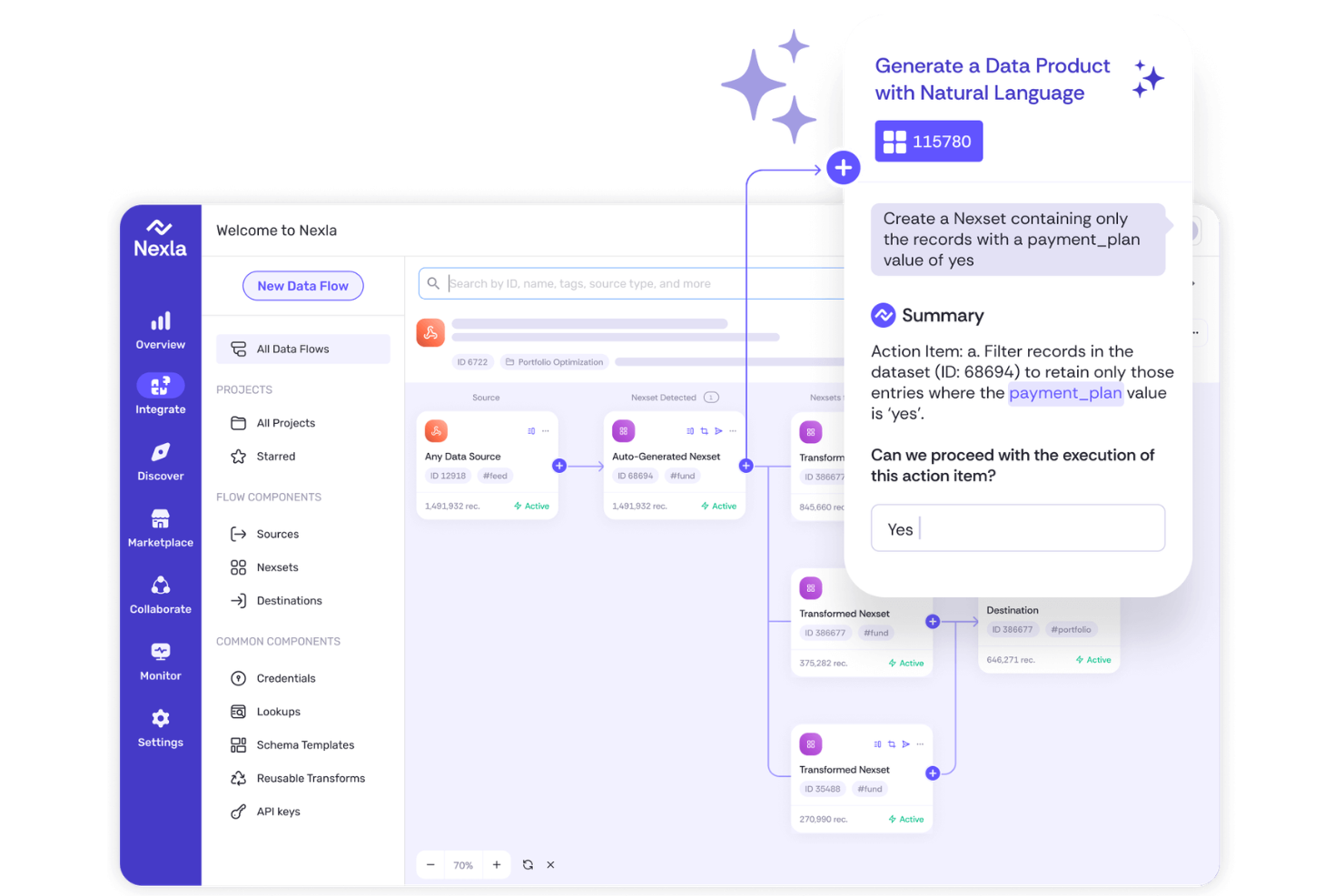
Nexla is a converged data integration platform that supports ETL, ELT, CDC, streaming, and API integration across 600+ connectors, with built-in data governance, no-code pipeline creation, and multi-cloud or on-premises deployment.
Who Is Nexla Best For?
Nexla is a strong fit for data engineering and IT teams at mid-to-large enterprises that manage complex, high-volume data pipelines across multiple cloud environments and on-premises systems.
Why I Picked Nexla
I picked Nexla as one of the best for governed self-service data integration because of how it handles access and governance together without making teams choose between the two. Nexla automatically generates Nexsets (governed, virtual data products with schema, metadata, lineage, and access controls) every time a new source is connected, so governance isn't a manual step. Teams can then publish those Nexsets to a private Data Product Marketplace, where access requests go through approval workflows and policies carry through to every downstream consumer, whether that's a Snowflake pipeline, a BI dashboard, or an AI agent.
Nexla Key Features
- Universal bidirectional connectors: Connect to 600+ sources and destinations, including cloud apps, APIs, databases, data warehouses, file systems, and SFTP, in both directions.
- AI-powered pipeline builder: Build data pipelines using natural language prompts or a no-code interface, with the option to switch to code when needed.
- Schema evolution detection: Nexla monitors source schemas and automatically flags or adapts pipelines when upstream data structures change.
- PII detection and masking: Automatically identify and mask sensitive fields within data flows before they reach downstream consumers.
Nexla Integrations
Nexla offers 600+ bidirectional connectors spanning databases, SaaS apps, APIs, file systems, LLMs, and vector databases. These include connectors for Snowflake, Salesforce, Amazon S3, Google BigQuery, Kafka, Databricks, SAP, Oracle, HubSpot, and Slack, among many others. Nexla also supports connecting to any REST or SOAP API for custom integrations. Zapier support is not clearly documented.
Pros and Cons
Pros:
- Supports all integration styles natively
- Deploys data workers inside your VPC
- Nexsets auto-generate schema and metadata
Cons:
- Debugging pipeline errors lacks transparency
- Struggles with very large data transfers


Celigo is an integration platform that simplifies application connectivity and business process automation. It mainly focuses on NetSuite users and serves mid to large-sized companies that aim to enhance operational efficiency through cloud applications and process automation.
Why I picked Celigo: It is tailored for NetSuite users and provides integration with this ERP system. The platform offers intuitive tools that simplify complex integrations and automate workflows. Its pre-built templates make it easy for your team to set up integrations quickly. Celigo's flexibility allows you to customize workflows to meet specific business needs, making it versatile.
Standout features & integrations:
Features include pre-built integration templates, reducing your team's time setting up connections. Celigo offers automation tools that help streamline business processes. The platform provides customization options, allowing your team to tailor workflows to fit unique operational needs.
Integrations include Salesforce, Shopify, Amazon, Zendesk, Google Workspace, Jira, Slack, QuickBooks, HubSpot, and Microsoft Dynamics 365.
Pros and Cons
Pros:
- Pre-built integration templates
- Customizable workflows
- Supports complex automation
Cons:
- Limited to cloud applications
- May need technical expertise
New Product Updates from Celigo
Celigo Adds API Group Assignment During API Setup
Celigo adds API group assignment during create, clone, and move actions. This reduces extra setup steps by letting teams organize APIs before the relative URI is defined. For more information, visit Celigo’s official site.
 .
.
Best for supply chain orchestration
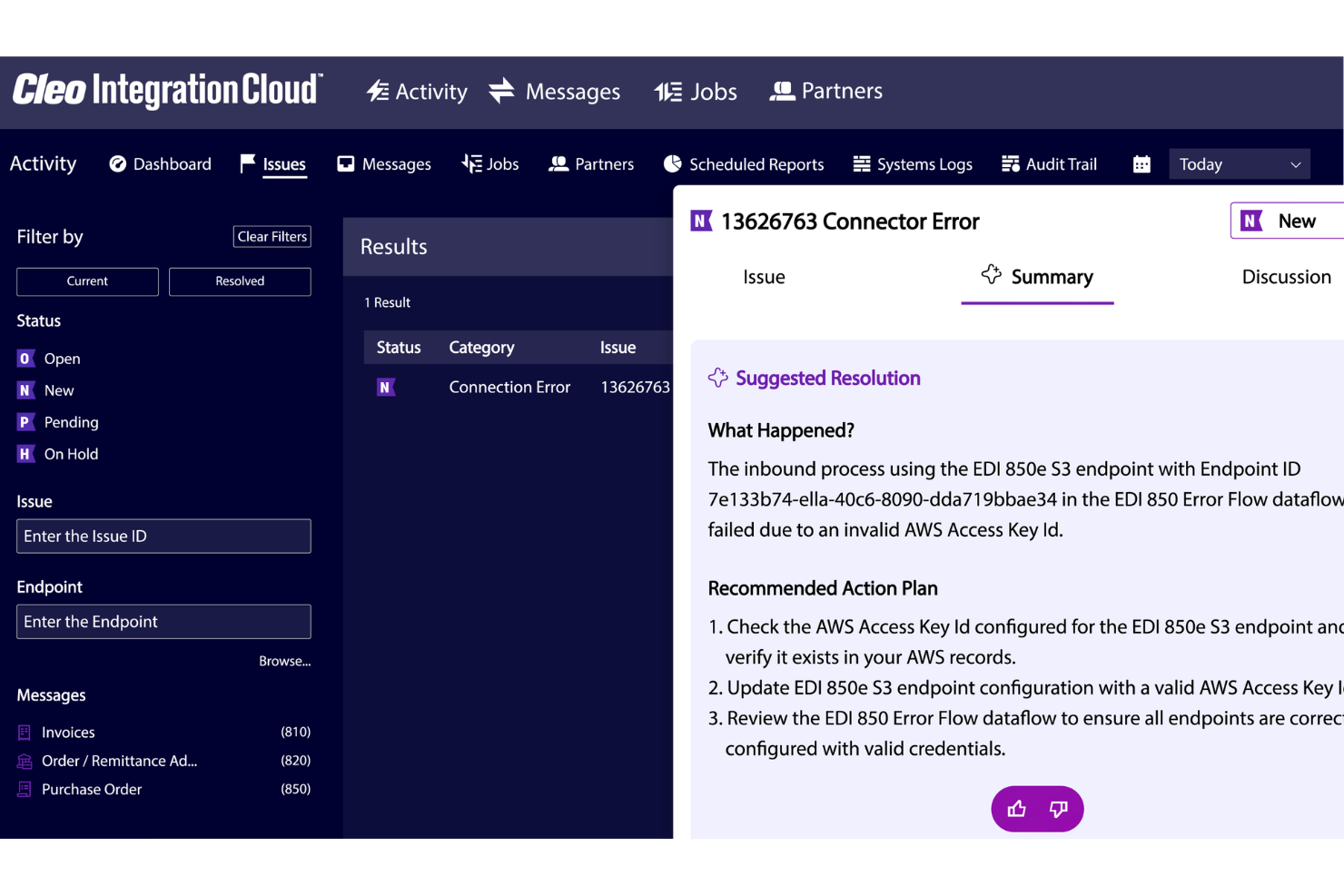
For businesses seeking to optimize their supply chain orchestration, Cleo Integration Cloud offers a compelling solution. It's designed to connect you with thousands of trading partners across various industries, such as logistics, manufacturing, retail, and healthcare. The platform addresses challenges like automated order intake and procurement orchestration, providing the tools needed to enhance operational efficiency and compliance.
Why I Picked Cleo Integration Cloud
I picked Cleo Integration Cloud for its strong focus on supply chain orchestration, which is critical for businesses looking to enhance their cloud integration capabilities. The platform's EDI compliance and API integration enable seamless connections to a vast network of trading partners. Additionally, the real-time visibility feature provides crucial insights to inform decisions and improve overall supply chain efficiency.
Cleo Integration Cloud Key Features
In addition to isupply chain orchestration, Cleo Integration Cloud offers:
- Automated Order Intake: Streamlines the process of receiving and processing orders, reducing manual intervention.
- Procurement Orchestration: Facilitates efficient procurement processes by automating routine tasks and ensuring compliance.
- Chargeback Prevention: Minimizes financial losses by identifying and addressing potential chargebacks before they occur.
- Pre-Built Integrations: Offers ready-to-use connectors for popular applications like Dynamics 365, NetSuite, and SAP, simplifying the integration process.
Cleo Integration Cloud Integrations
Cleo Integration Cloud integrations include Dynamics 365, NetSuite, SAP, FedEx, UPS, and connectors for ecommerce platforms, CRM/ERP systems, TMS/WMS platforms, databases, and cloud storage solutions.
Pros and Cons
Pros:
- Quick setup for EDI mappings compared to traditional integration platforms
- Reduces processing time with automated data transformation and integration flows
- Strong EDI mapping tools support fast integrations across multiple systems
Cons:
- Complex integration features require training and deeper technical understanding
- Some integrations require troubleshooting due to terminology and configuration complexity
New Product Updates from Cleo Integration Cloud
Cleo Integration Cloud Improves File Transfer Speeds
Cleo Integration Cloud improves file transfer speeds. This significantly reduces processing time for large files, improving overall efficiency. For more information, visit Cleo Integration Cloud’s official site.
 .
.
Skyvia
Best for cloud data integration

Skyvia is a cloud data integration platform designed for businesses that need to connect and manage data across multiple cloud services. It caters to data analysts and IT professionals looking to automate workflows and ensure data connectivity.
Why I picked Skyvia: It provides cloud data integration, allowing your team to connect various cloud services easily. It offers a user-friendly interface that simplifies the integration process. With features like data backup and data import/export, Skyvia ensures your data is accessible and secure. Its ability to handle complex data transformations makes it a reliable choice for data-centric businesses.
Standout features & integrations:
Features include data backup capabilities, allowing your team to secure information. Skyvia provides data import/export options, making data management more straightforward. Its data transformation tools help you modify and adapt data to meet your business needs.
Integrations include Salesforce, QuickBooks Online, Google BigQuery, HubSpot, Dynamics 365, Shopify, MySQL, PostgreSQL, Oracle, and SQL Server.
Pros and Cons
Pros:
- Strong cloud data focus
- Simple data import/export
- Secure data backup options
Cons:
- May require technical skills
- No mobile app support

Make
Best for automation simplicity

Make is a cloud-based automation platform designed to help businesses automate workflows and connect different applications. It caters to small and medium-sized teams looking to simplify processes and reduce manual tasks through easy-to-use automation tools.
Why I picked Make: It offers a straightforward approach to automation, making it accessible for teams without deep technical expertise. Its visual builder lets your team design workflows with ease. The platform supports various applications, ensuring flexibility when connecting your tools. Make's automation capabilities are ideal for simplifying routine tasks, allowing your team to focus on more strategic work.
Standout features & integrations:
Features include a visual workflow builder that simplifies creating automation. Make supports conditional logic, helping your team create dynamic workflows. It offers detailed analytics, providing insights into your automated processes.
Integrations include Google Workspace, Slack, Trello, Dropbox, Shopify, Mailchimp, Salesforce, Zendesk, and QuickBooks.
Pros and Cons
Pros:
- Simple automation setup
- Supports conditional logic
- Provides detailed analytics
Cons:
- Not ideal for larger teams
- No offline capabilities
Cyclr
Best for visual integration building

Cyclr is an embedded integration platform designed for B2B SaaS companies. It offers a low-code solution that simplifies integration processes and enhances operational efficiency. It provides a user-friendly orchestration layer and an extensive library of API connectors, making it ideal for SaaS providers looking to improve their integration capabilities.
Why I picked Cyclr: It offers a low-code approach, allowing your team to create integrations without extensive coding knowledge. Its visual integration builder provides a straightforward way to design and manage workflows. The platform's vast library of over 500 API connectors sets it apart, enabling fast and flexible data connections. Cyclr's embedding options allow you to customize the integration experience, making it versatile for various business needs.
Standout features & integrations:
Features include a user-friendly orchestration layer that simplifies workflow management. The platform supports creating custom connectors, giving your team flexibility in integration. It provides white-labeled embedding options, allowing you to tailor the user experience to match your brand.
Integrations include Salesforce, HubSpot, Shopify, Microsoft Dynamics, QuickBooks, Xero, Slack, Zendesk, Mailchimp, and Stripe.
Pros and Cons
Pros:
- Extensive API connector library
- Flexible embedding options
- Low-code integration builder
Cons:
- Limited to B2B SaaS focus
- Learning curve for advanced features

Linx
Best for low-code solutions

Linx is a low-code development platform for IT professionals and developers who need to quickly automate processes and integrate applications. It also serves businesses looking to enhance their operational efficiency by simplifying the development and deployment of backend applications.
Why I picked Linx: It offers a low-code environment that simplifies the development process for IT teams. Its drag-and-drop interface allows your team to automate processes with minimal coding. The platform's pre-built plugins help accelerate application integration. Linx is designed to be scalable, supporting your organization's growth and changing needs.
Standout features & integrations:
Features include a drag-and-drop designer that lets your team build applications without extensive coding. The platform provides pre-built plugins to speed up the integration process. Linx supports real-time debugging, allowing you to identify and fix issues during development quickly.
Integrations include Amazon S3, Microsoft SQL Server, MySQL, PostgreSQL, Oracle, Microsoft Dynamics 365, Salesforce, Azure, AWS Lambda, and Google Cloud Storage.
Pros and Cons
Pros:
- Low-code development environment
- Supports real-time debugging
- Scalable for growing needs
Cons:
- Requires technical expertise
- Limited to backend applications


Tray.ai is a cloud integration platform for businesses requiring advanced automation and connectivity across applications. It serves enterprises and growing companies looking to automate complex workflows and enhance operational efficiency through integration.
Why I picked Tray.ai: Tray.ai excels in handling complex workflows, offering a flexible platform for your team to create intricate automation processes. Its low-code interface allows you to build workflows without extensive coding knowledge. Tray.ai's ability to connect applications through APIs makes it versatile for various business needs. The platform's scalability ensures it can handle growing business demands efficiently.
Standout features & integrations:
Features include a visual workflow builder that simplifies the creation of complex processes. Tray.io offers real-time data processing, ensuring your team has up-to-date information. Its error-handling capabilities help identify and resolve issues quickly, maintaining smooth operations.
Integrations include Salesforce, Slack, Shopify, Marketo, HubSpot, Zendesk, Google Sheets, Microsoft Dynamics 365, ServiceNow, and QuickBooks.
Pros and Cons
Pros:
- Real-time data processing
- Low-code interface for ease
- Handles complex workflows well
Cons:
- Limited offline support
- Initial setup complexity


SnapLogic is a cloud-based integration platform designed for enterprises that require advanced data integration and application connectivity. It serves businesses looking to enhance digital transformation through intelligent integration and automation solutions.
Why I picked SnapLogic: It incorporates AI-driven integration, offering tools that leverage machine learning to optimize data processes. Its intuitive interface supports quick setup and management of integrations. The platform's scalability is ideal for handling large volumes of data across complex workflows. SnapLogic's analytics capabilities provide valuable insights into integration performance, helping your team make informed decisions.
Standout features & integrations:
Features include AI-driven insights that help optimize integration processes. SnapLogic offers a scalable architecture that supports large data volumes. The platform provides detailed analytics, giving your team a deeper understanding of workflow efficiency.
Integrations include Salesforce, SAP, Oracle, Microsoft Dynamics 365, Amazon Web Services, Google Cloud Platform, Workday, ServiceNow, Marketo, and Slack.
Pros and Cons
Pros:
- Provides detailed analytics
- Supports complex workflows
- Quick setup and management
Cons:
- Primarily enterprise-focused
- Limited offline capabilities


Jitterbit is an integration platform focused on connecting applications and automating workflows for businesses, emphasizing API creation. It serves enterprises looking to enhance digital operations by integrating diverse applications and creating custom APIs for efficient data exchange.
Why I picked Jitterbit: It excels in API creation, offering tools that enable your team to design, test, and manage APIs effectively. Its intuitive interface simplifies the process of connecting applications and automating workflows. Jitterbit supports real-time data processing, ensuring your team can access current data. The platform's scalability ensures it can meet the needs of growing businesses across various industries.
Standout features & integrations:
Features include an intuitive API design interface that makes creating and managing APIs straightforward for your team. Jitterbit offers real-time data processing, which helps keep your operations running smoothly. Its scalability supports business growth, adapting to increased data and user demands.
Integrations include Salesforce, SAP, Oracle, Microsoft Dynamics 365, NetSuite, Workday, ServiceNow, Marketo, Amazon Web Services, and Google Cloud Platform.
Pros and Cons
Pros:
- Strong API design capabilities
- Real-time data processing
- Scalable for growing businesses
Cons:
- Initial setup complexity
- Limited offline functionality
Other Cloud Integration Platforms
Here are some additional cloud integration platform options that didn’t make my shortlist but are still worth exploring.
- Albato
For application integration
- Frends
For regional compliance
- Alumio
For B2B ecommerce
- Blendr.io
For SaaS integrations
- Workato
For enterprise automation
- Boomi
For low-code iPaaS
- MuleSoft Anypoint Platform
For API management
- SAP Integration Suite
For SAP ecosystem
- Informatica Intelligent Cloud Services
For data governance
- TIBCO Cloud Integration
For hybrid environments
- Cloud Elements
For unified APIs


How I Evaluate Cloud Integration Platforms
I evaluate these platforms in two layers: the baseline every tool must clear to make the list, and the differentiators—like AI-assisted mapping or B2B/EDI support—that set the best apart.
Core Functionality (Table Stakes For This List)
When I'm selecting tools for my list, I rank each one on a scale from 0 (does not offer the functionality) to 5 (excels in this area) for each core functionality listed below. Then, I calculate the tool's total score into a percentage. Each tool needs to achieve a minimum total score of 75% to be considered for inclusion.
- Pre-Built Connector Library: I check the breadth and depth of available connectors—whether the platform covers the apps your stack likely runs on, like Salesforce, SAP, NetSuite, or Snowflake.
- API Management Capabilities: Designing, publishing, and securing APIs matters here. I look for full lifecycle support, including gateway policies, versioning, and usage analytics.
- Data Transformation & Mapping: Complex integrations require more than field-to-field mapping. I evaluate whether the platform handles format conversion across JSON, XML, EDI, and flat files.
- Workflow Orchestration Tools: A visual, low-code builder with conditional logic and event-based triggers is what I look for—something that lets both developers and less technical users design flows.
- Hybrid Deployment Support: Most teams run a mix of cloud and on-prem systems. I evaluate whether the platform offers secure agents or gateways to connect legacy ERP or database instances.
- Monitoring & Error Handling: Real-time dashboards, alerting, and auto-retry logic are key areas I check. A failed order sync at 2 a.m. should trigger an alert, not wait for someone to notice.
Once I have a list of tools that meet the criteria, I consider what sets each platform apart.
Differentiating Factors (What Sets Vendors Apart)
Here's how I compare and contrast different vendors:
Standout Features
AI-assisted integration is a major differentiator. Platforms that suggest field mappings or auto-detect schema changes save hours during complex migrations. I also look for event-driven architecture support, like native Kafka or webhook triggers, which matters when you need real-time order or inventory syncs. Developer extensibility rounds things out. CLI tools, Git-based version control, and custom connector SDKs give engineering teams the flexibility to go beyond what a visual builder offers.
Beyond Features
Security and compliance certifications matter a lot here. I check whether a platform holds SOC 2 Type II and ISO 27001, and whether it offers data residency controls for teams handling regulated workloads. Pricing transparency is another factor I evaluate closely—some vendors charge per connector, others per message volume, and that distinction shapes long-term cost as your integration count grows. I also consider the partner ecosystem, since a strong network of certified implementation partners can make the difference between a smooth rollout and a stalled one.
How To Choose A Cloud Integration Platform
It’s easy to get bogged down in long feature lists and complex pricing structures. Here's a checklist of factors to remember to help you stay focused as you work through your unique software selection process.
| Factor | What to Consider |
| Scalability | Ensure the platform can grow with your business. Look for features that support increased data volume and users without compromising performance. |
| Integrations | Check if the platform integrates with your existing tools, such as CRM, ERP, or marketing software. Seamless connections save your team time and effort. Depending on your business type and size, b2b multi-cloud platforms may be the best solution. |
| Customizability | Your team’s needs are unique. Choose a platform that lets you tailor workflows and processes to match your specific operational requirements. |
| Ease of Use | Opt for user-friendly interfaces that don’t require extensive training. This helps your team get up and running quickly, reducing downtime. |
| Budget | Compare pricing models to ensure the platform fits your financial plan. Be aware of hidden costs, such as setup fees or charges for extra features. |
| Security Safeguards | Data protection is essential. Look for platforms that offer security measures, such as encryption, compliance certifications, and regular audits. |
Trends In Cloud Integration Platforms
In my research, I sourced countless product updates, press releases, and release logs from different cloud integration platform vendors. Here are some of the emerging trends I’m keeping an eye on.
- AI-enhanced integration: AI optimizes data processing and automates repetitive tasks, making integrations more efficient. Some vendors incorporate AI to provide insights and improve workflow efficiency.
- Low-code/no-code development: More platforms provide low-code or no-code environments, allowing non-developers to create and manage integrations. This trend makes integration tools more accessible to a broader range of users.
- Data privacy and compliance: With increasing data regulations, platforms focus on features that ensure compliance with laws like GDPR and CCPA. These features are crucial for businesses handling sensitive data across borders.
- Integration of IoT devices: As IoT usage grows, integration platforms are beginning to support IoT data processing. This allows businesses to connect and manage data from various smart devices and sensors.
- Real-time analytics: There's a growing demand for real-time data analytics platforms, helping businesses make informed decisions quickly. This trend is especially relevant for companies needing immediate insights from their integrated data.
What Is A Cloud Integration Platform?
Cloud integration platform is a tool that connects different applications and data sources to enable smooth data flow and process automation. IT professionals, data analysts, and business managers generally use these tools to improve operational efficiency and data management.
Real-time data synchronization, low-code/no-code development, and AI-enhanced integration help optimize workflows and ensure compliance with data regulations. Similar to SaaS integration platforms, these tools allow businesses to connect disparate systems and automate complex processes efficiently.
Features Of Cloud Integration Platforms
When selecting a cloud integration platform, look for the following key features.
- Real-time data synchronization: Instantly updates data across connected systems, ensuring access to the most current information.
- Low-code/no-code development: Enables non-technical users to create and manage integrations with minimal coding.
- AI-enhanced integration: Optimizes data processing and automates repetitive tasks using artificial intelligence.
- Data privacy and compliance: Ensures integrations comply with data protection regulations, safeguarding sensitive information.
- API management: Facilitates the creation, deployment, and management of APIs for efficient data exchange.
- Scalability: Accommodates business growth by handling increased data volumes and user demands without performance degradation.
- IoT data integration: Processes and manages data from the Internet of Things devices for expanded use cases.
- Visual workflow builder: Provides an intuitive interface for designing and managing workflows.
- Advanced security measures: Protects data during transfers and integrations with encryption and security protocols.
- Detailed analytics: Offers insights into integration performance and data flow for informed decision-making.
- Pre-built connectors and adapters: Includes ready-to-use connectors for popular cloud-based applications to reduce setup time.
- Event-driven architecture: Supports integration flows triggered by real-time events for enhanced automation.
- Dashboards: Centralizes monitoring of integration flows and performance metrics.
- EDI (Electronic Data Interchange): Streamlines communication and data exchange, particularly in supply chain and logistics.
- End-to-end integration solutions: Manages the entire lifecycle of integrations and embedded iPaaS, from deployment to monitoring and optimization.
- Messaging capabilities: Provides secure and efficient messaging between applications and systems.
- Middleware integration: Bridges legacy systems with modern applications, ensuring compatibility and smooth data flow.
- Supply chain integration: Connects systems to streamline supply chain processes, reducing inefficiencies.
- Application programming interfaces (APIs): Supports API creation and management for seamless system interactions.
Benefits Of Cloud Integration Platforms
Implementing a cloud integration platform benefits your team and your business. Here are a few you can look forward to.
- Improved data accuracy: Real-time data synchronization ensures everyone accesses the most up-to-date information, reducing errors.
- Increased efficiency: Low-code/no-code development lets your team quickly set up integrations, saving time and resources.
- Enhanced compliance: Features like data privacy and compliance help your business adhere to necessary regulations, protecting sensitive data.
- Scalability for growth: The platform's scalability supports increased data and user demands, accommodating your business as it grows.
- Better decision-making: Detailed analytics provide insights into data flows and integration performance, helping you make informed decisions.
- Cost savings: Automating workflows with AI-enhanced integration reduces the need for manual intervention, lowering operational costs.
- Expanded capabilities: IoT data integration opens up new opportunities for managing smart devices and sensors, broadening your business's potential.
Costs & Pricing Of Cloud Integration Platforms
Selecting a cloud integration platform requires understanding the various pricing models and plans. Costs vary based on features, team size, add-ons, and more. The table below summarizes standard plans, their average prices, and typical features included in cloud integration platform solutions.
Plan Comparison Table for Cloud Integration Platforms
| Plan Type | Average Price | Common Features |
| Free Plan | $0 | Basic integrations, community support, and limited tasks. |
| Personal Plan | $10-$30 /user /month | More integrations, real-time data sync, and basic analytics. |
| Business Plan | $50-$150 /user /month | Advanced integrations, API access, and enhanced security. |
| Enterprise Plan | $200-$500 /user /month | Custom integrations, dedicated support, and compliance tools. |
Cloud Integration Platform FAQs
Here are some answers to common questions about cloud integration platforms:
What are the requirements for cloud integration platforms?
For successful cloud integration, start with a thorough assessment and planning phase. Your team should prioritize data security and choose the right API integration tools. Standardizing data formats and designing for scalability are also crucial. Documenting everything ensures that processes are clear and repeatable.
What does a cloud integration platform strategy involve?
A cloud integration strategy involves connecting cloud-based and on-premises applications for smooth data flow. This often uses APIs and iPaaS software for application, data, and hybrid integration. By implementing these strategies, your team can ensure efficient communication between systems.
How does a cloud integration platform improve business operations?
Cloud integration enhances business operations by providing real-time data access and improving collaboration. By streamlining data flow across different applications, your team can make informed decisions quickly, improving efficiency and productivity throughout your organization.
What challenges might arise on a cloud integration platform?
Common challenges include data compatibility issues, integration complexity, and potential security risks. You might also need help scaling integrations as your business grows. Address these challenges by choosing flexible and scalable integration solutions that meet your needs.
How can a cloud integration platform support digital transformation?
Cloud integration supports digital transformation by enabling seamless data exchange across platforms. This allows your team to leverage advanced analytics and automation tools, driving innovation and efficiency. Integrating cloud services allows your organization to adapt quickly to changing market demands.
What's Next?
Want to take your RevOps game to the next level?
Subscribe to The CRO Club newsletter for expert advice, software reviews, and other resources to help you deliver predictable growth at scale.