

WhatsUp Gold Review 2026: Pros, Cons, Features, and Pricing
WhatsUp Gold stands out for its intuitive interface and customizable monitoring, making it ideal for midsize IT teams seeking reliable, scalable network visibility.

We review tools independently, and commissions help fund our testing. See our transparency policy, our methodology, or suggest a tool.
WhatsUp Gold is a network monitoring software for IT teams that need full visibility into on-premises, cloud, and hybrid network environments from a single dashboard. I'd mainly consider it if you want the device discovery, topology mapping, and alerting depth that SolarWinds NPM offers, but without the licensing complexity and steeper costs that typically come with it.
WhatsUp Gold Evaluation Summary

4.4/5
- Pricing upon request
- Free 30-day trial + Free edition available
Why Trust Our Software Recommendations
6,700+
Reviews
20
Industry experts
16+
Evaluation factors
14
Years
Our team has been testing and reviewing software since 2012. As tech leaders ourselves, we know how difficult—and important—it is to choose the right software.
For this guide, we evaluated tools using hands-on testing and independent research, scoring tools using our selection criteria.
Our reviews reflect our human editorial judgment, not a sales pitch.
Expert reviewers:
- Paulo Gardini MiguelTech Director
 Tim FisherVP of AI
 Gabriel RosasTech Lead & Software Architect
 Christhian GruhnTech Lead & Platform Architect

WhatsUp Gold Overview
When judging network monitoring software, WhatsUp Gold impresses with its clear interface, customizable dashboards, and straightforward onboarding. Its device auto-discovery and topology mapping make it easy to visualize networks, while flexible alerting and reporting help teams act quickly. Pricing is transparent, and support is responsive, though integrations and advanced analytics may lag behind some competitors.
For IT teams in midsize to large environments who value ease of use and fast deployment over deep customization, WhatsUp Gold is a strong choice. Selecting it makes sense if you prioritize intuitive monitoring and reliable core functionality.
Pros
- Alerting and reporting are flexible and detailed.
- Customizable dashboards provide clear, actionable network views.
- Device auto-discovery quickly maps network infrastructure.
Cons
- Licensing and upgrades can be expensive for larger networks.
- Reporting tools lack depth for complex environments.
- Advanced analytics features are limited compared to peers.
Is WhatsUp Gold Right For Your Needs?
Who Would be a Good Fit for WhatsUp Gold?
WhatsUp Gold is best suited for midsize to large organizations that need clear network visibility and fast troubleshooting without heavy customization. Its device auto-discovery, topology mapping, and flexible alerting make it a strong choice for IT teams managing distributed networks or hybrid environments.
Companies with compliance requirements or those needing reliable uptime monitoring will find its reporting and alerting features especially useful. It’s also a good fit for departments that value intuitive dashboards and straightforward onboarding.
- Government AgenciesAudit-ready reporting and secure access controls meet regulatory needs.
- Enterprise IT DepartmentsScalable monitoring and clear visualization aid large, distributed teams.
- Managed Service ProvidersMulti-tenant monitoring and customizable dashboards suit client environments.
- Financial ServicesReal-time monitoring supports strict uptime and security requirements.
- Higher EducationCampus-wide device discovery and mapping help manage sprawling networks.
- Healthcare ITHIPAA compliance and uptime monitoring are supported by detailed alerting and reporting.
Who Would be a Bad Fit for WhatsUp Gold?
WhatsUp Gold may not suit organizations needing deep analytics, extensive integrations, or highly specialized monitoring. Small businesses with simple networks may find its pricing and feature set excessive. Teams requiring advanced automation or custom scripting will likely find its capabilities limited compared to more specialized tools.
Companies with highly dynamic cloud-native environments may also find its focus on traditional infrastructure less relevant.
- Data Science TeamsLimited analytics and visualization for complex data-driven monitoring.
- Telecom ProvidersDoes not support carrier-grade, high-volume network environments.
- Retail ChainsMulti-site WAN monitoring is less robust than some competitors.
- DevOps DepartmentsLacks advanced automation and custom scripting capabilities.
- Cloud-Native TeamsLimited cloud monitoring compared to cloud-focused tools.
- Small StartupsPricing and features are excessive for basic network needs.
Our Review Methodology
How We Test & Score Tools
We’ve spent years building, refining, and improving our software testing and scoring system. The rubric is designed to capture the nuances of software selection and what makes a tool effective, focusing on critical aspects of the decision-making process.
Below, you can see exactly how our testing and scoring works across seven criteria. It allows us to provide an unbiased evaluation of the software based on core functionality, standout features, ease of use, onboarding, customer support, integrations, customer reviews, and value for money.
Core Functionality (25% of final scoring)
The starting point of our evaluation is always the core functionality of the tool. Does it have the basic features and functions that a user would expect to see? Are any of those core features locked to higher-tiered pricing plans? At its core, we expect a tool to stand up against the baseline capabilities of its competitors.
Standout Features (25% of final scoring)
Next, we evaluate uncommon standout features that go above and beyond the core functionality typically found in tools of its kind. A high score reflects specialized or unique features that make the product faster, more efficient, or offer additional value to the user.
We also evaluate how easy it is to integrate with other tools typically found in the tech stack to expand the functionality and utility of the software. Tools offering plentiful native integrations, 3rd party connections, and API access to build custom integrations score best.
Ease of Use (10% of final scoring)
We consider how quick and easy it is to execute the tasks defined in the core functionality using the tool. High scoring software is well designed, intuitive to use, offers mobile apps, provides templates, and makes relatively complex tasks seem simple.
Onboarding (10% of final scoring)
We know how important rapid team adoption is for a new platform, so we evaluate how easy it is to learn and use a tool with minimal training. We evaluate how quickly a team member can get set up and start using the tool with no experience. High scoring solutions indicate little or no support is required.
Customer Support (10% of final scoring)
We review how quick and easy it is to get unstuck and find help by phone, live chat, or knowledge base. Tools and companies that provide real-time support score best, while chatbots score worst.
Customer Reviews (10% of final scoring)
Beyond our own testing and evaluation, we consider the net promoter score from current and past customers. We review their likelihood, given the option, to choose the tool again for the core functionality. A high scoring software reflects a high net promoter score from current or past customers.
Value for Money (10% of final scoring)
Lastly, in consideration of all the other criteria, we review the average price of entry level plans against the core features and consider the value of the other evaluation criteria. Software that delivers more, for less, will score higher.
Core Features
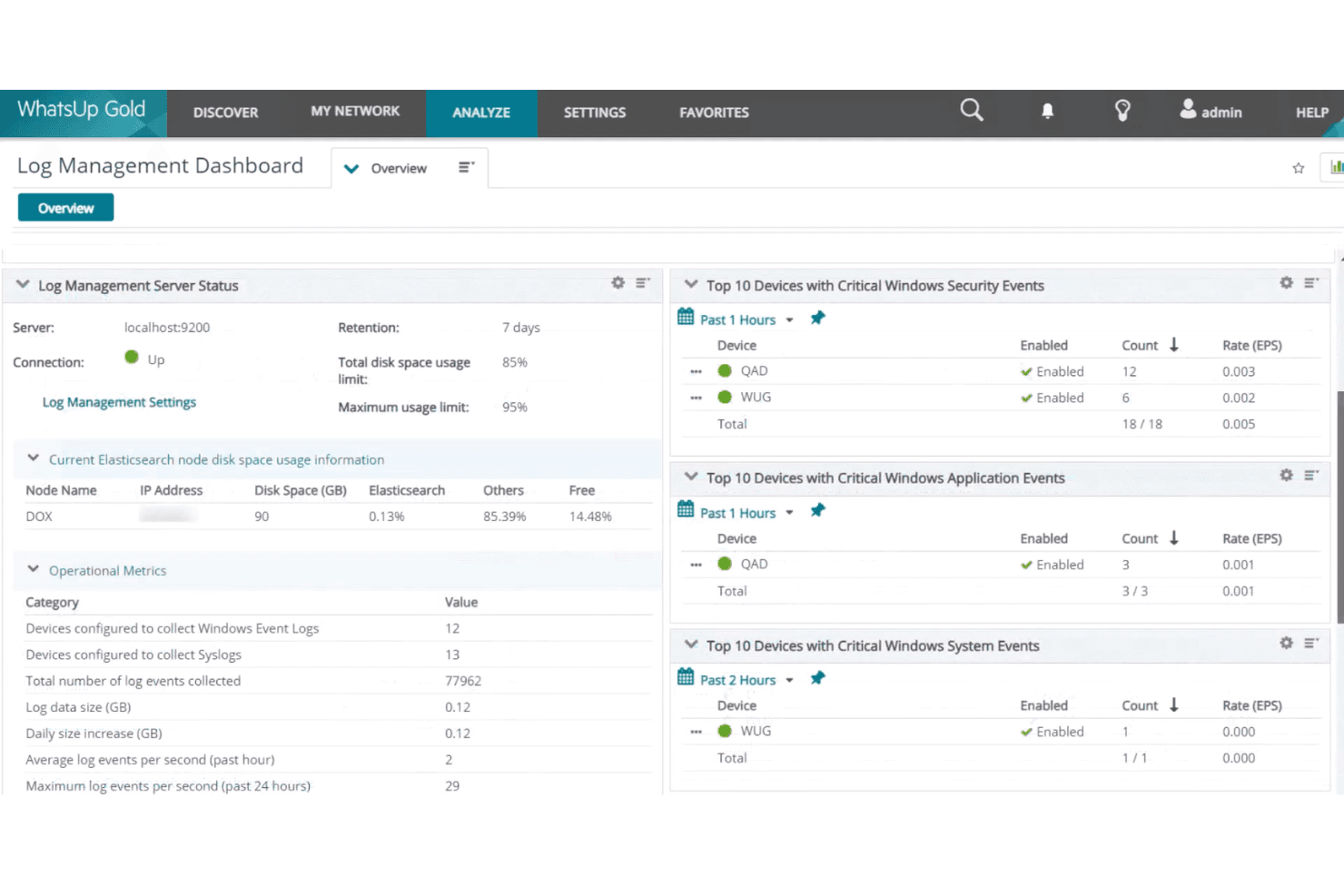
Automated Log Management
Collects and analyzes logs from all devices across your network in real-time. This feature provides centralized log storage, quick search capabilities, and automated alerts for faster troubleshooting and compliance auditing.
Comprehensive Reporting
Generates detailed reports on network performance, device status, and historical data. Customizable report templates help you analyze trends and maintain compliance with ease.
Dynamic Network Mapping
Automatically generates interactive maps that update as your network changes. Visual overlays show dependencies, wireless, virtual, and application infrastructure in real time.
Centralized Alert Management
Consolidates all network and server alerts into a single dashboard for quick response. Customizable notifications and smart prioritization help teams avoid missed or unnecessary alerts.
Application Performance Monitoring
Monitors both commercial and in-house applications with out-of-the-box and custom profiles. Provides real-time alerts, root cause analysis, and historical reporting for application health.
Comprehensive Asset Inventory
Maintains a detailed inventory of hardware, software, and configuration data across your environment. Supports compliance and audit needs with exportable reports and up-to-date asset tracking.
Ease of Use
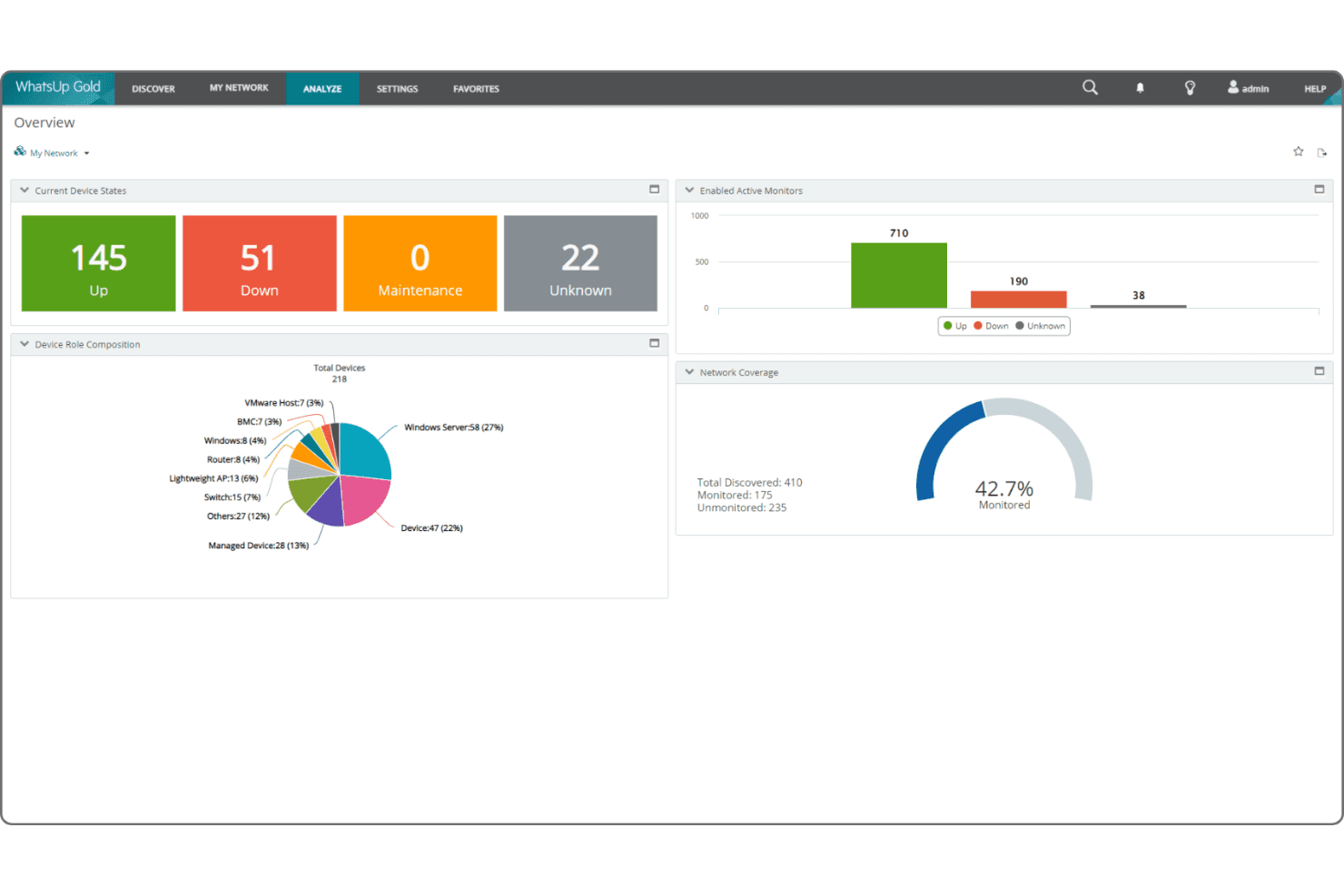
WhatsUp Gold is widely recognized for its intuitive interface and straightforward setup, making it accessible even for teams without deep network monitoring experience. The drag-and-drop dashboards, automated device discovery, and interactive maps reduce onboarding time and simplify daily monitoring tasks.
Users often highlight how quickly they can visualize network health and respond to alerts, though some advanced features may require extra configuration. Overall, it strikes a strong balance between usability and depth.
Integrations
WhatsUp Gold integrates with AWS, Azure, VMware, Microsoft SQL Server, Flowmon, WatchGuard, Splunk On-Call, Jira Service Management, PagerDuty, and ServiceNow, among others.
WhatsUp Gold also offers a REST API for custom integrations and automation, allowing connections with third-party tools and scripts.
WhatsUp Gold Specs
- Access Management: Yes
- Bug Tracking: No
- Compliance Tracking: Yes
- Custom Reports: Yes
- DDoS Protection: No
- Incident Management: No
- Malware Protection: No
- Network Device Performance Monitoring: Yes
- Network Traffic Monitoring: Yes
- Network Visualization: Yes
- Risk Assessment: No
- Security Migration: No
- Technical Health Assessment: No
- Workflow Management: No


