


Checksum Review: Pros, Cons, Features, and Pricing Explained


Modern development teams are shipping faster than ever, but testing hasn’t kept up. Writing and maintaining tests is time-consuming, and brittle test suites often break as quickly as they’re created.
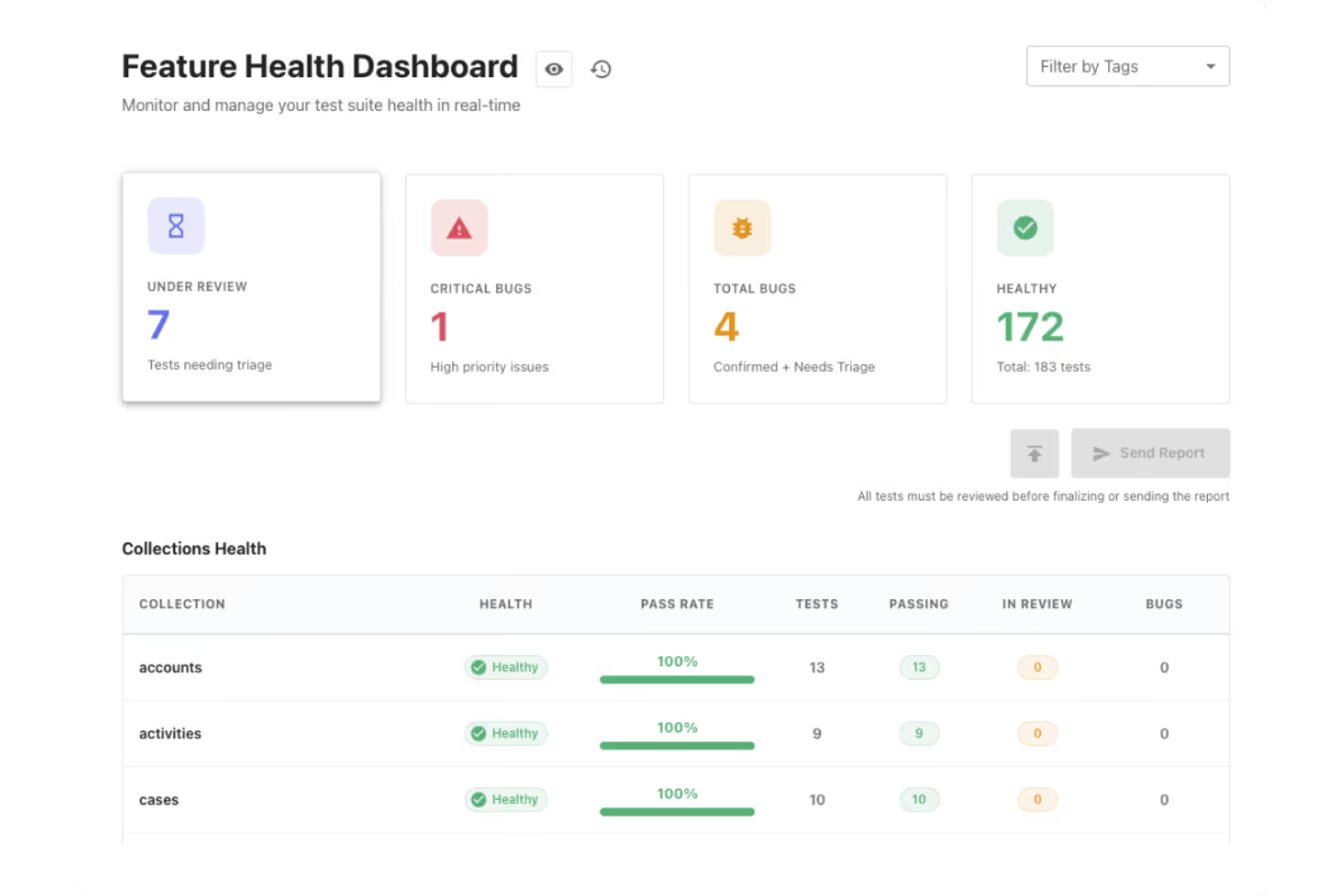
Checksum takes a different approach from traditional end-to-end testing tools. Instead of helping you write tests faster, it aims to remove the burden entirely by acting as a continuous quality system that runs in the background. It automatically generates, executes, and maintains tests as your application evolves, helping teams catch issues early without slowing down delivery.
In this review, I’ll break down how Checksum works, where it fits best, its strengths and limitations, and whether it’s the right choice for your team.
Checksum Evaluation Summary
- Pricing upon request
- 30-day free trial
Why Trust Our Software Reviews
We’ve been testing and reviewing software since 2023. As tech leaders ourselves, we know how critical and difficult it is to make the right decision when selecting software.
We invest in deep research to help our audience make better software purchasing decisions. We’ve tested more than 2,000 tools for different tech use cases and written over 1,000 comprehensive software reviews. Learn how we stay transparent & our software review methodology.
Checksum Overview
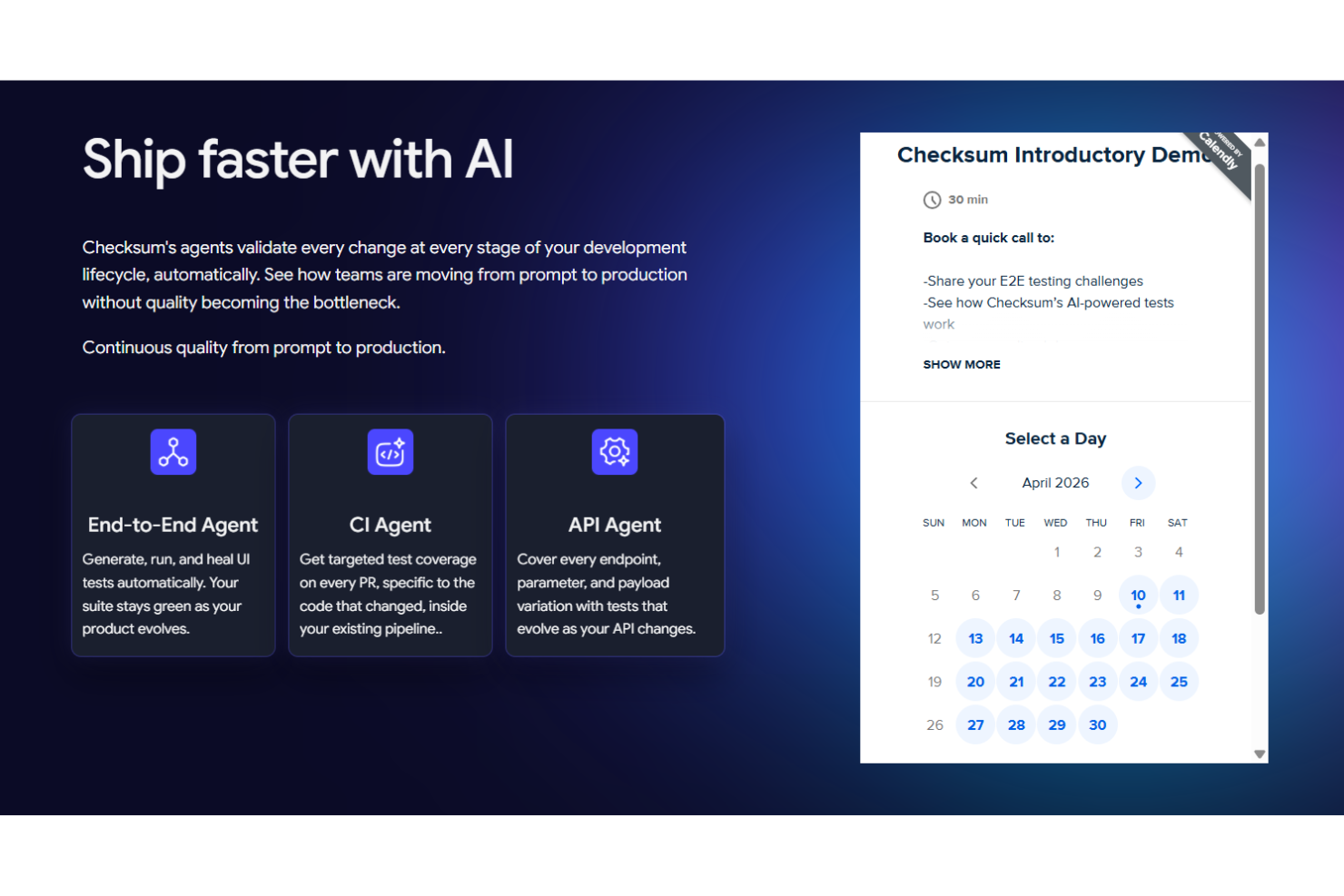
Checksum’s platform provides testing solutions built around autonomous agents that cover multiple layers of testing. Its end-to-end agent generates and maintains Playwright-based test suites that evolve with your UI, while its CI agent creates targeted tests for each pull request to validate code changes before they’re merged. An API agent adds deeper coverage by testing endpoints and multi-step workflows across systems. The end-to-end testing agent is powered by a fine-tuned model trained on over 1.5 million test runs, enabling it to mimic real user interactions and generate reliable, high-quality tests.
All tests are delivered as standard Playwright code directly into your repository, so your team owns the output while Checksum maintains it over time. While test generation and maintenance are automated, teams can guide coverage by specifying high-priority areas or providing test scenarios, which Checksum converts into Playwright code.
pros
-
Fully autonomous test generation, execution, and maintenance (not just AI-assisted).
-
Automatically heals broken tests as the application changes, reducing maintenance overhead.
-
Delivers tests as real Playwright code in your repo (no vendor lock-in).
cons
-
Requires access to a live staging or production-like environment to get started.
-
Higher cost and no self-serve pricing make it less suitable for smaller teams or tight budgets.
-
Not fully hands-off—some test maintenance may involve optional human review.
Is Checksum Right For Your Needs?
Who Would be a Good Fit for Checksum?
Checksum is a strong fit for teams that need to scale testing alongside fast-moving CI/CD workflows without taking on the burden of maintaining test suites. It’s especially well-suited for engineering organizations that ship frequently and want reliable, always-on software quality signals without slowing down development. If your team values deep CI/CD integration, tests delivered as code, and reduced manual QA effort over time, Checksum can fit naturally into your workflow.
-
Teams with Broad Test Coverage Needs
Checksum is a strong fit for teams that want unified coverage across end-to-end, API, and PR-level testing, without stitching together multiple tools or systems.
-
Organizations Treating Quality as Infrastructure
Companies that view testing as a core part of their delivery pipeline benefit most from Checksum’s continuous approach to test generation, execution, and maintenance.
-
QA Teams
Checksum allows QA teams to shift away from fixing brittle tests, focusing on higher-value validation work while the platform continuously maintains the test suite.
-
Web Applications with Complex User Flows
Products with multi-step user journeys gain value from Checksum’s end-to-end test generation and auto-healing, ensuring critical paths stay covered as UI elements and flows change.
-
Lean Startups & Teams with No Existing Test Coverage
Teams starting from zero can use Checksum to rapidly generate a full test suite without upfront engineering effort. This makes it a strong fit for teams that need to go from no coverage to comprehensive validation quickly, without building a testing framework from scratch.
-
SaaS Teams (Mid-Market & Enterprise)
Checksum helps mid-market and enterprise SaaS teams with established CI/CD workflows maintain reliable test coverage as they ship frequent releases, automatically generating and updating tests as the product evolves without engineering effort.
Who Would be a Bad Fit for Checksum?
Checksum isn’t ideal for teams looking for a lightweight, self-serve testing tool or those working outside modern web application environments. Its guided onboarding, pricing model, and Playwright-centric approach make it better suited for organizations with established CI/CD workflows and dedicated quality investment. If you require full control over test creation, support for native mobile apps, or highly customized testing frameworks, you may find it less aligned with your needs.
-
Mobile App Developers
Checksum is primarily focused on web applications and browser-based testing, so teams building native mobile apps may need a separate solution for full coverage.
-
Self-Serve Buyers
Teams looking for a quick, self-serve tool with instant signup and minimal setup may find Checksum’s guided onboarding and sales-led process slower to adopt.
-
Budget-Conscious Teams
Checksum’s pricing is structured around ongoing test maintenance and service, which may not fit teams with limited budgets or those experimenting with software testing tools.
-
Framework-Specific Teams
Organizations deeply committed to testing frameworks outside of Playwright or Cypress may face friction adopting Checksum’s Playwright-centric approach.
-
High-Control Environments
Teams that require full control over every aspect of test creation and maintenance may find Checksum’s autonomous, agent-driven model less flexible than manual frameworks.
-
Non-Web or Legacy Systems
Checksum is best suited for modern web applications with stable environments, so teams working with legacy systems or non-browser-based platforms may see limited value.
Our Review Methodology
How We Test & Score Tools
We’ve spent years building, refining, and improving our software testing and scoring system. The rubric is designed to capture the nuances of software selection and what makes a tool effective, focusing on critical aspects of the decision-making process.
Below, you can see exactly how our testing and scoring works across seven criteria. It allows us to provide an unbiased evaluation of the software based on core functionality, standout features, ease of use, onboarding, customer support, integrations, customer reviews, and value for money.
Core Functionality (25% of final scoring)
The starting point of our evaluation is always the core functionality of the tool. Does it have the basic features and functions that a user would expect to see? Are any of those core features locked to higher-tiered pricing plans? At its core, we expect a tool to stand up against the baseline capabilities of its competitors.
Standout Features (25% of final scoring)
Next, we evaluate uncommon standout features that go above and beyond the core functionality typically found in tools of its kind. A high score reflects specialized or unique features that make the product faster, more efficient, or offer additional value to the user.
We also evaluate how easy it is to integrate with other tools typically found in the tech stack to expand the functionality and utility of the software. Tools offering plentiful native integrations, 3rd party connections, and API access to build custom integrations score best.
Ease of Use (10% of final scoring)
We consider how quick and easy it is to execute the tasks defined in the core functionality using the tool. High scoring software is well designed, intuitive to use, offers mobile apps, provides templates, and makes relatively complex tasks seem simple.
Onboarding (10% of final scoring)
We know how important rapid team adoption is for a new platform, so we evaluate how easy it is to learn and use a tool with minimal training. We evaluate how quickly a team member can get set up and start using the tool with no experience. High scoring solutions indicate little or no support is required.
Customer Support (10% of final scoring)
We review how quick and easy it is to get unstuck and find help by phone, live chat, or knowledge base. Tools and companies that provide real-time support score best, while chatbots score worst.
Customer Reviews (10% of final scoring)
Beyond our own testing and evaluation, we consider the net promoter score from current and past customers. We review their likelihood, given the option, to choose the tool again for the core functionality. A high scoring software reflects a high net promoter score from current or past customers.
Value for Money (10% of final scoring)
Lastly, in consideration of all the other criteria, we review the average price of entry level plans against the core features and consider the value of the other evaluation criteria. Software that delivers more, for less, will score higher.
Core Features
Autonomous Test Generation (Playwright)
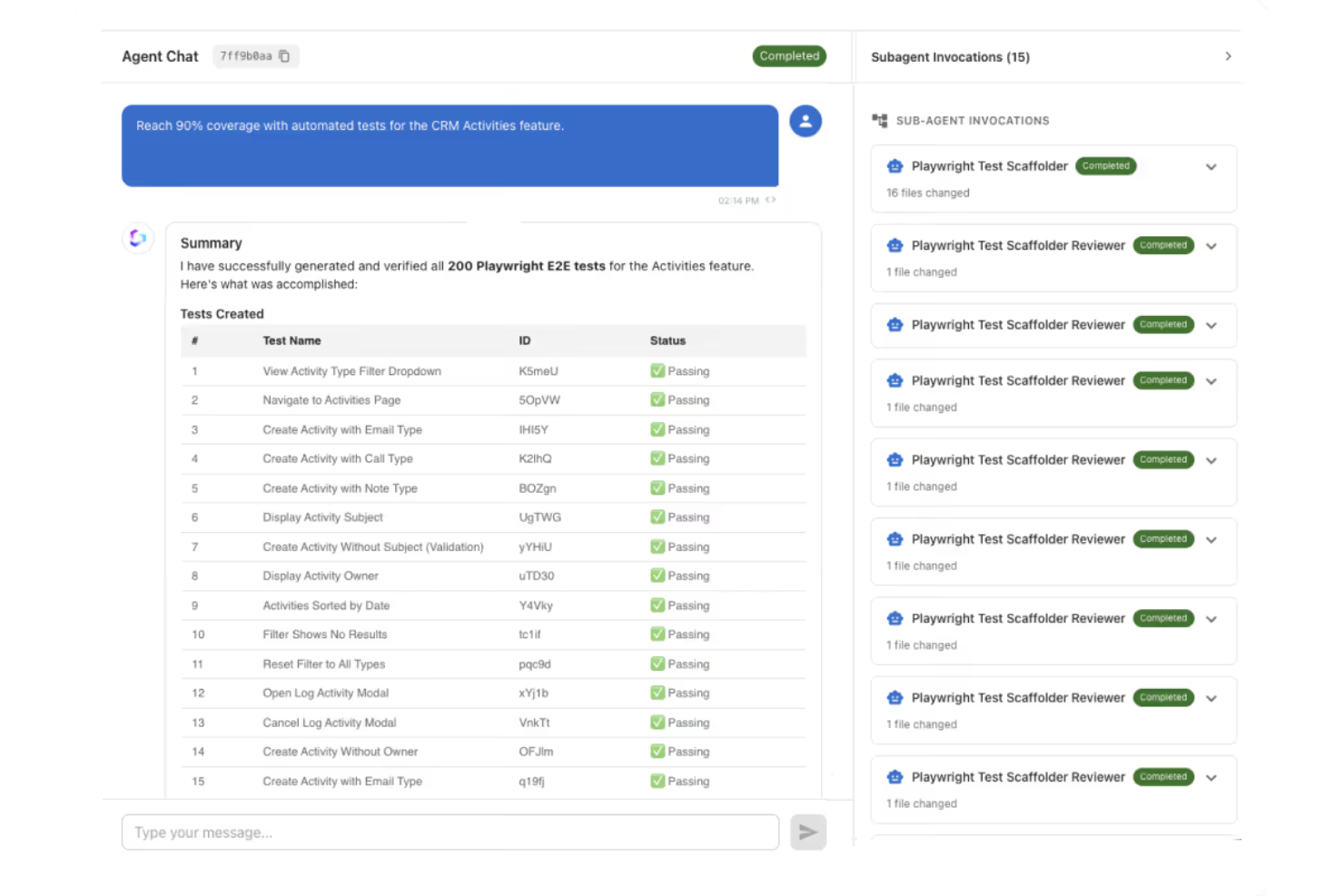
Checksum’s automated testing feature generates production-ready Playwright test suites for your web application, including structured code like page objects and reusable functions, delivered directly to your repository.
Self-Healing Test Maintenance
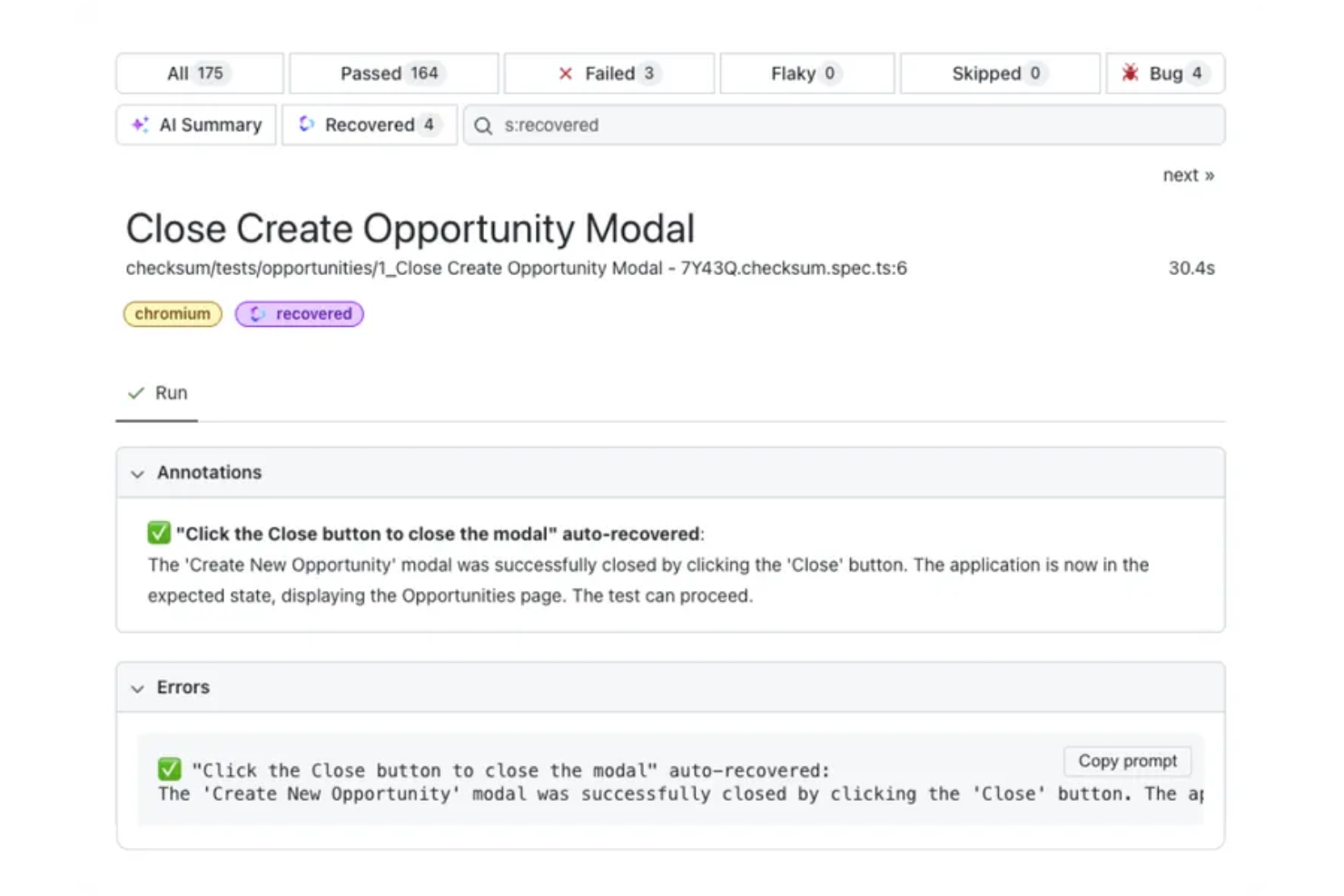
As your application changes, Checksum detects and fixes broken tests automatically, proposing updates via pull requests so your suite stays reliable without manual testing upkeep.
PR-Level CI Testing
Checksum lets you generate and run tests for each pull request (often 50–200 tests), helping teams validate specific code changes before they’re merged.
API and End-to-End Coverage
Checksum tests both user-facing workflows and backend systems, covering UI flows and API interactions without requiring separate tools.
Tests as Code (Repository Ownership)
All tests are committed as standard Playwright code directly into your repository, giving your team full ownership and the ability to run them anywhere.
CI/CD Integration
Checksum integrates directly into existing CI/CD pipelines, running tests automatically as part of your development workflow without requiring a separate system.
Fine-Tuned AI-Powered Testing Model
Checksum’s end-to-end testing agent is built on a fine-tuned model trained on over 1.5 million real-world test runs, enabling it to generate higher-quality tests that reflect real user behavior. Combined with custom tools for interaction and assertion evaluation, this allows the platform to produce reliable, production-ready test coverage.
Manual Test Creation (Optional Input & Scenario-Based Generation)
While Checksum automates test generation and maintenance, teams can optionally guide coverage by identifying critical areas or writing test scenarios. The platform then translates these inputs into Playwright tests, combining human insight with automated execution.
Standout Features
Fully Autonomous Testing System
Checksum operates as a background agent that generates, runs, and maintains tests independently—without requiring ongoing prompts or manual intervention. This enables teams to scale testing output without scaling effort.
Results-as-a-Service Model (Optional Human Verification)
Checksum offers optional human review of test outputs, providing an added layer of validation for teams that want accuracy without sacrificing test automation.
Multi-Agent Architecture
Checksum uses specialized agents for E2E testing, API validation, and CI workflows, enabling deeper coverage across the software development lifecycle.
Ease of Use
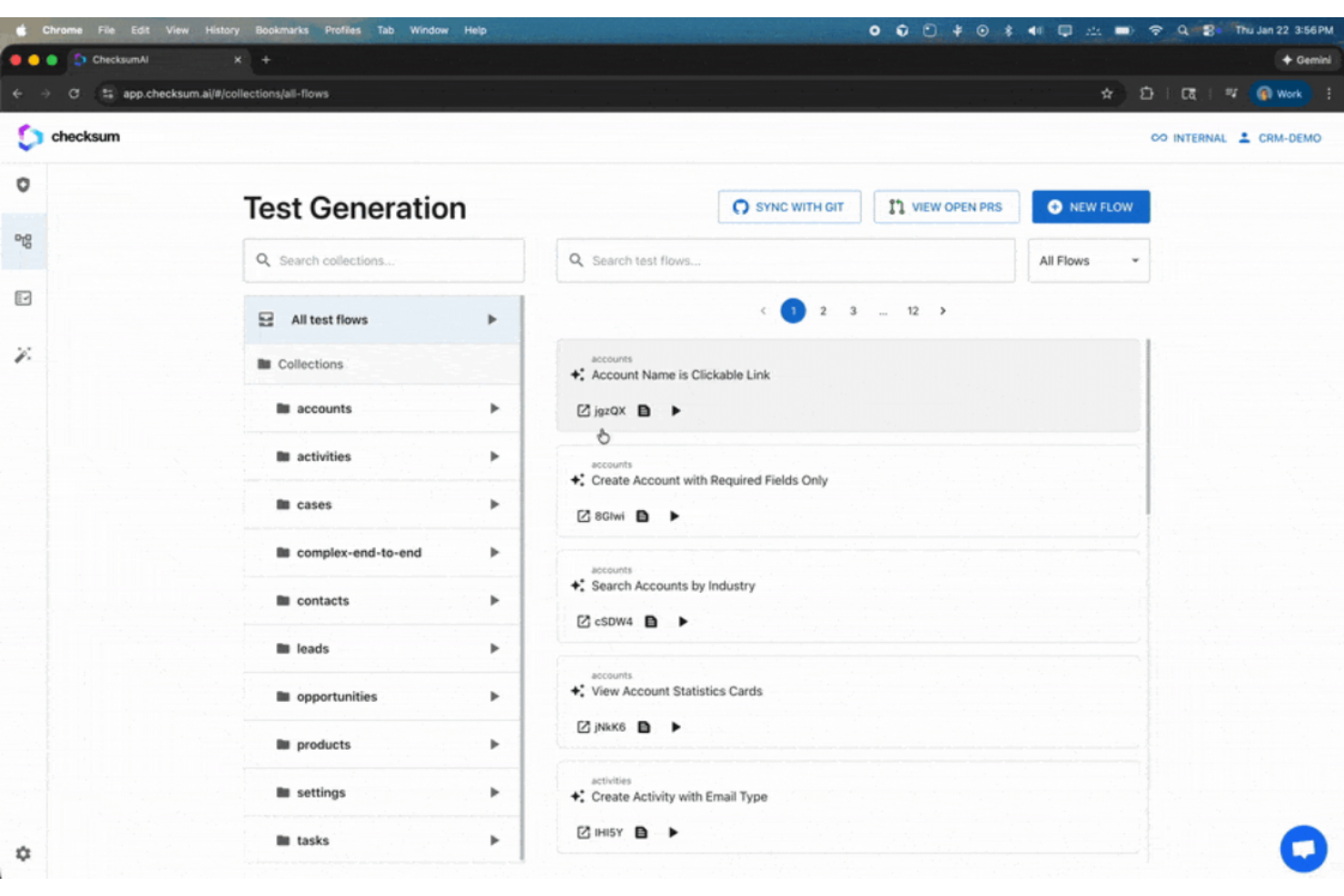
Checksum isn’t a traditional self-serve testing tool, but it becomes easy to use once implemented. Instead of requiring teams to write and manage tests manually, it handles test generation, execution, and maintenance in the background. While onboarding is guided and involves integrating your environment, repository, and CI/CD pipeline, the day-to-day experience is lightweight—tests are automatically created, updated, and fixed, with changes delivered via pull requests so teams can focus on reviewing results rather than maintaining test suites.
Onboarding
Checksum’s onboarding is structured and fully guided rather than self-serve. New customers go through a Proof of Value (POV), where Checksum works directly with your team to integrate with your environment, repository, and CI/CD pipeline while generating an initial test suite. This approach requires some upfront coordination, but it ensures tests are running in your workflow and delivering value early in the process.
Support is a key part of the experience, with a dedicated solutions engineer available throughout onboarding to help configure coverage, review results, and answer questions. While it’s not an instant setup, most teams begin seeing tests generated and running within the first phase, with a fully functioning test suite typically established over the course of the onboarding period.
Customer Support
Checksum provides a high-touch support model centered around a dedicated solutions engineer, often available via Slack, who assists with onboarding, test coverage setup, and ongoing troubleshooting. Rather than relying on traditional ticket-based support, the experience is more proactive and hands-on, with guidance built into the onboarding process and early usage. This approach is especially helpful for teams adopting continuous testing, as it ensures they get value quickly without needing deep in-house expertise.

Integrations
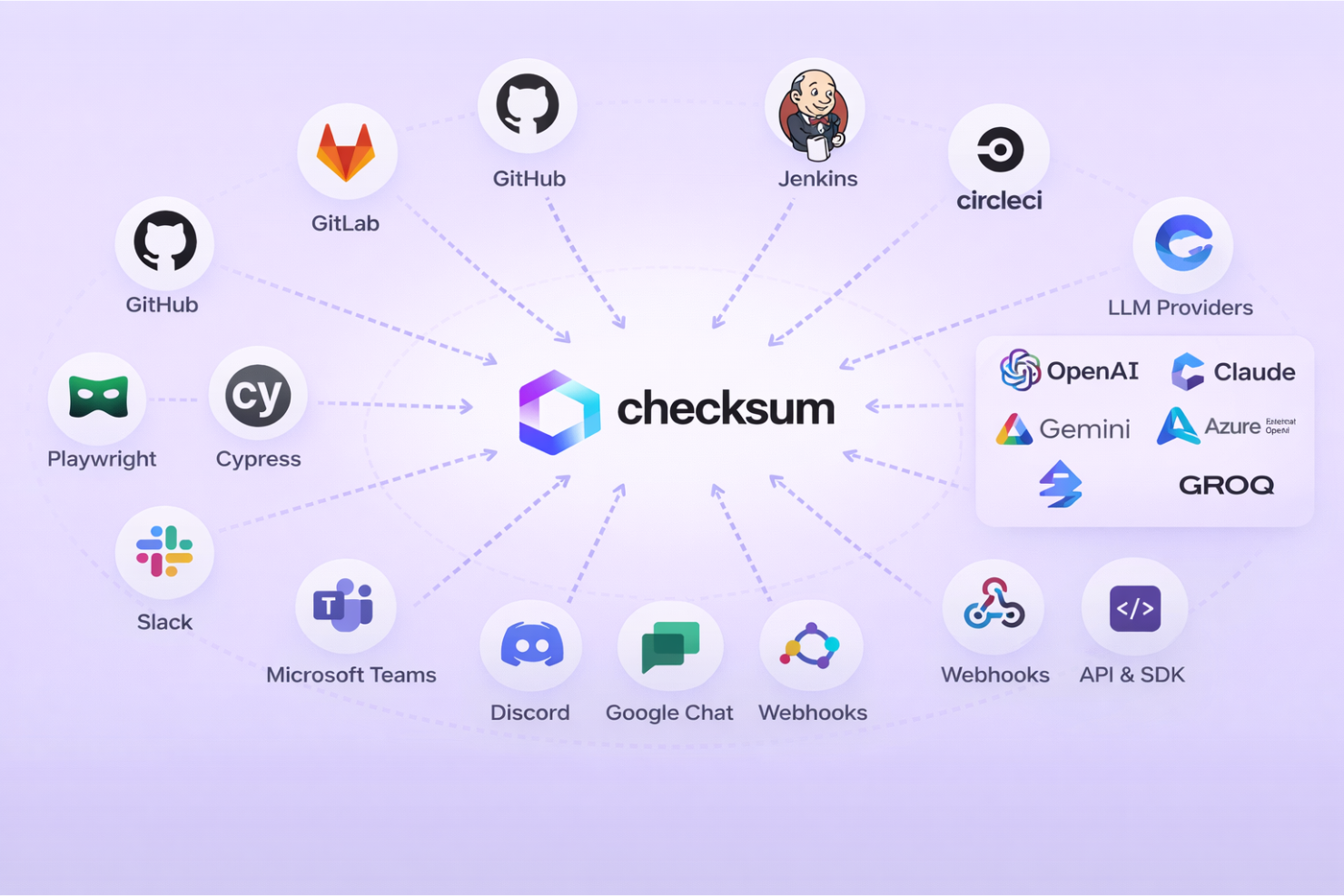
Checksum integrates directly with developer workflows and infrastructure, including GitHub and GitLab, CI/CD tools like Jenkins and CircleCI, testing frameworks such as Playwright and Cypress, and multiple LLM providers, including OpenAI, Claude, Gemini, Azure OpenAI, and Groq. It also connects with communication tools like Slack, Microsoft Teams, Discord, and Google Chat to deliver real-time test results and alerts.
In addition to native integrations, Checksum supports webhooks with extensive event coverage and offers an API and SDK for custom workflows and can connect with third-party tools.
Value for Money
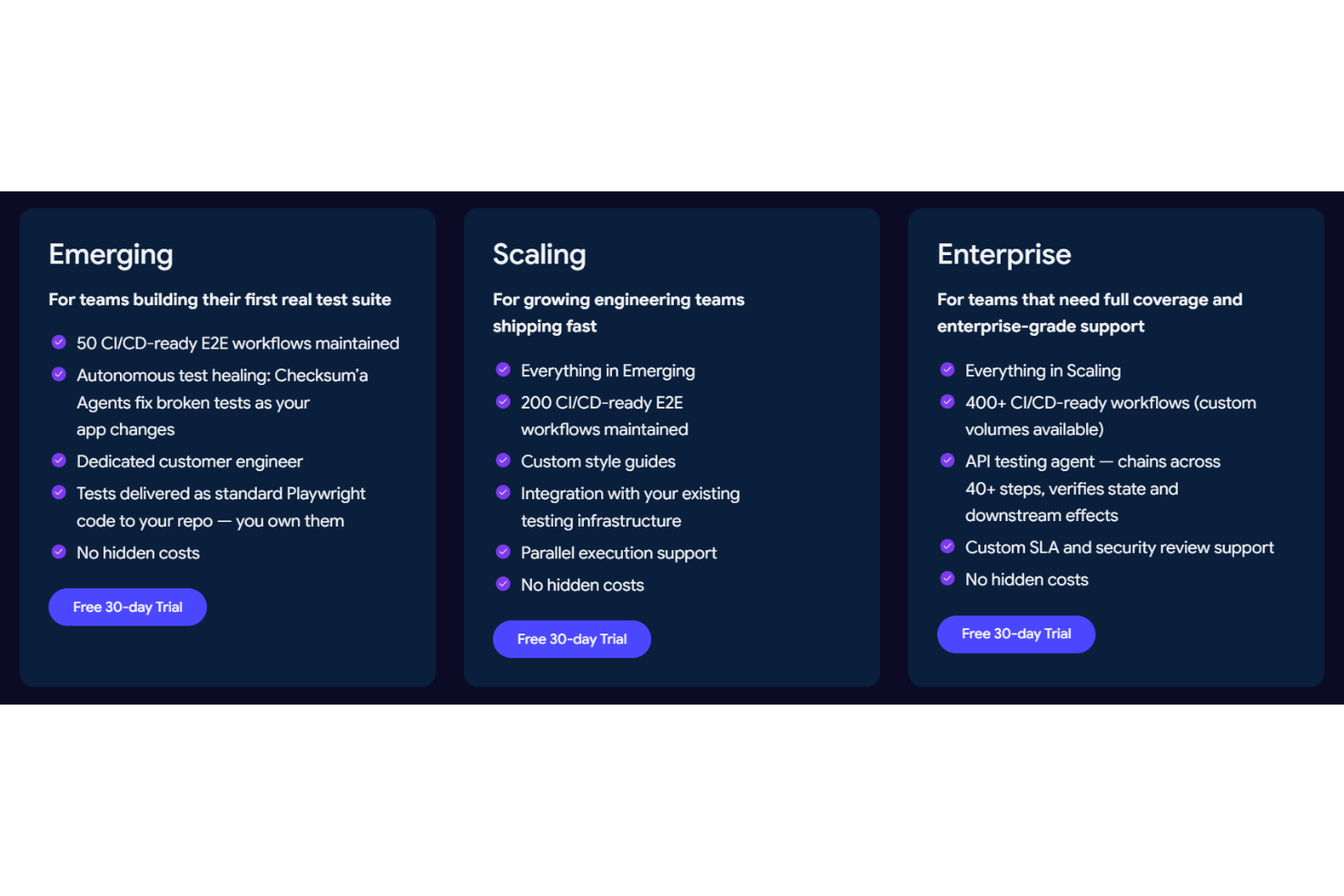
Checksum offers strong value for teams looking to eliminate the ongoing cost of writing and maintaining tests, but it’s positioned as a higher-investment solution rather than a low-cost tool. Pricing is based on the number of workflows (tests) maintained—not seats or test runs—which makes costs more predictable as teams scale. While exact pricing isn’t publicly available, the model is designed for organizations that treat testing as infrastructure and want to reduce long-term engineering effort.
- Emerging: 50 workflows maintained, autonomous test healing, dedicated solutions engineer, tests delivered as Playwright code
- Scaling: 200 workflows, custom style guides, integration with existing testing infrastructure, parallel execution
- Enterprise: 400+ workflows, API testing agent, custom SLA and security support
Checksum Specs
- A/B Testing
- API
- Automated Testing
- Browser Compatibility Testing
- Bug Tracking
- Calendar Management
- CI/CD Integration
- Dashboard
- Data Export
- Data Import
- Data Visualization
- Developer Tools
- External Integrations
- History/Version Control
- Manual Testing
- Multi-User
- Notifications
- Performance Testing
- Regression Testing
- Scheduling
- Status Notifications
- Third-Party Plugins/Add-Ons
Checksum FAQs
How does Checksum handle test maintenance as my application changes?
Can I customize the tests generated by Checksum?
What types of applications does Checksum support?
How does Checksum integrate with my CI/CD pipeline?
What reporting and analytics features does Checksum offer?
How does Checksum ensure data security and compliance?
What support options are available if I run into issues?
How quickly can I get started with Checksum?
What outcomes have real customers had with Checksum?
Checksum Company Overview & History
Checksum is a San Francisco-based technology company focused on autonomous testing and continuous quality assurance for modern web applications. Its platform generates, runs, and maintains tests alongside CI/CD workflows, helping teams ship faster without sacrificing reliability. Checksum is an independent company with customers including Counterpart, Postilize, Reservamos, Clearpoint Strategy, Ketch, Stellic, and Engagement Agents, and while it highlights strong customer outcomes, it does not publicly disclose details about its workforce, revenue, or funding.
Checksum Major Milestones
- 2023: Checksum was founded and began development of its AI-powered testing platform.
- 2024: Public launch of the Checksum platform for end-to-end, API, and CI testing.
- 2024: Adoption by notable clients in insurance tech, legal tech, SaaS, travel tech, and retail sectors.
- 2025: Featured in customer case studies for enabling major cost savings and faster release cycles.