

Encontrar la herramienta adecuada para la gestión de datos de prueba puede ser una tarea complicada. Con tantas opciones disponibles, es difícil determinar cuál satisface realmente tus necesidades sin malgastar tiempo o recursos valiosos. Si has tenido problemas con herramientas demasiado complejas, que no se adaptan al crecimiento de tus proyectos o que no cumplen con las normativas de privacidad de datos, no eres el único. Una buena herramienta de gestión de datos de prueba debe agilizar la creación, gestión y seguridad de tus conjuntos de datos, además de integrarse perfectamente en tus flujos de trabajo de pruebas.
Como profesional de las pruebas de software con experiencia práctica en docenas de herramientas, me he encontrado con los mismos desafíos a los que te enfrentas y los he superado. Por eso he creado esta guía: para simplificar tu búsqueda y ofrecerte una lista seleccionada de las mejores herramientas de gestión de datos de prueba disponibles actualmente. Tanto si tu prioridad es la automatización como el cumplimiento normativo o la escalabilidad, esta publicación te ayudará a tomar una decisión informada.
Por qué confiar en nuestras recomendaciones de software
6,700+
Reviews
20
Industry experts
16+
Evaluation factors
14
Years
Nuestro equipo lleva probando y evaluando software desde 2012. Como líderes tecnológicos, sabemos lo difícil —y lo importante— que es elegir el software adecuado.
Para esta guía, evaluamos las herramientas mediante pruebas prácticas e investigación independiente, puntuando las herramientas según nuestros criterios de selección.
Nuestras reseñas reflejan nuestro criterio editorial humano, no un discurso de ventas.
Revisores expertos:
- Paulo Gardini MiguelDirector técnico
 Tim FisherVP de IA
 Gabriel RosasTech Lead y arquitecto de software
 Christhian GruhnTech Lead y arquitecto de plataforma

Tabla comparativa de herramientas de gestión de datos de prueba
La tabla siguiente compara los detalles de precios de mis principales herramientas de gestión de datos de prueba.
| Tool | Best For | Trial Info | Price | ||
|---|---|---|---|---|---|
| 1 | Ideal para el enmascaramiento alineado con el cumplimiento y la creación automática de subconjuntos | Prueba gratuita de 14 días | Precios bajo solicitud | Website | |
| 2 | Ideal para datos de prueba sintéticos nativos de CI/CD | Demostración gratuita disponible | Precio bajo solicitud | Website | |
| 3 | Ideal para gestionar distintos entornos de datos de prueba desde una ubicación central | Prueba gratuita de 14 días | Desde €15,000/usuario/año (facturado anualmente) | Website | |
| 4 | Ideal para la gestión de datos de prueba durante todo su ciclo de vida con clonación de bases de datos | Demostración gratuita disponible | Precios bajo solicitud | Website | |
| 5 | La mejor opción para el enmascaramiento de datos de prueba que incluye mainframe | No disponible | Precio bajo solicitud | Website | |
| 6 | Ideal para empresas con entornos complejos | Prueba gratuita de 30 días disponible | Precio bajo solicitud | Website | |
| 7 | La mejor creación de subconjuntos entre bases de datos en sectores regulados | Demostración gratuita disponible | Precio bajo solicitud | Website | |
| 8 | La mejor opción para el enmascaramiento en canalizaciones con múltiples bases de datos | Demostración gratuita disponible | Precios bajo consulta | Website | |
| 9 | Ideal para el diseño visual de datos basado en la cobertura | Prueba gratuita de 14 días | Precio bajo solicitud | Website | |
| 10 | Ideal para clonar bases de datos al estilo de Git en cinco motores | Demostración gratuita disponible | Precio bajo consulta | Website |





Análisis de las mejores herramientas de gestión de datos de prueba
A continuación encontrarás mis resúmenes detallados de las mejores herramientas de gestión de datos de prueba que han llegado a mi lista seleccionada. Mis análisis ofrecen una visión detallada de las características principales, ventajas y desventajas, integraciones y casos de uso ideales de cada herramienta para ayudarte a encontrar la mejor opción para ti.
 Ideal para el enmascaramiento alineado con el cumplimiento y la creación automática de subconjuntos
- Prueba gratuita de 14 días
- Precios bajo solicitud
Visit WebsiteCustomer Rating:4.3/5
Tonic enmascara y desidentifica columnas sensibles de bases de datos para obtener datos de prueba seguros. Tonic Structural es una plataforma de gestión de datos de prueba que enmascara, crea subconjuntos y aprovisiona datos de producción para entornos no productivos, con compatibilidad para bases de datos relacionales, NoSQL, almacenes de datos y fuentes de archivos.
¿Para quién es más adecuado Tonic?
Tonic Structural es una opción excelente para equipos de los sectores sanitario y financiero centrados en el cumplimiento normativo que necesitan enmascarar y crear subconjuntos de datos de producción, manteniendo al mismo tiempo documentación de privacidad preparada para auditorías.
Por qué elegí Tonic
Tonic merece estar en mi lista de opciones principales porque sus capacidades de enmascaramiento y creación de subconjuntos están estrechamente integradas de una forma que rara vez encuentro. Me encanta cómo Privacy Hub marca cada columna como En riesgo, Protegida o No sensible, y luego permite aplicar generadores en bloque y exportar un Informe de privacidad completo para fines de auditoría. El creador de subconjuntos patentado gestiona automáticamente las claves foráneas virtuales y las dependencias circulares, por lo que el subconjunto enmascarado mantiene la integridad referencial incluso en esquemas complejos con varias tablas.
Características principales de Tonic
- Agente Structural: Un asistente de chat de IA integrado en la aplicación que resume los resultados del análisis de sensibilidad, recomienda generadores y los aplica automáticamente a las columnas.
- Controles de privacidad diferencial: Los generadores categóricos y continuos admiten privacidad diferencial, con un presupuesto de privacidad configurable para limitar la inferencia estadística a partir de los datos transformados.
- Salida al repositorio de contenedores: Structural escribe los datos enmascarados y divididos en subconjuntos directamente como volúmenes de contenedor para PostgreSQL, MySQL y SQL Server, lo que permite iniciar bases de datos aisladas bajo demanda.
- Historial de versiones: Registra cada cambio en la configuración del espacio de trabajo —generadores, reglas de creación de subconjuntos, modos de tabla y scripts posteriores a los trabajos—, con atribución y la posibilidad de restaurar versiones anteriores.
Integraciones de Tonic
Tonic ofrece integraciones nativas con PostgreSQL, MySQL, SQL Server, Oracle, MongoDB, Snowflake, BigQuery, Redshift, Databricks y Amazon S3. También admite la API REST, GitHub Actions, Kubernetes, Helm y registros de contenedores, incluidos Amazon ECR, Google Artifact Registry y Azure Container Registry.
Pros and Cons
Pros:
- Conserva las combinaciones entre tablas en esquemas complejos
- Privacy Hub asigna las columnas sensibles para las auditorías
- Los datos similares a los de producción conservan las relaciones estadísticas
Cons:
- La síntesis desde cero requiere el producto Fabricate por separado
- Las bases de datos en contenedores requieren una implementación de Kubernetes
Learn more about Tonic: Ideal para datos de prueba sintéticos nativos de CI/CD
- Demostración gratuita disponible
- Precio bajo solicitud
Visit WebsiteCustomer Rating:4.6/5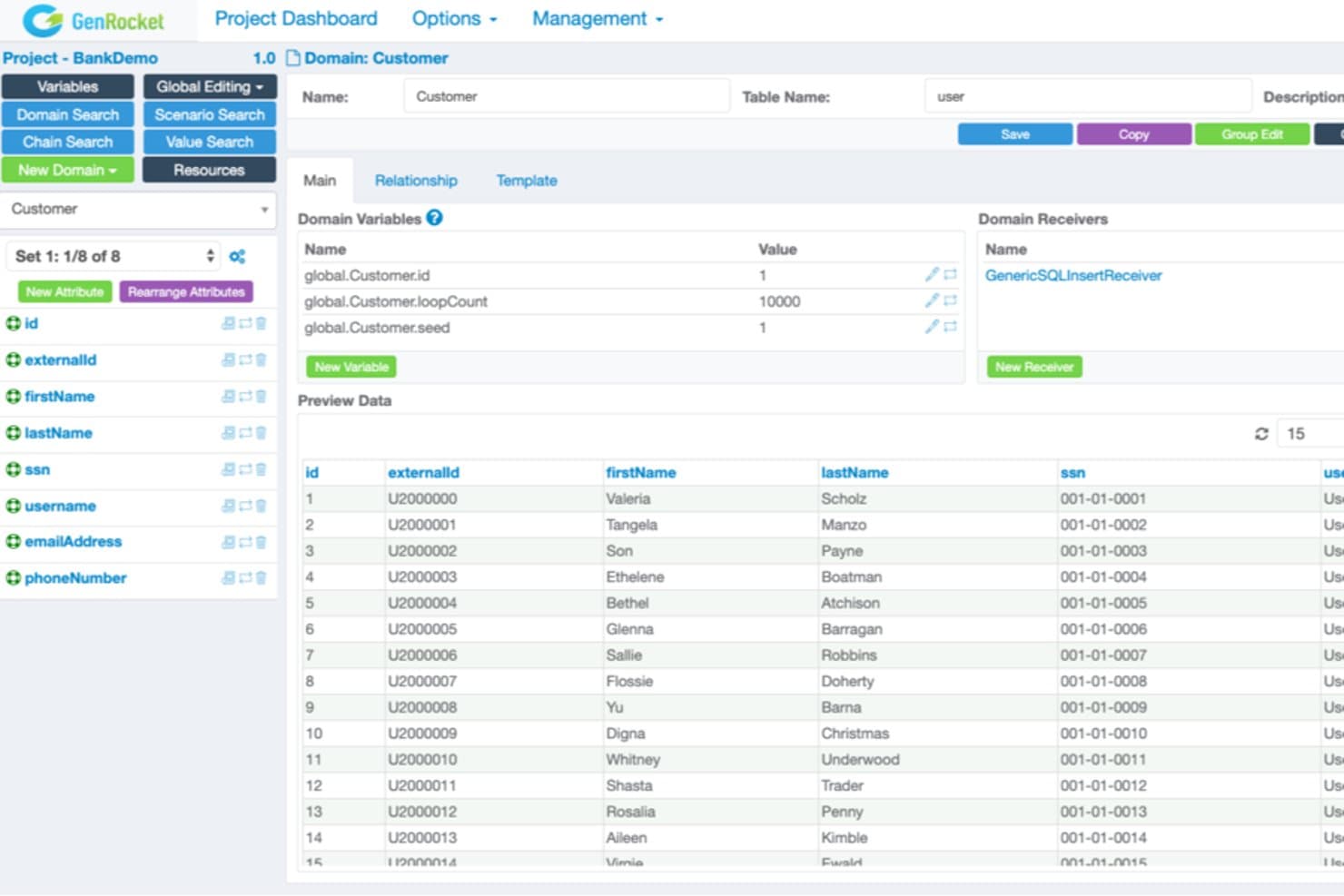
GenRocket permite a los usuarios previsualizar y configurar visualmente los dominios de datos de prueba. GenRocket es una plataforma de gestión de datos de prueba sintéticos que genera datos en tiempo real a partir de metadatos y esquemas, abarcando el enmascaramiento de datos, la creación inteligente de subconjuntos, la generación en múltiples formatos y el aprovisionamiento de autoservicio en canalizaciones de CI/CD.
¿Para quién es GenRocket más adecuado?
GenRocket es una opción excelente para los equipos de QA y DevOps que necesitan generar datos de prueba sintéticos bajo demanda directamente dentro de las canalizaciones de CI/CD, sin tocar nunca los datos de producción.
Por qué elegí GenRocket
GenRocket ocupa un lugar en mi lista de opciones principales porque es la única plataforma de datos de prueba que he visto creada específicamente para generar datos sintéticos en tiempo real, directamente dentro de una canalización de CI/CD y sin tocar nunca la producción. Su motor patentado de integridad referencial mantiene la coherencia de los datos simultáneamente en varios esquemas y bases de datos, algo realmente poco común. También me gusta que cada conjunto de datos de un caso de prueba se genere en tan solo 100 milisegundos, de modo que la ejecución de la canalización no se detenga mientras espera el aprovisionamiento de datos.
Características principales de GenRocket
- Detección de cambios de esquema G-Delta: Identifica automáticamente los cambios en los esquemas de bases de datos de MySQL, MS SQL, Oracle y PostgreSQL, y luego activa G-Refactor para actualizar todos los casos de datos de prueba afectados.
- Enmascaramiento en el lugar: Reemplaza los campos confidenciales de las bases de datos Oracle, MS SQL Server, IBM DB2, PostgreSQL y MySQL por equivalentes generados sintéticamente, sin leer nunca valores reales de producción.
- Portal de autoservicio G-Portal: Ofrece a desarrolladores y evaluadores una interfaz basada en roles para buscar, solicitar, hacer seguimiento y descargar casos de datos de prueba sin involucrar a un equipo central de datos en cada solicitud.
- Más de 750 generadores de datos inteligentes: Abarca prácticamente cualquier tipo de dato, dominio o regla empresarial, incluida la lógica condicional, las dependencias entre campos y las restricciones de expresiones regulares.
Integraciones de GenRocket
GenRocket se integra con Jenkins, Azure DevOps, TeamCity, CircleCI, GitHub, Cucumber, Selenium, JUnit, JMeter y LoadRunner. También admite la API REST, JDBC, SOAP, sockets TCP/IP y la implementación en Docker para flujos de trabajo de CI/CD personalizados.
Pros and Cons
Pros:
- La generación de datos sintéticos mantiene la integridad referencial
- Aprovisionamiento de datos en tiempo real para canalizaciones de CI/CD
- Volumen de datos ilimitado sin ciclos de actualización
Cons:
- No ofrece enmascaramiento reversible ni con conservación de formato
- La detección de información de identificación personal (PII) no estará completamente disponible hasta {{year}}
Learn more about GenRocket: Ideal para gestionar distintos entornos de datos de prueba desde una ubicación central
- Prueba gratuita de 14 días
- Desde €15,000/usuario/año (facturado anualmente)
Visit WebsiteCustomer Rating:4.5/5
El enmascaramiento de datos ayuda a mantener privada la información confidencial de los clientes. DATPROF es una plataforma de gestión de datos de prueba que combina el enmascaramiento de datos, la creación de subconjuntos, la generación de datos sintéticos, el descubrimiento de información personal identificable (PII), la virtualización de bases de datos y el aprovisionamiento centralizado en fuentes de datos relacionales, NoSQL y en la nube.
¿Para quién es más adecuado DATPROF?
DATPROF es una opción especialmente adecuada para ingenieros de datos y administradores de bases de datos de empresas medianas y grandes que gestionan entornos complejos con múltiples bases de datos, donde la integridad referencial y el cumplimiento normativo son imprescindibles.
Por qué elegí DATPROF
Elegí DATPROF como una de las mejores opciones porque su modelo de licencias independiente del volumen realmente lo distingue: el coste de la licencia se mantiene fijo tanto si enmascaras 500 GB como 100 TB, algo importante al crear un subconjunto de una base de datos de producción como la de 23 TB que Heineken redujo a 130 GB. La detección patentada de ciclos de claves foráneas de DATPROF Subset gestiona esquemas complejos con varios miles de tablas, al tiempo que mantiene intacta la integridad referencial entre sistemas. Si a esto le sumamos la orquestación centralizada del portal Runtime, cada miembro del equipo puede aprovisionar su propio entorno actualizado sin tener que esperar a un administrador de bases de datos.
Características principales de DATPROF
- Enmascaramiento determinista entre sistemas: Aplica valores enmascarados coherentes para la misma entrada en varias bases de datos simultáneamente, preservando la integridad referencial para la trazabilidad de las pruebas de extremo a extremo.
- Descubrimiento y perfilado de PII: Analiza las bases de datos para identificar automáticamente dónde se encuentran los datos confidenciales, con compatibilidad para reglas de detección personalizadas mediante expresiones regulares o expresiones basadas en listas.
- Portal de aprovisionamiento de autoservicio: Permite que los evaluadores y desarrolladores inicien sesión en DATPROF Runtime y actualicen sus propios entornos de prueba de forma independiente, sin tener que esperar a un administrador de bases de datos.
- Clonación de bases de datos mediante copia al escribir: DATPROF Virtualize pone en marcha entornos de bases de datos virtuales de tamaño completo sin consumir almacenamiento adicional, con una reversión de instantáneas completada en menos de 20 segundos.
Integraciones de DATPROF
DATPROF admite integraciones de CI/CD con Jenkins, Azure DevOps, GitLab y Bamboo, además de integraciones de automatización de pruebas con Parasoft y Tosca. Su API REST permite integraciones personalizadas, y hay listados disponibles en Azure Marketplace y AWS Marketplace.
Pros and Cons
Pros:
- El enmascaramiento preserva la integridad referencial entre bases de datos
- La creación de subconjuntos reduce eficazmente los enormes conjuntos de datos de producción
- Portal web basado en roles para actualizaciones de autoservicio
Cons:
- Compatibilidad nativa limitada con fuentes de datos SaaS
- No ofrece cobertura para sistemas centrales ni para una gama más amplia de bases de datos NoSQL
Learn more about DATPROF: Ideal para la gestión de datos de prueba durante todo su ciclo de vida con clonación de bases de datos
- Demostración gratuita disponible
- Precios bajo solicitud

Enov8 proporciona una visión ejecutiva de la información de identificación personal en las fuentes de datos de un vistazo. Enov8 es una plataforma de gestión de datos de prueba que cubre todo el ciclo de vida de la gestión de datos de prueba (TDM), incluido el perfilado de datos impulsado por IA, el enmascaramiento, la creación de subconjuntos, la generación de datos sintéticos y la virtualización de bases de datos mediante su motor de clonación vME.
¿Para quién es más adecuado Enov8?
Enov8 es una excelente opción para equipos de DevOps y control de calidad de sectores regulados que necesitan una única plataforma para gestionar conjuntamente el enmascaramiento, la creación de subconjuntos, los datos sintéticos y la virtualización de bases de datos.
Por qué elegí Enov8
Elegí Enov8 como una de las mejores opciones porque es la única herramienta de mi lista que combina la gestión de datos de prueba durante todo su ciclo de vida con su motor de clonación de bases de datos vME, que crea copias de bases de datos realistas respecto a producción de aproximadamente 40 MB por clon, independientemente del tamaño de origen. Me gusta que el enmascaramiento, la creación de subconjuntos y la generación de datos sintéticos se integren directamente en la capa de virtualización, de modo que los clones ya cumplen con los requisitos de privacidad antes de llegar a un entorno de prueba.
Funciones principales de Enov8
- Descubrimiento de información de identificación personal impulsado por IA: Un motor de perfilado basado en aprendizaje automático analiza automáticamente las fuentes de datos conectadas para clasificar los campos confidenciales y señalar las columnas con riesgo normativo antes de comenzar el enmascaramiento.
- Reservas de datos de prueba: Un sistema de reservas integrado permite a los equipos reservar y gestionar conjuntos de datos de forma centralizada, evitando conflictos entre usuarios y entornos simultáneos.
- Análisis de validación posterior al enmascaramiento: Una ejecución de validación basada en aprendizaje automático confirma la eficacia del enmascaramiento después de cada proceso de protección y genera evidencias de cumplimiento listas para auditorías.
- Centro de integraciones de DevOps Manager: Una capa de orquestación independiente del lenguaje que aloja scripts de automatización en Python, Bash, Ansible, Java y otros lenguajes, conectando Enov8 con canalizaciones de CI/CD en Jenkins, GitLab CI/CD y Azure DevOps.
Integraciones de Enov8
Enov8 admite más de 100 integraciones, incluidas Jenkins, GitLab CI/CD, Azure DevOps, CircleCI, Travis CI, Bitbucket Pipelines, AWS CodeDeploy y Ansible. Su API REST, los webhooks, el programador y la compatibilidad con DevOps Manager permiten crear flujos de trabajo de CI/CD personalizados.
Pros and Cons
Pros:
- Virtualización de bases de datos con clones pequeños de 40 MB
- Descubrimiento de información de identificación personal y validación del enmascaramiento impulsados por IA
- Las reservas centralizadas de datos de prueba evitan conflictos de asignación
Cons:
- El volumen de reseñas públicas es relativamente limitado
- No se indican certificaciones de cumplimiento de terceros
Learn more about Enov8: La mejor opción para el enmascaramiento de datos de prueba que incluye mainframe
- No disponible
- Precio bajo solicitud

Broadcom Test Data Manager realiza un seguimiento de los estados de los trabajos de importación en una sola vista. Broadcom Test Data Manager es una plataforma empresarial de gestión de datos de prueba que combina el enmascaramiento de datos, la generación de datos sintéticos, la creación de subconjuntos, el descubrimiento de PII, la virtualización de bases de datos y el aprovisionamiento de autoservicio, con soporte específico para entornos de mainframe junto con bases de datos distribuidas y en la nube modernas.
¿Para quién es más adecuado Broadcom Test Data Manager?
Las grandes empresas que ejecutan entornos de mainframe junto con sistemas distribuidos modernos obtendrán el mayor beneficio de esta plataforma.
Por qué elegí Broadcom Test Data Manager
He incluido Broadcom Test Data Manager entre mis principales opciones porque es la única plataforma que he visto que trata los entornos de mainframe como un elemento de primer nivel junto con los sistemas distribuidos modernos. Su módulo CA TDM for Mainframe permite enmascarar y crear subconjuntos de datos en z/OS, VSAM e IMS mediante la misma interfaz que se utiliza para SQL Server u Oracle. El mapa de calor automatizado de PII analiza esquemas completos de mainframe y marca los campos confidenciales antes de aplicar una sola regla de enmascaramiento, lo que reduce el trabajo de asignación manual que suele ralentizar a los equipos de cumplimiento.
Características principales de Broadcom Test Data Manager
- Portal de datos de autoservicio: Un catálogo centralizado donde los evaluadores solicitan, reservan y liberan datos de prueba bajo demanda mediante formularios dinámicos, sin tener que esperar a los administradores de bases de datos.
- Virtualización de bases de datos DAVE: Un motor de clonación mediante copia al escribir que crea clones de bases de datos independientes a partir de una imagen base compartida en cuestión de minutos y con una sobrecarga mínima de almacenamiento.
- Automatización de flujos de trabajo Javelin: Un motor visual de automatización integrado que coordina las tareas de enmascaramiento, creación de subconjuntos y aprovisionamiento, y que puede activarse mediante la API REST o canalizaciones de CI/CD.
- Conservación de la integridad referencial: Las operaciones de enmascaramiento y creación de subconjuntos mantienen las relaciones entre tablas para que los conjuntos de datos de prueba sigan siendo funcionalmente coherentes en las pruebas de extremo a extremo.
Integraciones de Broadcom Test Data Manager
Entre las integraciones documentadas se incluyen Azure DevOps, CA Release Automation, CA Service Virtualization, CA BlazeMeter, CA Agile Requirements Designer, HP ALM y CA Agile Central. Las API REST permiten crear flujos de trabajo de CI/CD personalizados, mientras que Docker y Kubernetes admiten implementaciones en contenedores.
Pros and Cons
Pros:
- Enmascaramiento de datos de prueba que incluye mainframe
- Descubrimiento automatizado de PII y mapas de calor
- Virtualización de bases de datos mediante copia al escribir (DAVE)
Cons:
- No hay ninguna opción de implementación SaaS disponible
- La interfaz parece anticuada y compleja
Learn more about Broadcom Test Data Manager: Ideal para empresas con entornos complejos
- Prueba gratuita de 30 días disponible
- Precio bajo solicitud
Visit WebsiteCustomer Rating:4.5/5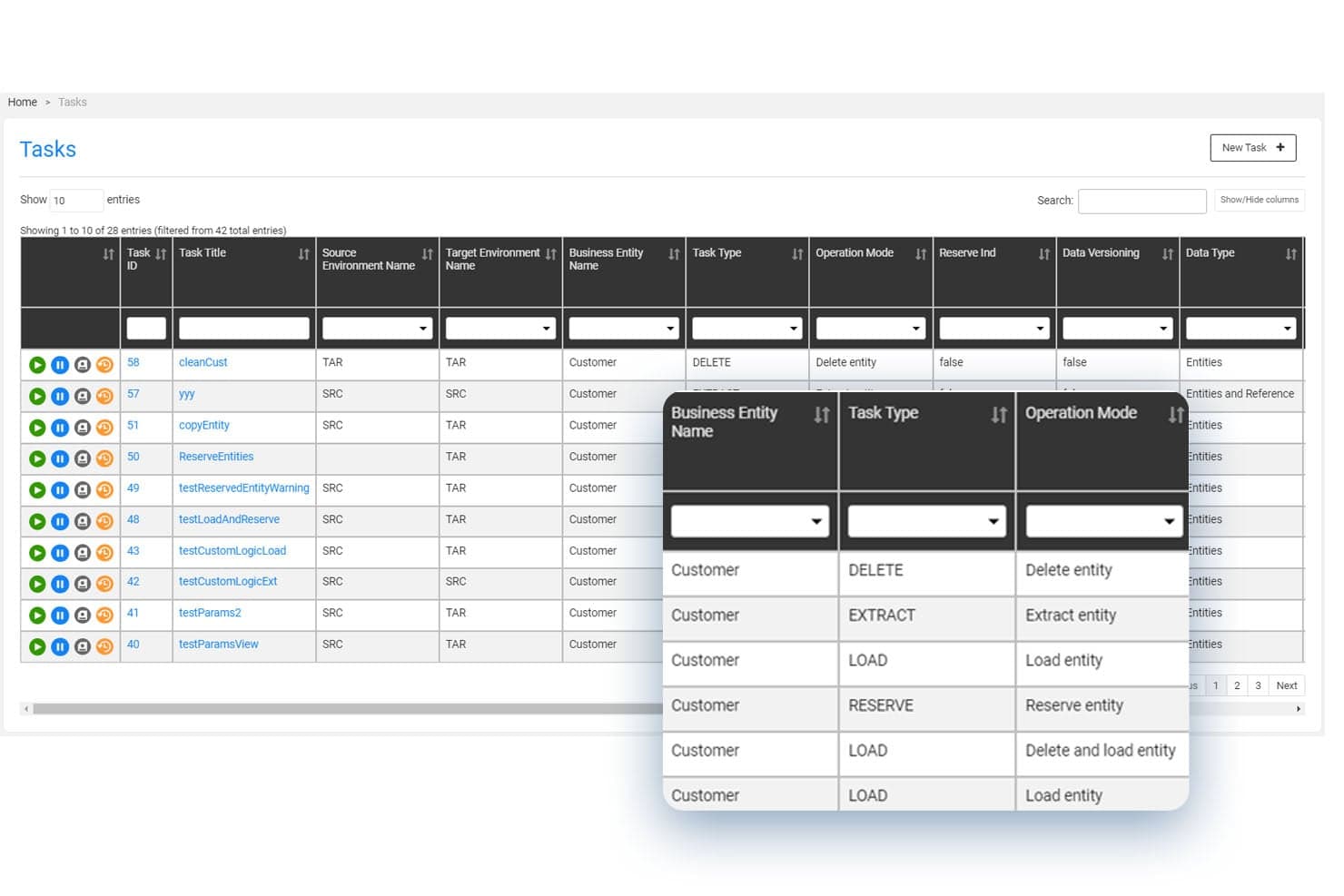
La Gestión de Datos de Prueba de K2View permite a los usuarios gestionar y filtrar tareas de datos por tipo y modo de operación. La Gestión de Datos de Prueba de K2View es una plataforma empresarial de gestión de datos de prueba que unifica el enmascaramiento de datos, la generación de datos sintéticos, la segmentación y el aprovisionamiento de autoservicio en fuentes de datos relacionales, NoSQL, mainframe y en la nube mediante una arquitectura patentada Micro-Database™.
¿Para quién es más adecuada la Gestión de Datos de Prueba de K2View?
K2View está diseñada para grandes empresas que gestionan datos de prueba en entornos mixtos —mainframe, nube, NoSQL y relacionales— al mismo tiempo.
Por qué elegí la Gestión de Datos de Prueba de K2View
K2View ocupa un lugar en mi lista de preseleccionados porque su arquitectura patentada Micro-Database™ resuelve un problema que la mayoría de las herramientas de gestión de datos de prueba esquivan: mantener la integridad referencial simultáneamente en fuentes mainframe, NoSQL y en la nube. Me impresiona especialmente su enmascaramiento durante la extracción, lo que significa que la información de identificación personal se enmascara en el punto de extracción y nunca llega sin enmascarar a un entorno de prueba. Su segmentación centrada en entidades permite a los equipos extraer un registro completo de cliente que abarca Oracle, Kafka y MongoDB en una sola operación, sin reglas de unión manuales.
Características principales de la Gestión de Datos de Prueba de K2View
- Portal de gestión de datos de prueba de autoservicio: Una interfaz web que permite a los evaluadores solicitar, reservar y revertir datos de prueba sin involucrar a los equipos de datos o de administración de bases de datos.
- Instantáneas y reversión con Time Machine: Guarda estados específicos de los datos de prueba en cualquier momento para que los evaluadores puedan restaurar los entornos instantáneamente a una configuración conocida.
- Detección automatizada de información de identificación personal: Los clasificadores integrados exploran todas las fuentes conectadas, etiquetan los campos confidenciales y recomiendan o aplican automáticamente políticas de enmascaramiento.
- Gestión de datos de prueba agéntica: Una capacidad basada en IA que lee casos de prueba y ensambla de forma autónoma conjuntos de datos conformes y listos para el aprovisionamiento, sin configuración manual.
Integraciones de la Gestión de Datos de Prueba de K2View
K2View ofrece conectores integrados para Oracle, SQL Server, PostgreSQL, DB2, MongoDB, Snowflake, Salesforce, Amazon S3, Kafka y sistemas mainframe. La conectividad REST, JDBC y ODBC permite integraciones personalizadas y flujos de trabajo de CI/CD con Jenkins, GitHub Actions y Azure DevOps.
Pros and Cons
Pros:
- El enmascaramiento durante la extracción evita la exposición de información de identificación personal sin enmascarar
- La segmentación centrada en entidades abarca mainframe y nube
- Detección automatizada de información de identificación personal integrada en la plataforma
Cons:
- No está diseñada para equipos pequeños
- La integración de CI/CD basada en API requiere configuración
Learn more about K2View Test Data Management: La mejor creación de subconjuntos entre bases de datos en sectores regulados
- Demostración gratuita disponible
- Precio bajo solicitud

IBM InfoSphere Optim te ayuda a crear rápidamente datos de prueba. La gestión de datos de prueba de IBM es una solución empresarial de gestión de datos de prueba que abarca el enmascaramiento de datos, la creación de subconjuntos entre bases de datos y el aprovisionamiento de datos bajo demanda en una amplia variedad de fuentes de datos relacionales y de sistemas mainframe.
¿Para quién es más adecuada la gestión de datos de prueba de IBM?
La gestión de datos de prueba de IBM es especialmente adecuada para grandes empresas de sectores regulados—servicios financieros, atención sanitaria y seguros—que operan en entornos complejos con múltiples bases de datos o que incluyen sistemas mainframe, donde el enmascaramiento de datos y la creación de subconjuntos entre bases de datos son requisitos de cumplimiento normativo.
Por qué elegí la gestión de datos de prueba de IBM
La gestión de datos de prueba de IBM ocupa un lugar en mi lista de opciones principales por la forma en que gestiona la creación de subconjuntos entre bases de datos a nivel de objeto de negocio, extrayendo simultáneamente subconjuntos con integridad referencial de varias bases de datos conectadas. Me impresiona especialmente su capacidad de extracción federada, que permite a los equipos trabajar en entornos de datos heterogéneos, incluidas fuentes mainframe como VSAM e IMS, donde prácticamente ninguna herramienta de la competencia opera. Sus más de 40 reglas de enmascaramiento predefinidas, con resultados que conservan el formato, la hacen realmente útil en entornos regulados por el RGPD y la HIPAA.
Características principales de la gestión de datos de prueba de IBM
- Integración con Governance Catalog: Permite arrastrar y soltar reglas de clasificación de datos directamente en mapas de columnas para asignar automáticamente rutinas de enmascaramiento desde un catálogo central de políticas.
- Entorno de ejecución Apache Spark: Un motor Spark integrado gestiona el procesamiento de datos a gran escala dentro de flujos de trabajo automatizados de creación de subconjuntos y enmascaramiento.
- Control de acceso basado en roles: El control de acceso basado en roles (RBAC) impulsado por Keycloak, con compatibilidad con LDAP, SAML, OIDC y Kerberos, controla quién puede acceder a los conjuntos de datos de prueba, solicitarlos y actualizarlos.
- Informes de cumplimiento: Los informes integrados validan la aplicación de las políticas de privacidad de datos en entornos regulados por el RGPD y la HIPAA.
Integraciones de la gestión de datos de prueba de IBM
Las integraciones documentadas incluyen IBM Governance Catalog, IBM Cloud Pak for Data, Keycloak, Apache Spark y bases de datos como Db2, Oracle, SQL Server, PostgreSQL, Snowflake, SAP, Teradata, Informix, Netezza y MongoDB de forma limitada. Su API REST OpenAPI 2.0 admite la orquestación personalizada y los flujos de trabajo de CI/CD, mientras que la edición para z/OS se conecta con VSAM e IMS.
Pros and Cons
Pros:
- Conserva la integridad referencial entre bases de datos
- El enmascaramiento que conserva el formato admite datos regulados
- Gestiona subconjuntos de VSAM e IMS
Cons:
- No ofrece generación nativa de datos sintéticos
- Las copias físicas sustituyen a la clonación virtual
Learn more about IBM Test Data Management: La mejor opción para el enmascaramiento en canalizaciones con múltiples bases de datos
- Demostración gratuita disponible
- Precios bajo consulta

Tonic.ai permite a los usuarios gestionar reglas de enmascaramiento de datos en tablas de bases de datos. Tonic.ai es una plataforma de gestión de datos de prueba que abarca el enmascaramiento y la creación de subconjuntos de datos estructurados, la redacción de datos no estructurados y la generación de datos totalmente sintéticos en bases de datos relacionales, almacenes NoSQL y almacenes de datos en la nube.
¿Para quién es más adecuado Tonic.ai?
Tonic.ai es una opción excelente para ingenieros de datos y administradores de bases de datos que gestionan datos de prueba en entornos complejos con múltiples bases de datos, incluidas bases de datos relacionales, almacenes NoSQL y almacenes de datos en la nube.
Por qué elegí Tonic.ai
Elegí Tonic.ai como una de las mejores opciones porque su motor de enmascaramiento determinista aplica valores enmascarados coherentes para la misma entrada en PostgreSQL, MongoDB, Snowflake y todas las demás fuentes de tu canalización de forma simultánea. Esto significa que un ID de cliente enmascarado en tu base de datos relacional coincide con el mismo valor enmascarado en tu almacén de datos y almacén de documentos, manteniendo intactas las uniones entre sistemas. Su motor patentado de creación de subconjuntos refuerza esta capacidad al extraer fragmentos con coherencia referencial; así fue como eBay redujo un conjunto de datos de 8PB a un entorno de prueba limpio de 1GB sin romper ninguna relación entre tablas.
Características principales de Tonic.ai
- Detección automatizada de PII/PHI: Analiza las fuentes de datos conectadas, detecta campos sensibles y recomienda transformaciones de enmascaramiento sin necesidad de asignar columnas manualmente una por una.
- Tonic Ephemeral: Inicia bases de datos aisladas bajo demanda dentro de canalizaciones de CI/CD mediante conexiones DNS directas y las elimina automáticamente después de ejecutar las pruebas.
- Detección de cambios en el esquema: Identifica columnas nuevas o modificadas y puede bloquear automáticamente la generación de datos para evitar filtraciones accidentales de PII en entornos de prueba.
- Preajustes de generadores: Permite guardar y reutilizar reglas de enmascaramiento y transformación con nombre de forma global en todos los espacios de trabajo, manteniendo coherentes las políticas de enmascaramiento a gran escala.
Integraciones de Tonic.ai
Tonic.ai ofrece una integración nativa con GitHub Actions, además de conectividad mediante API REST para Jenkins y GitLab CI. Se conecta con PostgreSQL, MySQL, SQL Server, Oracle, MongoDB, DynamoDB, Snowflake, BigQuery, Redshift y Databricks.
Pros and Cons
Pros:
- El motor patentado de creación de subconjuntos preserva la integridad referencial
- Enmascaramiento determinista en múltiples plataformas de bases de datos
- Detección automatizada de PII con recomendaciones de IA
Cons:
- No ofrece compatibilidad nativa con fuentes de datos de sistemas centrales
- La configuración inicial puede ser compleja para las empresas
Learn more about Tonic.ai: Ideal para el diseño visual de datos basado en la cobertura
- Prueba gratuita de 14 días
- Precio bajo solicitud

Curiosity Software visualiza las relaciones entre datos mediante un diagrama de partición radial. Curiosity Software es una plataforma de gestión de datos de prueba que combina enmascaramiento de datos, generación de datos sintéticos, creación de subconjuntos, virtualización y aprovisionamiento de autoservicio en más de 250 integraciones de fuentes, incluidos sistemas mainframe como VSAM, IMS y CICS.
¿Para quién es más adecuado Curiosity Software?
Curiosity Software es adecuado para equipos empresariales de control de calidad y especialistas en datos que trabajan en entornos complejos con múltiples fuentes, especialmente aquellos que gestionan sistemas mainframe o datos de prueba sujetos a requisitos de cumplimiento a gran escala.
Por qué elegí Curiosity Software
Elegí Curiosity Software como una de las mejores opciones porque su enfoque basado en la cobertura para el diseño de datos realmente lo distingue. En lugar de escribir manualmente scripts con reglas para los datos de prueba, se crean modelos visuales de flujo de datos que codifican la lógica empresarial y las restricciones, y la plataforma identifica automáticamente las brechas de cobertura y genera datos sintéticos para cubrirlas. Considero especialmente útil la herramienta 'Find and Make': localiza los datos existentes que necesitan las pruebas y genera registros sintéticos específicos únicamente donde persisten brechas, por lo que nunca se aprovisionan datos en exceso ni se trabaja a ciegas.
Funciones principales de Curiosity Software
- Detección automatizada de PII: analiza las fuentes de datos conectadas para localizar y marcar automáticamente los campos confidenciales antes de aprovisionar los datos en entornos que no son de producción.
- Portal de aprovisionamiento de autoservicio: un portal web permite a los equipos solicitar y aprovisionar datos de prueba bajo demanda mediante trabajos parametrizados y reutilizables, sin involucrar al equipo de datos de prueba.
- Integración con canalizaciones CI/CD: los trabajos de datos de prueba pueden activarse dinámicamente mediante API en Jenkins, GitLab, GitHub, Azure DevOps y Bitbucket para entregar datos justo a tiempo.
- Linaje de datos basado en grafos: almacena la trazabilidad y los datos de relaciones entre fuentes mediante Neo4j, generando representaciones visuales de las canalizaciones que muestran claves foráneas, uniones y referencias huérfanas.
Integraciones de Curiosity Software
Curiosity Software ofrece más de 250 integraciones, incluidas Oracle, SQL Server, Snowflake, Salesforce, VSAM, IMS, Jenkins, GitHub, GitLab y Azure DevOps. Sus API admiten integraciones personalizadas y la entrega de datos de prueba justo a tiempo, activada mediante CI/CD, en entornos en la nube, locales e híbridos.
Pros and Cons
Pros:
- Diseño visual de datos de prueba basado en modelos
- Enmascaramiento y creación de subconjuntos de datos mainframe incluidos
- Detección automatizada de PII con funciones orientadas al cumplimiento
Cons:
- Las opciones de creación de subconjuntos están menos detalladas en la documentación
- No hay certificaciones SOC 2 ni ISO 27001 publicadas
Learn more about Curiosity Software: Ideal para clonar bases de datos al estilo de Git en cinco motores
- Demostración gratuita disponible
- Precio bajo consulta

Redgate SQL Provision permite a los usuarios gestionar clones de bases de datos en varias instancias de SQL. Redgate SQL Provision es una herramienta de gestión de datos de prueba que abarca el enmascaramiento de datos, la creación de subconjuntos y la clonación de bases de datos al estilo de Git en SQL Server, PostgreSQL, MySQL, MariaDB y Oracle.
¿Para quién es más adecuado Redgate SQL Provision?
Redgate SQL Provision es una opción excelente para administradores de bases de datos e ingenieros de control de calidad que necesitan clonar y enmascarar bases de datos rápidamente y con control de versiones en varios motores relacionales.
Por qué elegí Redgate SQL Provision
Elegí Redgate SQL Provision como uno de los mejores porque su clonación de bases de datos al estilo de Git es realmente diferente de cualquier otra que haya visto en los cinco motores. Redgate Clone pone en marcha un contenedor de datos activo en segundos, independientemente del tamaño de la base de datos, por lo que una base de datos de SQL Server de 5 TB se aprovisiona tan rápido como una de 128 MB. Puedes crear ramas, restablecer y guardar revisiones como en un flujo de trabajo de Git, lo que facilita proporcionar a cada evaluador su propio entorno aislado sin duplicar el almacenamiento.
Características principales de Redgate SQL Provision
- CLI de anonimización (
rganonymize): Una herramienta de línea de comandos de tres pasos que clasifica las columnas de información personal identificable, asigna reglas de enmascaramiento y reemplaza los valores reales en SQL Server, PostgreSQL, MySQL, MariaDB y Oracle. - Enmascaramiento determinista: Enmascara el mismo valor de entrada con el mismo resultado cada vez mediante una semilla fija, manteniendo la coherencia de los datos enmascarados en las tablas relacionadas.
- Creación de subconjuntos de datos: La CLI
rgsubsetextrae una parte configurable de tu base de datos de origen —por defecto, el 10 %— y sigue las claves foráneas para preservar la integridad referencial. - Conjuntos de datos personalizados mediante IA: Te permite describir en lenguaje natural los valores que necesitas y genera una lista revisable de hasta 1.000 valores para utilizarla en la sustitución durante el enmascaramiento.
Integraciones de Redgate SQL Provision
Redgate SQL Provision se integra con SQL Server, PostgreSQL, MySQL, MariaDB, Oracle, Docker, AWS CloudFormation, Azure Kubernetes Service, SQL Data Catalog, PowerShell y dbatools. Sus CLIs admiten flujos de trabajo de CI/CD mediante scripts, pero no están documentados complementos nativos para Jenkins, Azure DevOps y GitHub Actions.
Pros and Cons
Pros:
- La creación de ramas al estilo de Git actualiza rápidamente las bases de datos de prueba
- El enmascaramiento determinista preserva la coherencia entre tablas
- La creación de subconjuntos consciente de las claves foráneas protege la integridad relacional
Cons:
- La generación de datos sintéticos se limita a listas de valores
- El posicionamiento del producto genera incertidumbre en los compradores
Learn more about Redgate SQL Provision:
Otras herramientas de gestión de datos de prueba
Estas son algunas opciones adicionales de herramientas de gestión de datos de prueba que no llegaron a mi lista seleccionada, pero que aún merece la pena consultar:
- 11Perforce DelphixIdeal para virtualizar clones completos de bases de datos de producción
- 12SynthesizedLa mejor opción para el enmascaramiento de datos de prueba nativo de SAP
- 13Tricentis ToscaMejor para pruebas impulsadas por IA
- 14InformaticaLa mejor opción para pruebas empresariales
- 15BMC CompuwareIdeal para pruebas inmediatas
- 16Rocket Data ExpressIdeal para ahorrar recursos de prueba
- 17Accelario Continuous DataOps PlatformIdeal para la virtualización de bases de datos activada por CI/CD
- 18Avo Test Data ManagementIdeal para generación rápida y confiable de datos de prueba
- 19SynthoIdeal para la generación de datos sintéticos centrada en la privacidad
- 20IRI VoracityLa mejor opción para enmascarar conjuntamente datos estructurados y datos oscuros
Cómo evalúo las herramientas de gestión de datos de prueba
Divido mi evaluación en tres partes, y la funcionalidad principal tiene el mayor peso: una herramienta debe enmascarar los datos confidenciales y generar conjuntos de datos sintéticos realistas. A partir de ahí, analizo funciones destacadas como el descubrimiento de datos confidenciales. Además de las funciones, considero la flexibilidad de implementación, el soporte del proveedor y la claridad de los precios.
Funcionalidad principal (requisitos básicos para esta lista)
Al seleccionar las herramientas para mi lista, puntúo cada una en una escala de 0 (no ofrece la funcionalidad) a 5 (sobresale en esta área) para cada una de las funcionalidades principales que se indican a continuación. Después convierto el total en un porcentaje para ayudar a evaluar la adecuación general de cada herramienta, otorgando un peso adicional a las funcionalidades que he considerado esenciales.
- Enmascaramiento de datos (esencial): Compruebo si las técnicas de enmascaramiento se mantienen coherentes entre las fuentes, de modo que un identificador de cliente enmascarado en una tabla coincida en todos los lugares donde aparece.
- Generación de datos sintéticos (esencial): Busco herramientas que produzcan conjuntos de datos estadísticamente realistas, no solo cadenas aleatorias, para que los equipos de control de calidad puedan detectar casos límite durante las pruebas.
- Subconjuntos de datos: Evalúo qué tan bien una herramienta extrae conjuntos de datos más pequeños mientras conserva las relaciones de clave foránea en esquemas complejos de varias tablas.
- Aprovisionamiento de entornos de prueba: En este caso, los ciclos rápidos de clonación y actualización son importantes. Analizo con qué rapidez pueden los equipos crear un entorno nuevo antes de cada sprint.
- Gestión de la integridad referencial: Las relaciones rotas entre tablas invalidan los resultados de las pruebas. Compruebo que las uniones y las restricciones se mantengan después de ejecutar procesos de enmascaramiento o creación de subconjuntos.
- Integración con canalizaciones: Busco integraciones nativas con herramientas de CI/CD como Jenkins o GitLab, para que el aprovisionamiento de datos se active automáticamente junto con los pasos de compilación e implementación.
Una vez que tengo una lista de herramientas que cumplen los criterios, considero qué diferencia a cada plataforma.
Factores diferenciadores (qué distingue a los proveedores)
Así es como comparo y contrasto los distintos proveedores:
Funciones destacadas
Busco una generación de datos basada en IA que aprenda los patrones de producción y genere conjuntos de datos sintéticos estadísticamente fieles, sin necesidad de crear reglas manualmente. El descubrimiento de datos confidenciales es igual de importante, ya que clasificar automáticamente la información de identificación personal (PII) en distintas fuentes reduce el riesgo de incumplimiento antes de que siquiera comience el enmascaramiento. También evalúo los datos de prueba con control de versiones, donde los equipos pueden crear ramas y revertir conjuntos de datos entre ciclos de sprint.
Más allá de las funciones
Evalúo si un proveedor ofrece modelos de implementación locales, en la nube e híbridos, ya que los equipos de sectores regulados a menudo necesitan que los datos permanezcan detrás de un cortafuegos. La transparencia de los precios es igual de importante: algunos proveedores cobran según el volumen de datos, mientras que otros facturan por entorno, y esta diferencia determina si la adopción puede ampliarse a varios equipos de producto. También compruebo la disponibilidad de asistencia para la incorporación y la calidad de la documentación, especialmente en organizaciones que no cuentan con una sólida capacidad interna de ingeniería de datos.
Cómo elegir una herramienta de gestión de datos de prueba
Es fácil perderse entre largas listas de características y estructuras de precios complejas. Para ayudarte a mantener la concentración mientras avanzas en tu proceso particular de selección de software, aquí tienes una lista de factores que debes tener en cuenta:
| Factor | Qué debes considerar |
|---|---|
| FactorEscalabilidad | Qué debes considerar¿La herramienta crecerá junto con tu equipo? Ten en cuenta el volumen de datos y el crecimiento de usuarios futuros. Busca planes flexibles que permitan adaptarse al crecimiento sin aumentos significativos de costes. |
| FactorIntegraciones | Qué debes considerar¿Funciona con tus sistemas actuales? Comprueba la compatibilidad con tus herramientas de pruebas, bases de datos y flujos de trabajo actuales para evitar interrupciones. |
| FactorPersonalización | Qué debes considerar¿Puedes adaptar la herramienta a tus necesidades? Evalúa si permite crear plantillas de datos y flujos de trabajo personalizados que se ajusten a tus procesos. |
| FactorFacilidad de uso | Qué debes considerar¿Es fácil de usar para tu equipo? Ten en cuenta la curva de aprendizaje y si el personal no técnico puede utilizar la herramienta fácilmente sin una formación exhaustiva. |
| FactorImplementación e incorporación | Qué debes considerar¿Con qué rapidez puedes empezar? Busca herramientas que ofrezcan una configuración rápida, recursos de formación y asistencia para garantizar una transición fluida. |
| FactorCoste | Qué debes considerar¿Se ajusta a tu presupuesto? Compara los modelos de precios y asegúrate de que no haya cargos ocultos. Comprueba si existe una prueba gratuita o una demostración para probarla antes de comprometerte. |
| FactorMedidas de seguridad | Qué debes considerar¿Cómo protege tus datos? Asegúrate de que la herramienta cumpla las normas de seguridad de datos y ofrezca cifrado y controles de acceso para proteger la información confidencial. |
| FactorRequisitos de cumplimiento | Qué debes considerar¿Satisface las necesidades normativas? Verifica si la herramienta permite cumplir las normativas pertinentes de protección de datos, como el RGPD o HIPAA, según los requisitos de tu sector. |
¿Qué son las herramientas de gestión de datos de prueba?
Las herramientas de gestión de datos de prueba son programas utilizados para generar, gestionar y mantener datos con fines de pruebas de software. Se encargan de crear y manipular datos de prueba, garantizando que sean precisos, seguros y adecuados para diversos escenarios de prueba.
Estas herramientas desempeñan un papel fundamental en la organización y el aprovisionamiento de datos para las pruebas funcionales, de rendimiento y de regresión en el desarrollo de software, y a menudo funcionan junto con herramientas de pruebas de bases de datos para garantizar una validación exhaustiva de los datos.
Características
Al seleccionar herramientas de gestión de datos de prueba, presta atención a las siguientes características clave:
- Enmascaramiento de datos: Protege la información confidencial reemplazándola por datos ficticios, garantizando el cumplimiento de las normativas de privacidad.
- Subconjuntos de datos: Extrae un subconjunto de datos de grandes conjuntos de datos, haciendo que las pruebas sean más manejables y eficientes.
- Capacidades de integración: Se conecta con las herramientas de pruebas y las bases de datos existentes, facilitando flujos de trabajo fluidos.
- Plantillas de datos personalizadas: Permite a los usuarios crear plantillas adaptadas a sus necesidades específicas de pruebas, mejorando la flexibilidad.
- Generación de datos basada en IA: Utiliza inteligencia artificial para generar datos de prueba realistas, mejorando la precisión de las pruebas.
- Aprovisionamiento de datos en tiempo real: Proporciona acceso inmediato a los datos de prueba necesarios, reduciendo las demoras en el proceso de pruebas.
- Compatibilidad con múltiples nubes: Permite que la herramienta funcione en diferentes entornos de nube, ofreciendo flexibilidad en la implementación.
- Cifrado y controles de acceso: Garantiza la seguridad de los datos mediante su cifrado y la configuración de permisos de acceso de los usuarios.
- Recursos de formación: Ofrece tutoriales, seminarios web y otros materiales de aprendizaje para facilitar la incorporación de usuarios y la adopción de la herramienta.
- Compatibilidad con normativas: Ayuda a garantizar que el tratamiento de datos cumpla con los estándares y las normativas del sector, como el RGPD o la HIPAA.
Ventajas
La implementación de herramientas de gestión de datos de prueba ofrece varias ventajas para tu equipo y tu empresa. Estas son algunas de las que puedes esperar:
- Mayor privacidad de los datos: Las funciones de enmascaramiento de datos ayudan a proteger la información confidencial, garantizando el cumplimiento de las normativas de privacidad.
- Mayor eficiencia en las pruebas: El aprovisionamiento de datos en tiempo real reduce las demoras y permite ciclos de pruebas más rápidos.
- Mayor precisión de los datos: La generación de datos basada en IA crea datos de prueba realistas, aumentando la fiabilidad de los resultados de las pruebas.
- Ahorro de costes: Los subconjuntos de datos extraen únicamente los datos necesarios, reduciendo los costes de almacenamiento y procesamiento.
- Flexibilidad en la implementación: La compatibilidad con múltiples nubes permite que la herramienta funcione en distintos entornos y se adapte a las necesidades de tu infraestructura.
- Incorporación sencilla para los usuarios: El acceso a recursos de formación y tutoriales facilita la adopción rápida y el uso eficiente de la herramienta.
- Cumplimiento normativo: Las funciones de compatibilidad con normativas ayudan a cumplir los estándares del sector, reduciendo el riesgo de problemas legales.
Costes y precios
La selección de herramientas de gestión de datos de prueba requiere comprender los distintos modelos de precios y planes disponibles. Los costes varían en función de las características, el tamaño del equipo, los complementos y otros factores. La tabla siguiente resume los planes habituales, sus precios medios y las características que suelen incluir las soluciones de herramientas de gestión de datos de prueba:
Tabla comparativa de planes para herramientas de gestión de datos de prueba
| Tipo de plan | Precio medio | Características habituales |
|---|---|---|
| Tipo de planPlan gratuito | Precio medio$0 | Características habitualesEnmascaramiento de datos básico, subconjuntos de datos limitados y capacidades de integración limitadas. |
| Tipo de planPlan personal | Precio medio$5-$25/usuario/mes | Características habitualesMayor privacidad de los datos, generación de datos basada en IA y asistencia básica. |
| Tipo de planPlan empresarial | Precio medio$30-$75/usuario/mes | Características habitualesSubconjuntos de datos avanzados, compatibilidad con múltiples nubes y acceso a recursos de formación. |
| Tipo de planPlan corporativo | Precio medio$100+/usuario/mes | Características habitualesPlantillas de datos personalizadas, asistencia integral para el cumplimiento normativo, asistencia premium al cliente y capacidades de integración completas. |
Preguntas frecuentes sobre herramientas de gestión de datos de prueba
Estas son algunas respuestas a preguntas frecuentes sobre las herramientas de gestión de datos de prueba:
¿Debería elegir funciones de enmascaramiento o de datos sintéticos?
El enmascaramiento protege los datos reales ocultando los datos personales. El software que genera datos sintéticos crea conjuntos de datos falsos, pero realistas. Elige el enmascaramiento si utilizas datos de producción; elige los datos sintéticos si quieres conjuntos de datos de prueba más seguros y generados por completo.
Si todavía estás en la fase de “necesito recopilar más datos de prueba”, prueba: Las 10 mejores herramientas de pruebas de usabilidad para obtener comentarios de usuarios reales.
¿Por qué es importante la seguridad de los datos en las herramientas de TDM?
El software de TDM suele gestionar datos de producción confidenciales. Sin un enmascaramiento o cifrado adecuados, te arriesgas a sufrir filtraciones o problemas de cumplimiento. Elige siempre una herramienta que admita cifrado, anonimización y controles de acceso.
¿Qué integraciones debería admitir una herramienta de TDM?
Debería funcionar con tus herramientas de CI/CD, como Jenkins, GitLab o Azure DevOps. La integración con las principales bases de datos (Oracle, SQL Server, PostgreSQL) y plataformas en la nube también es fundamental para una automatización fluida.
¿Cómo se prueba una herramienta de TDM antes de comprarla?
Realiza una pequeña prueba de concepto. Intenta clonar, enmascarar y actualizar los datos en tu entorno real. Comprueba la rapidez con la que funciona y si se adapta a tu flujo de trabajo actual.
¿Cómo pueden ayudar las herramientas de TDM con el cumplimiento normativo?
Las buenas herramientas registran cada cambio en los datos, conservan registros de auditoría y garantizan que los datos enmascarados mantengan su coherencia. Esto ayuda a tu equipo a cumplir normativas como el RGPD, HIPAA o la CCPA.