


Hiver vs. HelpDesk: Comparison & Expert Reviews For 2026



Hiver gives your team an easy-to-use customer service workspace that helps you stay organized, respond faster, and cut down the busywork that slows your day. HelpDesk offers a structured ticketing system built to handle high volumes, automate routine tasks, and keep every request on track. If you’re trying to solve problems like missed messages, long response times, and messy workflows, these tools take different approaches worth understanding. In this article, I’ll compare both platforms and walk you through their features, strengths, weaknesses, pricing models, and how they stack up as service desk software.
Hiver vs. HelpDesk: An Overview
Hiver
HelpDesk


Why Trust Our Software Recommendations
Our team has been testing and reviewing software since 2012. As tech leaders ourselves, we know how difficult—and important—it is to choose the right software.
For this guide, we evaluated tools using hands-on testing and independent research, scoring tools using our selection criteria.
Our reviews reflect our human editorial judgment, not a sales pitch.
Expert reviewers:
Hiver vs. HelpDesk Pricing Comparison
| Hiver | HelpDesk | |
|---|---|---|
| Free Trial | Free plan available | Free plan + free demo available |
| Pricing | From $35/user/month | From $29/user/month |
Hiver vs. HelpDesk Pricing & Hidden Costs
Hiver’s pricing model is structured around tiers that scale with features and team size — from a free plan that supports core inbox, chat, and ticketing features to higher plans adding SLAs, automation, and analytics. HelpDesk uses a user-based subscription model where you pay per agent under different plans (Team, Business, Enterprise) and each plan comes with specific limits on templates, forwarding addresses, rules, and custom fields; upgrades unlock higher limits and more features.
A good way to choose between them is to match your team size and growth plans: if you have a small or growing team, Hiver’s free or mid-tier plan may stretch further, while if you expect heavy ticket volume, automation, and many agents, HelpDesk’s per-user pricing gives clearer scaling — you just need to map your expected user count and ticket load to each plan’s limits.
Hiver vs. HelpDesk Feature Comparison
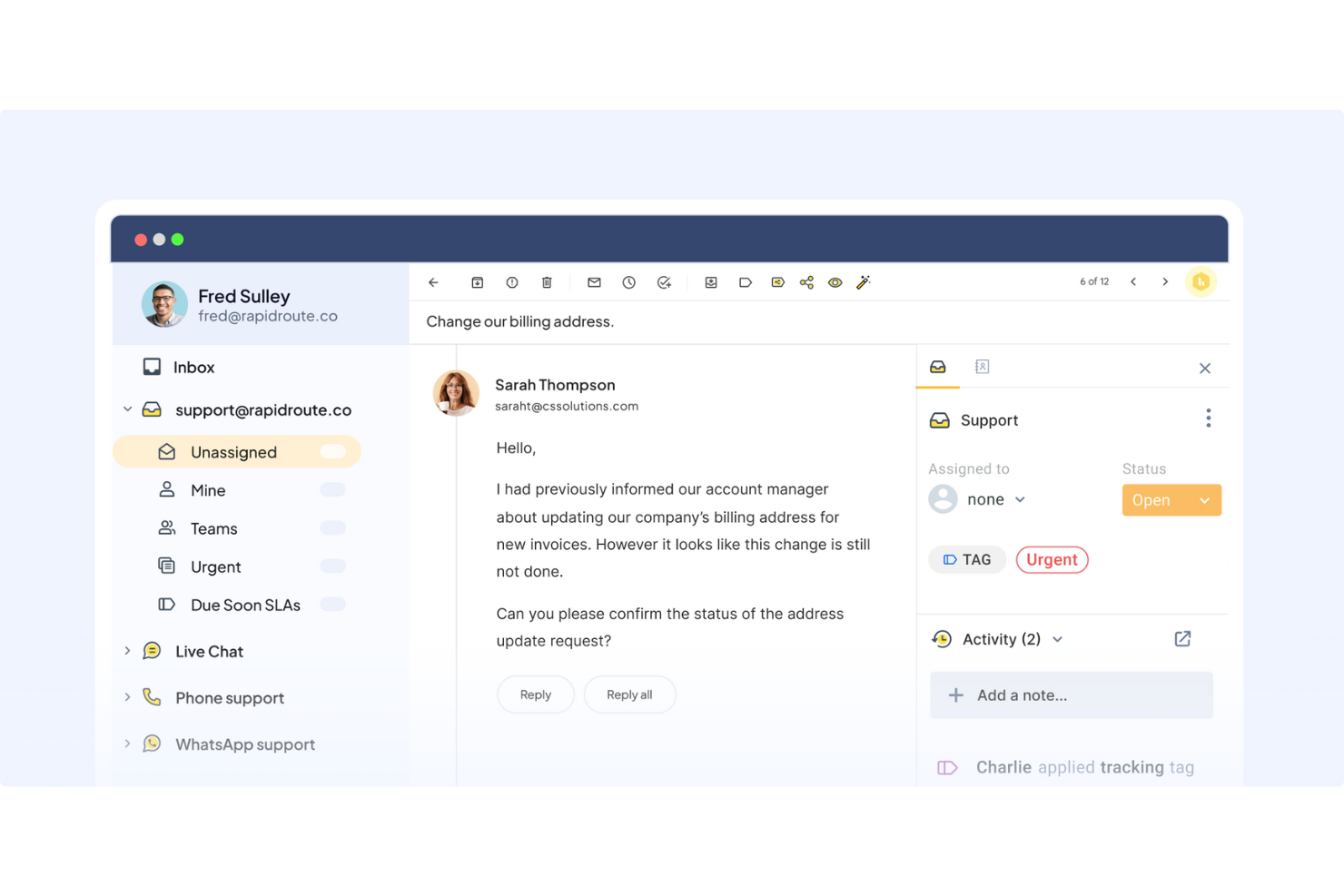
With Hiver’s omnichannel inbox, you can manage emails, chats, WhatsApp, voice, and portal messages all in one view so your team doesn’t have to switch tools when support volume spikes. With HelpDesk’s ticketing system and flexible automation rules, you can assign, prioritize, and track support cases systematically, which works well if you want clear workflows and SLA-driven resolution.
| Hiver | HelpDesk | |
|---|---|---|
| API | ||
| Analytics | ||
| Batch Permissions & Access | ||
| CRM Integration | ||
| Call Integration | ||
| Chat | ||
| Contact Management | ||
| Contact Sharing | ||
| Customer Management | ||
| Customer Service | ||
| Dashboard | ||
| Data Export | ||
| Data Import | ||
| Data Visualization | ||
| Email Integration | ||
| Escalation Management | ||
| External Integrations | ||
| Instant Chat Integration | ||
| Knowledge Base | ||
| Lead Management | ||
| Lead Scoring | ||
| Multi-User | ||
| Notifications | ||
| Real-time Alerts | ||
| Scheduling | ||
| Self-service Portal | ||
| Social Media Integration | ||
| Support Forum | ||
| Third-Party Plugins/Add-Ons | ||
| Ticket Management | ||
| Workflow Management |
Hiver vs. HelpDesk Integrations
| Integration | Hiver | HelpDesk |
| Salesforce | ✅ | ✅ |
| HubSpot | ✅ | ✅ |
| Shopify | ✅ | ✅ |
| Netsuite | ✅ | ❌ |
| Zapier | ✅ | ✅ |
| Asana | ✅ | ❌ |
| Jira | ✅ | ✅ |
| Pipedrive | ✅ | ❌ |
| Aircall | ✅ | ❌ |
| Slack | ✅ | ✅ |
| API | ✅ | ✅ |
Hiver and HelpDesk both integrate with popular CRMs, ecommerce tools, communication systems, and workflow apps, but Hiver generally offers broader coverage in operational and voice-focused tools. Depending on your tech stack, either tool can slot into your daily workflow, but the range and depth of integrations may matter if your team relies heavily on external systems.
Hiver vs. HelpDesk Security, Compliance & Reliability
| Factor | Hiver | HelpDesk |
| Data Encryption | Uses TLS/SSL (128-bit and strong encryption standards) and secure AWS hosting. | Uses 256-bit SSL secure connection and secure message storage. |
| Compliance Standards | ISO 27001, SOC 2 Type II, GDPR, CCPA compliance. | GDPR compliance, Privacy Shield certification, role-based access control. |
| Access Control & Roles | Offers custom roles, SSO options, and strict access policies. | Provides role-based access control, admin/agent/viewer roles, and audit logs. |
| Data Logging & Audit | Logs access, monitors production servers, supports audits and secure storage. | Offers audit log of user activity and message history tracking. |
When it comes to security and compliance, both tools take protection seriously. If security is a top priority, I recommend you compare both tools’ compliance documentation and access controls carefully to ensure they match your data policies and regulatory requirements.
Hiver vs. HelpDesk Ease of Use
| Factor | Hiver | HelpDesk |
| User Interface | Modern, intuitive UI that helps teams move quickly with minimal clutter. | Ticket-centric UI that’s clear and organized — ideal for structured workflows. |
| Onboarding Speed | Easy to set up; channels can be connected in minutes; AI features optional and gradual. | Setup is straightforward but may need configuration of automation rules and workflows. |
| Workflow Clarity | Good for teams handling mixed channels and conversational support. | Suits teams needing clear ticket ownership, priorities, and tracking across cases. |
| Automation Complexity | Supports rule-based automation and AI-powered tagging and summaries. | Offers rich automation rules, macros, tagging, custom fields, and templating. |
Hiver's modern UI lowers friction and helps your team adapt fast, which is great if you want quick adoption and informal support workflows. HelpDesk feels more structured and formal, which helps if your support volume is high and you need strict ticket routing, auditing, and reporting.
Hiver vs HelpDesk: Pros & Cons
Hiver
- Hiver AI reduces manual effort by drafting responses, auto-tagging conversations, and summarizing threads in seconds
- You deliver human-like, personalized responses without switching tabs or sounding robotic.
- Your team stays aligned with shared drafts, notes, collision alerts, and clear ownership.
- No advanced help desk forecasting, capacity planning, or predictive SLA breach modeling.
- Complex enterprise workflows may require more customization than Hiver currently offers.
- Teams with support channels outside of chat, email, and call (like social channels), may find the platform lacks features.
HelpDesk
- HelpDesk offers a user-friendly interface that makes it easy for your team to navigate and manage tasks.
- It provides robust customer support, ensuring your team gets quick assistance when needed.
- HelpDesk's customizable features allow your team to tailor the software to fit specific workflow needs.
- Some users find the initial setup process requires a bit more time and effort.
- The reporting features may not be as advanced as some other help desk software options.
- Scalability can be an issue for larger organizations with complex needs.
Best Use Cases for Hiver and HelpDesk
Hiver
- Small Support Teams The interface is simple enough that your team can start resolving issues within hours.
- E-Commerce Businesses You can access customer and order context quickly, making it easier to handle common inquiries.
- IT Help Desks SLA tracking, automations, and routing help you manage internal requests smoothly.
- Logistics & Operations Shared inboxes and clear workloads help you stay organized across high message volumes.
- Travel & Hospitality Natural, friendly replies help maintain strong relationships with customers and travelers.
- AI-Driven Teams AI Copilot removes manual effort so your team can focus on higher-value tasks.
HelpDesk
- Remote Work Teams HelpDesk’s cloud-based platform allows your team to coordinate and manage support tasks from anywhere, keeping operations smooth.
- Education Institutions Your administrative staff can streamline communication with students and parents using HelpDesk’s organized support system.
- Small Business Owners HelpDesk offers a customizable platform that fits your specific workflow needs, making it easy to manage customer interactions.
- IT Support Departments With HelpDesk, your team can effectively prioritize and resolve technical issues, enhancing overall productivity.
- Healthcare Customer Service Your team can efficiently handle sensitive patient inquiries, thanks to HelpDesk’s secure and organized ticketing system.
- Retail Support Teams HelpDesk helps your team manage high volumes of customer inquiries with ease, ensuring quick response times.
Who Should Use Hiver, and Who Should Use HelpDesk?
Hiver is a great fit if you run a small to mid-size support team, you want quick setup, your support involves a lot of email, chat, or mixed-channel conversations, and you value friendly, human-like responses assisted by AI. On the other hand, I think HelpDesk makes more sense if your team handles high ticket volumes, needs formal ticket workflows, detailed automation, and structured case tracking — especially in organizations where SLA, prioritization, and auditability matter.
Differences Between Hiver and HelpDesk
| Hiver | HelpDesk | |
|---|---|---|
| Ease of Use | Very easy for teams to set up with minimal context switching and a familiar interface. | May have steeper setup depending on workflows, but built for ticket-based support and scale. |
| Reporting & Analytics | Hiver provides dashboard-based insights into performance and SLAs | HelpDesk offers detailed reports, exports, and weekly summaries geared toward data-driven teams. |
| Ticketing Approach | Supports basic ticketing-style workflows (emails as tasks), but optimized around a centralized inbox rather than heavy ticket-tracking. | More robust ticket-based system: tickets from many channels, with full tracking, assignment, prioritization, and reporting capabilities. |
| User Interface | Modern and intuitive, helping teams move fast. | Ticket-based, formal help desk layout. |
| Workflows | Flexible, conversational, suitable for dynamic support. | Rigorous, structured, good for high-volume or compliance-sensitive environments. |
| Visit HiverOpens new window | Read HelpDesk ReviewOpens new window |
Similarities Between Hiver and HelpDesk
| Automation | Both leverage automation and AI to speed up ticket handling, tagging, summarizing, and response drafting to reduce manual work. |
|---|---|
| Collaboration | Both offer team workflow features: shared views or inboxes, assignment, team roles, and shared ticket handling to prevent overlaps. |
| Multichannel Support | Both platforms let you handle messages from email, chat, e-commerce, and other channels — giving you flexibility in how customers reach out. |
| Scalability | Both tools offer tiered plans or user-based pricing so you can scale as your team or ticket volume grows. |
| Security | Both commit to data encryption, role-based access, and compliance standards suitable for businesses concerned with privacy and data safety. |
| Visit HiverOpens new window Read HelpDesk ReviewOpens new window | |