

Atlassian Confluence Review 2026: Pros, Cons, Features, and Pricing


Atlassian Confluence is a team collaboration tool designed to centralize documentation, project planning, and knowledge sharing for technical teams. For IT specialists managing complex systems and cross-functional projects, it offers structured spaces, granular permissions, and deep integration with other Atlassian products. This Atlassian Confluence review covers features, use cases, pros and cons, and pricing—helping you decide if its approach to collaboration aligns with your team’s needs for reliability, security, and scalability.
Confluence Evaluation Summary

- From $5.42/user/month
- Free plan available
Why Trust Our Software Reviews
Confluence Overview
When judging Atlassian Confluence against other team collaboration tools, its structured documentation, granular permissions, and deep integrations set it apart for technical teams. The interface can feel dense, and onboarding may require extra guidance, but its flexible page templates and strong support resources help teams organize complex projects. Pricing is competitive for larger organizations, though smaller teams may find it less cost-effective.
If you’re selecting a solution for environments with layered permissions, audit trails, and integration needs, Confluence is a strong contender—especially for IT, DevOps, or project-heavy teams needing centralized, searchable knowledge.
pros
-
It boosts your team's productivity by keeping everyone on the same page.
-
The intuitive interface helps your team work together seamlessly.
-
You can easily organize and share your team's knowledge in one place.
cons
-
It can be challenging to manage permissions for different users.
-
Your team may need time to adjust to the interface if they're used to other tools.
-
You might find the search functionality less effective for large databases.
-

Freshservice
Visit WebsiteThis is an aggregated rating for this tool including ratings from Crozdesk users and ratings from other sites.4.6 -
Deel IT
Visit Website -
Rippling IT
Visit WebsiteThis is an aggregated rating for this tool including ratings from Crozdesk users and ratings from other sites.4.8



Our Review Methodology
How We Test & Score Tools
We’ve spent years building, refining, and improving our software testing and scoring system. The rubric is designed to capture the nuances of software selection and what makes a tool effective, focusing on critical aspects of the decision-making process.
Below, you can see exactly how our testing and scoring works across seven criteria. It allows us to provide an unbiased evaluation of the software based on core functionality, standout features, ease of use, onboarding, customer support, integrations, customer reviews, and value for money.
Core Functionality (25% of final scoring)
The starting point of our evaluation is always the core functionality of the tool. Does it have the basic features and functions that a user would expect to see? Are any of those core features locked to higher-tiered pricing plans? At its core, we expect a tool to stand up against the baseline capabilities of its competitors.
Standout Features (25% of final scoring)
Next, we evaluate uncommon standout features that go above and beyond the core functionality typically found in tools of its kind. A high score reflects specialized or unique features that make the product faster, more efficient, or offer additional value to the user.
We also evaluate how easy it is to integrate with other tools typically found in the tech stack to expand the functionality and utility of the software. Tools offering plentiful native integrations, 3rd party connections, and API access to build custom integrations score best.
Ease of Use (10% of final scoring)
We consider how quick and easy it is to execute the tasks defined in the core functionality using the tool. High scoring software is well designed, intuitive to use, offers mobile apps, provides templates, and makes relatively complex tasks seem simple.
Onboarding (10% of final scoring)
We know how important rapid team adoption is for a new platform, so we evaluate how easy it is to learn and use a tool with minimal training. We evaluate how quickly a team member can get set up and start using the tool with no experience. High scoring solutions indicate little or no support is required.
Customer Support (10% of final scoring)
We review how quick and easy it is to get unstuck and find help by phone, live chat, or knowledge base. Tools and companies that provide real-time support score best, while chatbots score worst.
Customer Reviews (10% of final scoring)
Beyond our own testing and evaluation, we consider the net promoter score from current and past customers. We review their likelihood, given the option, to choose the tool again for the core functionality. A high scoring software reflects a high net promoter score from current or past customers.
Value for Money (10% of final scoring)
Lastly, in consideration of all the other criteria, we review the average price of entry level plans against the core features and consider the value of the other evaluation criteria. Software that delivers more, for less, will score higher.
Core Features
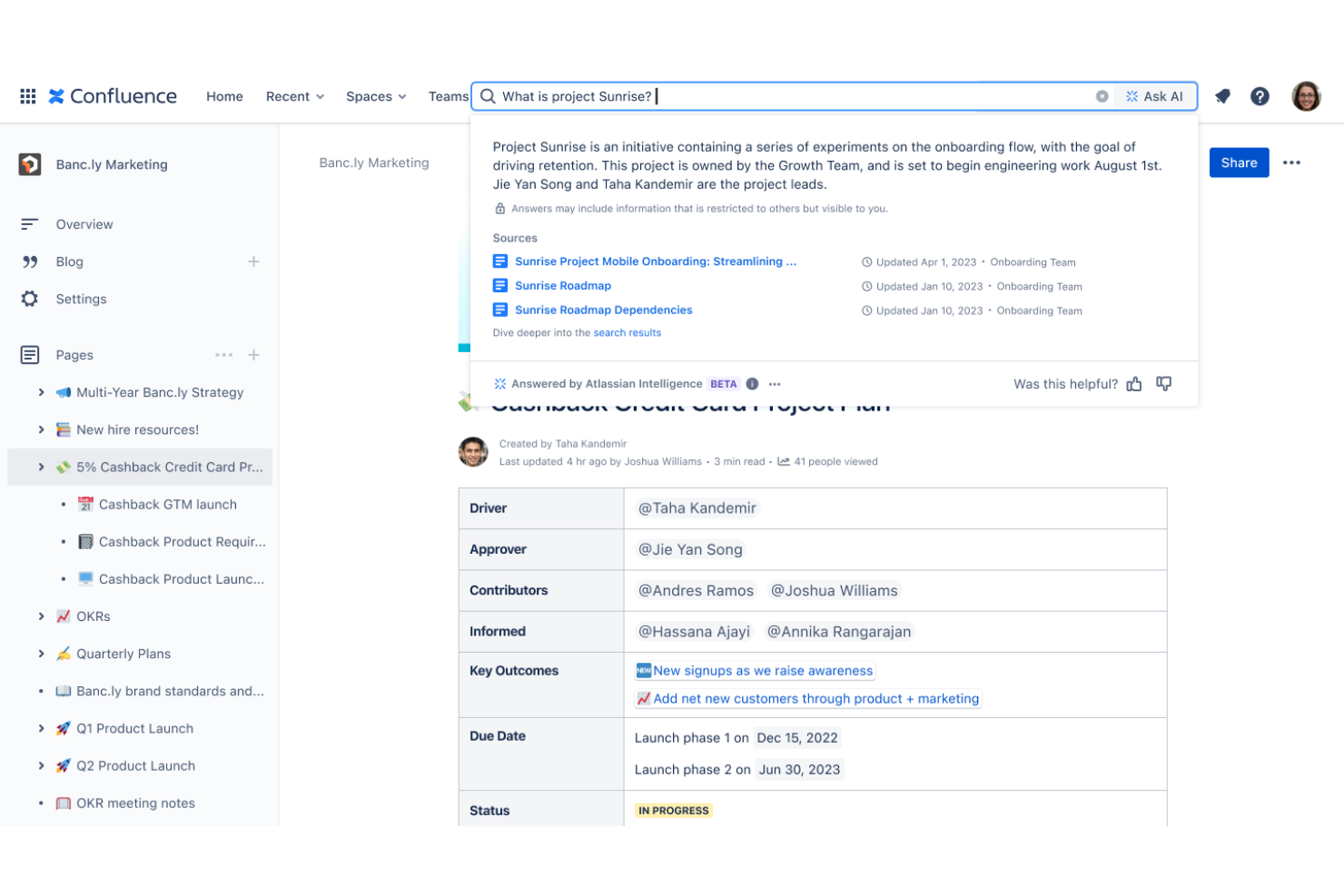
AI-Powered Search
Find relevant pages and answers instantly using context-aware, AI-driven search across all spaces.
Live Collaborative Editing
Multiple users can edit pages in real time, with changes tracked and merged automatically.
Granular Permissions
Control access at the space, page, or even section level for secure collaboration.
Ready-to-Use Templates
Choose from a wide range of templates for project plans, meeting notes, and technical documentation.
Whiteboards and Diagrams
Create visual diagrams and flowcharts directly within Confluence for brainstorming and planning.
Version History and Audit Trails
Track every change with detailed version history and restore previous versions as needed.
Ease of Use
Atlassian Confluence offers powerful organization and documentation tools, but its interface can feel dense and overwhelming, especially for new users. Many users report that navigating nested spaces and managing permissions requires extra onboarding and training. However, once teams adapt, features like templates, inline comments, and collaborative editing make structured knowledge sharing efficient. The platform is best suited for teams willing to invest time in setup and process standardization.

Integrations
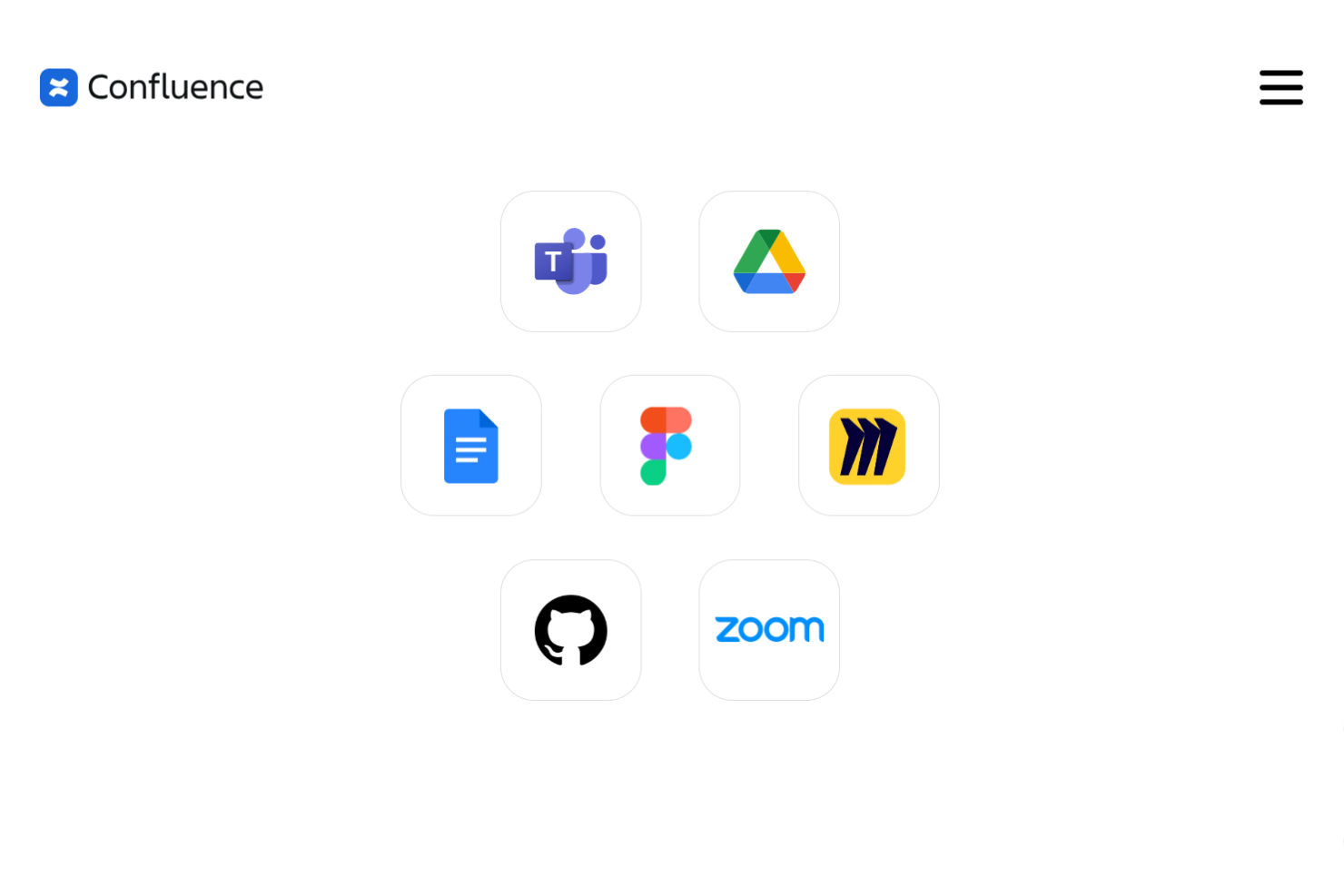
Atlassian Confluence integrates with Jira, Trello, Slack, Microsoft Teams, Google Drive, Dropbox, GitHub, Salesforce, Zoom, and Outlook, among others.
Confluence also offers a REST API and connects with third-party integration tools for custom workflows and automation.
Confluence Specs
- 2-Factor Authentication
- API
- Batch Permissions & Access
- Budgeting
- Calendar Management
- Contact Management
- Contact Sharing
- Customer Management
- Dashboard
- Data Export
- Data Import
- Data Visualization
- Email Integration
- Expense Tracking
- External Integrations
- Gantt Charts
- Google Apps Integration
- Multi-User
- Notifications
- Project Management
- Resource Management
- Scheduling
- Task Scheduling/Tracking
- Third-Party Plugins/Add-Ons
- Travel Management