

ER/Studio vs. Hackolade: Comparison & Expert Reviews For 2026
I break down ER/Studio vs. Hackolade head-to-head—strengths, weaknesses, and which tool fits your data modeling needs best in 2026.

We review tools independently, and commissions help fund our testing. See our transparency policy, our methodology, or suggest a tool.
If you’re working across multiple databases, APIs, or cloud platforms, choosing the right database design tool—or broader data modeling tool—gets complicated fast. ER/Studio and Hackolade both help you design and manage data, but they take very different approaches depending on whether you need structured governance or flexible modeling for modern data formats.
In this comparison, I’ll break down where each tool shines, along with their pros, cons, pricing, and ideal use cases, so you can confidently choose the right fit.
ER/Studio
4/5
- Free trial + free demo available
- From $2,687/user (billed annually)
Hackolade

0/5
- Free 14-day trial available
- From €175/month
Why Trust Our Software Recommendations
6,700+
Reviews
20
Industry experts
16+
Evaluation factors
14
Years
Our team has been testing and reviewing software since 2012. As tech leaders ourselves, we know how difficult—and important—it is to choose the right software.
For this guide, we evaluated tools using hands-on testing and independent research, scoring tools using our selection criteria.
Our reviews reflect our human editorial judgment, not a sales pitch.
Expert reviewers:
- Paulo Gardini MiguelTech Director
 Tim FisherVP of AI
 Gabriel RosasTech Lead & Software Architect
 Christhian GruhnTech Lead & Platform Architect

| ER/Studio | Hackolade | |
|---|---|---|
| Free Trial | Free trial + free demo available | Free 14-day trial available |
| Pricing | From $2,687/user (billed annually) | From €175/month |
ER/Studio vs. Hackolade Pricing & Hidden Costs
ER/Studio uses a tiered subscription model built around its ER/Studio Data Architect tool, with costs increasing as you add collaboration, governance features, and components like Team Server. Hackolade offers more transparent seat-based pricing through Hackolade Studio, with options for individuals and teams, but advanced capabilities—like Git integration, CLI automation, and certain governance integrations—are often limited to higher tiers or add-ons.
To pick the right vendor, look beyond the sticker price. List your must-have features, consider how your team plans to grow, and check whether you’ll need premium support, additional integrations, or expanded collaboration over time. I’d recommend speaking directly with both sales teams about your roadmap and expected usage to fully understand total costs before you commit.
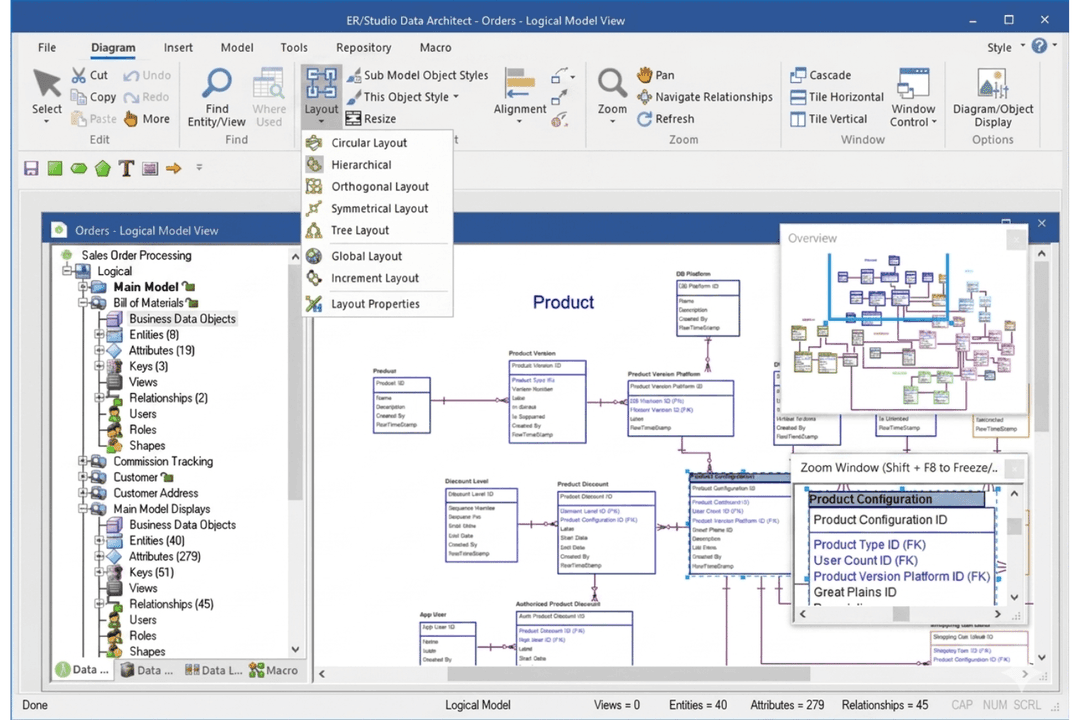
Overall, ER/Studio and Hackolade both support visual data modeling, schema design, and strong data visualization, along with core workflows like reverse engineering and forward engineering. You’ll also find version control capabilities, model comparison, and documentation features in both tools, making them solid options for teams working with complex data structures across multiple systems.
ER/Studio stands out with enterprise-grade metadata management, business glossary integration, and advanced lineage and impact analysis. Hackolade, on the other hand, excels in modeling modern data formats, with strong support for NoSQL, APIs, and nested JSON structures, along with Git-native collaboration that fits naturally into developer workflows.
| ER/Studio | Hackolade | |
|---|---|---|
| 2-Factor Authentication | No | No |
| Analytics | No | No |
| API | Yes | No |
| Dashboard | Yes | Yes |
| Data Export | Yes | Yes |
| Data Import | Yes | Yes |
| Data Visualization | Yes | Yes |
| External Integrations | Yes | Yes |
| Multi-User | Yes | Yes |
| Notifications | No | No |
| SEO | No | No |
| Integration | ER/Studio | Hackolade |
| Microsoft SQL Server | ✅ | ✅ |
| Oracle Database | ✅ | ✅ |
| IBM Db2 | ✅ | ✅ |
| PostgreSQL | ✅ | ✅ |
| Snowflake | ✅ | ✅ |
| MySQL | ✅ | ✅ |
| MongoDB | ✅ | ✅ |
| Collibra | ✅ | ✅ |
| Microsoft Purview | ✅ | ❌ |
| GitHub/GitLab/Bitbucket | ✅ | ✅ |
| Jira | ✅ | ✅ |
| Okta/Entra ID | ✅ | ❌ |
| API | ✅ | ❌ (CLI-based, limited API) |
| Zapier | ❌ | ❌ |
ER/Studio and Hackolade overlap on many major database platforms, including both relational database systems and cloud data warehouses, but they diverge in how they approach integrations. ER/Studio leans more heavily into enterprise ecosystems, with strong support for governance platforms like Microsoft Purview and identity providers like Okta and Entra ID.
It’s also worth noting that ER/Studio offers a more traditional REST API for extensibility, while Hackolade relies more on CLI-based automation and integration with external tools. Neither platform supports Zapier-style plug-and-play automation, so integrations tend to be more technical and workflow-driven, often requiring teams to streamline processes through scripting or DevOps pipelines.
| Factor | ER/Studio | Hackolade |
| Data Encryption | Supports secure data handling through enterprise-grade deployment and access control practices. | Encrypts sensitive data at rest and relies on customer-managed storage and security controls. |
| Audit Trails | Detailed lineage, change tracking, and audit capabilities for governance workflows. | Basic change tracking; auditability depends on Git history and storage systems. |
| User Access | Role-based access control with support for enterprise identity providers (SSO). | Access control handled through customer-managed systems (e.g., file storage, Git, IAM). |
| Regulatory Compliance | Supports SOC 2, ISO 27001, and GDPR compliance initiatives through governance, lineage, and policy management capabilities. | Emphasizes data privacy by keeping models within customer-controlled environments. |
| Availability | Supports enterprise deployment models with backup and recovery options. | No vendor-hosted infrastructure; reliability depends on local environment and storage setup. |
ER/Studio is designed for organizations that require structured governance, centralized oversight, and support for enterprise compliance initiatives. Its alignment with standards and frameworks such as SOC 2, ISO 27001, GDPR, and encryption best practices makes it well-suited for regulated environments where auditability and governance are critical. Hackolade takes a different approach, emphasizing privacy and control by keeping models within customer-managed environments and relying on existing infrastructure for security and access management.
In practice, ER/Studio is a stronger fit for enterprises prioritizing formal governance and compliance alignment, while Hackolade appeals to teams that prefer decentralized, security-first architectures with direct control over their data and infrastructure.
| Factor | ER/Studio | Hackolade |
| User Interface | Feature-rich and structured, but can feel overwhelming to new users. | Clean, minimalist interface designed for clarity, though more complex at scale. |
| Onboarding | Steeper learning curve, especially for advanced modeling and governance features. | Faster initial onboarding, with guided tutorials and eLearning resources. |
| Setup Process | Setup can be more involved, especially with repositories and integrations. | Flexible setup with desktop or browser-based use, generally quicker to start. |
| Documentation | Extensive and detailed, but can be dense for new users. | Well-structured documentation, tutorials, and certified eLearning paths. |
| Customer Support | Tiered enterprise support with premium options and SLAs. | Primarily documentation, eLearning, and email-based support with defined SLAs. |
ER/Studio prioritizes depth and structure, which makes it more powerful but also harder to learn—especially if you’re new to formal data modeling or governance. Hackolade is easier to pick up initially, with a more streamlined interface and onboarding experience, though it still requires time to master for complex, multi-system use cases. Overall, ER/Studio is better suited for experienced teams that need control and standardization, while Hackolade is a strong choice if you want faster adoption and a more flexible modeling experience without needing real-time collaboration features.
ER/Studio
- Models and standardizes data across complex, multi-platform environments.
- Connects business definitions, metadata, and models for full alignment.
- Advanced change management with compare, merge, and lineage visibility.
- Steeper learning curve for teams new to data modeling.
- Requires workflow integration to realize full platform value.
- Not a standalone data catalog or governance solution.
Hackolade
- Polyglot modeling across SQL, NoSQL, APIs, and formats.
- Git-native collaboration supports branching, reviews, and CI workflows.
- Supports complex JSON and nested data structures.
- Relational database support is less feature-rich than others.
- Not a traditional SaaS with built-in collaboration hosting.
- Licensing model is complex with multiple seat types.
ER/Studio
- Enterprise Data Architecture TeamsTeams managing multiple databases, platforms, and systems benefit from unified modeling, version control, and cross-environment consistency.
- Data Governance and Stewardship InitiativesOrganizations standardizing definitions, enforcing naming conventions, and aligning business and technical metadata gain strong value from ER/Studio.
- Regulated and Compliance-Driven EnvironmentsIndustries like finance, healthcare, and government benefit from lineage visibility, auditability, and consistent data definitions.
- Multi-Platform and Hybrid Cloud EnvironmentsTeams working across cloud, on-prem, and mixed data systems can model and manage everything in one consistent framework.
- Data Engineering and Database Development TeamsTeams responsible for schema design, change management, and database evolution benefit from compare/merge, reverse engineering, and lifecycle control.
- Organizations Building AI-Ready or Analytics-Ready Data FoundationsTeams that need consistent, well-defined data structures to support analytics and AI benefit from ER/Studio’s semantic and metadata alignment.
Hackolade
- Polyglot Data Modeling EnvironmentsOrganizations managing multiple databases, APIs, and storage formats benefit from a single modeling layer across SQL, NoSQL, and beyond.
- JSON and Semi-Structured Schema DesignTeams working with nested documents, arrays, and denormalized data get strong visual tools tailored to modern data structures.
- Data Engineering and Pipeline EvolutionReverse engineering and schema comparison help teams keep models aligned with rapidly changing data pipelines.
- Git-Based Collaboration and Metadata-as-CodeTeams using Git workflows can version, review, and manage schema changes alongside application code.
- Enterprise Data Architecture and GovernanceCentralized modeling, naming standards, and documentation support consistency across large, distributed systems.
- API and Schema-Driven DevelopmentModel-driven generation of OpenAPI and schema artifacts helps teams align backend data models with APIs.
Who Should Use ER/Studio, and Who Should Use Hackolade?
If you’re managing a complex data environment with multiple systems, strict governance requirements, or a need to align business definitions with technical models—especially at the enterprise level—I’d recommend ER/Studio. It’s built for teams that care about consistency, lifecycle control, and long-term data architecture, not just designing schemas. You’ll benefit most if you already have data modeling or governance practices in place and need a platform to standardize and scale them across teams.
On the other hand, if your work revolves around modern data formats like JSON, APIs, or NoSQL databases, I’d lean toward Hackolade. It’s a strong fit for developer-driven data teams, even within enterprise environments, that want flexibility, Git-based workflows, and support for polyglot systems without the overhead of centralized data governance tooling. In my experience, it’s ideal for teams that prioritize speed, adaptability, and building data pipelines across diverse technologies.
| ER/Studio | Hackolade | |
|---|---|---|
| Automation Tools | ER/Studio Built-in lifecycle tools for compare, merge, lineage, and standards with strong functionality for enterprise workflows. | Hackolade Strong CLI and DevOps automation for schema workflows and CI/CD. |
| Collaboration Model | ER/Studio Centralized repository and Team Server for shared access. | Hackolade Git-native collaboration with branching, pull requests, and versioning. |
| Data Architecture Approach | ER/Studio Focus on standardization, governance, and lifecycle management with high scalability across teams and systems. | Hackolade Focus on flexible schema design across modern, evolving data systems. |
| Data Model Support | ER/Studio Strong across relational, cloud, and structured enterprise systems. | Hackolade Polyglot modeling across SQL, NoSQL, APIs, and semi-structured formats. |
| Governance Features | ER/Studio Enterprise-grade metadata, lineage, glossary, and governance workflows. | Hackolade Limited governance; relies more on integrations and external systems. |
| Metadata Management | ER/Studio Centralized metadata, glossary, and business-technical alignment. | Hackolade Metadata handled within models; less emphasis on business context. |
| Complex Data Environments | Both are designed for teams working with complex, multi-system data architectures. |
|---|---|
| Data Lineage & Impact Awareness | Both provide visibility into relationships and dependencies to support change management. |
| Multi-Platform Support | Both support modeling across multiple database types and modern data platforms. |
| Version Control | Both offer version tracking and model comparison, though implemented differently (repository vs Git). |
| Visual Data Modeling | Both provide advanced visual modeling environments for designing and managing data schemas. |