

Security compliance software helps your team manage regulatory requirements by automating evidence collection, monitoring controls, and keeping audit documentation ready. If you’re tired of tracking dozens of frameworks and staying ahead of shifting standards, you’re in the right place. This guide will help you compare the top options built for fast-changing IT environments so you can find a tool that fits your compliance needs, team workflows, and business scale.
Why Trust Our Software Recommendations
6,700+
Reviews
20
Industry experts
16+
Evaluation factors
14
Years
Our team has been testing and reviewing software since 2012. As tech leaders ourselves, we know how difficult—and important—it is to choose the right software.
For this guide, we evaluated tools using hands-on testing and independent research, scoring tools using our selection criteria.
Our reviews reflect our human editorial judgment, not a sales pitch.
Expert reviewers:
- Paulo Gardini MiguelTech Director
 Tim FisherVP of AI
 Gabriel RosasTech Lead & Software Architect
 Christhian GruhnTech Lead & Platform Architect

Security Compliance Software Summary
This comparison chart summarizes pricing details for my top security compliance software selections to help you find the best software for your budget and business needs.
| Tool | Best For | Trial Info | Price | ||
|---|---|---|---|---|---|
| 1 | Best for integrated tech risk management | Free demo available | Pricing upon request | Website | |
| 2 | Best for unified audit and evidence portals | Free demo available | Pricing upon request | Website | |
| 3 | Best for configurable workflow automation | Free demo available | Pricing upon request | Website | |
| 4 | Best for cloud-native compliance automation | Free demo available | Pricing upon request | Website | |
| 5 | Best for scaling compliance programs | Free demo available | Pricing upon request | Website | |
| 6 | Best for multi-framework readiness | Free demo + free trial available | Pricing upon request | Website | |
| 7 | Best for customizable risk registers | Free demo available | Pricing upon request | Website | |
| 8 | Best for simplified audit preparation | Free demo available | Pricing upon request | Website | |
| 9 | Best for fast, automated evidence collection | Free demo available | Pricing upon request | Website | |
| 10 | Best for real-time control monitoring | Free demo available | Pricing upon request | Website |


Security Compliance Software Reviews
Below are my detailed summaries of the best security compliance software that made it onto my shortlist. My reviews offer a detailed look at the features, best use cases, and integrations of each platform to help you find the best one for you.
 Best for integrated tech risk management
- Free demo available
- Pricing upon request
Visit WebsiteCustomer Rating:4.4/5
OneTrust offers a compliance initiative setup with inventory selection. OneTrust Tech Risk & Compliance is a GRC platform that centralizes compliance automation, control monitoring, risk assessment, and policy management across 55+ security frameworks including SOC 2, ISO 27001, HIPAA, and NIST.
Who Is OneTrust Best For?
OneTrust is a strong fit for enterprise security and GRC teams managing compliance across multiple frameworks, jurisdictions, and business units simultaneously.
Why I Picked OneTrust
OneTrust earns its spot on my shortlist because of how tightly it connects asset inventory, risk scoring, and compliance controls in one place. I particularly like the shared evidence framework, which lets my team collect evidence once and automatically map it across 50+ frameworks simultaneously. The automated risk mapping ties directly to the asset inventory, so when a new system is onboarded, risk exposure updates without any manual intervention.
OneTrust Key Features
- Policy management workflows: Create, update, and track policy versions with built-in approval and attestation workflows.
- Customizable risk register: Log, categorize, and score information security risks in a structured register.
- Auditor collaboration portal: Grant auditors secure, read-only access to compliance evidence and request tracking.
- Pre-built framework library: Access pre-mapped control libraries for SOC 2, ISO 27001, HIPAA, GDPR, NIST, and more.
OneTrust Integrations
OneTrust offers native integrations with AWS, Azure, Google Cloud Platform, ServiceNow, Jira, Okta, Workday, Salesforce, Slack, GitHub, and Microsoft 365. An API is available for custom integrations.
Pros and Cons
Pros:
- Built-in vendor risk assessment questionnaire automation
- Automated risk scoring tied to asset inventory
- Cross-maps controls across 55+ frameworks simultaneously
Cons:
- API throughput is subject to module-level limits
- Broad governance scope adds configuration overhead
Learn more about OneTrust: Best for unified audit and evidence portals
- Free demo available
- Pricing upon request

Thoropass offers a unified compliance dashboard with framework health tracking. Thoropass is a compliance automation platform that combines automated evidence collection, continuous control monitoring, policy management, and in-platform auditor collaboration across 30+ security frameworks including SOC 2, ISO 27001, HIPAA, and PCI DSS.
Who Is Thoropass Best For?
IT compliance managers and GRC teams at growth-stage companies pursuing their first SOC 2 or ISO 27001 certification will get the most from Thoropass's bundled software-plus-auditor model.
Why I Picked Thoropass
Thoropass earns its spot on my shortlist because the audit portal isn't bolted on as an afterthought: auditors operate inside the same platform where my team manages evidence. First Pass AI pre-screens submitted evidence before it reaches a human auditor, which cuts review cycles without sacrificing accuracy. Evidence requests and fulfillment happen in one place, so my team isn't emailing attachments back and forth with external auditors or reconciling two separate systems during crunch time before a report deadline.
Thoropass Key Features
- Multi-framework control mapping: Map a single control or policy across multiple compliance frameworks to reuse evidence and reduce duplicate work.
- Continuous control monitoring: Track the status of security controls in real time with automated alerts for drift and misconfigurations.
- Risk register module: Maintain a live inventory of risks, with scoring and tracking for remediation linked directly to your compliance workflows.
- Policy management toolkit: Use built-in policy templates, version control, and attestation workflows to align employees with compliance requirements.
Thoropass Integrations
Thoropass offers native integrations with AWS, Azure, Google Cloud Platform, Okta, GitHub, Jira, Slack, BambooHR, and Google Workspace.
Pros and Cons
Pros:
- Covers 30+ frameworks with cross-mapped controls
- AI pre-screens evidence before auditor review
- Auditors collaborate inside the platform directly
Cons:
- Onboarding takes longer for complex tech stacks
- Must use Thoropass partner auditors for reports
Learn more about Thoropass: Best for configurable workflow automation
- Free demo available
- Pricing upon request

LogicGate Risk Cloud centralizes enterprise risks with heat maps and mitigation tracking. LogicGate Risk Cloud is a no-code GRC platform that combines risk management, controls compliance, policy management, internal audit, and third-party risk into a single configurable environment built around automated workflows and a flexible graph database.
Who Is LogicGate Risk Cloud Best For?
It's a strong fit for enterprise GRC and compliance teams that need to manage multiple risk and audit programs across a complex organizational structure.
Why I Picked LogicGate Risk Cloud
I've included LogicGate Risk Cloud in my top picks because its no-code graph database lets my team build and modify compliance workflows without developer support. When a new framework drops, I can run an Automated Gap Analysis to visually map existing controls against new requirements and auto-generate corrective action plans via Spark AI. That level of configurability means my team isn't locked into rigid, predefined templates the way you are with most compliance tools.
LogicGate Risk Cloud Key Features
- Regulatory management application: Lets you manage and map controls to frameworks like SOC 2, ISO 27001, HIPAA, PCI DSS, and GDPR.
- Risk Cloud Quantify: Enables quantitative risk analysis using Monte Carlo simulations and the Open FAIR model.
- Internal audit workspace: Dedicated module for tracking audit requests, managing evidence, and collaborating with external auditors.
- Third-party risk management AI agent: Automates vendor risk assessment workflows and streamlines compliance checks for third-party relationships.
LogicGate Risk Cloud Integrations
LogicGate Risk Cloud offers native integrations with Salesforce, ServiceNow, Jira, Power BI, Workday, Slack, AWS, and Microsoft Teams, and it connects with Zapier. An API is available for custom integrations.
Pros and Cons
Pros:
- Open FAIR quantitative risk scoring built in
- Spark AI flags gaps against new frameworks
- Graph data model links controls across frameworks
Cons:
- Full deployments favor dedicated GRC administrators
- Advanced risk quantification costs extra
Learn more about LogicGate Risk Cloud: Best for cloud-native compliance automation
- Free demo available
- Pricing upon request

Scrut Automation centralizes compliance frameworks and risk monitoring in one dashboard. Scrut Automation is an AI-powered GRC platform that centralizes compliance automation, continuous control monitoring, risk management, and audit preparation across 60+ frameworks from a single interface.
Who Is Scrut Automation Best For?
Scrut Automation is a strong fit for fast-growing, cloud-native companies whose security and GRC teams need to hit compliance milestones without building out a large dedicated compliance function.
Why I Picked Scrut Automation
I picked Scrut Automation as one of the best because of how it handles continuous compliance across cloud-native environments. The agentic Evidence Collector pulls real-time data from AWS, GitHub, and Okta without my team manually chasing screenshots before every audit. On top of that, its Unified Control Framework means implementing one control automatically maps it across every applicable framework, which cuts a significant amount of duplicated work when my team is running SOC 2 and ISO 27001 side by side.
Scrut Automation Key Features
- Automated policy management: Offers a library of auditor-approved templates with version control and employee attestation workflows.
- Risk register with scoring: Tracks compliance and security risks, assigning quantitative and qualitative scores with remediation plans.
- Vendor risk assessment module: Manages third-party risk through automated security questionnaires and integrated vendor inventory.
- Auditor collaboration portal: Provides secure, scoped access for auditors to review evidence, track requests, and monitor audit progress.
Scrut Automation Integrations
Scrut Automation offers native integrations with AWS, Azure, Google Cloud Platform, Okta, GitHub, GitLab, Jira, Google Workspace, and Slack. An API is also available for custom integrations.
Pros and Cons
Pros:
- Dedicated customer success support during onboarding
- Single control maps across multiple frameworks automatically
- Automated evidence collection across 150+ integrations
Cons:
- Broad feature set may overwhelm smaller teams
- Custom frameworks add configuration overhead
Learn more about Scrut Automation:

Scytale centralizes compliance audits, controls, and risk tracking in one dashboard. Scytale is an AI-powered GRC platform that pairs compliance automation with embedded human expert advisory services, covering 80+ frameworks with automated evidence collection, continuous control monitoring, and risk management.
Who Is Scytale Best For?
Scytale fits startups and mid-market security teams pursuing multi-framework certification without a dedicated in-house compliance function.
Why I Picked Scytale
I picked Scytale as one of the best because of how well it handles multi-framework scaling without multiplying your team's workload. When my team adds a new framework like ISO 42001 on top of an existing SOC 2 program, Scytale's cross-mapping automatically surfaces which controls carry over. The Gap Remediator agent then prioritizes what still needs to close, so we're not manually triaging a spreadsheet every time we expand scope.
Scytale Key Features
- Policy management hub: Centralized library with templates, version history, and automated review cycles.
- Vendor risk management: Built-in workflows for assessing, tracking, and storing third-party vendor documentation.
- Auditor collaboration portal: Dedicated interface for secure evidence sharing, request tracking, and audit status updates.
- AI-powered questionnaire automation: Automatically answers security questionnaires using a knowledge base and confidence scoring.
Scytale Integrations
Scytale offers native integrations with AWS, Azure, Google Cloud Platform, Okta, Azure Active Directory, GitHub, GitLab, Jira, Google Workspace, and Slack. An API is available for custom integrations.
Pros and Cons
Pros:
- AI agents speed up gap analysis
- Dedicated compliance advisors included with subscription
- Covers 80+ frameworks with cross-mapped controls
Cons:
- Evidence automation depends on connected system coverage
- Multi-framework programs require careful initial mapping
Learn more about Scytale: Best for multi-framework readiness
- Free demo + free trial available
- Pricing upon request
Visit WebsiteCustomer Rating:4.8/5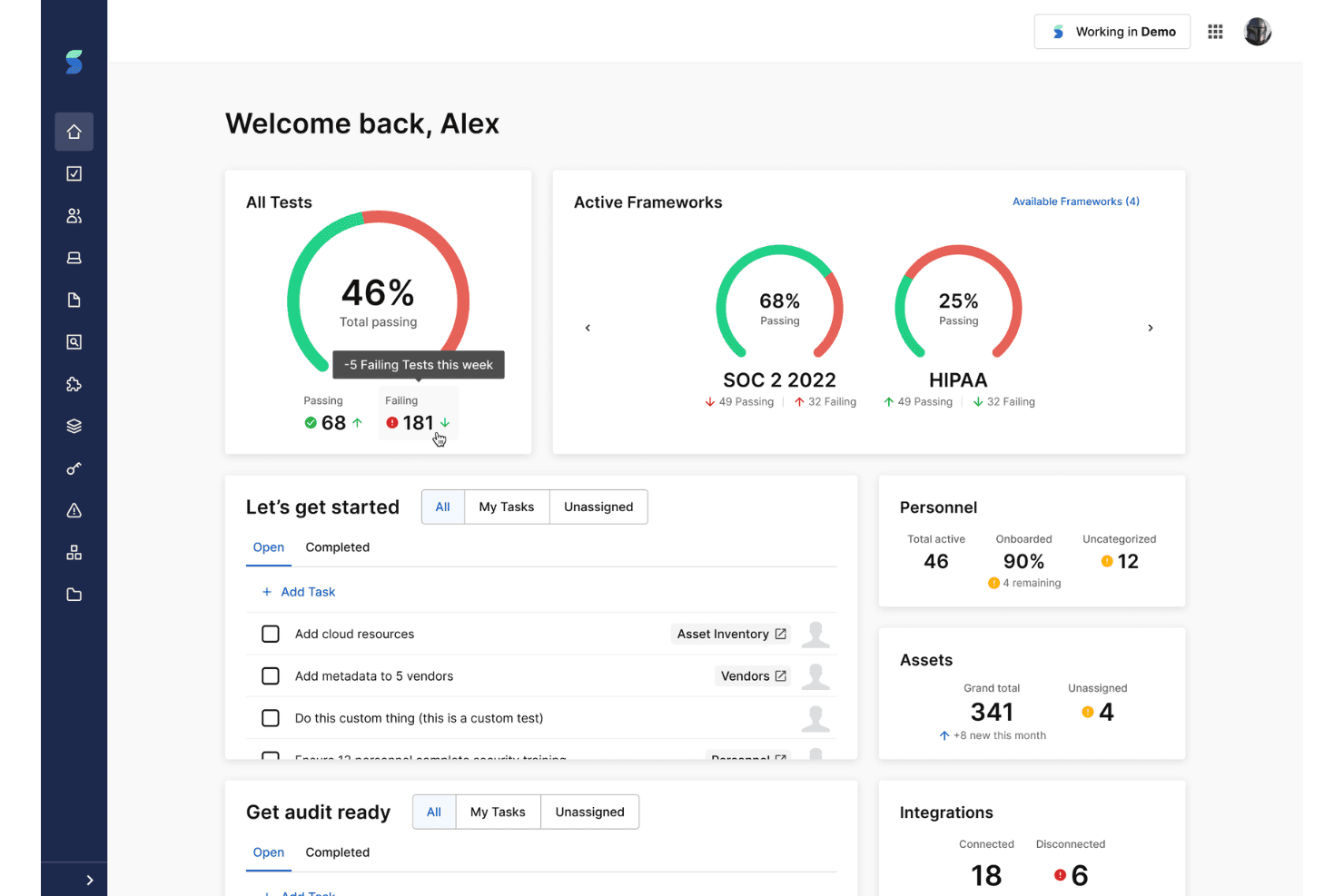
Secureframe tracks compliance readiness across multiple frameworks, with pass rates and audit preparation tasks in one dashboard. Secureframe is a security compliance platform that automates evidence collection, continuous control monitoring, risk management, and policy management across 35+ frameworks including SOC 2, ISO 27001, HIPAA, PCI DSS, and CMMC.
Who Is Secureframe Best For?
Secureframe is a strong fit for security and GRC teams at growth-stage tech companies pursuing multiple compliance certifications simultaneously.
Why I Picked Secureframe
Secureframe earns its spot on my shortlist because of how well it handles running SOC 2, ISO 27001, and CMMC simultaneously. The cross-framework control mapping means you're not duplicating work across certifications. I also like Comply AI for Policies, which generates policy language mapped across all active frameworks at once, rather than forcing you to maintain separate policy sets per program.
Secureframe Key Features
- Risk register and scoring: Catalogue security and compliance risks, assign quantitative and qualitative scores, and track remediation status in one dashboard.
- Auditor collaboration portal: Invite auditors to review evidence, track requests, and manage audit status without exporting sensitive files.
- Policy version control: Manage edits and track changes on policy documents with version history and attestation workflows tied to compliance needs.
- Vendor risk management module: Maintain an inventory of third-party vendors, conduct security assessments, and automate questionnaire distribution.
Secureframe Integrations
Secureframe offers native integrations with AWS, Azure, Google Cloud, Okta, GitHub, Jira, Slack, Google Workspace, Microsoft 365, and Salesforce. An API is available for custom integrations.
Pros and Cons
Pros:
- Real-time control monitoring flags drift instantly
- Comply AI generates policy language automatically
- Covers 35+ compliance frameworks with cross-mapping
Cons:
- Can overwhelm teams new to GRC
- Pricing scales steeply with added frameworks
Learn more about Secureframe: Best for customizable risk registers
- Free demo available
- Pricing upon request
Visit WebsiteCustomer Rating:4.6/5
Hyperproof's dashboard gives a unified view of compliance program health. Hyperproof is a GRC platform that combines compliance management, risk register workflows, policy management, and audit collaboration with cross-framework control mapping across 160+ pre-built frameworks.
Who Is Hyperproof Best For?
Hyperproof suits mid-market to enterprise GRC and security compliance teams managing multiple concurrent frameworks across complex, multi-entity organizations.
Why I Picked Hyperproof
I picked Hyperproof as one of the best because its risk register setup goes further than most GRC platforms I've used. You can run multiple registers simultaneously, each with its own customized scoring scales for likelihood, impact, and risk tolerance. I also like that you can add custom fields to each register, which then surface as filters on dashboards and reports, keeping your risk view organized across different divisions or entities.
Hyperproof Key Features
- Cross-framework control mapping: Map a single control to multiple compliance frameworks to reduce duplicated effort.
- Automated control testing: Set up recurring automated tests for controls with auto-escalation of failed checks.
- Policy management with attestation: Store, version, and distribute policies while tracking employee acknowledgments tied to compliance requirements.
- In-platform auditor workspace: Grant auditors dedicated access to evidence, request tracking, and audit dashboards without exporting files.
Hyperproof Integrations
Hyperproof offers native integrations with AWS, Azure, Okta, Jira, GitHub, and Slack. An API is available for custom integrations.
Pros and Cons
Pros:
- Dedicated auditor workspace reduces evidence export friction
- Runs multiple risk registers with custom scoring
- Supports 160+ pre-built compliance framework templates
Cons:
- Vendor risk workflows need more automation
- Dashboards offer limited tailoring
Learn more about Hyperproof: Best for simplified audit preparation
- Free demo available
- Pricing upon request
Visit WebsiteCustomer Rating:5/5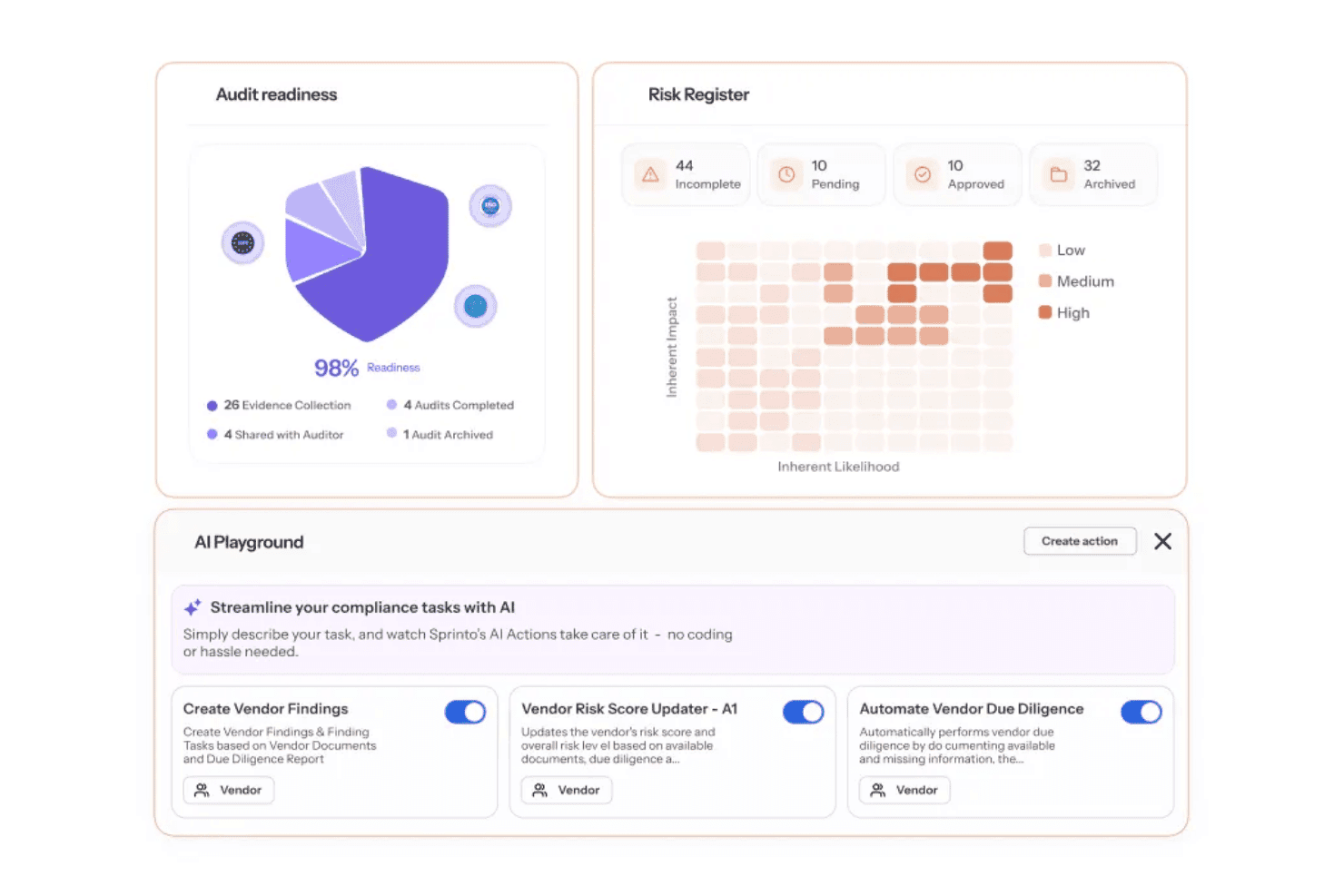
Sprinto centralizes audit readiness, risk tracking, and AI-driven vendor compliance. Sprinto is an autonomous compliance automation platform that continuously monitors security controls, automates evidence collection across 300+ integrations, and manages multi-framework GRC programs including SOC 2, ISO 27001, HIPAA, and PCI DSS.
Who Is Sprinto Best For?
Sprinto is a strong fit for startups and scaling companies working toward their first security certification and looking to get audit-ready without building a compliance program from scratch.
Why I Picked Sprinto
I've included Sprinto in my top picks because it bundles in-house lead auditors with your first certification audit, which is something I don't see from most compliance tools. When I'm preparing for a SOC 2 or ISO 27001 audit, Sprinto's Evidence gap analysis AI flags missing evidence before the auditor ever sees it. The Bring Your Own Auditor feature also lets me share evidence directly through the platform, keeping the back-and-forth contained and organized.
Sprinto Key Features
- Multi-framework cross-mapping: Map a single control to multiple compliance frameworks for streamlined evidence reuse.
- Vendor risk management module: Automate vendor inventory, tiering, and third-party due diligence workflows within your compliance program.
- AI-powered questionnaire response: Auto-respond to security questionnaires and RFPs using policy and evidence data.
- Public trust center: Share real-time compliance status and control details with external stakeholders through a dedicated trust portal.
Sprinto Integrations
Sprinto offers native integrations with AWS, Azure, Google Cloud Platform, Okta, GitHub, GitLab, Jira, Google Workspace, and Slack. An API is available for custom integrations.
Pros and Cons
Pros:
- Flags missing evidence before auditors review
- Continuous control monitoring with real-time alerts
- Bundles in-house auditors for certification audits
Cons:
- Multi-entity management requires Enterprise
- Nonstandard controls require extra configuration
Learn more about Sprinto: Best for fast, automated evidence collection
- Free demo available
- Pricing upon request
Visit WebsiteCustomer Rating:4.6/5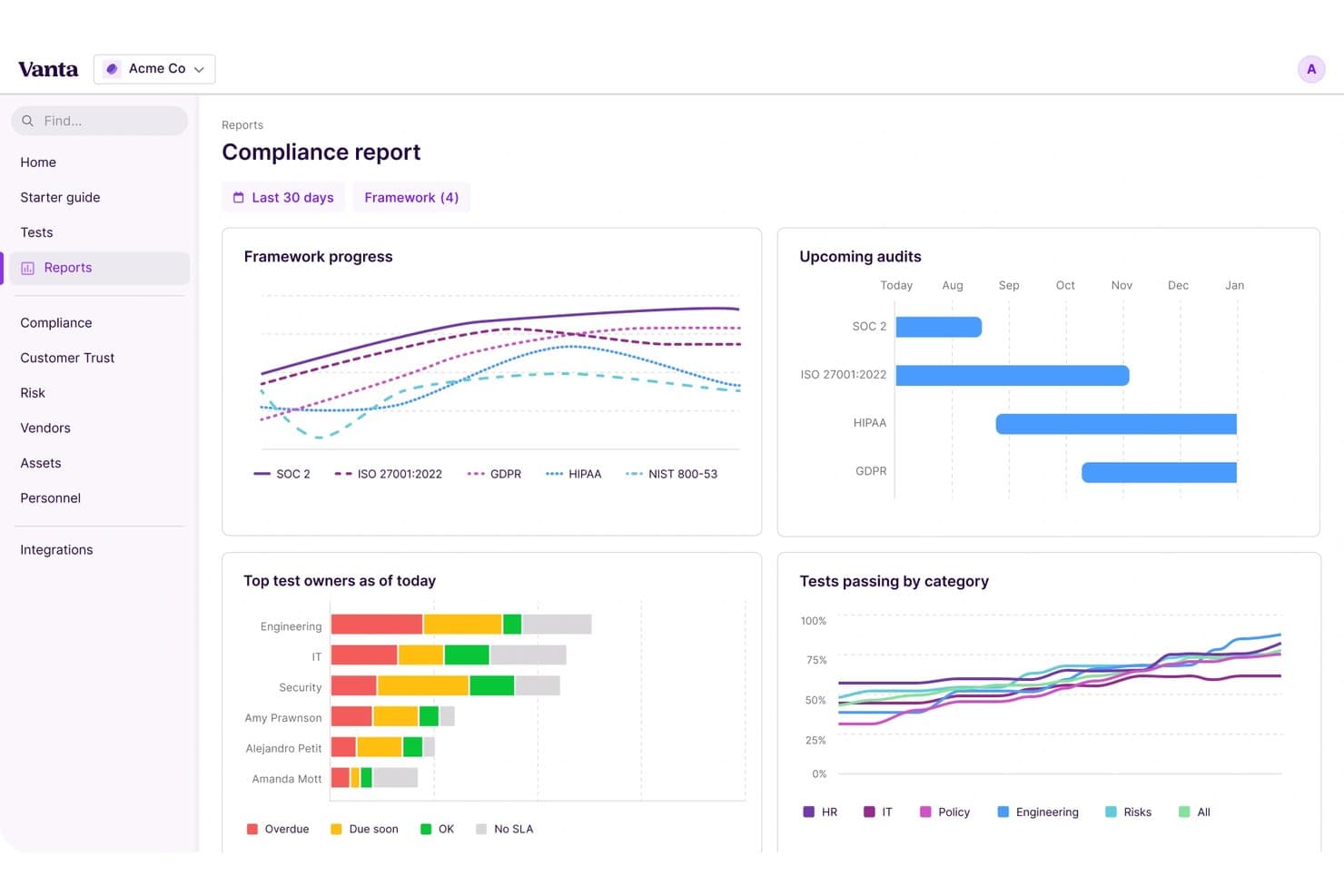
Vanta offers a compliance report dashboard with framework progress tracking. Vanta is an automated security compliance platform built around continuous control monitoring, AI-driven policy management, and evidence collection across 15+ frameworks including SOC 2, ISO 27001, HIPAA, and PCI DSS.
Who Is Vanta Best For?
Vanta is a strong fit for cloud-native startups and growth-stage tech companies working through their first SOC 2 or ISO 27001 audit.
Why I Picked Vanta
Vanta earns its spot on my shortlist because of how aggressively it automates evidence collection. I love that the platform runs 1,400+ pre-built tests hourly across connected systems, so evidence gaps surface before an auditor ever asks. The Vanta AI Agent goes a step further, running real-time evidence checks and flagging failed controls with remediation guidance automatically.
Vanta Key Features
- Multi-framework crosswalking: Map a single control to multiple compliance frameworks for more efficient evidence management.
- Custom risk register: Identify, score, and track remediation of risks with built-in qualitative and quantitative scoring options.
- Policy template library: Access pre-built, framework-specific policy templates with version control and employee attestation workflows.
- Trust Center: Create a public portal to share your real-time compliance status and documentation with prospects and partners.
Vanta Integrations
Vanta offers native integrations with AWS, Azure, Google Cloud Platform, Okta, OneLogin, GitHub, GitLab, Jira, Slack, and Google Workspace. An API is available for custom integrations.
Pros and Cons
Pros:
- Multi-framework crosswalking reduces duplicate evidence collection
- AI flags failed controls automatically
- 1,400+ automated control tests run hourly
Cons:
- Limited custom framework configuration for complex enterprises
- Some controls still require manual evidence uploads

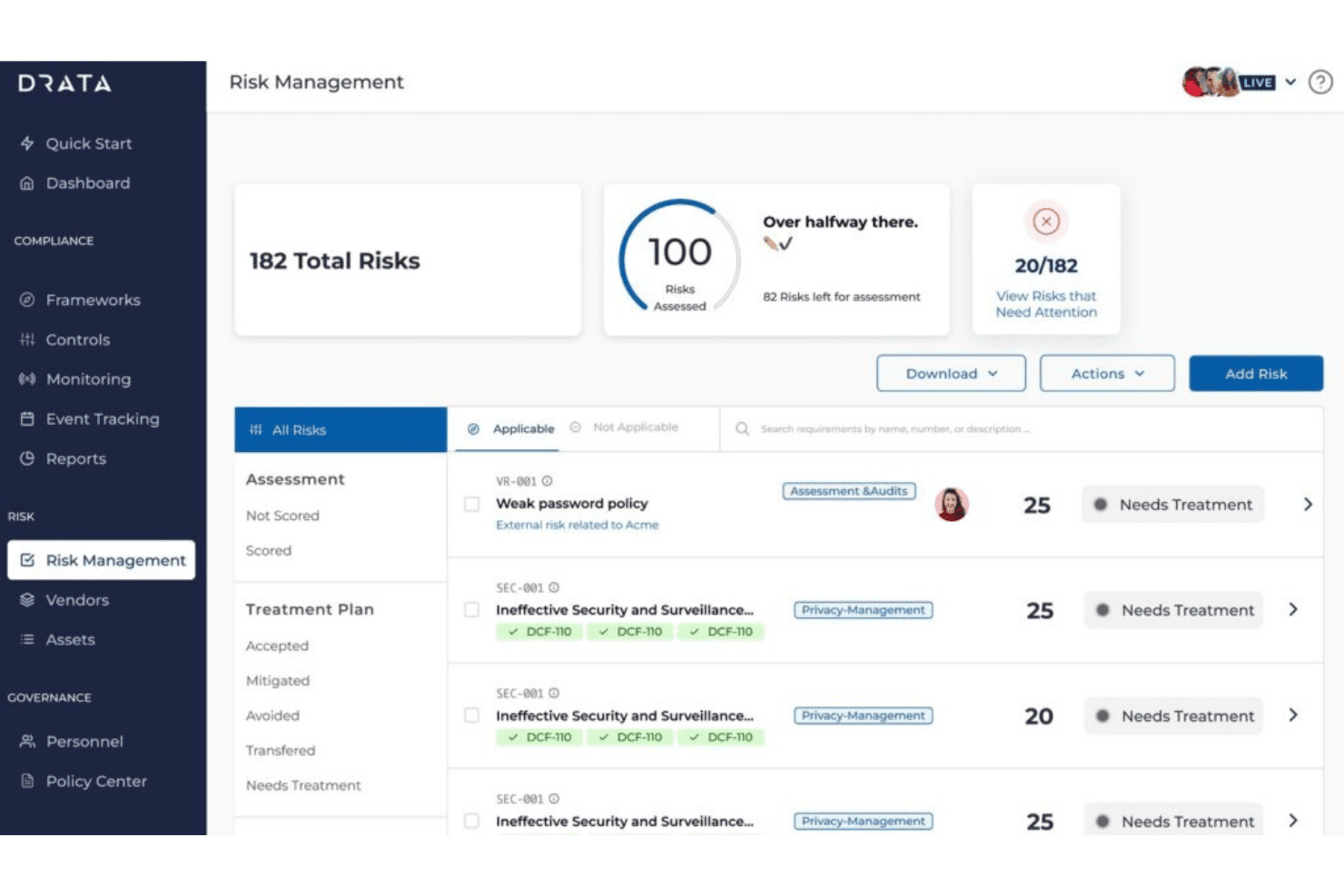
Drata centralizes risk tracking and treatment planning in one dashboard. Drata is an AI-native compliance automation platform that combines continuous control monitoring, automated evidence collection, policy management, risk registers, vendor risk workflows, and auditor collaboration across 20+ security frameworks.
Who Is Drata Best For?
Drata is a strong fit for growth-stage SaaS companies and cloud-native teams where GRC analysts, IT compliance managers, and security engineers share ownership of a multi-framework audit program.
Why I Picked Drata
I picked Drata as one of the best because its Monitoring & Tests module runs automated control checks continuously, not on a fixed schedule. When a control fails, it surfaces a remediation plan immediately rather than waiting for your next audit cycle. I've found that kind of always-on visibility is rare, and the fact that it maintains close to 90% automated evidence coverage across 120+ controls in a single program is what sets it apart when you're running SOC 2 and ISO 27001 at the same time.
Drata Key Features
- Multi-framework crosswalking: Map a single control to multiple compliance frameworks, so evidence collected once applies everywhere it’s relevant.
- Risk management module: Maintain an integrated risk register with scoring, ownership assignment, and remediation tracking for security and compliance risks.
- Vendor risk workflows: Assess, onboard, and manage third-party vendors with centralized tracking and automated security questionnaire distribution.
- Trust Center portal: Share real-time compliance status, documentation, and trust signals with customers and stakeholders in a branded web portal.
Drata Integrations
Drata offers native integrations with AWS, Azure, Google Cloud Platform, Okta, Microsoft 365, Jira, GitHub, GitLab, Slack, Salesforce, and BambooHR, with an API available for custom integrations.
Pros and Cons
Pros:
- Real-time alerts with built-in remediation guidance
- Cross-maps single controls across 20+ frameworks
- Automated evidence collection across 120+ controls
Cons:
- Reporting customization is limited for complex needs
- High alert volume during initial integration setup
Learn more about Drata:
Other Security Compliance Software
Here are some additional security compliance software options that didn’t make it onto my shortlist, but are still worth checking out:
- 11OptroBest for AI-driven compliance controls
- 12ServiceNow GRCBest for enterprise-wide control oversight
- 13SAI360Best for global compliance framework coverage
- 14ArcherBest for centralized risk & compliance management
- 15MetricStreamBest for enterprise-scale audit orchestration
- 16IBM OpenPagesBest for AI-enabled regulatory reporting
- 17RiskonnectBest for visual compliance dashboarding
- 18LogicManagerBest for automated policy lifecycle management
- 19AnecdotesBest for customizable compliance data pipelines
- 20Diligent One PlatformBest for unified board and compliance governance
How I Evaluate Security Compliance Software
I check these tools in two layers: baseline requirements like SOC 2 evidence automation and real-time control monitoring, then the differentiators that reveal where one platform outperforms another.
Core Functionality (Table Stakes For This List)
When I'm selecting tools for my list, I rank each one on a scale from 0 (does not offer the functionality) to 5 (excels in this area) for each core functionality listed below. I then calculate the tool's total score into a percentage, using 65% as a benchmark to help assess its overall fit for the list.
- Framework Coverage: I look for pre-built control mappings across major standards like SOC 2, ISO 27001, HIPAA, and PCI DSS, plus cross-mapping so one control satisfies multiple frameworks.
- Automated Evidence Collection: Pulling screenshots and exporting logs manually is a time sink. I evaluate how many native integrations a platform offers across cloud, identity, and code repo systems.
- Continuous Control Monitoring: Point-in-time checks miss drift between audits. I look for real-time or near-real-time testing that flags control failures and provides actionable alerts.
- Policy Management: Template libraries, version control, and employee attestation workflows all matter. I check whether policies map directly to framework requirements or exist in isolation.
- Risk Assessment & Management: I evaluate risk register depth, including whether the platform supports both quantitative and qualitative scoring, treatment plans, and remediation tracking.
- Audit Management: Auditor collaboration features like read-only portals, evidence linking, and request tracking reduce back-and-forth. I look for tools that keep everything in one place.
Once I have a list of tools that meet the criteria, I consider what sets each platform apart.
Differentiating Factors (What Sets Vendors Apart)
Here's how I compare and contrast different vendors:
Standout Features
Multi-framework crosswalking is a big differentiator. When one access control maps to SOC 2, ISO 27001, and HIPAA at the same time, you avoid duplicating evidence across audits. I also evaluate vendor risk management modules, specifically whether third-party assessments and questionnaire tracking tie directly into your compliance posture. AI-powered questionnaire response is worth looking at too, since auto-filling SIG or CAIQ responses from past answers saves hours during sales cycles.
Beyond Features
Auditor partnerships matter. I check whether a platform has established relationships with accredited audit firms and offers read-only portals so auditors can pull evidence directly. Tech stack integration depth is equally important—surface-level connectors to AWS or Okta aren't enough if they don't pull granular evidence. I also evaluate pricing transparency, especially how costs scale when you add frameworks. A startup pursuing its first SOC 2 has very different needs than a mid-market team managing four or five certifications.
How to Choose a Security Compliance Software
Are you wondering which security compliance software will actually make your next audit easier—not just promise automation on paper?
| If your priority is… | Look for… |
|---|---|
| If your priority is…Speed to first audit | Look for…Guided onboarding paired with milestone checklists |
| If your priority is…Managing multiple frameworks at once | Look for…Multi-framework control mapping and policy re-use |
| If your priority is…Reducing manual evidence collection | Look for…Deep, native integrations for cloud, HRIS, and IdP |
| If your priority is…Satisfying auditor requests efficiently | Look for…Auditor collaboration workspaces with read-only access |
| If your priority is…Scaling compliance as your company grows | Look for…Predictable, per-framework or per-seat pricing models |
How to Vet Your Shortlist
- Test real evidence pulls: Run a trial integration and export an evidence artifact from at least two key systems.
- Review policy workflows end-to-end: Request a demo walkthrough showing policy versioning and employee attestations in action.
- Request audit collaboration proof: Have the vendor provide an auditor login or portal screenshot with example requests and status updates.
- Verify integration coverage: Submit a ticket listing your critical SaaS, IaaS, and HR systems, checking response time/accuracy for direct integration support.
- Tradeoff—automation vs. advisory: Decide if you want fully automated compliance for speed, or a platform with access to compliance advisors for hands-on support.
What Is Security Compliance Software?
Security compliance software is a platform that helps IT, compliance, and security teams automate evidence collection, monitor controls, and manage regulatory requirements across multiple frameworks. With built-in integrations and pre-mapped controls, these platforms reduce manual audit prep and support continuous monitoring so you can stay ahead of changing standards. This lets you centralize workflows, prepare for external audits, and satisfy both ongoing compliance and new framework requirements.
Features of Security Compliance Software
When selecting security compliance software, keep an eye out for the following key features:
- Framework coverage: Supports multiple standards like SOC 2, ISO 27001, HIPAA, and PCI DSS with pre-built control libraries and mapping.
- Automated evidence collection: Connects to systems such as AWS, Azure, Okta, and HRIS platforms to automatically gather audit evidence without manual uploads.
- Continuous control monitoring: Tracks the effectiveness of security controls in real time and alerts users to failures or drift from policy requirements.
- Policy management: Offers templated policies, version tracking, and workflow tools so employees can acknowledge or attest to compliance directly in the platform.
- Risk register: Allows users to identify, score, and track remediation of risks related to data security, data privacy, and regulatory obligations.
- Audit management: Provides auditor collaboration workspaces, request tracking, and secure evidence sharing while supporting compliance reporting.
- Vendor risk management: Centralizes third-party risk assessments, automates security questionnaires, and helps monitor your broader attack surface.
- Access controls: Sets permissions and role-based access management to restrict sensitive compliance data and support access reviews.
- Reporting and dashboards: Summarizes security posture, compliance status, risk trends, and audit progress for stakeholders and compliance officers.
- Integration library: Includes a catalog of native integrations for cloud, identity, HR, ticketing, and vulnerability management systems.
Common Security Compliance Software AI Features
Beyond the standard security compliance software features listed above, many of these solutions are incorporating AI with features like:
- Automated questionnaire response: Uses AI to analyze past answers and documentation, then drafts responses to security questionnaires such as CAIQ or SIG, saving hours on vendor reviews.
- Evidence validation and anomaly detection: AI reviews collected evidence for inconsistencies, missing data, or signs of control drift, flagging issues before audits or compliance failures occur.
- Control mapping recommendations: Suggests optimal mappings between controls and multiple frameworks by analyzing your environment and compliance requirements, reducing manual crosswalking.
- Predictive risk scoring: AI models assess historical incidents and current control status to forecast potential compliance risks and prioritize remediation efforts.
- Natural language policy search: Lets users query policies and compliance documentation using conversational language, making it easier to find relevant requirements or evidence.
Benefits of Security Compliance Software
Implementing security compliance software provides several benefits for your team and your business. Here are a few you can look forward to:
- Reduced audit prep time: Automated evidence collection and auditor portals minimize manual work required to get ready for external assessments.
- Real-time compliance visibility: Continuous control monitoring and dashboards let you spot gaps or failed internal controls instantly rather than waiting for scheduled audits.
- Simplified multi-framework management: Crosswalking controls across each cybersecurity framework allows you to maintain compliance with SOC 2, ISO 27001, HIPAA, and others from a single platform.
- Centralized risk tracking: Risk registers and dashboards keep track of security and compliance risks, remediation status, and trends in one place.
- Efficient policy management: Policy templates, versioning, and attestation workflows make employee compliance faster and more organized.
- Scalable as you grow: Integration libraries and flexible pricing let your compliance program expand as you add team members, frameworks, or regions.
- Improved third-party assessments: Vendor risk management modules and AI-powered questionnaire responses streamline onboarding and oversight of suppliers and partners.
Costs and Pricing of Security Compliance Software
Selecting security compliance software requires an understanding of the various pricing models and plans available. Costs vary based on features, team size, add-ons, and more. The table below summarizes common plans, their average prices, and typical features included in security compliance software solutions:
Plan Comparison Table for Security Compliance Software
| Plan Type | Average Price | Common Features |
|---|---|---|
| Plan TypeFree Plan | Average Price$0 | Common FeaturesBasic framework coverage, limited evidence uploads, one standard integration, and basic reporting. |
| Plan TypePersonal Plan | Average Price$30–$75/user/month | Common FeaturesCore compliance automation, a small integration library, policy templates, and single-framework support. |
| Plan TypeBusiness Plan | Average Price$120–$300/user/month | Common FeaturesMulti-framework mapping, risk registers, audit management, native integrations, and vendor management modules. |
| Plan TypeEnterprise Plan | Average Price$400–$800/user/month | Common FeaturesCustom integrations, advanced analytics, dedicated onboarding, API access, and 24/7 support. |
Security Compliance Software FAQs
Here are some answers to common questions about security compliance software:
How does security compliance software help with audit preparation?
Security compliance software automates evidence collection, tracks auditor requests, and centralizes documentation, letting your team get audit-ready faster while reducing manual effort.
Can security compliance software support multiple compliance frameworks at once?
Yes, most solutions allow you to map controls and policies across multiple frameworks like SOC 2, ISO 27001, and HIPAA, so you avoid duplicating work.
What integrations are essential in security compliance software?
Key integrations include cloud providers, HR and identity management tools, ticketing systems, and source code repositories, making it easier to automate compliance evidence collection.
Is security compliance software suitable for small companies?
Yes, there are entry-level plans designed for startups and small teams that cover core compliance needs while offering room to grow as requirements expand.
How often are these platforms updated for new regulatory frameworks?
Most vendors push frequent updates to support new framework versions and emerging regulations, minimizing the risk of falling behind on compliance changes.