
Vanta Review 2026: Pros, Cons, Features, and Pricing
Vanta streamlines compliance for fast-growing teams, offering automation and ease of use, but may not suit highly customized or complex enterprise needs.

We review tools independently, and commissions help fund our testing. See our transparency policy, our methodology, or suggest a tool.
Vanta is a CTO compliance software that automates security audits and evidence collection for frameworks like SOC 2, ISO 27001, HIPAA, and GDPR. It's built for engineering and security teams that need to achieve and maintain compliance certifications without dedicating heavy manual effort to audit prep. If you're weighing Vanta against something like Drata, Vanta's edge is its broader integration library and built-in vendor risk management—making it the stronger choice when your compliance scope extends to third-party relationships and not just internal systems.
Vanta Evaluation Summary
4.6/5
- Pricing upon request
- Free demo available
Why Trust Our Software Recommendations
6,700+
Reviews
20
Industry experts
16+
Evaluation factors
14
Years
Our team has been testing and reviewing software since 2012. As tech leaders ourselves, we know how difficult—and important—it is to choose the right software.
For this guide, we evaluated tools using hands-on testing and independent research, scoring tools using our selection criteria.
Our reviews reflect our human editorial judgment, not a sales pitch.
Expert reviewers:
- Paulo Gardini MiguelTech Director
 Tim FisherVP of AI
 Gabriel RosasTech Lead & Software Architect
 Christhian GruhnTech Lead & Platform Architect

Vanta Overview
When judging Vanta against other compliance software, its automated evidence collection, intuitive dashboard, and broad integration library stand out for teams seeking quick onboarding and minimal manual work. Pricing is transparent, and support is responsive, making it appealing for startups and mid-sized companies prioritizing speed and clarity.
However, those needing deep customization or highly granular controls may find Vanta less flexible than some alternatives. If you’re selecting a solution for SOC 2, ISO 27001, or HIPAA readiness with limited internal compliance resources, Vanta’s streamlined approach and guided onboarding make it a strong contender.
Pros
- Provides a clear, actionable dashboard for audit readiness.
- Offers real-time compliance monitoring and alerts.
- Automates evidence collection for over 35 compliance frameworks.
Cons
- Limited flexibility for highly specialized compliance needs.
- Pricing can be high for smaller organizations.
- Lacks advanced reporting and analytics features.
Is Vanta Right For Your Needs?
Who Would be a Good Fit for Vanta?
Vanta is best suited for fast-growing tech companies, SaaS providers, and organizations with lean IT or security teams that need to achieve and maintain compliance quickly. Its automated evidence collection, real-time monitoring, and guided onboarding make it ideal for businesses with limited compliance expertise or resources.
Teams handling sensitive data or working in regulated industries will benefit from Vanta’s clear audit trails and support for multiple frameworks.
- Cloud-Native BusinessesVanta’s integrations with AWS, Azure, and GCP streamline cloud compliance.
- Small IT DepartmentsGuided onboarding and automation reduce manual compliance workloads.
- Remote-First TeamsVanta’s robust monitoring helps you meet strict data protection regulations like HIPAA.
- Healthcare ProvidersHIPAA-specific controls and evidence collection simplify healthcare compliance.
- Fintech CompaniesReal-time monitoring and audit readiness support ongoing financial compliance needs.
- SaaS StartupsVanta’s automation and templates help startups achieve SOC 2 or ISO 27001 quickly.
Who Would be a Bad Fit for Vanta?
Vanta may not be the best choice for large enterprises with highly complex compliance requirements, organizations needing deep customization, or those operating in industries with niche regulatory frameworks. Its feature set is designed for speed and simplicity, which can limit flexibility for teams with unique or advanced needs.
- On-Premise IT TeamsCloud-focused integrations do not support on-premise infrastructure compliance.
- Heavily Regulated PharmaMissing features for GxP or other pharma-specific compliance standards.
- Legal DepartmentsLimited advanced reporting and documentation customization for legal reviews.
- Manufacturing FirmsDoes not address physical security or operational compliance needs.
- Government AgenciesLacks support for specialized government frameworks like FedRAMP.
- Large EnterprisesVanta’s controls may not cover complex, multi-entity compliance structures.
Our Review Methodology
How We Test & Score Tools
We’ve spent years building, refining, and improving our software testing and scoring system. The rubric is designed to capture the nuances of software selection and what makes a tool effective, focusing on critical aspects of the decision-making process.
Below, you can see exactly how our testing and scoring works across seven criteria. It allows us to provide an unbiased evaluation of the software based on core functionality, standout features, ease of use, onboarding, customer support, integrations, customer reviews, and value for money.
Core Functionality (25% of final scoring)
The starting point of our evaluation is always the core functionality of the tool. Does it have the basic features and functions that a user would expect to see? Are any of those core features locked to higher-tiered pricing plans? At its core, we expect a tool to stand up against the baseline capabilities of its competitors.
Standout Features (25% of final scoring)
Next, we evaluate uncommon standout features that go above and beyond the core functionality typically found in tools of its kind. A high score reflects specialized or unique features that make the product faster, more efficient, or offer additional value to the user.
We also evaluate how easy it is to integrate with other tools typically found in the tech stack to expand the functionality and utility of the software. Tools offering plentiful native integrations, 3rd party connections, and API access to build custom integrations score best.
Ease of Use (10% of final scoring)
We consider how quick and easy it is to execute the tasks defined in the core functionality using the tool. High scoring software is well designed, intuitive to use, offers mobile apps, provides templates, and makes relatively complex tasks seem simple.
Onboarding (10% of final scoring)
We know how important rapid team adoption is for a new platform, so we evaluate how easy it is to learn and use a tool with minimal training. We evaluate how quickly a team member can get set up and start using the tool with no experience. High scoring solutions indicate little or no support is required.
Customer Support (10% of final scoring)
We review how quick and easy it is to get unstuck and find help by phone, live chat, or knowledge base. Tools and companies that provide real-time support score best, while chatbots score worst.
Customer Reviews (10% of final scoring)
Beyond our own testing and evaluation, we consider the net promoter score from current and past customers. We review their likelihood, given the option, to choose the tool again for the core functionality. A high scoring software reflects a high net promoter score from current or past customers.
Value for Money (10% of final scoring)
Lastly, in consideration of all the other criteria, we review the average price of entry level plans against the core features and consider the value of the other evaluation criteria. Software that delivers more, for less, will score higher.
Core Features
Automated Evidence Collection
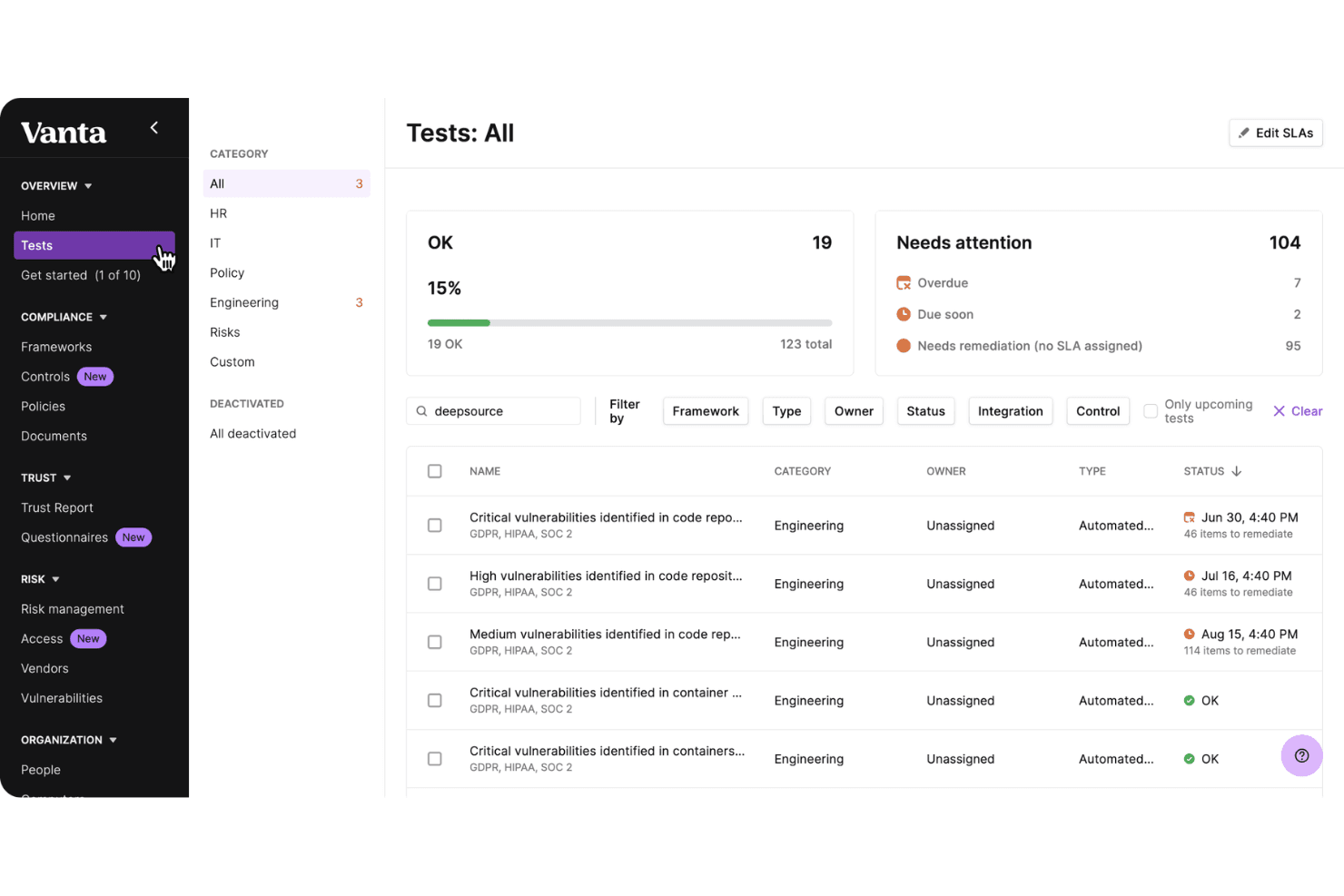
Vanta automatically gathers evidence for over 35 compliance frameworks, reducing manual work and audit preparation time.
Continuous Controls Monitoring
The platform monitors your environment in real time, alerting you to compliance gaps or policy violations as they happen.
Risk Management
Vanta centralizes risk identification and assessment, letting you track, prioritize, and remediate risks from a single dashboard.
Personnel and Access Management
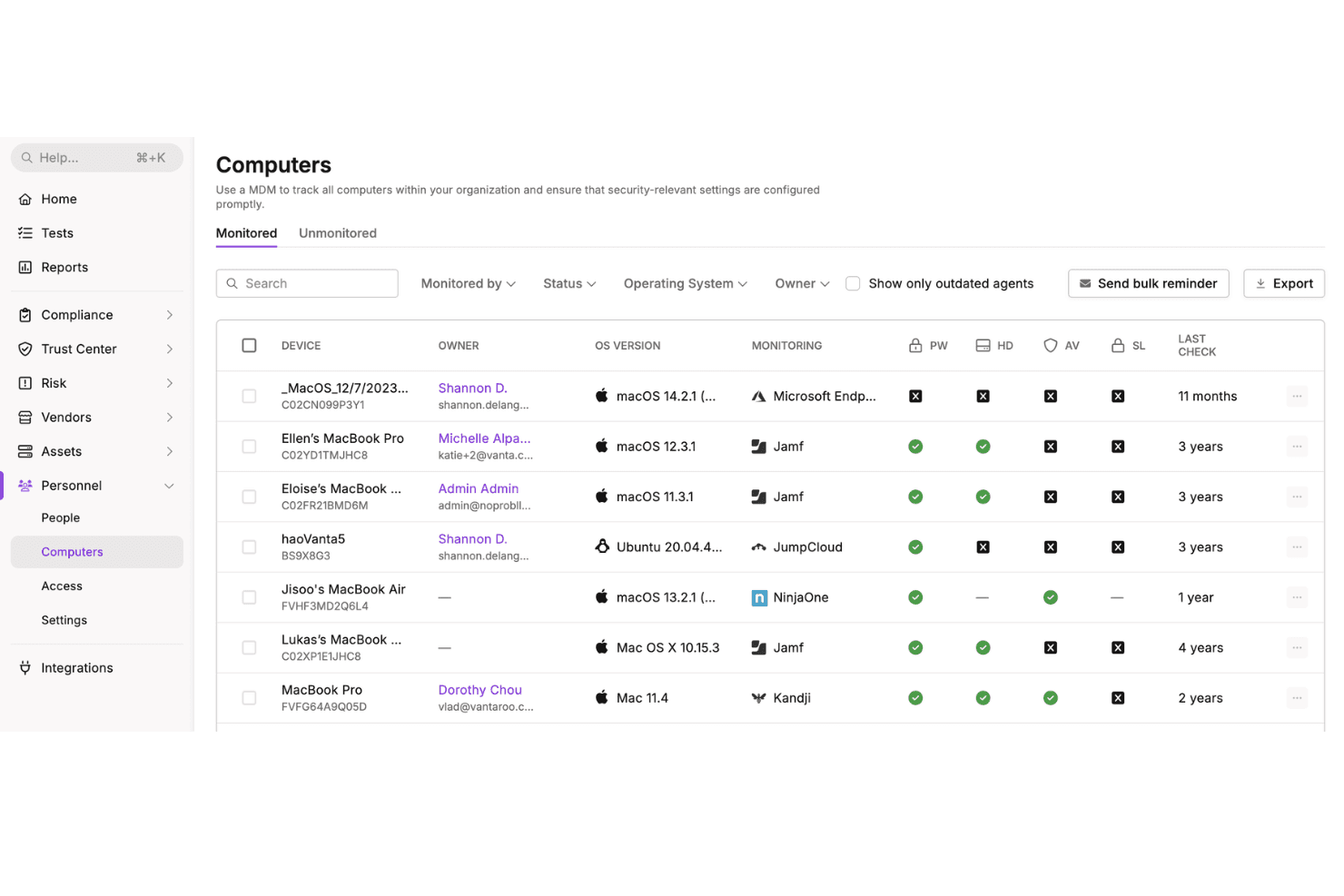
Control user permissions and access, ensuring only authorized personnel can reach sensitive systems and data.
Streamlined Audit Preparation
Vanta organizes and stores all compliance documentation, making it easy to share with auditors and demonstrate readiness.
Trust Center
Showcase your compliance status and security posture to customers and partners with a public-facing trust portal.
Standout Features
Guided Policy Builder
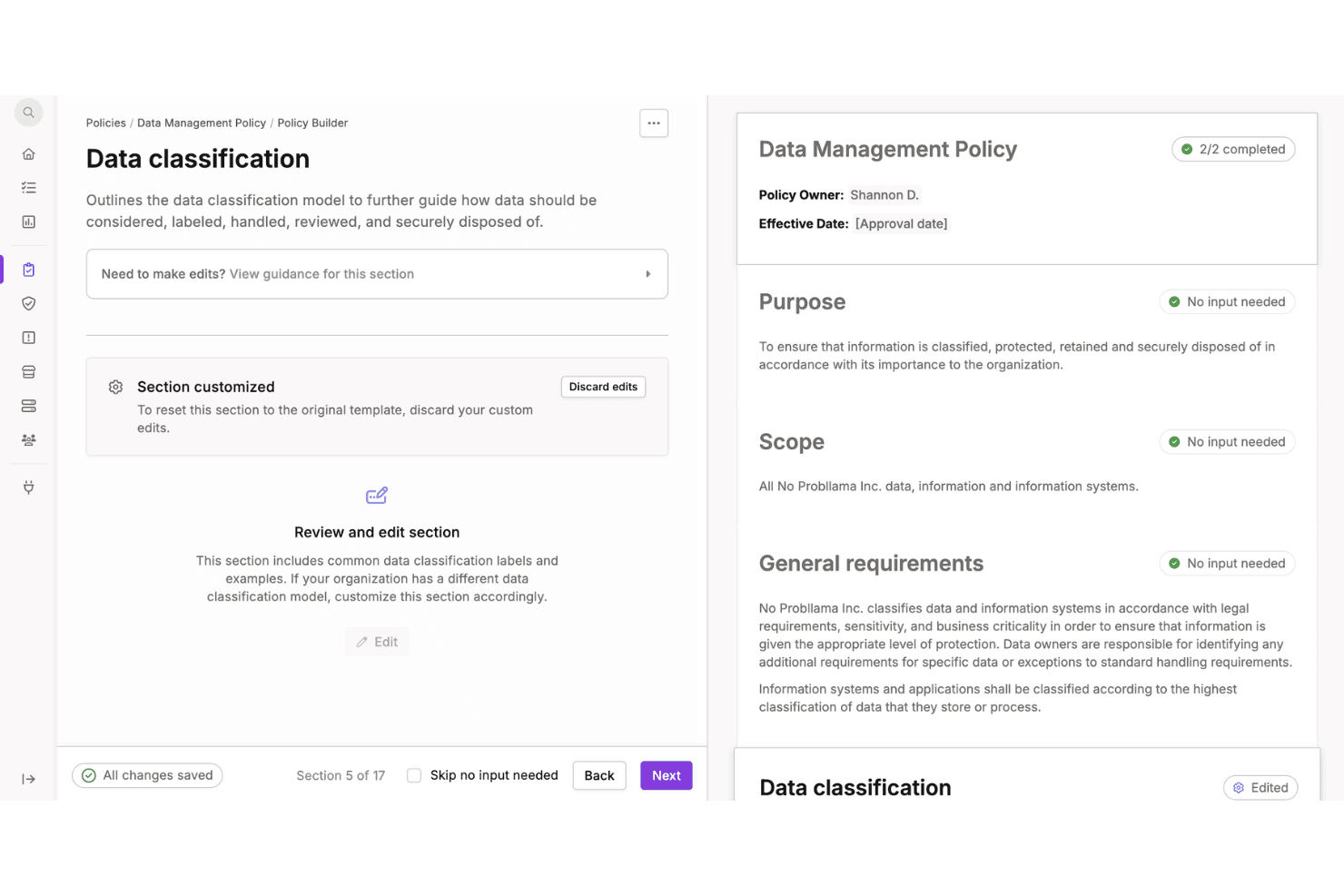
Vanta offers a step-by-step policy builder that helps you create, customize, and implement security policies tailored to your organization. This tool simplifies policy management for teams without dedicated compliance staff.
Risk Assessment and Remediation
Vanta identifies security risks and provides actionable recommendations to help you remediate issues promptly, ensuring your organization stays compliant and secure.
Ease of Use
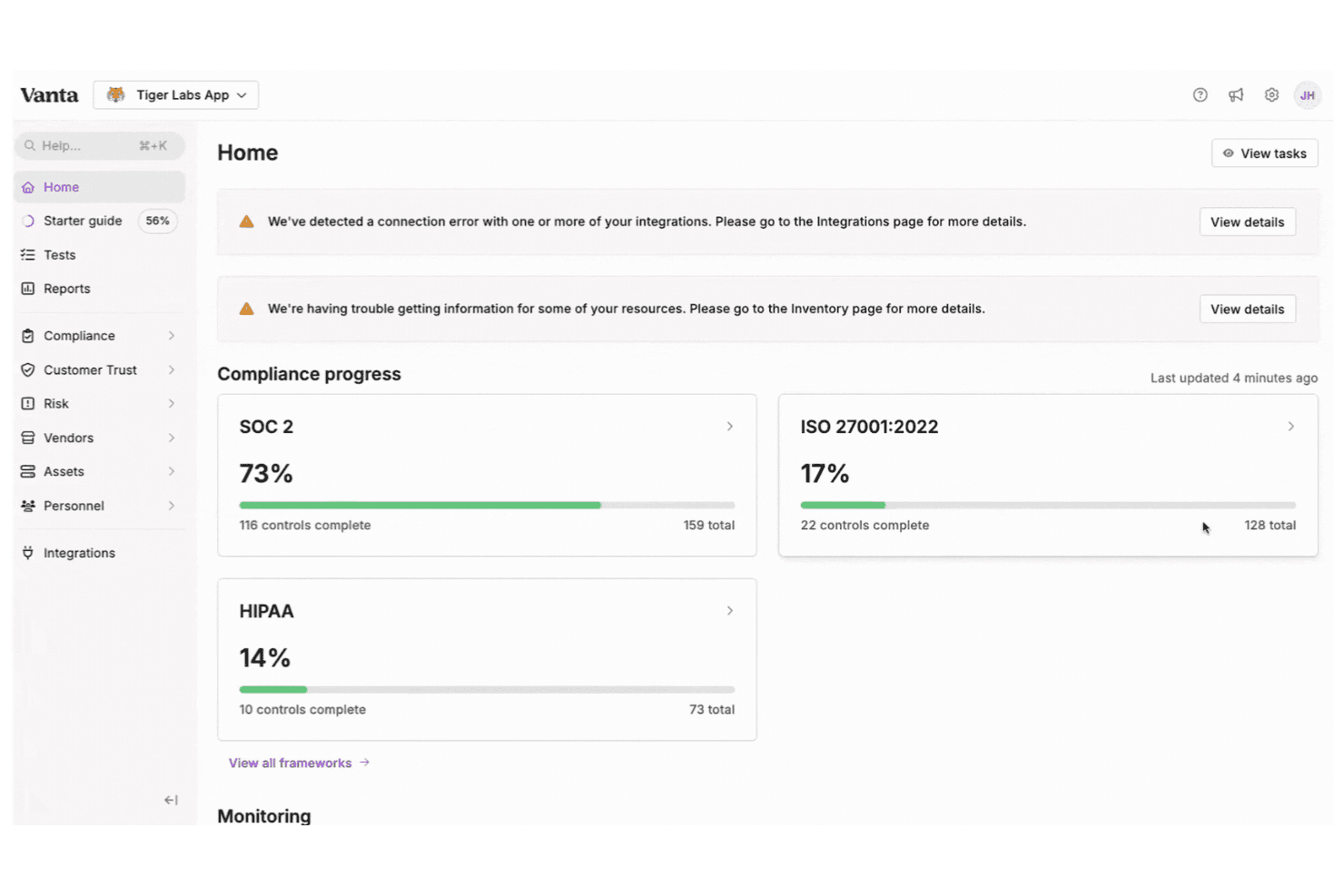
Vanta stands out for its clean interface and intuitive workflows, making compliance tasks accessible even for teams without dedicated compliance experts. Users consistently mention the straightforward onboarding process and clear, actionable dashboards. Automated evidence collection and guided policy creation reduce manual effort and confusion.
While some advanced users wish for deeper customization, most find Vanta’s usability a major advantage, especially when managing multiple frameworks or preparing for audits with limited internal resources.
Onboarding
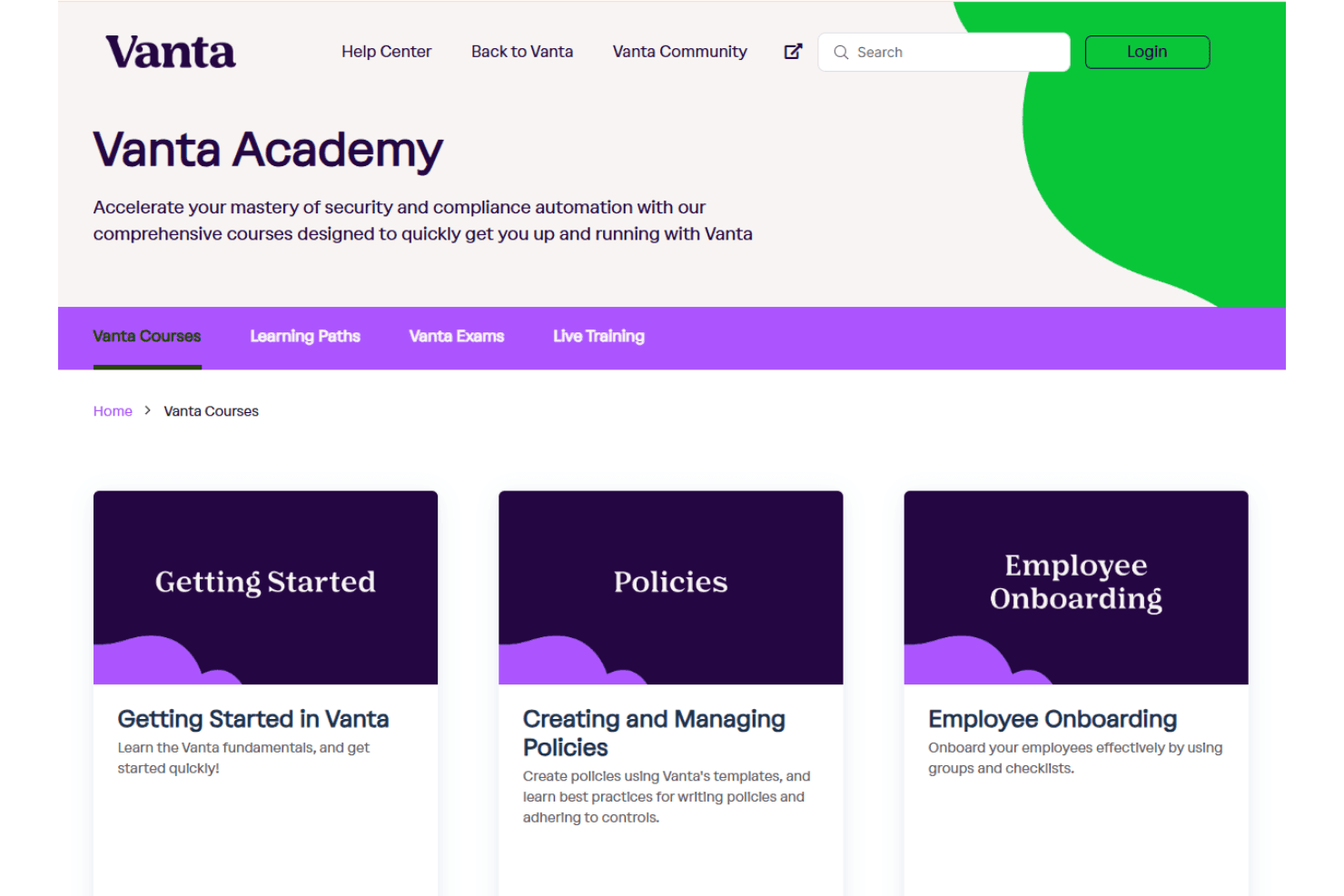
Vanta’s onboarding process is widely praised for its speed and clarity, with most users able to connect systems and start tracking compliance within days. The platform provides step-by-step guidance, in-app checklists, and access to live support, which helps teams move quickly from setup to value.
Many users highlight the helpful documentation and responsive customer success team, making it easier to navigate initial compliance requirements and avoid common pitfalls during implementation.
Customer Support
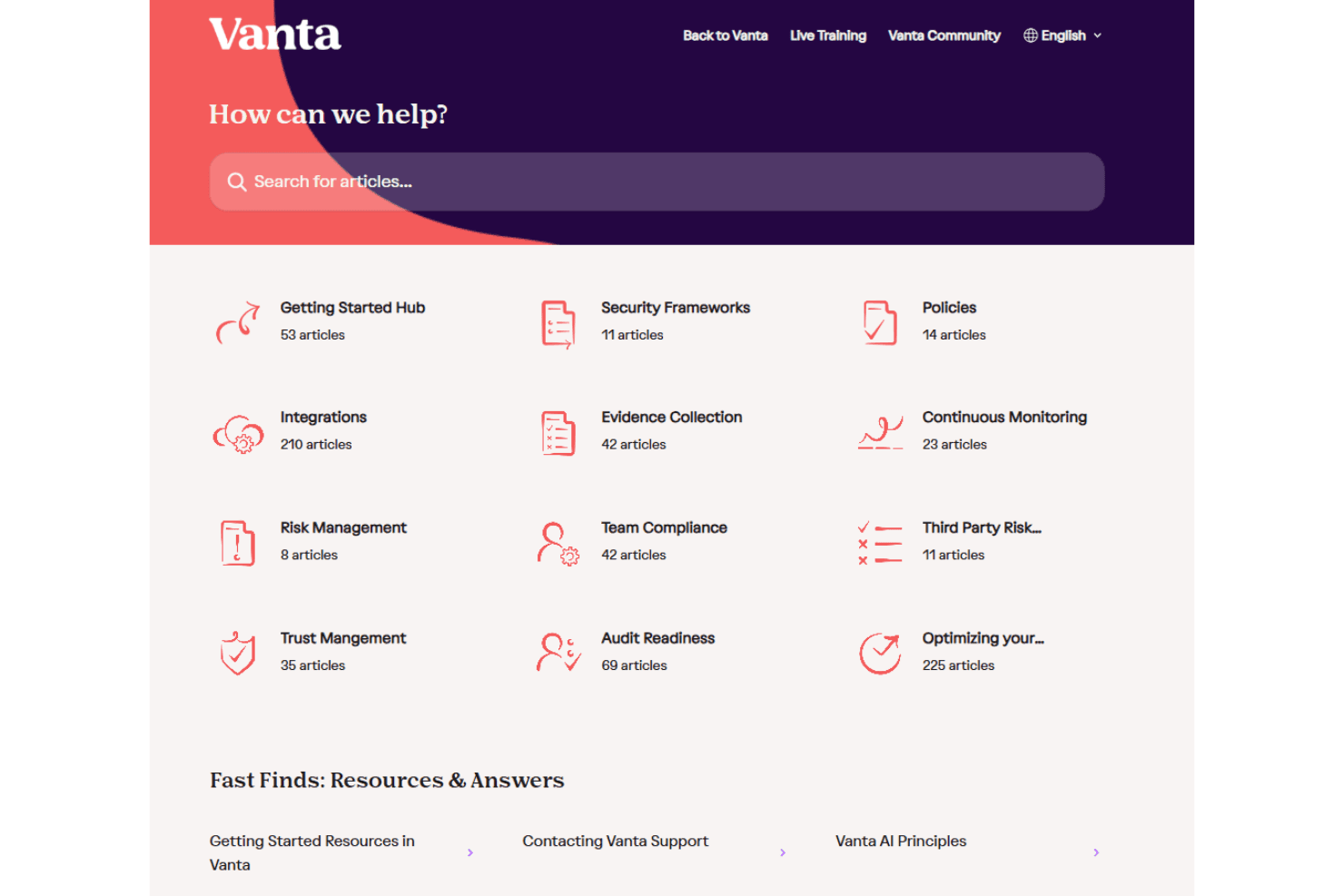
Vanta’s customer support receives strong feedback for its responsiveness and expertise, with users noting quick turnaround times and knowledgeable assistance. Support is available through live chat, email, and scheduled calls, which helps resolve compliance questions and technical issues efficiently.
Many users appreciate the proactive outreach from customer success managers, especially during audits or onboarding, making the support experience feel both accessible and genuinely helpful throughout the compliance journey.
Integrations
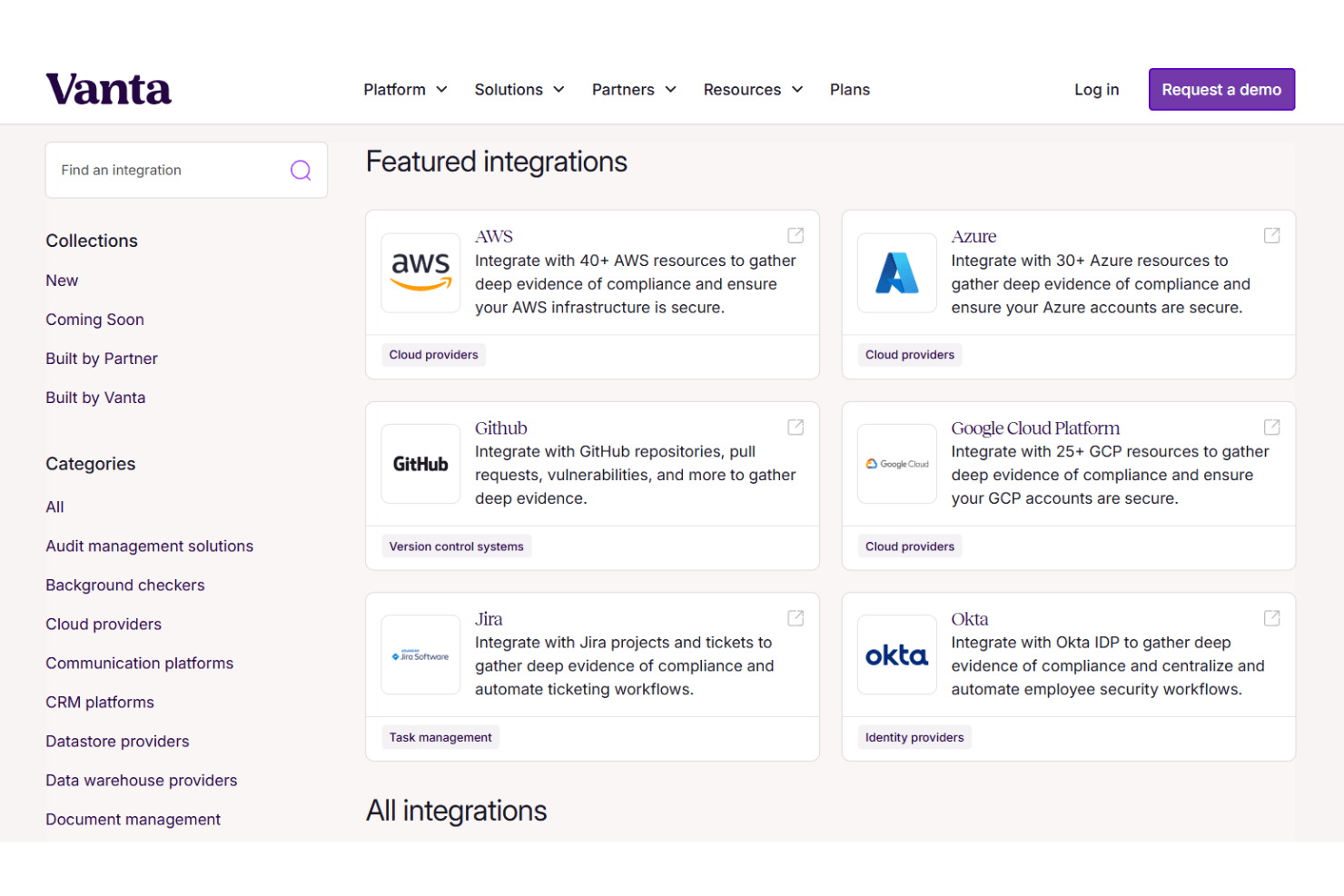
Vanta integrates with AWS, Google Cloud Platform, Azure, Okta, GitHub, GitLab, Jira, Salesforce, Slack, and 1Password, among others.
Vanta also offers an API for custom integrations and connects with hundreds of third-party tools across cloud, identity, HR, and security categories.
Value for Money
Vanta is a premium solution, with users noting its higher price point but justifying the cost through automation, audit readiness, and time saved on manual compliance work.
While pricing is custom and can scale significantly, the platform’s ability to streamline SOC 2, ISO 27001, and similar frameworks makes it a cost-efficient investment for teams that want faster compliance and reduced operational overhead.
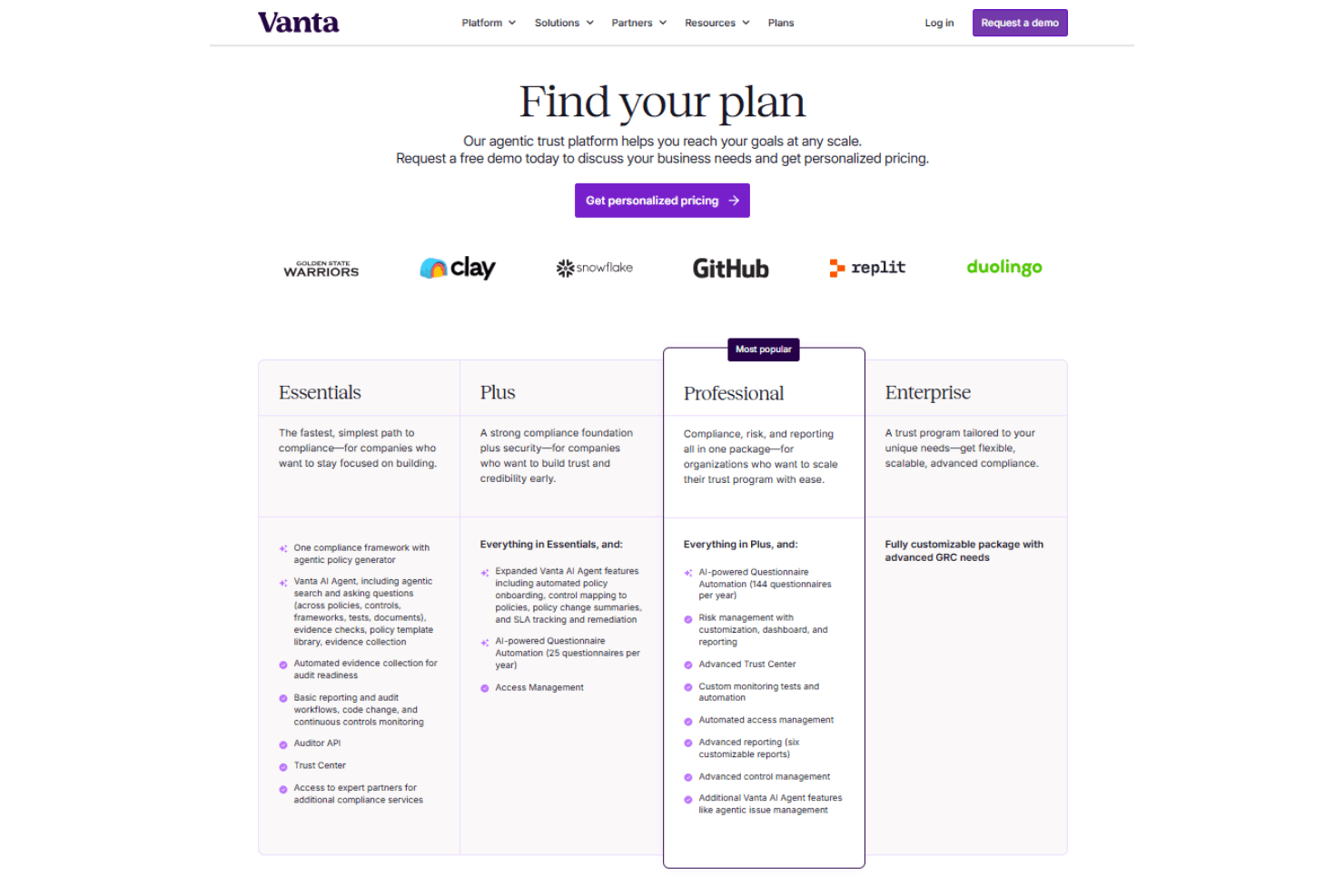
- Essentials: Basic compliance automation for a single framework.
- Plus: Adds workflows, access management, and expanded automation.
- Professional: Advanced automation with risk management and reporting.
- Enterprise: Fully customizable compliance for large, complex organizations
Vanta Specs
- 2-Factor Authentication: No
- Access Management: No
- API: Yes
- Approval Workflows: No
- Audit Management: No
- Balance Sheet: No
- Billing/Invoicing: No
- Budgeting: No
- Calendar Management: No
- Compliance Tracking: No
- CRM Integration: No
- Dashboard: Yes
- Data Export: Yes
- Data Import: Yes
- Data Visualization: Yes
- Document Management: No
- Employee Training: No
- Expense Tracking: No
- External Integrations: Yes
- Forecasting: No
- History/Version Control: No
- Incident Management: No
- Multi-Currency: No
- Multi-User: Yes
- Notifications: Yes
- P&L: No
- Policy Management: No
- Real-time Alerts: Yes
- Regulatory Alerts: No
- Risk Assessment: No
- Scheduling: No
- Tax Management: No
- Workflow Management: Yes
Vanta FAQs
Vanta Company Overview & History
Vanta is a leading trust management and compliance automation platform founded in 2018 by CEO Christina Cacioppo. Headquartered in San Francisco, Vanta operates as a remote-first company with additional offices in New York, London, Dublin, and Sydney, and employs around 1,400 people.
The company is backed by major investors including Sequoia Capital, Craft Ventures, Y Combinator, J.P. Morgan, and Goldman Sachs. Vanta serves over 12,000 customers worldwide—including notable clients like Ramp, Clay, and Cognisys—and reached a $4.15 billion valuation following its 2025 Series D funding round.
Vanta Major Milestones
- 2018: Company founded by Christina Cacioppo in San Francisco.
- 2018: First funding round and initial product launch focused on compliance automation.
- 2024: Surpassed $100M in annual revenue and 8,000 customers.
- 2025: Raised $150M in Series D funding, reaching a $4.15 billion valuation.
- 2025: Expanded platform with AI-powered trust management and continuous GRC capabilities.
- 2026: Grew workforce to approximately 1,400 employees and continued global expansion.