Enterprise organizations are under growing pressure to modernize data architecture while simultaneously scaling analytics, governance, cloud transformation, and AI initiatives.
The challenge is that many organizations are trying to build those initiatives on top of fragmented data environments that were never designed for semantic consistency at enterprise scale.
Business definitions vary across departments. Metadata lives in disconnected systems. Legacy platforms contain undocumented relationships no one fully understands anymore. Analytics teams create their own interpretations of business logic while governance teams attempt to standardize definitions after the fact.
Then AI enters the equation and exposes every inconsistency immediately.
AI systems rely heavily on structure, metadata, lineage, relationships, and semantic consistency. When those foundations are weak, organizations begin experiencing downstream problems that compound quickly across the business.
Teams encounter conflicting analytics and reporting because departments define metrics differently. Governance initiatives struggle because lineage and ownership are difficult to trace across disconnected systems. AI initiatives generate inconsistent outputs because metadata lacks context and semantic alignment. Even routine modernization projects become harder because nobody fully understands how systems, definitions, and dependencies connect together.
Increasingly, enterprise organizations are realizing that AI readiness is not simply about deploying copilots or large language models. It starts much earlier with creating shared understanding around enterprise data.
That is where ER/Studio fits into the conversation.
What Is ER/Studio?
ER/Studio is an enterprise data modeling and metadata management platform that helps organizations design logical and physical data models, standardize business definitions, govern metadata, improve collaboration, and create AI-ready data foundations.
Rather than treating data modeling, governance, metadata management, and collaboration as separate activities handled across disconnected tools, ER/Studio connects them into a unified enterprise architecture framework built for enterprise scale.
- Organizations use ER/Studio to:
- Design conceptual, logical, and physical data models
- Generate physical database code through forward engineering
- Standardize metadata and business terminology
- Create enterprise business glossaries and data dictionaries
- Improve data lineage and traceability visibility
- Support collaborative data modeling across distributed teams
- Govern enterprise architecture through integrations with Microsoft Purview and Collibra
- Create semantic consistency for analytics and AI initiatives
What makes this especially valuable is that these capabilities are not isolated features operating independently from one another. The platform connects business meaning, metadata, governance, lineage, collaboration, and implementation into a shared operational framework.
That alignment becomes increasingly important as enterprise data ecosystems grow more distributed, more complex, and more dependent on trusted data for analytics and AI initiatives.
What Is Enterprise Data Modeling?
Enterprise data modeling is the process of defining, structuring, and standardizing business data across systems, applications, and teams to improve consistency, governance, analytics, scalability, and long-term operational alignment.
At enterprise scale, data modeling is not simply about designing database schemas. It is about creating a shared semantic foundation the organization can operate from consistently.
Most organizations experience a familiar pattern over time. A business team requests a new metric or capability. A development team implements it quickly. Another department later creates something similar using different business rules, naming standards, or structures. Eventually, the enterprise accumulates multiple versions of the same concepts scattered across disconnected systems and reporting environments.
Over time, the organization loses confidence in the consistency of its own data.
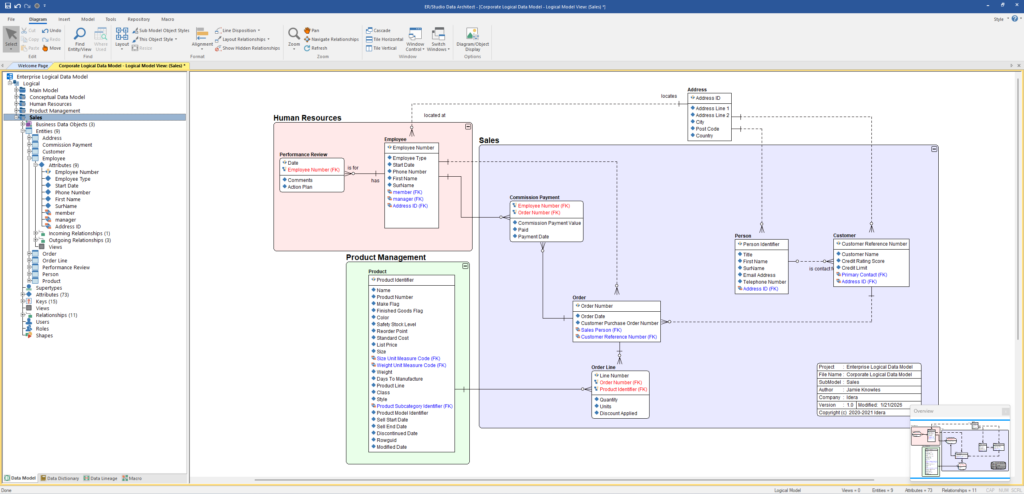
ER/Studio helps organizations address that problem by connecting conceptual, logical, and physical data models directly to business meaning, metadata, governance, and lineage.
Instead of architecture becoming fragmented over time, organizations create a durable semantic framework that evolves alongside the business itself.
Want to learn more about ER/Studio?
Enterprise Logical Data Models Connect Business Meaning to Technical Implementation
Many organizations move too quickly from business requests directly into implementation.
A stakeholder asks for a new metric. A developer creates tables. Another team creates something similar six months later using different business rules, metadata structures, and naming conventions.
Eventually, nobody fully agrees on what the data actually means.
Enterprise logical data models help prevent that fragmentation before it spreads across operational systems, analytics platforms, APIs, cloud environments, and AI initiatives.
Logical models allow organizations to define:
- Business entities
- Relationships
- Ownership
- Standards
- Metadata
- Rules
- Semantic meaning
independently from the underlying technology stack.
That distinction matters because business meaning changes much more slowly than technology platforms do.
ER/Studio allows enterprise architects to connect those logical definitions directly to physical implementation while maintaining traceability between business understanding and technical architecture.
The platform also supports forward engineering, allowing organizations to generate platform-ready database code directly from governed logical and physical data models.
This creates stronger consistency across analytics, governance, integration, and modernization initiatives because business meaning remains connected to implementation throughout the lifecycle of enterprise data.
Instead of repeatedly recreating definitions across departments and systems, organizations establish a semantic backbone that supports long-term scalability.
What Does “AI-Ready Data” Actually Mean?
AI-ready data is data that is structured consistently, governed properly, clearly defined, connected through metadata and lineage, and semantically aligned across systems and departments.
This is where many enterprise AI initiatives encounter problems.
AI systems rely heavily on semantic consistency. If business definitions conflict across systems or metadata lacks context, AI models inherit those inconsistencies immediately.
Nearly 90% of enterprise data remains unstructured, creating major challenges for AI reliability and context accuracy. And 63% of organizations either do not have or are unsure if they have the right data management practices for AI.
Humans often compensate for these gaps manually. Analysts know which dashboards to trust. Engineers know which transformations to avoid. Governance teams maintain institutional knowledge that never fully becomes operationalized.
AI systems cannot compensate for ambiguity in the same way humans can. In fact, poor data quality costs organizations an average of $12.9 million annually.
That is why semantic architecture is becoming one of the most important components of enterprise AI readiness.
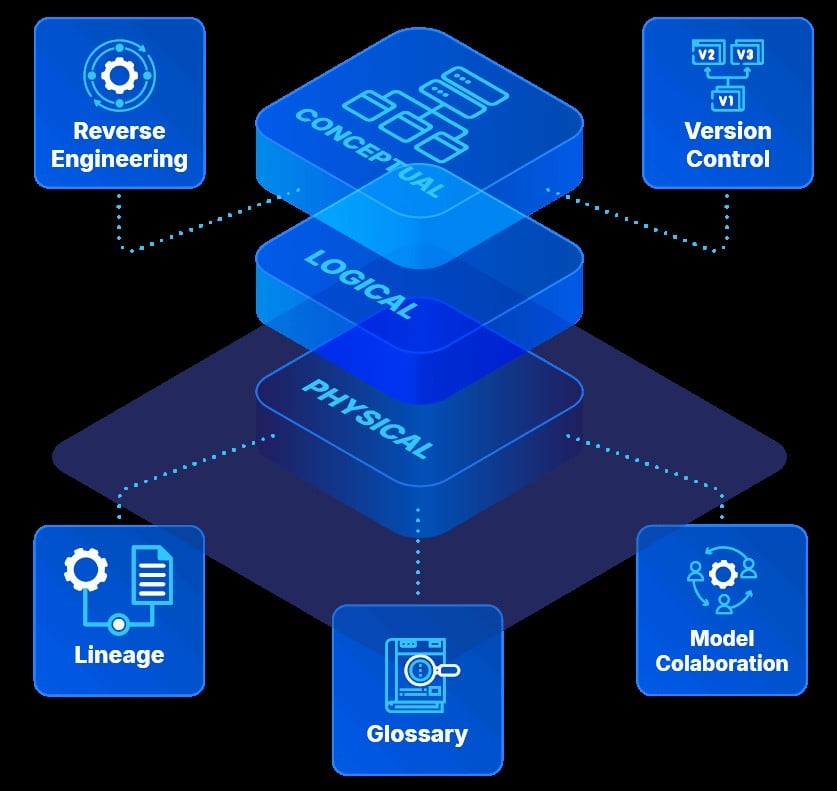
ER/Studio helps organizations create AI-ready data foundations by connecting enterprise data modeling, metadata management, business glossaries, lineage, governance workflows, universal mappings, and semantic definitions into a unified enterprise architecture environment.
This allows organizations to create much stronger alignment between business meaning and technical implementation.
For example:
- Business glossary terms can connect directly to technical metadata
- Enterprise lineage remains visible across systems
- Definitions stay aligned to physical implementation
- Metadata becomes searchable and reusable across teams
- Governance workflows remain connected to architecture decisions
That semantic consistency improves the reliability of analytics, reporting, governance, and AI-driven decision-making because the enterprise is operating from shared meaning rather than disconnected interpretations.
Why Metadata Management and Business Glossaries Have Become Strategic
For years, many organizations treated metadata management as secondary documentation work.
Glossaries lived in spreadsheets. Lineage diagrams became outdated. Definitions drifted away from implementation. Governance teams operated separately from architecture teams.
As enterprise environments scale, that model becomes increasingly difficult to sustain.
Organizations now need metadata and business terminology to function operationally, not just descriptively.
What Is a Business Glossary?
A business glossary helps organizations standardize enterprise terminology by connecting business definitions directly to technical metadata, enterprise data models, governance workflows, and architecture assets.
ER/Studio supports enterprise metadata management through:
- Enterprise business glossaries
- Data dictionaries
- Enterprise data catalogs
- Metadata repositories
- Universal mappings
- Cross-system lineage visibility
- Semantic relationship management
What makes this important is not simply the existence of the glossary itself. It is the fact that business definitions remain connected directly to implementation, lineage, governance, and metadata across the enterprise.
That creates stronger alignment between business and technical teams because everyone is operating from the same semantic framework.
Instead of relying on tribal knowledge or disconnected documentation, organizations create centralized visibility into how enterprise data is defined, governed, and operationalized.
Why Collaborative Data Modeling Matters at Enterprise Scale
Modern enterprise data architecture is no longer managed by isolated technical teams working independently inside desktop modeling tools.
Today’s enterprise data environments involve architects, engineers, analysts, governance leaders, compliance teams, data stewards, business stakeholders, regional teams, and AI initiatives operating simultaneously across shared systems.
Without structured collaboration, enterprise architecture environments become increasingly difficult to manage as organizations scale.
Different teams begin modifying the same models independently. Naming conventions drift between business units. Governance teams lose visibility into who changed what and why. In large organizations, even small inconsistencies can cascade downstream into analytics, integration, compliance, and AI systems.
Over time, organizations typically encounter several operational problems:
- Version conflicts, where multiple teams overwrite or duplicate each other’s work because there is no centralized collaboration workflow
- Architectural drift, where standards and definitions slowly diverge across departments, making enterprise-wide consistency difficult to maintain
- Duplicate modeling efforts, where separate teams unknowingly recreate the same entities, mappings, or structures in parallel
- Limited governance visibility, where organizations struggle to trace changes, ownership, approvals, and lineage across rapidly evolving environments
These are not simply operational inconveniences. They directly impact reporting consistency, governance effectiveness, analytics trustworthiness, and the reliability of downstream AI initiatives.
ER/Studio’s multi-user repository was designed specifically to solve these enterprise collaboration challenges.
The repository allows multiple architects and teams to work concurrently on shared enterprise data models while maintaining governance, version control, traceability, and architectural consistency.
Large enterprise models can also be divided into focused submodels, allowing distributed teams to work independently while remaining aligned to the broader enterprise architecture.
That operational structure helps organizations scale enterprise data architecture initiatives without sacrificing governance or consistency.
Extending Enterprise Architecture Collaboration with Team Server Core
One of the biggest weaknesses in many enterprise data initiatives is that architecture knowledge remains trapped inside technical teams.
Business stakeholders often receive static exports, screenshots, or disconnected documentation long after important architectural decisions have already been made.
ER/Studio Team Server Core helps solve that challenge through a secure web-based collaboration portal designed to make enterprise architecture more accessible across the organization.
What Is Team Server Core?
Team Server Core is ER/Studio’s browser-based collaboration portal that allows technical and business users to explore enterprise data models, metadata, business glossaries, and governance information without requiring desktop modeling tools.
Organizations can use Team Server Core to:
- Publish enterprise data models to the web
- Browse metadata and glossary definitions
- Support collaborative architecture discussions
- Search across enterprise architecture assets
- Centralize governance reviews and approvals
- Connect workflows with Jira and development processes
What makes this especially valuable is that collaboration remains connected directly to the architecture itself.
Feedback, approvals, governance discussions, and metadata reviews happen in context rather than across disconnected email threads, spreadsheets, and exported documentation.
This creates a much stronger operational connection between business meaning and technical implementation because architecture becomes visible and collaborative across the enterprise instead of isolated within technical teams.
How ER/Studio Supports Enterprise Data Governance
Many governance initiatives struggle because governance processes operate separately from the architecture they are trying to govern.
Documentation exists in one platform. Metadata exists somewhere else. Stewardship workflows operate independently from implementation. Lineage visibility remains incomplete across systems.
As enterprise environments scale, governance becomes increasingly reactive.
ER/Studio approaches governance differently by embedding governance directly into enterprise architecture workflows.
Organizations can:
- Track enterprise lineage across systems
- Analyze downstream impact before changes occur
- Standardize enterprise definitions
- Maintain audit visibility into architectural evolution
- Govern metadata directly within the modeling environment
- Synchronize stewardship and governance workflows
ER/Studio also integrates with enterprise governance ecosystems like Microsoft Purview and Collibra , helping organizations connect governance initiatives, metadata management, stewardship workflows, business glossaries, enterprise lineage, and enterprise architecture assets into a more unified governance strategy.
That level of integration helps governance become operational instead of administrative because governance remains connected directly to the architecture itself.
The Future of AI Will Depend on Semantic Trust
The organizations succeeding with AI over the next decade will not simply be the organizations with the most data or the fastest automation strategies.
They will be the organizations that understand their data better than everyone else.
They will understand what their data means, how definitions connect across systems, where data originated, which metadata can be trusted, how lineage impacts downstream decisions, and how governance aligns with implementation.
Because AI amplifies whatever structure already exists inside the enterprise.
If architecture is fragmented, AI scales fragmentation.
If definitions conflict, AI scales inconsistency.
If metadata lacks context, AI scales ambiguity.
But when enterprise data is modeled clearly, governed consistently, and connected through shared semantic architecture, AI becomes significantly more reliable, explainable, and operationally valuable.
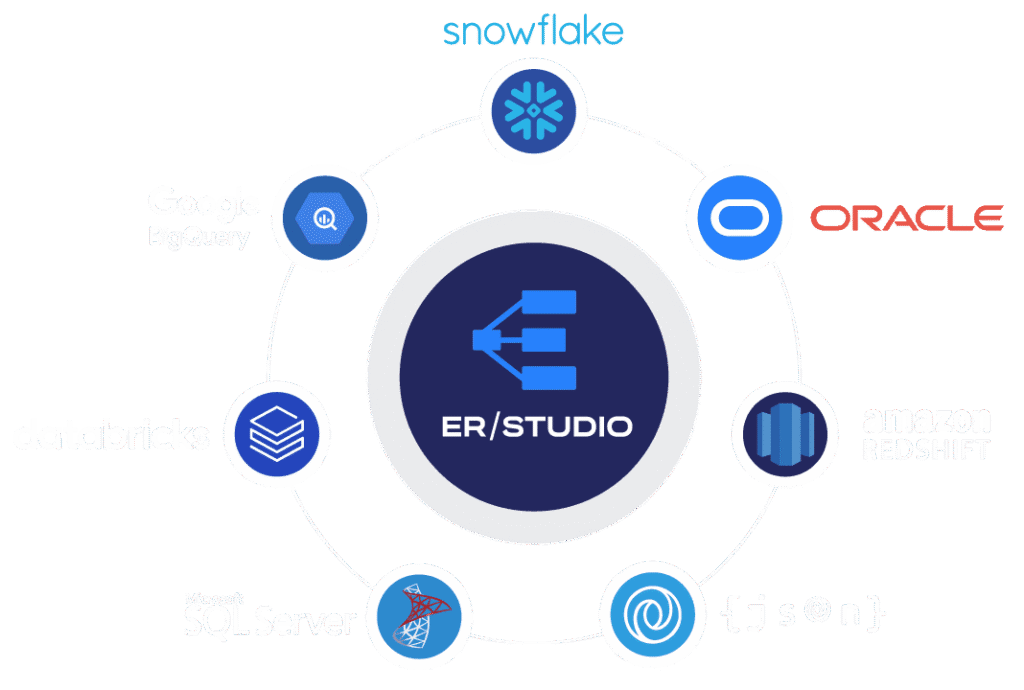
ER/Studio helps organizations build that foundation by connecting enterprise data modeling, metadata management, collaborative architecture workflows, governance, lineage, and semantic consistency into a unified enterprise architecture strategy.
The companies that lead in the AI era will not be the ones asking AI the most questions. They will be the ones whose data is structured well enough to trust the answers.