

Reseña de Corgea: Ventajas, Desventajas, Características y Precios
¿Sufres una acumulación creciente de alertas de seguridad y te preguntas si Corgea es la plataforma AppSec que realmente puede solucionar vulnerabilidades por ti? Esta reseña desglosa sus funciones, fortalezas y limitaciones para que puedas decidir rápidamente si se adapta al flujo de trabajo y objetivos de seguridad de tu equipo.

Revisamos herramientas de forma independiente y las comisiones ayudan a financiar nuestras pruebas. Consulta nuestra política de transparencia, nuestra metodología o sugiere una herramienta.
Security alerts keep piling up, developers keep shipping, and the gap between finding vulnerabilities and fixing them keeps getting wider.
Many AppSec platforms promise to detect and fix issues automatically, but it makes sense to pause and take a closer look at specific features before committing time and budget.
In this Corgea review, I break down how the platform works, what problems it solves, and where it fits compared to other tools so you can decide if it is worth adopting.
Corgea Evaluation Summary

0/5
- From $34/developer/month
- Free plan available
Por qué confiar en nuestras recomendaciones de software
6,700+
Reviews
20
Industry experts
16+
Evaluation factors
14
Years
Nuestro equipo lleva probando y evaluando software desde 2012. Como líderes tecnológicos, sabemos lo difícil —y lo importante— que es elegir el software adecuado.
Para esta guía, evaluamos las herramientas mediante pruebas prácticas e investigación independiente, puntuando las herramientas según nuestros criterios de selección.
Nuestras reseñas reflejan nuestro criterio editorial humano, no un discurso de ventas.
Revisores expertos:
- Paulo Gardini MiguelDirector técnico
 Tim FisherVP de IA
 Gabriel RosasTech Lead y arquitecto de software
 Christhian GruhnTech Lead y arquitecto de plataforma

Corgea Overview
Corgea is an AI-driven application security platform that helps development and security teams detect, prioritize, and fix vulnerabilities.
Rather than operating as a standalone security tool, Corgea integrates with repositories, CI pipelines, and developer environments to continuously scan code, identify real risks, and generate remediation suggestions.
By combining automated scanning, alert prioritization, and AI-generated fixes, the platform reduces manual security work. It helps teams ship secure code faster without slowing development.
One area where Corgea stands out is its ability to detect complex application-layer vulnerabilities, including business logic and authorization issues, while providing contextual analysis that helps reduce unnecessary security alerts.
Pros
- AI-generated security fixes help reduce manual remediation work.
- Strong automation helps streamline vulnerability detection, prioritize actionable findings, and reduce time spent reviewing low-value alerts.
- Built to integrate into developer workflows and existing toolchains.
Cons
- Primarily designed for technical teams.
- Newer vendor with a limited track record.
- Reporting and analytics are limited to higher-tier plans, so teams that need deeper visibility may have to upgrade sooner.
Is Corgea Right For Your Needs?
Who Would be a Good Fit for Corgea?
Corgea is built for modern software teams that want security built into their development workflow without slowing releases. If your team ships frequently and relies on CI/CD, Corgea helps automate vulnerability detection, triage, and remediation so security can scale alongside development.
- Fast-Moving Software Development TeamsFrequent release teams benefit from continuous scanning and auto-fix, which detect vulnerabilities and generate remediation pull requests automatically.
- DevOps and CI/CD-Driven WorkflowsTeams using GitHub, GitLab, Jenkins, or Azure DevOps benefit from native integrations that run security checks directly in pipelines and pull requests.
- Teams With Large Security BacklogsAuto-triage helps engineering and security teams prioritize real risks and reduce false positives.
- Companies Using Open-Source DependenciesTeams that rely on third-party libraries benefit from OSS dependency scanning that detects vulnerable packages early.
- Organizations Handling Sensitive DataBusinesses working with personal or healthcare data benefit from using PII/PHI and secret scanning to detect exposed sensitive information.
- Security Teams Supporting Developer ProductivityPolicies and automated remediation help AppSec and DevSecOps teams enforce security standards with minimal manual effort.
Who Would be a Bad Fit for Corgea?
Corgea targets modern development teams with active CI/CD workflows and dedicated engineering resources. If your organization doesn’t regularly ship software, lacks technical infrastructure, or needs highly specialized enterprise security tooling, Corgea is unlikely to be a strong fit.
- Non-Software or Offline BusinessesOrganizations that don’t build or maintain software won’t benefit from Corgea’s code scanning and CI/CD integrations, which are built specifically for development workflows.
- Teams Without CI/CD or Version Control WorkflowsCorgea relies on pipeline and repository integrations, so teams not using tools like GitHub, GitLab, or CI/CD pipelines won’t fully benefit from the platform.
- Very Small Teams With Minimal Security NeedsSmall teams with simple applications may find Corgea’s automation and advanced scanning features unnecessary compared to lighter security tools.
- Organizations Needing Deep Security CustomizationTeams requiring highly specialized or heavily customized security tooling may find Corgea’s policy and customization options too limited.
- Non-Technical or Business-Only TeamsCorgea is built for developers and security engineers, so teams without technical expertise may struggle to use the platform effectively.
Nuestra metodología de revisión
Cómo probamos y puntuamos las herramientas
Hemos invertido años construyendo, refinando y mejorando nuestro sistema de pruebas y puntuación de software. La rúbrica está diseñada para captar los matices de la selección de software y lo que hace a una herramienta efectiva, enfocándose en aspectos críticos del proceso de toma de decisiones.
A continuación, puedes ver exactamente cómo nuestro sistema de prueba y puntuación funciona a través de siete criterios. Esto nos permite ofrecer una evaluación imparcial del software basada en funcionalidad central, características destacadas, facilidad de uso, incorporación, soporte al cliente, integraciones, reseñas de clientes y relación calidad-precio.
Funcionalidad principal (25% de la puntuación final)
El punto de partida de nuestra evaluación siempre es la funcionalidad central de la herramienta. ¿Tiene las características y funciones básicas que un usuario esperaría encontrar? ¿Alguna de esas funciones principales está limitada a planes de precios superiores? Esperamos que una herramienta esté a la altura de las capacidades básicas de sus competidores.
Características destacadas (25% de la puntuación final)
Luego, evaluamos las características poco comunes y sobresalientes que van más allá de la funcionalidad principal que normalmente se encuentra en herramientas de su tipo. Una puntuación alta refleja características especializadas o únicas que hacen el producto más rápido, eficiente o que ofrecen valor adicional al usuario.
También evaluamos qué tan fácil es integrar con otras herramientas que normalmente forman parte del ecosistema tecnológico para expandir la funcionalidad y utilidad del software. Las herramientas que ofrecen abundantes integraciones nativas, conexiones de terceros y acceso API para crear integraciones personalizadas obtienen la mejor puntuación.
Facilidad de uso (10% de la puntuación final)
Consideramos cuán rápido y sencillo es ejecutar las tareas definidas por la funcionalidad principal usando la herramienta. El software con mejor puntuación está bien diseñado, es intuitivo, ofrece aplicaciones móviles, proporciona plantillas y hace que tareas relativamente complejas parezcan sencillas.
Incorporación (10% de la puntuación final)
Sabemos lo importante que es la adopción rápida por parte del equipo para una nueva plataforma, por lo que evaluamos cuán fácil es aprender y usar una herramienta con entrenamiento mínimo. Evaluamos cuán rápido un miembro del equipo puede configurarla y comenzar a utilizarla sin experiencia previa. Las soluciones con mayor puntuación requieren poco o ningún soporte.
Soporte al cliente (10% de la puntuación final)
Revisamos qué tan rápido y sencillo es resolver dudas y encontrar ayuda por teléfono, chat en vivo o base de conocimientos. Las herramientas y compañías que proporcionan soporte en tiempo real obtienen la mejor puntuación, mientras que los chatbots obtienen la peor.
Reseñas de clientes (10% de la puntuación final)
Además de nuestras pruebas y evaluaciones, consideramos la puntuación neta de promotores por parte de clientes actuales y anteriores. Revisamos la probabilidad de que elijan la herramienta de nuevo para la funcionalidad principal. Una puntuación alta refleja una alta puntuación neta de promotores actuales o pasados.
Relación calidad-precio (10% de la puntuación final)
Por último, considerando todos los demás criterios, revisamos el precio promedio de los planes de nivel básico comparado con las funciones principales y consideramos el valor de los demás criterios de evaluación. El software que ofrezca más, por menos, obtendrá una puntuación mayor.
Core Features
AI Application Security Scanning
This capability forms the foundation of the platform. Every other feature depends on accurate detection, so strong scanning enables Corgea to provide meaningful triage and remediation.
OSS Dependency Scanning
Modern applications rely heavily on open source software. Supply chain security reduces real-world risk and prevents attacks from compromised packages.
Secret Detection
Credential exposure remains one of the most common causes of breaches. Detecting secrets in code prevents credential leaks and security incidents.
Malware Detection
Corgea scans code and dependencies to detect malicious or injected code that could compromise applications, infrastructure, or development environments.
AI Auto Triage
Security teams often struggle with large volumes of alerts. Reducing noise and highlighting real risks lets teams move faster and make better decisions.
AI Auto Fix
Many security tools stop at detection. Corgea closes the gap between finding vulnerabilities and fixing them.

Standout Features
In Editor Security Fixes
Corgea provides a Visual Studio Code extension that allows developers to review and apply security fixes directly inside their editor while they write code.
Source and Sink Analysis
This deeper context helps Corgea identify complex security issues, including business logic flaws and authorization vulnerabilities that traditional pattern-based scanners can miss. By analyzing how data moves through an application, the platform provides more relevant findings and helps reduce alert noise so teams can focus on issues that matter most.

Ease of Use
Corgea fits directly into existing developer workflows, making it easy to adopt without major process changes.
You can connect repositories, run scans through CI pipelines, and receive fixes directly in pull requests, so security becomes part of your normal development cycle instead of a separate task.
With CLI and API support for automation, teams can integrate scanning and remediation quickly and keep development moving without extra overhead.

Onboarding
Corgea provides a quickstart guide that lets teams connect their repositories and begin scanning in minutes.
Documentation states you can get started in less than five minutes by installing the GitHub app and connecting your code. The documentation also walks teams through configuration, customization, applying fixes, and managing team access, giving users a clear step-by-step path from setup to ongoing use.
With built-in guides, tutorials, and API documentation available for deeper integrations and automation, teams have multiple resources to support both initial setup and long term adoption.

Customer Support
Corgea provides support through a contact form for direct inquiries and a knowledge hub with documentation, guides, and resources to help teams troubleshoot and learn independently. The platform also offers custom demos that explain workflows and features during evaluation.

Integrations
Corgea offers native integrations with developer tools and workflows, including GitHub, GitLab, Azure DevOps, Jenkins, Visual Studio Code, Visual Studio, and a CLI for automation.
It also connects with tools like Jira, Slack, Zapier, and SAML-based identity providers, helping teams embed security directly into repositories, pipelines, chat, and ticketing systems.
An API is available for teams that want to build custom integrations or automate security workflows further.

Value for Money
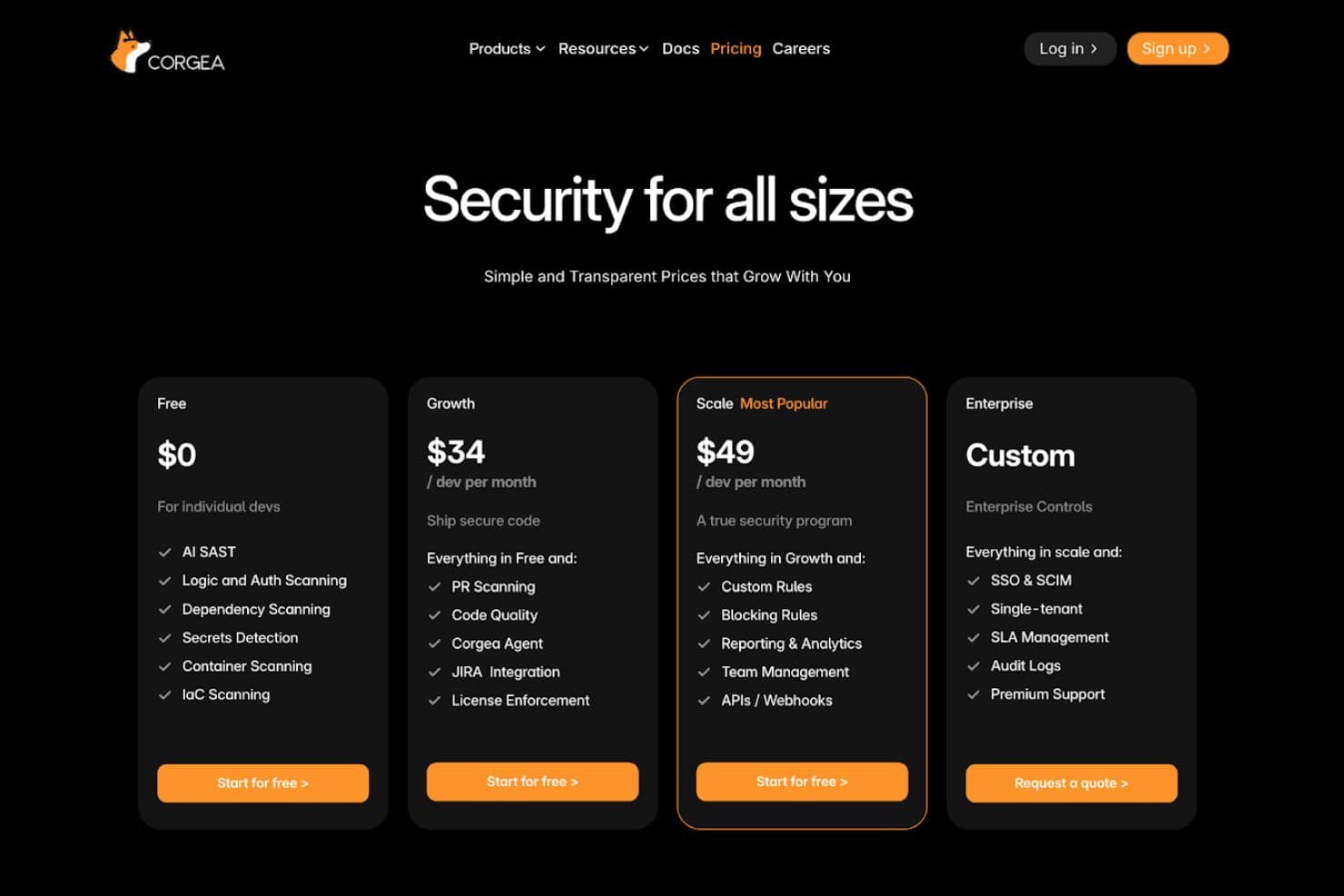
Corgea uses a tiered pricing model that lets teams start with core security scanning and expand into automation, integrations, and enterprise governance as they grow.
- Free: Includes AI SAST, logic and auth scanning, dependency scanning, secrets detection, container scanning, and IaC scanning for individual developers and small teams.
- Growth: Adds pull request scanning, code quality checks, Jira integration, and license enforcement to support team workflows.
- Scale: Introduces custom rules, blocking rules, reporting and analytics, team management, APIs, and webhooks for a more complete security program.
- Enterprise: Provides SSO, SCIM, single tenant deployment, SLA management, audit logs, and premium support for enterprise environments.
This structure makes it easy to begin with essential features and upgrade as security and compliance needs increase.
Corgea Specs
- 2-Factor Authentication: No
- Access Management: No
- Anti-Virus: No
- API: Yes
- Audit Management: No
- Audit Trail: No
- Batch Permissions & Access: No
- Compliance Tracking: No
- Dashboard: Yes
- Data Export: Yes
- Data Import: Yes
- DDoS Protection: No
- External Integrations: Yes
- File Sharing: No
- File Transfer: No
- Firewall: No
- Incident Management: Yes
- Malware Protection: No
- Multi-User: Yes
- Notifications: Yes
- Password & Access Management: No
- Policy Management: Yes
- Real-time Alerts: Yes
- Report & Compliance: Yes
- Risk Assessment: Yes
- Security Migration: No
- Threat Detection: No
- Workflow Management: Yes
Corgea FAQs
Corgea Company Overview & History
Corgea, founded by Ahmad Sadeddin, is a San Francisco-based cybersecurity startup founded in 2023 that builds an AI-driven platform to automate vulnerability detection, triage, and remediation for modern development teams.
The company focuses on helping developers secure applications more efficiently by reducing false positives and accelerating remediation workflows.
Corgea Major Milestones
- 2023: Corgea was founded in California.
- 2024: Raised USD 2.6 million in seed funding from prominent investors.