

Navigieren durch die 10 besten IoT-Plattformen des Jahres 2026

10 Beste IoT-Plattformen Kurzliste
Here's my pick of the 10 best software from the 24 tools reviewed.


Sich in der Welt der IoT-Plattformen zurechtzufinden, kann überwältigend sein – besonders, wenn Sie nach der passenden Lösung für Ihr Team suchen. Bei so vielen Möglichkeiten ist es schwer zu wissen, welche Ihren Bedürfnissen wirklich gerecht wird. Als jemand, der Software unabhängig testet und bewertet, kenne ich diese Herausforderungen und möchte Sie dabei unterstützen, diese zu meistern.
Ich habe eine gründlich recherchierte Liste der besten verfügbaren IoT-Plattformen zusammengestellt und dabei besonderen Wert auf deren einzigartige Merkmale und Vorteile gelegt. Nach meiner Erfahrung kann eine zuverlässige Plattform die Arbeitsweise Ihres Teams grundlegend verändern, mit Lösungen für Datenmanagement, Konnektivität und mehr.
Im Verlauf dieses Artikels finden Sie unabhängige Bewertungen, die Ihnen helfen, fundierte Entscheidungen zu treffen. Lassen Sie uns gemeinsam entdecken, was diese Plattformen für Sie leisten können.
Why Trust Our Software Reviews
Beste IoT-Plattformen Zusammenfassung
| Tool | Best For | Trial Info | Price | ||
|---|---|---|---|---|---|
| 1 | Best for CRM integrated IoT solutions | Not available | Pricing upon request | Website | |
| 2 | Best for scalable cloud integration | Not available | From $7/user/month (billed annually) + $49 base fee per month | Website | |
| 3 | Best for large-scale enterprise solutions | Free demo + 30-day free trial available | Pricing upon request | Website | |
| 4 | Best for industrial automation and digitalization | Free demo available | Pricing upon request | Website | |
| 5 | Best for rapid IoT application development | Not available | Pricing upon request | Website | |
| 6 | Best for IoT fleet management | Not available | Pricing upon request | Website | |
| 7 | Best for smart home device platforms | Not available | Pricing upon request | Website | |
| 8 | Best for end-to-end device connectivity | Free plan available | From $299/block/month | Website | |
| 9 | Best for IoT module hardware integration | Not available | Pricing upon request | Website | |
| 10 | Best for real-time IoT data visualization | Free demo available | Pricing upon request | Website |
-

Site24x7
Visit WebsiteThis is an aggregated rating for this tool including ratings from Crozdesk users and ratings from other sites.4.6 -
GitHub Actions
Visit WebsiteThis is an aggregated rating for this tool including ratings from Crozdesk users and ratings from other sites.4.8 -
Docker
Visit WebsiteThis is an aggregated rating for this tool including ratings from Crozdesk users and ratings from other sites.4.6




Beste IoT-Plattformen Bewertungen


Salesforce IoT Cloud is a platform that bridges the gap between customer relationship management (CRM) and IoT. By connecting devices to Salesforce's vast CRM ecosystem, the tool provides real-time data insights and fosters improved customer experiences. The tool's strength lies in its CRM-integrated IoT solutions, allowing businesses to capitalize on their IoT data within the context of customer management.
Why I Picked Salesforce IoT Cloud:
While choosing the right platforms for IoT, the Salesforce IoT Cloud struck me as a distinctive tool, given its deep integration with a world-class CRM system. I determined that its tight-knit combination of IoT and CRM functions made it stand apart from other contenders. I chose this tool because it uniquely addresses the need for businesses to directly relate IoT data with customer behaviors and trends. It is undoubtedly best suited for organizations looking for CRM-integrated IoT solutions.
Standout features and integrations:
The Salesforce IoT Cloud boasts features like proactive device monitoring, which can trigger CRM workflows based on device data. Additionally, with the Event Processing Engine, businesses can process billions of events daily, analyzing data and taking necessary actions. Integrations are at the heart of Salesforce, and the IoT Cloud integrates effortlessly with other Salesforce products, ensuring a unified experience and leveraging existing CRM data.
Pros and Cons
Pros:
- Proactive device monitoring that can drive CRM actions
- Ability to process billions of events daily
- Deep integration with Salesforce CRM for cohesive data handling
Cons:
- Some users may desire more out-of-the-box integrations with non-Salesforce products
- Can be on the pricier side compared to other IoT platforms
- Might have a learning curve for those unfamiliar with Salesforce


Amazon Web Services (AWS) IoT is a comprehensive platform that delivers a robust set of services for connecting devices, managing applications, and integrating with the cloud. Its focus on scalable cloud integration allows businesses to grow and adapt their IoT infrastructure easily, a feature that directly ties into why it is best for scalable cloud integration.
Why I Picked Amazon Web Services (AWS) IoT:
I chose AWS IoT because of its wide-reaching functionality and a strong emphasis on scalability. Among the many platforms I've compared, its cloud integration services stood out, offering versatile options for businesses of all sizes. AWS IoT is best for scalable cloud integration, enabling organizations to expand their connected devices and applications while ensuring robust security and efficiency.
Standout Features and Integrations:
AWS IoT offers features like Device Defender, which monitors and ensures device security, and IoT Core, which allows connectivity between devices and the cloud. It also includes analytics tools that enable real-time processing of data. Important integrations include those with AWS Lambda for code execution, Amazon S3 for storage, and Amazon SageMaker for machine learning capabilities.
Pros and Cons
Pros:
- Scalable to accommodate business growth
- Strong focus on security and compliance
- Wide range of features and tools
Cons:
- Limited support for non-AWS environments
- Can become costly as usage increases
- Complex for new users to understand

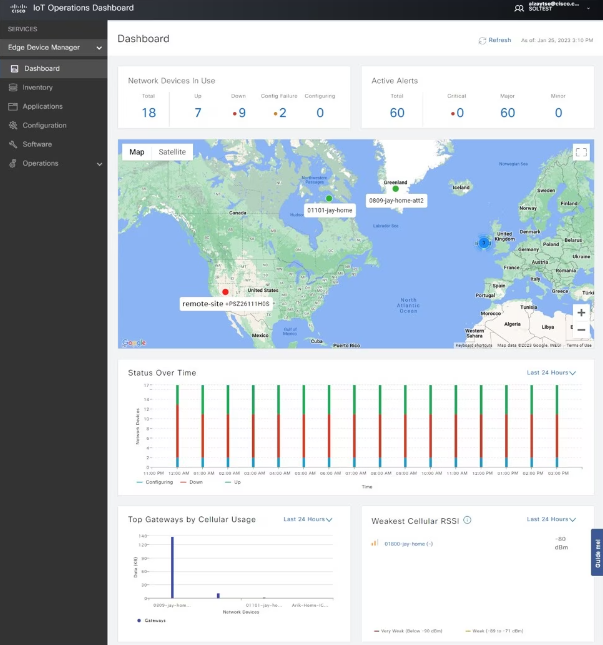
Cisco IoT is synonymous with robust, enterprise-level IoT solutions designed for scalability and reliability. By catering to large-scale enterprises, it lives up to its reputation, making it undeniably the best choice for expansive corporate networks seeking IoT integration.
Why I Picked Cisco IoT:
When it came to selecting IoT platforms that cater specifically to large enterprises, Cisco was impossible to overlook. From all the options, it stood apart, not just because of the brand's reputation but due to its commitment to handling the complexities of vast enterprise networks. In my comparisons and evaluations, I determined that for corporations seeking a resilient, scalable IoT solution, Cisco IoT is unequivocally best for large-scale enterprise solutions.
Standout Features and Integrations:
Cisco IoT boasts a suite of security features ensuring safe device connectivity across sprawling enterprise networks. Its data analytics tools provide real-time insights, pivotal for making critical business decisions. Integration-wise, Cisco IoT works harmoniously with ERP systems like SAP, Oracle, and Salesforce, connecting the dots between operations and data.
Pros and Cons
Pros:
- Integrates with major ERP systems
- Comprehensive security features for large-scale deployments
- Tailored for vast enterprise networks
Cons:
- Complexity necessitates IT professionals for setup and maintenance
- Proprietary hardware is often required
- Might be overkill for smaller businesses


Siemens is a global powerhouse focusing on the areas of electrification, automation, and digitalization. As one of the world's largest producers of energy-efficient, resource-saving technologies, Siemens is a leading supplier of systems for power generation and transmission. Its commitment to industrial automation and digitalization makes it an ideal choice for businesses aiming to streamline their industrial processes.
Why I Picked Siemens:
I determined Siemens to be a prominent contender when selecting tools for this list, mainly due to its significant contributions in the domain of industrial automation. Having opinions and comparisons from industry experts further reinforced my judgment. Siemens stands apart, particularly because of its unparalleled expertise and vast experience in the industry. For organizations emphasizing industrial automation and digital transformation, Siemens naturally presents itself as the optimal choice.
Standout features and integrations:
Siemens boasts a comprehensive range of software for automation, including SIMATIC SCADA, TIA Portal, and SINAMICS Drive Technology. These tools offer advanced functionalities that can integrate easily with various industrial hardware and software. Furthermore, Siemens integrates effortlessly with many IoT platforms, ensuring real-time data exchange and rapid insights.
Pros and Cons
Pros:
- Strong integrations with various industrial IoT platforms
- Renowned for its reliability and efficiency in the industry
- Comprehensive range of automation software solutions
Cons:
- Licensing structure may be complex for some businesses
- While robust, some tools have a steep learning curve
- The vast array of solutions can be overwhelming for newcomers


ThingWorx, a product by PTC, is designed to empower businesses with swift IoT application development capabilities. Recognized for its intuitive interface and tools, it is ideally positioned for organizations that want to quickly prototype, develop, and deploy IoT solutions.
Why I Picked ThingWorx (PTC):
When searching for platforms that allow accelerated IoT application development, ThingWorx constantly emerged as a top choice. I chose it due to its unique blend of user-friendly design tools and powerful backend capabilities. My judgment, after comparing various platforms, was that ThingWorx provides the right balance of simplicity and functionality, making it best for rapid IoT application development.
Standout features and integrations:
ThingWorx shines with its drag-and-drop interface, enabling non-developers to visualize and create IoT applications. Its robust analytics tools provide actionable insights derived from data streams. As for integrations, ThingWorx collaborates effectively with popular cloud platforms like AWS and Azure, allowing for data synchronization and management across systems.
Pros and Cons
Pros:
- Efficient integration with major cloud platforms
- Comprehensive analytics tools for real-time insights
- Drag-and-drop interface simplifies application creation
Cons:
- Some users might prefer code-heavy environments for deeper customization
- Licensing costs can be high for larger enterprises
- Might have a steeper learning curve for complete novices


Balena provides a platform tailored for developers to deploy, manage, and scale IoT fleets. Its tools cater to the entire device lifecycle, from development to deployment and monitoring. The platform's primary strength lies in efficient fleet management, making it an apt choice for the "best for" claim.
Why I Picked Balena:
In my journey of examining various IoT tools, I determined that Balena had distinct advantages in managing multiple devices. Its focus on fleet management set it apart from many other solutions I reviewed. I believe that for organizations looking to oversee extensive IoT deployments and simplify device maintenance, Balena is the front-runner, earning its title as best for IoT fleet management.
Standout features and integrations:
One of Balena's key features is its BalenaCloud, which allows for easy deployment and updates to IoT devices. The platform also supports a container-based approach, ensuring consistent environments across all devices. In terms of integrations, Balena can work with popular cloud providers, such as AWS, Google Cloud, and Azure, facilitating better data management and analytics.
Pros and Cons
Pros:
- Comprehensive integrations with major cloud providers
- Container-based system ensures consistency across devices
- BalenaCloud simplifies device deployment and updates
Cons:
- Limited to its own operating system, balenaOS, for some functionalities
- Certain advanced features may require a deeper technical understanding
- Might be complex for users unfamiliar with containerization


Tuya provides an all-inclusive IoT platform that aids manufacturers, brands, OEMs, and retail chains in developing smart home devices. By offering a unified suite of tools and solutions, Tuya empowers businesses to bring smart devices to consumers globally. Its emphasis on the smart home ecosystem naturally positions it as a preferred choice for those prioritizing this niche.
Why I Picked Tuya:
I chose Tuya after determining its leadership in the realm of smart home platforms. In my judgment, and after comparing several platforms, Tuya stood out for its expansive ecosystem and ability to cater to multiple stakeholders in the smart device manufacturing process. This has led me to believe that Tuya is best suited for smart home device platforms.
Standout features and integrations:
Tuya offers a robust AI+IoT platform, which facilitates rapid development and launch of smart devices. Its capabilities span from voice and video services to data analytics, helping businesses glean actionable insights. Integration-wise, Tuya’s platform meshes well with major voice assistants like Amazon Alexa and Google Assistant, thus enhancing user experience.
Pros and Cons
Pros:
- Ready compatibility with leading voice assistants
- Extensive support for voice and video services
- Comprehensive AI+IoT platform suitable for diverse smart device creation
Cons:
- Some advanced features might have steeper learning curves
- Customizing for very specific niches might present challenges
- Might be overwhelming for newcomers due to its vast array of features


Particle is a leading force when it comes to connecting devices from the edge to the cloud. Its prowess in maintaining consistent and reliable connections across the entire spectrum of IoT infrastructure gives credence to its standing as the best for end-to-end device connectivity.
Why I Picked Particle:
In my journey of selecting the optimal IoT platforms, Particle emerged as a unique entity. My determination was based on its unmatched capability to ensure consistent device connectivity, from the smallest sensor to the vast realms of the cloud. Comparing it with peers, Particle's concentration on delivering uninterrupted connections made it a standout. It's this commitment to connectivity that solidified my opinion that Particle is genuinely best for end-to-end device connectivity.
Standout Features and Integrations:
Particle showcases a Device Cloud feature, which manages the health of devices, ensuring they remain connected. Its Edge Operations feature facilitates smooth firmware updates. As for integrations, Particle aligns well with popular platforms such as Google Cloud, Microsoft Azure, and IFTTT, ensuring devices can interact with a multitude of services easily.
Pros and Cons
Pros:
- Streamlined firmware update process
- Integrates with major cloud platforms
- Strong emphasis on continuous device connectivity
Cons:
- Costs can accumulate with the addition of more devices
- Initial learning curve for new users
- Limited to its ecosystem for some features


Telit specializes in offering advanced IoT modules, platforms, and services. Designed for easy integration into various applications, Telit's solutions make it easier for businesses to tap into the power of the Internet of Things. Their expertise in IoT module hardware integration stood out, making them an appropriate choice for the designated "best for" title.
Why I Picked Telit:
In my exploration of numerous IoT solutions, I selected Telit for its comprehensive approach to hardware module integration. Compared to other tools, Telit's offerings uniquely focus on ensuring that IoT modules integrate effectively with various applications and systems. I'm of the opinion that Telit holds a distinctive edge in this domain, aptly positioning it as the best for IoT module hardware integration.
Standout features and integrations:
Telit's modules boast high-speed connectivity options, including 5G, catering to diverse IoT application needs. Their OneEdge software suite simplifies device management and offers tools for quicker IoT deployments. As for integrations, Telit's modules are compatible with numerous platforms, ensuring that businesses can tie them into their existing infrastructure without significant hurdles.
Pros and Cons
Pros:
- Wide compatibility ensures smooth integration with various platforms
- OneEdge software eases device management and accelerates deployments
- High-speed connectivity options, including 5G, cater to varied needs
Cons:
- Custom integrations could present challenges for certain legacy systems
- Initial setup might require a significant technical understanding
- Some modules might be overkill for simpler IoT projects


Losant is a comprehensive IoT platform geared towards visualizing and analyzing IoT data in real time. It empowers enterprises to connect their devices, collect data, and generate instant visual insights to make informed decisions. Its proficiency in presenting real-time IoT data visually is what aligns it with the "best for" claim.
Why I Picked Losant:
In my process of selecting platforms, I judged Losant based on its robust visualization capabilities and versatility. It caught my attention due to its distinct emphasis on real-time data representation, making it unique compared to other platforms. My opinion is that for businesses prioritizing immediate insights from their IoT data, Losant stands out as the ideal choice, making it best for real-time data visualization.
Standout features and integrations:
Losant offers powerful features like its Visual Workflow Engine, allowing users to build and customize their IoT solutions without intensive coding. Additionally, its End-User Experiences tool enables businesses to create custom branded interfaces for their users. Integrations-wise, Losant supports a variety of third-party systems, including MQTT, RESTful APIs, and Webhooks, making it compatible with a broad spectrum of devices and applications.
Pros and Cons
Pros:
- Broad integration capabilities with third-party systems
- End-User Experiences tool for custom-branded user interfaces
- Advanced Visual Workflow Engine for tailored IoT solutions
Cons:
- Potential costs associated with scaling large deployments
- Limited built-in tools for non-visualization aspects of IoT
- Might require a steep learning curve for non-technical users
Weitere IoT-Plattformen
Im Folgenden finden Sie eine Liste weiterer IoT-Plattformen, die ich zwar auf die Shortlist gesetzt, aber nicht unter die Top 10 aufgenommen habe. Sie sind definitiv einen Blick wert.
- Bosch IoT Suite
For diverse IoT ecosystem support
- Ayla Networks
For agile IoT device management
- Blynk
-iot-platforms
- Microsoft Azure IoT
-iot-platforms
- Ubidots
-iot-platforms
- NimbeLink
-iot-platforms
- myDevices
-iot-platforms
- Kaa IoT Platform
-iot-platforms
- DeviceHive
-iot-platforms
- SiteWhere
-iot-platforms
- ClearBlade
-iot-platforms
- IBM Watson IoT
-iot-platforms
- Cisco IoT Cloud Connect
-iot-platforms
- Oracle IoT Cloud
-iot-platforms


Verwandte Bewertungen
IoT-Plattform Auswahlkriterien
Bei der Auswahl der besten IoT-Plattformen für diese Liste habe ich auf gemeinsame Käuferbedürfnisse und Schmerzpunkte wie Gerätekompatibilität und Datensicherheit geachtet. Zusätzlich habe ich folgendes Rahmenwerk genutzt, um meine Bewertung strukturiert und fair zu gestalten:
Kernfunktionen (25 % der Gesamtbewertung)
Um in diese Liste aufgenommen zu werden, musste jede Lösung die folgenden häufigen Anwendungsfälle abdecken:
- Geräte-Konnektivität
- Datenanalyse
- Fernüberwachung
- Sicherheitsmanagement
- Skalierbarkeit
Zusätzliche herausragende Funktionen (25 % der Gesamtbewertung)
Um die Auswahl weiter einzugrenzen, habe ich außerdem nach besonderen Features wie folgenden gesucht:
- Edge-Computing-Fähigkeiten
- Integration mit KI-Tools
- Anpassbare Dashboards
- Echtzeit-Benachrichtigungen
- Prädiktive Wartung
Benutzerfreundlichkeit (10 % der Gesamtbewertung)
Um mir einen Eindruck von der Benutzerfreundlichkeit jeder Lösung zu verschaffen, habe ich auf folgende Punkte geachtet:
- Intuitives Oberflächendesign
- Einfache Navigation
- Klare Dokumentation
- Minimale Einrichtungskomplexität
- Benutzerfreundliche Steuerung
Onboarding (10 % der Gesamtbewertung)
Um die Einarbeitung bei jeder Plattform zu beurteilen, habe ich folgende Aspekte einbezogen:
- Verfügbarkeit von Trainingsvideos
- Interaktive Produkttouren
- Zugang zu Webinaren
- Umfassende Vorlagen
- Reaktionsschnelle Chatbots
Kundensupport (10 % der Gesamtbewertung)
Um die Kundendienstleistungen der jeweiligen Softwareanbieter zu beurteilen, habe ich Folgendes berücksichtigt:
- 24/7-Erreichbarkeit
- Multikanal-Supportoptionen
- Reaktionsgeschwindigkeit auf Anfragen
- Zugang zu einem dedizierten Support-Team
- Qualität der Problemlösungsressourcen
Preis-Leistungs-Verhältnis (10 % der Gesamtbewertung)
Um das Preis-Leistungs-Verhältnis jeder Plattform zu bewerten, habe ich Folgendes einbezogen:
- Wettbewerbsfähige Preisgestaltung
- Funktionen auf den jeweiligen Preisstufen
- Flexibilität bei Preisplänen
- Keine versteckten Gebühren
- Kosten-Nutzen-Analyse
Kundenbewertungen (10 % der Gesamtbewertung)
Um einen Eindruck der allgemeinen Kundenzufriedenheit zu erhalten, habe ich bei der Analyse der Kundenrezensionen Folgendes berücksichtigt:
- Gesamte Zufriedenheitsbewertungen
- Rückmeldungen zur Zuverlässigkeit
- Kommentare zur Benutzerfreundlichkeit
- Erwähnung von bestimmten Funktionen
- Langfristige Nutzererfahrungen
So wählen Sie eine IoT-Plattform aus
Es ist leicht, sich in langen Funktionslisten und komplexen Preisstrukturen zu verlieren. Damit Sie bei der Auswahl Ihrer individuellen Software fokussiert bleiben, finden Sie hier eine Checkliste mit Faktoren, die Sie berücksichtigen sollten:
| Faktor | Was zu berücksichtigen ist |
|---|---|
| Skalierbarkeit | Kann die Plattform mit Ihrem Wachstum Schritt halten? Berücksichtigen Sie zukünftige Anforderungen und ob die Plattform ohne hohe Kosten oder Komplexität skalieren kann. |
| Integrationen | Arbeitet sie mit Ihren aktuellen Systemen zusammen? Achten Sie auf native Integrationen mit bestehender Software, um teure Eigenentwicklungen zu vermeiden. |
| Anpassbarkeit | Können Sie die Plattform auf Ihre Arbeitsabläufe zuschneiden? Prüfen Sie, ob die Plattform sich individuell auf Ihre spezifischen Prozessanforderungen anpassen lässt. |
| Benutzerfreundlichkeit | Ist die Plattform für Ihr Team einfach zu bedienen? Testen Sie die Benutzeroberfläche auf Intuitivität und Einfachheit, um eine schnelle Einführung sicherzustellen. |
| Implementierung und Onboarding | Wie lange dauert die Inbetriebnahme? Bewerten Sie die zur Verfügung gestellten Ressourcen und die Unterstützung beim Einrichten und Schulen, z. B. Tutorials oder dedizierte Onboarding-Teams. |
| Kosten | Passt der Preis zu Ihrem Budget? Vergleichen Sie die Preisstufen und achten Sie darauf, dass keine versteckten Gebühren anfallen. Stellen Sie den Preis ins Verhältnis zum gebotenen Gegenwert. |
| Sicherheitsvorkehrungen | Sind Ihre Daten und Geräte sicher? Achten Sie auf Verschlüsselung, Einhaltung von Datenschutzstandards und regelmäßige Sicherheitsupdates. |
| Verfügbarkeit des Supports | Ist Hilfe verfügbar, wenn Sie sie brauchen? Suchen Sie nach 24/7-Supportoptionen und prüfen Sie die Qualität des Kundendienstes durch Bewertungen oder direkte Anfragen. |
Was sind IoT-Plattformen?
IoT-Plattformen sind Werkzeuge, die Daten von internetfähigen Geräten verbinden, verwalten und analysieren. Diese Plattformen werden typischerweise von IT-Profis, Entwicklern und Business-Analysten genutzt, um die Betriebsabläufe zu verbessern und datenbasierte Entscheidungen zu treffen. Geräteanbindung, Datenanalysen und Funktionen zur Fernüberwachung helfen bei der Systemintegration, Prozessoptimierung und Verbesserung der Nutzererfahrung. Insgesamt bieten diese Tools Unternehmen eine Grundlage, um IoT-Technologien effektiv einzusetzen.
Funktionen
Achten Sie bei der Auswahl von IoT-Plattformen besonders auf folgende Schlüsselfunktionen:
- Geräte-Konnektivität: Ermöglicht nahtlose Kommunikation zwischen Geräten und sorgt dafür, dass Daten effizient gesammelt und übertragen werden.
- IoT-Analyseplattform: Bietet Einblicke, indem Daten von vernetzten Geräten verarbeitet und analysiert werden, um fundierte Entscheidungen zu unterstützen.
- Fernüberwachung: Ermöglicht es Nutzern, Geräte und Systeme von überall aus zu überwachen, was das Management und die Fehlerbehebung verbessert.
- Edge Computing: Verarbeitet Daten näher an der Quelle, reduziert Latenzzeiten und verbessert die Reaktionszeiten für Echtzeitanwendungen.
- Anpassbare Dashboards: Bietet Nutzern die Möglichkeit, Oberflächen individuell zu gestalten und wichtige Daten und Kennzahlen bedarfsgerecht anzuzeigen.
- Sicherheitsmanagement: Schützt Daten und Geräte durch Verschlüsselung und Einhaltung von Branchenstandards und sorgt damit für Sicherheit und Vertrauen.
- Over-the-Air-Updates: Ermöglicht Software-Updates aus der Ferne, sodass Geräte ohne manuelles Eingreifen auf dem neuesten Stand bleiben.
- Skalierbarkeit: Unterstützt das Wachstum, indem immer mehr Geräte und größere Datenmengen aufgenommen werden können, ohne die Leistung zu beeinträchtigen.
Vorteile
Die Implementierung von IoT-Plattformen bringt zahlreiche Vorteile für Ihr Team und Ihr Unternehmen. Hier sind einige, auf die Sie sich freuen können:
- Verbesserte Effizienz: Automatisiert Datensammlung und -analyse, sodass Ihr Team sich auf strategische Aufgaben statt auf manuelle Prozesse konzentrieren kann.
- Verbesserte Entscheidungsfindung: Bietet Echtzeiteinblicke durch Datenanalysen und hilft Ihrem Team, schnelle und fundierte Geschäftsentscheidungen zu treffen.
- Kosteneinsparungen: Reduziert Betriebskosten durch optimierte Ressourcennutzung und minimierte Ausfallzeiten mittels vorausschauender Wartung.
- Erhöhte Skalierbarkeit: Ermöglicht Ihrem Unternehmen zu wachsen, indem mehr Geräte und Daten ohne zusätzliche Infrastruktur aufgenommen werden können.
- Bessere Sicherheit: Schützt sensible Daten und Geräte mit fortschrittlichen Sicherheitsfunktionen wie VPN-Software, gewährleistet Compliance und minimiert Risiken.
- Fernzugriff: Ermöglicht Überwachung und Verwaltung von Geräten von jedem Ort aus und verbessert damit Flexibilität und Reaktionszeiten.
Kosten & Preise
Bei der Auswahl von IoT-Plattformen ist es wichtig, die verschiedenen Preismodelle und -pläne zu verstehen. Die Kosten variieren je nach Features, Teamgröße, Zusatzoptionen und mehr. Die nachstehende Tabelle fasst gängige Tarife, deren durchschnittliche Preise sowie typische Features von IoT-Plattform-Lösungen zusammen:
Tarifvergleichstabelle für IoT-Plattformen
| Tarifart | Durchschnittspreis | Gemeinsame Features |
|---|---|---|
| Gratis-Tarif | $0 | Grundlegende Konnektivität, begrenzter Datenspeicher und Community-Support. |
| Personal-Tarif | $5-$25/user/month | Erweiterte Konnektivität, grundlegende Analysen und E-Mail-Support. |
| Business-Tarif | $30-$75/user/month | Vollständige Analysen, erweiterte Sicherheitsfunktionen und bevorzugter Support. |
| Enterprise-Tarif | $100+/user/month | Individuelle Integrationen, dediziertes Account-Management und umfassende Analysen. |
IoT-Plattformen FAQs
Wie verhindern IoT-Plattformen Systemausfälle?
Sie überwachen Daten von vernetzten Geräten, um Probleme frühzeitig zu erkennen, damit Teams diese beheben können, bevor sie zu Verzögerungen oder Ausfällen führen.
Welche Herausforderungen gibt es bei der Nutzung von IoT-Plattformen?
Unternehmen stehen häufig vor Einrichtungsproblemen, Kompatibilitätsschwierigkeiten zwischen Geräten und Bedenken hinsichtlich der Datensicherheit. Sorgfältige Planung und Tests können den Prozess erleichtern.
Können IoT-Plattformen auch ohne Internet funktionieren?
Ja. Viele können Daten lokal speichern und verarbeiten und synchronisieren sich mit der Cloud, sobald die Internetverbindung wiederhergestellt ist.
Wie schützen IoT-Plattformen Nutzerdaten?
Sie setzen Verschlüsselung, sichere Zugangskontrollen und Datenschutzvorgaben wie die DSGVO ein, um vertrauliche Informationen zu schützen.
Wie helfen IoT-Daten, bessere Entscheidungen zu treffen?
Durch die Umwandlung von Echtzeitdaten in Erkenntnisse helfen IoT-Plattformen Unternehmen, Trends zu erkennen, Verschwendung zu reduzieren und tägliche Abläufe zu optimieren.
Wie geht es weiter?
Wenn Sie gerade dabei sind, nach IoT-Plattformen zu recherchieren, verbinden Sie sich mit einem SoftwareSelect-Berater für kostenlose Empfehlungen.
Sie füllen ein Formular aus und führen ein kurzes Gespräch, in dem Ihre speziellen Anforderungen besprochen werden. Anschließend erhalten Sie eine Shortlist von Softwareoptionen zur Prüfung. Die Berater unterstützen Sie während des gesamten Kaufprozesses – inklusive Preisverhandlungen.