

Avis sur AWS CloudHSM : Avantages, Inconvénients, Fonctionnalités et Tarification Expliqués
Salesflare se distingue comme un CRM convivial conçu pour les petites équipes B2B, excellent en automatisation et simplicité, mais pouvant manquer de personnalisation avancée pour les processus de vente complexes.

Nous évaluons les outils indépendamment ; les commissions aident à financer nos tests. Consultez notre politique de transparence et notre méthodologie.
AWS CloudHSM is an HSM vendor offering dedicated, single-tenant hardware security modules hosted inside AWS. I'd consider it if your team needs FIPS 140-2 Level 3-compliant key management without running physical hardware on-premises. It integrates more natively with AWS services like Amazon RDS, EC2, and CloudTrail than Thales Luna Network HSM does, which makes it the stronger choice when your workloads are already in AWS.
AWS CloudHSM Evaluation Summary
4.5/5
- Pricing upon request
- Free demo available
Pourquoi faire confiance à nos recommandations de logiciels
6,700+
Reviews
20
Industry experts
16+
Evaluation factors
14
Years
Notre équipe teste et évalue des logiciels depuis 2012. En tant que leaders technologiques nous-mêmes, nous savons à quel point il est difficile — et important — de choisir le bon logiciel.
Pour ce guide, nous avons évalué les outils grâce à des tests pratiques et une recherche indépendante, en notant les outils selon nos critères de sélection.
Nos avis reflètent notre jugement éditorial humain, et non un argumentaire de vente.
Réviseurs experts:
- Paulo Gardini MiguelDirecteur technique
 Tim FisherVP de l'IA
 Gabriel RosasTech Lead et architecte logiciel
 Christhian GruhnTech Lead et architecte plateforme

AWS CloudHSM Overview
When judging AWS CloudHSM against other HSM vendors, its deep AWS integration, pay-as-you-go pricing, and managed infrastructure make it a strong choice for teams already invested in AWS. The interface and onboarding are straightforward for cloud-native environments, and support is reliable through AWS channels.
However, it underperforms for organizations needing advanced customization or hybrid deployments. If you're selecting an HSM for workloads like database encryption or application-level key management within AWS, CloudHSM is a practical, scalable option. For highly specialized or on-premises needs, you may find its flexibility limited compared to some alternatives.
Pros
- Single-tenant hardware security modules meet strict compliance needs
- Pay-as-you-go pricing helps control operational costs
- FIPS 140-2 Level 3 validation supports regulated industries
Cons
- No support for hybrid or on-premises deployments
- Limited algorithm and protocol support compared to some peers
- Requires AWS ecosystem for full feature access
Is AWS CloudHSM Right For Your Needs?
Who Would be a Good Fit for AWS CloudHSM?
AWS CloudHSM is a strong choice for organizations that operate primarily in the cloud, require strict compliance, and want to avoid managing physical HSM appliances. It's especially well-suited for regulated industries, large enterprises with AWS investments, and teams that need scalable, managed key storage for sensitive workloads. The service's FIPS 140-2 Level 3 validation and single-tenant model make it a reliable option for those with high security and isolation requirements.
- Financial ServicesMeets regulatory demands for key management and auditability in banking.
- Healthcare ProvidersSupports HIPAA-compliant encryption for sensitive patient data in AWS.
- SaaS ProvidersEnables secure, scalable key storage for multi-tenant cloud-based applications.
- Large EnterprisesFits organizations with complex AWS environments and strict compliance needs.
- Security OperationsProvides dedicated hardware security modules for cryptographic operations and key lifecycle control.
- DevOps TeamsAutomates key management within AWS-native CI/CD pipelines.
Who Would be a Bad Fit for AWS CloudHSM?
AWS CloudHSM is less suitable for organizations with hybrid or on-premises infrastructure, those needing broad algorithm support, or teams outside the AWS ecosystem. If your business relies on legacy systems, requires advanced customization, or operates in regions where AWS is not available, you may find CloudHSM's capabilities limited compared to other options.
- Small BusinessesOverkill for limited budgets and simple encryption requirements.
- Government AgenciesMay require on-premises HSMs for classified or sovereign workloads.
- Hybrid IT TeamsLacks support for seamless integration with on-premises infrastructure.
- Telecom ProvidersLimited protocol support may not meet industry-specific encryption needs.
- Non-AWS WorkloadsThe feature set is restricted outside the AWS ecosystem.
- Research InstitutionsMay need advanced cryptographic algorithms not supported by CloudHSM.
Notre méthodologie d'évaluation
Comment nous testons et notons les outils
Nous avons passé des années à développer, affiner et améliorer notre système de test et de notation des logiciels. Cette grille d’évaluation est conçue pour saisir les subtilités de la sélection des logiciels et ce qui rend un outil efficace, en se concentrant sur les aspects critiques du processus de décision.
Vous trouverez ci-dessous le détail de notre processus de test et de notation sur sept critères. Cela nous permet de fournir une évaluation impartiale du logiciel basée sur les fonctionnalités principales, les caractéristiques distinctives, la facilité d’utilisation, l’intégration, l’accompagnement lors de la prise en main, le support client, les avis utilisateurs et le rapport qualité-prix.
Fonctionnalité principale (25% de la note finale)
Le point de départ de notre évaluation est toujours la fonctionnalité principale de l’outil. Possède-t-il les fonctions de base auxquelles un utilisateur s’attend ? Certaines de ces fonctionnalités principales sont-elles limitées à des forfaits plus chers ? Nous attendons d’un outil qu’il soit au moins à la hauteur des capacités de base de ses concurrents.
Fonctionnalités remarquables (25% de la note finale)
Ensuite, nous évaluons les fonctionnalités exceptionnelles qui dépassent la fonctionnalité de base habituellement trouvée dans ce type d’outil. Un score élevé reflète des fonctionnalités spécialisées ou uniques rendant le produit plus rapide, plus efficace ou apportant une valeur ajoutée à l’utilisateur.
Nous évaluons aussi la facilité d’intégration avec d’autres outils courants dans la pile technologique pour élargir les fonctionnalités et l’utilité du logiciel. Les outils dotés de nombreuses intégrations natives, de connexions tierces et d’un accès API facilitant des intégrations personnalisées obtiennent les meilleurs scores.
Facilité d’utilisation (10% de la note finale)
Nous considérons la rapidité et la simplicité d’exécution des tâches principales avec l’outil. Les logiciels les mieux notés sont bien conçus, intuitifs, proposent des applications mobiles, offrent des modèles et rendent des tâches relativement complexes très simples.
Accompagnement lors de la prise en main (10% de la note finale)
Nous savons que l’adoption rapide d’une nouvelle plateforme au sein d’une équipe est cruciale. Nous évaluons donc la facilité avec laquelle un nouvel utilisateur peut apprendre et utiliser un outil avec un minimum de formation. Les meilleures solutions permettent une mise en route rapide, sans nécessité de support.
Support client (10% de la note finale)
Nous analysons la facilité et la rapidité avec lesquelles il est possible d’obtenir de l’aide par téléphone, chat en direct ou base de connaissances. Les outils et entreprises offrant une assistance en temps réel obtiennent les meilleurs scores, tandis que les chatbots sont moins bien notés.
Avis utilisateurs (10% de la note finale)
Au-delà de nos propres tests et évaluations, nous tenons compte du net promoter score des utilisateurs actuels et passés. Nous regardons la probabilité qu’ils choisiraient à nouveau l’outil pour ses fonctionnalités principales. Un logiciel bien noté reflète un net promoter score élevé.
Rapport qualité-prix (10% de la note finale)
Enfin, en tenant compte de tous les autres critères, nous examinons le prix moyen des forfaits d’entrée de gamme par rapport aux fonctionnalités principales et à la valeur des autres critères. Un logiciel offrant plus, pour moins cher, obtiendra un meilleur score.
Core Features
FIPS 140-2 Level 3 Validation
AWS CloudHSM appliances are certified to meet strict federal security standards. This supports compliance for regulated industries like finance and healthcare.
Single-Tenant Hardware
Each HSM instance is dedicated to a single customer, ensuring strong isolation. This reduces risk of cross-tenant data exposure.
Automated Cluster Management
Easily initialize and manage AWS CloudHSM cluster deployments across multiple AWS Availability Zones. This helps maintain high availability and fault tolerance.
Full Key Ownership
You control and manage encryption keys and private keys directly, not AWS. This supports strict compliance and audit requirements.
Scalable On-Demand Provisioning
Add or remove HSM capacity as your needs change, with no hardware to manage. This flexibility supports unpredictable or growing workloads.
Native AWS Service Integration
CloudHSM works with AWS services like Amazon RDS, Redshift, and Elastic Load Balancing. This enables secure key storage for a wide range of AWS-native apps.
Ease of Use
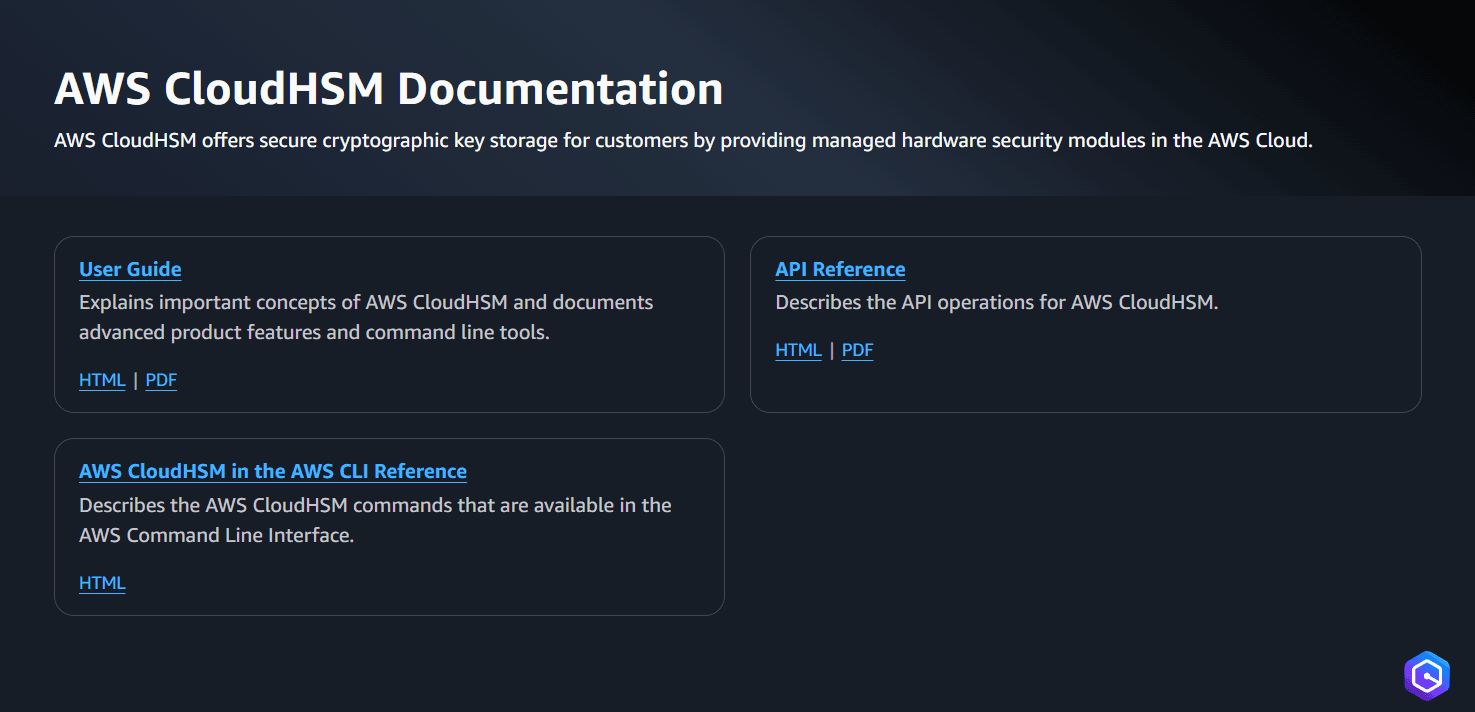
AWS CloudHSM is user-friendly for teams already familiar with AWS, offering straightforward setup through the AWS Management Console and CLI. Users appreciate the clear documentation — including a comprehensive user guide — and automated cluster management, which reduces manual effort. However, some find the initial configuration and client installation complex compared to simpler cloud services. Overall, its usability is strong for cloud-native teams, but less so for those without AWS experience or those needing hybrid or on-premises deployments.
Integrations
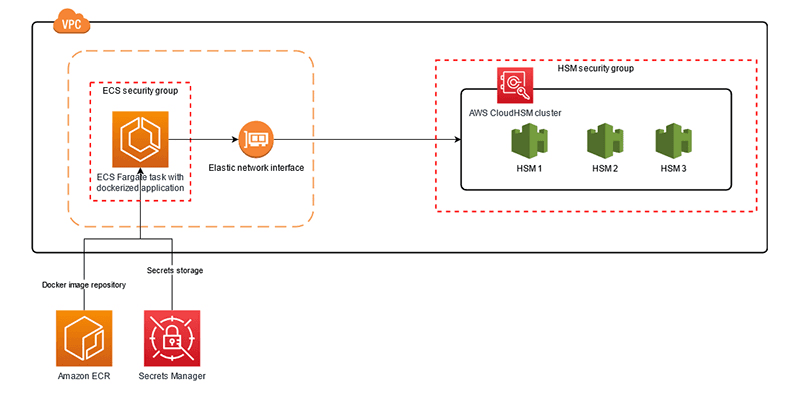
AWS CloudHSM integrates with Amazon RDS, Amazon Redshift, Amazon Elastic Load Balancing, Amazon S3, AWS Key Management Service, AWS Certificate Manager, Amazon EC2, AWS Lambda, Amazon CloudWatch, and AWS Secrets Manager, among others.
AWS CloudHSM also provides a client SDK and APIs for custom integrations and supports connections with third-party applications that use standard cryptographic libraries.
AWS CloudHSM Specs
- 2-Factor Authentication: No
- Access Management: Yes
- Anti-Virus: No
- API: Yes
- Audit Trail: Yes
- Bug Tracking: No
- Calendar Management: No
- Customer Management: No
- Dashboard: No
- Data Export: Yes
- Data Import: Yes
- Data Visualization: No
- Email Integration: No
- External Integrations: Yes
- File Sharing: No
- File Transfer: No
- Firewall: No
- Google Apps Integration: No
- Inventory Tracking: No
- Malware Protection: No
- Multi-User: Yes
- Network Device Performance Monitoring: Yes
- Network Traffic Monitoring: No
- Network Visualization: No
- Notifications: Yes
- Project Management: No
- Remote Access: Yes
- Risk Assessment: No
- SAP Integration: No
- Scheduling: No
- Software Integration: Yes
- Third-Party Plugins/Add-Ons: Yes
- Ticket Management: No


