

Rotating proxy providers supply pools of IP addresses that automatically switch while you access web resources, letting you bypass IP bans and data scraping limits. If you’re looking for a reliable way to gather data, run automations, or browse without revealing your source, picking the right rotating proxy provider matters. With so many options, it’s tough to know who delivers consistent performance, strong security, and simple integration.
In this guide, you’ll find an up-to-date breakdown of the top rotating proxy providers—including the kinds of features, usage, and controls you should expect—so you can choose confidently and avoid unwelcome surprises.
Why Trust Our Software Recommendations
6,700+
Reviews
20
Industry experts
16+
Evaluation factors
14
Years
Our team has been testing and reviewing software since 2012. As tech leaders ourselves, we know how difficult—and important—it is to choose the right software.
For this guide, we evaluated tools using hands-on testing and independent research, scoring tools using our selection criteria.
Our reviews reflect our human editorial judgment, not a sales pitch.
Expert reviewers:
- Paulo Gardini MiguelTech Director
 Tim FisherVP of AI
 Gabriel RosasTech Lead & Software Architect
 Christhian GruhnTech Lead & Platform Architect

Rotating Proxy Providers Comparison Table
This comparison table summarizes pricing details for my top rotating proxy provider selections:
| Tool | Best For | Trial Info | Price | ||
|---|---|---|---|---|---|
| 1 | Best for multi-protocol compatibility | 7-day trial for $4 | From $4/GB (pay-as-yoy-go) | Website | |
| 2 | Best for integrated browser automation | Free trial available | From $5.30/GB (pay-as-you-go) | Website | |
| 3 | Best for advanced rotation scheduling | Not available | From $7/month | Website | |
| 4 | Best for transparent proxy sourcing | 3-day free trial | From $2/month | Website | |
| 5 | Best for fully customizable proxy lists | Free plan available | From $7/month | Website | |
| 6 | Best for precision targeting by location | Free plan available | From $200/month | Website | |
| 7 | Best for pay-as-you-go bandwidth options | Free demo available | From $4.90/GB | Website | |
| 8 | Best for automated large-scale scraping | Free trial available | From $0.5/1,000 records | Website | |
| 9 | Best for granular session management | Free plan available | From $1.5/1,000 records/month | Website | |
| 10 | Best for quick configuration at scale | 3-day free trial | From $2/GP | Website |


Best Rotating Proxy Providers Reviews
Below are my detailed summaries of the best rotating proxy providers that made it onto my shortlist. My reviews offer a detailed look at the features, pricing, and capabilities of each platform to help you find the best one for you.
 Best for multi-protocol compatibility
- 7-day trial for $4
- From $4/GB (pay-as-yoy-go)
Visit WebsiteCustomer Rating:4.8/5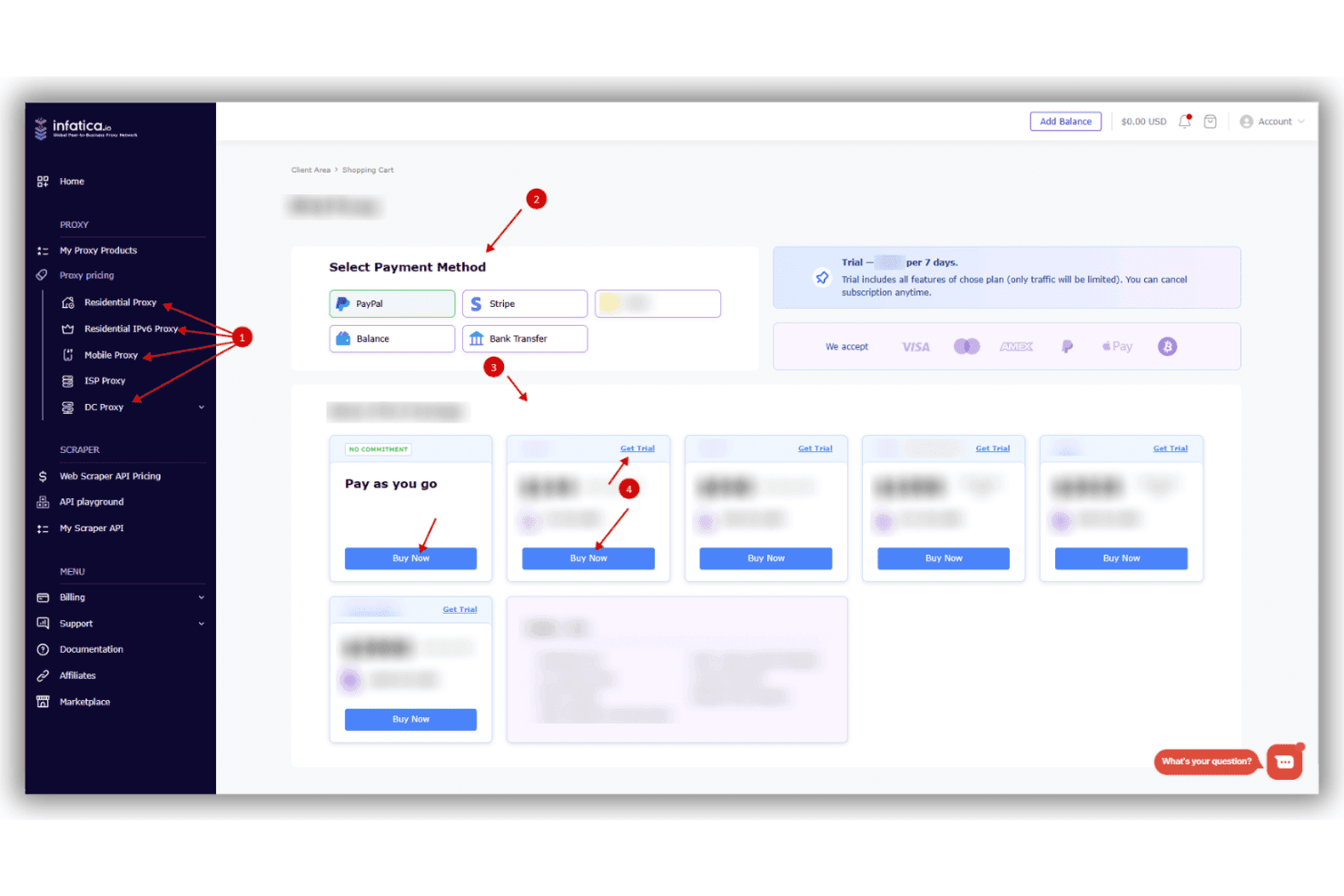
Infatica offers multiple proxy types and a shopping cart with various payment methods including PayPal, Stripe, Balance, and Bank Transfer. Infatica is a rotating proxy network with 40M+ residential, mobile, ISP, and datacenter IPs across 195 countries, supporting HTTP, HTTPS, and SOCKS5 protocols with country, city, and ISP-level geo-targeting.
Who Is Infatica Best For?
Infatica suits web scraping engineers and DevOps teams who need a proxy network that works across multiple protocols and integrates with existing code in languages like Python, Go, or Node.js.
Why I Picked Infatica
I've included Infatica in my top picks because it's one of the few rotating proxy providers that natively supports HTTP, HTTPS, and SOCKS5 across all proxy types, including residential, mobile, ISP, and datacenter. That SOCKS5 support matters when your scraping stack goes beyond basic HTTP requests, such as tools built in Go or Node.js that need lower-level socket control. I also like that the residential pool includes mobile IPs by default, so you get real 4G/5G addresses without switching to a separate product or plan.
Infatica Key Features
- City and ISP-level geo-targeting: Choose proxies based on specific cities or ISPs within 195+ countries.
- Real-time usage dashboard: Monitor proxy traffic, request volume, and active sessions in an interactive web dashboard.
- Sub-user and API credential management: Create and manage sub-users or rotate credentials via a public API.
- Large ethically sourced proxy pool: Access over 40 million residential, mobile, ISP, and datacenter IPs with clear compliance certifications.
Infatica Integrations
Native integrations are not clearly listed. The tool supports integrations via its public API for custom proxy management and can be used with most scraping frameworks through standard proxy configuration.
Pros and Cons
Pros:
- API allows detailed sub-user management
- Offers mobile, residential, ISP, and datacenter IPs
- Supports HTTP, HTTPS, and SOCKS5 protocols
Cons:
- ASN-level geo-targeting not available
- Custom rotation intervals are limited
Learn more about Infatica: Best for integrated browser automation
- Free trial available
- From $5.30/GB (pay-as-you-go)
Visit WebsiteCustomer Rating:4.4/5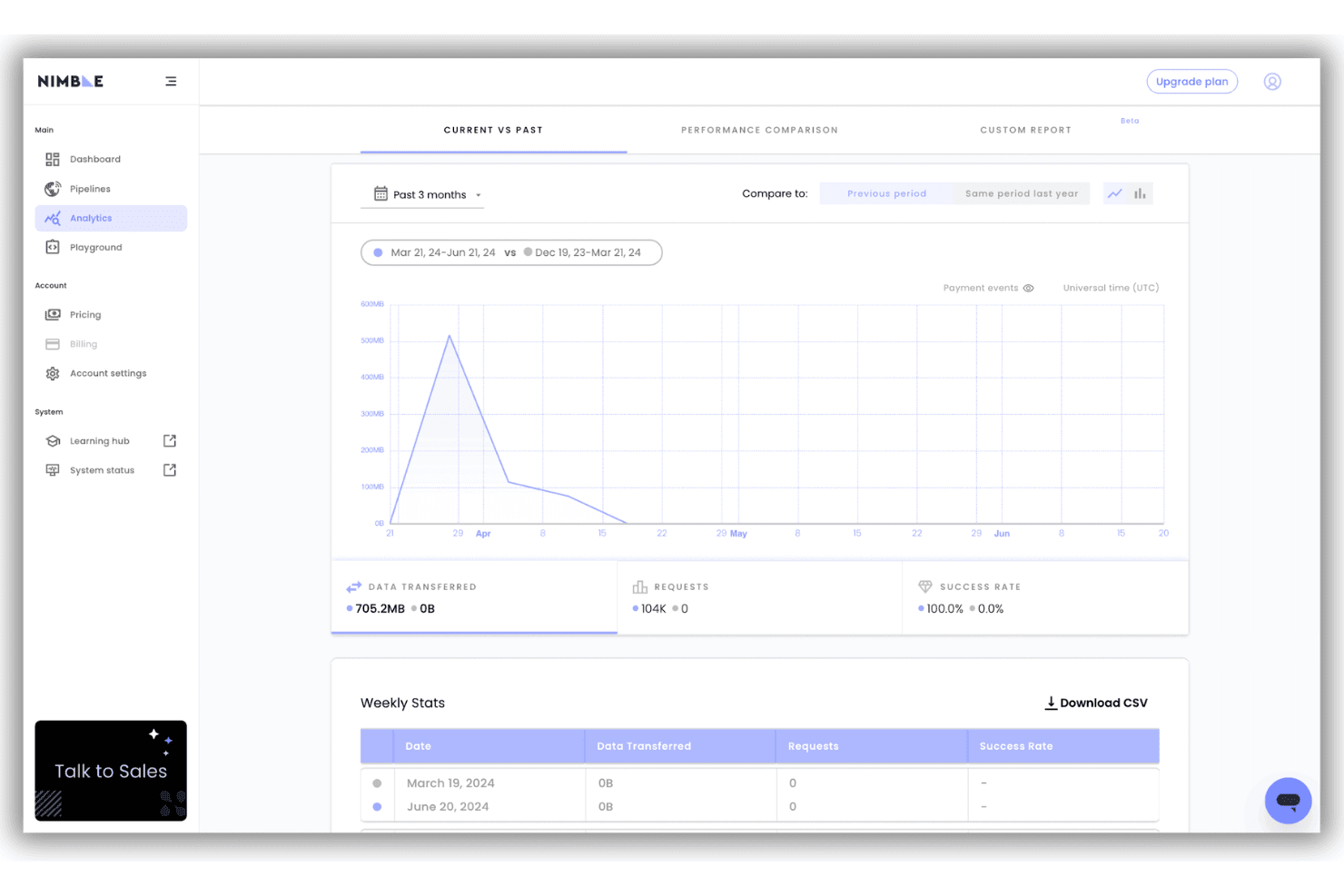
Nimble's analytics dashboard displays current vs past data transfer metrics, requests, and success rates over a three-month period. Nimble IP is a rotating proxy network combining residential, datacenter, and mobile proxies with an AI-powered optimization engine and native integrations for browser automation tools like Puppeteer, Playwright, and Selenium.
Who Is Nimble Best For?
Nimble IP suits engineering and data teams running high-volume scraping pipelines who need reliable proxy infrastructure with built-in anti-detection at scale.
Why I Picked Nimble
I picked Nimble as one of the best because its browserless driver stack natively supports Puppeteer, Playwright, and Selenium with built-in proxies already attached, so there's no separate proxy chaining to configure. What I really like is the AI Stealth Undetection Technology, which handles fingerprinting and block avoidance at the driver level. My team can run JS-rendered scraping jobs using the Render JS + Stealth driver without bolting on a separate anti-detect layer.
Nimble Key Features
- Granular geo-targeting: Choose proxies by country, state, or city for precise request routing.
- Multiple proxy types: Access residential, datacenter, and mobile (4G) IPs within the same network.
- Live usage dashboard: Monitor bandwidth, request success rates, and traffic analytics in real time.
- API-first integration: Route traffic through a single proxy gateway compatible with any HTTP client or custom script.
Nimble Integrations
Nimble offers native integrations with Puppeteer, Selenium, Scrapy, and Model Context Protocol (MCP). An API is available for custom integrations.
Pros and Cons
Pros:
- High success rates on protected websites
- AI-driven anti-detection and block avoidance
- Native support for popular scraping frameworks
Cons:
- Lacks carrier or ASN-level targeting
- Smaller IP pool than leading competitors
Learn more about Nimble:

ProxyEmpire offers a residential proxy manager dashboard with sticky session support, host/port/username/password configuration, and real-time bandwidth usage tracking. ProxyEmpire is a rotating proxy service with residential, mobile, static residential, and datacenter proxy types, offering per-request and timed IP rotation, granular geo-targeting, and session control across 170+ countries.
Who Is ProxyEmpire Best For?
ProxyEmpire suits web scraping engineers and DevOps teams who need fine-grained control over IP rotation schedules across large-scale, multi-region data collection workflows.
Why I Picked ProxyEmpire
I picked ProxyEmpire as one of the best because its rotation configuration goes deeper than most providers I've tested. You can set timed rotation intervals anywhere from 90 seconds to 60 minutes, run per-request rotation, or lock to sticky sessions, all controlled through an API that manages session IDs and targeting per endpoint. Unlimited concurrent sessions mean I can run multiple rotation schedules in parallel without hitting caps.
ProxyEmpire Key Features
- Granular geo-targeting options: Choose proxies by country, region, city, or ASN for precise location control.
- Multiple proxy types supported: Access residential, static residential, datacenter, and mobile proxies under a single account.
- Rollover bandwidth: Unused proxy traffic rolls over to the next month on eligible plans.
- API-based proxy management: Generate endpoints, manage credentials, and control proxy sessions programmatically.
ProxyEmpire Integrations
ProxyEmpire offers native integrations with Multilogin, Kameleo, GoLogin, OctoBrowser, and Dolphin Anty for browser profile management. Browser extensions for Chrome and Firefox are also available.
Pros and Cons
Pros:
- Offers static and mobile proxies together
- City and ASN level geo-targeting available
- Customizable rotation intervals and session control
Cons:
- Smaller residential pool than major competitors
- Does not offer SOCKS5 protocol
Learn more about ProxyEmpire:

Thordata offers residential proxy plans ranging from 1GB to 250GB, with the most popular 250GB plan priced at $1.2/GB for a total of $300. Thordata is a rotating proxy provider offering residential, mobile, static ISP, and datacenter proxies alongside built-in scraping tools including a SERP API, Web Unlocker, and headless Scraping Browser.
Who Is Thordata Best For?
Thordata is a strong fit for web scraping engineers and developers who need high-volume residential or mobile proxy access at competitive per-GB pricing.
Why I Picked Thordata
I picked Thordata as one of the best because its residential IP pool is built on a consent-based sourcing model, meaning the IPs come from real users who have actively opted in to share their bandwidth. That sourcing transparency matters when you're running large-scale scraping on platforms that fingerprint proxy traffic. I also like that country, state, city, and ASN-level geo-targeting is included at no extra cost, giving my team precise control over where requests appear to originate.
Thordata Key Features
- Multi-protocol gateway support: Enables connections via HTTP(S) and SOCKS5 for flexible integration with various scraping environments.
- Unified access to multiple proxy types: Lets you use residential, datacenter, ISP, and mobile proxies under the same dashboard and billing account.
- Advanced geo-targeting options: Supports targeting proxies by country, state, city, and ASN for precise location-based requests.
- Real-time usage monitoring dashboard: Provides live insights into bandwidth consumption, connection status, and active proxy sessions.
Thordata Integrations
Thordata offers native integrations with Puppeteer, Playwright, Selenium, AdsPower, BitBrowser, SwitchyOmega, and FoxyProxy, and provides an API for custom integrations.
Pros and Cons
Pros:
- Live proxy usage metrics and API monitoring
- Supports ASN and carrier-level geo-targeting
- Consent-based residential and mobile IP sourcing
Cons:
- Small review volume compared to major competitors
- Mixed reliability reports for Google scraping
Learn more about Thordata:
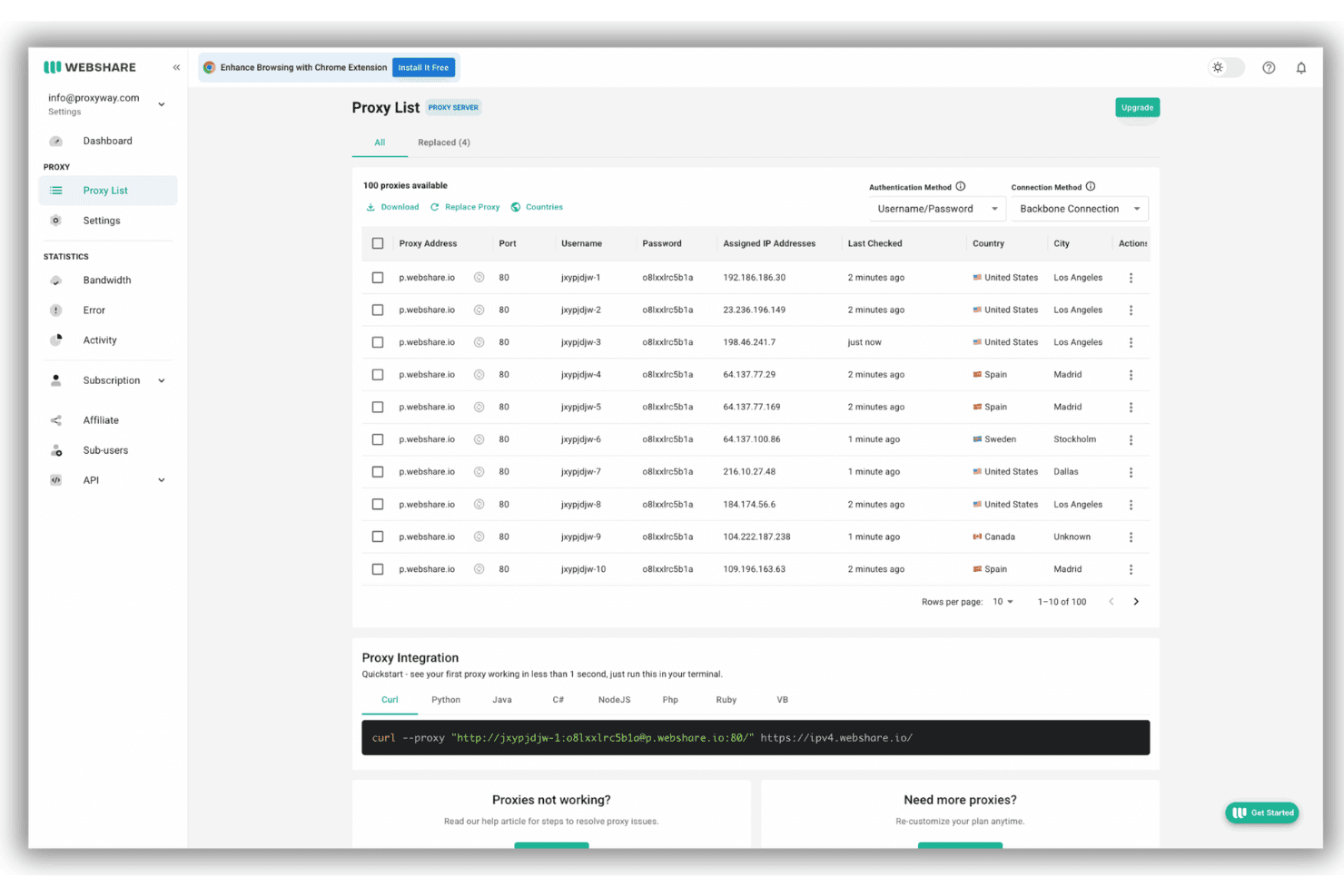
Webshare displays a proxy list dashboard with 100 available proxies, showing IP addresses, ports, usernames, passwords, and server locations across multiple countries. Webshare is a rotating proxy provider offering residential, static residential, ISP, and datacenter proxies with per-request IP rotation, city-level geo-targeting across 195 countries, and HTTP/SOCKS5 protocol support.
Who Is Webshare Best For?
Webshare suits web scraping engineers and data teams who need a flexible, bandwidth-based proxy plan that scales from small projects to high-volume production workloads.
Why I Picked Webshare
I picked Webshare as one of the best because the proxy list customization goes deeper than most providers allow. I can mix rotating residential, static residential, ISP, and datacenter proxies within a single account, then dial in country or city targeting directly through endpoint username string parameters. On top of that, bandwidth-based plans (from 1 GB to 3,000+ GB) mean I configure exactly the traffic volume I need, with no fixed IP count forcing my hand.
Webshare Key Features
- Protocol support: Use both HTTP and SOCKS5 across all proxy types.
- Geo-targeting by city: Select proxies from specific cities in 195 countries.
- REST API access: Manage proxies and consume usage data programmatically.
- Anti-detect browser integrations: Connect with tools like Multilogin, GoLogin, AdsPower, and more.
Webshare Integrations
Webshare offers native integrations with anti-detect browsers like GoLogin, BitBrowser, and more, as well as proxy clients including Shadowrocket, Proxifier, SwitchyOmega, and Shadowsocks. An API is available for custom integrations.
Pros and Cons
Pros:
- Mix proxy types in one subscription
- Bandwidth-based plans for any project size
- City-level targeting in 195 countries
Cons:
- ASN or carrier targeting not supported
- No mobile proxies available
Learn more about Webshare: 6Best for precision targeting by location
SOAX
- Free plan available
- From $200/month
Visit WebsiteCustomer Rating:4.8/5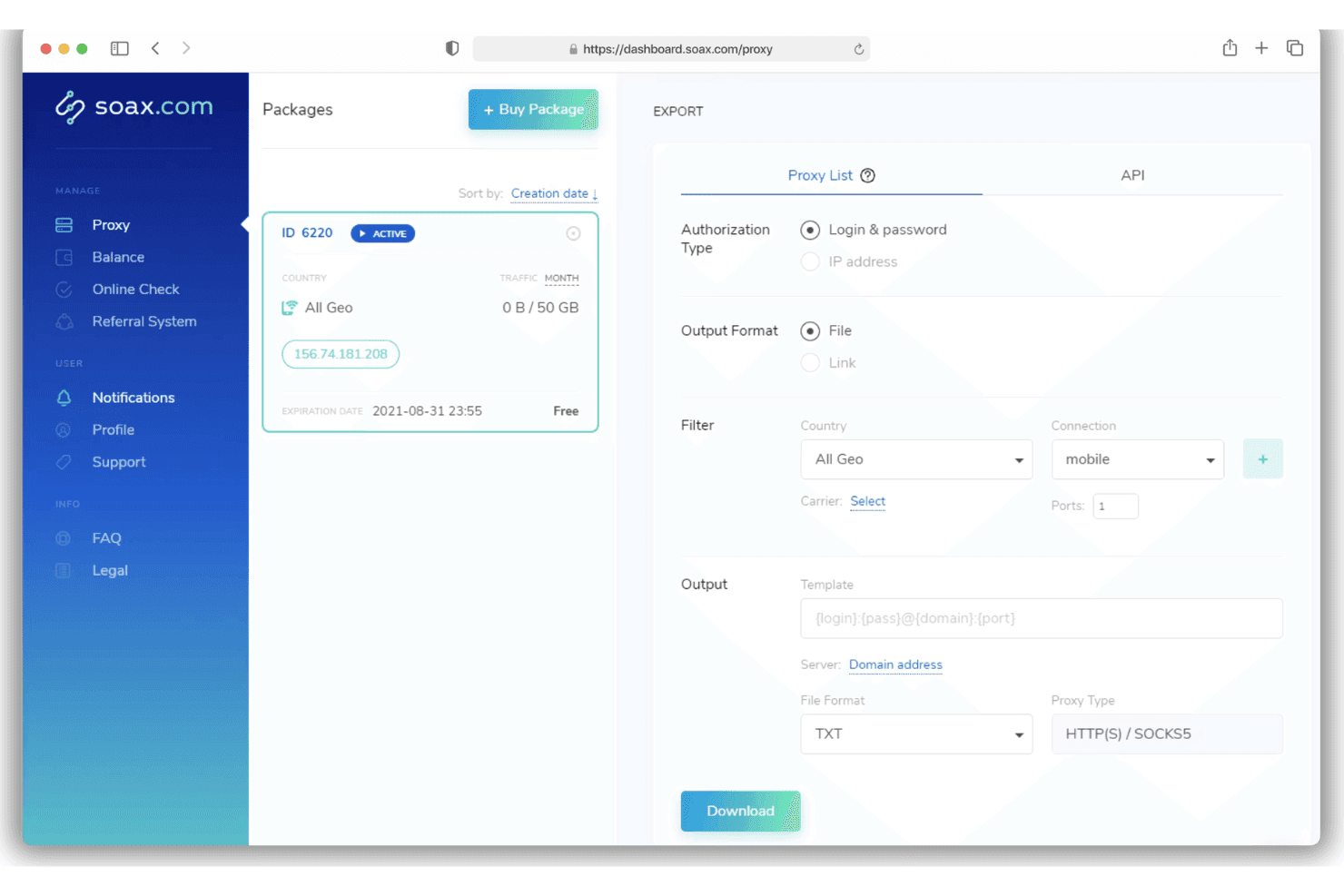
SOAX offers a proxy dashboard where users can export proxy lists with filters for country, connection type, carrier, and output format. SOAX is a rotating proxy provider with a pool of 191 million+ residential, mobile, datacenter, and ISP proxies, offering per-request and interval-based IP rotation with country, city, ASN, and carrier-level geo-targeting across 195+ locations.
Who Is SOAX Best For?
SOAX is a strong fit for web scraping engineers and data teams that need granular location control for large-scale, geo-sensitive data collection.
Why I Picked SOAX
I've included SOAX in my top picks because the depth of its geo-targeting goes well beyond country-level filtering. I can target by city, ASN, and carrier in a single request, which is exactly what I need when scraping content that varies by ISP or verifying ads shown only in specific metro areas. On Scale and Enterprise plans, ZIP-code targeting is also available, which I've used to pinpoint local SERP results without any additional configuration.
SOAX Key Features
- Real-time usage dashboard: Track bandwidth, request statistics, and live session data from a web interface.
- Multiple proxy types in one plan: Access residential, mobile, datacenter, and US ISP proxies under a unified subscription.
- Unlimited concurrent sessions: Initiate as many simultaneous proxy connections as needed for high-volume operations.
- API and integration support: Connect directly with anti-detect browsers, automation tools, and manage proxies programmatically via API.
SOAX Integrations
SOAX offers native integrations with anti-detect browsers including Dolphin Anty, GoLogin, Kameleo, Linken Sphere, Octobrowser, Multilogin, Incogniton, and AdsPower. An API is available for custom integrations.
Pros and Cons
Pros:
- Flexible API and session management options
- High reliability for rotating mobile proxies
- City and carrier-level geo targeting available
Cons:
- Static residential proxy option is missing
- No built-in CAPTCHA solving features
Learn more about SOAX: Best for pay-as-you-go bandwidth options
- Free demo available
- From $4.90/GB
Visit WebsiteCustomer Rating:4.6/5
IPRoyal displays a dashboard with proxy statistics, product offerings like Mobile and Web Unblocker, and a residential bandwidth usage chart. IPRoyal is a residential proxy network with 64M+ IPs across 195+ countries, offering per-request IP rotation, configurable sticky sessions, city-level geo-targeting, and HTTP(S) and SOCKS5 protocol support.
Who Is IPRoyal Best For?
IPRoyal is a strong fit for web scraping engineers and small-to-mid-size teams that need flexible, on-demand proxy access without committing to a monthly subscription.
Why I Picked IPRoyal
IPRoyal earns its spot on my shortlist because its never-expiring PAYG traffic model is genuinely rare in the residential proxy space. I like that I can buy 10 GB, use 3 GB on one project, and return weeks later without losing the remainder. The per-request rotation and configurable sticky sessions (up to 7 days) make it straightforward to balance fresh IPs against session continuity depending on the task at hand.
IPRoyal Key Features
- City-level geo-targeting: Route proxy sessions through specific cities in over 195 countries.
- Support for four proxy types: Access residential, datacenter, ISP, and mobile proxies using a single platform.
- SOCKS5 and HTTP(S) protocol support: Integrate with scraping tools or custom scripts using either protocol as needed.
- API for proxy management: Use REST API endpoints to programmatically rotate IPs and monitor traffic usage.
IPRoyal Integrations
IPRoyal integrates with tools like Multilogin and GoLogin, and offers a REST API for custom integrations.
Pros and Cons
Pros:
- City-level targeting for granular geo-testing
- Supports residential, datacenter, ISP, and mobile proxies
- Traffic never expires until fully consumed
Cons:
- Proxy pool lags behind market leaders in size
- No ASN or carrier-level targeting
Learn more about IPRoyal: Best for automated large-scale scraping
- Free trial available
- From $0.5/1,000 records
Visit WebsiteCustomer Rating:4.5/5
Oxylabs displays a residential proxies statistics dashboard showing traffic and request data. Oxylabs is a residential proxy network with a 175M+ IP pool that supports automatic rotation, sticky sessions, geo-targeting across 195 countries, and HTTP(S), HTTP3, and SOCKS5 protocols.
Who Is Oxylabs Best For?
Oxylabs is a strong fit for web scraping engineers and data teams running high-volume, production-grade collection pipelines that can't afford frequent blocks or downtime.
Why I Picked Oxylabs
I picked Oxylabs as one of the best because its 175M+ residential IP pool and unlimited concurrent sessions make it genuinely built for automated, high-volume scraping. When I'm running thousands of parallel requests, per-request rotation via the endpoint generator keeps blocks to a minimum. Sticky sessions let me maintain the same IP across multi-step workflows, like logging in and paginating through results, without re-authenticating mid-run.
Oxylabs Key Features
- Geo-targeting by city and ZIP: Route requests through specific locations across 195 countries with city and ZIP-level granularity.
- Multiple proxy types managed together: Access residential, datacenter, ISP, and mobile proxies from a single dashboard and shared pool.
- Real-time usage dashboard and API: Monitor bandwidth, request stats, and manage sub-users programmatically for operational control.
- Protocol and authentication options: Supports HTTP(S), HTTP3, SOCKS5, plus both username/password and IP whitelisting for secure access.
Oxylabs Integrations
Oxylabs offers native integrations with Scrapy, Selenium, Puppeteer, and Playwright, official SDKs for Python and Go, and provides an API for custom integrations.
Pros and Cons
Pros:
- Real-time usage data and API access
- Supports HTTP(S), HTTP3, and SOCKS5 protocols
- Residential IP pool spans 195 countries
Cons:
- Setup can require technical onboarding
- No usage-based pay-as-you-go option
Learn more about Oxylabs: Best for granular session management
- Free plan available
- From $1.5/1,000 records/month
Visit WebsiteCustomer Rating:4.7/5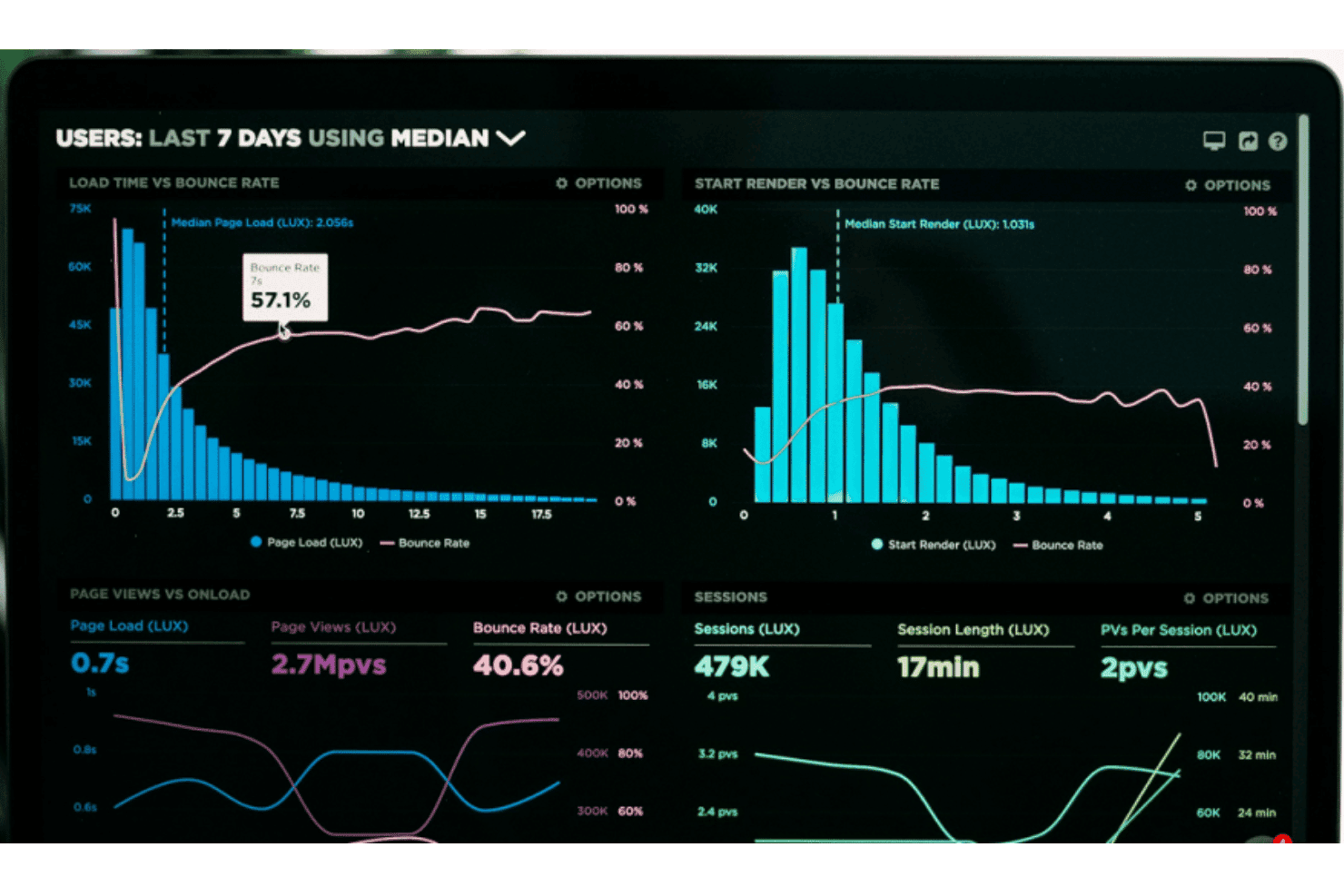
Bright Data's analytics dashboard displays load time vs bounce rate, start render metrics, page views, and session data over the last 7 days. Bright Data is a proxy network platform offering residential, datacenter, ISP, and mobile proxies with rotating and sticky sessions, geo-targeting down to city and ASN level, and API-driven session control across a 400M+ IP pool.
Who Is Bright Data Best For?
Bright Data is a strong fit for enterprise web scraping engineers and data teams who need reliable residential IP access at high volume across dozens of geo targets.
Why I Picked Bright Data
Bright Data earns its spot as one of the best on my shortlist because the session control options go deeper than any other provider I've tested. I can assign custom session IDs, set sticky session durations by request count or time interval, and switch between per-request rotation and persistent sessions within the same zone. That level of control is genuinely useful when scraping platforms that track user behavior across requests, where a mid-session IP change triggers a block.
Bright Data Key Features
- Geo-targeting by ASN and carrier: Choose proxies at the country, city, ASN, or carrier level for region-specific requests.
- Multiple proxy types in one platform: Access residential, mobile, ISP, and datacenter proxies through a single unified dashboard.
- Live dashboard and API monitoring: Track real-time bandwidth, domain usage, and success rates with web and API-based analytics.
- Compliance and KYC onboarding: Supports GDPR, CCPA, and SOC certifications with strict customer vetting for network access.
Bright Data Integrations
Bright Data offers native integrations with Puppeteer, Playwright, Selenium, and Azure Marketplace. An open API and open-source Proxy Manager are available for custom integrations.
Pros and Cons
Pros:
- Detailed geo-targeting down to ASN and carrier
- Reliable proxy pool includes residential, mobile, ISP, datacenter
- Session control supports custom sticky durations
Cons:
- Bandwidth usage can spike unexpectedly
- Extra compliance steps delay onboarding
Learn more about Bright Data:
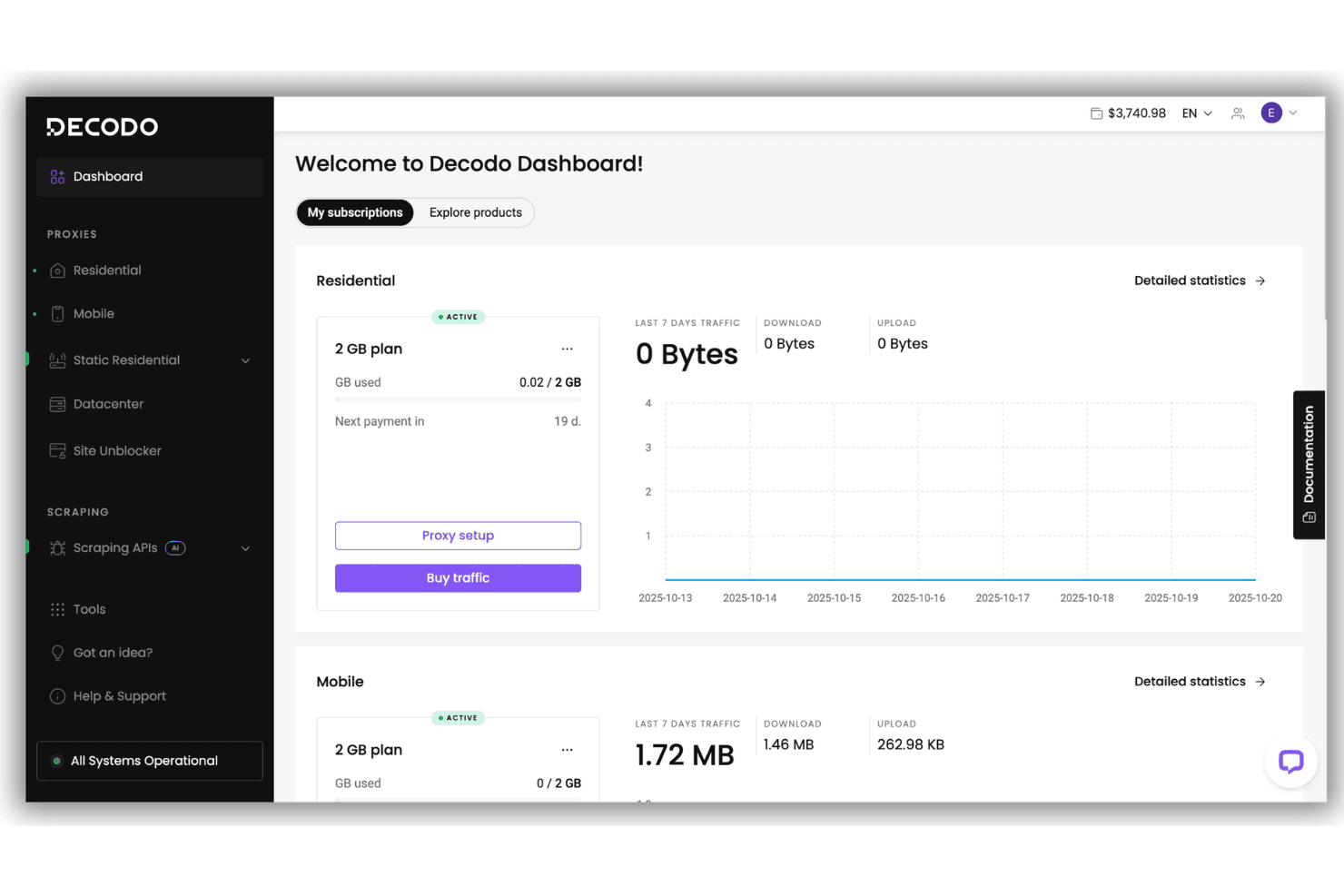
Decodo (formerly Smartproxy) offers a dashboard displaying active residential and mobile proxy subscriptions with traffic usage statistics and quick setup options. Decodo is a rotating proxy network offering residential, mobile, datacenter, and ISP proxies across 195+ locations, with per-request IP rotation, sticky sessions, geo-targeting down to ZIP and ASN level, and a built-in web scraping API.
Who Is Decodo (formerly Smartproxy) Best For?
Decodo is a strong fit for web scraping engineers and data teams who need to manage large-scale, multi-region proxy infrastructure without heavy manual configuration.
Why I Picked Decodo (formerly Smartproxy)
I picked Decodo as one of the best because its endpoint generation system lets you configure per-request rotation, sticky session duration (1 minute to 24 hours), and geo-targeting down to ZIP and ASN level directly from the dashboard, with no code changes needed. That matters when you're managing dozens of concurrent scraping jobs across multiple regions. City, ZIP, and ASN targeting are included on every plan, so scaling doesn't require renegotiating your configuration.
Decodo (formerly Smartproxy) Key Features
- Unified proxy platform: Access residential, mobile, datacenter, and ISP proxies from one account with shared bandwidth.
- Carrier-level mobile proxy targeting: Target requests by carrier across 700+ mobile operators globally.
- Live usage dashboard: Monitor bandwidth, success rates, sub-user activity, and top domains in real time.
- Built-in Site Unblocker API: Route requests through a managed proxy layer with automatic CAPTCHA handling and JavaScript rendering.
Decodo (formerly Smartproxy) Integrations
Decodo offers native integrations with tools like Shadowrocket, AdsPower, Postman, Scrapy, SwitchyOmega, Multilogin, Axios, and FoxyProxy, and provides an API for custom integrations.
Pros and Cons
Pros:
- Sticky sessions customizable up to 24 hours
- City, ZIP, ASN, and carrier targeting available
- Fast proxy endpoint configuration and rotation
Cons:
- Residential pool smaller than some competitors
- SOCKS5 not available for all proxy types
Learn more about Decodo (formerly Smartproxy):
Other Rotating Proxy Providers
Here are some additional rotating proxy providers options that didn’t make it onto my shortlist, but are still worth checking out:
- 11RayobyteBest for contract-free flexible plans
- 12DataImpulseBest for unlimited concurrent connections
- 13NodeMavenBest for managed IP reputation control
- 14Live ProxiesBest for ultra-low latency connections
- 15GeonixBest for global network coverage options
- 16ScraperAPIBest for effortless API-based proxy use
- 17MarsProxiesBest for tailored proxy pools by niche
- 18EvomiBest for dedicated dashboard control features
- 19ShifterBest for unlimited bandwidth residential IPs
- 20Zyte APIBest for integrated data extraction workflows
How I Evaluate Rotating Proxy Providers
I split my evaluation into baseline requirements—like per-request IP rotation and geo-targeting—and differentiators like session control flexibility and ethical IP sourcing.
Core Functionality (Table Stakes For This List)
When I'm selecting tools for my list, I rank each one on a scale from 0 (does not offer the functionality) to 5 (excels in this area) for each core functionality listed below. Then, I calculate the tool's total score into a percentage. Each tool needs to achieve a minimum total score of 65% to be considered for inclusion.
- IP Rotation Mechanism: I look for automatic per-request rotation or configurable intervals, since scraping targets like search engines flag repeated IPs fast.
- Large IP Pool: Pool size and network diversity matter—providers with millions of IPs across residential and mobile sources reduce the risk of overlap on popular targets.
- Geo-Targeting Options: I check whether targeting goes beyond country-level to city or ASN, which is key for localized SERP tracking and region-locked content access.
- Multiple Proxy Types: A mix of residential, datacenter, mobile, and ISP proxies under one account lets you match proxy type to each task without juggling vendors.
- Protocol & Authentication: I evaluate whether providers support HTTP(S) and SOCKS5 alongside both user:pass and IP whitelist auth for flexible integration into existing stacks.
- Session Control: Sticky sessions are essential for multi-step workflows like checkout testing, so I look for configurable durations alongside standard per-request rotation.
Once I have a list of tools that meet the criteria, I consider what sets each platform apart.
Differentiating Factors (What Sets Vendors Apart)
Here's how I compare and contrast different vendors:
Standout Features
Built-in unblocker and CAPTCHA handling is a major separator. Providers that bundle auto-retry logic and headless rendering into the proxy endpoint save you from building that infrastructure yourself when scraping protected targets. I also check for real-time usage dashboards with API access—monitoring bandwidth and success rates per domain helps troubleshoot drops fast. Having residential, datacenter, ISP, and mobile proxies under one account matters too when your team runs mixed workloads.
Beyond Features
Pricing model matters a lot here. GB-based billing suits high-volume scraping, while per-request pricing works better for lighter, targeted jobs like ad verification. I also evaluate how providers source their residential IPs—consent-based acquisition and ethical sourcing documentation can make or break enterprise procurement reviews. Developer experience is another key factor; quality code samples for frameworks like Scrapy and Puppeteer, plus clear API docs, tell you how quickly your team can integrate and start collecting data.
How to Choose Rotating Proxy Providers
It’s easy to get bogged down in long feature lists and complex pricing structures. To help you stay focused as you work through your unique software selection process, here’s a checklist of factors to keep in mind:
| Factor | What to Consider |
|---|---|
| FactorScalability | What to ConsiderWill the tool handle your data collection volume as workloads grow? Check limits on concurrent sessions and IP pool access. |
| FactorIntegrations | What to ConsiderDoes the provider offer SDKs or APIs compatible with your data pipeline, scraping tools, or headless browsers? |
| FactorCustomizability | What to ConsiderCan rotation rules, geo-targeting, or session controls be tailored to match your workflow or compliance needs? |
| FactorEase of use | What to ConsiderHow intuitive is dashboard setup, rotation logic configuration, and proxy management for non-specialist users on your team? |
| FactorImplementation and onboarding | What to ConsiderHow long will it take to get production-ready—think documentation clarity, account approvals, and initial setup steps. |
| FactorCost | What to ConsiderHow predictable are total monthly costs? Consider GB-based, request-based, or hybrid billing to avoid surprise overages. |
| FactorSecurity safeguards | What to ConsiderWhat controls are in place for data privacy, encrypted proxy authentication, and network abuse monitoring? |
| FactorInternal resourcing needs | What to ConsiderWill scaling require specialized staff, ongoing developer effort, or are no-code and automation options sufficient for your team? |
What Are Rotating Proxy Providers?
Rotating proxy providers are proxy service providers that supply pools of IP addresses that automatically change, or “rotate,” across user web requests. This approach helps prevent IP blocks, bypass geo-restrictions, and reduce detection while gathering data, testing geo-locked content, or running automation workflows with a rotating proxy server. Many providers also offer static proxies for use cases that require a consistent IP address. These services are commonly used for market research, price monitoring, and travel fare aggregation, sourcing IPs from data centers and internet service providers to provide reliable, flexible access to diverse network origins without revealing a fixed identity.
Features of Rotating Proxy Providers
When selecting rotating proxy providers, keep an eye out for the following key features:
- IP rotation mechanism: Automatically assigns a new IP address either per request or at set intervals to help prevent bans and detection during large-scale web activities.
- Large IP pool: Offers access to millions of diverse IP addresses, spanning residential, datacenter, ISP, and mobile networks for broader reach and reduced IP overlap.
- Geo-targeting: Enables you to select specific countries, cities, or regions for your exit IP, making it possible to access location-specific content and services.
- Session control: Lets you maintain the same IP for a configurable period, which is essential for multi-step workflows like login persistence or checkout processes.
- Protocol support: Provides compatibility with HTTP(S) and SOCKS5 protocols, supporting a wider range of use cases and integration with different tools.
- Authentication options: Supports both username/password and IP whitelisting for secure and flexible access tailored to your infrastructure.
- Usage dashboard: Real-time dashboards display bandwidth consumption, connection status, and usage analytics so teams can monitor and optimize activities.
- Unblocker/CAPTCHA handling: Includes automated logic for bypassing common web scraping obstacles such as CAPTCHAs or advanced site protections without manual intervention.
- Multiple proxy types: Allows you to switch between or combine residential, datacenter, ISP, and mobile proxies in a unified platform to match different project requirements.
Benefits of Rotating Proxy Providers
Implementing rotating proxy providers provides several benefits for your team and your business. Here are a few you can look forward to:
- Reduced risk of bans: Automatic IP rotation helps minimize blocking and rate limiting while running high-frequency or large-scale data collection tasks.
- Seamless geo-access: Geo-targeting features let you access region-specific content, test localization, and verify ads from anywhere in the world.
- Workflow flexibility: Session control and multiple proxy types support a range of use cases, from persistent logins to fast, disposable requests.
- Operational transparency: Real-time dashboards and analytics provide full visibility into connection health, bandwidth use, and request success rates.
- Faster troubleshooting: Built-in unblocker and CAPTCHA handling reduce time spent on dealing with access challenges on protected or dynamic websites.
- Easier scaling: Large and diverse IP pools allow you to ramp up web scraping, monitoring, or verification projects quickly without bottlenecks.
- Improved data quality: Reliable proxy infrastructure and session management mean fewer dropped requests, improving the accuracy of your datasets.
Costs and Pricing of Rotating Proxy Providers
Selecting rotating proxy providers requires an understanding of the various pricing models and plans available. Costs vary based on features, team size, add-ons, and more. The table below summarizes common plans, their average prices, and typical features included in rotating proxy providers solutions:
Plan Comparison Table for Rotating Proxy Providers
| Plan Type | Average Price | Common Features |
|---|---|---|
| Plan TypeFree Plan | Average Price$0 | Common FeaturesLimited IP rotation, a small number of daily requests, basic geo-targeting, and restricted protocol support. |
| Plan TypePersonal Plan | Average Price$30-$100/month | Common FeaturesLarger IP pool access, per-request rotation, broader geo-targeting, session control, and standard dashboards. |
| Plan TypeBusiness Plan | Average Price$200-$800/month | Common FeaturesMillions of IPs, detailed analytics, API access, team management, priority support, and multiple proxy types. |
| Plan TypeEnterprise Plan | Average Price$1,000+/month | Common FeaturesDedicated account manager, custom SLAs, compliance documentation, global geo-targeting, and full integration APIs. |
Rotating Proxy Providers FAQs
Here are some answers to common questions about rotating proxy providers: