

Risk-based vulnerability management software helps you identify, prioritize, and remediate security threats by focusing on real business risk, not just technical severity. If you’re tired of generic vulnerability lists and alert fatigue, you need tools that cut through the noise and show you what to fix first.
In this guide, you’ll find the best risk-based vulnerability management solutions for 2026, chosen for their ability to help your team protect what matters, keep up with growing threats, and make smarter decisions. Get practical insights to select the right platform for your environment, whether you’re managing sprawling infrastructure or tightening up workflows.
Why Trust Our Software Recommendations
6,700+
Reviews
20
Industry experts
16+
Evaluation factors
14
Years
Our team has been testing and reviewing software since 2012. As tech leaders ourselves, we know how difficult—and important—it is to choose the right software.
For this guide, we evaluated tools using hands-on testing and independent research, scoring tools using our selection criteria.
Our reviews reflect our human editorial judgment, not a sales pitch.
Expert reviewers:
- Paulo Gardini MiguelTech Director
 Tim FisherVP of AI
 Gabriel RosasTech Lead & Software Architect
 Christhian GruhnTech Lead & Platform Architect

Risk-Based Vulnerability Management Software Comparison Table
This comparison table summarizes pricing details for my top risk-based vulnerability management software selections:
| Tool | Best For | Trial Info | Price | ||
|---|---|---|---|---|---|
| 1 | Best real-world exploit likelihood scoring | Free plan + free demo | From $29,000/year (billed annually) | Website | |
| 2 | Best for explainable AI in exposure management | Free demo | Pricing upon request | Website | |
| 3 | Best for machine-learning threat scoring | Free demo | Pricing upon request | Website | |
| 4 | Best for agentic workflow automation at scale | Free demo | Pricing upon request | Website | |
| 5 | Best for customizable enterprise integrations | Free demo | Pricing upon request | Website | |
| 6 | Best for threat intelligence-powered scoring | Free demo | Pricing upon request | Website | |
| 7 | Best for AI-driven exposure prioritization | Free demo | Pricing upon request | Website | |
| 8 | Best unified dashboard view across risk domains | Free trial + free demo | Pricing upon request | Website | |
| 9 | Best for built-in IT asset discovery | 30-day free trial | Pricing upon request | Website | |
| 10 | Best automation for multi-source risk data | Free demo | Pricing upon request | Website |


Best Risk-Based Vulnerability Management Software Reviews
Below are my detailed summaries of the best risk-based vulnerability management software that made it onto my shortlist. My reviews offer a detailed look at the features, integrations, and best use cases of each platform to help you find the best one for you.
 Best real-world exploit likelihood scoring
- Free plan + free demo
- From $29,000/year (billed annually)
Visit WebsiteCustomer Rating:5/5
Strobes RBVM offers a centralized vulnerabilities dashboard displaying nearly 497K total findings with priority scores, SLA compliance, exploitability metrics, and detailed vulnerability listings. Strobes RBVM is a risk-based vulnerability management platform that aggregates findings from across your scanner stack, applies multi-factor risk scoring using EPSS and CISA KEV data, and orchestrates remediation workflows through integrations with your existing ITSM tools.
Who Is Strobes RBVM Best For?
Strobes RBVM is a strong fit for mid-size to enterprise SecOps teams managing vulnerability data across multiple scanners and cloud environments.
Why I Picked Strobes RBVM
I picked Strobes RBVM as one of the best because its risk-scoring engine goes beyond static CVSS by combining EPSS exploit probability with CISA KEV catalogue matching and asset criticality weighting. What I find especially useful is that scores update continuously as threat conditions and compensating controls change, so my team isn't chasing stale data. That means we can defensibly de-prioritize a high-CVSS CVE with no public exploit in favour of a lower-severity one that's actively being weaponized in the wild.
Strobes RBVM Key Features
- Integrated asset discovery: Automatically pulls in assets from cloud, code, and infrastructure sources for unified visibility.
- Deduplication across scanners: Aggregates and deduplicates findings from SAST, DAST, SCA, container, and infra scanners.
- Automated remediation ticketing: Routes prioritized vulnerability findings directly to ITSM tools like Jira and ServiceNow.
- Customizable executive dashboards: Provides real-time security metrics including backlog reduction, MTTR, and resolution trends.
Strobes RBVM Integrations
Strobes RBVM offers 120+ native integrations, including Jira, ServiceNow, AWS Inspector, Azure Defender, GCP Security Command Center, Qualys, Nessus, Snyk, Checkmarx, and Wiz. An API is available for custom integrations.
Pros and Cons
Pros:
- Executive dashboards tailored for security leadership
- Aggregates findings from cloud, app, and infra sources
- Dynamic risk scoring updates as threat context changes
Cons:
- No built-in risk quantification by financial impact
- Board-level PDF reports lack customization options
Learn more about Strobes RBVM:

Brinqa offers a Monitor dashboard displaying assets by status, risk rating, and type alongside critical, high, and medium vulnerability findings with SLA tracking metrics. Brinqa is a unified exposure management platform that ingests vulnerability and asset data from 260+ security tools, applies AI-driven risk scoring, and orchestrates remediation workflows across enterprise environments.
Who Is Brinqa Best For?
Brinqa is built for large enterprises running complex, multi-tool security environments where CISOs and security teams need unified visibility across thousands of assets.
Why I Picked Brinqa
I picked Brinqa as one of the best because its AI Deduplication Agent and AI Attribution Agent don't just score risk; they show exactly why a vulnerability is flagged, tracing each decision back to asset ownership and exploitability data. That explainability is what I need when justifying prioritization to stakeholders beyond raw CVSS scores. The human-in-the-loop confidence thresholds also let my team accept or override AI outputs case by case, keeping the risk model grounded.
Brinqa Key Features
- Unified Cyber Risk Graph: Maps exposures, assets, identities, and business context from all integrated sources into a single view.
- SmartFlows automation: Lets you build drag-and-drop workflows to automate remediation assignments and notifications.
- Connector library: Includes 260+ integrations with vulnerability scanners, ITSM tools, directories, CMDBs, and cloud services.
- Custom risk dashboards: Lets you create role-based, interactive dashboards to visualize risk posture and remediation progress.
Brinqa Integrations
Brinqa offers over 260 native integrations, including Qualys, Rapid7 InsightVM, Tenable, Microsoft Defender for Endpoint, CrowdStrike, Prisma Cloud, Jira, ServiceNow, BitSight, and GitHub. An API is available for custom integrations.
Pros and Cons
Pros:
- Correlates vulnerabilities with asset business context
- Workflow automation for remediation and notifications
- AI-driven risk scoring with transparent logic
Cons:
- Requires external agents for endpoint scanning
- Lacks out-of-the-box remediation tools
Learn more about Brinqa:
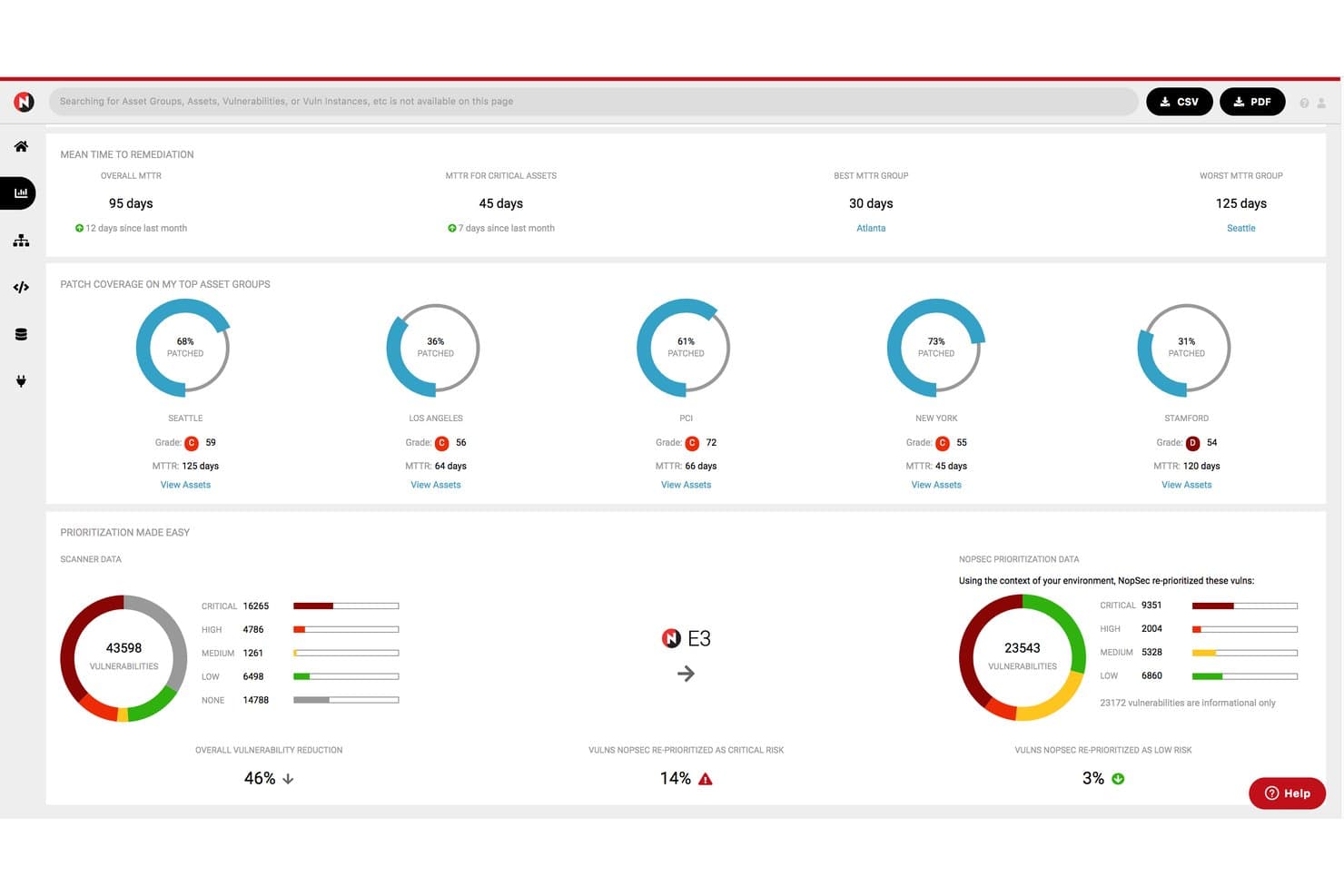
NopSec offers a unified vulnerability risk management dashboard displaying mean time to remediation, patch coverage by asset group, and prioritized vulnerability data with a 46% overall vulnerability reduction. NopSec is a risk-based vulnerability management platform that aggregates data from infrastructure, cloud, and application scanners, applies ML-driven threat scoring, and orchestrates remediation workflows through ITSM integrations and SLA tracking.
Who Is NopSec Best For?
NopSec is a strong fit for security teams at mid-market and enterprise organizations that are scaling a formal vulnerability management program and need ML-driven prioritization to cut through scanner noise.
Why I Picked NopSec
I picked NopSec as one of the best because its patented ML scoring engine goes beyond static CVSS weights to predict which vulnerabilities are most likely to be weaponized. I particularly like the Celebrity Vuln Hunt module, which delivers just-in-time alerts on zero-day and high-profile CVEs as active exploitation patterns emerge. The Risk Simulator also lets me model what-if scenarios to see how remediation decisions shift overall risk exposure before committing resources.
NopSec Key Features
- Attack Surface 360 external scanning: Continuously discovers and monitors internet-facing assets for unmanaged or new exposures.
- Collaborator ITSM integration: Sends vulnerability tickets directly into IT service management tools like Jira for workflow tracking.
- PowerIntel reporting suite: Delivers customizable executive dashboards and operational reports for vulnerability and remediation metrics.
- InControl compensating control validation: Verifies technical controls and tracks whether security measures are operating as intended.
NopSec Integrations
NopSec offers native integrations with vulnerability scanners like Tenable, Qualys, Rapid7, and CrowdStrike, as well as ServiceNow, Jira, and configuration management databases. An API is available for custom integrations.
Pros and Cons
Pros:
- Consolidates scanner, cloud, and CMDB data
- Customizable risk dashboards for executives and analysts
- ML threat scoring predicts weaponized vulnerabilities
Cons:
- Lacks native closed-loop patch automation
- Closed-loop patch automation not available
Learn more about NopSec: Best for agentic workflow automation at scale
- Free demo
- Pricing upon request

SAFE Security offers a Top Risks Dashboard with aggregate risk metrics including likelihood, loss magnitude, and annualized loss to support risk-based vulnerability management. SAFE Security is an agentic AI-driven cyber risk management platform that aggregates vulnerability and exposure data across 200+ integrations, applies business-context risk scoring, and orchestrates remediation through automated AI workflows.
Who Is SAFE Security Best For?
SAFE Security is a strong fit for enterprise security teams that already have vulnerability scanners in place and need a risk quantification and orchestration layer on top.
Why I Picked SAFE Security
I picked SAFE Security as one of the best because its agentic workflow engine genuinely changes how my team handles exposure response at scale. With 100+ prebuilt agentic workflow templates, I can automate ticket routing, ownership assignment, and exception management without building playbooks from scratch. The Agentic KEV Response feature also re-prioritizes exposures automatically the moment a new CISA KEV is published, so my team isn't scrambling manually when a zero-day drops.
SAFE Security Key Features
- Unified exposure inventory: Aggregates vulnerability and asset data from over 200 security and infrastructure integrations.
- Risk-based scoring engine: Applies dynamic risk scores using exploitability, real-time threat intel, and business context.
- Exposure validation: Simulates attack paths and validates which vulnerabilities are exploitable in your environment.
- Compliance-mapped dashboards: Delivers reporting mapped to NIST, ISO 27001, CIS, and PCI DSS standards.
SAFE Security Integrations
SAFE Security offers over 150 native integrations, including Tenable Vulnerability Management, Qualys VMDR, Rapid7 InsightVM, CrowdStrike Falcon, Wiz, ServiceNow, Jira, Okta, Microsoft Entra ID, and GitHub. An API is also available for custom integrations.
Pros and Cons
Pros:
- Custom risk scoring beyond CVSS or vendor defaults
- Financial risk quantification built on FAIR modelling
- Agentic workflows automate large-scale remediation tasks
Cons:
- Lacks built-in scanning capabilities
- Requires upstream scanners for vulnerability ingestion
Learn more about SAFE Security: Best for customizable enterprise integrations
- Free demo
- Pricing upon request

Nucleus Security offers customizable risk-based dashboards displaying total risk scores, asset counts, average vulnerability age, past due percentages, and SLA compliance metrics. Nucleus Security is a risk-based vulnerability management platform that aggregates findings from 176+ security tools, correlates them with threat intelligence and asset context, and prioritizes vulnerabilities for remediation.
Who Is Nucleus Security Best For?
Nucleus Security fits enterprise security teams managing complex, multi-scanner environments who need a centralized platform for vulnerability aggregation, prioritization, and remediation tracking.
Why I Picked Nucleus Security
I picked Nucleus Security because its FlexConnect framework lets my team pull in findings from virtually any custom data source, not just the 176+ named connectors already built into the platform. That matters when our environment includes legacy tools or homegrown scanners that most RBVM platforms simply won't touch. I also like that asset deduplication runs automatically across all those sources, so my risk scores aren't inflated by duplicate findings from overlapping scanners.
Nucleus Security Key Features
- Custom risk scoring: Create dynamic risk scores by integrating exploitability data, asset criticality, and business context.
- Threat intelligence feeds: Incorporate real-time exploit and threat feeds, including CISA KEV and EPSS, to inform prioritization.
- Remediation workflow automation: Assign, track, and manage remediation tickets through bi-directional Jira and ServiceNow integrations.
- POA&M compliance reporting: Generate executive, operational, and audit-ready reports focused on federal requirements and remediation SLAs.
Nucleus Security Integrations
Nucleus Security offers 176+ native integrations, including Tenable, Qualys, Rapid7, AWS Inspector, ServiceNow, Jira, Mandiant Advantage, Aqua, CrowdStrike, Microsoft Defender for Endpoint, and Splunk. An API is available for custom integrations.
Pros and Cons
Pros:
- Enables custom risk scoring formulas
- Supports granular asset and vulnerability deduplication
- Connects to over 170 security tools
Cons:
- Minimal patch validation automation built-in
- Reporting customization requires admin setup
Learn more about Nucleus Security: Best for threat intelligence-powered scoring
- Free demo
- Pricing upon request
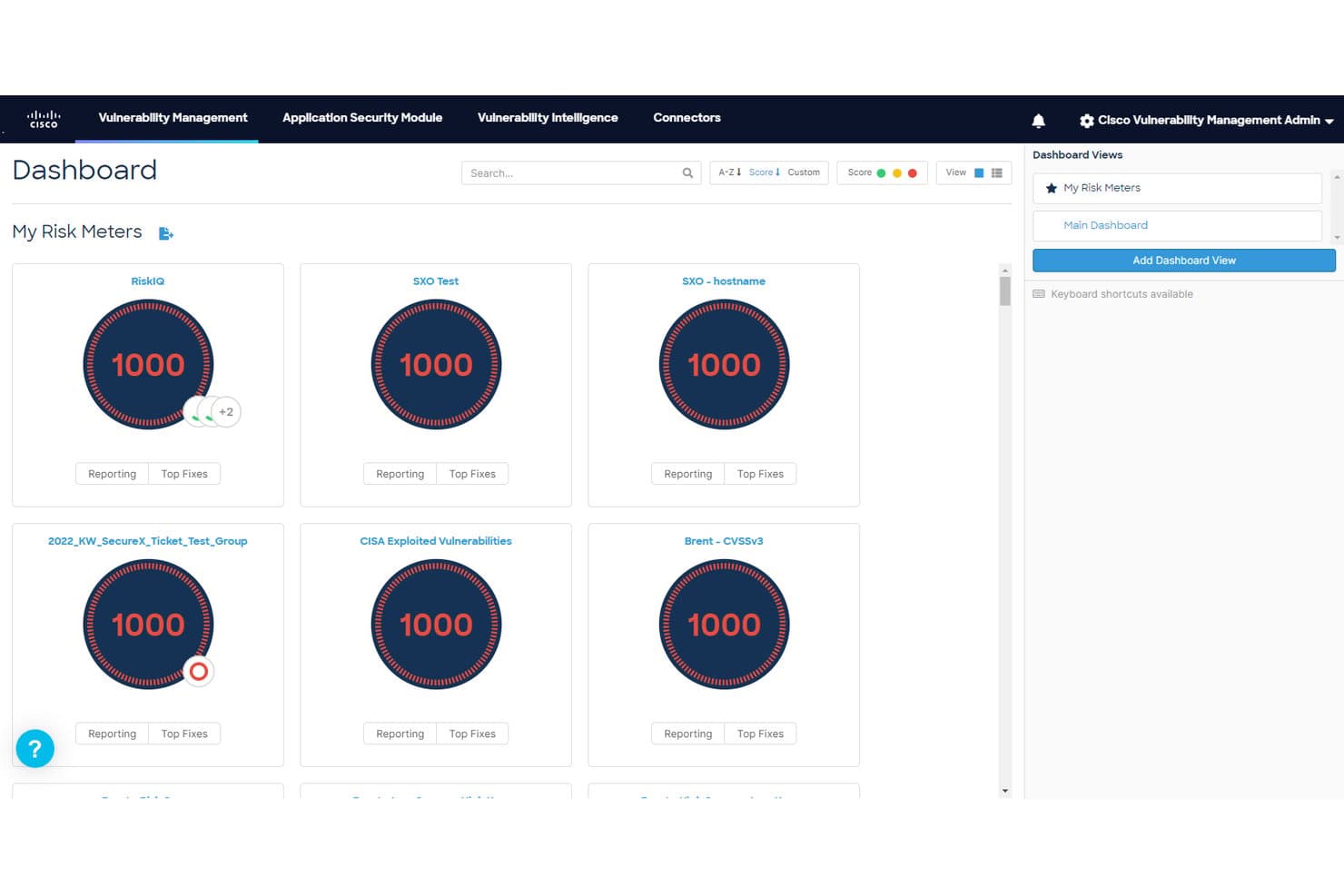
Cisco Vulnerability Management offers a risk meter dashboard displaying multiple asset groups each scored at 1000, with Reporting and Top Fixes actions available per group. Cisco Vulnerability Management is a SaaS-based vulnerability management platform that uses predictive data science and 19+ threat intelligence feeds to score and prioritize CVEs by real-world exploitability and asset criticality.
Who Is Cisco Vulnerability Management Best For?
It's a strong fit for enterprise security teams managing large, complex environments where Cisco infrastructure is already central to the stack.
Why I Picked Cisco Vulnerability Management
I picked Cisco Vulnerability Management because of how its scoring model forecasts vulnerability weaponization, not just flags it. By pulling from 19+ threat intelligence feeds and layering in Cisco Talos zero-day data, the platform predicts exploit likelihood with up to 94% accuracy. That means my team can act on what's most likely to be weaponized next, rather than defaulting to whatever scored highest on CVSS.
Cisco Vulnerability Management Key Features
- Risk Meters: Visualize vulnerability risk across different asset groups and environments with dynamic dashboards.
- Top Fix Groups: Identify prioritized sets of vulnerabilities to remediate for the greatest risk reduction.
- Bi-directional ticketing integration: Sync remediation tickets with ITSM tools to track progress and assignments.
- Peer benchmarking: Compare your risk scores against industry peers using built-in reporting tools.
Cisco Vulnerability Management Integrations
Cisco Vulnerability Management offers native integrations with Cisco Secure Endpoint, Cisco Talos, Cisco XDR, major vulnerability scanners like Tenable and Qualys, and leading ITSM tools including ServiceNow and Jira. An API is available for custom integrations.
Pros and Cons
Pros:
- Evidence-based SLAs for remediation tracking
- Predictive exploit scoring using real-world threat data
- Asset grouping with dynamic Risk Meter dashboards
Cons:
- Lacks custom vulnerability risk scoring
- Only supports CVE vulnerability findings
Learn more about Cisco Vulnerability Management: Best for AI-driven exposure prioritization
- Free demo
- Pricing upon request
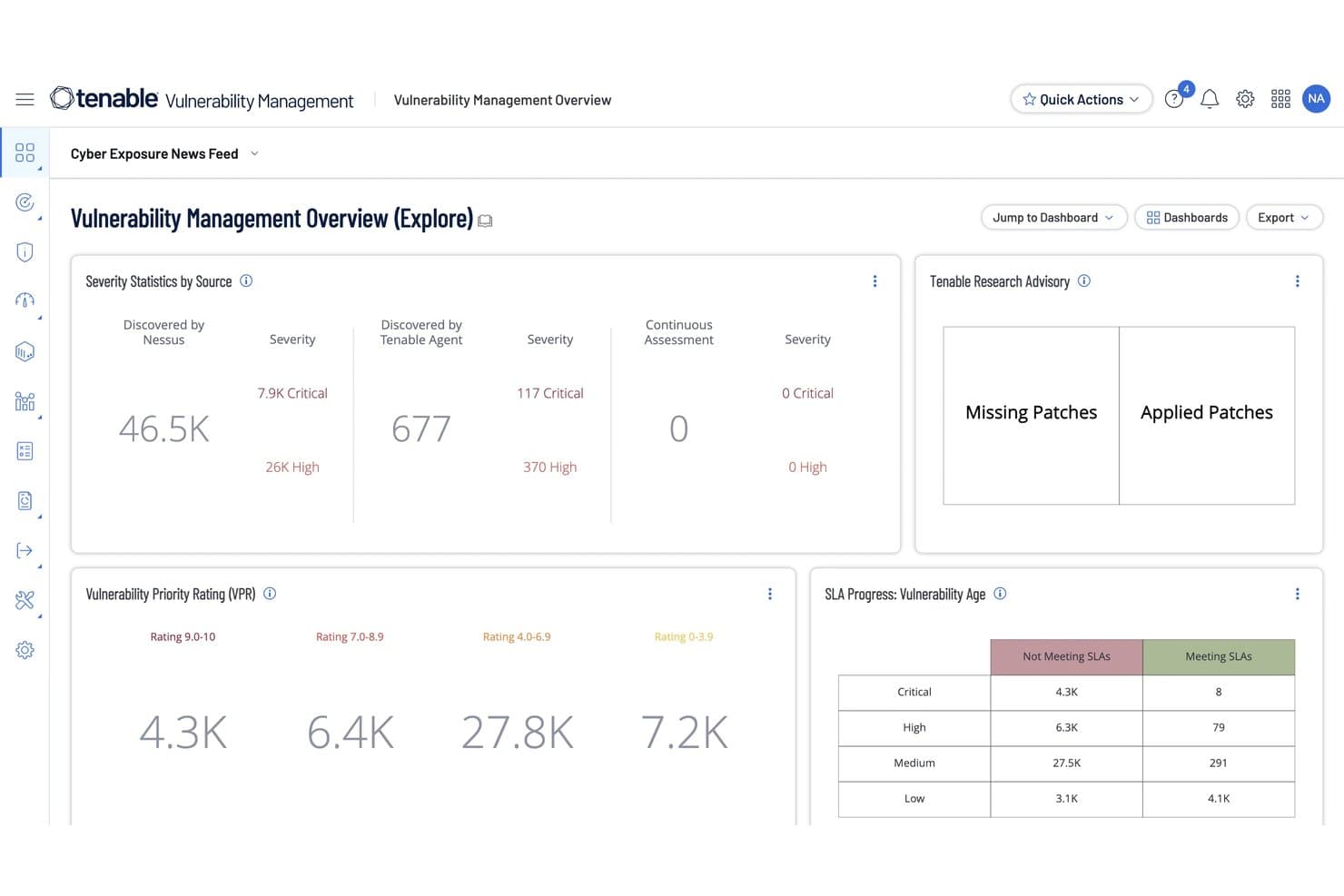
Tenable Vulnerability Management offers a risk-based overview dashboard displaying severity statistics, vulnerability priority ratings, SLA progress, and patch advisory data. Tenable Vulnerability Management is a cloud-based risk-based vulnerability management platform that combines continuous asset discovery, AI-driven vulnerability scoring, threat intelligence correlation, and remediation workflow orchestration across hybrid, cloud, and OT environments.
Who Is Tenable Vulnerability Management Best For?
It's a strong fit for enterprise security teams and SecOps leads managing large, complex environments across cloud, on-premises, and OT infrastructure.
Why I Picked Tenable Vulnerability Management
I picked Tenable Vulnerability Management as one of the best because its Vulnerability Priority Rating (VPR) fundamentally changes how my team triages CVEs. Unlike raw CVSS scores, VPR factors in active exploitation signals, ransomware associations, and asset criticality in real time, so my team isn't chasing theoretical risk. The Hexa AI agentic layer goes further still. It doesn't just surface exposure; it acts on it, executing remediation steps within guardrails my team sets.
Tenable Vulnerability Management Key Features
- Continuous asset discovery: Automatically identifies known and unknown assets across cloud, on-premises, and OT environments.
- Bi-directional ticketing: Integrates with ITSM tools like ServiceNow and Jira to sync and manage remediation tickets.
- PCI ASV integration: Supports PCI DSS scanning and attestation requirements as part of routine vulnerability management.
- Automated patch management add-on: Enables automated remediation workflows with configurable SLAs and safety guardrails.
Tenable Vulnerability Management Integrations
Tenable Vulnerability Management offers native integrations with ServiceNow, Splunk, and Jira. It natively connects with other Tenable solutions across cloud, web app, OT, and identity security. An API is available for custom integrations.
Pros and Cons
Pros:
- Automated remediation with closed-loop validation
- Continuous asset discovery across hybrid environments
- AI-driven Vulnerability Priority Rating scoring
Cons:
- Lacks agentless network scanning option
- Limited add-on for automated patching
Learn more about Tenable Vulnerability Management: Best unified dashboard view across risk domains
- Free trial + free demo
- Pricing upon request
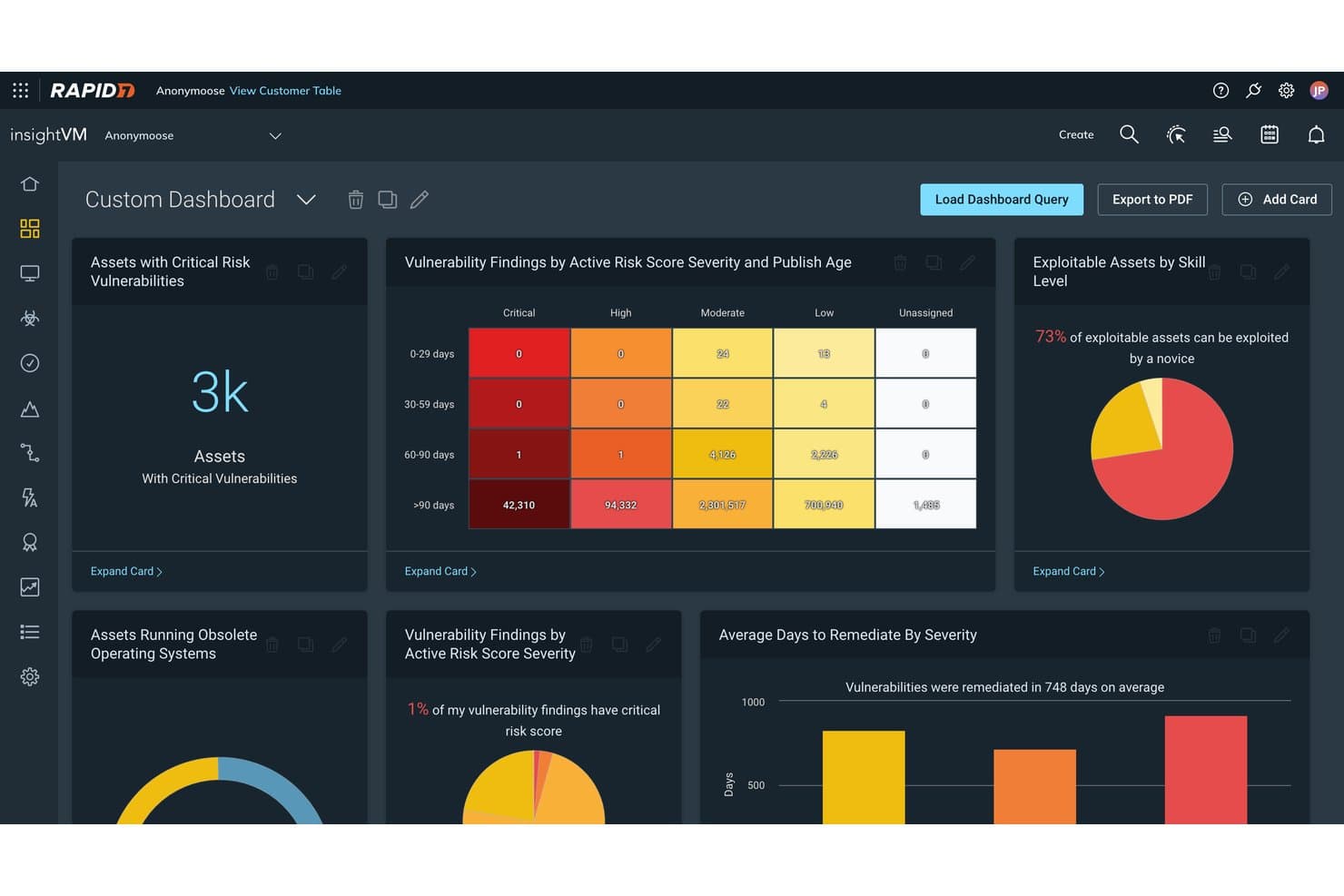
Rapid7 InsightVM offers a custom dashboard displaying critical vulnerability findings, exploitable assets by skill level, and average remediation days by severity. Rapid7 InsightVM is a risk-based vulnerability management platform that combines agent-based and network scanning, dynamic risk scoring, and remediation workflow orchestration across hybrid, cloud, and on-premises environments.
Who Is Rapid7 InsightVM Best For?
InsightVM is a strong fit for enterprise security teams managing complex hybrid environments who need to coordinate vulnerability remediation across both security and IT functions.
Why I Picked Rapid7 InsightVM
I picked Rapid7 InsightVM as one of the best because the live dashboard genuinely delivers on the promise of a unified view, pulling vulnerability data, asset criticality, and Active Risk Scores into a single pane across on-premises, cloud, and container environments. What I especially like is the Executive Risk View, which surfaces risk posture and SLA progress in a format that's usable in a board-level conversation without any extra prep work. Add the Goals and SLAs tracking layer, and I can monitor remediation commitments without switching contexts or tools.
Rapid7 InsightVM Key Features
- Remediation workflow automation: Create, assign, and track vulnerability remediation tasks integrated with Jira and ServiceNow.
- Dynamic asset tagging: Automatically group and prioritize assets based on criticality, environment, or ownership.
- Agent-based and network scanning: Scan both on-premises and cloud environments using lightweight agents or network-based methods.
- Threat intelligence integration: Incorporate real-time exploit and malware data to inform vulnerability prioritization.
Rapid7 InsightVM Integrations
Rapid7 InsightVM offers native integrations with Jira, ServiceNow, Microsoft SCCM, Ivanti, and integrates natively with Rapid7 products like InsightConnect and InsightIDR. An API is available for custom integrations.
Pros and Cons
Pros:
- Remediation projects with SLA tracking
- Dynamic asset tagging and prioritization
- Executive Risk View for board-level reporting
Cons:
- Lacks native cloud security posture tracking
- Limited third-party scanner data aggregation
Learn more about Rapid7 InsightVM:
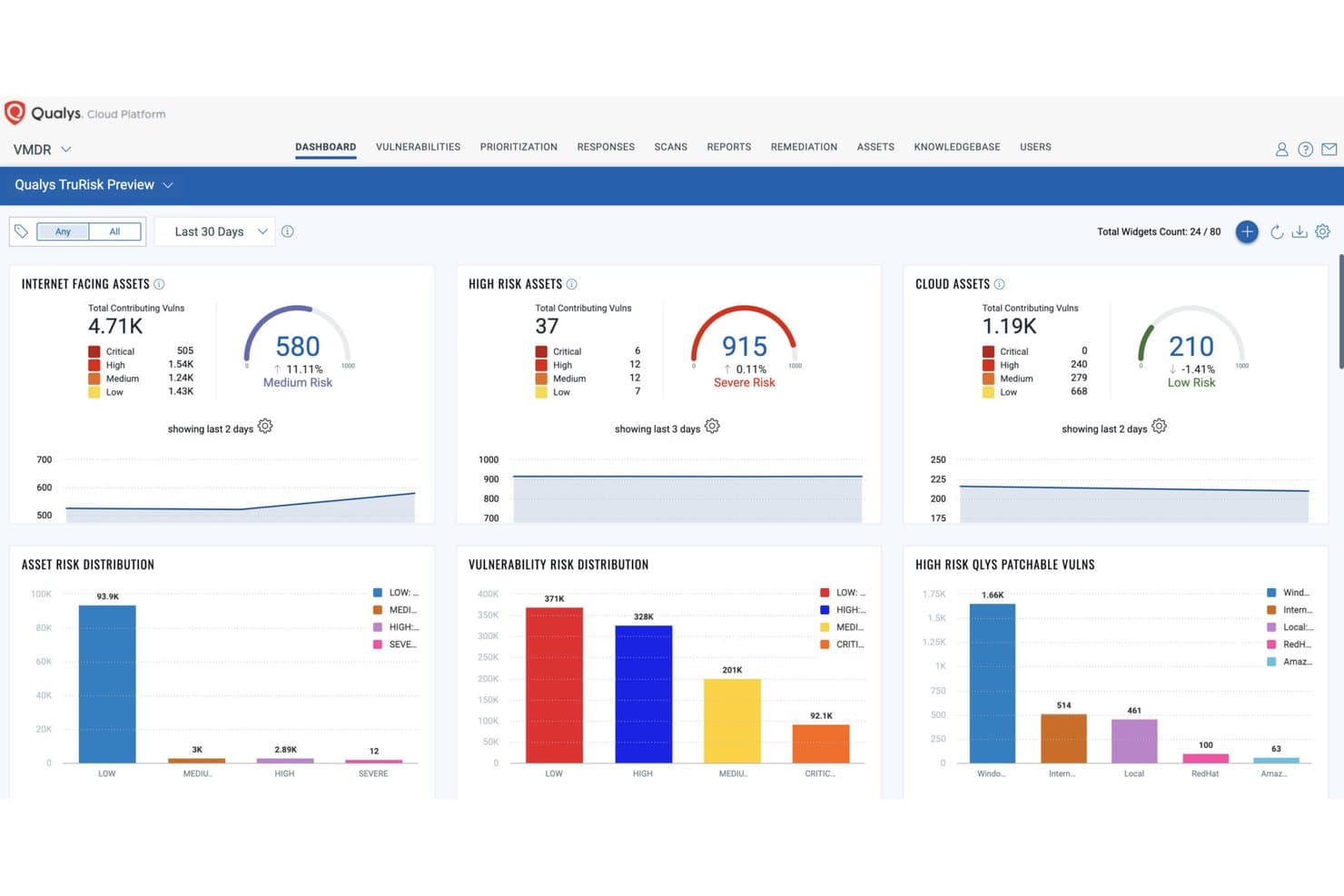
Qualys VMDR offers a TruRisk dashboard displaying risk-based vulnerability metrics across internet-facing, high-risk, and cloud assets with distribution charts. Qualys VMDR is a cloud-based vulnerability management platform that consolidates asset discovery, risk-based prioritization via TruRisk scoring, threat intelligence correlation, and patch remediation orchestration into a single agent-driven solution.
Who Is Qualys VMDR Best For?
Qualys VMDR is a strong fit for enterprise security teams managing large, complex hybrid environments across cloud, on-premises, and OT/IoT infrastructure.
Why I Picked Qualys VMDR
I picked Qualys VMDR as one of the best because its built-in asset discovery goes beyond scheduled scans. Passive Scanning Sensors detect unknown assets the moment they connect to the network, and Cloud Agents provide 2-second visibility across on-premises, cloud, OT, and IoT devices without requiring network access. That real-time inventory feeds directly into TruRisk scoring, so every asset entering my environment is immediately assessed for risk rather than waiting for the next scan cycle.
Qualys VMDR Key Features
- TruRisk scoring: Assigns dynamic, contextual risk scores that reflect exploitability, threat intelligence, and asset criticality.
- MITRE ATT&CK mapping: Aligns vulnerabilities to attacker techniques and tactics using the MITRE ATT&CK framework.
- Integrated patch management: Enables targeted remediation actions directly from risk dashboards with Qualys Patch Management.
- Bi-directional ITSM integration: Connects with ServiceNow and Jira for automated ticketing and remediation workflow tracking.
Qualys VMDR Integrations
Qualys VMDR offers native integrations with ServiceNow, Jira (Cloud and on-premises), and AWS EC2. An API is available for custom integrations.
Pros and Cons
Pros:
- Integrated patch remediation from risk dashboard
- Dynamic TruRisk scoring for every vulnerability
- Real-time asset discovery with passive sensors
Cons:
- Requires dedicated agent deployment
- Lacks built-in code scanner integration
Learn more about Qualys VMDR: Best automation for multi-source risk data
- Free demo
- Pricing upon request
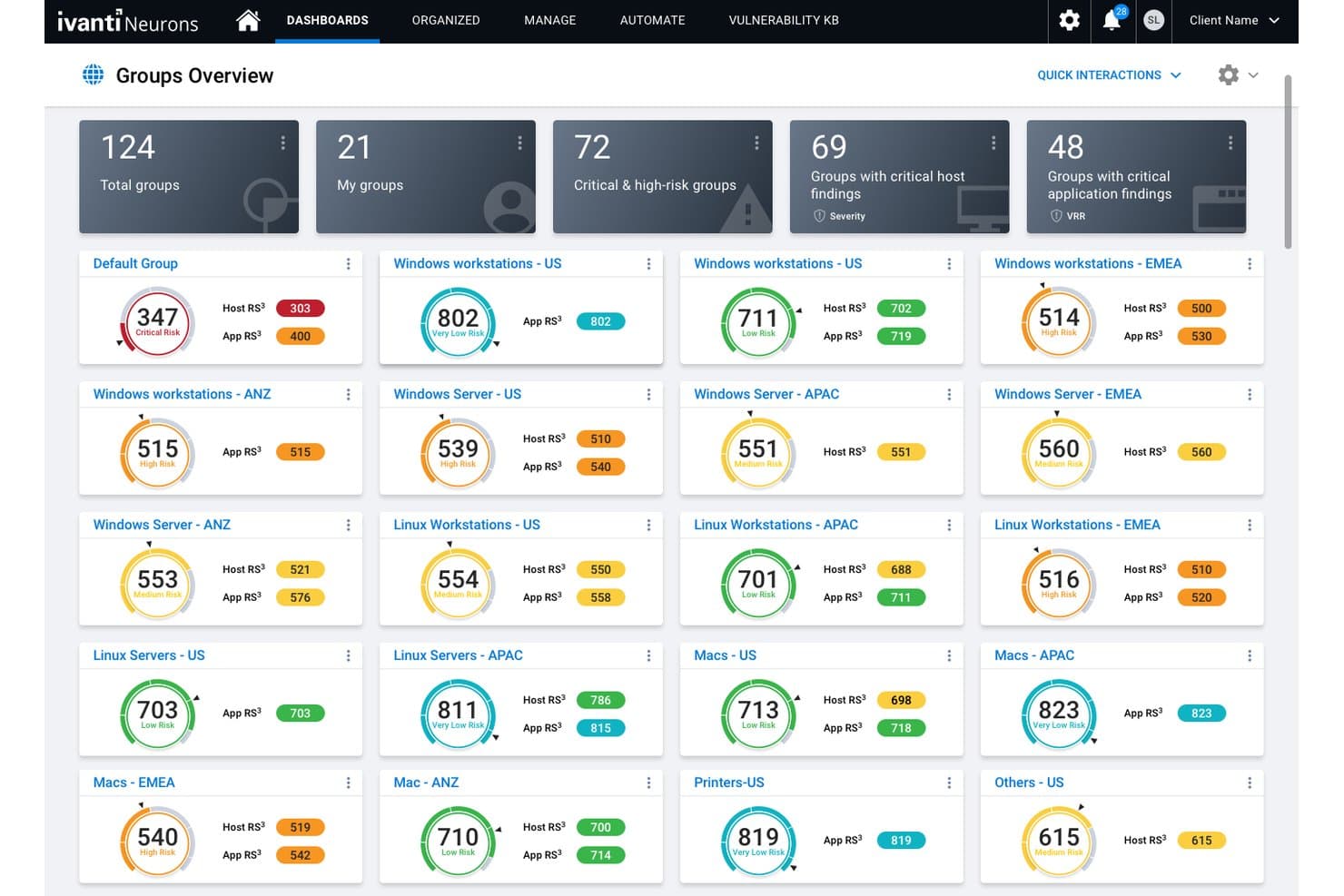
Ivanti Neurons for RBVM offers a Groups Overview dashboard displaying risk scores, host findings, and application findings across 124 device groups worldwide. Ivanti Neurons for RBVM is a SaaS-based risk-based vulnerability management platform that ingests vulnerability data from 100+ sources, applies proprietary risk scoring, and orchestrates remediation workflows across ITSM and patch management tools.
Who Is Ivanti Neurons for RBVM Best For?
It's a strong fit for large enterprise security teams managing vulnerability data across complex, multi-scanner environments who need centralized risk prioritization and remediation tracking.
Why I Picked Ivanti Neurons for RBVM
I've included Ivanti Neurons for RBVM in my top picks because of how it pulls in data from 100+ vulnerability sources and automatically correlates findings against threat intelligence, asset criticality, and exploit availability. That correlation powers the Vulnerability Risk Rating (VRR), a proprietary score that replaces raw CVSS with context tied to ransomware and active exploits. Playbook automation then handles SLA assignment and remediation alerts without manual triage.
Ivanti Neurons for RBVM Key Features
- RS³ organizational risk scoring: Quantifies and visualizes risk posture across the entire organization so you can track risk levels over time.
- Role-based access controls: Lets you define user roles for granular access to risk data, dashboards, and workflows.
- Threat-based system views: Surfaces critical exposures connected to high-priority threats like ransomware or known exploits.
- Executive and ransomware dashboards: Delivers prebuilt dashboards tailored for executive visibility and focused reporting on ransomware exposure.
Ivanti Neurons for RBVM Integrations
Ivanti Neurons for RBVM offers native integrations with Ivanti Neurons for ITSM, Ivanti Neurons for Patch Management, and Snyk, and supports ingestion from over 100 vulnerability data sources via API, flat file, or XML. An API is available for custom integrations.
Pros and Cons
Pros:
- Automated SLA assignment and workflow routing
- Includes ransomware-focused threat mapping
- Correlates vulnerabilities from 100+ data sources
Cons:
- Requires manual setup for custom playbooks
- Lacks built-in automated patch validation
Learn more about Ivanti Neurons for RBVM:
Other Risk-Based Vulnerability Management Software
Here are some additional risk-based vulnerability management software options that didn’t make it onto my shortlist, but are still worth checking out:
- 11SeemplicityBest for AI-powered remediation task routing
- 12HackuityBest for consolidating vulnerability tools
- 13Tripwire IP360Best network-based vulnerability discovery
- 14EdgescanBest coverage of external and internal assets
- 15CrowdStrike Falcon Exposure ManagementBest for threat detection suite integration
- 16Hive ProBest predictive attack path visualization
- 17Arctic Wolf Aurora Exposure ManagementBest for managed proactive risk reduction
- 18ArmorCodeBest for unified security posture monitoring
How I Evaluate Risk-Based Vulnerability Management Software
I split my evaluation into baseline requirements—like context-aware risk scoring and ITSM ticket routing—and the differentiators that separate good tools from truly useful ones.
Core Functionality (Table Stakes For This List)
When I'm selecting tools for my list, I rank each one on a scale from 0 (does not offer the functionality) to 5 (excels in this area) for each core functionality listed below. Then, I calculate the tool's total score as a percentage. Each tool needs to achieve a minimum total score of 65% to be considered for inclusion.
- Risk-Based Prioritization: I evaluate whether the tool scores vulnerabilities using exploitability, threat intel, and asset value rather than just raw CVSS numbers.
- Vulnerability Data Aggregation: The platform should ingest findings from multiple scanners like Tenable, Qualys, or Rapid7 and normalize them into one view.
- Asset Context Enrichment: I look for CMDB integration and business-context tagging so risk scores reflect asset ownership, data sensitivity, and criticality.
- Threat Intelligence Integration: Real-time feeds like EPSS, CISA KEV, and ransomware associations should actively shape how vulnerabilities get scored and surfaced.
- Remediation Workflow Orchestration: I check for bi-directional sync with tools like Jira or ServiceNow, plus SLA tracking and automated ticket assignment.
- Risk Reporting & Dashboards: Dashboards should offer role-based views so analysts see operational detail and CISOs see risk trends and remediation progress.
Once I have a list of tools that meet the criteria, I consider what sets each platform apart.
Differentiating Factors (What Sets Vendors Apart)
Here's how I compare and contrast different vendors:
Standout Features
Attack path analysis is a real differentiator. I look for tools that map how vulnerabilities chain across assets to reach key systems. That helps you fix choke points instead of chasing isolated CVEs. Business context weighting matters just as much. Tagging assets by data sensitivity or compliance scope ensures risk scores reflect real organizational impact. I also evaluate executive risk reporting, where platforms translate technical findings into financial terms a CISO can bring to the board.
Beyond Features
Scanner and data source integrations are a big deal. I check whether a platform works with your existing scanners and pushes tickets into tools like Jira or ServiceNow without forcing you to rip and replace. Risk scoring transparency also matters. I look for audit trails that explain why a CVE was prioritized, so you can defend your patching decisions during audits. Deployment model is worth evaluating too, especially if you operate in regulated industries where cloud-only SaaS won't fly.
How to Choose Risk-Based Vulnerability Management Software
It’s easy to get bogged down in long feature lists and complex pricing structures. To help you stay focused as you work through your unique software selection process, here’s a checklist of factors to keep in mind:
| Factor | What to Consider |
|---|---|
| FactorScalability | What to ConsiderCan the platform support your asset volume today and as you grow? Consider global expansion or M&A scenarios. |
| FactorIntegrations | What to ConsiderDoes it ingest data from your scanners, cloud providers, and ITSM tools without major workarounds? |
| FactorCustomizability | What to ConsiderCan you tune risk scoring, dashboards, or workflows to fit company policies or reporting structures? |
| FactorEase of use | What to ConsiderIs the UI intuitive for both practitioners and executives? Will your team actually adopt it quickly? |
| FactorImplementation and onboarding | What to ConsiderWhat’s the typical time-to-value? Ask about deployment models, onboarding timelines, and migration support. |
| FactorCost | What to ConsiderHow does pricing align with your expected user count and asset footprint? Understand licensing triggers. |
| FactorSecurity safeguards | What to ConsiderDoes the vendor meet your data protection standards for sensitive vulnerability and asset data? |
| FactorCompliance requirements | What to ConsiderCan the solution support audits and help document adherence to frameworks like PCI DSS, HIPAA, or NIST? |
What Is Risk-Based Vulnerability Management Software?
Risk-based vulnerability management software is a security platform that prioritizes vulnerabilities based on real-world risk, not just technical severity. It combines data from multiple scanners, asset context, and threat intelligence to highlight which issues to address first, helping security teams focus on what matters most for their organization’s risk posture.
Features of Risk-Based Vulnerability Management Software
When selecting risk-based vulnerability management software, keep an eye out for the following key features:
- Risk-based prioritization: Uses exploitability, business impact, and real-world threat data to rank vulnerabilities by true organizational risk—not just severity scores.
- Vulnerability data aggregation: Consolidates findings from diverse scanners and cloud tools into a unified inventory, giving you a complete and accurate picture of risk.
- Asset context enrichment: Links vulnerabilities with asset ownership, criticality, and business function so teams understand the impact of each finding.
- Threat intelligence integration: Incorporates live exploit feeds, malware campaigns, and other threat intelligence sources to inform risk calculations and flag actively exploited issues.
- Remediation ticketing workflows: Assigns, tracks, and manages fix tasks through integration with ITSM tools, ensuring vulnerabilities are remediated and verified within defined SLAs.
- Customizable dashboards: Presents risk and remediation data visually, tailoring views for analysts, managers, and executives with drill-down and trend analysis.
- Audit and compliance reporting: Generates reports aligned with industry frameworks—like PCI DSS or NIST—for audit preparation and ongoing compliance tracking.
- Closed-loop verification: Automatically re-scans assets to confirm remediation is complete, reducing manual follow-up and missed fixes.
- API and integration support: Offers detailed APIs and connectors for syncing with asset inventories, configuration management, and external reporting systems.
Benefits of Risk-Based Vulnerability Management Software
Implementing risk-based vulnerability management software provides several benefits for your team and your business. Here are a few you can look forward to:
- Focused remediation: Prioritize vulnerabilities that present real organizational risk so your team fixes what truly matters first.
- Unified risk view: Aggregate findings from multiple scanners and sources to deliver a single, normalized dashboard for vulnerability management.
- Informed decision-making: Asset context, business impact, and threat intelligence integration help stakeholders understand risk in business terms, not just technical jargon.
- Improved compliance: Automated audit and framework-aligned reporting eases evidence collection and tracking for industry regulations and standards.
- Workflow automation: Integrated remediation ticketing and closed-loop verification drive efficient, accountable patching across IT and security teams.
- Executive reporting: Custom dashboards and risk quantification tools make it easier to communicate cyber risk and remediation progress to leaders and boards.
- Reduced remediation backlog: By filtering out low-impact threats, teams spend less time chasing minor issues, shrinking overall patching queues.
Costs and Pricing of Risk-Based Vulnerability Management Software
Selecting risk-based vulnerability management software requires an understanding of the various pricing models and plans available. Costs vary based on features, team size, add-ons, and more. The table below summarizes common plans, their average prices, and typical features included in risk-based vulnerability management software solutions:
Plan Comparison Table for Risk-Based Vulnerability Management Software
| Plan Type | Average Price | Common Features |
|---|---|---|
| Plan TypeFree Plan | Average Price$0 | Common FeaturesLimited asset support, basic risk scoring, manual reporting, and no integrations. |
| Plan TypePersonal Plan | Average Price$50-$200/month | Common FeaturesSingle user access, standard risk scoring, data aggregation, and simple dashboards. |
| Plan TypeBusiness Plan | Average Price$500-$2,000/month | Common FeaturesMulti-user support, custom risk weighting, integrations with scanners and ITSM, compliance reports, and SLAs. |
| Plan TypeEnterprise Plan | Average Price$2,000-$10,000/month | Common FeaturesEnterprise asset scale, advanced analytics, threat intelligence feeds, attack path analysis, API access, and premium support. |
Risk-Based Vulnerability Management Software FAQs
Here are some answers to common questions about risk-based vulnerability management software:
How is risk-based vulnerability management different from traditional vulnerability management?
Risk-based vulnerability management prioritizes issues based on asset context and real-world threats, not just technical severity scores or basic vulnerability scanning. Unlike traditional vulnerability management, it evaluates business criticality, threat actors, and likelihood of exploitation to prevent data breaches and optimize the overall vulnerability management lifecycle.
What types of assets can risk-based vulnerability management software cover?
You can expect coverage for on-prem systems, cloud workloads, containers, endpoints, and IoT assets. Some platforms improve network and application security by integrating results from penetration testing and vulnerability assessment tools, providing complete attack surface visibility across web applications, mobile devices, and external entry points.
Does risk-based vulnerability management software integrate with our existing tools?
Yes, most solutions integrate with common scanners, ITSM platforms like Jira or ServiceNow, and asset inventories. Check that the specific tools your organization uses are supported for direct data flow and workflow automation.
Can it help with compliance requirements?
Yes, many platforms generate audit-ready reports and track remediation SLAs aligned with frameworks like PCI DSS, HIPAA, NIST, or ISO 27001. This supports evidence collection and helps demonstrate risk-based decision-making during assessments.
How long does it take to implement risk-based vulnerability management software?
Implementation can range from a few days to several weeks depending on asset scale, integration needs, and organizational complexity. It’s a good idea to ask vendors about onboarding support, available playbooks, and training resources for your team.