

AI governance tools are platforms that help your team control, monitor, and document how artificial intelligence systems are used across your organization. If you’re here, you’re probably facing urgent questions about compliance, risk, and transparency as you adopt formal AI governance frameworks. Whether you need to prove compliance with strict frameworks, monitor for bias and drift, or build an accountable audit trail, the right tool is your foundation.
This guide covers the top options for 2026, so you can compare leading solutions and make an informed decision that fits the pace and realities of your AI operations.
Why Trust Our Software Recommendations
6,700+
Reviews
20
Industry experts
16+
Evaluation factors
14
Years
Our team has been testing and reviewing software since 2012. As tech leaders ourselves, we know how difficult—and important—it is to choose the right software.
For this guide, we evaluated tools using hands-on testing and independent research, scoring tools using our selection criteria.
Our reviews reflect our human editorial judgment, not a sales pitch.
Expert reviewers:
- Paulo Gardini MiguelTech Director
 Tim FisherVP of AI
 Gabriel RosasTech Lead & Software Architect
 Christhian GruhnTech Lead & Platform Architect

AI Governance Tools Comparison Table
This comparison table summarizes pricing details for my top AI governance tools selections:
| Tool | Best For | Trial Info | Price | ||
|---|---|---|---|---|---|
| 1 | Best for end-to-end model risk management | Free demo available | Pricing upon request | Website | |
| 2 | Best for end-to-end data and model lineage | Free demo available | Pricing upon request | Website | |
| 3 | Best for GenAI guardrails and risk evaluation | Free demo available | Pricing upon request | Website | |
| 4 | Best for audit-ready model documentation | Not available | Pricing upon request | Website | |
| 5 | Best for unified data and AI compliance reporting | Free trial available | From $12/month (billed annually) | Website | |
| 6 | Best for policy-driven regulatory compliance | Free demo available | Pricing upon request | Website | |
| 7 | Best for multi-framework compliance coverage | Free demo available | Pricing upon request | Website | |
| 8 | Best for enterprise model lifecycle management | Free trial + free demo available | From $795/month | Website | |
| 9 | Best for privacy-first governance workflows | Free demo available | Pricing upon request | Website | |
| 10 | Best for automated model inventory and discovery | Free demo available | Pricing upon request | Website |


Best AI Governance Tools Reviews
Below are my detailed summaries of the best AI governance tools that made it onto my shortlist. My reviews offer a detailed look at the capabilities, best use cases, and integrations of each platform to help you find the best one for you.
 Best for end-to-end model risk management
- Free demo available
- Pricing upon request

DataRobot offers quota monitoring and usage tracking per entity, enabling CTOs to govern AI resource consumption and enforce rate limits across deployments. DataRobot is an AI governance platform that covers model registry, real-time policy enforcement, pre-deployment red-teaming, and compliance monitoring across cloud, on-premises, edge, and air-gapped environments.
Who Is DataRobot Best For?
DataRobot suits large enterprises in regulated industries—like financial services and defense—managing large-scale AI deployments that span multiple environments and require audit-ready compliance documentation.
Why I Picked DataRobot
DataRobot earns its spot on my shortlist because the three-layer governance model addresses risk at every stage of the model lifecycle. Pre-deployment red-teaming surfaces bias, jailbreaks, and toxicity before anything ships, while real-time moderation blocks unsafe outputs in production. I also like how policies are defined once and automatically propagated across the entire agent estate, so governance coverage doesn't drift as deployments multiply.
DataRobot Key Features
- Central model inventory: Catalogs all models, datasets, owners, and use cases across diverse environments in a unified registry.
- Automated compliance documentation: Generates structured records tailored to industry regulations like the EU AI Act and NIST AI RMF.
- Real-time LLM guardrails: Filters for prompt injection, PII leakage, hallucinations, and hidden security vulnerabilities in AI/LLM outputs as they occur.
- Native Airflow integration: Orchestrates model workflows and batch processing through direct integration with Apache Airflow.
DataRobot Integrations
DataRobot offers native integrations with SAP, Snowflake, Amazon S3, MLFlow, Tableau, Pinecone, Databricks, HuggingFace, Streamlit, and more. An API is available for custom integrations.
Pros and Cons
Pros:
- Pre-built regulatory framework mapping
- Real-time LLM output moderation
- Automated compliance documentation workflows
Cons:
- Advanced features require significant user training
- No public pricing transparency
Learn more about DataRobot: Best for end-to-end data and model lineage
- Free demo available
- Pricing upon request

Collibra Data Governance offers a Model Registry dashboard that tracks AI models by status, ownership, and lifecycle with analytics and filtering capabilities. Collibra Data Governance is an enterprise data and AI governance platform that centralizes model inventory, policy enforcement, compliance mapping, and end-to-end lineage tracking across cloud and on-premises environments.
Who Is Collibra Data Governance Best For?
Collibra is a strong fit for large enterprises in regulated industries like finance and healthcare that need governance across complex, multi-cloud AI and data environments.
Why I Picked Collibra Data Governance
Collibra Data Governance earns its spot on my shortlist because the lineage coverage genuinely goes further than most tools I've tested. I can trace a model's full history from raw source datasets through training runs, inference pipelines, and live deployment, all in one connected view. The 2025 Deasy Labs acquisition also extends that lineage to unstructured data like documents and transcripts, which was a real gap in most governance platforms I've evaluated.
Collibra Data Governance Key Features
- AI Command Center: Centralizes registration, assessment, and monitoring of AI models and use cases across cloud providers.
- Automated policy enforcement: Lets you configure rules and approval workflows to govern AI assets throughout their lifecycle.
- Compliance mapping dashboards: Maps your models against frameworks like the EU AI Act, NIST AI RMF, and ISO 42001 for regulatory alignment.
- Role-based access controls: Supports granular data and model governance with permissions for data stewards, risk officers, and audit teams.
Collibra Data Governance Integrations
Collibra Data Governance offers 100+ native integrations, including AWS SageMaker, Azure AI Foundry, Databricks Unity Catalog, Google Vertex AI, Tableau, Salesforce, Slack, MLflow, and SAP AI Core. An API is also available for custom integrations.
Pros and Cons
Pros:
- Automated workflows for AI risk assessment
- Extensive compliance mapping and reporting features
- End-to-end data and model lineage tracking
Cons:
- Complex implementation for resource-limited teams
- Model performance monitoring is limited
Learn more about Collibra Data Governance: Best for GenAI guardrails and risk evaluation
- Free demo available
- Pricing upon request

Lumenova AI offers a comprehensive AI Governance Platform with seven key features including risk management, guardrails, and automated documentation. Lumenova AI is an AI governance and model risk management platform that combines AI model inventory, risk assessment workflows, compliance mapping, guardrails, and production model monitoring across traditional ML and GenAI systems.
Who Is Lumenova AI Best For?
Lumenova AI is a strong fit for enterprises in regulated industries like banking, insurance, and healthcare that need to govern both traditional ML models and GenAI systems.
Why I Picked Lumenova AI
Lumenova AI earns its spot on my shortlist because of how it handles GenAI risk at the inference layer. I particularly like the guardrails module, which filters for prompt injection, harmful content, and sensitive data exposure in real time across LLM and agent interactions. The evaluations layer goes deep too, covering 200+ metrics across hallucination detection, bias, and security resilience, backed by a library of 80+ pre-built risk scenarios.
Lumenova AI Key Features
- Centralized AI model inventory: Catalogs all AI and ML models with metadata, versioning, and ownership details in a single auditable registry.
- Compliance mapping and evidence generation: Maps models to frameworks like the EU AI Act and NIST AI RMF, creating audit-ready documentation.
- Lifecycle management workflows: Supports AI model tracking from ideation through deployment and retirement, capturing lineage and status changes.
- Role-based collaboration: Enables risk, compliance, and technical stakeholders to coordinate reviews, sign-offs, and approvals across the governance process.
Lumenova AI Integrations
Native integrations are not publicly listed. Lumenova AI provides an API for custom integrations.
Pros and Cons
Pros:
- Centralized lifecycle workflows for model governance
- Advanced risk scenario library and framework coverage
- Comprehensive GenAI guardrails for LLMs and agents
Cons:
- Native integrations not clearly documented
- No self-serve onboarding or instant access
Learn more about Lumenova AI:

Monitaur offers an Apply Governance workflow that lets users set risk level, review due date, and compliance template for AI models flagged as high risk. Monitaur is an AI governance platform built for regulated enterprises, covering model inventory, risk assessment, policy enforcement, compliance mapping, and automated audit documentation across the full model lifecycle.
Who Is Monitaur Best For?
Monitaur is a strong fit for risk and compliance teams in regulated industries like insurance and financial services that need structured AI governance programs.
Why I Picked Monitaur
I picked Monitaur as one of the best because its approach to audit-ready documentation is the most automated I've seen. Automate Record captures every AI decision against predefined safe ranges and auto-maps that evidence to Common Controls, covering NIST AI RMF, ISO 42001, and the EU AI Act. Before deployment, FlightSim runs synthetic simulations and returns letter grades with remediation guidance, creating a documented pre-deployment validation record.
Monitaur Key Features
- Centralized inventory: Catalogs all AI models, use cases, and vendors in a single registry with ownership and lifecycle status.
- Customizable policy templates: Offers ready-to-use templates aligned with major frameworks such as the EU AI Act, NIST AI RMF, and ISO 42001.
- Collaborative workflow management: Enables multi-stakeholder policy reviews, risk assessments, and approvals across compliance and technical teams.
- Third-party AI oversight: Manages and monitors external and vendor-supplied AI models alongside internal deployments.
Monitaur Integrations
Monitaur offers native integrations with Databricks, MLFlow, DataRobot, Azure, AWS SageMaker, ServiceNow, Confluence, Langfuse, GitHub, and more. An API is available for custom integrations.
Pros and Cons
Pros:
- Pre-deployment validation with FlightSim grading
- Centralized model inventory with lifecycle tracking
- Automated evidence collection for regulatory frameworks
Cons:
- Limited explainability features compared to some peers
- Quote-based pricing, no transparent tier info
Learn more about Monitaur: Best for unified data and AI compliance reporting
- Free trial available
- From $12/month (billed annually)

Microsoft Purview offers a Data Security Posture Management (DSPM) for AI dashboard that provides AI governance tools including compliance recommendations, interaction reports, and sensitive data protection insights. Microsoft Purview is a data governance and compliance platform from Microsoft that combines data classification, DLP, insider risk management, and AI app oversight across Microsoft 365 and multicloud environments.
Who Is Microsoft Purview Best For?
It's a natural fit for enterprise IT and compliance teams already running Microsoft 365 who need centralized visibility into data security and AI app governance.
Why I Picked Microsoft Purview
I picked Microsoft Purview as one of the best because its Compliance Manager maps AI systems against the EU AI Act, NIST, and 300+ other regulatory templates from a single console. DSPM for AI then layers on a real-time risk dashboard that tracks compliance posture across Copilot, ChatGPT Enterprise, and Gemini simultaneously. I find the combination of data classification and AI app compliance reporting in one portal is what separates it from point solutions in this space.
Microsoft Purview Key Features
- Unified data catalog: Centralizes metadata and classification for data assets across Microsoft 365, Azure, and supported multicloud sources.
- Insider risk management: Monitors and investigates suspicious user activity and potential data exfiltration involving sensitive content.
- Data loss prevention policies: Automates enforcement to prevent sensitive data leaks in emails, files, and AI-enabled applications.
- Audit logging and eDiscovery: Captures immutable activity logs and supports advanced search and legal hold across enterprise data.
Microsoft Purview Integrations
Microsoft Purview has native integrations across the Microsoft ecosystem, including Microsoft 365 and Azure, and supports connections to sources like SharePoint, SQL Server, Amazon S3, and Entra ID. An API is available for custom integrations.
Pros and Cons
Pros:
- Strong DLP and insider risk management
- Unified data and AI governance portal
- Deep compliance mapping for global regulations
Cons:
- AI model inventory is limited to apps
- No native model monitoring capabilities
Learn more about Microsoft Purview: Best for policy-driven regulatory compliance
- Free demo available
- Pricing upon request
Visit WebsiteCustomer Rating:4.2/5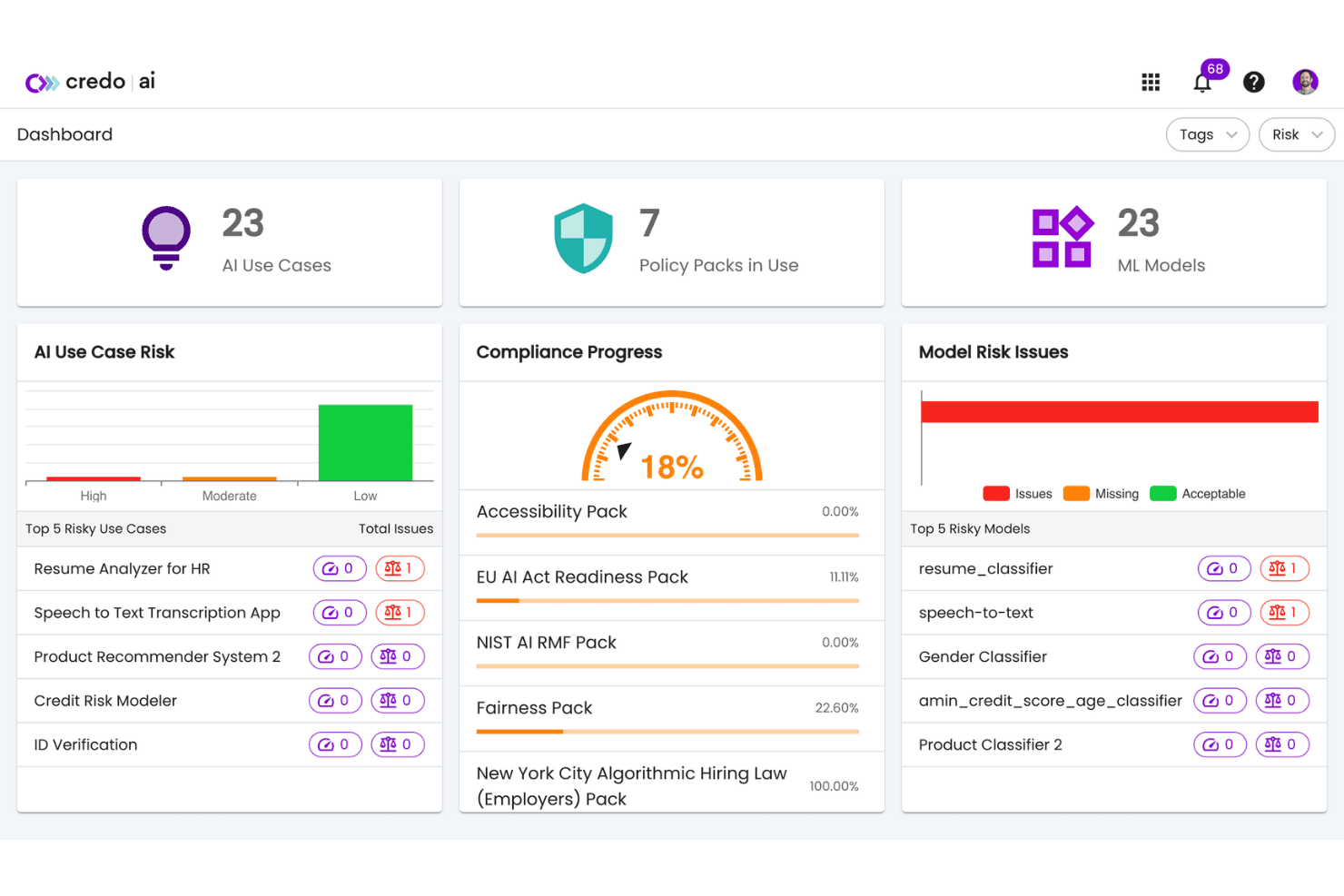
Credo AI offers a centralized governance dashboard displaying AI use case risk levels, compliance progress across policy packs, and model risk issues for CTOs managing AI oversight. Credo AI is a purpose-built AI governance platform that combines an AI model registry, automated risk assessment, policy enforcement, compliance mapping, and runtime monitoring across the full AI lifecycle.
Who Is Credo AI Best For?
Credo AI is a strong fit for enterprise teams in regulated industries like financial services and healthcare that need structured AI risk and compliance oversight.
Why I Picked Credo AI
I picked Credo AI as one of the best because its pre-built policy packs for EU AI Act, NIST AI RMF, and ISO 42001 give compliance teams a direct path from regulation to enforcement, without building frameworks from scratch. I like how the Policy Engine automates evidence collection and generates audit-ready documentation as models move through the lifecycle. The Agent Registry also impresses me, letting my team govern autonomous AI agents with the same policy-driven rigor applied to traditional models.
Credo AI Key Features
- Shadow AI discovery: Continuously scans cloud and code environments to auto-detect unregistered AI and agentic systems.
- Governance knowledge graph: Connects regulations, controls, and AI components for unified policy orchestration and oversight.
- Runtime governance: Ingests traces and applies real-time policy checks as models or agents process data in production.
- Python SDK: Lets teams integrate governance checks and policy enforcement directly into ML pipelines and custom workflows.
Credo AI Integrations
Credo AI offers native integrations with 30+ apps including AWS, Microsoft, Databricks, and IBM, and provides an API and Python SDK for custom enterprise AI applications.
Pros and Cons
Pros:
- Agent registry supports agentic AI governance
- Shadow AI discovery across cloud environments
- Automated policy packs for major regulations
Cons:
- Interface complexity may slow initial onboarding
- Lacks deep technical model explainability
Learn more about Credo AI: Best for multi-framework compliance coverage
- Free demo available
- Pricing upon request
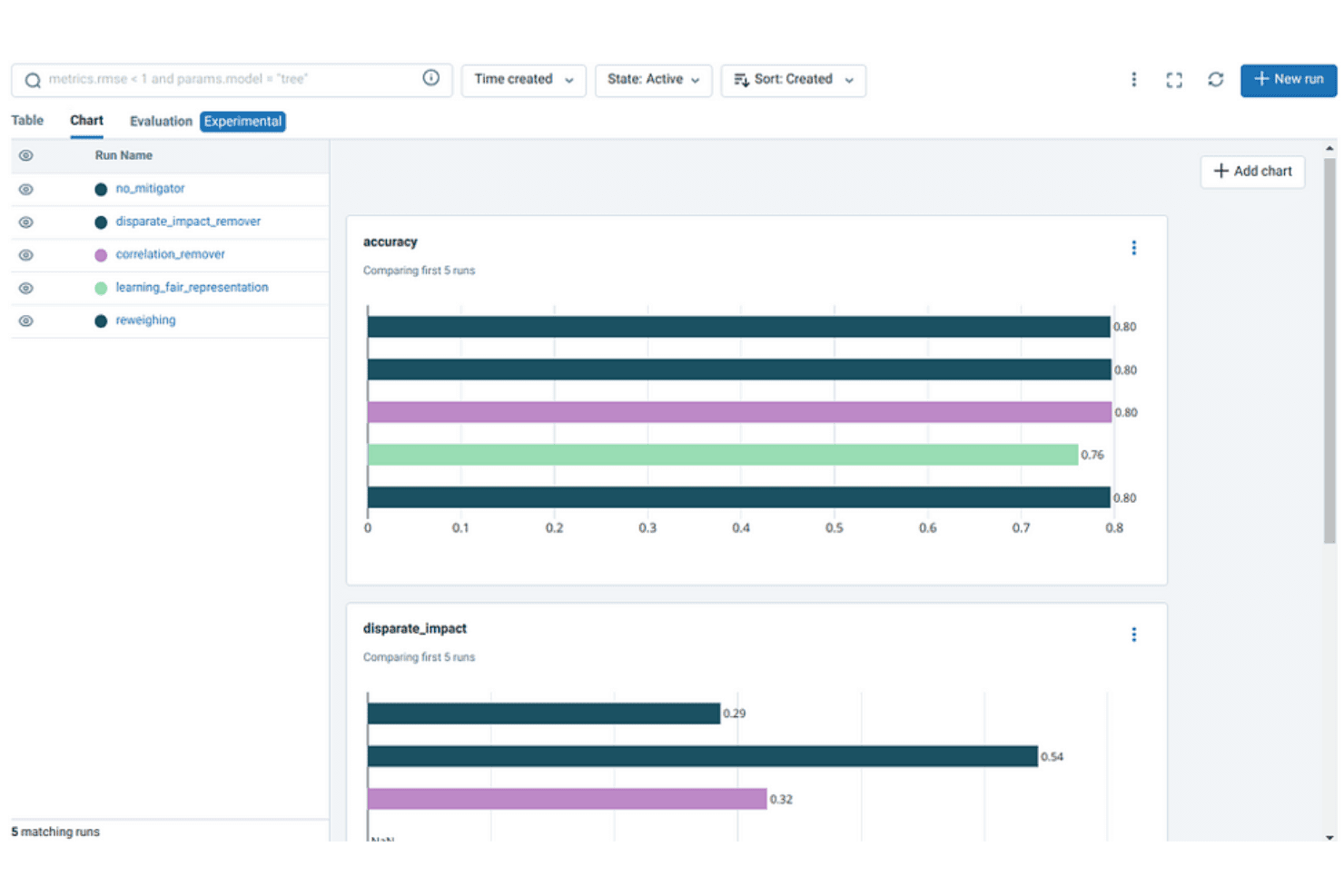
Holistic AI offers a comparative chart view of fairness mitigation runs, tracking accuracy and disparate impact metrics across five algorithms. Holistic AI is an enterprise AI governance platform that combines automated AI system discovery, continuous risk and bias testing, runtime policy enforcement, and regulatory compliance mapping across the full AI model lifecycle.
Who Is Holistic AI Best For?
It's a strong fit for large enterprises with broad AI deployments that need to document and prove compliance across multiple regulatory frameworks simultaneously.
Why I Picked Holistic AI
Holistic AI earns its spot on my shortlist because of how it handles simultaneous compliance across the EU AI Act, NIST AI RMF, ISO 42001, and NYC Local Law 144. What I particularly like is the automated control mapping: it maps your AI systems to each framework's controls and flags gaps without manual cross-referencing. I also rely on its continuous evidence collection to generate audit-ready documentation without rebuilding it from scratch before every regulatory review.
Holistic AI Key Features
- Automated model inventory: Scans cloud platforms, code repositories, and SaaS tools to detect and register all AI systems within the organization.
- LLM guardrails: Provides real-time content filtering for prompt injection, hallucinations, PII leakage, and unsafe outputs in generative AI workflows.
- Role-based collaboration: Offers interfaces and workflows tailored to data scientists, compliance leads, and executives for coordinated governance actions.
- Immutable audit trails: Automatically records decision history, approvals, and model changes for regulator-ready documentation and accountability.
Holistic AI Integrations
Holistic AI offers native integrations with AWS, Azure, GitHub, Databricks, ServiceNow, Snowflake, Confluence, Langsmith, CrewAI, and more, plus an API for custom integrations.
Pros and Cons
Pros:
- Real-time LLM guardrails for generative AI
- Automated model discovery across environments
- Extensive regulatory framework coverage
Cons:
- Fewer explainability options than MLOps tools
- Limited code-level model inspection
Learn more about Holistic AI: Best for enterprise model lifecycle management
- Free trial + free demo available
- From $795/month
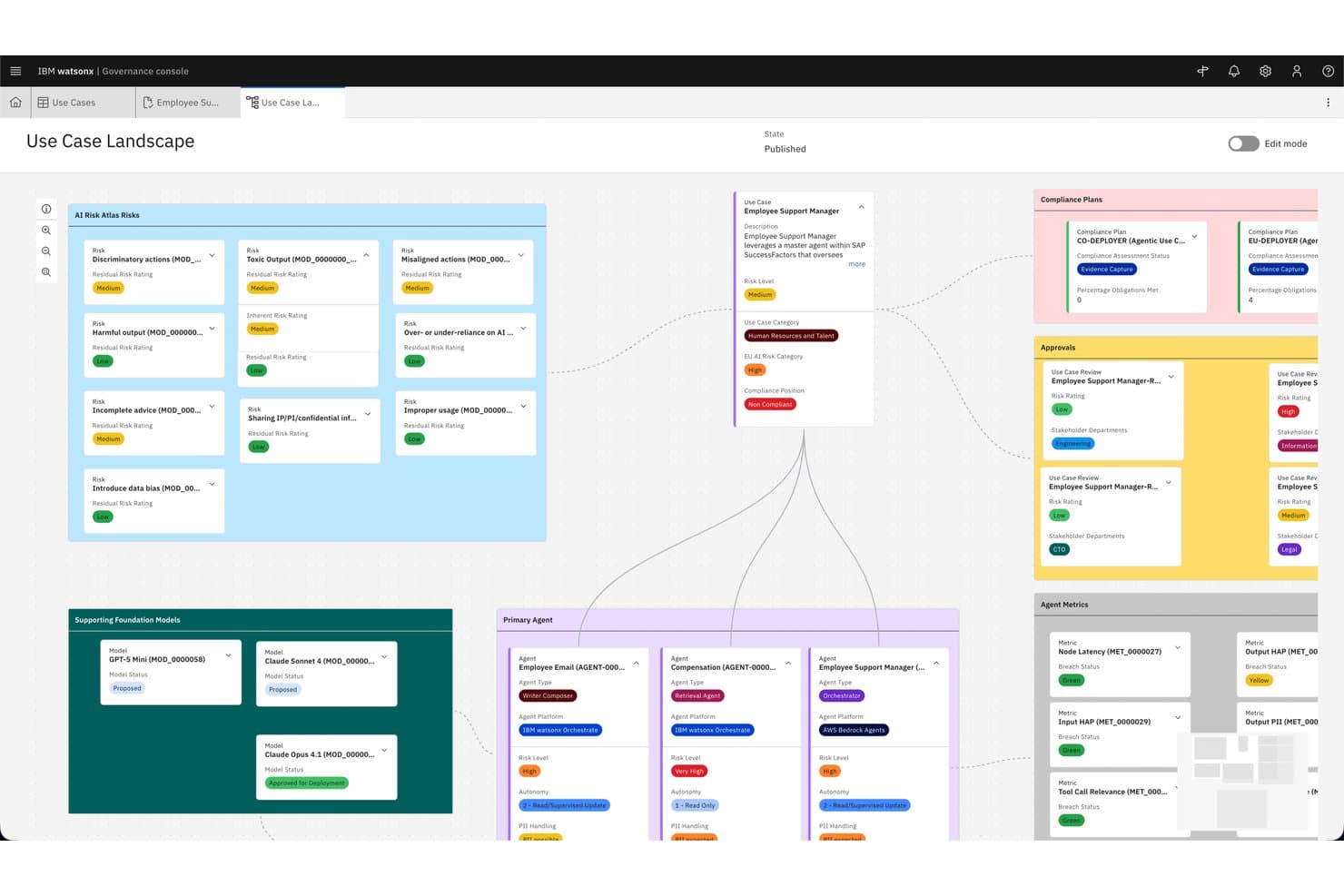
IBM watsonx.governance offers a Use Case Landscape view that maps AI risks, compliance plans, agent metrics, and approval workflows for enterprise AI governance. IBM watsonx.governance is an enterprise AI governance platform that combines model lifecycle management, risk assessment, policy enforcement, compliance mapping, and continuous monitoring across multi-vendor AI environments.
Who Is IBM watsonx.governance Best For?
It's a strong fit for large regulated enterprises in financial services, healthcare, and insurance that need centralized AI oversight across complex, multi-vendor environments.
Why I Picked IBM watsonx.governance
I picked IBM watsonx.governance as one of the best because its Governance Graph maps every AI asset across the entire estate, connecting models, policies, and regulatory requirements in one living view. I also like how automated AI factsheets generate audit-ready documentation at every lifecycle stage, capturing ownership, risk scores, and approvals without manual work. The closed-loop enforcement layer automatically routes breaches and risk signals back to corrective actions for proactive risk mitigation.
IBM watsonx.governance Key Features
- Automated model discovery: Continuously scans connected environments for shadow AI and undocumented models.
- Regulatory framework mapping: Maps and monitors AI systems against regulations like the EU AI Act, NIST AI RMF, and ISO 42001.
- LLM guardrails and red teaming: Filters and tests LLMs for prompt injection, hallucinations, PII leakage, and toxic content.
- Evidence and audit automation: Creates immutable audit trails, model cards, and one-click evidence reports for compliance.
IBM watsonx.governance Integrations
IBM watsonx.governance offers native integrations with Amazon SageMaker and has native integrations across the Microsoft ecosystem, including Microsoft Azure. An API is available for custom integrations.
Pros and Cons
Pros:
- Supports advanced LLM guardrails and red teaming
- Provides automated regulatory mapping and compliance checks
- Maps AI assets across hybrid cloud environments
Cons:
- Reporting customization can be rigid
- Setup complexity for multi-stakeholder deployments
Learn more about IBM watsonx.governance: Best for privacy-first governance workflows
- Free demo available
- Pricing upon request
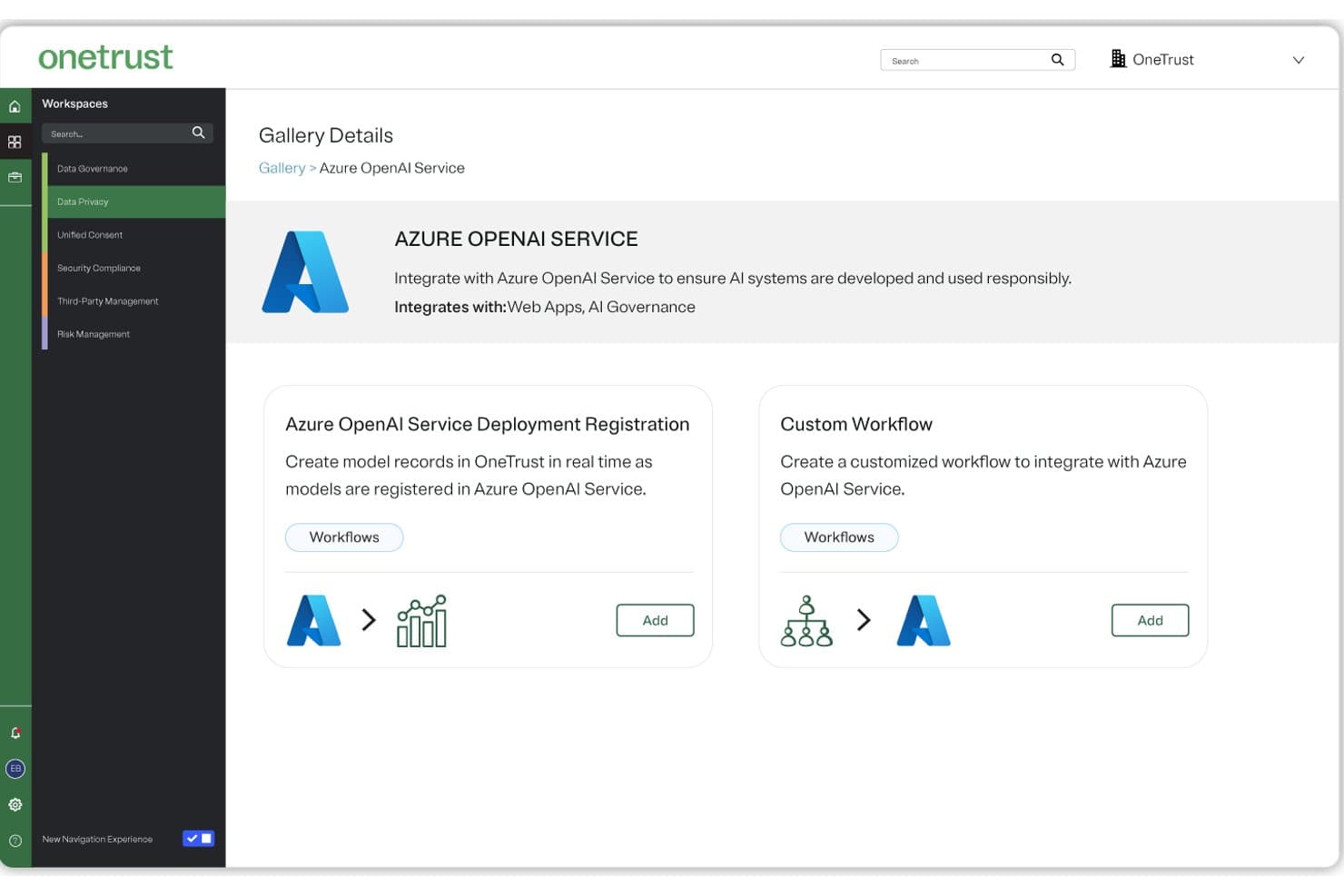
OneTrust AI Governance offers Azure OpenAI Service integration to automatically register AI model deployments and create customized governance workflows. OneTrust AI Governance is an enterprise AI governance platform that extends a privacy and risk management foundation into AI-specific workflows, covering model inventory, risk assessment, compliance mapping, policy enforcement, and runtime guardrails.
Who Is OneTrust AI Governance Best For?
It's a strong fit for large, regulated enterprises that already manage privacy and risk programs and need AI governance layered into that existing infrastructure.
Why I Picked OneTrust AI Governance
I've included OneTrust AI Governance in my top picks because its privacy-first foundation is built in, not bolted on. When a model processes personal data, OneTrust detects PII at runtime, correlates it with strict data privacy obligations, and enforces redaction or blocking before output reaches users. I also like that its compliance mapping covers the EU AI Act, NIST AI RMF, and ISO 42001 simultaneously, surfacing gaps across all three frameworks in a single risk assessment.
OneTrust AI Governance Key Features
- Centralized model inventory: Maintains a complete AI inventory by cataloging all models, datasets, agents, and vendors in a single searchable system.
- Automated regulatory mapping: Aligns AI systems with frameworks like EU AI Act, NIST AI RMF, ISO 42001, and GDPR.
- Configurable approval workflows: Supports intake, review, and sign-off gates for AI lifecycle governance.
- Runtime guardrail enforcement: Applies prompt filtering, data redaction, and action blocking for production AI and agent workloads.
OneTrust AI Governance Integrations
OneTrust AI Governance offers over 100 native integrations, including Databricks, Google Vertex AI, Twilio, RingCentral, Salesforce, Snowflake, ServiceNow, Power BI, and Okta. An API is also available for custom integrations.
Pros and Cons
Pros:
- Compliance coverage for multiple AI regulations
- Automated evidence collection for audits
- Privacy-by-design workflows for model governance
Cons:
- Implementation can be resource-intensive
- Fairness and explainability features less advanced
Learn more about OneTrust AI Governance:
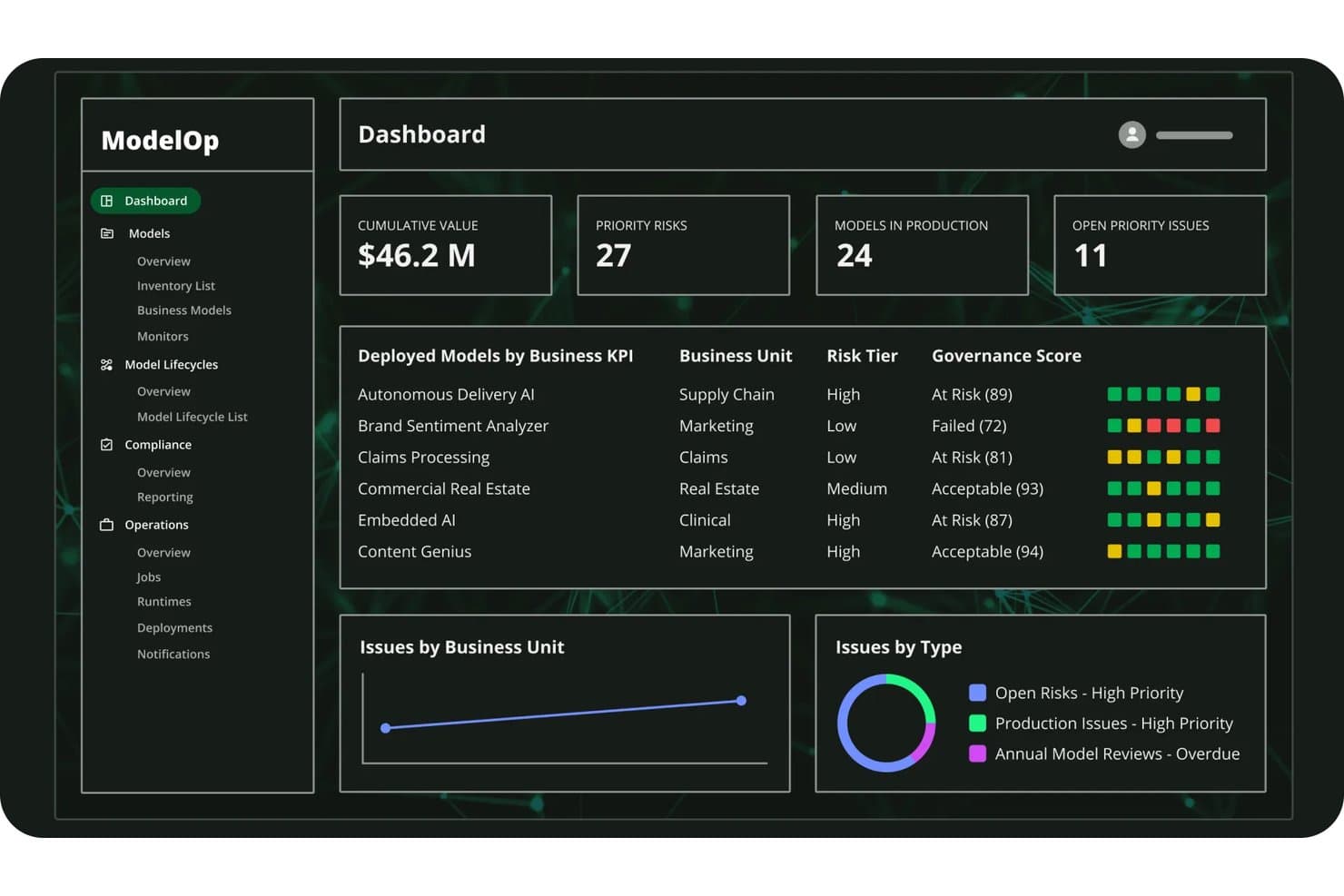
ModelOp offers a centralized AI governance dashboard displaying deployed models, risk tiers, governance scores, and priority issues across business units. ModelOp Center is an enterprise AI governance platform that centralizes model inventory, lifecycle management, policy enforcement, and compliance mapping across ML, GenAI, agentic, and third-party AI systems.
Who Is ModelOp Best For?
ModelOp is designed for large enterprises in regulated industries—financial services, healthcare, insurance, and pharma—managing complex, heterogeneous AI portfolios across multiple teams and systems.
Why I Picked ModelOp
ModelOp earns its spot on my shortlist because its automated discovery genuinely solves shadow AI exposure. I particularly like how it queries MCP and A2A servers to import agent card information and tool definitions automatically, so even newly deployed agents get registered without manual effort. It also surfaces custom GPTs and AI embedded in third-party SaaS tools that most teams don't know are running in their environment.
ModelOp Key Features
- Centralized AI system of record: Catalogs every model, agent, and AI solution with ownership, lineage, and deployment status across your organization.
- Lifecycle workflow automation: Standardizes reviews, approvals, and policy enforcement for AI systems from intake through retirement.
- Multi-framework compliance mapping: Aligns each AI-driven system to requirements in EU AI Act, NIST AI RMF, OCC SR 11-7, ISO 42001, and more.
- Automated audit documentation: Generates model cards, validation reports, and audit trails for regulatory and internal review needs.
ModelOp Integrations
ModelOp offers 50+ native integrations, including Amazon Web Services, Azure, Google Cloud Platform, ServiceNow, Jira, Databricks, Snowflake, Power BI, Tableau, and OpenAI. An API is also available for custom integrations.
Pros and Cons
Pros:
- End-to-end model lifecycle governance workflows
- Regulatory mapping spans multiple global frameworks
- Automated discovery covers shadow and agentic AI
Cons:
- Advanced features require extensive onboarding
- Model monitoring lacks root cause analysis
Learn more about ModelOp:
Other AI Governance Tools
Here are some additional AI governance tools that didn’t make it onto my shortlist, but are still worth checking out:
- 11Fiddler AIBest for real-time model performance monitoring
- 12ArthurBest for advanced AI bias and drift detection
- 13Domino Data LabBest for model oversight in regulated industries
- 14AtlanBest for active metadata and context mapping
- 15TrustibleBest for automated regulatory mapping workflows
- 16DatatronBest for centralized rule-based AI monitoring
- 17ModulosBest for automated EU AI Act compliance
- 18FairNowBest for bias detection across model lifecycles
How I Evaluate AI Governance Tools
To make my shortlist, each platform needs to go beyond checkbox compliance and actually help teams track, control, and document AI systems in production. I break my evaluation into two layers: the core functionality every tool must deliver and the differentiating factors that separate one vendor from another.
Core Functionality (Table Stakes for This List)
When I'm selecting tools for my list, I rank each one on a scale from 0 (does not offer the functionality) to 5 (excels in this area) for each core functionality listed below. Then, I calculate the tool's total score into a percentage. Each tool needs to achieve a minimum total score of 65% to be considered for inclusion.
- AI Model Inventory: I look for a centralized registry that tracks model versions, owners, and deployment status so nothing runs in production unaccounted for.
- Risk Assessment: Structured scoring workflows matter here, especially ones that tie risk tiers to specific model use cases like credit decisioning or hiring.
- Policy Enforcement: I evaluate whether the platform can automate approval gates and guardrails rather than just storing written policies as static documents.
- Compliance Mapping: Coverage of major frameworks like the EU AI Act, NIST AI RMF, and ISO 42001 is the baseline I check for in every tool.
- Model Monitoring: Real-time tracking for bias, drift, and fairness is what I look for, particularly for models serving live customer-facing applications.
- Audit Documentation: The platform should generate model cards, impact assessments, and audit trails that are ready to hand to a regulator or internal reviewer.
Once I have a list of tools that meet the criteria, I consider what sets each platform apart.
Differentiating Factors (What Sets Vendors Apart)
Here's how I compare and contrast different vendors:
Standout Features
Automated model discovery is a major differentiator. I check whether a platform can scan cloud environments and repos to surface shadow AI that teams didn't register. LLM guardrails matter more each quarter as generative AI adoption grows; I look for real-time prompt filtering that catches PII leakage and hallucinations before they reach end users. Bias and fairness testing rounds out my evaluation, especially tools that run disparate impact analysis across demographic subgroups and flag drift over time.
Beyond Features
The integration ecosystem is one of the first things I check. A platform that connects to your ML stack—SageMaker, Databricks, Azure ML—and syncs with GRC and ticketing tools like Jira keeps governance embedded in existing workflows. Deployment flexibility also matters; teams in regulated industries often need on-premise or VPC options to meet data residency requirements. I evaluate multi-stakeholder collaboration too, looking for role-based views that give risk officers, data scientists, and executives each the right level of detail.
How to Choose AI Governance Tools
It’s easy to get bogged down in long feature lists and complex pricing structures. To help you stay focused as you work through your unique software selection process, here’s a checklist of factors to keep in mind:
| Factor | What to Consider |
|---|---|
| FactorScalability | What to ConsiderCan the tool handle hundreds of models, users, and workflows as your AI footprint grows? Ask vendors how they support expansion across business units. |
| FactorIntegrations | What to ConsiderDo you need native connections to ML platforms, data lakes, IAM, or ticketing systems? List your top systems and test for API or prebuilt connector support. |
| FactorCustomizability | What to ConsiderHow deeply can you tailor risk scoring, policy workflows, or compliance mappings to fit your organization’s needs—not just out-of-the-box templates? |
| FactorEase of use | What to ConsiderWill technical and non-technical stakeholders be able to use the tool easily? Assess interface clarity through demos or trials across different user groups. |
| FactorImplementation and onboarding | What to ConsiderWhat resources are required to deploy and operationalize the platform? Check for vendor support, time to initial value, and change management planning. |
| FactorCost | What to ConsiderIs the pricing based on number of models, users, or cloud usage? Compare long-term costs and check for flexibility in scaling up or reducing scope. |
| FactorSecurity safeguards | What to ConsiderWhat encryption, access controls, and audit mechanisms are in place? Make sure safeguards align with your industry’s regulatory requirements and security posture. |
| FactorCompliance requirements | What to ConsiderDoes the tool meet current and emerging regulations you face, such as the EU AI Act or sector-specific rules? Consider frameworks, evidence generation, and update cadence. |
What Are AI Governance Tools?
AI governance tools are platforms that help organizations monitor, control, and document the development and use of AI systems throughout their lifecycle. These tools support compliance with regulations, manage risk across models, and maintain audit trails for accountability. By centralizing oversight, they give IT teams, compliance leads, and executives visibility into how AI is deployed, ensuring ethical, transparent, and secure operations.
Features of AI Governance Tools
When selecting AI governance tools, keep an eye out for the following key features:
- Centralized model inventory: Catalogs all AI/ML models in one place, including their owners, deployment status, and lifecycle stage.
- Automated risk assessment: Guides users through structured workflows to evaluate risks like bias, privacy, and regulatory exposure for each model.
- Policy enforcement workflows: Enables teams to define, automate, and track policy approvals, guardrails, and governance rules across the AI pipeline.
- Regulatory compliance mapping: Aligns models with specific laws and frameworks by generating evidence and mapping controls to existing global regulations.
- Real-time model monitoring: Tracks deployed models for bias, drift, fairness, explainability, and performance degradation, with alerts for issues as they occur.
- Audit documentation automation: Produces audit trails, impact assessments, and model cards automatically for transparency and regulatory reporting needs.
- LLM and generative AI guardrails: Monitors large language model outputs, screens for prompt injection, PII leakage, and harmful or nonsensical outputs.
- Role-based access controls: Restricts access to sensitive data and workflows based on user roles, supporting compliance and reducing internal risk.
- Integration with MLOps stack: Connects with ML platforms, data lakes, ticketing systems, and identity providers to unify governance across existing workflows.
Benefits of AI Governance Tools
Implementing AI governance tools provides several benefits for your team and your business. Here are a few you can look forward to:
- Regulatory compliance support: Stay up to date with evolving laws and frameworks by generating evidence and mapping AI activities to global regulations.
- Reduced model risk: Identify and address issues like bias, drift, and privacy risks early with automated monitoring and risk assessments.
- Greater accountability: Maintain transparent audit trails, model cards, and approval records, making it easier to track decisions and demonstrate compliance.
- Centralized oversight: Gain a complete view of all AI systems and model ownership across your organization through centralized inventories and role-based dashboards.
- Operational efficiency: Automate policy enforcement, audit documentation, and governance processes to save your team time and cut manual overhead.
- Improved cross-team collaboration: Enable data scientists, risk officers, IT, and executives to work from a single source of truth with tailored user views and shared workflows.
- Protection for generative AI: Monitor generative models for prompt abuse, PII leakage, and harmful outputs, mitigating new risks as your AI use expands.
Costs and Pricing of AI Governance Tools
Selecting AI governance tools requires an understanding of the various pricing models and plans available. Costs vary based on features, team size, add-ons, and more. The table below summarizes common plans, their average prices, and typical features included in AI governance tools:
Plan Comparison Table for AI Governance Tools
| Plan Type | Average Price | Common Features |
|---|---|---|
| Plan TypeFree Plan | Average Price$0 | Common FeaturesBasic model inventory, limited risk assessment, and manual policy tracking. |
| Plan TypePersonal Plan | Average Price$15-$40/user/month | Common FeaturesCentralized model management, basic compliance mapping, and limited integration options. |
| Plan TypeBusiness Plan | Average Price$50-$120/user/month | Common FeaturesAutomated risk workflows, real-time model monitoring, audit documentation, integration with ML platforms, and role-based controls. |
| Plan TypeEnterprise Plan | Average Price$150+/user/month | Common FeaturesAdvanced policy enforcement, full regulatory coverage, high-scale automation, deployment flexibility, and dedicated support. |
AI Governance Tools FAQs
Here are some answers to common questions about AI governance tools:
What types of organizations need AI governance tools?
AI governance tools are useful for any organization deploying AI in regulated or business-critical environments, especially those in finance, healthcare, insurance, and government, or any team scaling AI use across departments.
Can AI governance tools help with compliance audits?
Yes, most AI governance platforms generate audit trails, model documentation, and compliance evidence automatically to support internal audits and external regulator requests.
How do AI governance tools integrate with existing tech stacks?
Many solutions offer prebuilt connectors for ML platforms, MLOps tools, data lakes, and ticketing systems, as well as APIs for embedding governance checks into CI/CD pipelines and orchestration frameworks.
Is it possible to monitor both traditional models and generative AI with these tools?
Yes, leading platforms support monitoring for all types of models—including traditional machine learning and generative AI—flagging risks like bias, drift, and prompt injection.
How do these tools handle sensitive data and deployment requirements?
Many vendors offer SaaS, private cloud, or on-premise deployment to meet data residency and security needs, and support air-gapped installations for high-compliance industries.