

As plataformas de programação colaborativa ajudam os programadores a trabalhar no mesmo código em tempo real, estejam eles do outro lado da mesa ou do outro lado do mundo.
Estas ferramentas tornam-se essenciais quando a partilha de ecrã não é suficiente, o controlo de versões se torna confuso ou está a perder tempo a tentar resolver problemas através do chat. A edição em tempo real, os terminais partilhados e a colaboração no navegador facilitam a resolução conjunta de problemas, sem constantes mudanças de contexto ou confusão.
Trabalhei com equipas que utilizam estas ferramentas para tudo, desde revisões entre pares e integração de novos membros até sessões completas de depuração de código. Este guia baseia-se nessa experiência e pretende ajudá-lo a escolher uma plataforma adequada à forma como a sua equipa escreve e implementa código.
Why Trust Our Software Recommendations
6,700+
Reviews
20
Industry experts
16+
Evaluation factors
14
Years
Our team has been testing and reviewing software since 2012. As tech leaders ourselves, we know how difficult—and important—it is to choose the right software.
For this guide, we evaluated tools using hands-on testing and independent research, scoring tools using our selection criteria.
Our reviews reflect our human editorial judgment, not a sales pitch.
Expert reviewers:
- Paulo Gardini MiguelTech Director
 Tim FisherVP of AI
 Gabriel RosasTech Lead & Software Architect
 Christhian GruhnTech Lead & Platform Architect

Tabela de comparação de plataformas de programação colaborativa
Esta tabela de comparação resume os detalhes dos preços das minhas principais escolhas de plataformas de programação colaborativa:
| Tool | Best For | Trial Info | Price | ||
|---|---|---|---|---|---|
| 1 | Best for remote team task management | Free plan + trial + demo available | From $10.99/user/month (billed annually) | Website | |
| 2 | Best for secure file sharing and storage | 14-day free trial | From CAD$21/user/month (billed annually) | Website | |
| 3 | Best for centralized team knowledge sharing | Free plan + 7-day trial available | From $5.78/user/month (billed annually) | Website | |
| 4 | Best for code skill assessments and training | Free trial available | From $199/user/month | Website | |
| 5 | Best for integrating code documentation with coding tasks | Free demo available | Pricing upon request | Website | |
| 6 | Best for internal technical knowledge base | From $10/user/month | Website | ||
| 7 | Best for live collaborative coding sessions | From $9.90/user/month (billed annually) | Website | ||
| 8 | Best for visual brainstorming and idea mapping | Free plan + 14-day free trial + free demo available | From $8/user/month (billed annually) | Website | |
| 9 | Best for AI project planning and resourcing | Free plan + 14-day trial available | From $9/user/month (billed annually) | Website | |
| 10 | Best for seamless team communication and collaboration | Free trial available | From $15/user/month (billed annually) | Website |


Avaliações das melhores plataformas de programação colaborativa
 Best for remote team task management
- Free plan + trial + demo available
- From $10.99/user/month (billed annually)
Visit WebsiteCustomer Rating:4.4/5
Asana's my tasks is your one-stop-shop for viewing and prioritizing all of the work assigned to you. Asana is a task and project management tool that helps teams organize, track, and manage their work. It's instrumental in remote work settings, where coordinating tasks and maintaining project visibility can also be very challenging.
Why I Picked Asana:
Asana's prowess in facilitating remote team task management quickly emerged when considering various tools. Its comprehensive feature set, coupled with an intuitive interface, helps it outshine competitors. I chose Asana because it bridges the gap in communication and project oversight often experienced in remote teams, making it the best for this use case.
Standout features and integrations:
Asana offers various features, including timeline views, task dependencies, and custom fields to add project-specific details. Additionally, it provides Kanban boards for visual project management. Asana integrates well with numerous third-party applications such as Slack, Google Drive, and Zoom, enhancing its utility in a typical remote work setup.
Pros and Cons
Pros:
- A broad range of third-party integrations
- Versatile view options, including lists, boards, and timelines
- Advanced task management with features like dependencies and custom fields
Cons:
- Advanced features like workload and goals are only available in the business plan.
- Limited functionality in the free plan
- It can be overwhelming for new users due to its numerous features.
Learn more about Asana: 2Best for secure file sharing and storage
Box
- 14-day free trial
- From CAD$21/user/month (billed annually)
Visit WebsiteCustomer Rating:4.3/5
Stay proactive with Box's shield machine learning and the ability to set policies that detect threats. Keep your files safe with cloud-native security and compliance capabilities like granular access controls, watermarking, and classification. The box is a cloud-based storage and collaboration tool that allows users to securely store, share, and access files online. Its robust security features make it an ideal choice for businesses seeking to securely share sensitive files and data, making it particularly suitable for secure file sharing and storage.
Why I Picked Box:
During my selection process, I chose Box because of its dedication to data security and ease of use. It's an essential storage solution and a comprehensive platform offering robust data encryption and detailed access controls. The box is the best for secure file sharing and storage due to its steadfast commitment to data protection.
Standout features and integrations:
Box offers real-time collaboration, automatic file sync, and version history. But what makes it truly stand out is its security features, including granular access controls, advanced encryption, and compliance with various global privacy standards. Box also integrates well with many business apps, including Office 365, G Suite, Salesforce, and Slack.
Pros and Cons
Pros:
- Real-time collaboration on documents
- Integrates with a wide range of third-party applications
- Robust security features offer strong data protection.
Cons:
- The search functionality could be improved for ease of use.
- The file size limit in the basic plan
- The user interface can be confusing for first-time users.
Learn more about Box: Best for centralized team knowledge sharing
- Free plan + 7-day trial available
- From $5.78/user/month (billed annually)
Visit WebsiteCustomer Rating:4.3/5
With Confluence you can create anything from project plans and marketing campaigns to product requirements, and more. Confluence is a robust collaborative software platform designed to centralize team knowledge sharing. It's a digital workspace where teams can also create, share, and collaborate on projects in one accessible location.
Why I Picked Confluence:
Confluence's ability to foster a unified knowledge-sharing space caught my attention in assessing multiple collaborative platforms. It's not just about creating and editing documents, but it's the way Confluence makes knowledge accessible and organized for every team member. The platform's distinctiveness lies in its ability to bridge information gaps within a team, which justifies why I consider it the best for centralized team knowledge sharing.
Standout features and integrations:
Confluence's page and space structure help teams effectively organize their work and knowledge. The platform also offers powerful search functionality, ensuring critical information is always available. On the integration side, Confluence works well with tools such as Jira, Trello, Slack, and many other tools, facilitating a smooth work process with your existing toolset.
Pros and Cons
Pros:
- Excellent integration with other Atlassian products and a host of external tools
- Robust search functionality for quick access to information
- Provides a centralized platform for team knowledge sharing
Cons:
- Customization options may seem limited for complex project needs.
- The user interface could benefit from a design overhaul.
- The learning curve might be steep for non-technical users.
 Best for code skill assessments and training
- Free trial available
- From $199/user/month
Visit WebsiteCustomer Rating:4.4/5
Coderbyte's assessment builder makes it easy for non-technical users to create a relevant assessment Coderbyte is a web-based platform aimed at helping individuals improve their coding skills through practice and testing. With an extensive collection of coding challenges and preparatory courses for coding interviews, it is particularly beneficial for skills assessment and training.
Why I Picked Coderbyte:
When it came to picking a platform for coding skills assessments and training, Coderbyte seemed a natural choice. Additionally, its comprehensive library of coding challenges for various difficulty levels makes it stand out. The fact that these challenges cater to different programming languages strengthens my judgment that Coderbyte is the best platform for code skill assessments and training.
Standout features and integrations:
Critical features of Coderbyte include a diverse set of coding challenges, an in-built code editor for practice, and solutions provided by the community. It also offers official solutions and a video walkthrough for some of its challenges, facilitating better understanding. Though direct integrations are limited, it supports various programming languages, allowing users to practice and learn in the language of their preference.
Pros and Cons
Pros:
- Community solutions and video walkthroughs are available
- Supports multiple programming languages
- Wide range of coding challenges
Cons:
- The interface could be improved for a better user experience.
- High starting price for individual users
- Limited direct integrations
Learn more about Coderbyte: Best for integrating code documentation with coding tasks
- Free demo available
- Pricing upon request
Visit WebsiteCustomer Rating:4.4/5
Using Swimm, document complex flows spanning multiple files and repos with rich content that interacts directly with the code and automatically updates as your code changes. Swimm is a tool that ensures documentation stays synced with your codebase. It provides an environment for writing and managing documents and allows developers to link parts of their papers to relevant code snippets. This unique feature positions Swimm as a fantastic tool for integrating code documentation with coding tasks.
Why I Picked Swimm:
Swimm stood out in selecting tools for this list for its innovative approach to keeping code documentation up-to-date, a frequent challenge in dynamic development environments. Also, i appreciate how Swimm creates a symbiosis between code and documentation, making it the ideal choice for integrating code documentation with coding tasks.
Standout features and integrations:
Critical features of Swimm also include its automated syncing between documentation and codebase, the ability to write unit tests in documentation, and the creation of interactive learning materials. As for integrations, Swimm works well with Github, allowing for seamless connection with your repositories.
Pros and Cons
Pros:
- Supports the creation of interactive learning materials
- The ability to write unit tests in documentation
- Code and documentation stay in sync.
Cons:
- A limited number of direct integrations
- A bit of a learning curve for non-technical team members
- Higher starting price point compared to some competitors
Learn more about Swimm:

Using Stack Overflow for Teams, Slack integration is possible. Stack Internal is an internal knowledge-sharing and collaboration platform primarily targeting technical teams. It thrives as a private, secure space where couples can ask questions and get answers, making it an ideal tool for creating an internal technical knowledge base.
Why I Picked Stack Internal:
I chose Stack Internal for this list due to its strong reputation for facilitating efficient knowledge sharing within technical teams. Also, what makes it different is its familiar Q&A format that so many developers and technical staff are accustomed to, which increases adoption and utilization rates. For these reasons, I determined Stack Internal to be the best tool for creating an internal technical knowledge base.
Standout features and integrations:
Stack Internal provides features like tagging, instant search, and an integrated interface, making knowledge accumulation and retrieval swift and efficient. Its integrations with everyday tools such as Slack and Microsoft Teams ensure that essential updates and discussions are noticed.
Pros and Cons
Pros:
- Valuable integrations with tools like Slack and Microsoft Teams
- Efficient search and tagging system for ease of information retrieval
- Familiar Q&A format that's easy to adopt
Cons:
- No option for a single-user plan
- Less suited for non-technical teams
- The cost might be prohibitive for smaller teams.
Learn more about Stack Internal: Best for live collaborative coding sessions
- From $9.90/user/month (billed annually)

Run tests and debug with the integrated GUI test runner and debugger, and use the embedded terminal as Code With Me acts as a full-fledged JetBrains IDE for your remote projects. Code With Me is a service by JetBrains that enables developers to share the project in their IDE with others, facilitating real-time, joint coding. It stands out for its live coding sessions, where multiple participants can simultaneously observe and adjust the code.
Why I Picked Code With Me:
Code With Me stood out in selecting tools for this list because it takes coding collaboration to the next level with its live coding sessions. The ability to share a project from one's IDE in real time sets it apart from other collaboration tools. Given these unique characteristics, I've determined Code With Me to be the top choice for live collaborative coding sessions.
Standout features and integrations:
Critical features of Code With Me include its simultaneous collaborative editing as well as its integrated voice and video chat, and a follow-participant feature that allows you to view someone else's actions in real time. Integration with popular IDEs like IntelliJ IDEA, PyCharm, WebStorm, and others is a significant advantage, allowing developers to work in an environment they are comfortable with.
Pros and Cons
Pros:
- Integration with popular JetBrains IDEs
- Integrated voice and video chat for better communication
- Real-time collaborative coding is possible.
Cons:
- Pricing could be a barrier for smaller teams.
- Some learning curves to use efficiently.
- It might be overkill for simple collaborative tasks.
Learn more about Code With Me: 8Best for visual brainstorming and idea mapping
Miro
- Free plan + 14-day free trial + free demo available
- From $8/user/month (billed annually)
Visit WebsiteCustomer Rating:4.8/5
With Miro it can explain complex processes and systems with visual mapping and diagramming. Miro is an interactive online whiteboard platform that boosts team collaboration and creativity. It's a digital canvas where teams can brainstorm, map out ideas, and turn them into tangible actions.
Why I Picked Miro:
Miro's capacity to encourage visual brainstorming and idea mapping stood out in my selection process. Also, its ability to foster creativity and collaboration in a virtual environment makes it unique in a pool of similar tools. Miro is particularly adept at transforming abstract concepts into explicit visual representations, leading me to deem it as the best for visual brainstorming and idea mapping.
Standout features and integrations:
Miro offers numerous templates, such as brainstorming, flowcharts, and mind maps, facilitating efficient idea generation. The infinite canvas can accommodate expansive ideas without restrictions. Miro also integrates well with applications like Google Drive, Dropbox, Slack, and even more specialized tools like Jira and Sketch, allowing for a cohesive workflow.
Pros and Cons
Pros:
- Seamless integrations with various productivity tools
- Extensive selection of templates for different use cases
- Infinite canvas for unrestricted idea generation and mapping
Cons:
- Advanced features are locked behind higher-tier plans
- Real-time collaboration can be laggy with a large number of participants.
- The interface might feel overwhelming to new users.
Learn more about Miro: Best for AI project planning and resourcing
- Free plan + 14-day trial available
- From $9/user/month (billed annually)
Visit WebsiteCustomer Rating:4.6/5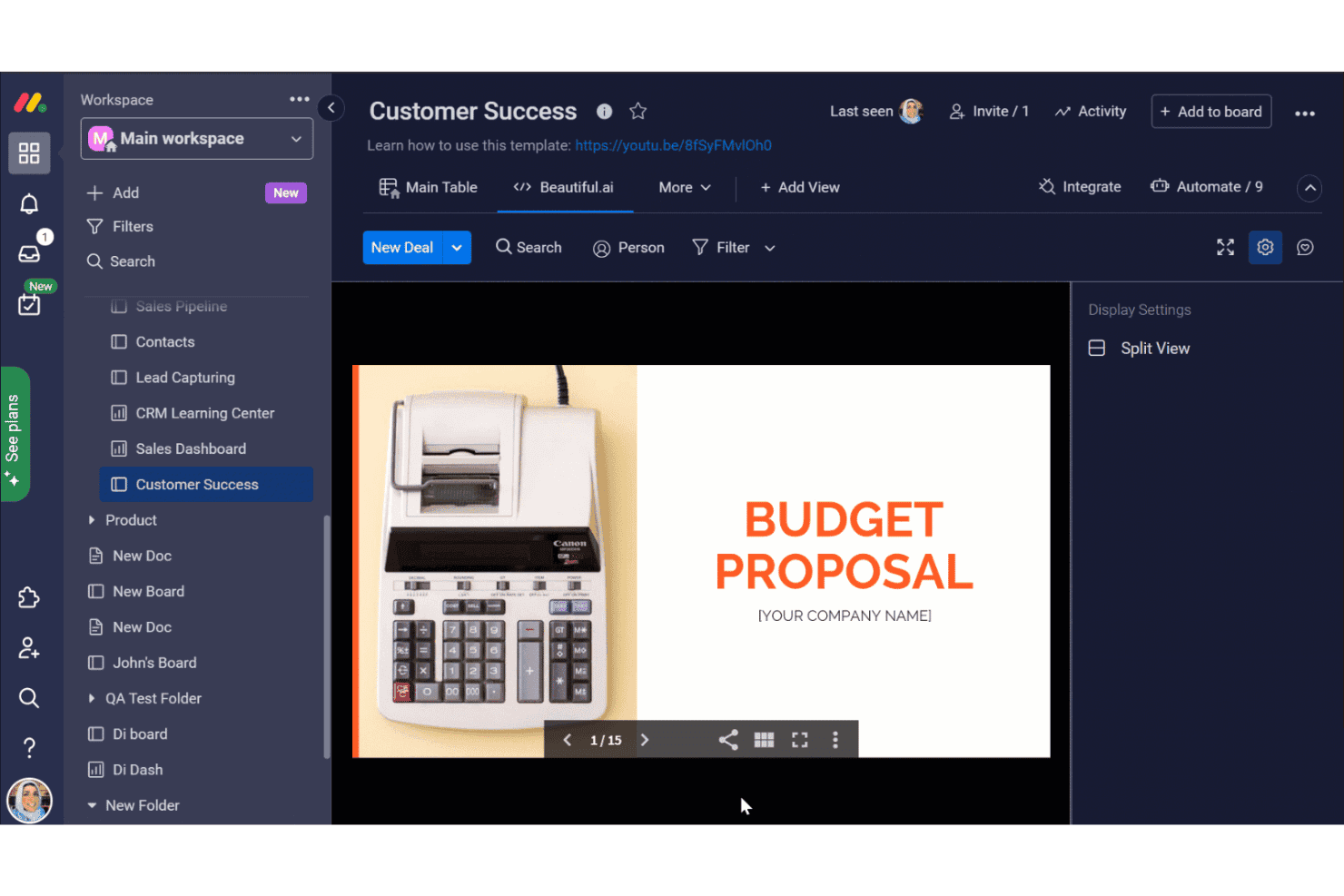
monday.com offers a Beautiful.ai integration within its Customer Success board, allowing users to embed and view Budget Proposal presentations directly in the workspace. Monday AI Workspace is an AI-powered work management platform that combines project planning, sprint tracking, resource assignment, and dev toolchain integrations—including GitHub and GitLab—into a unified workspace for engineering and cross-functional teams.
Who Is Monday AI Workspace Best For?
It's a strong fit for mid-size to enterprise engineering teams that need AI-assisted sprint planning and cross-functional project visibility alongside their existing dev tooling.
Why I Picked Monday AI Workspace
Monday AI Workspace earns its spot on my shortlist because I love how its AI handles sprint planning and resource load-balancing without manual intervention. When I assign a sprint, the AI surfaces capacity conflicts and recommends reassignments based on historical velocity data. I also find the AI-spotted risk detection genuinely useful: it flags dependency bottlenecks before they derail a release cycle.
Monday AI Workspace Key Features
- GitHub and GitLab integration: Link pull requests, commits, and repo details directly to project boards for workflow visibility.
- Sprint management boards: Organize, prioritize, and track sprint tasks with customizable agile board views.
- Custom automation builder: Set up workflow automations that trigger updates, notifications, or reminders based on board activity.
- Dependency mapping: Visualize and manage task dependencies to identify blockers and sequence work efficiently.
Monday AI Workspace Integrations
Monday AI Workspace offers hundreds of native integrations through its built-in integrations and marketplace, including GitHub, GitLab, Jira, Slack, Microsoft Teams, Google Workspace, Salesforce, and Zapier. An API is available for custom integrations.
Pros and Cons
Pros:
- Real-time workload visibility across engineering teams
- Native sprint planning views built into boards
- AI assigns tasks based on team capacity
Cons:
- No built-in code execution or terminal
- Not built for real-time code editing
Learn more about monday AI Workspace: 10Best for seamless team communication and collaboration
Nextiva
- Free trial available
- From $15/user/month (billed annually)
Visit WebsiteCustomer Rating:4.5/5
Users can easily manage their sales pipeline and track deals, using Nextiva's pipeline view feature. Import contacts easily. Log information after every interaction. Nextiva is a unified communications platform that combines VoIP phone services, team messaging, video conferencing, and customer management tools. Given its comprehensive communication suite that facilitates smooth collaboration among team members, it aligns perfectly with the need for team communication and collaboration.
Why I Picked Nextiva:
I picked Nextiva as a part of this list due to its versatile functionality that spans various aspects of business communication. It has a broad range of features contributing to its distinction, from cloud phone service to team chat to customer service tools. Because of this extensive range of communication and collaboration capabilities, I see Nextiva as an ideal team communication tool.
Standout features and integrations:
Some critical elements of Nextiva include VoIP phone services, team messaging, video conferencing, and customer relationship management tools. Its advanced analytics and reporting further enhance its utility for businesses. Nextiva integrates well with commonly used business tools such as Microsoft Teams, Google Workspace, Salesforce, and Zendesk.
Pros and Cons
Pros:
- Smooth integration with many third-party business applications
- Advanced analytics and reporting
- A comprehensive suite of communication tools
Cons:
- Setup can be somewhat complicated for non-technical users.
- Requires high-speed internet for optimal performance
- The pricing structure can be complex for new users.
Learn more about Nextiva:
Outras plataformas de programação colaborativa
Segue-se uma lista de plataformas de programação colaborativa adicionais que selecionei, mas que ainda não conseguiram entrar nas 10 primeiras. Vale a pena conhecê-las.
- 11LucidsparkBest for real-time collaborative brainstorming
- 12Zoho ProjectsBest for large-scale project management
- 13WrikeGood for customizable project management needs
- 14TrelloGood for visually organizing project workflows
- 15BacklogGood for comprehensive project and code management
- 16KontentinoGood for managing and approving social media content
- 17ReviewStudioGood for collaborative creative project reviews
- 18EliumGood for knowledge sharing and collaboration within teams
- 19ZiflowGood for automating creative content review and approval processes
- 20ConnecteamGood for managing and engaging with non-desk teams
- 21Project.coGood for coordinating and tracking project communications
- 22ZulipGood for organized, topic-based team communication
- 23ConnectWise ScreenConnectGood for secure remote control solutions
- 24YouTrackGood for Agile project management and issue tracking
- 25Birdview PSAGood for streamlining project, service, and client management
- 26Visual PlanningGood for streamlining resource scheduling
- 27LedgerGood for managing projects, resources, and finances in one platform
- 28BOASTGood for all-in-one business operations and project management
- 29RealityMAXGood for remote work and training via virtual reality
- 30TrackfrontGood for managing vendor and purchase order processes
- 31StartMeetingGood for affordable video and audio conferencing
- 32Pexip Secure CollaborationGood for video conferencing with a focus on security
Avaliações de outras plataformas de programação colaborativa
- Software de desenvolvimento de websites
- Software de desenvolvimento de aplicações
- Software de desenvolvimento de aplicações móveis
- Plataformas de desenvolvimento na nuvem
How I Evaluate Collaborative Coding Platforms
Whether I'm evaluating tools for pair programming sessions or live technical interviews, I split my assessment into baseline requirements and the differentiators that actually set platforms apart.
Core Functionality (Table Stakes For This List)
When I'm selecting tools for my list, I rank each one on a scale from 0 (does not offer the functionality) to 5 (excels in this area) for each core functionality listed below. Then, I calculate the tool's total score into a percentage. Each tool needs to achieve a minimum total score of 65% to be considered for inclusion.
- Real-Time Co-Editing: I look for smooth multi-cursor editing where two or more developers can type in the same file simultaneously, like during a live pair programming session with a remote teammate.
- Multi-Language Support: The platform should handle syntax highlighting and execution for languages my team actually uses, from Python and JavaScript to Go or Rust.
- Integrated Code Execution: I check whether developers can run and test code directly inside the session, so a team debugging a failing unit test doesn't need to context-switch to a local terminal.
- Shared Development Environment: A cloud-based workspace with a file system and terminal matters here, especially for onboarding new hires who need a ready-to-go project environment on day one.
- Version Control Integration: I evaluate how each platform connects with Git providers like GitHub, GitLab, or Bitbucket for committing, branching, and pushing changes from within the editor.
- In-Session Communication: Built-in chat, voice, or video keeps collaborators in the same window, which I find essential when walking a colleague through a complex merge conflict.
Once I have a list of tools that meet this criteria, I consider what sets each platform apart.
Differentiating Factors (What Sets Vendors Apart)
Here's how I compare and contrast different vendors:
Standout Features
AI coding assistance is a big differentiator. I look for platforms where inline suggestions and error explanations speed up collaborative debugging without breaking the session's flow. Session recording also matters, especially for engineering managers who want to review how a mob programming session unfolded or replay a technical interview for a hiring panel. For teams running live coding assessments, built-in interview tools like candidate scoring and question banks save the hassle of stitching together separate platforms.
Beyond Features
Security and compliance top my list here. I check for SOC 2, SSO/SAML support, and audit logs, since enterprise procurement teams will block adoption without them. Ecosystem fit also weighs heavily. A platform that plugs into your existing stack—think GitHub for version control, Slack for notifications, Jira for ticket linking—cuts down on workflow friction. I also evaluate pricing flexibility, particularly whether a vendor offers separate tiers for interview-only use versus full team collaboration, so you're not overpaying for capabilities you don't need.
Como escolher uma plataforma de programação colaborativa
É fácil ficar atolado em listas extensas de funcionalidades e estruturas de preços complexas. Para o ajudar a manter-se concentrado enquanto analisa o seu processo específico de seleção de software, segue-se uma lista de fatores a ter em conta:
| Fator | O que considerar |
|---|---|
| FatorEscalabilidade | O que considerarA plataforma pode crescer com a sua equipa? Considere se suporta um número crescente de utilizadores e projetos sem problemas de desempenho. |
| FatorIntegrações | O que considerarEstabelece ligação com as outras ferramentas que utiliza? Verifique a compatibilidade com o seu conjunto de software atual, como ferramentas de gestão de projetos ou de integração e entrega contínuas. |
| FatorPossibilidade de personalização | O que considerarPode adaptá-la aos seus fluxos de trabalho? Procure plataformas que permitam fazer ajustes para se adequarem às práticas e preferências específicas de programação da sua equipa. |
| FatorFacilidade de utilização | O que considerarA plataforma é intuitiva? Certifique-se de que tem uma interface fácil de utilizar, que reduz o tempo de aprendizagem e mantém a sua equipa produtiva. |
| FatorImplementação e integração inicial | O que considerarA transição é simples? Avalie os recursos disponíveis para a integração inicial, como materiais de formação e apoio ao cliente durante a configuração. |
| FatorCusto | O que considerarEnquadra-se no seu orçamento? Compare os planos de preços, tenha em conta os custos adicionais e procure uma solução que ofereça o melhor valor para o seu investimento. |
| FatorMedidas de segurança | O que considerarOs seus projetos estão protegidos? Verifique as medidas de segurança da plataforma, incluindo a encriptação de dados e os controlos de acesso, para manter o seu código seguro. |
O que é uma plataforma de programação colaborativa?
Uma plataforma de programação colaborativa é uma ferramenta que permite a vários programadores escrever, editar e depurar código em conjunto e em tempo real. É utilizada por engenheiros de software, equipas remotas e formadores de programação que precisam de trabalhar em conjunto sem estarem no mesmo local.
Funcionalidades como terminais partilhados, edição de código em direto e chat integrado ajudam a resolver erros mais rapidamente, a rever código em grupo e a manter todos alinhados. Estas ferramentas facilitam a escrita conjunta de código sem que os utilizadores se atrasem uns aos outros.
Funcionalidades
Ao selecionar uma plataforma de programação colaborativa, procure as seguintes funcionalidades essenciais:
- Colaboração em tempo real: Permite que vários programadores trabalhem simultaneamente na mesma base de código, melhorando a comunicação e a eficiência da equipa.
- Integração com controlo de versões: Liga-se a sistemas de controlo de versões como o Git, permitindo acompanhar facilmente as alterações e o histórico do código.
- Processo de revisão de código: Facilita a revisão do código pelos pares, garantindo a qualidade e a consistência em toda a base de código antes da implementação.
- Suporte para várias linguagens: Oferece compatibilidade com várias linguagens de programação, tornando a plataforma versátil para diferentes projetos e equipas.
- Funcionalidades de ambiente de desenvolvimento integrado (IDE): Disponibiliza ferramentas e editores de programação integrados para simplificar o processo de desenvolvimento.
- Programação assistida por IA: Sugere conclusões e otimizações de código, ajudando os programadores a escrever código mais rapidamente e com menos erros.
- Fluxos de trabalho personalizáveis: Permite que as equipas adaptem a plataforma às suas práticas de programação específicas e às necessidades dos projetos.
- Capacidades de edição offline: Permite que os programadores trabalhem no código sem ligação à Internet, garantindo a produtividade em qualquer situação.
- Medidas de segurança avançadas: Protege o código e os dados através de encriptação e controlos de acesso, garantindo a segurança do projeto.
- Tutoriais interativos do produto: Disponibiliza orientações passo a passo para novos utilizadores, simplificando o processo de integração e reduzindo o tempo de aprendizagem.
Vantagens
A implementação de uma plataforma de programação colaborativa proporciona várias vantagens à sua equipa e à sua empresa. Eis algumas das que pode esperar:
- Colaboração melhorada: As funcionalidades de colaboração em tempo real permitem que a sua equipa trabalhe em conjunto de forma mais eficaz, reduzindo falhas de comunicação e aumentando a produtividade.
- Maior qualidade do código: Os processos de revisão de código garantem que todo o código é verificado quanto a erros e consistência, resultando em software de melhor qualidade e mais fiável.
- Maior flexibilidade: O suporte para várias linguagens permite que a sua equipa trabalhe em projetos diversificados sem estar limitada pelas restrições das linguagens de programação.
- Fluxos de trabalho simplificados: Os fluxos de trabalho personalizáveis permitem que a sua equipa adapte a plataforma às suas necessidades específicas, melhorando a eficiência geral da gestão de projetos.
- Desenvolvimento mais rápido: A programação assistida por IA acelera o processo de programação ao fornecer sugestões e automatizar tarefas repetitivas, permitindo que a sua equipa se concentre na inovação.
- Maior segurança: As medidas de segurança avançadas protegem o seu código e os seus dados, proporcionando tranquilidade quanto à segurança do projeto.
- Integração fácil: Os tutoriais interativos do produto e os recursos ajudam os novos utilizadores a começar rapidamente, reduzindo o tempo de inatividade e aumentando a produtividade da equipa.
Custos & preços
A seleção de uma plataforma de programação colaborativa exige uma compreensão dos vários modelos de preços e planos disponíveis. Os custos variam consoante as funcionalidades, o tamanho da equipa, os complementos e outros fatores. A tabela abaixo resume os planos comuns, os respetivos preços médios e as funcionalidades normalmente incluídas nas soluções de plataformas de programação colaborativa:
Tabela de comparação de planos para plataformas de programação colaborativa
| Tipo de plano | Preço médio | Funcionalidades comuns |
|---|---|---|
| Tipo de planoPlano gratuito | Preço médio$0 | Funcionalidades comunsColaboração básica, armazenamento limitado e apoio da comunidade. |
| Tipo de planoPlano pessoal | Preço médio$5-$25/utilizador/mês | Funcionalidades comunsFerramentas de colaboração melhoradas, mais armazenamento e integrações básicas. |
| Tipo de planoPlano empresarial | Preço médio$25-$50/utilizador/mês | Funcionalidades comunsIntegrações avançadas, funcionalidades de segurança reforçadas e apoio prioritário. |
| Tipo de planoPlano empresarial de grande escala | Preço médio$50-$100/utilizador/mês | Funcionalidades comunsSoluções personalizáveis, gestão de conta dedicada e apoio empresarial. |
Perguntas mais frequentes sobre plataformas de programação colaborativa (Perguntas frequentes)
Pode descrever a sua experiência com ambientes de programação colaborativa ou projetos de grupo?
Em projetos de programação colaborativa, os membros da equipa contribuem para criar e rever código. Trabalhar em pares ou equipas resulta geralmente em menos erros, maior qualidade do código e conclusão mais rápida dos projetos. Esta abordagem tira partido de competências e perspetivas diversificadas, melhorando o processo de desenvolvimento global.
Como gere conflitos na programação colaborativa?
A gestão de conflitos requer um controlo de versões eficaz e uma comunicação clara. Ferramentas como o Git ajudam, permitindo que os membros da equipa integrem alterações e resolvam conflitos de forma sistemática. Reuniões regulares da equipa e documentação clara também desempenham um papel crucial na minimização de mal-entendidos.
Porque é importante o controlo de versões na programação colaborativa?
O controlo de versões é crucial porque regista alterações, mantém o histórico do projeto e permite que vários membros da equipa trabalhem na mesma base de código sem substituírem o trabalho uns dos outros. Garante que as versões anteriores possam ser restauradas, se necessário, proporcionando uma rede de segurança às equipas de desenvolvimento.