

Reseña de Iru 2026: Ventajas, desventajas, características y precios
Iru destaca en la gestión de dispositivos móviles por su enfoque en la conectividad global, lo que lo convierte en una opción ideal para empresas que gestionan flotas a través de fronteras, aunque puede no ser adecuado para quienes necesitan controles avanzados de aplicaciones.

Revisamos herramientas de forma independiente y las comisiones ayudan a financiar nuestras pruebas. Consulta nuestra política de transparencia, nuestra metodología o sugiere una herramienta.
Iru is an MDM software for IT teams managing device fleets across remote or distributed environments. It handles device enrollment, policy enforcement, and app management across platforms from a single console. I'd mainly consider it if you need tighter control over endpoint configuration than Microsoft Intune provides out of the box, but want something less resource-intensive to deploy and maintain than an enterprise platform like VMware Workspace ONE.
Iru Evaluation Summary
4.7/5
- Pricing upon request
- 14-day free trial + free demo available
Por qué confiar en nuestras recomendaciones de software
6,700+
Reviews
20
Industry experts
16+
Evaluation factors
14
Years
Nuestro equipo lleva probando y evaluando software desde 2012. Como líderes tecnológicos, sabemos lo difícil —y lo importante— que es elegir el software adecuado.
Para esta guía, evaluamos las herramientas mediante pruebas prácticas e investigación independiente, puntuando las herramientas según nuestros criterios de selección.
Nuestras reseñas reflejan nuestro criterio editorial humano, no un discurso de ventas.
Revisores expertos:
- Paulo Gardini MiguelDirector técnico
 Tim FisherVP de IA
 Gabriel RosasTech Lead y arquitecto de software
 Christhian GruhnTech Lead y arquitecto de plataforma

Iru Overview
Iru offers a unique edge in MDM by prioritizing global connectivity and fleet oversight, making it a strong choice for organizations with international logistics or transport operations. While its interface is straightforward and onboarding is quick, Iru’s feature set is more focused on tracking and compliance than deep app management or custom integrations. Pricing is competitive for large-scale deployments, and support is responsive, but those needing granular device controls may find it limited.
I think Iru is best for teams managing cross-border assets who value reliable tracking and simple, centralized management over advanced customization.
Pros
- Zero-touch deployment simplifies onboarding for large device fleets
- Strong compliance automation with adaptive evidence mapping
- Reliable endpoint protection across Apple, Windows, and Android devices
Cons
- Limited advanced app management compared to some competitors
- API access not included in base pricing tier
- Fewer third-party integrations for directory and workflow tools
Is Iru Right For Your Needs?
Who Would be a Good Fit for Iru?
Iru is a strong choice for organizations that manage large fleets of devices across borders, especially in industries where compliance, logistics, and real-time tracking are essential. Its strengths in zero-touch deployment, compliance automation, and reliable endpoint protection make it ideal for teams that need to monitor and secure devices in the field without complex app management needs. Iru’s focus on global connectivity and centralized oversight is best suited for businesses with distributed assets and strict regulatory requirements.
- Logistics CompaniesIru’s real-time tracking and compliance features support fleet management and regulatory needs.
- Transportation ProvidersCentralized device oversight helps monitor vehicles and drivers across regions.
- Field Service TeamsZero-touch deployment enables quick device rollouts for remote technicians.
- Healthcare OrganizationsCompliance automation assists with regulatory evidence and device security.
- Large EnterprisesScalable management supports thousands of devices across multiple countries.
- Government AgenciesStrong endpoint protection and compliance tools meet public sector standards.
Who Would be a Bad Fit for Iru?
Iru may not be the best option for organizations that require deep app management, extensive integrations, or highly customized workflows. Teams focused on granular device controls, advanced application deployment, or integration with a wide range of third-party tools may find Iru’s feature set limiting. Smaller businesses or those with simple device needs might also find its capabilities more than they require.
- Small StartupsIru’s advanced compliance and tracking features may be unnecessary overhead.
- App-Heavy Tech FirmsLimited app management restricts control over custom or proprietary apps.
- Retail ChainsFewer integrations make it harder to connect with POS or inventory systems.
- Education DepartmentsLack of classroom management tools limits suitability for schools.
- HR DepartmentsMinimal workflow integrations don’t support onboarding or offboarding processes.
- Creative AgenciesLimited customization and app deployment options hinder device flexibility.
Nuestra metodología de revisión
Cómo probamos y puntuamos las herramientas
Hemos invertido años construyendo, refinando y mejorando nuestro sistema de pruebas y puntuación de software. La rúbrica está diseñada para captar los matices de la selección de software y lo que hace a una herramienta efectiva, enfocándose en aspectos críticos del proceso de toma de decisiones.
A continuación, puedes ver exactamente cómo nuestro sistema de prueba y puntuación funciona a través de siete criterios. Esto nos permite ofrecer una evaluación imparcial del software basada en funcionalidad central, características destacadas, facilidad de uso, incorporación, soporte al cliente, integraciones, reseñas de clientes y relación calidad-precio.
Funcionalidad principal (25% de la puntuación final)
El punto de partida de nuestra evaluación siempre es la funcionalidad central de la herramienta. ¿Tiene las características y funciones básicas que un usuario esperaría encontrar? ¿Alguna de esas funciones principales está limitada a planes de precios superiores? Esperamos que una herramienta esté a la altura de las capacidades básicas de sus competidores.
Características destacadas (25% de la puntuación final)
Luego, evaluamos las características poco comunes y sobresalientes que van más allá de la funcionalidad principal que normalmente se encuentra en herramientas de su tipo. Una puntuación alta refleja características especializadas o únicas que hacen el producto más rápido, eficiente o que ofrecen valor adicional al usuario.
También evaluamos qué tan fácil es integrar con otras herramientas que normalmente forman parte del ecosistema tecnológico para expandir la funcionalidad y utilidad del software. Las herramientas que ofrecen abundantes integraciones nativas, conexiones de terceros y acceso API para crear integraciones personalizadas obtienen la mejor puntuación.
Facilidad de uso (10% de la puntuación final)
Consideramos cuán rápido y sencillo es ejecutar las tareas definidas por la funcionalidad principal usando la herramienta. El software con mejor puntuación está bien diseñado, es intuitivo, ofrece aplicaciones móviles, proporciona plantillas y hace que tareas relativamente complejas parezcan sencillas.
Incorporación (10% de la puntuación final)
Sabemos lo importante que es la adopción rápida por parte del equipo para una nueva plataforma, por lo que evaluamos cuán fácil es aprender y usar una herramienta con entrenamiento mínimo. Evaluamos cuán rápido un miembro del equipo puede configurarla y comenzar a utilizarla sin experiencia previa. Las soluciones con mayor puntuación requieren poco o ningún soporte.
Soporte al cliente (10% de la puntuación final)
Revisamos qué tan rápido y sencillo es resolver dudas y encontrar ayuda por teléfono, chat en vivo o base de conocimientos. Las herramientas y compañías que proporcionan soporte en tiempo real obtienen la mejor puntuación, mientras que los chatbots obtienen la peor.
Reseñas de clientes (10% de la puntuación final)
Además de nuestras pruebas y evaluaciones, consideramos la puntuación neta de promotores por parte de clientes actuales y anteriores. Revisamos la probabilidad de que elijan la herramienta de nuevo para la funcionalidad principal. Una puntuación alta refleja una alta puntuación neta de promotores actuales o pasados.
Relación calidad-precio (10% de la puntuación final)
Por último, considerando todos los demás criterios, revisamos el precio promedio de los planes de nivel básico comparado con las funciones principales y consideramos el valor de los demás criterios de evaluación. El software que ofrezca más, por menos, obtendrá una puntuación mayor.
Core Features
Endpoint Management
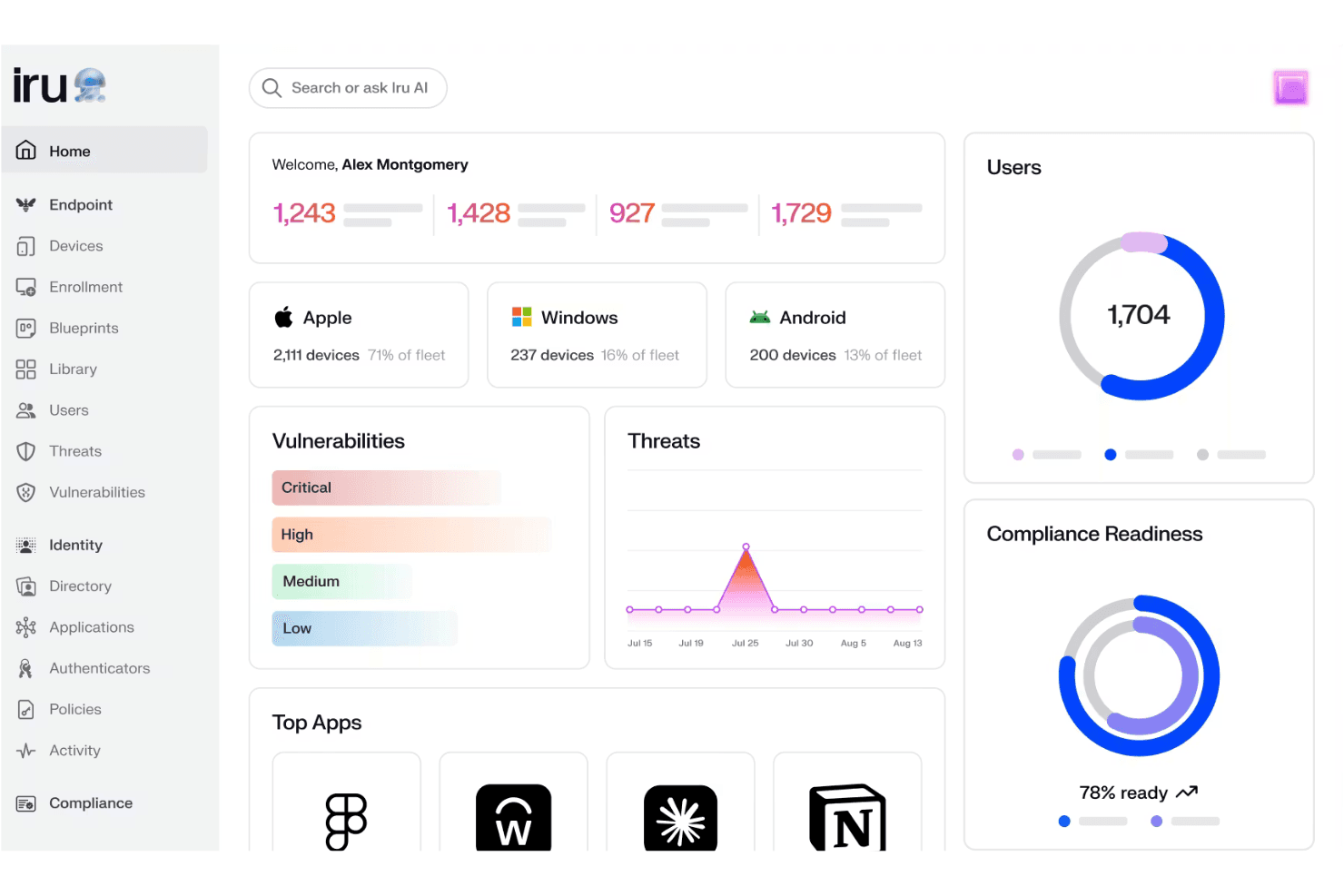
Manage every device with a single lightweight agent for centralized control. This lets you monitor, update, and secure devices across your organization.
Passwordless Identity
Enable passwordless access that adapts to user context for secure authentication. This reduces credential risks and streamlines user logins.
Continuous Compliance
Stay audit-ready with ongoing evidence collection and adaptive compliance automation. Iru’s AI-driven compliance tools help you meet regulatory requirements without manual tracking.
Endpoint Detection
Detect and respond to threats on Apple, Windows, and Android devices in real time. This feature helps IT teams quickly identify and contain security incidents.
Vulnerability Management
Identify and address vulnerabilities across your device fleet automatically. Iru’s system scans for weaknesses and provides actionable remediation steps.
AI-Powered Insights
Leverage Iru AI to automate compliance, generate insights, and trigger actions from a unified interface. This helps you make informed decisions and respond faster to issues.

Ease of Use
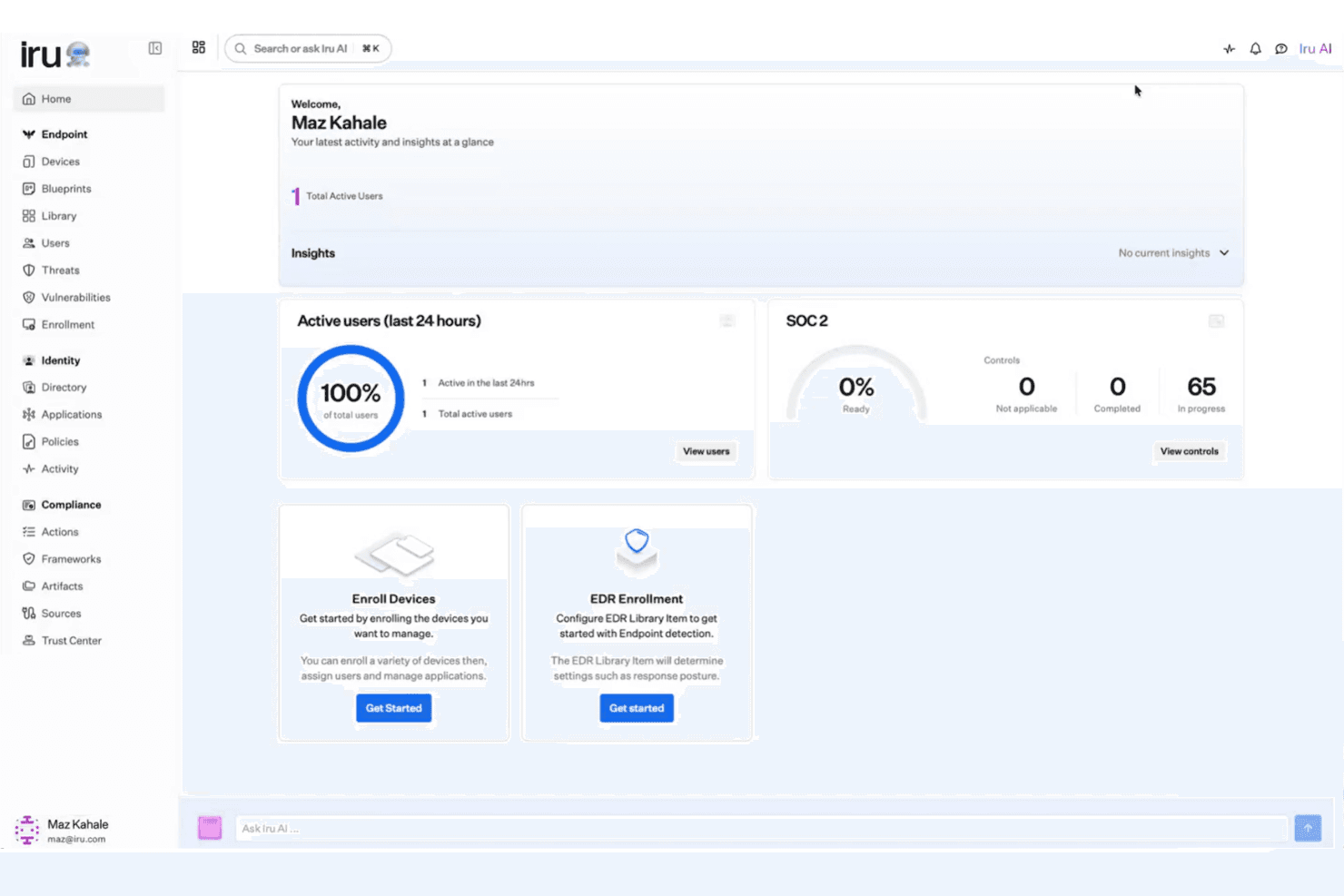
Iru’s interface is clean and straightforward, making it easy for IT teams to onboard and manage devices without extensive training. Users often mention the intuitive dashboard and clear workflows for compliance and device monitoring. I think the zero-touch deployment and passwordless identity features reduce friction for both admins and end users.
While it lacks some advanced customization, Iru’s focus on simplicity and automation makes it accessible for organizations managing large, distributed fleets.
Integrations
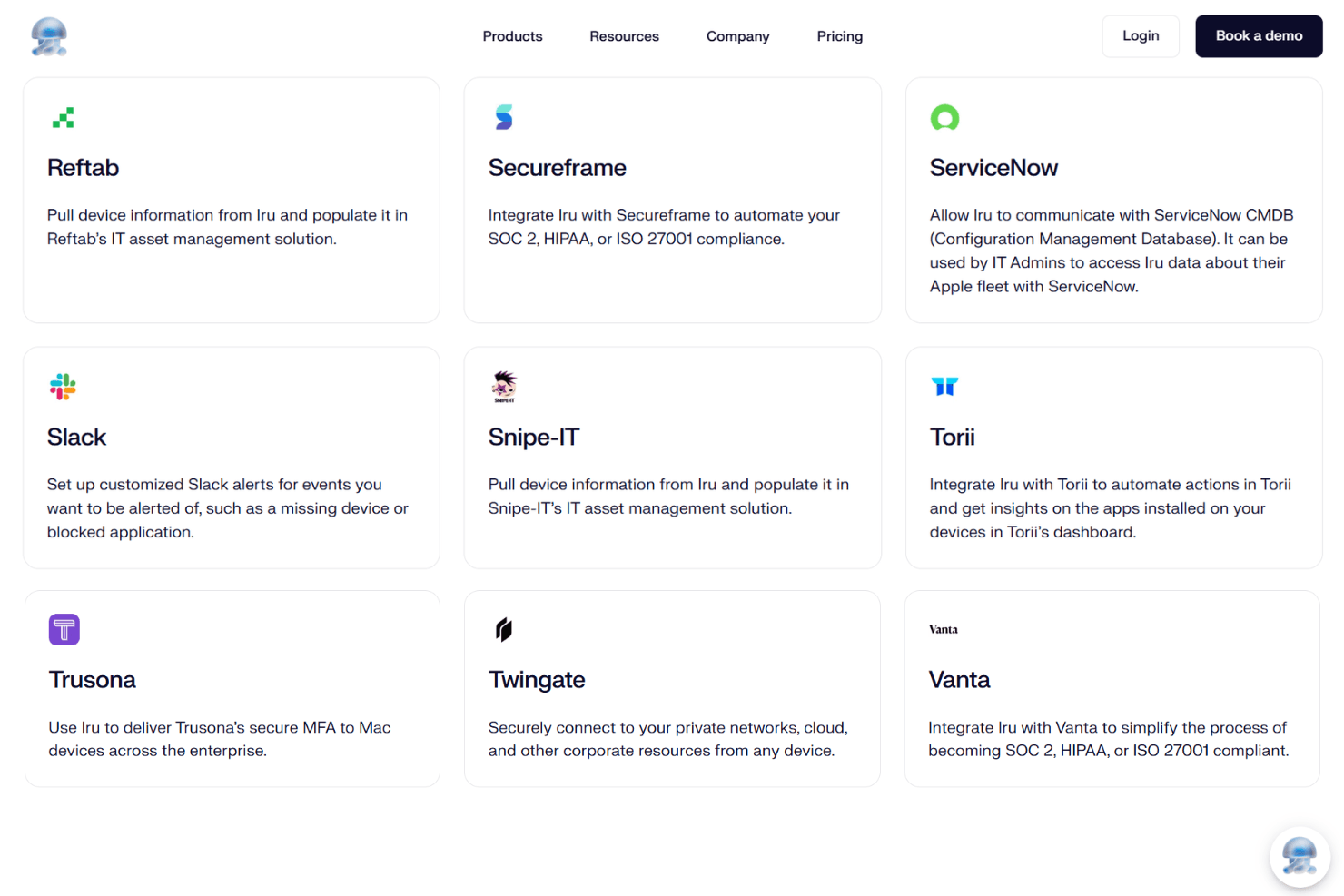
Iru integrates with Microsoft Azure Active Directory, Okta, Google Workspace, Slack, ServiceNow, Jira, AWS, Salesforce, Zendesk, and OneLogin, among others.
Iru also offers an API for custom integrations and automation, but does not connect with third-party integration tools out of the box.
Iru Specs
- 2-Factor Authentication: Yes
- Access Management: Yes
- Anti-Virus: Yes
- API: Yes
- Audit Trail: Yes
- Bug Tracking: No
- Calendar Management: No
- Customer Management: No
- Dashboard: Yes
- Data Export: Yes
- Data Import: Yes
- Data Visualization: Yes
- Email Integration: No
- External Integrations: Yes
- File Sharing: No
- File Transfer: No
- Firewall: Yes
- Google Apps Integration: No
- Inventory Tracking: No
- Malware Protection: Yes
- Multi-User: Yes
- Network Device Performance Monitoring: Yes
- Network Traffic Monitoring: Yes
- Network Visualization: No
- Notifications: Yes
- Project Management: No
- Remote Access: Yes
- Risk Assessment: Yes
- SAP Integration: No
- Scheduling: Yes
- Software Integration: Yes
- Third-Party Plugins/Add-Ons: Yes
- Ticket Management: No


