
10 Beste Cloud-Plattformen für Maschinelles Lernen im Jahr 2026

10 Beste Machine Learning Cloud Platform Shortlist
Here's my pick of the 10 best software from the 20 tools reviewed.


Sich in der Welt des Machine Learning zurechtzufinden, kann eine Herausforderung sein – besonders, wenn Sie die passende Cloud-Plattform für Ihr Team suchen. Ob Sie mit komplexen Datensätzen arbeiten oder Prognosemodelle verbessern möchten: Die richtige Lösung kann entscheidend sein.
Nach meiner Erfahrung ist es entscheidend, eine Plattform zu finden, die zu den eigenen spezifischen Anforderungen passt – sei es hinsichtlich Datenverarbeitung, Integration oder benutzerfreundlichen Oberflächen. Ich habe die führenden Optionen unabhängig getestet und bewertet, um Ihnen eine fundierte Entscheidungsgrundlage zu bieten.
In diesem Artikel teile ich objektive Einblicke zu den besten Machine-Learning-Cloud-Plattformen, gehe auf deren Besonderheiten und Vorteile ein. Lassen Sie uns gemeinsam die perfekte Lösung für die Anforderungen Ihres Teams finden.
Table of Contents
Why Trust Our Software Reviews
Zusammenfassung der besten Machine Learning Cloud Plattformen
Diese Vergleichstabelle fasst die Preisinformationen zu meinen besten Machine-Learning-Cloud-Plattform-Auswahlen zusammen, damit Sie die passende Lösung für Ihr Budget und Ihr Unternehmen finden können.
| Tool | Best For | Trial Info | Price | ||
|---|---|---|---|---|---|
| 1 | Best for accelerating end-to-end MLOps | 14-day free trial | Pricing upon request | Website | |
| 2 | Best for integrating with AWS services | Not available | From $8.20/user/month for on-demand notebook instances | Website | |
| 3 | Best for Alibaba Cloud users | Not available | From $60/user/month | Website | |
| 4 | Best for Oracle database integrations | Not available | From $200/user/month | Website | |
| 5 | Best for TensorFlow-based machine learning models | Not available | From $10/user/month | Website | |
| 6 | Best for handling multi-structured data | Not available | From $40/active user/hour | Website | |
| 7 | Best for large-scale machine learning tasks | Not available | From $0.19/hour | Website | |
| 8 | Best for Apache Spark-based analytics | Not available | From $99/user/month (billed annually) | Website | |
| 9 | Best for real-time data analytics | Not available | Pricing upon request | Website | |
| 10 | Best for visual workflow design | Not available | From $2,500/user/month | Website |
-

Site24x7
Visit WebsiteThis is an aggregated rating for this tool including ratings from Crozdesk users and ratings from other sites.4.6 -
GitHub Actions
Visit WebsiteThis is an aggregated rating for this tool including ratings from Crozdesk users and ratings from other sites.4.8 -
Docker
Visit WebsiteThis is an aggregated rating for this tool including ratings from Crozdesk users and ratings from other sites.4.6




Testbericht: Beste Machine Learning Cloud Plattformen
Nachfolgend finden Sie meine ausführlichen Zusammenfassungen der besten Machine-Learning-Cloud-Plattformen, die es auf meine Shortlist geschafft haben. Meine Bewertungen bieten einen detaillierten Blick auf die wichtigsten Funktionen, Vorteile & Nachteile, Integrationen sowie ideale Einsatzmöglichkeiten jeder Lösung, damit Sie die beste für Ihre Anforderungen finden können.


The Iguazio MLOps cloud platform is a comprehensive tool designed to automate and accelerate the end-to-end process of developing, deploying, and managing machine learning and generative AI applications. Its end-to-end capabilities make it ideal for businesses looking to scale development and manage AI workflows efficiently.
Why I Picked Iguazio: I chose Iguazio because of its comprehensive automation capabilities for machine learning pipelines and its ability to handle real-time data analysis and rapid deployment of AI models. The platform's integrated feature store, advanced technology, and robust security measures also differentiate it from other platforms.
Standout features & integrations:
Aside from its integrated feature store, the platform includes monitoring and re-training capabilities for ongoing performance checks and automatic model updates in response to drift detection. It supports integrations like NVIDIA, NetApp, AWS, Google, Microsoft Azure, Dell, and MongoDB.
Pros and Cons
Pros:
- Integrated feature store
- Dynamic scaling capabilities
- Automates machine learning pipelines
Cons:
- Slight learning curve for new users
- User interface could be easier to navigate


AWS SageMaker is a fully managed machine learning service from Amazon that empowers developers to construct, train, and deploy machine learning models effortlessly. Given its integration with the AWS ecosystem, SageMaker emerges as a leading choice for organizations and individuals already using AWS services.
Why I Picked AWS SageMaker: I chose AWS SageMaker for its versatility and excellent synergy with the AWS ecosystem. The decision was made easier by SageMaker's suite of capabilities that are meticulously designed to cater to the demands of machine learning tasks. SageMaker's close-knit integration with AWS services, like AWS Lambda, Amazon S3, and Amazon DynamoDB, makes it the best choice for users already within the AWS environment, looking to keep their workflows consolidated.
Standout features & integrations:
AWS SageMaker offers powerful features like built-in Jupyter notebooks, a wide range of pre-built algorithms, and flexible distributed training options. The platform is best known for its integration capabilities. It smoothly integrates with other AWS services, such as AWS Glue for data extraction and Amazon Athena for running SQL queries, making it a go-to choice for AWS users.
Pros and Cons
Pros:
- Scalability with AWS's vast infrastructure
- Provides robust capabilities for model building, training, and deployment
- Excellent integration with AWS services
Cons:
- The interface might be daunting for beginners
- May require a strong understanding of AWS environment
- Pricing model can be complex and hard to predict


Alibaba Cloud Machine Learning Platform for AI offers a robust and efficient machine learning service designed for data analysis, modeling, prediction, and more. This tool is a no-brainer for existing Alibaba Cloud users, given its integration with other services in the Alibaba Cloud ecosystem.
Why I Picked Alibaba Cloud Machine Learning Platform for AI: The strength of the Alibaba Cloud Machine Learning Platform lies in its synergy with the Alibaba Cloud ecosystem, which is why I selected it for my list. Its performance, usability, and, notably, its native integration with Alibaba Cloud's data storage and computing services make it a standout. If you're already using Alibaba Cloud, this platform is the best for leveraging machine learning capabilities within the same ecosystem.
Standout features & integrations:
Notable features of the platform include automated machine learning, data preprocessing, and model training and evaluation. It boasts a series of integrations with Alibaba Cloud services, including but not limited to Alibaba Cloud OSS for data storage, Alibaba Cloud MaxCompute for big data computing, and Alibaba Cloud DataWorks for data integration and management.
Pros and Cons
Pros:
- Flexible pricing based on resource usage
- Automated machine learning capabilities
- Impecabble integration with Alibaba Cloud services
Cons:
- Extra charges for additional resources
- Can be complex for beginners
- Less effective for users outside the Alibaba Cloud ecosystem

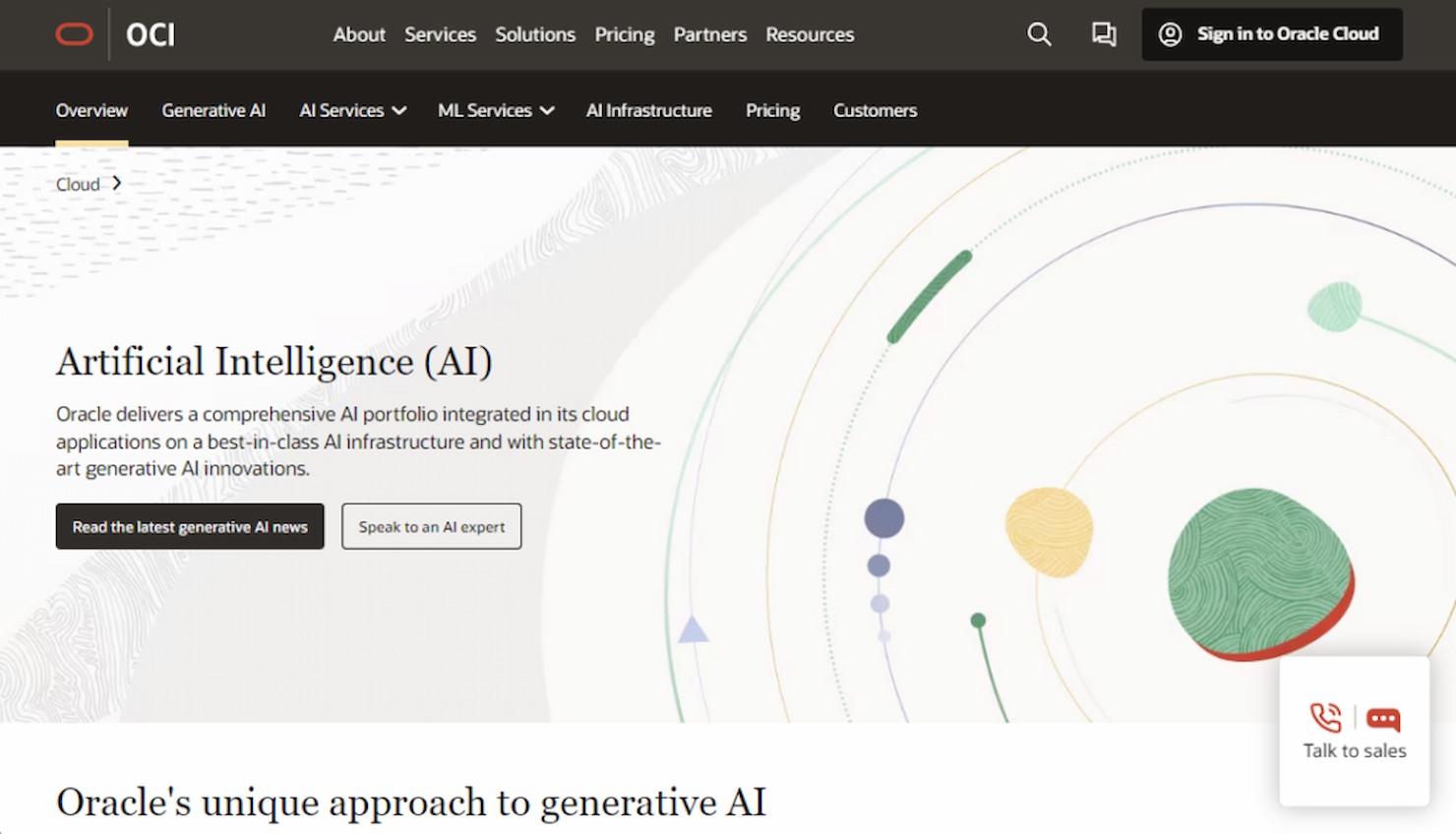
Oracle AI Platform Cloud Service offers comprehensive machine learning solutions to build, train, and manage models effectively. This platform becomes exceptionally efficient when used in conjunction with Oracle's database services, making it a perfect fit for businesses that rely on Oracle databases.
Why I Picked Oracle AI Platform Cloud Service: I chose Oracle AI Platform Cloud Service for its in-depth integration with Oracle databases. These integrations make it unique in its ability to allow access to data for machine learning models directly from Oracle databases. Given the sophistication and popularity of Oracle databases in businesses worldwide, this tool stands out as the best for integrating machine learning with Oracle databases.
Standout features & integrations:
Oracle AI Platform Cloud Service shines with features such as automated machine learning, data analytics, and visualization tools. Its deep integration with Oracle databases allows users to utilize their data directly in machine learning models. Furthermore, it can integrate with other Oracle cloud services, such as Oracle Cloud Infrastructure Data Science, offering a comprehensive data science and machine learning ecosystem.
Pros and Cons
Pros:
- Collaboration features for team-based projects
- Comprehensive machine learning and data science tools
- Deep integration with Oracle databases
Cons:
- Additional charges for data storage and processing
- Complexity of use for beginners
- High starting price compared to other platforms


TensorFlow Cloud is a library that aims to streamline the process of training TensorFlow models on Google Cloud. It is an effective choice for those looking to leverage the robust TensorFlow ecosystem for creating, training, and deploying machine learning models, especially on Google Cloud.
Why I Picked TensorFlow Cloud: I included TensorFlow Cloud on this list due to its direct compatibility with TensorFlow, one of the most popular and widely-used libraries in the machine learning field. This inherent compatibility sets it apart, making it a natural choice for users already working within the TensorFlow ecosystem. Accordingly, I determined it as the best for TensorFlow-based machine learning models.
Standout features & integrations:
TensorFlow Cloud enables users to run their TensorFlow training scripts on Google Cloud effortlessly. It includes features such as distributed training, hyperparameter tuning, and simplified cloud resource specification. As for integrations, TensorFlow Cloud directly connects with Google Cloud services such as Google Cloud Storage, Google Kubernetes Engine, and Google AI Platform.
Pros and Cons
Pros:
- Supports distributed training and hyperparameter tuning
- Integration with Google Cloud services
- Direct compatibility with TensorFlow
Cons:
- May be complex for beginners to machine learning
- Limited to Google Cloud services
- Costs can quickly escalate with heavy resource usageCosts can quickly escalate with heavy resource usage


Snowflake Data Cloud is a comprehensive data platform designed for the cloud. This tool's unique architecture allows it to handle diverse, multi-structured data efficiently, making it an ideal choice for organizations dealing with complex data types.
Why I Picked Snowflake Data Cloud: I selected Snowflake Data Cloud due to its superior handling of multi-structured data, which includes traditional tabular data, nested data types, and semi-structured data. This versatility, coupled with its cloud-native design, makes it stand out. Given the increasing diversity of data structures in use today, Snowflake shines as the best solution for handling multi-structured data.
Standout features & integrations:
Snowflake's standout features include its unique multi-cluster shared data architecture, virtually unlimited scalability, and automatic query optimization. Its platform supports a plethora of integrations, with popular ones including Tableau, PowerBI, and Looker for data visualization and various ETL tools like Fivetran, Stitch, and Matillion.
Pros and Cons
Pros:
- Wide range of integrations
- Highly scalable and flexible
- Exceptional handling of multi-structured data
Cons:
- Requires careful management to avoid excessive usage costs
- Steeper learning curve compared to traditional databases
- Consumption-based pricing model may lead to unpredictable costs


Google Cloud Artificial Intelligence (AI) Platform is a comprehensive suite that offers tools for the entire machine learning lifecycle, enabling users to build, deploy, and manage machine learning models effectively. Its proficiency in handling large-scale tasks is evident in its vast resource pool, ability to manage heavy data flow, and quick scalability, underscoring its position as the best for large-scale machine learning tasks.
Why I Picked Google Cloud AI Platform: As an ardent user of machine learning platforms, I chose Google Cloud AI Platform primarily for its ability to handle large-scale machine learning tasks effortlessly. Its breadth and depth of tools, combined with its impressive scalability, make it a reliable choice for big data endeavors. This platform shines when it comes to deploying machine learning models at scale, which is why I determined it as the best for large scale machine learning tasks.
Standout features & integrations:
Google Cloud AI Platform or GCP boasts features like built-in data labeling, AutoML capability, and robust model deployment options. Its easy integration with popular libraries like TensorFlow, PyTorch, and Scikit-learn further enhances its capabilities. Moreover, it provides interoperability with various Google Cloud services, such as BigQuery and Cloud Storage, simplifying the data ingestion process.
Pros and Cons
Pros:
- Integration with Google Cloud's other services
- Rich feature set with both pre-trained models and custom model options
- Offers robust large-scale machine learning capabilities
Cons:
- Some features might be overly complex for small-scale projects
- The learning curve for beginners can be steep
- Pricing can quickly scale up with high computational requirements


Databricks Unified Data Analytics is a distinguished platform that caters to big data processing and machine learning workloads. Its exemplary performance in Apache Spark-based analytics sets it apart, making it an ideal choice for those requiring Spark's processing prowess.
Why I Picked Databricks Unified Data Analytics: In selecting tools, the integration and execution of Apache Spark stood out in Databricks Unified Data Analytics, placing it on my list. The platform's unified approach to data science, data engineering, and business analytics is noteworthy. With its origins tied closely to Apache Spark, it excels in Spark-based analytics, thus my determination to be the best in this use-case.
Standout features & integrations:
The platform offers various standout features like collaborative notebooks, scalable clusters, and job scheduling. Databricks integrates well with popular data sources like HDFS, AWS S3, and Apache Kafka. It also offers connectors for data visualization tools like Tableau and PowerBI, providing comprehensive analytics solutions.
Pros and Cons
Pros:
- Robust integration with popular data sources and visualization tools
- Excellent collaboration with its notebook functionality
- Superior performance for Apache Spark-based analytics
Cons:
- Lack of real-time customer support
- It may require some knowledge of Spark for optimal use
- High starting price point could be a barrier for smaller organizations


TIBCO Software offers a range of software solutions for real-time data analytics. The tool helps organizations leverage their data efficiently, making it particularly suitable for real-time analytics tasks.
Why I Picked TIBCO Software: I picked TIBCO Software for its superior real-time analytics capabilities. Its ability to deliver instant insights from complex data sets distinguishes it from the rest. I made this choice because, in the modern data-driven world, the capacity to perform real-time analytics is pivotal, making TIBCO the best choice for this use case.
Standout features & integrations:
Some of TIBCO's important features include data discovery, predictive modeling, and operational intelligence. These features make it an excellent tool for users who need to make fast, data-driven decisions. TIBCO integrates with a variety of systems, including CRM tools, databases, and business intelligence tools, enhancing its utility in a broad range of business environments.
Pros and Cons
Pros:
- Features for predictive modeling and operational intelligence
- Wide range of integrations
- Robust real-time analytics capabilities
Cons:
- It may not be cost-effective for small organizations or simple use cases
- The breadth of tools and options can be overwhelming for beginners
- Pricing is not publicly disclosed


RapidMiner AI Hub is a platform that allows data scientists to build, validate, and deploy machine learning models using a visual interface. Its focus on visual workflows makes it particularly suitable for those who prefer a graphical approach to model creation over traditional code-based methods.
Why I Picked RapidMiner AI Hub: RapidMiner AI Hub made it onto my list due to its visually focused interface, which allows users to construct machine learning models by arranging elements in a visual workflow. This unique approach differentiates it from many of the more code-heavy platforms, and it led me to judge it as the best option for those prioritizing visual workflow design.
Standout features & integrations:
RapidMiner AI Hub's primary feature is its visual workflow design interface, which allows users to drag and drop elements to create complex machine learning models. It also provides team collaboration tools and built-in model validation features. On the integration side, RapidMiner AI Hub can connect with a wide range of databases, cloud storage platforms, and other data sources, including SQL, Oracle, and Amazon S3.
Pros and Cons
Pros:
- Collaboration and validation features built-i
- Wide range of integrations
- Visually oriented interface
Cons:
- Additional costs for extra services and capabilities
- Not ideal for those preferring code-based methods
- High starting price point
Weitere Machine Learning Cloud Plattformen
Unten finden Sie eine Liste zusätzlicher Machine-Learning-Cloud-Plattform-Tools, die ich ausgewählt habe, die es aber nicht in die Top 12 geschafft haben. Sie sind auf jeden Fall einen Blick wert.
- Dataiku
For collaborative data science projects
- DataRobot
For automated machine learning solutions
- H2O.ai
For AutoML and explainability features
- Pachyderm
Good for version-controlling data and models
- Qubole
Good for cloud-based big data analytics
- Domino Data Lab
Good for end-to-end data science workflow
- IBM Watson Studio
Good for AI model building with data analysis and visualization features
- Microsoft Azure Machine Learning
Https://azure.microsoft.com/en-us/products/machine-learning
- Valohai
Good for MLOps and automating machine learning pipelines
- BigML
Good for user-friendly machine learning model building


Auswahlkriterien für Machine Learning Cloud Plattformen
Bei der Auswahl der besten Machine-Learning-Cloud-Plattformen für diese Liste habe ich gängige Käuferwünsche und Pain Points wie Skalierbarkeit und einfache Integration in bestehende Systeme berücksichtigt. Außerdem habe ich zur strukturierten und fairen Bewertung folgendes Schema verwendet:
Kernfunktionen (25% der Gesamtbewertung)
Um in diese Liste aufgenommen zu werden, musste jede Lösung diese gängigen Anwendungsfälle abdecken:
- Datenvorverarbeitung und Datenbereinigung
- Modelltraining und Bereitstellung
- Echtzeit-Datenanalysen
- Datenvisualisierung
- Skalierbarkeit und Performance-Optimierung
Zusätzliche Besonderheiten (25% der Gesamtbewertung)
Um die Auswahl weiter einzugrenzen, habe ich auch nach einzigartigen Funktionen gesucht, zum Beispiel:
- Automatisierte Machine-Learning-Funktionen
- Integration mit IoT-Geräten
- Unterstützung von Edge Computing
- Fortschrittliches Data-Lineage-Tracking
- Anpassbare Dashboards und Berichte
Benutzerfreundlichkeit (10% der Gesamtbewertung)
Um die Benutzerfreundlichkeit jeder Plattform besser einschätzen zu können, habe ich folgende Kriterien berücksichtigt:
- Intuitive Benutzeroberfläche
- Klare Navigationspfade
- Verfügbarkeit von Drag-and-Drop-Werkzeugen
- Minimale Lernkurve
- Konsistenz über verschiedene Plattformen hinweg
Onboarding (10 % der Gesamtbewertung)
Um die Onboarding-Erfahrung jeder Plattform zu beurteilen, habe ich Folgendes berücksichtigt:
- Verfügbarkeit von Schulungsvideos
- Interaktive Produkttouren
- Umfassende Benutzerhandbücher
- Zugang zu Webinaren und Live-Demos
- Reaktionsschnelle Chatbots für schnelle Unterstützung
Kundensupport (10 % der Gesamtbewertung)
Um die Kundensupport-Services jedes Softwareanbieters zu beurteilen, habe ich Folgendes berücksichtigt:
- Verfügbarkeit von 24/7 Support
- Zugang zu kompetentem Supportpersonal
- Mehrere Supportkanäle (E-Mail, Telefon, Chat)
- Verfügbarkeit eines ausführlichen FAQ-Bereichs
- Community-Foren für gegenseitige Unterstützung
Preis-Leistungs-Verhältnis (10 % der Gesamtbewertung)
Um das Preis-Leistungs-Verhältnis jeder Plattform zu bewerten, habe ich Folgendes betrachtet:
- Konkurrenzfähige Preise im Vergleich zu Mitbewerbern
- Flexible Preismodelle
- Rabatte für Jahresabonnements
- Alle wichtigen Funktionen inklusive
- Verfügbarkeit von kostenlosen Test- oder Demoversionen
Kundenbewertungen (10 % der Gesamtbewertung)
Um einen Eindruck von der allgemeinen Kundenzufriedenheit zu gewinnen, habe ich bei der Auswertung von Kundenbewertungen Folgendes beachtet:
- Gesamtzufriedenheitsbewertungen
- Feedback zur Benutzerfreundlichkeit
- Kommentare zur Zuverlässigkeit und Verfügbarkeit (Uptime)
- User-Stories zur Problemlösungskompetenz
- Feedback zur Erfahrung mit dem Kundensupport
Wie wählt man eine Cloud-Plattform für Machine Learning aus?
Es ist leicht, sich in langen Funktionslisten und komplexen Preismodellen zu verlieren. Damit Sie sich bei Ihrer individuellen Softwareauswahl auf das Wesentliche konzentrieren können, finden Sie hier eine Checkliste der wichtigsten Faktoren:
| Faktor | Worauf zu achten ist |
|---|---|
| Skalierbarkeit | Kann die Plattform mit Ihren Anforderungen wachsen? Prüfen Sie, ob sie eine Skalierung hinsichtlich Datenvolumen und Nutzerzahl ohne nennenswerte Leistungseinbußen unterstützt. |
| Integrationen | Funktioniert sie mit Ihren bestehenden Tools? Achten Sie auf die Kompatibilität mit Ihrer aktuellen Systemlandschaft, um Datensilos zu vermeiden und Arbeitsabläufe zu optimieren. |
| Anpassbarkeit | Können Sie sie an Ihre Prozesse anpassen? Prüfen Sie, ob die Plattform individuelle Workflows und Dashboards für Ihre speziellen Geschäftsanforderungen ermöglicht. |
| Benutzerfreundlichkeit | Ist sie für Ihr Team einfach zu bedienen? Bewerten Sie die Lernkurve und stellen Sie sicher, dass die Benutzeroberfläche intuitiv und eine schnelle Einführung möglich ist. |
| Implementierung und Onboarding | Wie reibungslos verläuft der Umstieg? Berücksichtigen Sie Zeit- und Ressourcenaufwand für Einrichtung und Schulung und achten Sie auf umfassende Onboarding-Unterstützung. |
| Kosten | Passt sie zu Ihrem Budget? Vergleichen Sie Preismodelle, betrachten Sie die Gesamtkosten und achten Sie auf versteckte Gebühren oder Zusatzkosten. |
| Datensicherheit | Sind Ihre Daten und Abläufe sicher? Prüfen Sie die Einhaltung von Branchenstandards und die Verfügbarkeit von Funktionen wie Verschlüsselung und Zugriffskontrollen. |
| Support-Verfügbarkeit | Bekommen Sie die nötige Unterstützung? Stellen Sie sicher, dass der Anbieter schnellen und effektiven Support mit mehreren Kanälen und nachweislich guter Leistung bietet. |
Was ist eine Machine Learning Cloud-Plattform?
Eine Machine Learning Cloud-Plattform ist ein Service, der Werkzeuge und Ressourcen zum Erstellen, Bereitstellen und Verwalten von Machine-Learning-Modellen in der Cloud bereitstellt. Datenwissenschaftler, Analysten und IT-Fachkräfte nutzen diese Tools in der Regel, um die Datenanalyse und prädiktive Modellierung zu verbessern. Eigenschaften wie Skalierbarkeit, Integrationen und Benutzerfreundlichkeit unterstützen eine effiziente Modellentwicklung und -bereitstellung. Insgesamt bieten diese Plattformen eine flexible und zugängliche Möglichkeit, Machine-Learning-Technologie zu nutzen.
Funktionen
Achten Sie bei der Auswahl einer Cloud-Plattform für Machine Learning auf folgende Kernfunktionen:
- Skalierbarkeit: Ermöglicht es Ihrer Plattform, mit wachsender Daten- und Nutzerzahl zu wachsen und sorgt für gleichbleibende Performance.
- Integrationen: Ermöglicht die nahtlose Verbindung mit bestehenden Tools und Systemen, wodurch ein reibungsloser Datenfluss und eine effiziente Zusammenarbeit gefördert werden.
- Anpassbarkeit: Bietet die Möglichkeit, Workflows und Dashboards individuell auf Ihre spezifischen Geschäftsanforderungen und Prozesse zuzuschneiden.
- Automatisiertes maschinelles Lernen: Vereinfacht die Erstellung und Bereitstellung von Modellen, indem sich wiederholende Aufgaben automatisiert werden, was Zeit spart und Fehler reduziert.
- Echtzeit-Datenverarbeitung: Stellt sofortige Erkenntnisse zur Verfügung, indem Daten unmittelbar verarbeitet werden – nützlich für zeitkritische Anwendungen.
- Visuelles Workflow-Design: Ermöglicht es Nutzern, Modelle über intuitive Drag-and-Drop-Oberflächen zu erstellen und zu verwalten, wodurch der Programmieraufwand verringert wird.
- Sicherheitsmaßnahmen: Gewährleistet den Schutz Ihrer Daten durch Verschlüsselung, Zugriffskontrollen sowie die Einhaltung von Branchenstandards.
- Zusammenarbeitstools: Erleichtert die Teamarbeit, indem mehrere Nutzer gleichzeitig an Projekten arbeiten können und so die Effizienz gesteigert wird.
- Benutzerfreundliche Oberfläche: Macht die Plattform für Anwender aller Erfahrungsstufen zugänglich, steigert die Akzeptanz und vereinfacht die Nutzung.
Vorteile
Die Implementierung einer Cloud-Plattform für maschinelles Lernen bietet Ihrem Team und Ihrem Unternehmen vielfältige Vorteile. Hier sind einige, auf die Sie sich freuen können:
- Erhöhte Skalierbarkeit: Wachsende Daten- und Nutzeranforderungen können dank skalierbarer Infrastruktur problemlos bewältigt werden – ohne Einbußen bei der Performance.
- Verbesserte Zusammenarbeit: Ermöglicht es mehreren Teammitgliedern, gleichzeitig an Projekten zu arbeiten und fördert so Produktivität und Innovation.
- Schnellere Bereitstellung: Beschleunigt die Einführung und Produktion von Modellen durch automatisierte Funktionen für maschinelles Lernen.
- Kosteneffizienz: Reduziert den Bedarf an eigener IT-Infrastruktur und Wartung vor Ort, was insgesamt zu geringeren Kosten führt.
- Erhöhte Zugänglichkeit: Dank benutzerfreundlicher Oberflächen stehen Tools für maschinelles Lernen Nutzern aller Erfahrungsstufen zur Verfügung.
- Echtzeit-Einblicke: Erhalten Sie sofortigen Zugang zu Cloud-Analysen und treffen Sie datenbasierte Entscheidungen dank Echtzeit-Datenverarbeitungsfunktionen.
Kosten & Preisgestaltung
Die Auswahl einer Cloud-Plattform für maschinelles Lernen erfordert ein Verständnis der verschiedenen verfügbaren Preismodelle und Tarife. Die Kosten variieren je nach Funktionsumfang, Teamgröße, Erweiterungen und weiteren Faktoren. Die folgende Tabelle fasst gängige Tarife, deren Durchschnittspreise und typische Merkmale von Lösungen für maschinelles Lernen in der Cloud zusammen:
Tarifvergleichstabelle für Cloud-Plattformen für maschinelles Lernen
| Tarifart | Durchschnittlicher Preis | Häufige Funktionen |
|---|---|---|
| Gratis-Tarif | $0 | Begrenzte Datenverarbeitung, Basis-Analysen und Community-Support. |
| Persönlicher Tarif | $10-$30/Nutzer/Monat | Datenvisualisierung, grundlegende Integrationen und E-Mail-Support. |
| Business-Tarif | $40-$100/Nutzer/Monat | Erweiterte Analysen, Zusammenarbeitstools, automatisiertes maschinelles Lernen und vorrangiger Support. |
| Enterprise-Tarif | $150-$300/Nutzer/Monat | Anpassbare Funktionen, dedizierter Account-Manager, vollständige Integrationen und Premium-Support rund um die Uhr. |
Häufig gestellte Fragen zu Machine Learning Cloud-Plattformen
Hier finden Sie Antworten auf häufig gestellte Fragen zu Machine Learning Cloud-Plattformen:
Was ist der Unterschied zwischen lokalen und cloudbasierten Machine-Learning-Plattformen?
Cloudbasierte Plattformen bieten Flexibilität und Skalierbarkeit, da Sie Ressourcen nach Bedarf nutzen können, ohne eigene Hardware zu unterhalten. Lokale Lösungen erfordern eigene Infrastruktur, ermöglichen jedoch mehr Kontrolle über die Datensicherheit. Berücksichtigen Sie die Anforderungen und Ressourcen Ihres Teams, um die passende Lösung auszuwählen.
Wie sicher sind Machine Learning Cloud-Plattformen?
Die Sicherheit variiert je nach Anbieter, aber die meisten Plattformen setzen starke Maßnahmen wie Verschlüsselung, Zugriffskontrollen und die Einhaltung von Branchenstandards ein. Prüfen Sie stets die Sicherheitsrichtlinien Ihres Anbieters und berücksichtigen Sie die speziellen Anforderungen Ihrer Organisation, um einen optimalen Schutz Ihrer Daten zu gewährleisten.
Benötige ich technisches Vorwissen, um Machine Learning Cloud-Plattformen zu nutzen?
Einige Plattformen erfordern technisches Fachwissen, jedoch bieten viele benutzerfreundliche Oberflächen und automatisierte Funktionen, um den Einstieg zu erleichtern. Wenn Ihr Team kein technisches Vorwissen hat, suchen Sie nach Plattformen mit intuitiven Werkzeugen und umfassenden Supportangeboten für einen einfachen Start.
Wie geht es weiter?
Wenn Sie gerade dabei sind, sich über Machine Learning Cloud-Plattformen zu informieren, verbinden Sie sich mit einem SoftwareSelect-Berater für kostenlose Empfehlungen.
Sie füllen ein Formular aus und führen ein kurzes Gespräch, in dem Ihre spezifischen Anforderungen geklärt werden. Anschließend erhalten Sie eine Vorauswahl passender Softwarelösungen zur Überprüfung. Auf Wunsch werden Sie auch während des gesamten Kaufprozesses, einschließlich Preisverhandlungen, unterstützt.