

Airlock Digital Testbericht: Vorteile, Nachteile, Funktionen und Preise erklärt
Airlock Digital überzeugt durch seinen robusten Whitelisting-Ansatz, der präzise Kontrolle und starken Schutz bietet, jedoch möglicherweise mehr praktische Verwaltung als herkömmliche Cybersicherheits-Tools erfordert.

Wir bewerten Tools unabhängig; Provisionen helfen, unsere Tests zu finanzieren. Siehe unsere Transparenzrichtlinie und unsere Methodik.
Airlock Digital is a cyber security provider built around application allowlisting. It gives IT and security teams precise control over which executables, scripts, and installers can run across endpoints. It's worth considering if your organization needs to meet compliance frameworks like the Essential Eight or wants a stronger defense against ransomware than signature-based tools provide. Compared to broader EDR platforms like CrowdStrike, Airlock Digital keeps its focus on allowlisting policy management. That makes it a better fit when application control is your primary objective, not a secondary feature.
Airlock Digital Evaluation Summary
0/5
- Pricing upon request
- Free demo available
Warum Sie unseren Software-Empfehlungen vertrauen können
6,700+
Reviews
20
Industry experts
16+
Evaluation factors
14
Years
Unser Team testet und bewertet Software seit 2012. Als Tech-Führungskräfte wissen wir selbst, wie schwierig – und wichtig – es ist, die richtige Software auszuwählen.
Für diesen Leitfaden haben wir Tools mithilfe von praktischen Tests und unabhängiger Recherche bewertet und dabei unsere Bewertungskriterien angewendet.
Unsere Bewertungen spiegeln unser menschliches redaktionelles Urteilsvermögen wider, keine Verkaufsstrategie.
Expertenprüfer:
- Paulo Gardini MiguelTech-Direktor
 Tim FisherVP für KI
 Gabriel RosasTech Lead & Software-Architekt
 Christhian GruhnTech Lead & Plattform-Architekt

Airlock Digital Overview
If you’re judging cybersecurity software by control and precision, Airlock Digital is a top contender. Its allowlisting model gives you more authority over application execution than most alternatives, though it can mean more of an in-depth setup and ongoing management. I think its interface is straightforward, support is responsive, and onboarding is clear for teams familiar with endpoint security. Pricing is competitive for the level of control you get, but integrations are more limited than some broader platforms. I’d suggest Airlock Digital for organizations with strict compliance needs or those prioritizing zero-trust environments.
Pros
- Deny by default model blocks unknown and unauthorized applications
- Lightweight agent has minimal impact on endpoint performance
- Centralized management supports Windows, macOS, and Linux environments
Cons
- Limited integrations compared to broader cybersecurity platforms
- Requires ongoing policy tuning for dynamic environments
- Pricing may be higher than basic endpoint protection tools
Is Airlock Digital Right For Your Needs?
Who Would be a Good Fit for Airlock Digital?
Airlock Digital is a strong choice for organizations that need strict control over application execution and compliance with regulatory standards. Teams in highly regulated industries, or those with sensitive intellectual property, will appreciate its deny-by-default approach and centralized management. Its lightweight agent and cross-platform support make it practical for IT departments managing diverse endpoints. If your business faces targeted attacks or insider threats against critical infrastructure, Airlock Digital’s allowlisting model offers a clear advantage.
- Government AgenciesMeets strict compliance and audit requirements with granular application control.
- Financial ServicesProtects sensitive data and prevents unauthorized software in regulated environments.
- Healthcare ProvidersSupports HIPAA compliance and blocks unapproved medical software on endpoints.
- Manufacturing FirmsSecures industrial control systems by restricting executable code on shop floor devices.
- IT Security TeamsGives security teams granular visibility and control over endpoint applications.
- Medium EnterprisesFits organizations needing centralized policy management across multiple locations.
Who Would be a Bad Fit for Airlock Digital?
Airlock Digital isn’t ideal for businesses that need broad integrations, rapid onboarding for non-technical staff, or those with highly dynamic software environments. If your team relies on frequent software changes or needs advanced threat detection beyond allowlisting, you may find its model restrictive. Smaller businesses with limited IT resources may also struggle with ongoing policy management.
- Small StartupsRequires more policy management than most small teams can handle.
- Retail ChainsLacks integrations with many retail POS and inventory systems.
- Creative AgenciesRestricts frequent software installs and updates common in creative workflows.
- Education InstitutionsNot ideal for open environments with constantly changing applications.
- Managed Service ProvidersLimited multi-tenant features for MSPs managing many client environments.
- Incident Response TeamsDoes not provide advanced threat hunting or forensic analysis tools.
Unsere Bewertungsmethodik
Wie wir Werkzeuge testen & bewerten
Wir haben Jahre damit verbracht, unser System zur Softwareprüfung und -bewertung aufzubauen, zu verfeinern und zu verbessern. Das Bewertungsraster ist darauf ausgelegt, die Feinheiten der Softwareauswahl und Effektivität eines Tools einzufangen, wobei wir uns auf kritische Aspekte des Entscheidungsprozesses konzentrieren.
Nachfolgend sehen Sie genau, wie unser Test- und Bewertungssystem anhand von sieben Kriterien funktioniert. Es ermöglicht uns eine unparteiische Bewertung der Software basierend auf Grundfunktionalität, besonderen Funktionen, Benutzerfreundlichkeit, Onboarding, Kundensupport, Integrationen, Kundenbewertungen und Preis-Leistungs-Verhältnis.
Grundfunktionalität (25 % der Endbewertung)
Der Ausgangspunkt unserer Bewertung ist immer die Grundfunktionalität des Werkzeugs. Verfügt es über die grundlegenden Funktionen und Merkmale, die ein Benutzer erwarten würde? Sind grundlegende Funktionen auf höherpreisige Tarife beschränkt? Im Kern erwarten wir, dass ein Tool den Basisfähigkeiten seiner Konkurrenten standhält.
Besondere Features (25 % der Endbewertung)
Anschließend bewerten wir ungewöhnliche, herausragende Funktionen, die über die typische Grundfunktionalität von Tools dieser Art hinausgehen. Eine hohe Bewertung zeigt spezialisierte oder einzigartige Eigenschaften, die das Produkt schneller, effizienter oder für den Nutzer wertvoller machen.
Wir bewerten außerdem, wie einfach sich das Tool mit anderen üblichen Werkzeugen im Technologie-Stack integrieren lässt, um die Funktionalität und den Nutzen der Software zu erweitern. Tools mit vielen nativen Integrationen, Drittanbieter-Anbindungen und API-Zugang zur Erstellung kundenspezifischer Integrationen erhalten die besten Bewertungen.
Benutzerfreundlichkeit (10 % der Endbewertung)
Wir betrachten, wie schnell und einfach Aufgaben aus dem Bereich der Grundfunktionalität mit dem Tool erledigt werden können. Gut bewertete Software ist durchdacht gestaltet, intuitiv bedienbar, bietet mobile Apps, Vorlagen und lässt relativ komplexe Aufgaben einfach erscheinen.
Onboarding (10 % der Endbewertung)
Wir wissen, wie wichtig die schnelle Einführung eines neuen Tools für das Team ist, daher bewerten wir, wie leicht sich ein Werkzeug mit minimalem Training erlernen und nutzen lässt. Wir bewerten, wie schnell ein Teammitglied ohne Vorerfahrung anfangen kann. Hoch bewertete Lösungen benötigen wenig bis gar keine Unterstützung.
Kundensupport (10 % der Endbewertung)
Wir prüfen, wie schnell und einfach man bei Problemen Hilfe per Telefon, Live-Chat oder Wissensdatenbank erhält. Tools und Anbieter mit Echtzeit-Support werden besser bewertet, während Chatbots schlechter abschneiden.
Kundenbewertungen (10 % der Endbewertung)
Neben unserer eigenen Prüfung beziehen wir den Net Promoter Score aktueller und ehemaliger Kunden mit ein. Wir bewerten, wie wahrscheinlich es ist, dass sie sich erneut für das Werkzeug entscheiden würden. Hoch bewertete Software weist einen hohen Net Promoter Score auf.
Preis-Leistungs-Verhältnis (10 % der Endbewertung)
Abschließend vergleichen wir unter Berücksichtigung aller Kriterien den durchschnittlichen Preis der Einstiegspakete mit den Grundfunktionen und bewerten den Mehrwert aus den anderen Bewertungsbereichen. Software, die mehr fürs gleiche Geld bietet, schneidet besser ab.
Core Features
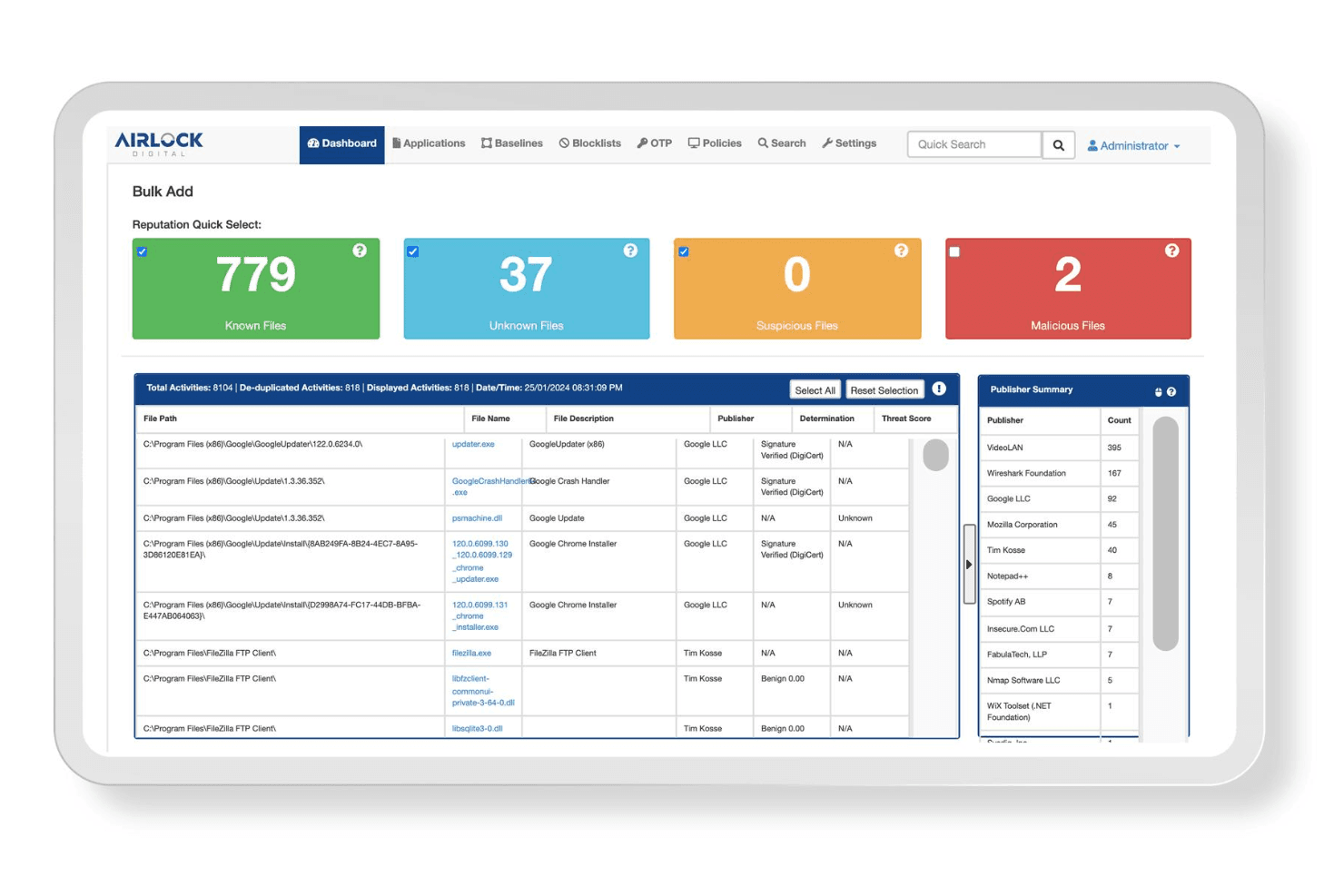
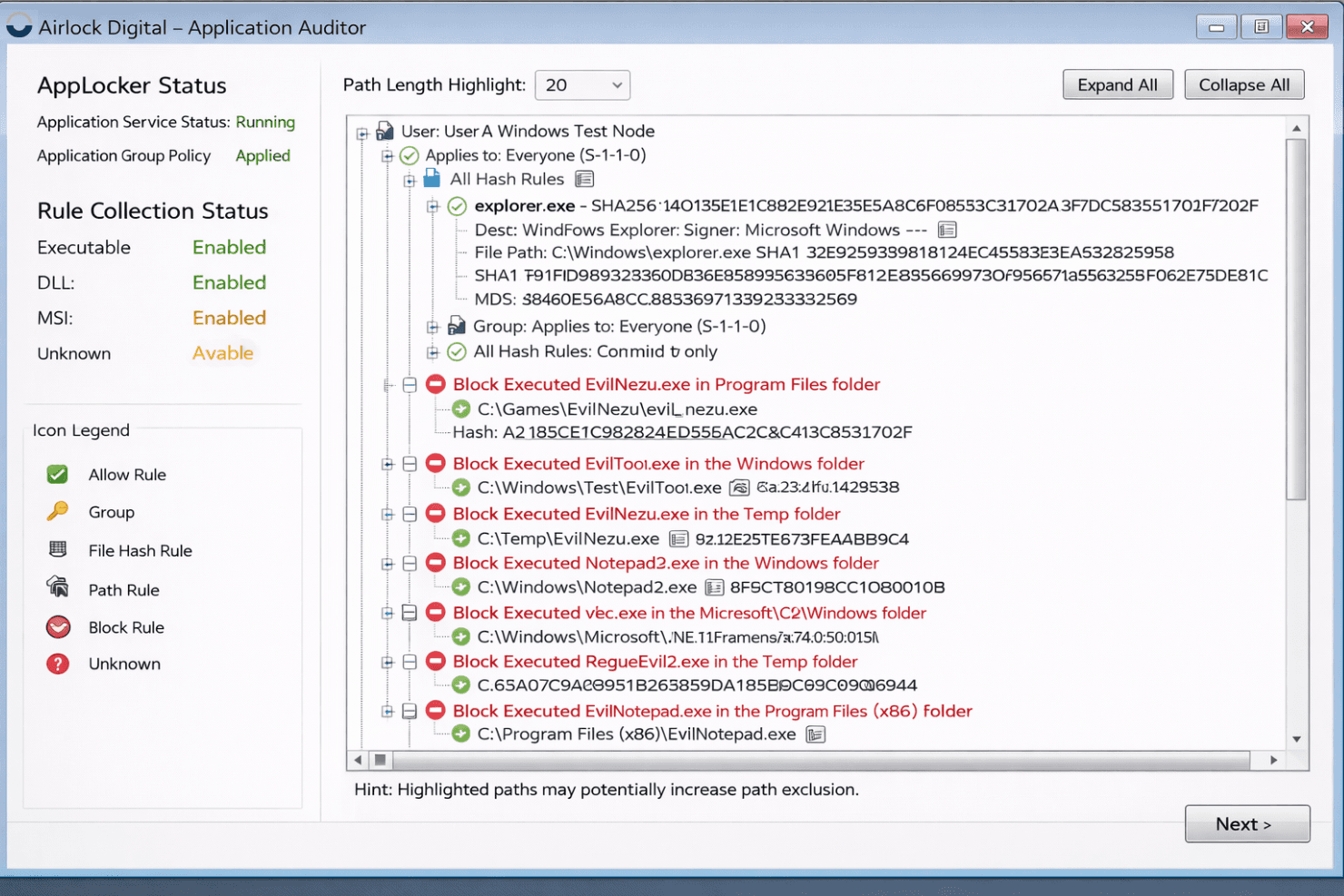
Deny by Default Application Control
Blocks all untrusted and unknown applications from running on endpoints. This approach prevents malware, ransomware, and unauthorized scripts before they can execute.
Centralized Policy Management
Lets you manage application control policies for Windows, macOS, and Linux from a single console. You can quickly update, enforce, and audit policies across your entire environment.
Workflow-Driven Allowlisting
Guides you through discovering, vetting, and approving executable code with repeatable workflows. This makes allowlisting practical and scalable for large organizations.
Blocklisting Capabilities
Allows you to explicitly block known malicious or unwanted files in addition to allowlisting. This dual approach gives you more flexibility in controlling your environment.
File Metadata Repository
Maintains a searchable database of all file metadata across your endpoints. You gain visibility into what’s running and can investigate suspicious files easily.
Legacy System Support
Supports application control on older versions of Windows, macOS, and Linux. This is valuable for organizations with legacy infrastructure that still needs protection.
Ease of Use
Airlock Digital is straightforward for IT teams familiar with application control, offering a clean interface and guided workflows that simplify policy creation and management. Users often mention that onboarding is clear, with helpful documentation and responsive support. However, ongoing policy tuning can be time-consuming in dynamic environments, and less technical users may find the allowlisting process demanding. Overall, it’s user-friendly for security professionals but may require more hands-on management than broader endpoint security tools.
Integrations
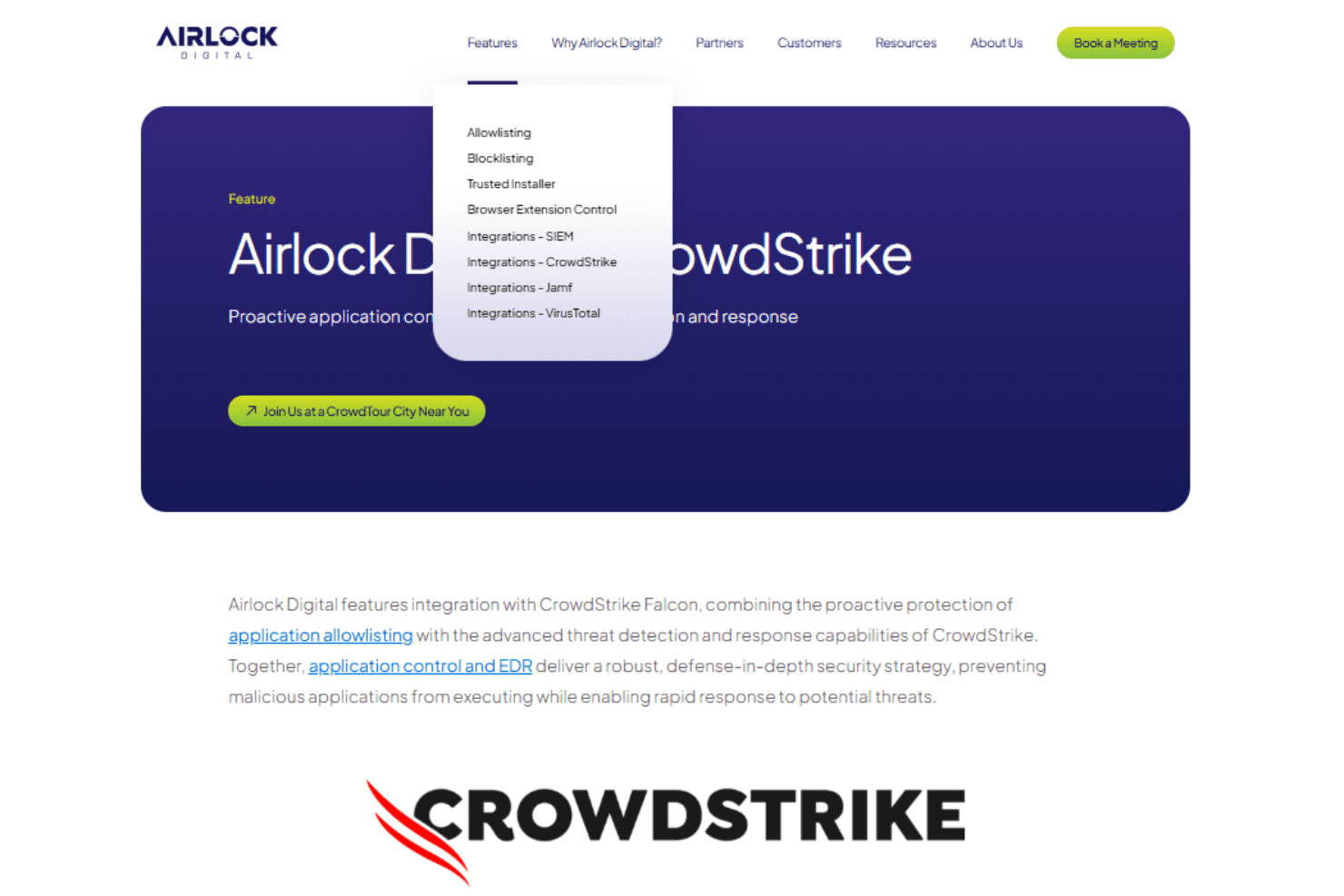
Airlock Digital integrates with Jamf, Splunk, Sumo Logic, Crowdstrike, and Microsoft SCCM, among others.
Airlock Digital also offers a rest API for custom integrations and automation.
Airlock Digital Specs
- 2-Factor Authentication: Yes
- Access Management: Yes
- Anti-Virus: Yes
- API: Yes
- Audit Management: Yes
- Audit Trail: Yes
- Batch Permissions & Access: Yes
- Compliance Tracking: Yes
- Dashboard: Yes
- Data Export: Yes
- Data Import: Yes
- DDoS Protection: Yes
- External Integrations: Yes
- File Sharing: Yes
- File Transfer: Yes
- Firewall: Yes
- Incident Management: Yes
- Malware Protection: Yes
- Multi-User: Yes
- Notifications: Yes
- Password & Access Management: Yes
- Policy Management: Yes
- Real-time Alerts: Yes
- Report & Compliance: Yes
- Risk Assessment: Yes
- Security Migration: Yes
- Threat Detection: Yes
- Workflow Management: Yes


