

The best AI-based testing automation tools help teams identify defects earlier, reduce manual test effort, increase test coverage, and maintain release quality as applications change. These tools adapt to UI and code changes so tests remain reliable across frequent updates.
Teams often adopt AI-based testing tools when manual testing slows releases, brittle scripts break after small changes, or gaps in coverage let defects reach production. Issues like flaky tests, long execution times, and limited visibility into failures reduce confidence and strain collaboration between development and QA teams.
With over 20 years in the industry as a Chief Technology Officer, I’ve tested and reviewed dozens of AI-based testing automation tools across real-world environments to evaluate their accuracy, integrations, and usability. This guide highlights the top AI-based testing automation tools that improve testing efficiency, support faster releases, and help teams deliver stable software. Each review covers features, pros and cons, and best-fit use cases to help you choose the right tool.
Why Trust Our Software Recommendations
6,700+
Reviews
20
Industry experts
16+
Evaluation factors
14
Years
Our team has been testing and reviewing software since 2012. As tech leaders ourselves, we know how difficult—and important—it is to choose the right software.
For this guide, we evaluated tools using hands-on testing and independent research, scoring tools using our selection criteria.
Our reviews reflect our human editorial judgment, not a sales pitch.
Expert reviewers:
- Paulo Gardini MiguelTech Director
 Tim FisherVP of AI
 Gabriel RosasTech Lead & Software Architect
 Christhian GruhnTech Lead & Platform Architect

Best AI-based Testing Automation Tools Summary
This comparison chart summarizes pricing details for my top AI-based testing automation tool selections to help you find the best one for your budget and business needs.
| Tool | Best For | Trial Info | Price | ||
|---|---|---|---|---|---|
| 1 | Best with business process modeling | 14-day free trial | Pricing upon request | Website | |
| 2 | Best with autonomous AI agents for PR testing | Free demo available | Pricing upon request | Website | |
| 3 | Best for unlimited users with fixed pricing | 14-day free trial + free plan available | From $99/month (billed annually) | Website | |
| 4 | Best with AI-driven test maintenance | Free plan + 30-day free trial + free demo available | From $180/seat/month | Website | |
| 5 | Best for autonomous test maintenance | Free plan + free trial available | From $20/month | Website | |
| 6 | Best for release confidence scoring | Free demo available | Pricing upon request | Website | |
| 7 | Best for agentic AI-powered test maintenance | 14-day free trial + free demo available | Pricing upon request | Website | |
| 8 | Best for AI-powered object recognition | 30-day free trial | Pricing upon request | Website | |
| 9 | Best with AI-powered test data generation | 14-day free trial + free demo available | From $3,598/year (billed annually) | Website | |
| 10 | Best for hybrid deployment flexibility | Free demo available | Pricing upon request | Website |


Best AI-based Testing Automation Tool Reviews
Below are my detailed summaries of the best AI-based testing automation tools that made it onto my shortlist. My reviews offer a detailed look at the key features, pros & cons, integrations, and ideal use cases of each tool to help you find the best one for you.
 Best with business process modeling
- 14-day free trial
- Pricing upon request
Visit WebsiteCustomer Rating:4.8/5This rating combines scores from multiple user review sites to reflect overall customer sentiment about the product.
ACCELQ enables codeless test creation and execution in the cloud. ACCELQ is a codeless AI-powered test automation platform that spans web, mobile, API, desktop, and packaged app testing through a business process modeling approach to test design and execution.
Who Is ACCELQ Best For?
It's a strong fit for enterprise QA teams that need both technical and non-technical team members to contribute to test automation across complex application portfolios.
Why I Picked ACCELQ
I picked ACCELQ because its Application Blueprint approach maps your actual business processes as a visual model, then generates tests directly against that model. When an app changes, ACCELQ's locator-free self-healing adapts automatically, without requiring me to touch a single selector. I also like the Autopilot module, which uses generative AI to author full test suites from those same process models, keeping test coverage aligned to business logic rather than UI structure.
ACCELQ Key Features
- Unified multi-channel automation: Automate tests across web, mobile, API, desktop, and mainframe platforms from a single interface.
- CI/CD pipeline integrations: Connect natively with Jenkins, Bamboo, Team City, and Azure DevOps for streamlined automated test execution.
- Integrated manual test management: Manage manual test cases and planning within the same platform as automated tests.
- Cross-browser and cloud device lab: Run tests in parallel across multiple browsers and cloud-hosted mobile devices for comprehensive coverage.
ACCELQ Integrations
ACCELQ offers native integrations with Jenkins, Bamboo, Team City, Azure DevOps, Jira, and GitHub. An API is available for custom integrations.
Pros and Cons
Pros:
- Business process models map to real workflows
- Self-healing locators reduce broken test maintenance
- Codeless authoring needs no scripting knowledge
Cons:
- Steeper initial setup for complex app environments
- Reporting dashboards lack depth vs. competitors
Learn more about ACCELQ: Best with autonomous AI agents for PR testing
- Free demo available
- Pricing upon request
Visit WebsiteCustomer Rating:4.7/5This rating combines scores from multiple user review sites to reflect overall customer sentiment about the product.
QA.tech AI validating dashboard updates, confirming critical user flows are tested and safe to release after automatically checking coverage and test results. QA.tech is an AI-native testing automation platform where autonomous agents crawl your application, generate test cases from natural language, and run exploratory and regression tests across web and mobile environments.
Who Is QA.tech Best For?
QA.tech is a strong fit for product and engineering teams at SaaS companies that ship frequently and rely on GitHub-based CI/CD workflows.
Why I Picked QA.tech
QA.tech earns its spot on my shortlist because its PR testing agent is genuinely first-class. When a developer opens a pull request, the agent automatically picks up the Vercel preview, runs full regression, and blocks the merge if something breaks. I also like that it separates real bugs from test instability, so my team isn't chasing false alarms on every CI run.
QA.tech Key Features
- Natural language test authoring: Create end-to-end test scenarios using plain English prompts across web, mobile, and API.
- Semantic UI agent navigation: AI agents explore applications contextually, adapting to changes in layout or flow automatically.
- Mobile and web parallel testing: Run autonomous tests simultaneously across multiple web and mobile environments on real and virtual devices.
- Playwright test import: Seamlessly migrate existing Playwright test suites into QA.tech for unified test automation management.
QA.tech Integrations
QA.tech offers native integrations with GitHub, Vercel, Playwright, and supports CI/CD orchestration through its API.
Pros and Cons
Pros:
- Filters flaky failures from genuine defects
- Agents run without manual test scripting
- PR-triggered agents catch bugs before merge
Cons:
- Smaller integration ecosystem than established competitors
- Limited to web application testing only
Learn more about QA.tech: Best for unlimited users with fixed pricing
- 14-day free trial + free plan available
- From $99/month (billed annually)
Visit WebsiteCustomer Rating:4.8/5This rating combines scores from multiple user review sites to reflect overall customer sentiment about the product.
BugBug lets users inspect and edit individual test step details. BugBug is a low-code E2E test automation tool that uses an AI Test Recorder, Adaptive Locators, and cloud-based scheduling to automate web application testing across Chromium-based browsers.
Who Is BugBug Best For?
BugBug suits small QA teams at growing companies that need to automate regression testing before releases without hiring dedicated automation engineers.
Why I Picked BugBug
I picked BugBug as one of the best because its flat-rate PRO plan unlocks unlimited users, so QA teams can onboard developers and stakeholders without costs climbing per seat. I like how Adaptive Locators automatically picks the most stable selector during recording, reducing broken tests after UI changes. Visual Regression on PRO plans then catches screenshot-level regressions before they reach production.
BugBug Key Features
- Reusable test components: Group steps into reusable components that can be shared across multiple tests.
- Human-readable YAML export: Export and import tests as plain-text YAML files for backup or code review.
- Inbox-based email testing: Built-in email inbox for verifying sign-up and authentication flows using unique links.
- Native integrations for notifications: Connect with Slack, Discord, and Linear to send automated run alerts to your team.
BugBug Integrations
BugBug offers native integrations with GitHub, GitLab, Bitbucket, Jenkins, Travis, Slack, Discord, Linear, and Trello. An API and command line interface are available for custom integrations and CI/CD pipeline automation.
Pros and Cons
Pros:
- No-code recorder suits non-technical QA testers
- Scheduled cloud runs need no extra infrastructure
- Adaptive Locators keep tests stable after changes
Cons:
- AI generation capabilities lag behind dedicated competitors
- Limited to Chromium-based browsers only
Learn more about BugBug: Best with AI-driven test maintenance
- Free plan + 30-day free trial + free demo available
- From $180/seat/month
Visit WebsiteCustomer Rating:4.4/5This rating combines scores from multiple user review sites to reflect overall customer sentiment about the product.
Katalon Studio supports web, mobile, and API test automation. Katalon Studio is an AI-powered test automation platform that spans web, mobile, API, and desktop testing, combining no-code, low-code, and full-code authoring with built-in AI agents for test generation, self-healing, and root cause analysis.
Who Is Katalon Studio Best For?
Katalon Studio is a strong fit for QA teams of mixed technical ability, where some members prefer low-code workflows and others need full scripting control.
Why I Picked Katalon Studio
I picked Katalon Studio as one of the best because its AI self-healing directly addresses the most time-consuming part of test maintenance. When a UI element shifts after a sprint release, the platform detects the change and updates the locator automatically, logging every fix applied. I also like the Root Cause Analyzer agent, which clusters related failures and pinpoints the underlying defect rather than leaving my team to triage each failure individually.
Katalon Studio Key Features
- AI-powered test case generation: Automatically build test cases from user stories or requirements using six specialized AI agents.
- Unified cross-platform automation: Run automated tests across web, mobile, API, and desktop environments within a single workspace.
- Cloud device orchestration: Access cross-browser and real mobile device testing via Katalon’s built-in cloud infrastructure.
- Native CI/CD pipeline integrations: Connect directly with popular CI/CD tools like Jenkins, GitHub Actions, Azure DevOps, and Docker for continuous testing workflows.
Katalon Studio Integrations
Katalon Studio offers native integrations with Jenkins, GitHub, GitLab, Azure DevOps, Jira, Bitbucket, Slack, TestRail, and qTest. An API is available for custom integrations.
Pros and Cons
Pros:
- Works for codeless and full-script workflows
- Supports web, mobile, API, and desktop testing
- AI self-healing reduces broken test maintenance time
Cons:
- Mobile testing lags behind dedicated mobile platforms
- AI features gated behind premium plan tiers
Learn more about Katalon Studio: Best for autonomous test maintenance
- Free plan + free trial available
- From $20/month
Visit WebsiteCustomer Rating:4.7/5This rating combines scores from multiple user review sites to reflect overall customer sentiment about the product.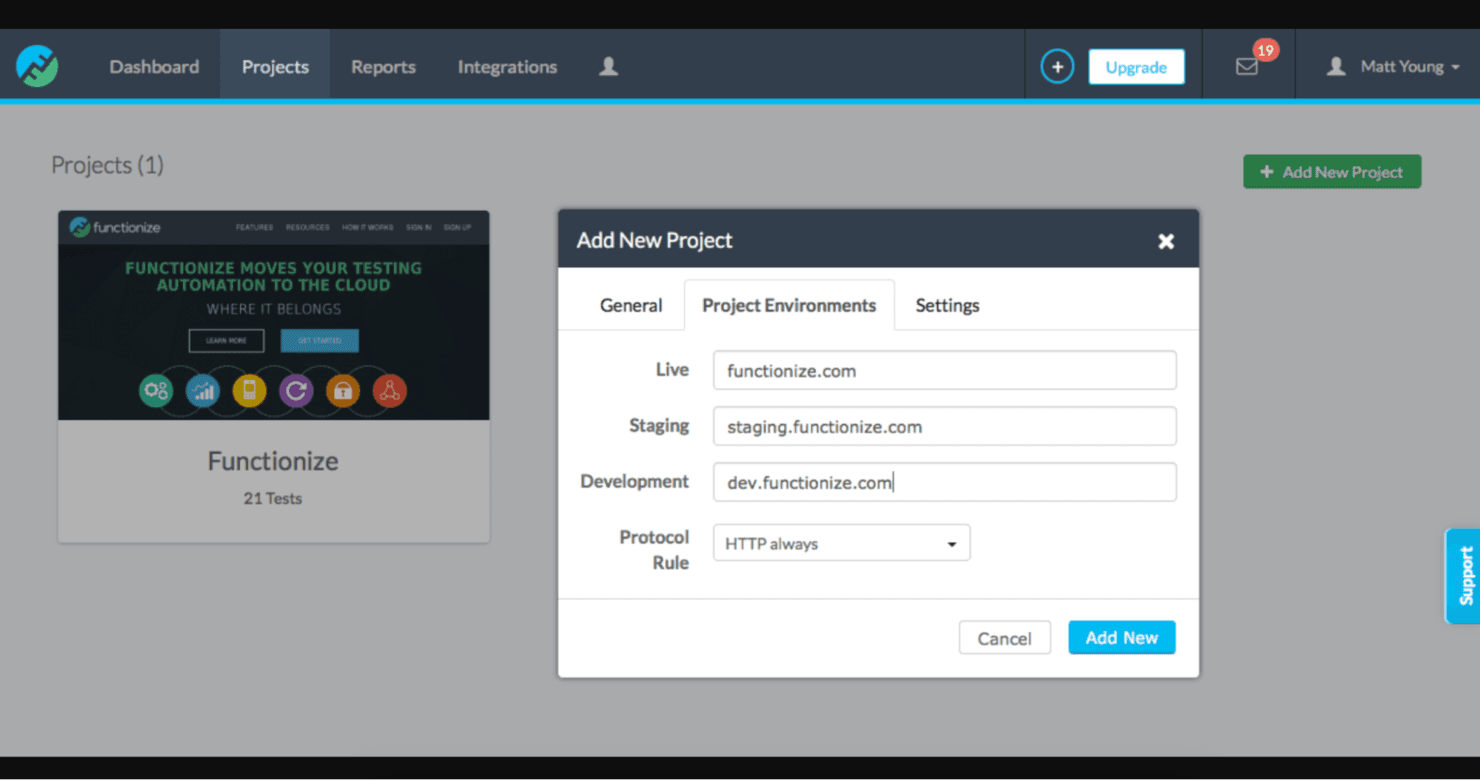
Functionize enables scalable, efficient web application testing. Functionize is an AI-based test automation platform that uses proprietary machine learning models and agentic AI to create, execute, and maintain web UI tests through natural language input and autonomous self-healing.
Who Is Functionize Best For?
Functionize suits enterprise QA teams and SDETs managing complex web application testing at scale, particularly those working with platforms like Salesforce, Workday, or ServiceNow.
Why I Picked Functionize
Functionize earns its spot on my shortlist because of how Studio handles test maintenance autonomously. When a UI element shifts, Studio re-identifies it using 200+ data points, heals the test, and reruns it to confirm the fix held. I also like that it pairs this with plain-language root-cause analysis, so my team isn't left guessing why a test failed.
Functionize Key Features
- Natural language test authoring: Allows users to describe workflows in plain English for automatic test creation.
- Proprietary AI models: Uses Functionize-built models for analysis and validation, not generic large language models.
- Native CI/CD integrations: Connects directly with tools like Jenkins, GitHub, Azure DevOps, and more.
- Element fidelity detection: Evaluates UI elements using over 200 data points for accurate identification and tracking.
Functionize Integrations
Functionize offers native integrations with Jenkins, GitHub, GitLab, Azure DevOps, CircleCI, Bamboo, Slack, PagerDuty, Jira, and TestRail. An API is available for custom integrations.
Pros and Cons
Pros:
- Deep coverage for enterprise SaaS apps
- Plain-English authoring suits non-technical testers
- Autonomous self-healing reduces manual test upkeep
Cons:
- Onboarding takes time for smaller teams
- Mobile testing support is limited
Learn more about Functionize: Best for release confidence scoring
- Free demo available
- Pricing upon request
Visit WebsiteCustomer Rating:4.4/5This rating combines scores from multiple user review sites to reflect overall customer sentiment about the product.
Testsigma enables fast web, mobile, and API test automation. Testsigma is an agentic AI test automation platform that uses a suite of AI agents to generate, execute, and self-heal tests across web, mobile, API, desktop, and Salesforce environments.
Who Is Testsigma Best For?
Testsigma is a strong fit for QA managers and SDETs at mid-to-large engineering teams running high-frequency release cycles across multiple platforms.
Why I Picked Testsigma
I picked Testsigma because its release confidence scoring is the most direct answer I've seen to the question every QA lead asks before a deploy: is it safe to ship? Atto, Testsigma's AI coworker, combines pass rate, coverage percentage, and critical-path analysis into a single ship/hold gate. I also like that test cases are generated directly from Jira stories and Figma designs, so coverage gaps are caught before a single script is written.
Testsigma Key Features
- Natural language test authoring: Write and edit automated tests in plain English with no coding required.
- In-depth Salesforce testing: Create and execute automated tests tailored for Salesforce, including Lightning, Classic, and CPQ environments.
- Parallel execution and device grid: Run tests at scale across 800+ browser/OS combinations and 2,000+ real mobile devices.
- API and database testing support: Automate API calls and validate backend database states as part of your test workflows.
Testsigma Integrations
Testsigma offers native integrations with Jenkins, GitHub, GitLab, Jira, Azure DevOps, Slack, and CircleCI, and provides an API for custom integrations.
Pros and Cons
Pros:
- Supports codeless and coded test workflows
- Release confidence scoring guides deployment decisions
- Self-healing tests adapt across UI changes
Cons:
- Steep initial setup for complex test environments
- Occasional flakiness reported with dynamic web elements
Learn more about Testsigma: 7Best for agentic AI-powered test maintenance
Mabl
- 14-day free trial + free demo available
- Pricing upon request
Visit WebsiteCustomer Rating:4.2/5This rating combines scores from multiple user review sites to reflect overall customer sentiment about the product.
Mabl helps teams automate visual and functional web app testing. Mabl is an AI-based testing automation platform that combines agentic test generation, self-healing test maintenance, and cross-platform coverage across web, mobile, and API testing.
Who Is Mabl Best For?
Mabl is a strong fit for enterprise QA and DevOps teams that need to scale automated test coverage without proportionally scaling headcount.
Why I Picked Mabl
Mabl earns its spot on my shortlist because its agentic approach to test maintenance is genuinely different from standard auto-healing tools. When a UI element changes, mabl's engine identifies it using alternative attributes and updates the test automatically, logging every fix it applies. What I find most useful is the agentic runtime recovery, which corrects test failures mid-run rather than waiting for a human to step in and rerun the suite.
Mabl Key Features
- Natural language authoring: Allows you to create and edit tests using plain English prompts.
- Test impact analysis: Uses AI to determine which tests are most relevant to recent code changes.
- Synthetic test data generation: Automatically produces test data for scenarios and compliance needs.
- Cross-browser and device coverage: Supports parallel testing across Chrome, Firefox, Edge, and Safari, plus cloud mobile device access.
Mabl Integrations
Mabl offers native integrations with Jenkins, GitHub, GitLab, Bitbucket, Azure DevOps, CircleCI, Bamboo, Slack, Jira, and Postman. An API is available for custom integrations.
Pros and Cons
Pros:
- No-code authoring suits non-technical QA testers
- Agentic AI detects and fixes failures mid-run
- Self-healing tests reduce manual maintenance overhead significantly
Cons:
- Execution speed slows noticeably on large test suites
- Mobile testing depth lags behind web coverage
Learn more about Mabl: Best for AI-powered object recognition
- 30-day free trial
- Pricing upon request

OpenText UFT One enables enterprise-wide automated app testing. OpenText UFT One is an AI-powered functional testing automation tool that supports test creation, self-healing, and execution across web, desktop, mobile, API, SAP, and mainframe environments.
Who Is OpenText UFT One Best For?
UFT One is a strong fit for enterprise QA teams managing complex, legacy-inclusive application portfolios spanning mainframe, SAP, and Windows-based environments.
Why I Picked OpenText UFT One
UFT One earns its spot on my shortlist because of how its AI handles object recognition under real testing pressure. When a UI element shifts or changes properties, the AI identifies it by context, image, and text rather than relying on brittle locators. I also like the AI mockup identification feature, which lets teams validate against design mockups before a full application build is in place.
OpenText UFT One Key Features
- Cross-platform automation: Supports automated testing across web, mobile, desktop, mainframe, API, and SAP environments.
- Integrated CI/CD support: Offers native integrations with Jenkins, Git, Docker, and OpenText ALM for pipeline execution.
- Data-driven testing: Enables test data parameterization using external sources like Excel and databases.
- Reusable modular test design: Provides a shared object repository and reusable components for efficient test maintenance.
OpenText UFT One Integrations
OpenText UFT One offers native integrations with Jenkins, Git, Docker, OpenText ALM/Quality Center, and Azure DevOps, and provides an API for custom integrations.
Pros and Cons
Pros:
- Self-healing tests reduce manual locator maintenance
- Supports legacy mainframe and SAP test automation
- Strong AI object recognition across UI changes
Cons:
- High resource consumption during local test execution
- Steep initial setup and configuration time required
Learn more about OpenText UFT One: Best with AI-powered test data generation
- 14-day free trial + free demo available
- From $3,598/year (billed annually)

TestComplete automates UI testing for desktop applications. TestComplete is an AI-assisted test automation platform from SmartBear that supports GUI testing across desktop, web, and mobile applications, with both script-based and codeless test authoring options.
Who Is TestComplete Best For?
TestComplete is a strong fit for enterprise QA teams in regulated or security-sensitive environments that need reliable, on-premises test automation for desktop and legacy applications.
Why I Picked TestComplete
I've included TestComplete in my top picks because its AI-powered test data generation stands out in a space where building realistic datasets is usually a major time sink. I like that it instantly produces reusable, contextually relevant test data, which makes data-driven testing far more practical at scale. Its self-healing capability and AI-driven visual testing with false-positive filtering add real depth to the AI feature set beyond just test authoring.
TestComplete Key Features
- Object recognition engine: Uses AI to identify UI elements in desktop, web, mobile, and PDF interfaces.
- Cross-platform testing: Supports automated testing for desktop, web, and mobile applications in a single solution.
- CI/CD tool integrations: Natively connects with Jenkins, Azure DevOps, GitHub Actions, and TeamCity for continuous testing.
- Support for multiple scripting languages: Allows authoring tests in JavaScript, Python, and VBScript to fit a range of development workflows.
TestComplete Integrations
TestComplete offers native integrations with Jenkins, Azure DevOps, Jira, GitHub, TeamCity, and Zephyr. An API is available for custom integrations.
Pros and Cons
Pros:
- Self-healing tests adapt to UI changes
- AI generates realistic test data automatically
- Supports desktop, web, and mobile testing
Cons:
- AI features are gated behind higher tiers
- Setup and configuration takes considerable time
Learn more about TestComplete: Best for hybrid deployment flexibility
- Free demo available
- Pricing upon request

Digital.ai Continuous Testing accelerates CI/CD software testing. Digital.ai Continuous Testing is an enterprise automated testing platform that covers functional, performance, and accessibility testing across real mobile devices and browsers, paired with AI-powered analytics and support for cloud, on-premises, and hybrid deployment configurations.
Who Is Digital.ai Continuous Testing Best For?
It's a strong fit for enterprise teams in regulated industries—such as finance, healthcare, and government—where strict data residency or air-gapped infrastructure requirements rule out cloud-only testing tools.
Why I Picked Digital.ai Continuous Testing
I picked Digital.ai Continuous Testing because no other tool on my list matches its deployment range: SaaS, on-premises, private device cloud, or fully air-gapped, all within one platform. I particularly like that it can run automated tests against hardened, production-protected app builds, which cloud-only tools simply can't do. Its Continuous Testing Lens adds real visibility between testers and stakeholders that I find genuinely useful for release sign-off decisions in high-compliance environments.
Digital.ai Continuous Testing Key Features
- Manual testing on real devices: Enable testers to interact directly with physical mobile devices and desktop browsers for exploratory or functional validation.
- Cross-browser support: Run automated tests against Chrome, Firefox, Safari, Edge, and Opera across macOS and Windows environments.
- Accessibility testing: Test and validate applications for accessibility compliance using integrations like VoiceOver, TalkBack, and Deque Axe.
- Performance testing with network simulation: Simulate different network conditions to assess application performance and user experience under variable connectivity.
Digital.ai Continuous Testing Integrations
Digital.ai Continuous Testing offers native integrations with Jenkins, Jira, GitLab, GitHub, Azure DevOps, and Selenium. An API is available for custom integrations.
Pros and Cons
Pros:
- Strong parallel execution across browsers and devices
- Flexible deployment across cloud and on-premises
- Supports real device testing at scale
Cons:
- AI test generation is less mature than competitors
- Setup complexity for on-premises deployments
Learn more about Digital.ai Continuous Testing:
Other AI-based Testing Automation Tools
Here are some additional AI-based testing automation tools options that didn’t make it onto my shortlist, but are still worth checking out:
- 11ApplitoolsBest with deterministic AI for compliance
- 12Rainforest QABest for AI-generated no-code test authoring
- 13TestimBest with AI-powered test impact analysis
- 14TestCraftBest for real-time feedback
- 15TestMu AIBest for cross-browser compatibility
- 16TestGridBest for on-premise deployment
- 17AutifyBest for no-code test creation
- 18ReflectBest for automated web testing
- 19SeaLightsBest for code quality insights
- 20DiffblueBest for Java code analysis
- 21EvoSuiteBest for unit test generation
How I Evaluate AI-Based Testing Automation Tools
I look at these tools in two layers: the must-haves (AI test generation, self-healing when locators break, CI/CD hooks) and the differentiators that make one tool the right fit over another.
Core Functionality (Table Stakes For This List)
When I'm selecting tools for my list, I rank each one on a scale from 0 (does not offer the functionality) to 5 (excels in this area) for each core functionality listed below. Then, I calculate the tool's total score into a percentage. Each tool needs to achieve a minimum total score of 65% to be considered for inclusion.
- AI-Driven Test Generation: I look at whether a tool can build test cases from natural language prompts, recorded sessions, or app crawling rather than requiring full manual scripting.
- Self-Healing Test Maintenance: When a dev team renames a button ID or restructures a page layout, I evaluate how well the tool auto-corrects locators to keep suites green.
- Cross-Platform Test Coverage: I check whether a single platform handles web, mobile, and API testing together, since most teams ship across all three surfaces.
- CI/CD Pipeline Integration: Tools should plug into pipelines like Jenkins, GitHub Actions, or GitLab CI with native connectors, triggering runs on every commit or merge request.
- AI-Powered Analytics and Insights: I look for intelligent failure grouping, flaky test detection, and root cause suggestions rather than just raw pass/fail logs after a run.
- Visual and Functional Validation: Beyond asserting element states, I evaluate whether the tool catches visual regressions like shifted layouts or font changes across viewports and browsers.
Once I have a list of tools that meet this criteria, I consider what sets each platform apart.
Differentiating Factors (What Sets Vendors Apart)
Here's how I compare and contrast different vendors:
Standout Features
Test impact analysis is a big differentiator for me. I look for tools that map code changes to affected tests so pipelines only run what's relevant, saving execution time on large suites. I also evaluate whether a tool offers both a no-code builder and exportable code in frameworks like Selenium or Playwright, since most teams have a mix of manual QA testers and SDETs. Natural language authoring adds further value by letting QA leads describe scenarios in plain English to generate usable tests.
Beyond Features
Ecosystem fit matters a lot. I check whether a tool connects to the test management and defect tracking platforms your team already uses, like Jira or TestRail, plus version control systems like GitHub or GitLab. Security and compliance are equally important—I look for SOC 2 and ISO 27001 certifications, SSO/SAML support, and data residency options. Pricing transparency also shapes my evaluation; I consider whether AI capabilities are included in base plans or gated behind premium tiers, and whether pricing scales by users, test runs, or parallel executions.
How to Choose an AI-based Testing Automation Tools
It’s easy to get bogged down in long feature lists and complex pricing structures. To help you stay focused as you work through your unique software selection process, here’s a checklist of factors to keep in mind:
| Factor | What to Consider |
| Scalability | Can the tool handle increased testing demands as your organization grows? Consider tools that support parallel test execution and larger test suites. |
| Integrations | Does the tool integrate with your existing tech stack, like CI/CD pipelines, bug tracking systems, or version control? Check for compatibility with key platforms. |
| Customizability | Can you tailor the tool to fit your team's workflow? Look for options that allow you to customize dashboards and reports. |
| Ease of use | Is the tool user-friendly for your team? A steep learning curve can delay implementation. Opt for intuitive interfaces and easy navigation. |
| Implementation and onboarding | How quickly can your team get up and running? Evaluate the availability of training resources, demos, or guided tours to ease the transition. |
| Cost | Does the pricing fit your budget? Consider the total cost of ownership, including hidden fees, and compare plans to ensure value for money. |
| Security safeguards | Does the tool comply with your security standards? Ensure it offers features like data encryption and secure user authentication. |
| Support availability | What level of support does the vendor provide? Evaluate the responsiveness and availability of customer support, including 24/7 options if needed. |
What Are AI-based Testing Automation Tools?
AI-based testing automation tools use artificial intelligence to automate the testing of applications. These tools are typically used by QA professionals, developers, and testers to improve testing efficiency and accuracy.
Automated test generation, self-healing tests, and real-time analytics help reduce manual testing efforts, identify issues quickly, and maintain test stability. Overall, these tools enhance the speed and reliability of the software development process.
Features of AI-based Testing Automation Tools
When selecting AI-based testing automation tools, keep an eye out for the following key features:
- Self-healing tests: Automatically adjust tests when application changes occur, reducing maintenance efforts.
- Automated test generation: Uses AI to create test cases, saving time and minimizing manual errors.
- Cross-platform testing: Supports testing across various devices and browsers, ensuring consistent performance.
- Real-time analytics: Provides immediate feedback on test results, allowing quick identification of issues.
- Codeless test creation: Empowers users to build tests without coding knowledge, making it accessible to non-developers.
- Parallel test execution: Runs multiple tests simultaneously, speeding up the testing process.
- Visual test debugging: Offers visual insights into test failures, simplifying the troubleshooting process.
- Intelligent object recognition: Enhances accuracy by identifying UI elements across different environments.
- Integration capabilities: Connects with existing tools and platforms, ensuring smooth workflow integration.
- Smart maintenance: Automatically updates tests to reflect changes in the application, reducing manual intervention.
Benefits of AI-based Testing Automation Tools
Implementing AI-based testing automation tools provides several benefits for your team and your business. Here are a few you can look forward to:
- Increased efficiency: Automated test generation and execution save time and resources, allowing your team to focus on more strategic tasks.
- Improved accuracy: Self-healing tests and intelligent object recognition reduce errors and ensure consistent test results.
- Faster release cycles: Parallel test execution speeds up the testing process, helping you deliver software updates more quickly.
- Enhanced test coverage: Cross-platform testing ensures your applications perform well across different devices and browsers.
- Cost savings: Reduced manual testing efforts and maintenance costs lead to financial savings for your business.
- Better insights: Real-time analytics and detailed reporting provide valuable feedback on application performance and quality.
- Accessibility for all team members: Codeless test creation allows non-developers to participate in the testing process, fostering collaboration.
Costs and Pricing of AI-based Testing Automation Tools
Selecting AI-based testing automation tools requires an understanding of the various pricing models and plans available. Costs vary based on features, team size, add-ons, and more. The table below summarizes common plans, their average prices, and typical features included in AI-based testing automation tools solutions:
Plan Comparison Table for AI-based Testing Automation Tools
| Plan Type | Average Price | Common Features |
| Free Plan | $0 | Basic test execution, limited integrations, and community support. |
| Personal Plan | $10-$30 /user /month | Test creation and execution, basic reporting, and email support. |
| Business Plan | $40-$70 /user /month | Advanced reporting, multiple integrations, and priority support. |
| Enterprise Plan | $100-$200 /user /month | Custom integrations, dedicated account management, and comprehensive analytics. |
AI-based Testing Automation Tools FAQs
Here are some answers to common questions about AI-based testing automation tools:
What is a key limitation of using AI testing tools?
AI testing tools can identify patterns but often lack domain-specific knowledge. This means they might miss defects requiring deep domain expertise. Your team should be aware of this limitation and consider supplementing AI testing with domain knowledge to ensure comprehensive testing.
Which AI tool is used for automation testing?
ACCELQ is a popular AI-powered automation testing tool. It’s codeless and cloud-based, providing unified automation for web, mobile, API, and more. If your team lacks programming skills, ACCELQ’s self-healing capabilities could be a great choice for simplifying test management.
How will AI affect test automation?
AI transforms test automation by speeding up test case generation, execution, and analysis. This boosts productivity and ensures consistent testing outcomes. If you want to enhance efficiency and reliability, integrating AI into your test automation processes can be beneficial.
How to integrate AI in test automation?
To integrate AI in test automation, start with automated test case generation. Use AI algorithms to analyze existing test cases and user interactions, which reduces manual effort and improves coverage. Consider tools that offer these capabilities to enhance your testing strategy.
How does AI enhance test maintenance?
AI enhances test maintenance with features like self-healing tests. These tests automatically adjust to application changes, minimizing manual updates. If your team struggles with maintaining test scripts, AI-driven maintenance can save time and reduce errors.
Can AI testing tools replace manual testers?
AI testing tools can’t fully replace manual testers. While they automate repetitive tasks and improve efficiency, human oversight is essential for domain-specific insights and creativity. Your team should use AI tools to complement manual testing, not replace it.
What's Next?
Boost your SaaS growth and leadership skills. Subscribe to our newsletter for the latest insights from CTOs and aspiring tech leaders. We'll help you scale smarter and lead stronger with guides, resources, and strategies from top experts!