

QA.tech Review 2026: Pros, Cons, Features and Pricing Overview
I dig into how QA.tech automates end-to-end testing with AI agents. Here’s what works, where it falls short, and if it’s the right tool for your stack.

We review tools independently, and commissions help fund our testing. See our transparency policy, our methodology, or suggest a tool.
End-to-end testing can quickly become difficult to maintain as applications grow and user flows become more complex. Test coverage gaps, broken tests, and repetitive maintenance work can make it harder for teams to catch issues before they reach users.
QA.tech is an AI-native end-to-end testing tool designed to solve this problem with autonomous agents that create, run, and adapt tests based on user interactions with your application. It helps teams maintain reliable test coverage while reducing the manual work involved in traditional QA processes.
In this review, I’ll cover QA.tech’s features, pros and cons, pricing, and more to help you decide if it fits your testing needs.
QA.tech Evaluation Summary

4.7/5
- Pricing upon request
- Free demo available
Why Trust Our Software Recommendations
6,700+
Reviews
20
Industry experts
16+
Evaluation factors
14
Years
Our team has been testing and reviewing software since 2012. As tech leaders ourselves, we know how difficult—and important—it is to choose the right software.
For this guide, we evaluated tools using hands-on testing and independent research, scoring tools using our selection criteria.
Our reviews reflect our human editorial judgment, not a sales pitch.
Expert reviewers:
- Paulo Gardini MiguelTech Director
 Tim FisherVP of AI
 Gabriel RosasTech Lead & Software Architect
 Christhian GruhnTech Lead & Platform Architect

QA.tech Overview
When judging QA.tech against its competitors, I think its biggest edge is its autonomous testing approach, in which AI agents understand applications and validate user goals rather than relying on traditional scripts. Its PR testing, CI/CD integrations, and parallel execution make it a strong fit for engineering teams shipping frequent updates.
However, I’d consider another solution if you need broader cross-browser coverage, performance testing, or ownership of exported test code. For teams looking to scale end-to-end testing while reducing manual test creation and maintenance, QA.tech stands out.
Pros
- AI agents automate end-to-end test creation and execution
- Strong CI/CD integrations with automated pull request testing
- Parallel test execution speeds up regression testing workflows
Cons
- Limited cross-browser testing beyond Chromium
- Tests cannot be exported as code-based scripts
- Teams may need time to adapt to autonomous testing workflows
Is QA.tech Right For Your Needs?
Who Would be a Good Fit for QA.tech?
QA.tech is a strong fit for software-driven organizations that ship modern web and mobile applications frequently. It works best for companies with active engineering teams, CI/CD workflows, and growing testing needs that are difficult to manage with traditional test automation.
- B2B SaaS CompaniesSaaS companies can use QA.tech to maintain test coverage across frequent product releases and changing application workflows.
- Software Development CompaniesDevelopment teams can automate end-to-end testing and integrate quality checks directly into CI/CD and pull request workflows.
- Fintech CompaniesFintech companies can validate critical user flows involving accounts, transactions, and complex authentication requirements.
- Healthtech PlatformsHealthtech platforms can automate regression testing as their applications, features, and user workflows continue to evolve.
- HR Tech and Recruiting PlatformsHR and recruiting platforms can test multi-step processes like onboarding, profiles, and user management across different roles.
- Ecommerce BusinessesEcommerce businesses can validate important customer journeys like account flows and checkout experiences during frequent updates.
Who Would be a Bad Fit for QA.tech?
QA.tech may not be the right fit for organizations without frequent releases, stable applications, or engineering involvement in QA workflows. Companies that need physical testing, full ownership of test scripts, or self-managed automation frameworks may benefit from a different solution.
- Pre-Product StartupsEarly-stage companies without a stable application or regular release cycle may not get enough value from continuous AI testing.
- Static Website BusinessesCompanies managing brochure sites or rarely updated pages may not need QA.tech’s continuous regression testing capabilities.
- Traditional QA OrganizationsOrganizations where QA operates separately from engineering may struggle to adopt development-focused testing workflows.
- Hardware CompaniesCompanies testing physical devices, hardware integrations, or robotics will need solutions built beyond software application testing.
- Script-Based Testing TeamsTeams that require ownership of exported Selenium or Playwright scripts may prefer traditional automation frameworks.
- Self-Managed Testing TeamsTeams looking for free, open-source frameworks they manage internally may not align with QA.tech’s managed testing approach.
Our Review Methodology
How We Test & Score Tools
We’ve spent years building, refining, and improving our software testing and scoring system. The rubric is designed to capture the nuances of software selection and what makes a tool effective, focusing on critical aspects of the decision-making process.
Below, you can see exactly how our testing and scoring works across seven criteria. It allows us to provide an unbiased evaluation of the software based on core functionality, standout features, ease of use, onboarding, customer support, integrations, customer reviews, and value for money.
Core Functionality (25% of final scoring)
The starting point of our evaluation is always the core functionality of the tool. Does it have the basic features and functions that a user would expect to see? Are any of those core features locked to higher-tiered pricing plans? At its core, we expect a tool to stand up against the baseline capabilities of its competitors.
Standout Features (25% of final scoring)
Next, we evaluate uncommon standout features that go above and beyond the core functionality typically found in tools of its kind. A high score reflects specialized or unique features that make the product faster, more efficient, or offer additional value to the user.
We also evaluate how easy it is to integrate with other tools typically found in the tech stack to expand the functionality and utility of the software. Tools offering plentiful native integrations, 3rd party connections, and API access to build custom integrations score best.
Ease of Use (10% of final scoring)
We consider how quick and easy it is to execute the tasks defined in the core functionality using the tool. High scoring software is well designed, intuitive to use, offers mobile apps, provides templates, and makes relatively complex tasks seem simple.
Onboarding (10% of final scoring)
We know how important rapid team adoption is for a new platform, so we evaluate how easy it is to learn and use a tool with minimal training. We evaluate how quickly a team member can get set up and start using the tool with no experience. High scoring solutions indicate little or no support is required.
Customer Support (10% of final scoring)
We review how quick and easy it is to get unstuck and find help by phone, live chat, or knowledge base. Tools and companies that provide real-time support score best, while chatbots score worst.
Customer Reviews (10% of final scoring)
Beyond our own testing and evaluation, we consider the net promoter score from current and past customers. We review their likelihood, given the option, to choose the tool again for the core functionality. A high scoring software reflects a high net promoter score from current or past customers.
Value for Money (10% of final scoring)
Lastly, in consideration of all the other criteria, we review the average price of entry level plans against the core features and consider the value of the other evaluation criteria. Software that delivers more, for less, will score higher.
Core Features
PR Testing
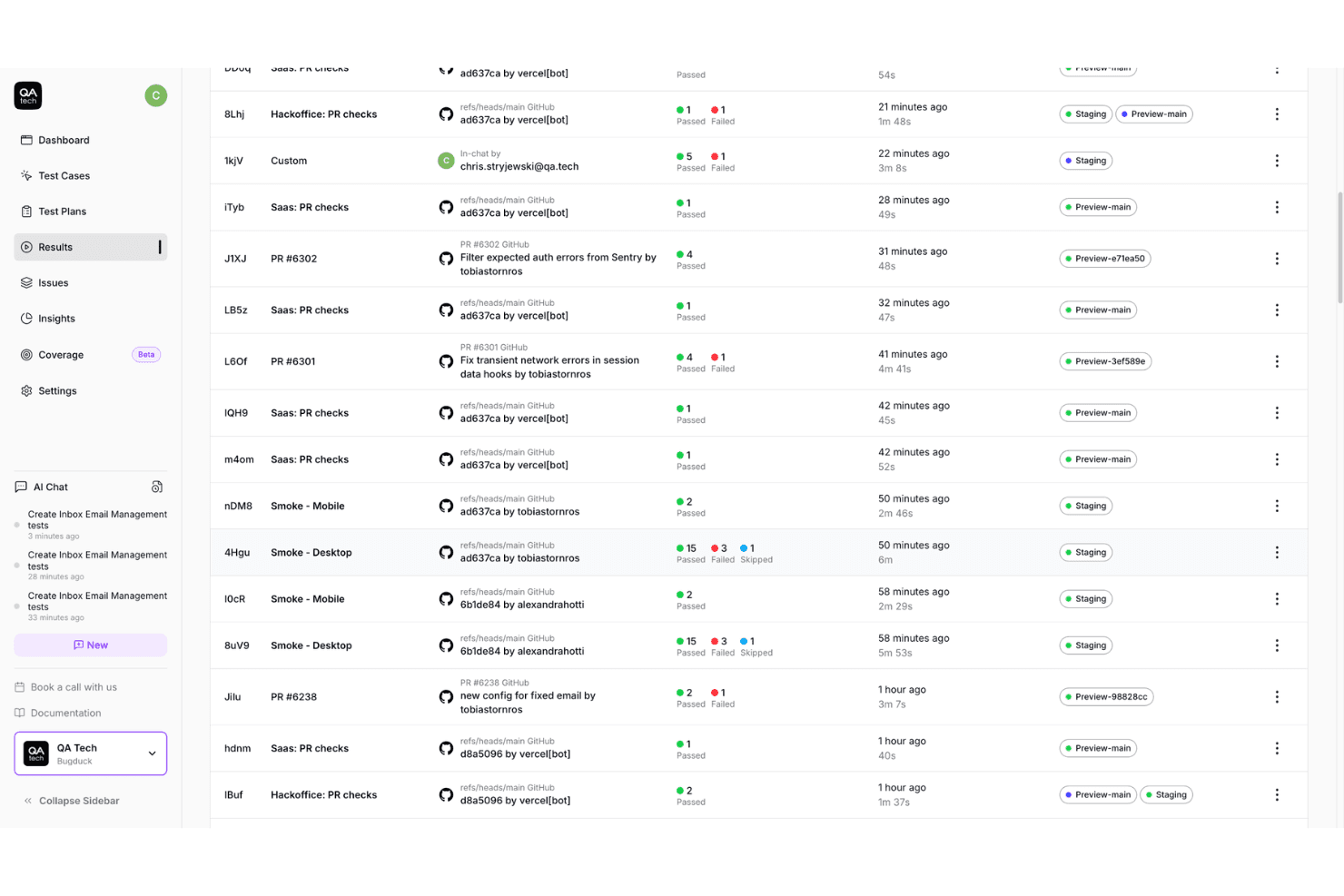
Generate and run tests from pull requests by analyzing code changes and identifying coverage gaps. This helps teams catch issues earlier while keeping test coverage aligned with new releases.
Autonomous AI Agents
Test applications with AI agents that reason through user goals instead of following fixed scripts. This reduces manual test maintenance when interfaces, workflows, or product features change.
Mobile App Testing
Test native iOS and Android applications using the same AI agent approach as web testing. Teams can validate mobile experiences across user flows while using the same knowledge system, configuration management, and agent-based approach.
Parallel Test Execution
Run test suites across multiple agents simultaneously to shorten regression testing cycles. This helps teams maintain reliable testing without slowing down frequent deployments.
Conversational Test Workspace
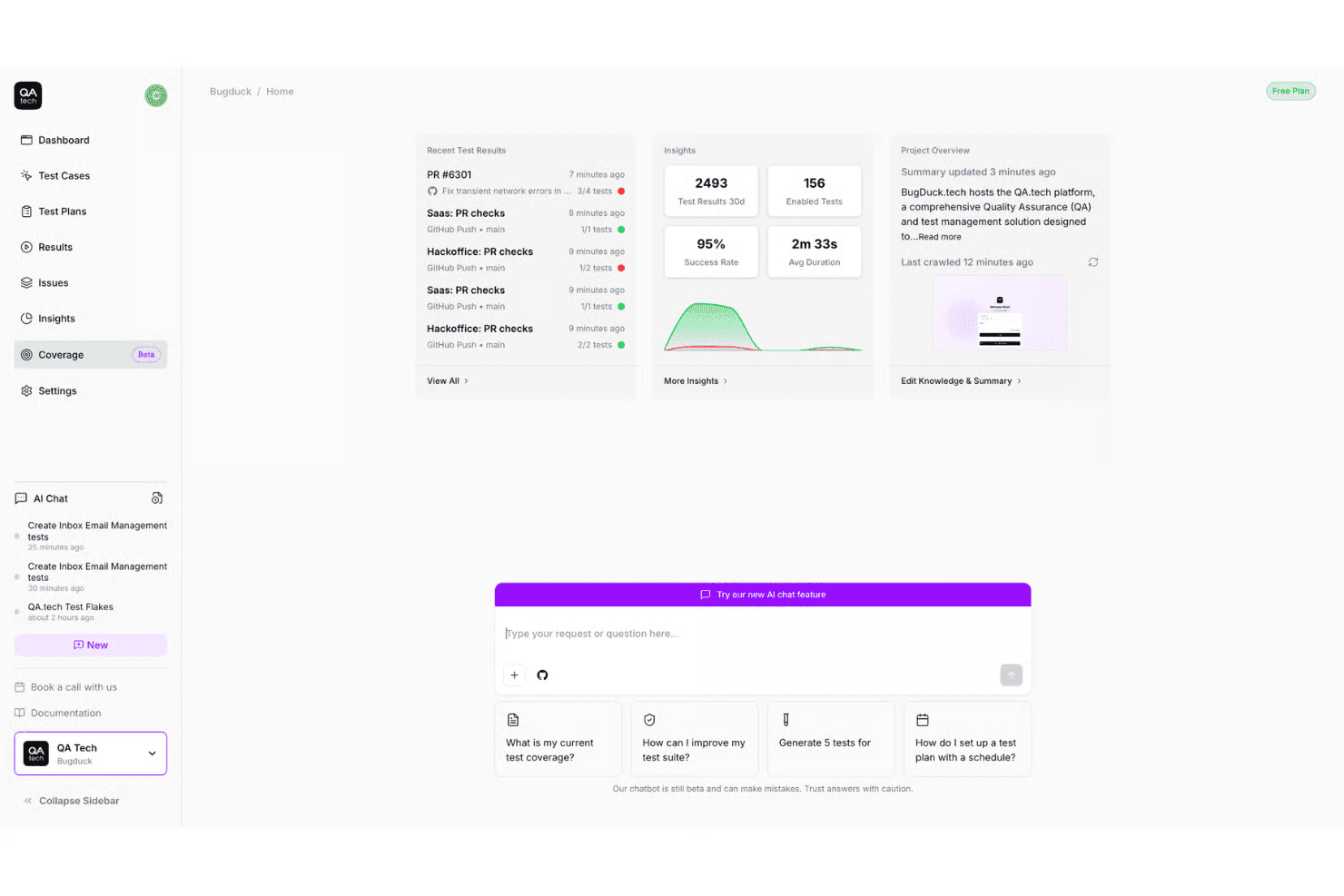
Create, edit, and run tests through a chat assistant that understands your application context. Teams can manage testing workflows without manually configuring every test step.
Issue Detection and Reporting
Identify failures with screenshots, playback context, and structured issue details. This gives developers the information they need to reproduce and resolve problems faster.
Standout Features
MCP Integration
Connect QA.tech with AI coding assistants like Cursor and Continue. Developers can run tests and review results directly within their existing coding workflows.
Shared Knowledge System
Build product context through a knowledge graph, documentation, and persistent rules. This helps agents understand application behavior and apply team standards across tests.
Ease of Use
QA.tech feels user-friendly by reducing the manual setup typically required in test automation. Its conversational workspace lets teams create, edit, and manage tests with AI assistance, while guided onboarding helps users build reliable workflows without needing deep automation expertise.

Onboarding
QA.tech provides a structured onboarding process led by a dedicated solutions engineer who helps teams connect their environment, set up initial tests, and build reliable testing workflows. Rather than a one-time setup, onboarding happens in phases with hands-on workshops, guided test creation, and implementation support to help teams understand how to work with AI agents.
Customers also receive ongoing assistance via shared Slack or Teams channels, email support, and follow-up sessions as their testing needs evolve.

Customer Support
QA.tech provides hands-on support through guided onboarding, dedicated solutions engineers, email support, and shared Slack or Teams channels. Teams receive structured setup guidance, from configuring environments to building their first tests, helping them establish reliable testing workflows faster.

Integrations
QA.tech integrates with GitHub, GitHub Actions, GitLab, Bitbucket Pipelines, Azure DevOps, CircleCI, Jenkins, Bitrise, Slack, Microsoft Teams, Jira, Linear, and Trello.
QA.tech also offers a REST API for custom workflows and API-driven testing, allowing teams to trigger test plans through their existing CI/CD pipelines.

Value for Money
QA.tech’s pricing is designed to scale with testing needs, from small teams starting with AI testing to organizations running larger QA workflows. While pricing is quote-based, the plans add value through expanded parallel testing, mobile testing, PR testing, integrations, and enterprise-level security and support.
- Starter: AI testing for individuals and small teams, including 1 user, 3 parallel test runs, exploratory testing, 2 environments, self-made integrations, and email support.
- Growth: Expanded testing for product teams with up to 5 users, custom parallel runs, mobile testing, PR testing, coverage reports, built-in integrations, and guided onboarding.
- Enterprise: Advanced testing for organizations needing unlimited parallel runs, unlimited environments, custom integrations, SLA-backed support, security reviews, and custom contracts.

QA.tech Specs
- A/B Testing: No
- API: Yes
- Automated Testing: Yes
- Browser Compatibility Testing: Yes
- Bug Tracking: Yes
- Calendar Management: No
- CI/CD Integration: Yes
- Dashboard: Yes
- Data Export: Yes
- Data Import: Yes
- Data Visualization: Yes
- Developer Tools: Yes
- External Integrations: Yes
- History/Version Control: Yes
- Manual Testing: No
- Multi-User: Yes
- Notifications: Yes
- Performance Testing: No
- Regression Testing: Yes
- Scheduling: Yes
- Status Notifications: Yes
- Third-Party Plugins/Add-Ons: Yes
QA.tech FAQs
QA.tech Company Overview & History
QA.tech is an AI-native software testing company founded in 2023 and headquartered in Stockholm, Sweden. The company helps engineering teams automate end-to-end testing for web and mobile applications using autonomous AI agents that create tests, validate releases, and reduce manual QA maintenance.
QA.tech Major Milestones
- 2023: QA.tech was founded by Daniel Mauno Pettersson, Vilhelm von Ehrenheim, and Patrick Lef with a mission to reduce the time developers spend writing and maintaining software tests.
- 2024: QA.tech secured $5 million in funding as it expanded its AI-powered platform for autonomous end-to-end testing.
- {{year}}: QA.tech continues advancing its agent-based testing platform with expanded support for web and mobile testing, PR validation, and developer workflows.