
Avis sur HelpDesk : avantages, inconvénients, fonctionnalités et tarifs
I put HelpDesk under the microscope to see whether its clean, practical approach delivers enough depth for growing support teams—or simply keeps ticketing refreshingly uncomplicated.

Nous évaluons les outils indépendamment ; les commissions aident à financer nos tests. Consultez notre politique de transparence et notre méthodologie.
HelpDesk is a ticketing help desk software for IT teams that need to centralize user requests, incident tickets, and support conversations across email, chat, Messenger, and SMS. I’d mainly consider it if you want a no-code service desk that’s quick to configure, with enough workflow rules, automation, and AI assistance to bring more structure to day-to-day IT support. I’d use it over Zendesk or Freshdesk if you want a simpler, faster-to-deploy ticketing system without the extra complexity of a broader service management suite.
HelpDesk Evaluation Summary
4.6/5
- From $34/agent/month
- 14-day free trial
Pourquoi faire confiance à nos recommandations de logiciels
6,700+
Reviews
20
Industry experts
16+
Evaluation factors
14
Years
Notre équipe teste et évalue des logiciels depuis 2012. En tant que leaders technologiques nous-mêmes, nous savons à quel point il est difficile — et important — de choisir le bon logiciel.
Pour ce guide, nous avons évalué les outils grâce à des tests pratiques et une recherche indépendante, en notant les outils selon nos critères de sélection.
Nos avis reflètent notre jugement éditorial humain, et non un argumentaire de vente.
Réviseurs experts:
- Paulo Gardini MiguelDirecteur technique
 Tim FisherVP de l'IA
 Gabriel RosasTech Lead et architecte logiciel
 Christhian GruhnTech Lead et architecte plateforme

HelpDesk Overview
I’d choose HelpDesk for small and growing IT teams that need a lightweight way to manage user requests, incident tickets, and support conversations without the overhead of a full ITSM suite. Its tiered plans scale from core ticketing and automation to stronger security, workflow customization, and onboarding. It offers more structure than a shared inbox, but it is less suited to teams that need deeper asset, change, and problem management.
Pros
- Reviewers praise HelpDesk’s clean interface for tracking multiple contact sources.
- AI drafts, summaries, and tagging reduce repetitive ticket handling.
- Round-robin assignment and collision detection support coordinated team queues.
Cons
- Lower tiers limit teams, rules, fields, and reporting depth.
- Advanced roles, SSO, and onboarding require Enterprise pricing.
- Reviewers report added costs for features previously included elsewhere.
Is HelpDesk Right For Your Needs?
Who Would be a Good Fit for HelpDesk?
HelpDesk suits small and growing support operations that need multichannel ticket handling without lengthy configuration. It works especially well for ecommerce, customer service, and support managers who value no-code workflows, AI assistance, integrations, and clear ticket ownership.
- Small Ecommerce BrandsShopify and WooCommerce integrations connect ecommerce support with email, chat, Messenger, and SMS tickets in one queue.
- Shared Inbox TeamsTeams moving from shared email can use round-robin assignment, collision detection, and a shared ticket queue to clarify ownership.
- Customer Service DepartmentsCustomer service teams can manage email, chat, Messenger, and SMS conversations while using AI drafts, summaries, and tagging.
- Lean Support TeamsSmall teams can configure no-code workflows and use browser or desktop apps without scripting or lengthy implementation work.
- Support ManagersSupport managers can use ticket summaries, AI Copilot, reporting, and custom fields to monitor and organize support work.
- Growing Support TeamsGrowing teams can use the Growth plan’s 10 teams, 10 AI Agents, advanced reporting, and 20 custom fields as operations expand.
Who Would be a Bad Fit for HelpDesk?
HelpDesk is less suitable for departments that need full IT service management, script-heavy automation, or extensive controls on lower-priced plans. Large organizations should also consider whether Enterprise pricing, tailored workflows, and dedicated onboarding match their purchasing requirements.
- Internal ITSM DepartmentsIT teams needing asset management, change management, or problem management should look beyond HelpDesk’s ticketing and workflow-focused feature set.
- Entry-Level Analytics TeamsTeams needing advanced reporting on the lowest tier may find Essential limiting because advanced reporting starts with the Growth plan.
- Script-Heavy OperationsDepartments that require scripted workflow logic may find HelpDesk restrictive because its workflows are designed around no-code configuration.
- Lower-Tier Compliance TeamsOrganizations requiring SSO and audit logs without Enterprise pricing may find HelpDesk unsuitable because those controls are Enterprise features.
- Fixed-Budget EnterprisesLarge companies needing multiple brands, tailored workflows, and dedicated account management must use custom-priced Enterprise rather than a fixed public plan.
- Dedicated Onboarding TeamsBusinesses requiring personalized onboarding from the start may find HelpDesk unsuitable because personalized onboarding and dedicated support are limited to Enterprise.
Notre méthodologie d'évaluation
Comment nous testons et notons les outils
Nous avons passé des années à développer, affiner et améliorer notre système de test et de notation des logiciels. Cette grille d’évaluation est conçue pour saisir les subtilités de la sélection des logiciels et ce qui rend un outil efficace, en se concentrant sur les aspects critiques du processus de décision.
Vous trouverez ci-dessous le détail de notre processus de test et de notation sur sept critères. Cela nous permet de fournir une évaluation impartiale du logiciel basée sur les fonctionnalités principales, les caractéristiques distinctives, la facilité d’utilisation, l’intégration, l’accompagnement lors de la prise en main, le support client, les avis utilisateurs et le rapport qualité-prix.
Fonctionnalité principale (25% de la note finale)
Le point de départ de notre évaluation est toujours la fonctionnalité principale de l’outil. Possède-t-il les fonctions de base auxquelles un utilisateur s’attend ? Certaines de ces fonctionnalités principales sont-elles limitées à des forfaits plus chers ? Nous attendons d’un outil qu’il soit au moins à la hauteur des capacités de base de ses concurrents.
Fonctionnalités remarquables (25% de la note finale)
Ensuite, nous évaluons les fonctionnalités exceptionnelles qui dépassent la fonctionnalité de base habituellement trouvée dans ce type d’outil. Un score élevé reflète des fonctionnalités spécialisées ou uniques rendant le produit plus rapide, plus efficace ou apportant une valeur ajoutée à l’utilisateur.
Nous évaluons aussi la facilité d’intégration avec d’autres outils courants dans la pile technologique pour élargir les fonctionnalités et l’utilité du logiciel. Les outils dotés de nombreuses intégrations natives, de connexions tierces et d’un accès API facilitant des intégrations personnalisées obtiennent les meilleurs scores.
Facilité d’utilisation (10% de la note finale)
Nous considérons la rapidité et la simplicité d’exécution des tâches principales avec l’outil. Les logiciels les mieux notés sont bien conçus, intuitifs, proposent des applications mobiles, offrent des modèles et rendent des tâches relativement complexes très simples.
Accompagnement lors de la prise en main (10% de la note finale)
Nous savons que l’adoption rapide d’une nouvelle plateforme au sein d’une équipe est cruciale. Nous évaluons donc la facilité avec laquelle un nouvel utilisateur peut apprendre et utiliser un outil avec un minimum de formation. Les meilleures solutions permettent une mise en route rapide, sans nécessité de support.
Support client (10% de la note finale)
Nous analysons la facilité et la rapidité avec lesquelles il est possible d’obtenir de l’aide par téléphone, chat en direct ou base de connaissances. Les outils et entreprises offrant une assistance en temps réel obtiennent les meilleurs scores, tandis que les chatbots sont moins bien notés.
Avis utilisateurs (10% de la note finale)
Au-delà de nos propres tests et évaluations, nous tenons compte du net promoter score des utilisateurs actuels et passés. Nous regardons la probabilité qu’ils choisiraient à nouveau l’outil pour ses fonctionnalités principales. Un logiciel bien noté reflète un net promoter score élevé.
Rapport qualité-prix (10% de la note finale)
Enfin, en tenant compte de tous les autres critères, nous examinons le prix moyen des forfaits d’entrée de gamme par rapport aux fonctionnalités principales et à la valeur des autres critères. Un logiciel offrant plus, pour moins cher, obtiendra un meilleur score.
Core Features
Multichannel Ticketing
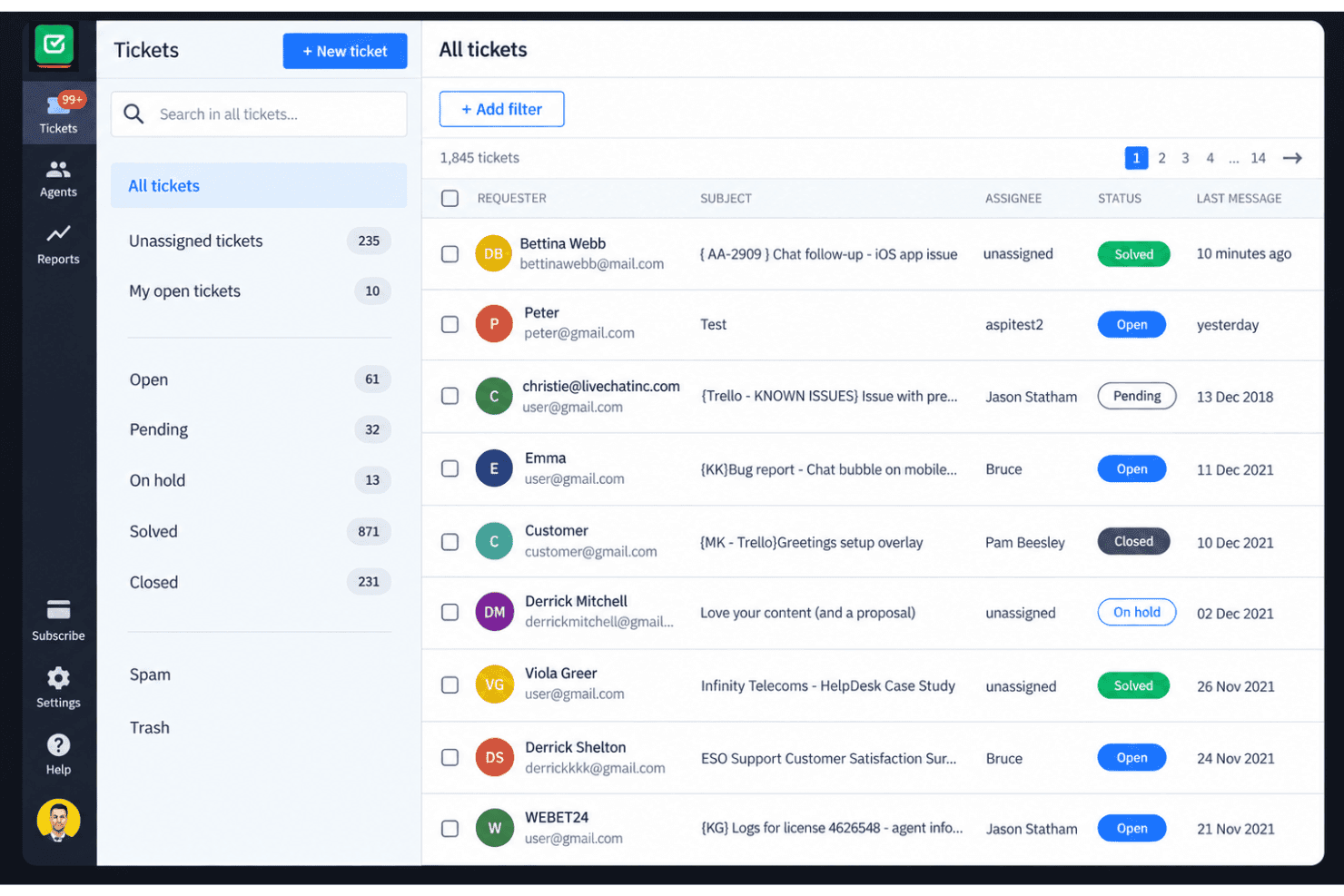
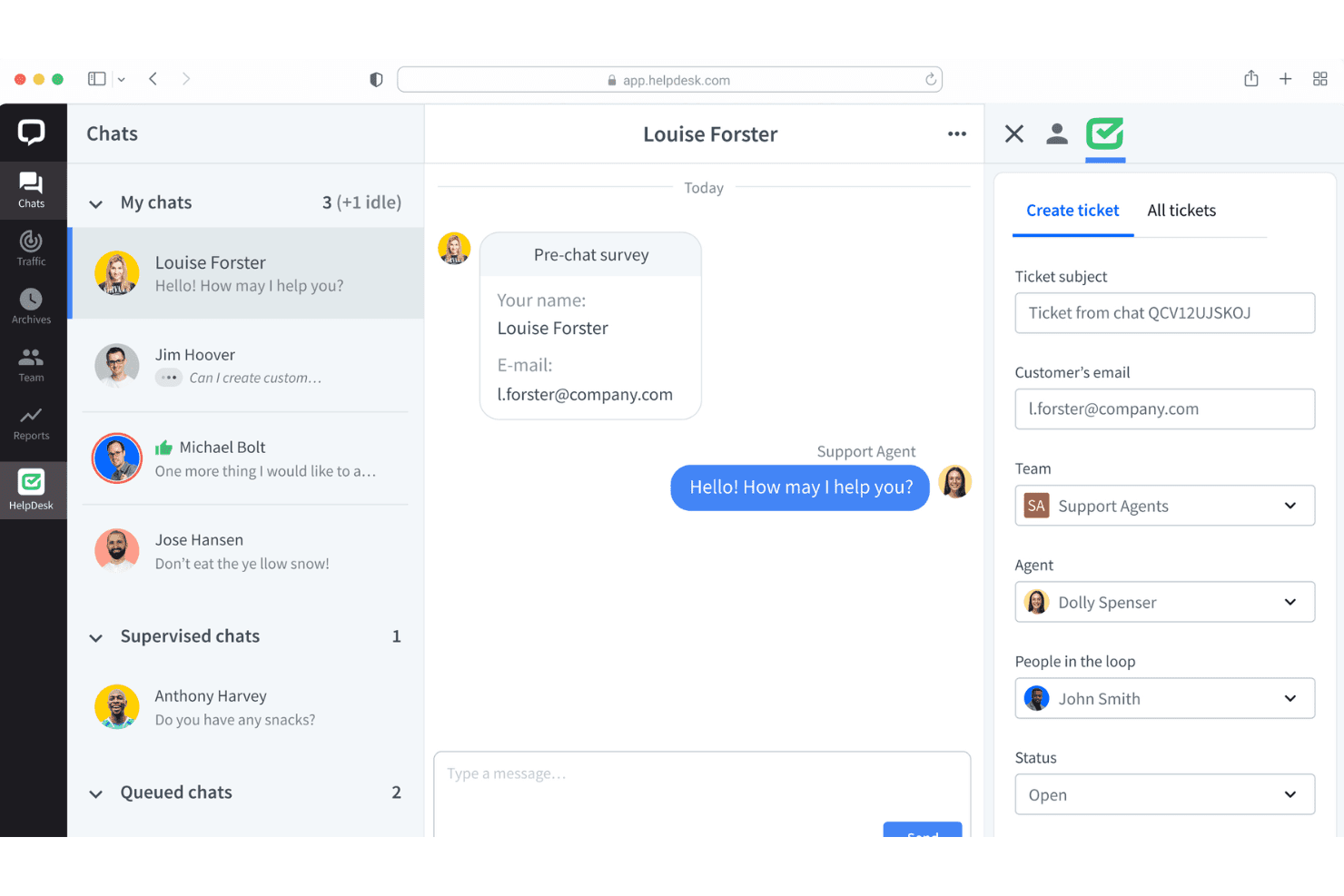
HelpDesk turns email, chat, Messenger, and SMS messages into support tickets in one workspace. This gives your team one queue for tracking customer conversations across channels.
Ticket Management
Teams can assign tickets, manage unlimited ticket volumes, and track each request through resolution. Round-robin assignment helps distribute incoming work across available agents.
No-Code Automated Workflows
No-code workflows automate ticket actions without requiring scripts or developer support. You can use them to apply consistent routing and handling rules as requests arrive.
AI Assistance
HelpDesk provides AI-generated drafts, ticket summaries, and tagging for support conversations. These tools give agents a faster starting point for replies and ticket organization.
Team Collaboration
Collision detection helps prevent multiple agents from responding to the same ticket at once. Shared ticket visibility also gives teams clearer ownership when handling busy queues.
Reporting
Built-in reporting gives teams a view of support activity and ticket performance. It helps you review queue patterns and identify where lower-tier reporting limits might affect your analysis.
Ease of Use
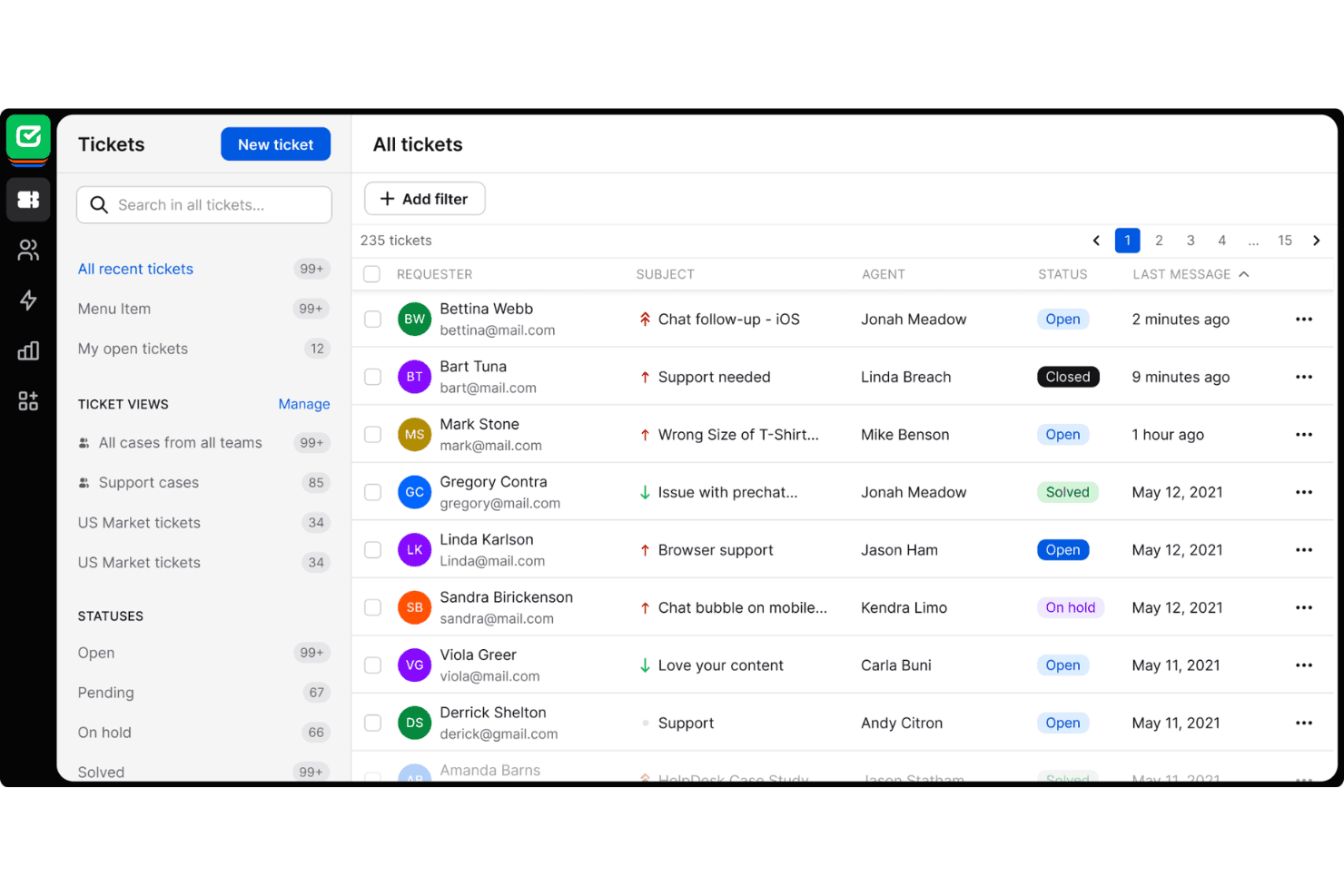
HelpDesk is one of the easier help desk tools to adopt, especially for teams moving from shared email. Reviewers praise its clean interface, while email, chat, Messenger, and SMS tickets stay in one queue. Round-robin assignment and collision detection clarify ownership, and no-code workflows avoid scripting. AI drafts, summaries, and tagging also reduce repetitive work. Usability declines on lower tiers when teams need deeper reporting, custom fields, or advanced controls.
Integrations
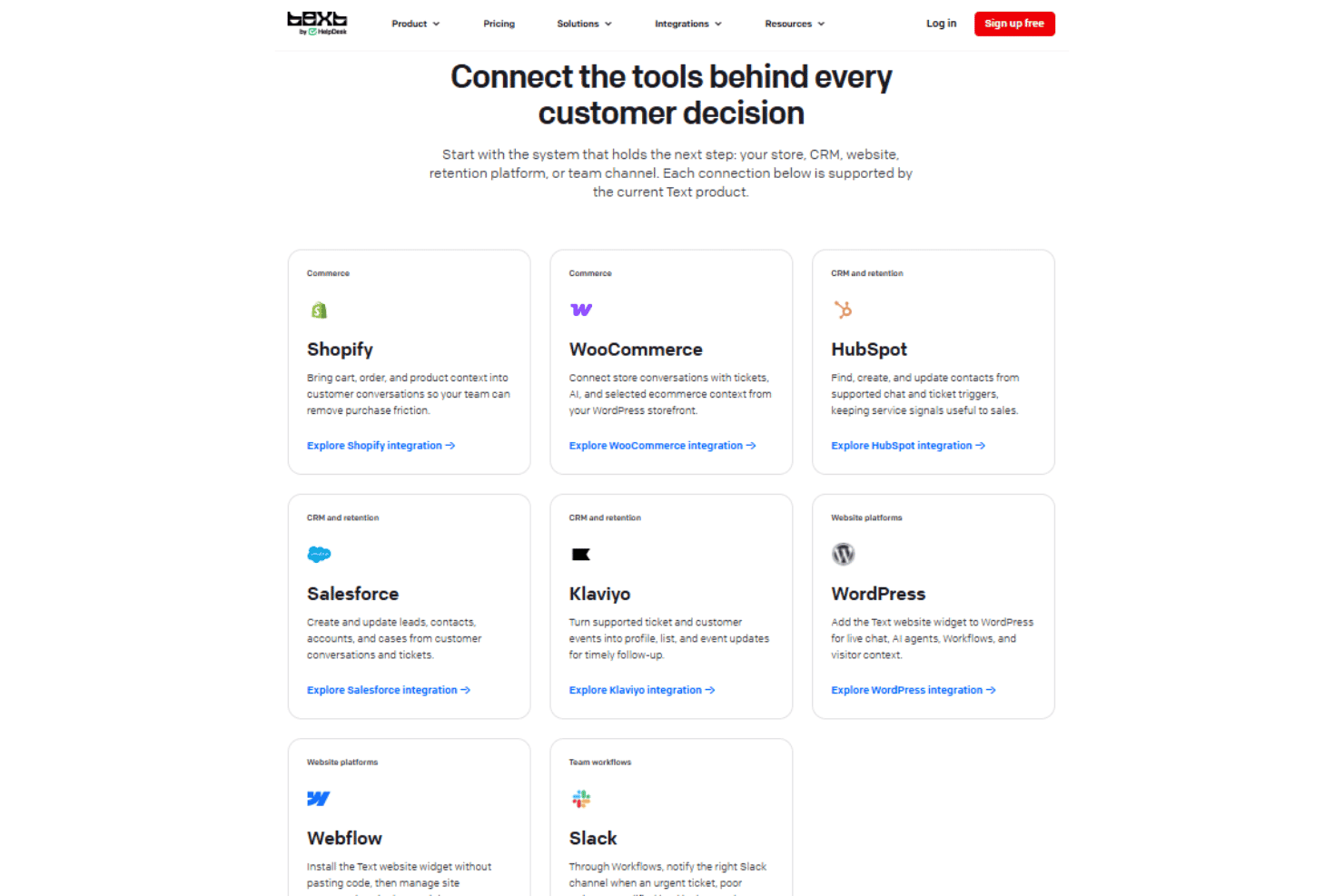
HelpDesk integrates with Shopify, WooCommerce, HubSpot, Salesforce, Klaviyo, WordPress, Webflow, and Slack.
HelpDesk also offers an API and webhooks, and connects with third-party integration tools such as Zapier.
HelpDesk Specs
- Analytics: Yes
- API: Yes
- Call Integration: Yes
- Chat: Yes
- Contact Management: Yes
- CRM Integration: Yes
- Customer Management: Yes
- Dashboard: Yes
- Data Export: Yes
- Data Import: Yes
- Data Visualization: Yes
- Email Integration: Yes
- External Integrations: Yes
- Instant Chat Integration: Yes
- Knowledge Base: Yes
- Lead Management: Yes
- Lead Scoring: Yes
- Multi-User: Yes
- Notifications: Yes
- Real-time Alerts: Yes
- Scheduling: Yes
- Self-service Portal: Yes
- Social Media Integration: Yes
- Support Forum: Yes
- Ticket Management: Yes
- Workflow Management: Yes


