

Reseña de Testiny 2026: Ventajas, Desventajas, Características y Precios
En mi carrera, he utilizado muchas herramientas de gestión de pruebas, incluyendo Testiny. Permíteme guiarte a través de las características de esta herramienta, sus alternativas y más.

Revisamos herramientas de forma independiente y las comisiones ayudan a financiar nuestras pruebas. Consulta nuestra política de transparencia, nuestra metodología o sugiere una herramienta.
Testiny is a test management software for QA teams that need to write, organize, and execute test cases across manual and automated workflows. I'd mainly consider it if you want something more approachable than TestRail, but with enough structure to support serious, at-scale QA processes.
Testiny Evaluation Summary
4.9/5
- From $15.42/user/month (billed annually)
- Free plan available
Por qué confiar en nuestras recomendaciones de software
6,700+
Reviews
20
Industry experts
16+
Evaluation factors
14
Years
Nuestro equipo lleva probando y evaluando software desde 2012. Como líderes tecnológicos, sabemos lo difícil —y lo importante— que es elegir el software adecuado.
Para esta guía, evaluamos las herramientas mediante pruebas prácticas e investigación independiente, puntuando las herramientas según nuestros criterios de selección.
Nuestras reseñas reflejan nuestro criterio editorial humano, no un discurso de ventas.
Revisores expertos:
- Paulo Gardini MiguelDirector técnico
 Tim FisherVP de IA
 Gabriel RosasTech Lead y arquitecto de software
 Christhian GruhnTech Lead y arquitecto de plataforma

Testiny Overview
Testiny offers a clean interface, fast onboarding, and affordable pricing, making it a strong choice for teams prioritizing ease of use and quick adoption. Its straightforward test case management and integrations with popular issue trackers set it apart for agile environments. While it lacks some advanced customization and reporting found in more complex tools, Testiny’s responsive support and intuitive workflow make it ideal for small to mid-sized teams judging value by simplicity and speed.
If you’re selecting a tool for rapid setup and minimal training, Testiny deserves serious consideration.
Pros
- You and your team can easily navigate its user-friendly interface.
- Testiny streamlines your testing process with its efficient core features.
- It provides strong support for agile methodologies, enhancing your workflow.
Cons
- You might find the onboarding process requires more time than expected.
- Some users feel customer support response times could be quicker.
- Testiny's customization options may not meet all your team's needs.
Is Testiny Right For Your Needs?
Who Would be a Good Fit for Testiny?
Testiny is ideal for agile development teams and tech startups that need a straightforward approach to managing testing workflows. If your team values efficiency and a user-friendly interface, Testiny’s core features will help you streamline testing tasks. Quality assurance departments in software companies will appreciate its support for agile methodologies, making it easier to keep up with fast-paced development cycles.
- Agile Development TeamsTestiny supports agile workflows, helping your team manage testing tasks efficiently.
- Tech StartupsIts user-friendly interface lets your startup focus on innovation without getting bogged down in complex testing tools.
- Quality Assurance DepartmentsTestiny simplifies the testing process, allowing your team to deliver high-quality software quickly.
- Small to Medium BusinessesIts core features provide the functionality you need without overwhelming your team with unnecessary complexities.
- Software CompaniesYou can streamline your testing process with Testiny’s efficient management capabilities.
- Project ManagersThe tool’s straightforward features make it easy for you to oversee testing phases and ensure your team meets deadlines.
Who Would be a Bad Fit for Testiny?
Large enterprises with complex testing needs might find Testiny unsuitable due to its limited customization options. If your organization requires highly specialized testing processes or extensive customization, Testiny’s straightforward features may not meet your needs. Teams that demand rapid customer support response times may also find Testiny lacking, as response times have been noted as slower than desired.
- Large EnterprisesTestiny’s limited customization options might not fit your complex testing processes.
- Highly Regulated IndustriesIf you need extensive compliance features, Testiny may not provide the depth required.
- Custom Software DevelopersTestiny’s straightforward features might not support the specialized testing your projects demand.
- Enterprise IT DepartmentsYour need for extensive scalability and customization may not align with Testiny’s capabilities.
- Heavily Integrative TeamsIf your team relies on multiple integrations, Testiny might not cover all your requirements.
- Fast-Paced Customer Support NeedsTeams needing rapid support may find Testiny’s response times slower than expected.
Nuestra metodología de revisión
Cómo probamos y puntuamos las herramientas
Hemos invertido años construyendo, refinando y mejorando nuestro sistema de pruebas y puntuación de software. La rúbrica está diseñada para captar los matices de la selección de software y lo que hace a una herramienta efectiva, enfocándose en aspectos críticos del proceso de toma de decisiones.
A continuación, puedes ver exactamente cómo nuestro sistema de prueba y puntuación funciona a través de siete criterios. Esto nos permite ofrecer una evaluación imparcial del software basada en funcionalidad central, características destacadas, facilidad de uso, incorporación, soporte al cliente, integraciones, reseñas de clientes y relación calidad-precio.
Funcionalidad principal (25% de la puntuación final)
El punto de partida de nuestra evaluación siempre es la funcionalidad central de la herramienta. ¿Tiene las características y funciones básicas que un usuario esperaría encontrar? ¿Alguna de esas funciones principales está limitada a planes de precios superiores? Esperamos que una herramienta esté a la altura de las capacidades básicas de sus competidores.
Características destacadas (25% de la puntuación final)
Luego, evaluamos las características poco comunes y sobresalientes que van más allá de la funcionalidad principal que normalmente se encuentra en herramientas de su tipo. Una puntuación alta refleja características especializadas o únicas que hacen el producto más rápido, eficiente o que ofrecen valor adicional al usuario.
También evaluamos qué tan fácil es integrar con otras herramientas que normalmente forman parte del ecosistema tecnológico para expandir la funcionalidad y utilidad del software. Las herramientas que ofrecen abundantes integraciones nativas, conexiones de terceros y acceso API para crear integraciones personalizadas obtienen la mejor puntuación.
Facilidad de uso (10% de la puntuación final)
Consideramos cuán rápido y sencillo es ejecutar las tareas definidas por la funcionalidad principal usando la herramienta. El software con mejor puntuación está bien diseñado, es intuitivo, ofrece aplicaciones móviles, proporciona plantillas y hace que tareas relativamente complejas parezcan sencillas.
Incorporación (10% de la puntuación final)
Sabemos lo importante que es la adopción rápida por parte del equipo para una nueva plataforma, por lo que evaluamos cuán fácil es aprender y usar una herramienta con entrenamiento mínimo. Evaluamos cuán rápido un miembro del equipo puede configurarla y comenzar a utilizarla sin experiencia previa. Las soluciones con mayor puntuación requieren poco o ningún soporte.
Soporte al cliente (10% de la puntuación final)
Revisamos qué tan rápido y sencillo es resolver dudas y encontrar ayuda por teléfono, chat en vivo o base de conocimientos. Las herramientas y compañías que proporcionan soporte en tiempo real obtienen la mejor puntuación, mientras que los chatbots obtienen la peor.
Reseñas de clientes (10% de la puntuación final)
Además de nuestras pruebas y evaluaciones, consideramos la puntuación neta de promotores por parte de clientes actuales y anteriores. Revisamos la probabilidad de que elijan la herramienta de nuevo para la funcionalidad principal. Una puntuación alta refleja una alta puntuación neta de promotores actuales o pasados.
Relación calidad-precio (10% de la puntuación final)
Por último, considerando todos los demás criterios, revisamos el precio promedio de los planes de nivel básico comparado con las funciones principales y consideramos el valor de los demás criterios de evaluación. El software que ofrezca más, por menos, obtendrá una puntuación mayor.
Core Features
Test Case Management
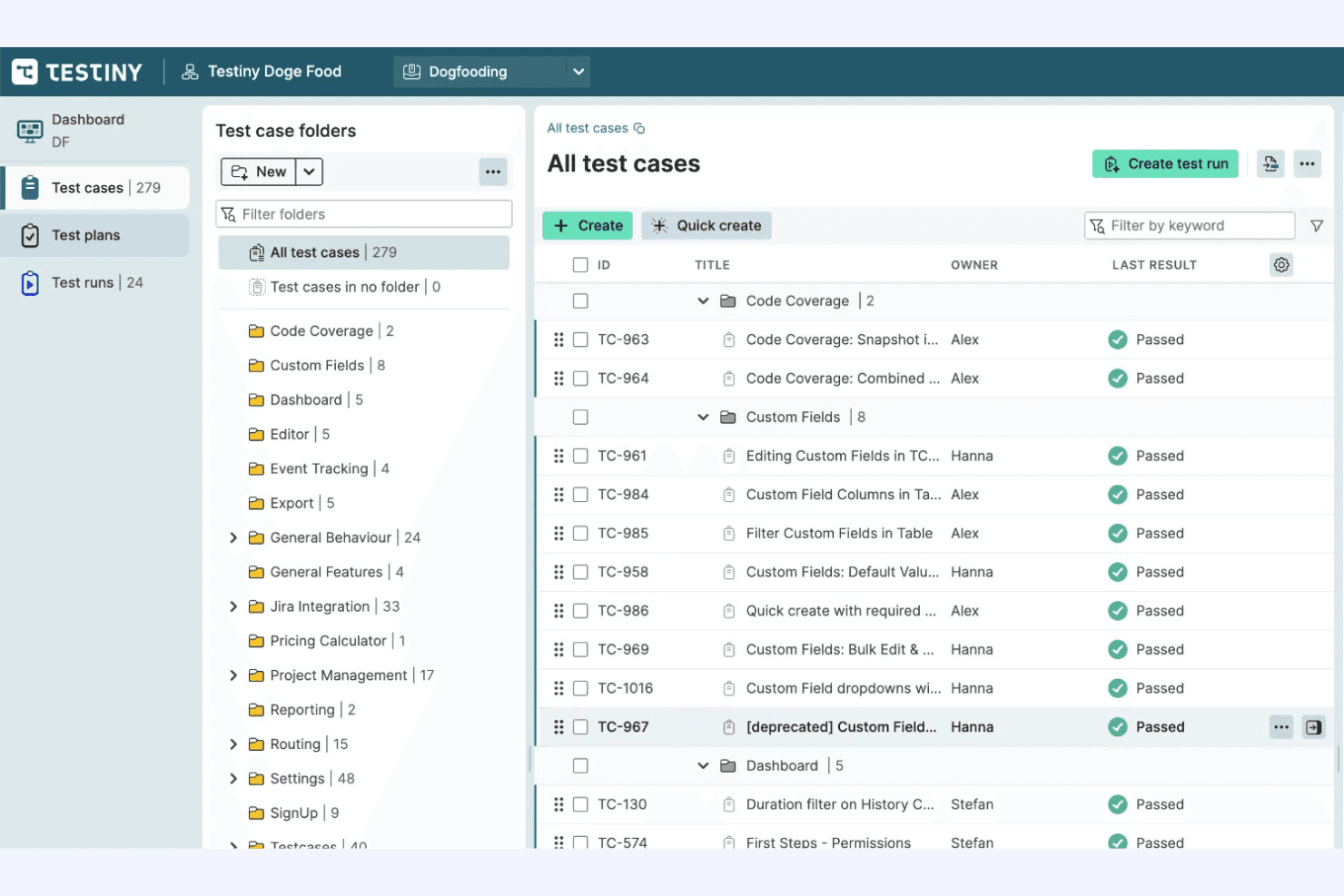
You can easily create, organize, and manage test cases to ensure thorough coverage. This feature helps your team maintain consistency and accuracy in testing.
Test Execution
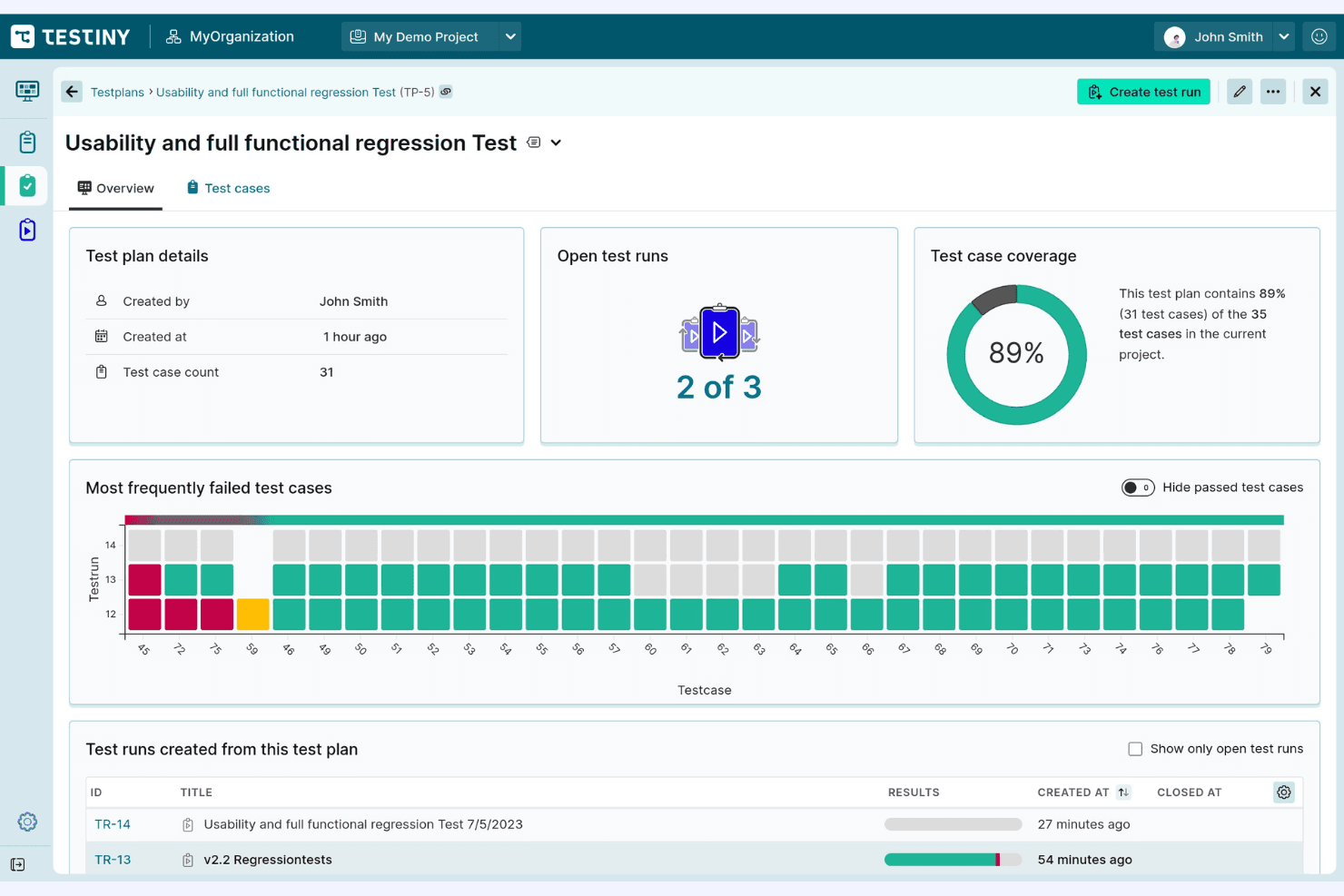
Execute your test cases smoothly and track results in real-time, giving your team immediate feedback. This keeps your testing process efficient and responsive.
Defect Tracking
Log and monitor defects seamlessly, so your team can address issues promptly. It helps improve your software quality by ensuring no bug goes unnoticed.
Reporting and Analytics
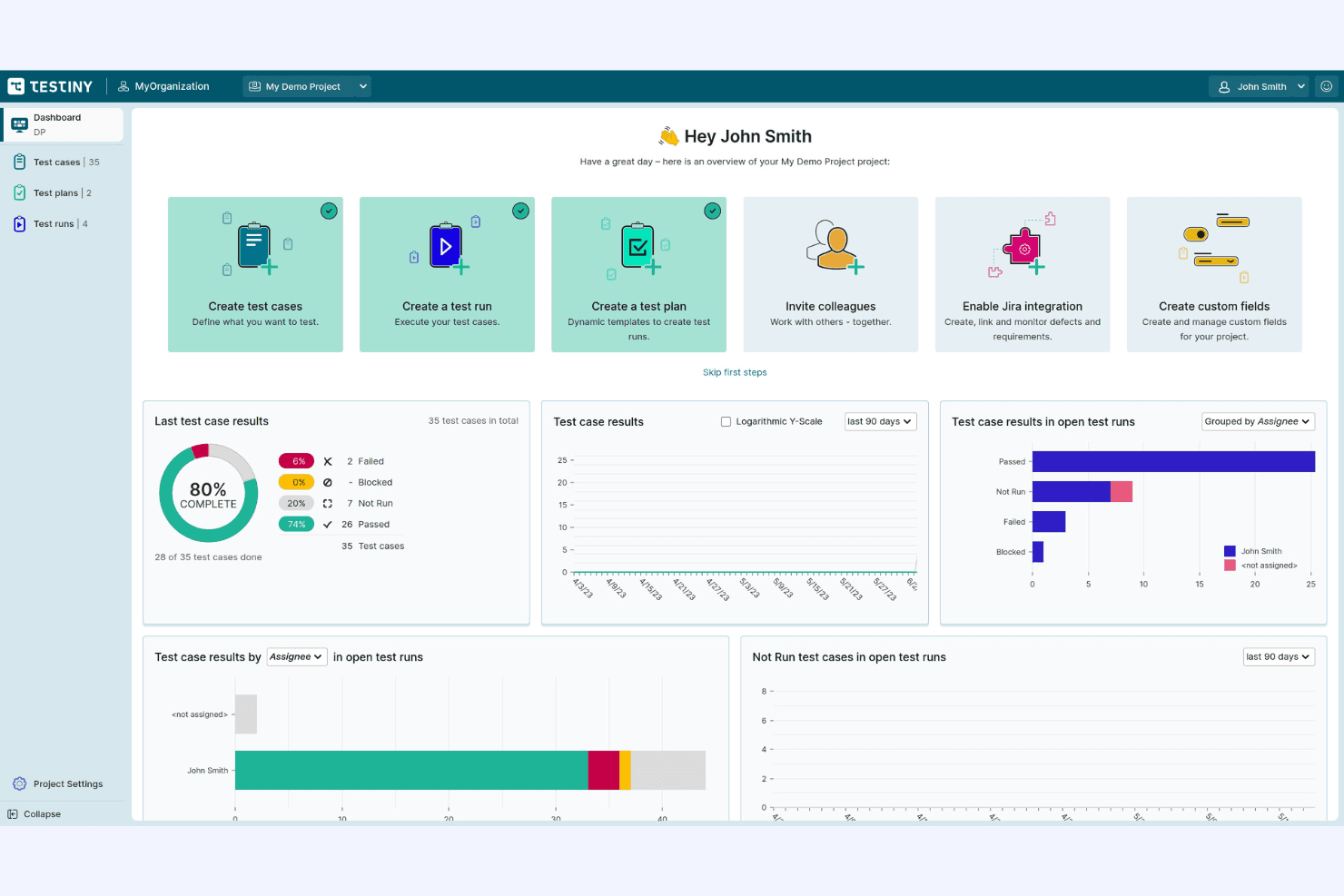
Generate detailed reports and gain insights into your testing activities. This aids your team in making informed decisions and optimizing testing strategies.
User Permissions
Control who can access specific features and data within Testiny. This ensures your team maintains security and accountability in testing processes.
Custom Fields and Templates
Create custom fields and select from various templates to match your workflow. This flexibility helps teams adapt Testiny to different testing styles.
Ease of Use
Testiny’s user-friendly interface makes it easy for your team to navigate and manage testing tasks efficiently. The straightforward design reduces the learning curve, letting you get up to speed quickly. User reviews often highlight how intuitive the system feels, allowing you to focus on testing rather than figuring out the software. Its simplicity doesn’t compromise functionality, making it a strong choice for teams that value both ease and effectiveness in their test management process.
Integrations
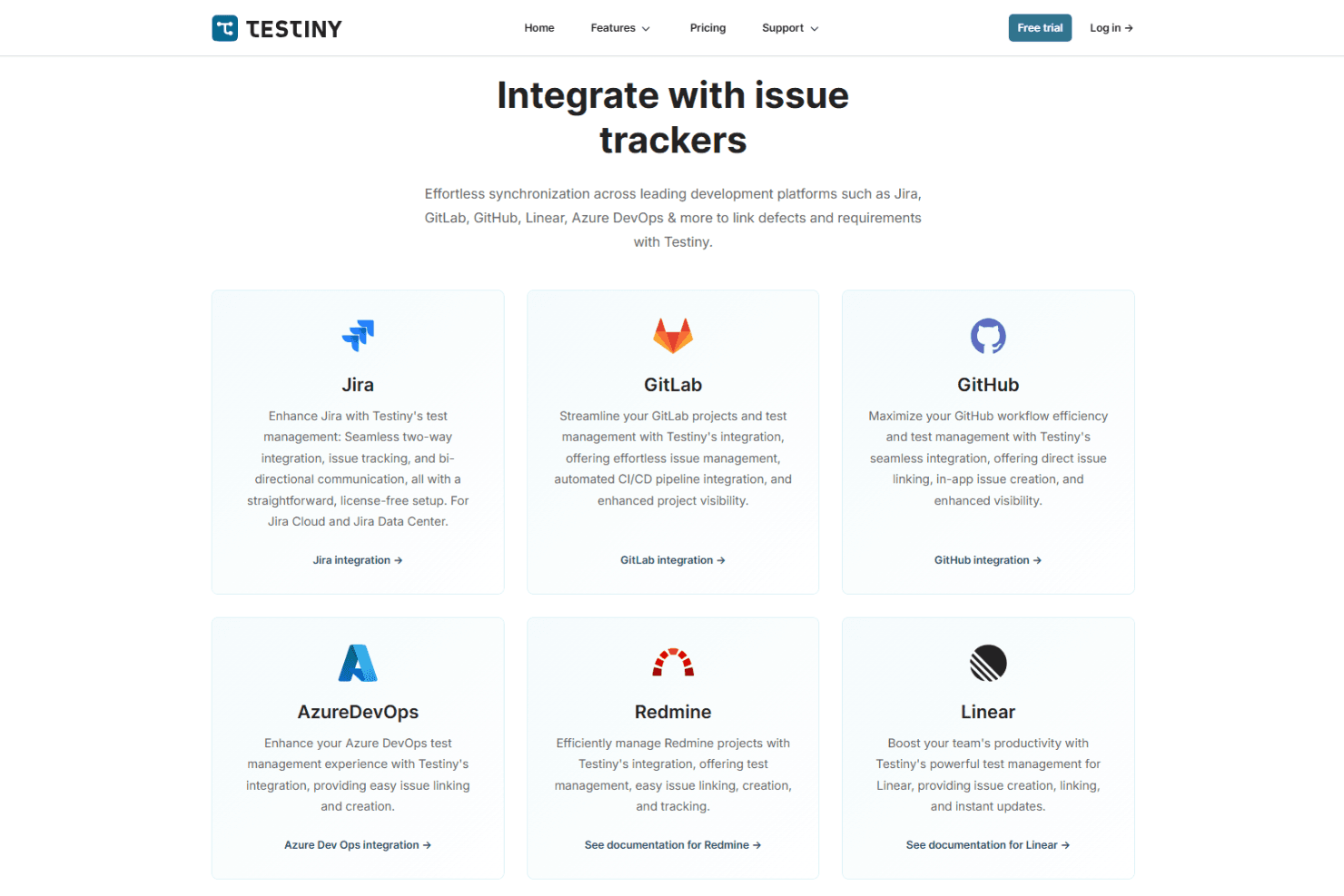
Testiny integrates with Jira, GitLab, GitHub, Azure DevOps, Redmine, Linear, Asana, Confluence, Trello, and monday.com, among others.
Testiny also offers a REST API and supports connections with a wide range of automation frameworks and CI/CD tools through its CLI and API.
New Product Updates from Testiny
Testiny Expands Test Case Folders and MCP Server
Testiny now lets users create test runs from folders and subfolders, view nested test cases together, and switch between folder and flat views. Its MCP server also adds test case creation and editing, Markdown or XML rich-text handling, and _etag-based conflict detection. Highlights include:
- Folder-Based Test Runs: Create a test run directly from a folder and include its subfolders.
- Nested Test Case Views: View test cases from selected folders and their subfolders together.
- Folder and Flat Views: Switch between grouped and flat test case layouts.
- MCP Test Case Editing: Create and edit test cases using Steps, Text, and BDD templates.
- Rich-Text Support: Read and write rich-text fields as Markdown or XML.
- Conflict Detection: Use
_etagtags to detect edit conflicts.
Visit Testiny’s official site for more details.
Testiny Adds Notifications and Webhooks
Testiny adds notifications for assigned test cases, closed test runs, and new comments, with email, browser, in-app, and digest delivery options. It also supports Slack, Microsoft Teams, Discord, Google Chat, and custom webhooks. Highlights include:
- Test Activity Notifications: Alerts users when test cases are assigned, test runs are closed, or comments are added.
- Multiple Delivery Channels: Sends notifications through email, browser, or in-app alerts.
- Digest Controls: Supports instant, hourly, or daily notification delivery.
- Team Messaging: Sends updates to Slack, Microsoft Teams, Discord, and Google Chat.
- Custom Webhooks: Connects Testiny activity with external tools through configurable webhooks.
- Template Filtering: Adds a Template column to test case lists with show, hide, and filtering options.
Visit Testiny’s official site for more details.
Testiny Adds BDD Test Cases With Gherkin Support
Testiny adds a BDD test case template with Given/When/Then syntax, 20 Gherkin dialects, and export support for .feature, CSV, Excel, and REST API workflows. It also supports importing BDD scenarios from CSV and TestRail. Highlights include:
- BDD Test Cases: Lets teams write tests as Gherkin scenarios using Given, When, and Then.
- Live Validation: Checks Gherkin syntax while test cases are being written.
- Gherkin Dialects: Supports 20 languages for BDD scenarios.
- Feature File Export: Exports BDD test cases as
.featurefiles. - BDD Import Support: Creates BDD test cases from CSV and TestRail imports.
Visit Testiny’s official site for more details.
Testiny Adds Xray for Jira Test Case Import
Testiny adds support for importing test cases from Xray for Jira, including Cloud and Data Center/Server deployments. The feature preserves custom fields, formatting, images, attachments, and work-item links to simplify migration and maintain test data integrity. Highlights include:
- Xray for Jira Import: Import test cases from Xray for Jira Cloud and Data Center/Server.
- Preserved Test Data: Retain custom fields, text formatting, images, attachments, and work-item links during import.
Visit Testiny's official site for more details.
Testiny Specs
- A/B Testing: No
- Access Management: No
- API: Yes
- Automated Testing: No
- Browser Compatibility Testing: No
- Bug Tracking: Yes
- CI/CD Integration: Yes
- Dashboard: Yes
- Data Export: Yes
- Data Import: Yes
- Data Visualization: Yes
- Developer Tools: No
- External Integrations: Yes
- History/Version Control: Yes
- Manual Testing: Yes
- Multi-User: Yes
- Notifications: Yes
- Performance Testing: No
- Regression Testing: No
- Scheduling: Yes
- Status Notifications: Yes
- Test Case Library: Yes
- Test Management: Yes
- Third-Party Plugins/Add-Ons: No


