

Snowflake Review 2026: Pros, Cons, Features and Pricing Overview
I’ve put Snowflake’s promises to the test—here’s what really stands out (and where it falls short) if you’re weighing your next data warehouse choice.

We review tools independently, and commissions help fund our testing. See our transparency policy, our methodology, or suggest a tool.
Snowflake is a cloud-based data warehouse software for data teams that need to store, process, and query large volumes of structured and semi-structured data across AWS, Azure, or Google Cloud without managing the underlying infrastructure. I'd point you to it if your team wants the elastic scale and multi-cloud flexibility of a platform like Amazon Redshift, but with separated storage and compute that let you spin warehouses up and down per workload instead of resizing a fixed cluster.
Snowflake Evaluation Summary
4.6/5
- From $2/credit
- 30-day free trial
Why Trust Our Software Recommendations
6,700+
Reviews
20
Industry experts
16+
Evaluation factors
14
Years
Our team has been testing and reviewing software since 2012. As tech leaders ourselves, we know how difficult—and important—it is to choose the right software.
For this guide, we evaluated tools using hands-on testing and independent research, scoring tools using our selection criteria.
Our reviews reflect our human editorial judgment, not a sales pitch.
Expert reviewers:
- Paulo Gardini MiguelTech Director
 Tim FisherVP of AI
 Gabriel RosasTech Lead & Software Architect
 Christhian GruhnTech Lead & Platform Architect

Snowflake Overview
If you're judging by elastic scale, multi-cloud connectivity, and the ability to separate storage and compute, I’d say Snowflake sets the bar for modern data warehouse software. You can spin up resources for batch workloads, exploratory analytics, or development without slow manual resizing. The interface is clean, and integrations are extensive, but pricing complexity and costs at scale will give you pause if predictability is key. I think Snowflake fits best for data teams with fluctuating workloads, high growth potential, and a need for flexibility across cloud providers. Onboarding is smooth, but deep support often requires premium tiers.
Pros
- Delivers true separation of storage and compute resources.
- Scales instantly to handle unpredictable or spiky workloads.
- Multi-cloud support across AWS, Azure, and Google Cloud.
Cons
- Pricing is hard to predict for high-volume workloads.
- Full database administration controls require premium support.
- Performance tuning options are limited compared to Redshift.
Is Snowflake Right For Your Needs?
Who Would be a Good Fit for Snowflake?
I think Snowflake is a strong choice for organizations with growing or variable data requirements, diverse integrations, and skilled teams who want managed infrastructure. Its usage-based pricing, scalable compute, and native connections to major cloud providers fit companies consolidating data from many sources or supporting analytics across departments. Snowflake’s quick setup, extensive SQL support, and reliable performance make it a solid bet for IT teams needing agility without complex server upkeep.
- Retail AnalyticsRetailers with massive, fast-changing transaction volumes can quickly analyze sales and inventory because Snowflake handles elastic scaling and integrates well with BI tools.
- Multi-Cloud EnterprisesBusinesses operating across AWS, Azure, and Google Cloud can centralize data easily—Snowflake’s cross-cloud support is best in its class.
- Marketing TeamsMarketing groups gain from Snowflake’s easy SQL analytics and integration with platforms like Salesforce, Looker, and Tableau for campaign performance analysis.
- Healthcare OrganizationsHealthcare companies benefit from Snowflake’s advanced compliance features (like HIPAA support in higher tiers) and strong security for sensitive data.
- SaaS StartupsSaaS vendors wanting to provision analytics for customers get fast onboarding and don’t have to build or maintain database infrastructure.
- Finance DepartmentsFinance teams processing high-frequency transactions or complex reporting can leverage Snowflake’s performance for queries and workload isolation features.
Who Would be a Bad Fit for Snowflake?
Snowflake isn’t going to serve every business equally well. Smaller companies, teams on a tight IT budget, or organizations with very simple data needs may find the pricing unpredictable or the feature set more than they require. When you don’t need enterprise-level integrations, scaling, or compliance—especially if you already run on a single cloud or don’t have dedicated data or IT staff—Snowflake could end up being more work or cost than value.
- Small NonprofitsResource-constrained groups might see variable costs add stress and most features go unused.
- Solo ConsultantsIndividuals working with modest data sets won’t need Snowflake’s scalable infrastructure or advanced security options.
- Manufacturing SMBsManufacturers with legacy systems and low data volume may struggle to justify Snowflake’s ongoing costs and limited support at lower tiers.
- Local Government ITPublic sector teams with strict procurement or on-premise requirements can’t use Snowflake’s cloud-only model.
- Artisanal Food ProducersSmall producers collecting basic sales data could use simpler, flat-fee databases with less complexity and cost.
- Academic Research LabsLabs handling sensitive data but lacking budget for premium support or compliance tiers may find onboarding and administration frustrating.
Our Review Methodology
How We Test & Score Tools
We’ve spent years building, refining, and improving our software testing and scoring system. The rubric is designed to capture the nuances of software selection and what makes a tool effective, focusing on critical aspects of the decision-making process.
Below, you can see exactly how our testing and scoring works across seven criteria. It allows us to provide an unbiased evaluation of the software based on core functionality, standout features, ease of use, onboarding, customer support, integrations, customer reviews, and value for money.
Core Functionality (25% of final scoring)
The starting point of our evaluation is always the core functionality of the tool. Does it have the basic features and functions that a user would expect to see? Are any of those core features locked to higher-tiered pricing plans? At its core, we expect a tool to stand up against the baseline capabilities of its competitors.
Standout Features (25% of final scoring)
Next, we evaluate uncommon standout features that go above and beyond the core functionality typically found in tools of its kind. A high score reflects specialized or unique features that make the product faster, more efficient, or offer additional value to the user.
We also evaluate how easy it is to integrate with other tools typically found in the tech stack to expand the functionality and utility of the software. Tools offering plentiful native integrations, 3rd party connections, and API access to build custom integrations score best.
Ease of Use (10% of final scoring)
We consider how quick and easy it is to execute the tasks defined in the core functionality using the tool. High scoring software is well designed, intuitive to use, offers mobile apps, provides templates, and makes relatively complex tasks seem simple.
Onboarding (10% of final scoring)
We know how important rapid team adoption is for a new platform, so we evaluate how easy it is to learn and use a tool with minimal training. We evaluate how quickly a team member can get set up and start using the tool with no experience. High scoring solutions indicate little or no support is required.
Customer Support (10% of final scoring)
We review how quick and easy it is to get unstuck and find help by phone, live chat, or knowledge base. Tools and companies that provide real-time support score best, while chatbots score worst.
Customer Reviews (10% of final scoring)
Beyond our own testing and evaluation, we consider the net promoter score from current and past customers. We review their likelihood, given the option, to choose the tool again for the core functionality. A high scoring software reflects a high net promoter score from current or past customers.
Value for Money (10% of final scoring)
Lastly, in consideration of all the other criteria, we review the average price of entry level plans against the core features and consider the value of the other evaluation criteria. Software that delivers more, for less, will score higher.
Core Features
Separation of Storage and Compute
You can scale compute resources up or down independently of storage, so you only pay for what you use. This flexibility lets you support varied workloads without the need to resize fixed clusters.
Multi-Cloud Support
Snowflake runs natively on AWS, Azure, and Google Cloud, allowing you to deploy in any major cloud provider. Your team can leverage cross-cloud data sharing and avoid vendor lock-in.
Zero Management Infrastructure
You don’t need to manage servers or perform routine maintenance—Snowflake handles all infrastructure, availability, and tuning in the background. This reduces admin workload and lets your team focus on data.
Secure Data Sharing
Share data securely between Snowflake accounts or with external partners without copying or moving actual data. You can grant granular access to live datasets for real-time collaboration.
Support for Semi-Structured Data
Store and query JSON, Avro, Parquet, and XML natively alongside structured data in the same system. This means you can run SQL queries on diverse data types without ETL conversions.
Time Travel
Access historical data or restore tables to previous states using built-in point-in-time recovery. This helps protect against accidental changes and supports audit or rollback needs.
Ease of Use
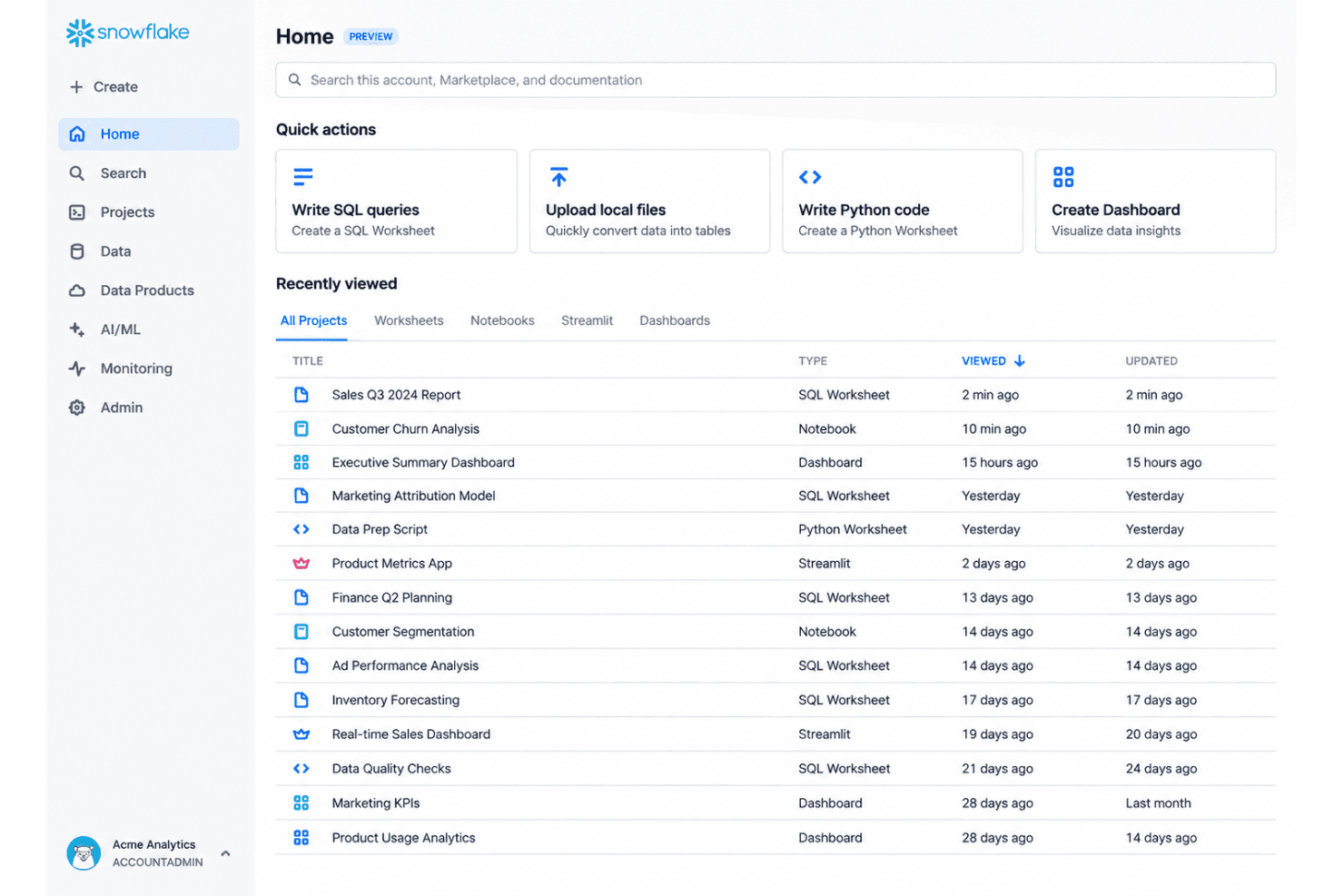
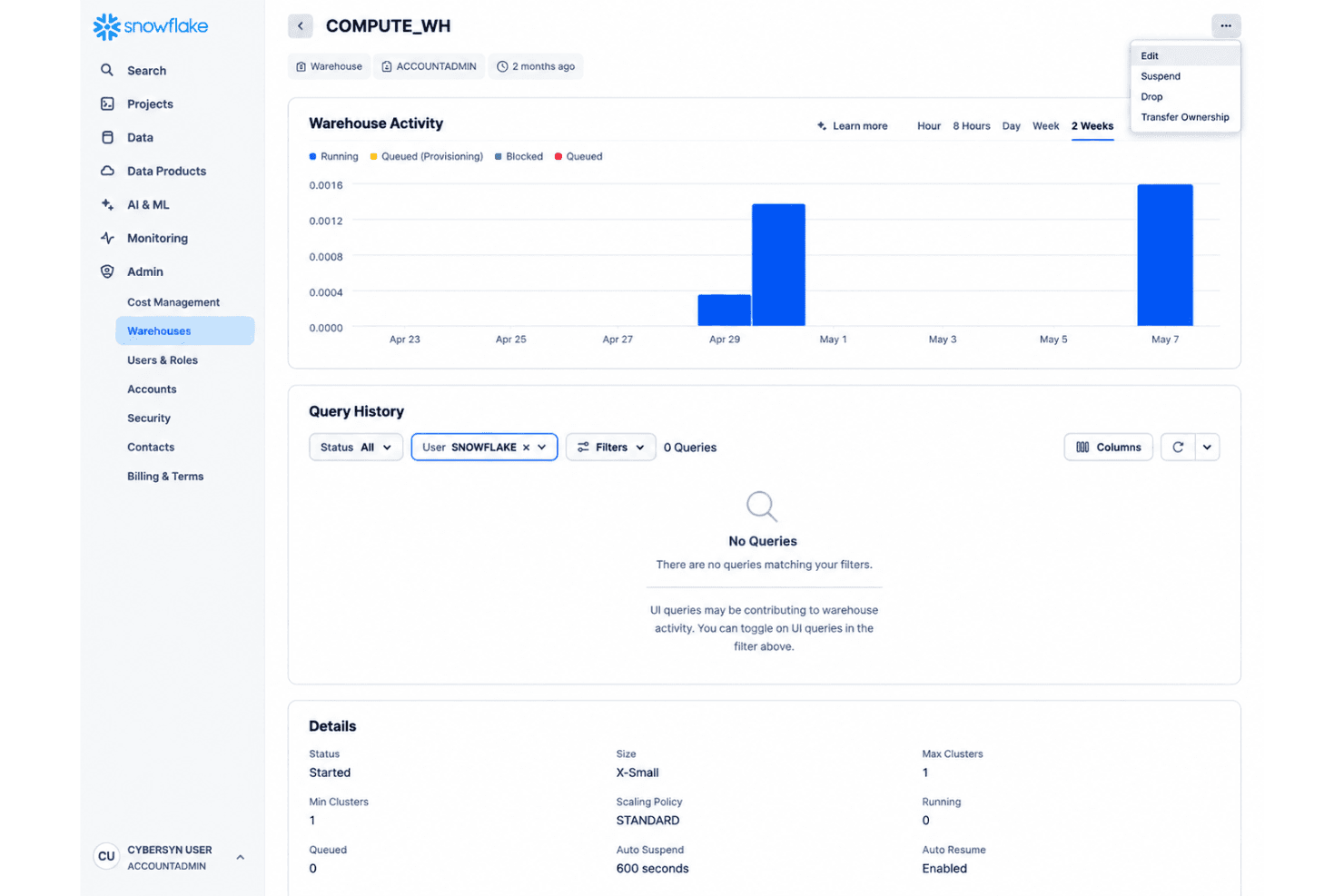
Snowflake is easy to learn—its interface is clean, SQL support is strong, and there’s almost no infrastructure to manage. You can create warehouses, load data, and run queries quickly with minimal setup. I think onboarding is straightforward for most data teams. However, navigation can feel busy for new users, and granular admin controls are sometimes buried behind paid support tiers or advanced settings.
Integrations
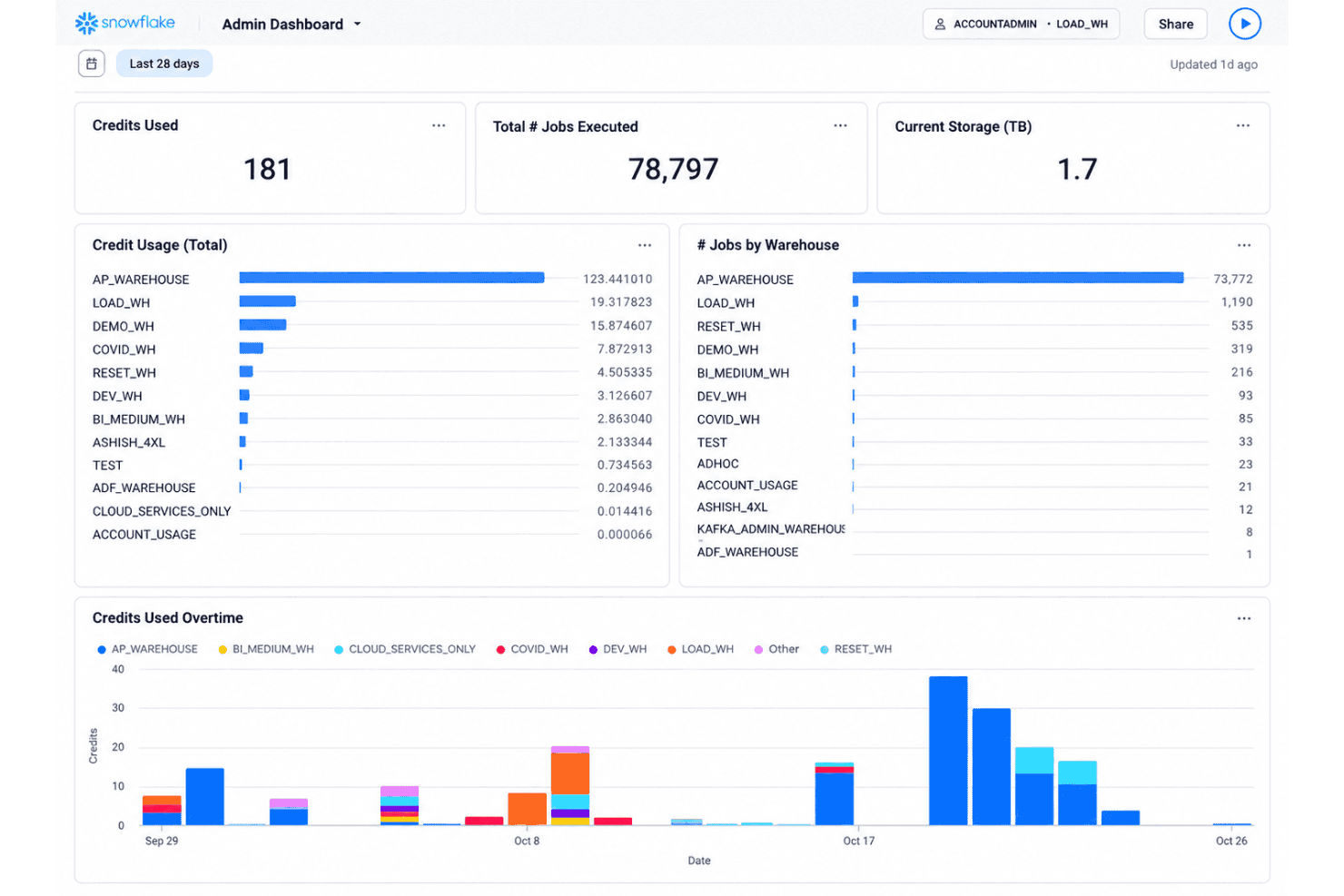
Snowflake integrates with Amazon S3, Microsoft Azure Blob Storage, Google Cloud Storage, Salesforce Data Cloud, ServiceNow, Tableau, Power BI, Looker, Informatica, and Fivetran, among others.
Snowflake also supports REST APIs and connects with third-party integration and workflow tools such as Zapier and Apache Airflow.

Snowflake Specs
- API: Yes
- Batch Permissions & Access: Yes
- Data Export: Yes
- Data Import: Yes
- External Integrations: Yes
- File Sharing: Yes
- File Transfer: Yes
- Multi-User: Yes
- Notifications: Yes
- Third-Party Plugins/Add-Ons: Yes


