

Kaseya Review: Pros, Cons, Features, and Pricing
Kaseya stands out by offering robust endpoint management at competitive pricing, making it a strong choice for IT teams seeking efficient security solutions.

We review tools independently, and commissions help fund our testing. See our transparency policy, our methodology, or suggest a tool.
Kaseya is an endpoint protection software built for MSPs and internal IT teams managing large fleets of endpoints from a single platform. I'd consider it if your team is already operating within the Kaseya ecosystem and wants security that integrates natively with your RMM, rather than adding a standalone tool like CrowdStrike on top of a separate management layer. That tight integration between endpoint visibility and threat response is where Kaseya tends to have a real edge for teams running Kaseya VSA.
Kaseya Evaluation Summary
4/5
- Price upon request
- 14-day free trial
Why Trust Our Software Recommendations
6,700+
Reviews
20
Industry experts
16+
Evaluation factors
14
Years
Our team has been testing and reviewing software since 2012. As tech leaders ourselves, we know how difficult—and important—it is to choose the right software.
For this guide, we evaluated tools using hands-on testing and independent research, scoring tools using our selection criteria.
Our reviews reflect our human editorial judgment, not a sales pitch.
Expert reviewers:
- Paulo Gardini MiguelTech Director
 Tim FisherVP of AI
 Gabriel RosasTech Lead & Software Architect
 Christhian GruhnTech Lead & Platform Architect

Kaseya Overview
In my opinion, Kaseya is a solid choice for endpoint cybersecurity, especially for mid-sized businesses and managed service providers. It excels in IT asset management with its automation capabilities and competitive pricing. However, the onboarding process and customer support could use improvement. Compared to competitors, Kaseya offers good value but may not be the easiest to use initially. It's best for teams that can invest time in learning the system and need a reliable solution for managing multiple endpoints.
Pros
- You can automate routine tasks in your IT environment with ease.
- It offers strong endpoint management features for your team.
- Its reporting tools help you track and manage your devices effectively.
Cons
- You might find the onboarding process a bit challenging.
- Customer support can be slow to respond to your issues.
- The user interface may feel outdated compared to other tools.
Is Kaseya Right For Your Needs?
Who Would be a Good Fit for Kaseya?
Kaseya suits mid-sized businesses and managed service providers that need strong endpoint management. If your team handles numerous devices, Kaseya's automation and reporting tools will help you manage them. It's especially useful if you're looking to automate routine IT tasks and need a solution that supports various devices.
- Mid-Sized BusinessesKaseya helps manage numerous devices with its automation and reporting features.
- Managed Service ProvidersYou can handle multiple clients' IT needs with Kaseya's strong management tools.
- IT DepartmentsKaseya's automation tools, such as out-of-the-box scripts, streamline your team's routine tasks.
- Healthcare IndustryKaseya ensures your devices comply with industry regulations through its comprehensive management features.
- Education SectorManage and secure numerous devices across campuses with Kaseya's endpoint management capabilities.
- Financial ServicesKaseya helps protect sensitive data with strong security measures and detailed reporting tools.
Who Would be a Bad Fit for Kaseya?
Kaseya isn't ideal for small businesses or startups with limited IT resources. Its onboarding process can be challenging, and smaller teams might struggle with its complexities. If you're in an industry that demands rapid deployment, Kaseya's interface might feel outdated. Teams needing immediate customer support may also find it lacking compared to other solutions.
- Small StartupsKaseya's complexity can overwhelm your limited IT resources.
- Rapid Deployment NeedsThe onboarding process might slow down your team's deployment timelines.
- Minimal IT TeamsKaseya's robust features require a dedicated team to manage effectively.
- Retail IndustryThe need for quick and simple solutions in retail might not align with Kaseya's setup.
- Fast-Paced EnvironmentsThe slow customer support might hinder your team's fast-paced needs.
Our Review Methodology
How We Test & Score Tools
We’ve spent years building, refining, and improving our software testing and scoring system. The rubric is designed to capture the nuances of software selection and what makes a tool effective, focusing on critical aspects of the decision-making process.
Below, you can see exactly how our testing and scoring works across seven criteria. It allows us to provide an unbiased evaluation of the software based on core functionality, standout features, ease of use, onboarding, customer support, integrations, customer reviews, and value for money.
Core Functionality (25% of final scoring)
The starting point of our evaluation is always the core functionality of the tool. Does it have the basic features and functions that a user would expect to see? Are any of those core features locked to higher-tiered pricing plans? At its core, we expect a tool to stand up against the baseline capabilities of its competitors.
Standout Features (25% of final scoring)
Next, we evaluate uncommon standout features that go above and beyond the core functionality typically found in tools of its kind. A high score reflects specialized or unique features that make the product faster, more efficient, or offer additional value to the user.
We also evaluate how easy it is to integrate with other tools typically found in the tech stack to expand the functionality and utility of the software. Tools offering plentiful native integrations, 3rd party connections, and API access to build custom integrations score best.
Ease of Use (10% of final scoring)
We consider how quick and easy it is to execute the tasks defined in the core functionality using the tool. High scoring software is well designed, intuitive to use, offers mobile apps, provides templates, and makes relatively complex tasks seem simple.
Onboarding (10% of final scoring)
We know how important rapid team adoption is for a new platform, so we evaluate how easy it is to learn and use a tool with minimal training. We evaluate how quickly a team member can get set up and start using the tool with no experience. High scoring solutions indicate little or no support is required.
Customer Support (10% of final scoring)
We review how quick and easy it is to get unstuck and find help by phone, live chat, or knowledge base. Tools and companies that provide real-time support score best, while chatbots score worst.
Customer Reviews (10% of final scoring)
Beyond our own testing and evaluation, we consider the net promoter score from current and past customers. We review their likelihood, given the option, to choose the tool again for the core functionality. A high scoring software reflects a high net promoter score from current or past customers.
Value for Money (10% of final scoring)
Lastly, in consideration of all the other criteria, we review the average price of entry level plans against the core features and consider the value of the other evaluation criteria. Software that delivers more, for less, will score higher.
Core Features
Automated Patch Management: Kaseya automates the patching process, ensuring your systems stay secure and reducing manual interventions.
Remote Monitoring: You can gain remote access to devices from anywhere, ensuring you can identify issues before they escalate.
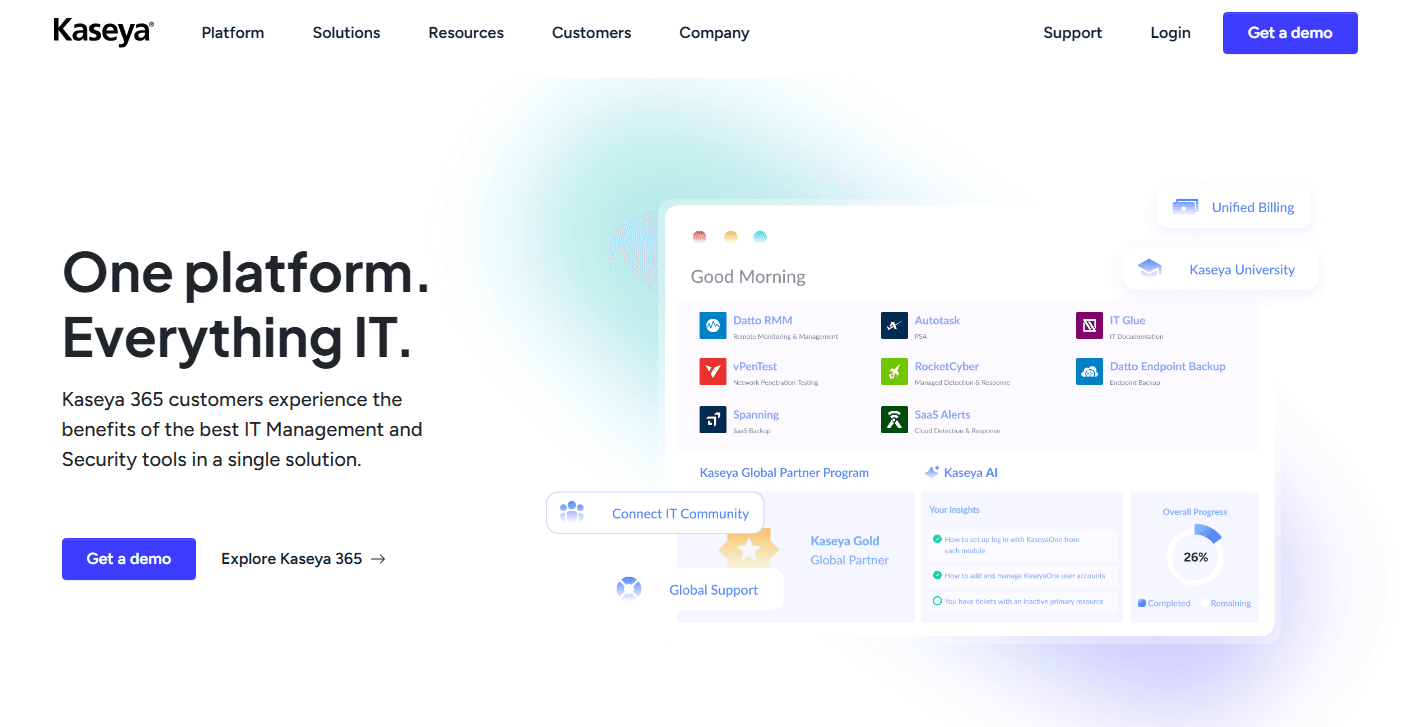
IT Documentation: Kaseya keeps all your IT documentation in one place, making it easy to access and keeping your team organized .
Endpoint Detection: Kaseya's detection tools identify threats to your devices, providing crucial security. This keeps your work environment safe from potential breaches.
Reporting Tools: You can generate detailed reports to understand your IT landscape better and make more informed decisions.
Network Monitoring: You can monitor your network's health and performance in real time. This lets you quickly address any disruptions.

Ease of Use
Kaseya's dashboard interface can feel outdated, as it's less intuitive than some of its competitors. You might find the learning curve steep, especially during onboarding. However, once your team gets familiar with its features, the automation and monitoring tools prove valuable in managing your IT tasks efficiently.

Integrations
Kaseya integrates with Microsoft 365, Salesforce, QuickBooks, IT Glue, Autotask, DattoRMM, BMS by Kaseya, Duo Security, Webroot, and Sophos. Kaseya also offers a REST API, allowing you to connect with third-party integration tools and create custom integrations to suit your needs.

Kaseya Specs
- API: Yes
- Batch Permissions & Access: Yes
- Customer Management: Yes
- Data Export: Yes
- Data Import: Yes
- External Integrations: Yes
- Malware Protection: Yes
- Multi-User: Yes
- Network Device Performance Monitoring: Yes
- Network Traffic Monitoring: Yes
- Network Visualization: Yes
- Notifications: Yes
- Password & Access Management: Yes


