
Dynatrace Review 2026: Pros, Cons, Features, and Pricing
Dynatrace stands out for its AI-driven insights and automation, making it ideal for complex environments, but its advanced features may be more than smaller teams need.

We review tools independently, and commissions help fund our testing. See our transparency policy, our methodology, or suggest a tool.
Dynatrace is an application monitoring software built for teams managing complex cloud-native, hybrid, or on-premises environments. It's worth considering when your infrastructure has grown to the point where manual root cause analysis is slowing incident response. Compared to Datadog, Dynatrace's AI engine (Davis AI) automatically pinpoints root causes rather than just surfacing metrics, which means your team spends less time triaging alerts and more time resolving actual issues.
Dynatrace Evaluation Summary
4.5/5
- From $4.50/1000 sessions
- Free demo available
Why Trust Our Software Recommendations
6,700+
Reviews
20
Industry experts
16+
Evaluation factors
14
Years
Our team has been testing and reviewing software since 2012. As tech leaders ourselves, we know how difficult—and important—it is to choose the right software.
For this guide, we evaluated tools using hands-on testing and independent research, scoring tools using our selection criteria.
Our reviews reflect our human editorial judgment, not a sales pitch.
Expert reviewers:
- Paulo Gardini MiguelTech Director
 Tim FisherVP of AI
 Gabriel RosasTech Lead & Software Architect
 Christhian GruhnTech Lead & Platform Architect

Dynatrace Overview
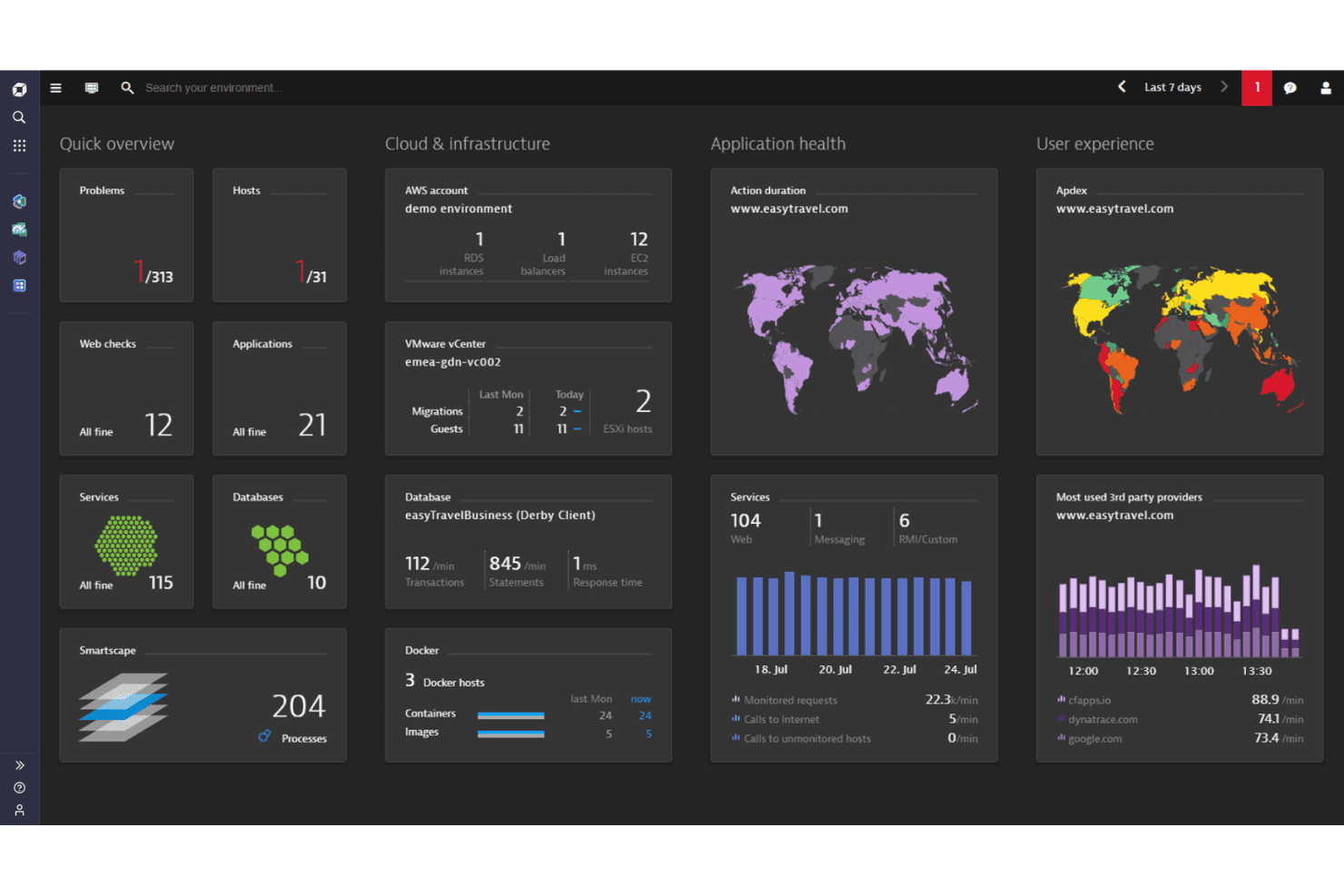
When judging Dynatrace against other performance monitoring tools, its AI-driven root cause analysis, automated discovery, and unified dashboard set it apart for large, dynamic environments. The interface is intuitive, and integrations cover most enterprise needs, though pricing can be higher than some alternatives.
Onboarding is straightforward for experienced teams, but the depth of features may overwhelm smaller organizations. Support is responsive, and documentation is thorough. If you’re selecting a tool for cloud-native, hybrid, or microservices-heavy systems, Dynatrace’s automation and analytics make it a top contender.
Pros
- Automated discovery and mapping simplify monitoring complex environments.
- Full-stack observability covers infrastructure, apps, and user experience.
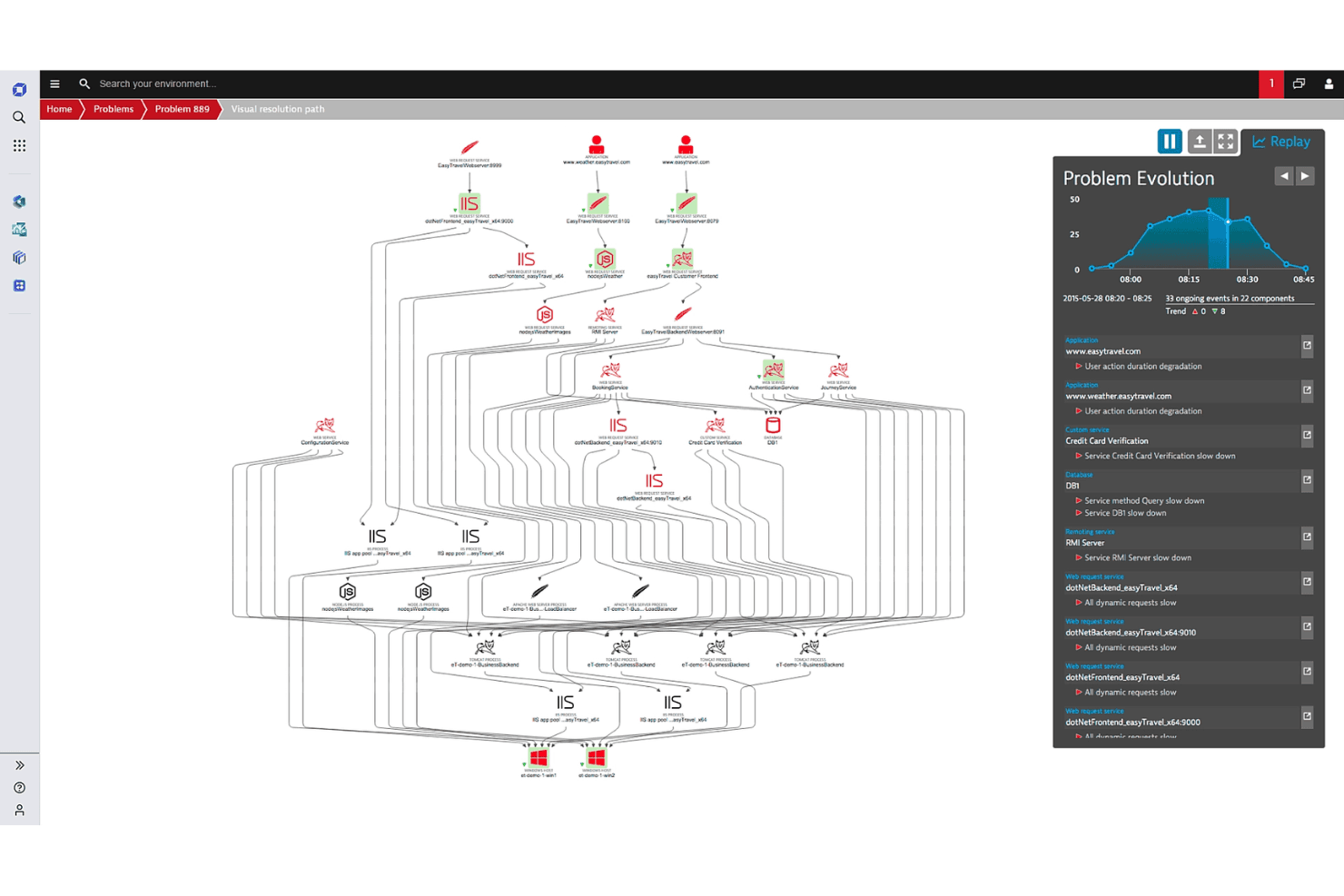
- AI-driven root cause analysis accelerates incident resolution.
Cons
- Feature depth may overwhelm smaller or less mature teams.
- Serverless and multi-cloud visibility lags behind some competitors.
- Pricing can escalate quickly with high data ingestion.
Is Dynatrace Right For Your Needs?
Who Would be a Good Fit for Dynatrace?
Dynatrace is best suited for organizations with complex, distributed systems that demand deep observability and automated root cause analysis. Its AI-driven analytics, full-stack monitoring, and automated discovery make it a strong choice for large enterprises, cloud-native teams, and regulated industries where uptime and compliance are critical.
Teams with dedicated IT operations or DevOps functions will benefit from Dynatrace’s granular insights and real-time dashboards, especially when managing hybrid or multi-cloud environments.
- Cloud-Native StartupsKubernetes and microservices support enables rapid scaling and troubleshooting.
- Healthcare ITGranular monitoring and security features support HIPAA and uptime needs.
- E-commerce PlatformsReal-user monitoring and performance analytics help optimize customer experience.
- DevOps TeamsAutomated deployment monitoring and AI-powered alerts fit continuous delivery pipelines.
- Financial ServicesIts end-to-end transaction tracing supports compliance and high-availability requirements.
- Large EnterprisesDynatrace scales to monitor thousands of hosts and services across global operations.
Who Would be a Bad Fit for Dynatrace?
Dynatrace may not be ideal for smaller organizations, teams with limited IT resources, or those with simple infrastructure needs. Its advanced features and pricing model can be excessive for basic monitoring, and the platform’s depth may overwhelm teams without dedicated monitoring expertise. Organizations with highly specialized legacy systems or minimal cloud adoption may also find limited value.
- FreelancersSolo operators rarely need enterprise-grade observability or automation.
- Education SectorBudget constraints and simple infrastructure needs make lighter tools preferable.
- Legacy-Only EnvironmentsLimited support for outdated systems reduces monitoring effectiveness.
- Basic Website HostingSimple uptime and response monitoring needs don’t justify Dynatrace’s capabilities.
- Non-Technical DepartmentsBusiness units without IT expertise may struggle with the platform’s complexity.
- Small BusinessesThe cost and feature set exceed what most small teams require.
Our Review Methodology
How We Test & Score Tools
We’ve spent years building, refining, and improving our software testing and scoring system. The rubric is designed to capture the nuances of software selection and what makes a tool effective, focusing on critical aspects of the decision-making process.
Below, you can see exactly how our testing and scoring works across seven criteria. It allows us to provide an unbiased evaluation of the software based on core functionality, standout features, ease of use, onboarding, customer support, integrations, customer reviews, and value for money.
Core Functionality (25% of final scoring)
The starting point of our evaluation is always the core functionality of the tool. Does it have the basic features and functions that a user would expect to see? Are any of those core features locked to higher-tiered pricing plans? At its core, we expect a tool to stand up against the baseline capabilities of its competitors.
Standout Features (25% of final scoring)
Next, we evaluate uncommon standout features that go above and beyond the core functionality typically found in tools of its kind. A high score reflects specialized or unique features that make the product faster, more efficient, or offer additional value to the user.
We also evaluate how easy it is to integrate with other tools typically found in the tech stack to expand the functionality and utility of the software. Tools offering plentiful native integrations, 3rd party connections, and API access to build custom integrations score best.
Ease of Use (10% of final scoring)
We consider how quick and easy it is to execute the tasks defined in the core functionality using the tool. High scoring software is well designed, intuitive to use, offers mobile apps, provides templates, and makes relatively complex tasks seem simple.
Onboarding (10% of final scoring)
We know how important rapid team adoption is for a new platform, so we evaluate how easy it is to learn and use a tool with minimal training. We evaluate how quickly a team member can get set up and start using the tool with no experience. High scoring solutions indicate little or no support is required.
Customer Support (10% of final scoring)
We review how quick and easy it is to get unstuck and find help by phone, live chat, or knowledge base. Tools and companies that provide real-time support score best, while chatbots score worst.
Customer Reviews (10% of final scoring)
Beyond our own testing and evaluation, we consider the net promoter score from current and past customers. We review their likelihood, given the option, to choose the tool again for the core functionality. A high scoring software reflects a high net promoter score from current or past customers.
Value for Money (10% of final scoring)
Lastly, in consideration of all the other criteria, we review the average price of entry level plans against the core features and consider the value of the other evaluation criteria. Software that delivers more, for less, will score higher.
Core Features
AI-Powered Root Cause Analysis
Dynatrace uses AI to automatically pinpoint the source of incidents, reducing manual troubleshooting and speeding up resolution.
Full-Stack Observability
Monitor infrastructure, applications, networks, and user experience in one unified platform for complete visibility.
Automated Discovery and Topology Mapping
Smartscape technology maps all dependencies and relationships in real time, helping teams understand complex environments instantly.
Real User Monitoring (RUM)
Track actual user sessions and behaviors to identify performance bottlenecks and optimize digital experiences.
Log Analytics
Ingest and analyze logs at scale with schema-on-read storage, enabling fast searches and contextual insights across all data.
OneAgent Deployment
A single agent collects metrics, traces, and logs across the entire stack, simplifying installation and ongoing management.
Ease of Use
Dynatrace offers a clean, intuitive interface that makes navigating complex environments straightforward, especially for experienced IT teams. Users often highlight the clarity of dashboards and the ease of deploying OneAgent across diverse systems. Automated discovery and AI-driven insights reduce manual setup and ongoing maintenance.
However, the platform’s depth and advanced features can feel overwhelming for smaller teams or those new to observability, making onboarding smoother for organizations with dedicated monitoring expertise.
Integrations
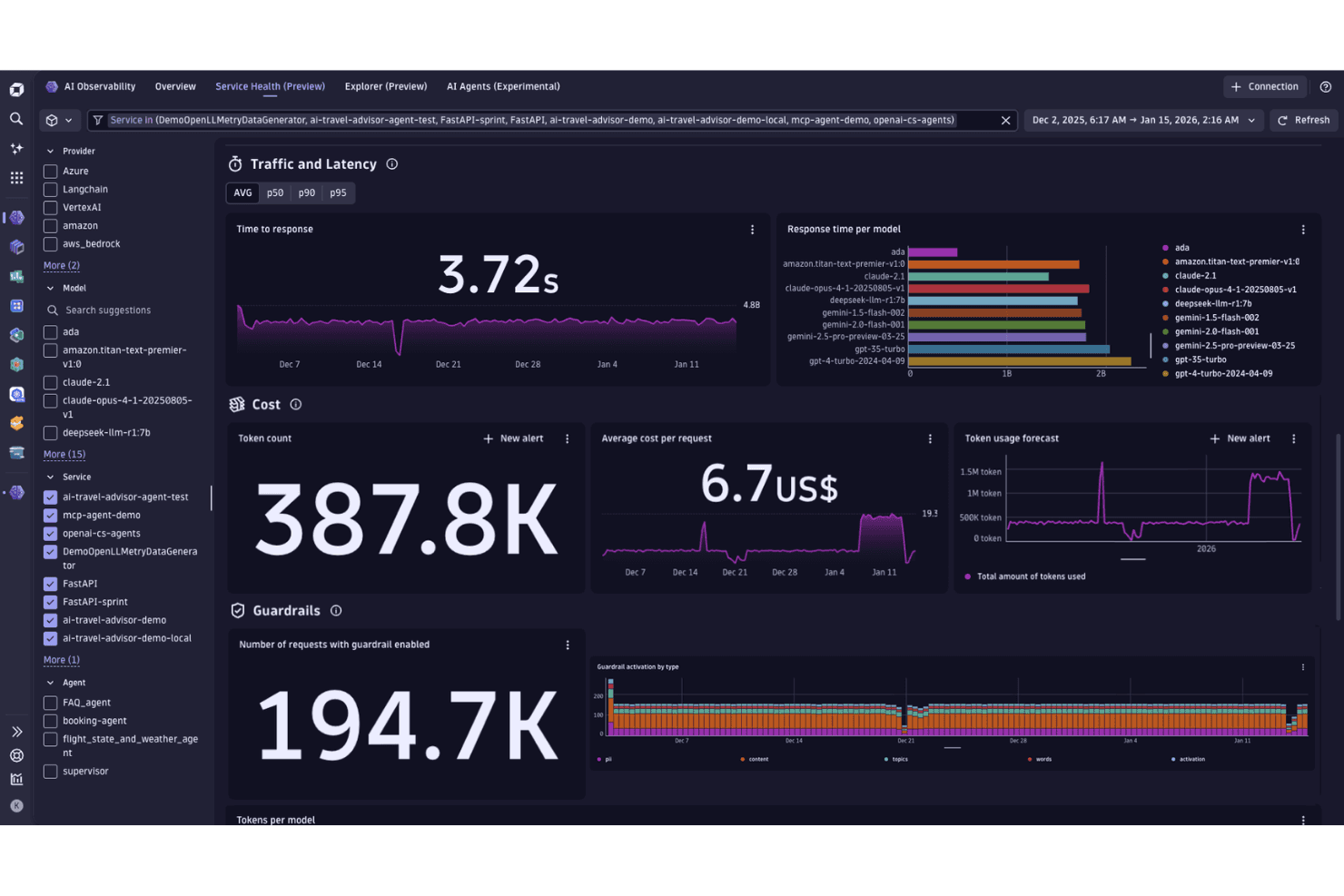
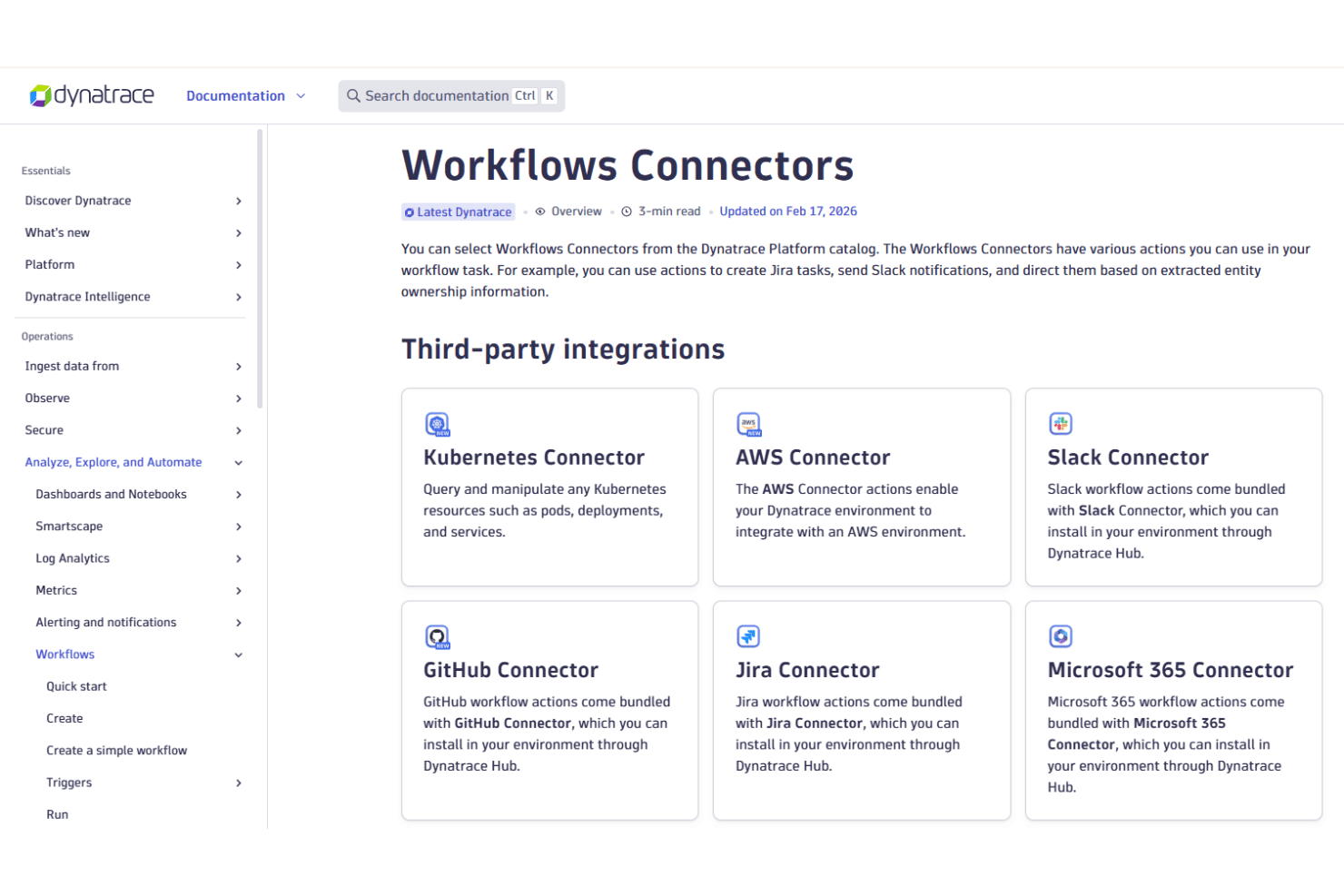
Dynatrace integrates with AWS, Azure, Google Cloud, Kubernetes, Slack, Jira, GitHub, Microsoft 365, PagerDuty, and VMware vROps, among others.
Dynatrace also offers a robust API and supports connections with third-party integration tools for custom workflows and automation.
Dynatrace Specs
- AI Integration: Yes
- API: Yes
- Automated Testing: No
- Browser Compatibility Testing: No
- Bug Tracking: No
- Code Review: No
- Custom Reports: Yes
- Data Export: Yes
- Data Import: Yes
- Developer Tools: Yes
- External Integrations: Yes
- Malware Protection: No
- Multi-User: Yes
- Notifications: Yes
- Performance Testing: Yes
- Process Reporting: Yes
- Static Analysis: No
- Status Notifications: Yes
- Workflow Management: No


