

Delinea Review 2026: Pros, Cons, Features and Pricing
I look beyond Delinea’s feature list to weigh its PAM strengths, trade-offs, and pricing—and help teams decide whether it’s the right fit.

We review tools independently, and commissions help fund our testing. See our transparency policy, our methodology, or suggest a tool.
Delinea provides privileged access management solutions for IT teams that need to control privileged accounts across cloud, on-premises, and hybrid systems. If you want flexible deployment without adopting a wider security platform, I’d choose Delinea over CyberArk for its SaaS, on-premises, and hybrid options.
Delinea Evaluation Summary
4.4/5
- Pricing upon request
- Free demo available
Why Trust Our Software Recommendations
6,700+
Reviews
20
Industry experts
16+
Evaluation factors
14
Years
Our team has been testing and reviewing software since 2012. As tech leaders ourselves, we know how difficult—and important—it is to choose the right software.
For this guide, we evaluated tools using hands-on testing and independent research, scoring tools using our selection criteria.
Our reviews reflect our human editorial judgment, not a sales pitch.
Expert reviewers:
- Paulo Gardini MiguelTech Director
 Tim FisherVP of AI
 Gabriel RosasTech Lead & Software Architect
 Christhian GruhnTech Lead & Platform Architect

Delinea Overview
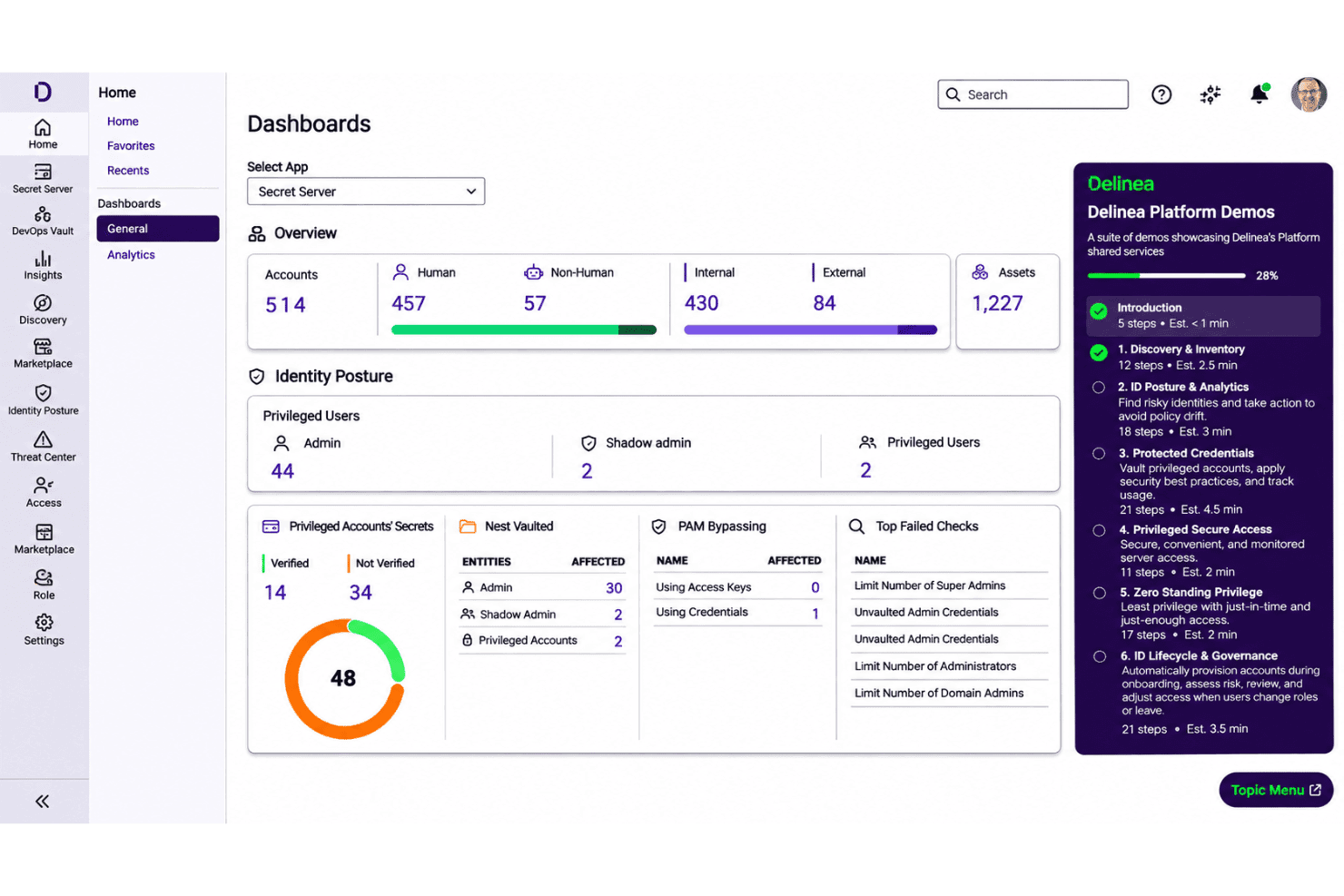
I’d choose Delinea when you need dedicated PAM across cloud, on-premises, or hybrid systems without adopting a wider security suite. Its portfolio can vault and rotate credentials, record privileged sessions, discover accounts, and control endpoint privileges; integrations with directory services, cloud platforms, and ITSM tools support mixed environments. Compared with larger platforms, Delinea’s focused scope and deployment options are appealing, though setup still takes planning around connectors and policies. I find the interface approachable once configured, but onboarding and support needs depend on your environment. Pricing isn’t public, so compare quotes by modules and users before selecting it.
Pros
- Automated credential rotation and check-in/check-out reduce unmanaged privileged passwords.
- Recorded privileged sessions and audit trails support investigations and compliance.
- Endpoint privilege controls extend PAM beyond credential vaulting.
Cons
- Deployment and advanced policy configuration can demand substantial administrator time.
- Users describe the interface and navigation as clunky.
- Quote-based pricing and rising costs can challenge large deployments.


Our Review Methodology
How We Test & Score Tools
We’ve spent years building, refining, and improving our software testing and scoring system. The rubric is designed to capture the nuances of software selection and what makes a tool effective, focusing on critical aspects of the decision-making process.
Below, you can see exactly how our testing and scoring works across seven criteria. It allows us to provide an unbiased evaluation of the software based on core functionality, standout features, ease of use, onboarding, customer support, integrations, customer reviews, and value for money.
Core Functionality (25% of final scoring)
The starting point of our evaluation is always the core functionality of the tool. Does it have the basic features and functions that a user would expect to see? Are any of those core features locked to higher-tiered pricing plans? At its core, we expect a tool to stand up against the baseline capabilities of its competitors.
Standout Features (25% of final scoring)
Next, we evaluate uncommon standout features that go above and beyond the core functionality typically found in tools of its kind. A high score reflects specialized or unique features that make the product faster, more efficient, or offer additional value to the user.
We also evaluate how easy it is to integrate with other tools typically found in the tech stack to expand the functionality and utility of the software. Tools offering plentiful native integrations, 3rd party connections, and API access to build custom integrations score best.
Ease of Use (10% of final scoring)
We consider how quick and easy it is to execute the tasks defined in the core functionality using the tool. High scoring software is well designed, intuitive to use, offers mobile apps, provides templates, and makes relatively complex tasks seem simple.
Onboarding (10% of final scoring)
We know how important rapid team adoption is for a new platform, so we evaluate how easy it is to learn and use a tool with minimal training. We evaluate how quickly a team member can get set up and start using the tool with no experience. High scoring solutions indicate little or no support is required.
Customer Support (10% of final scoring)
We review how quick and easy it is to get unstuck and find help by phone, live chat, or knowledge base. Tools and companies that provide real-time support score best, while chatbots score worst.
Customer Reviews (10% of final scoring)
Beyond our own testing and evaluation, we consider the net promoter score from current and past customers. We review their likelihood, given the option, to choose the tool again for the core functionality. A high scoring software reflects a high net promoter score from current or past customers.
Value for Money (10% of final scoring)
Lastly, in consideration of all the other criteria, we review the average price of entry level plans against the core features and consider the value of the other evaluation criteria. Software that delivers more, for less, will score higher.
Core Features
Privileged Credential Vaulting
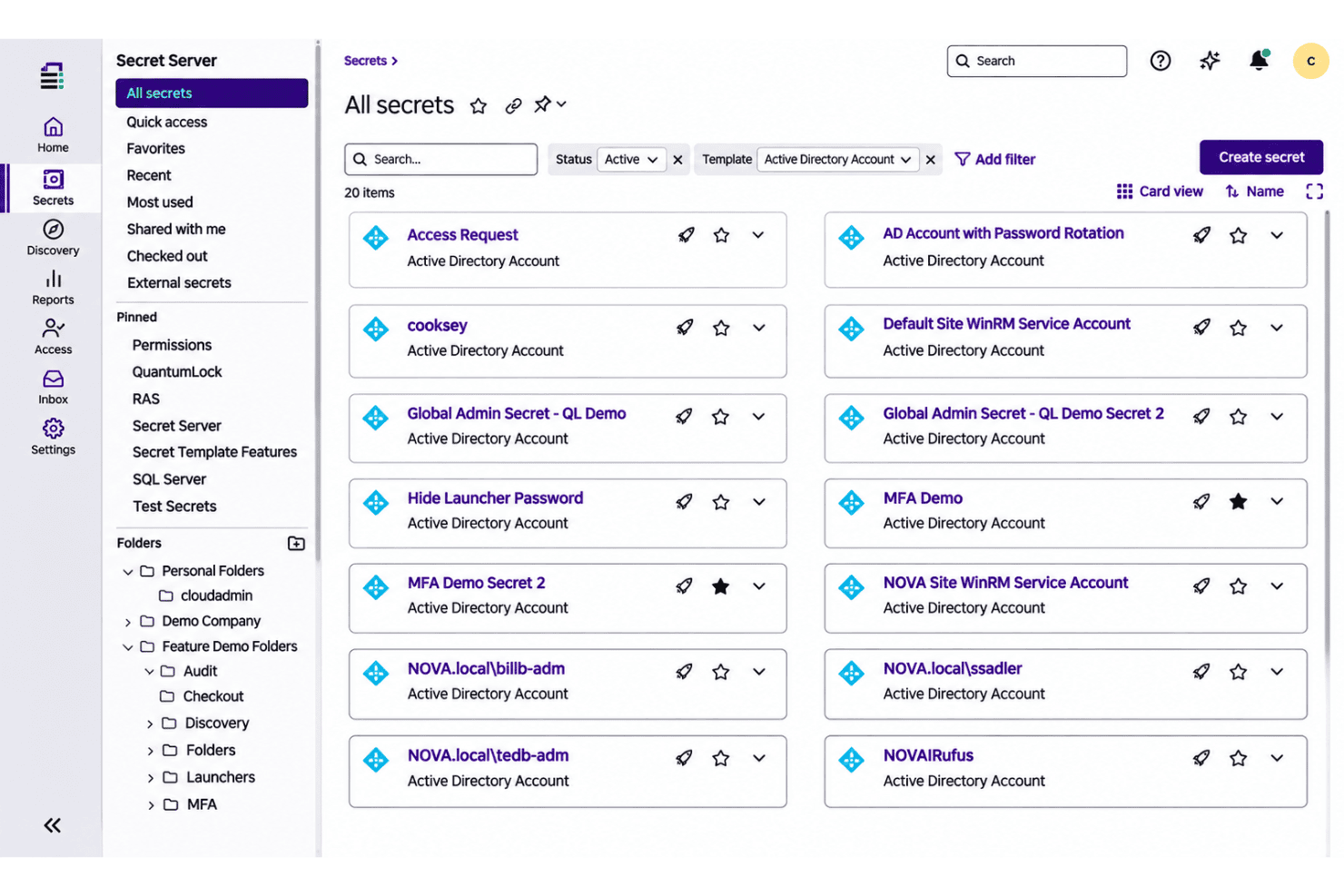
Secret Server stores privileged passwords in an encrypted vault and controls access with roles and approval workflows. Your team can manage admin, service, and application credentials centrally instead of leaving them in shared files.
Automated Credential Rotation
Secret Server can create, rotate, and expire passwords using automation and templates. For example, rotating a service account password helps limit how long an exposed credential remains usable.
Privileged Account Discovery
Delinea discovers and inventories privileged accounts for centralized management. This helps your team find unmanaged local or service accounts that might otherwise escape access controls.
Session Monitoring and Recording
Secret Server monitors and records privileged sessions, with audit trails and customizable reports. When an administrator changes a production system, your team can review the session during an investigation or audit.
Just-In-Time Privilege Access
Delinea Server PAM supports granular elevation policies and self-service requests for temporary access. You can grant an administrator the specific server privileges needed for a task without leaving elevated access in place indefinitely.
Endpoint Privilege and Application Control
Privilege Manager can remove local admin rights and apply policies to elevate, allow, deny, or restrict applications. For example, you can let a trusted application run with elevated privileges while blocking or sandboxing an unapproved one.
Ease of Use
Delinea is reasonably approachable once configured, but setup can take administrator time. You'll need to plan connectors and policies, especially for advanced access controls. Its range of configuration options may also require familiarization before daily navigation feels straightforward. The vault, credential rotation, and session-recording tools keep key PAM tasks together, but teams should expect an onboarding effort before workflows become routine.
Integrations
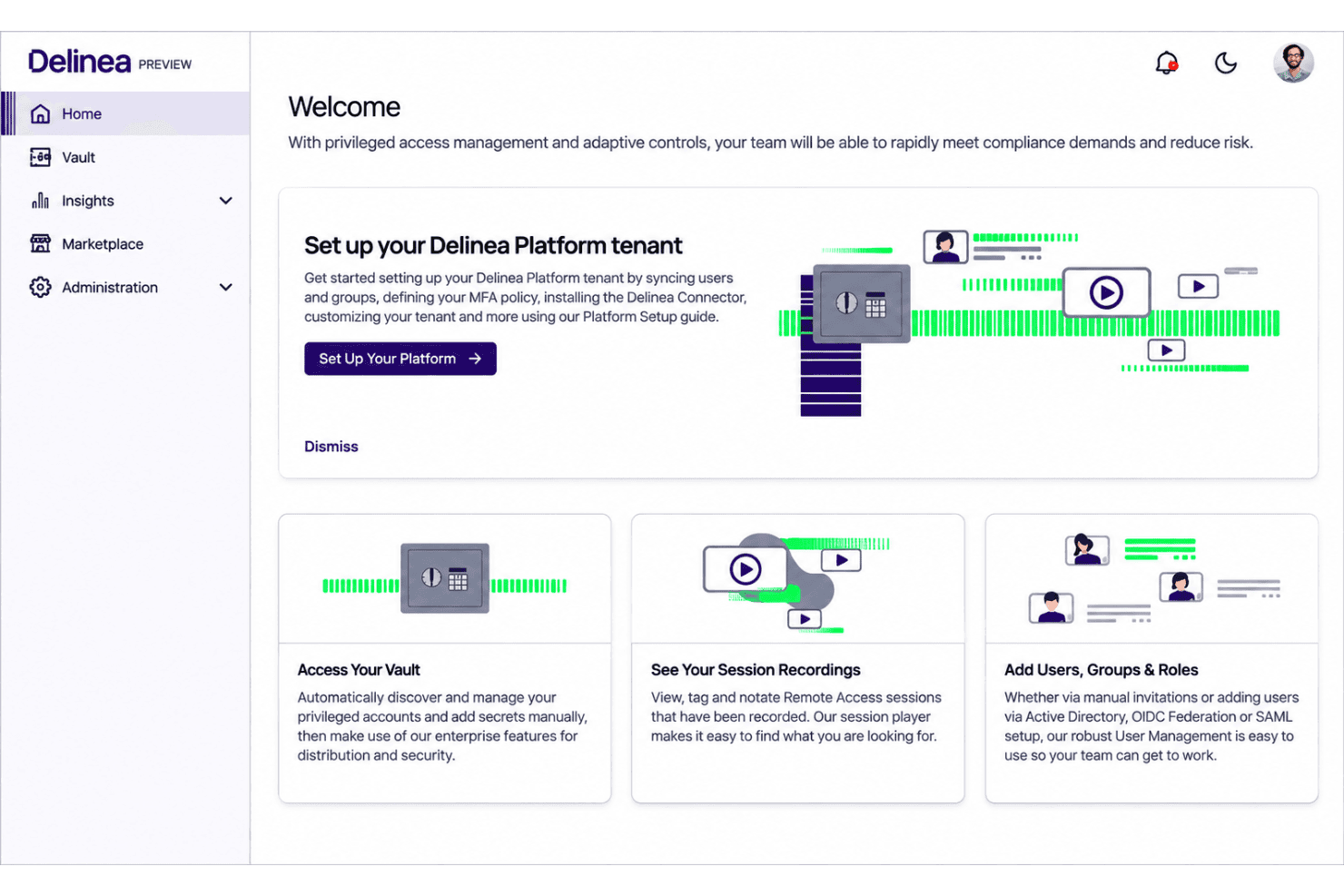
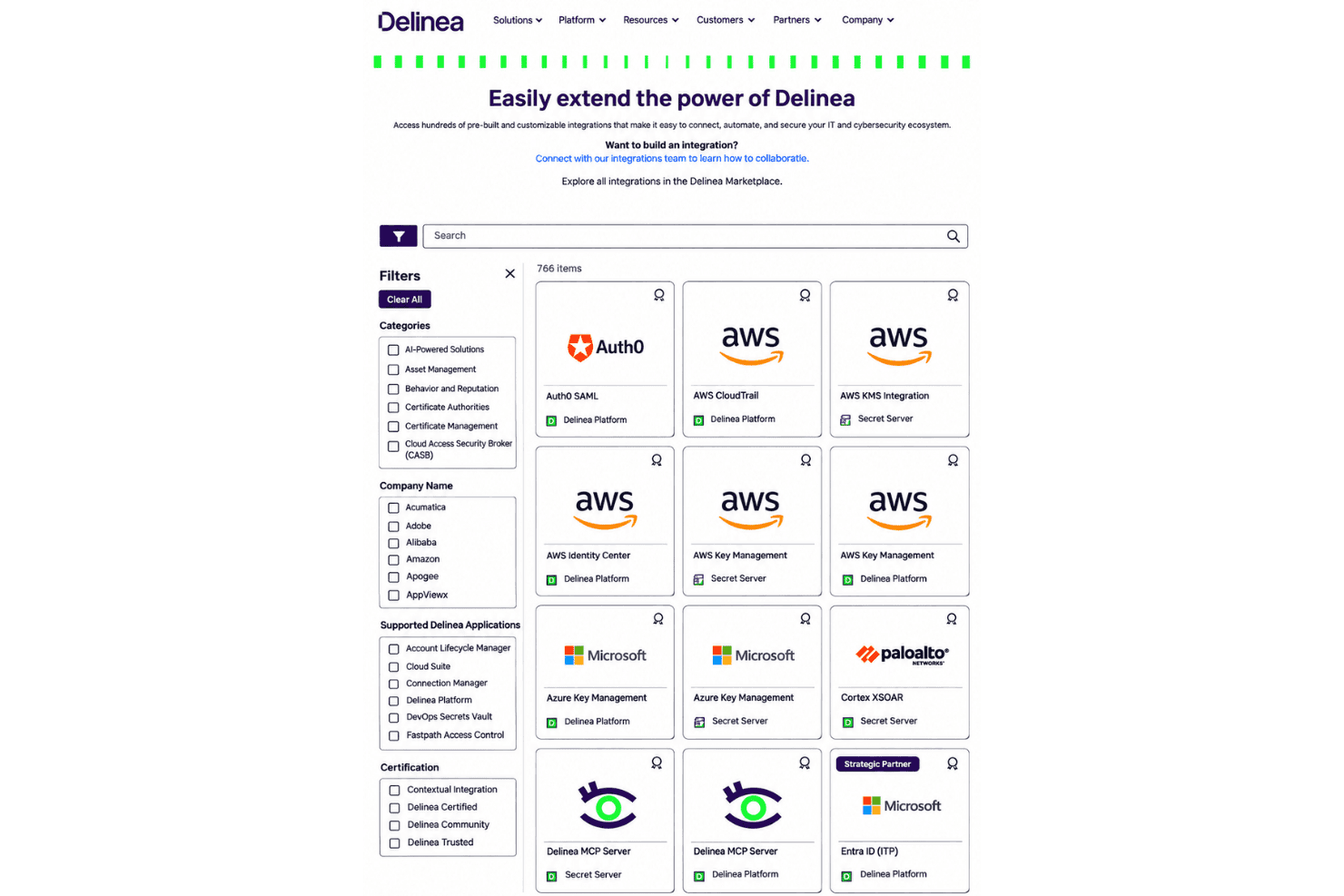
Delinea integrates with AWS, Microsoft Azure, Google Cloud, Active Directory, Duo, ServiceNow, Splunk, Jira, SAP, and UiPath, among others. Secret Server also offers SOAP and REST APIs for connecting with third-party applications and services, with additional integrations available through Delinea's Integrations Marketplace.
Delinea Specs
- API: Yes
- Bug Tracking: No
- CI/CD Integration: Yes
- Cloud Deployment: Yes
- Code Review: No
- Code Transformation: No
- Collaboration Support: Yes
- Data Export: Yes
- Data Import: Yes
- Developer Tools: Yes
- External Integrations: Yes
- Git Integration: Yes
- History/Version Control: No
- IDE Plugins: No
- Local Deployment: Yes
- Multi-User: Yes
- Notifications: Yes
- Project Management: No
- Release Management: No
- Static Analysis: No
- Task Scheduling/Tracking: No
- Testing: No


