

Dataiku Review 2026: Key Features, Pros, Cons and Pricing Explained
I’ve put Dataiku to the test—here’s what makes it stand out (and trip up) as a cloud ML platform, with real insight into its features, fit, and hidden tradeoffs for your 2026 decisions.

We review tools independently, and commissions help fund our testing. See our transparency policy, our methodology, or suggest a tool.
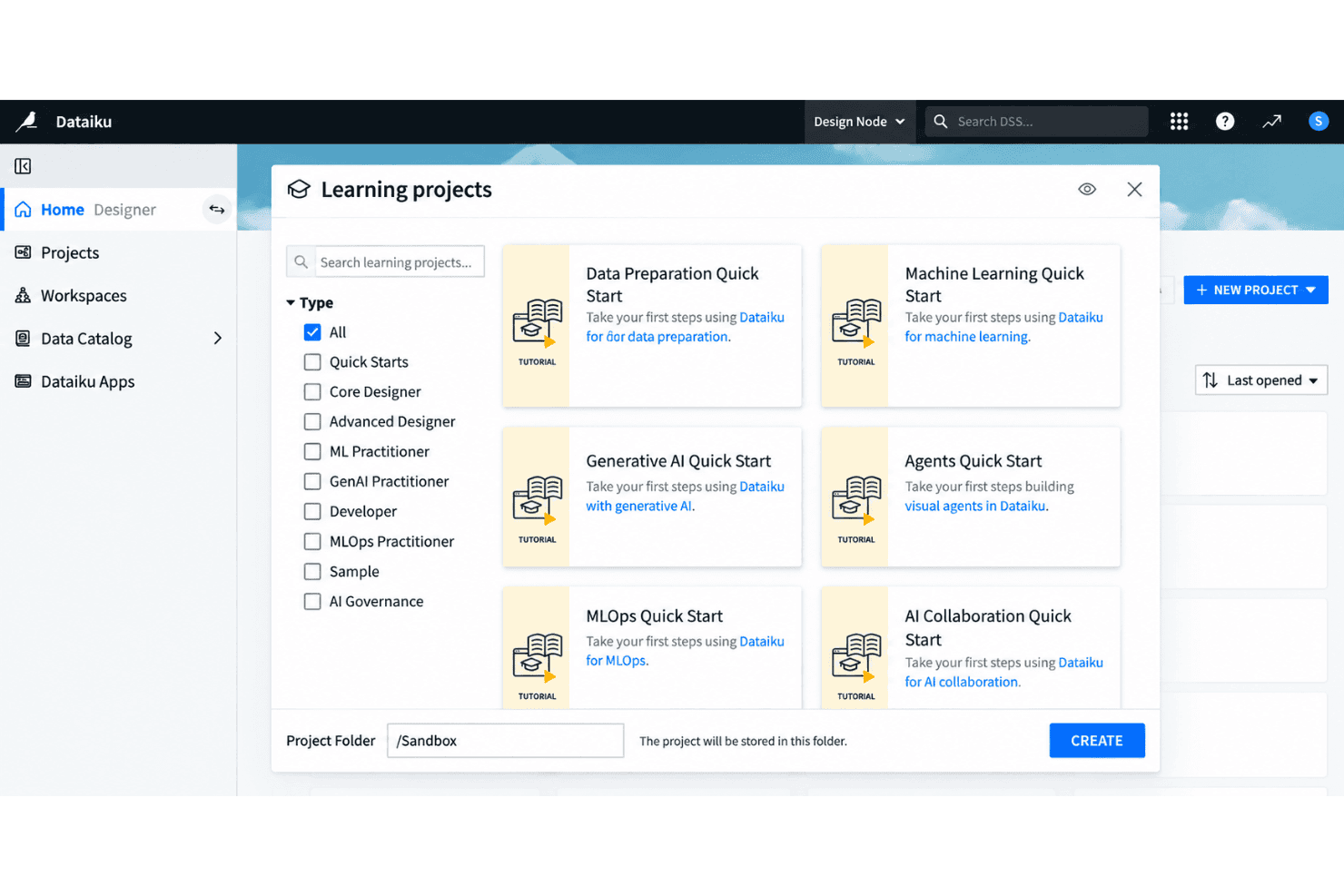
Dataiku is a machine learning cloud platform for data science teams that need to build, deploy, and monitor AI and analytics projects across a shared environment. I'd consider it when your organization has a mix of data engineers, analysts, and business users who all need to collaborate on the same pipelines, without forcing everyone into a code-first workflow. Compared to a tool like Databricks, which leans heavily on notebooks and Spark expertise, Dataiku gives you a visual flow interface alongside Python, R, and SQL, so IT teams can support both citizen data scientists and advanced ML engineers on one governed platform.
Dataiku Evaluation Summary
4.6/5
- Pricing upon request
- 14-day free trial
Why Trust Our Software Recommendations
6,700+
Reviews
20
Industry experts
16+
Evaluation factors
14
Years
Our team has been testing and reviewing software since 2012. As tech leaders ourselves, we know how difficult—and important—it is to choose the right software.
For this guide, we evaluated tools using hands-on testing and independent research, scoring tools using our selection criteria.
Our reviews reflect our human editorial judgment, not a sales pitch.
Expert reviewers:
- Paulo Gardini MiguelTech Director
 Tim FisherVP of AI
 Gabriel RosasTech Lead & Software Architect
 Christhian GruhnTech Lead & Platform Architect

Dataiku Overview
Choosing Dataiku as your machine learning cloud platform means you get an intuitive visual interface and solid collaboration tools that suit cross-functional teams. I think Dataiku’s low-code flexibility lets a broader group dig in, while its granular controls support technical customization when you need it. Onboarding is friendlier than most, with extensive docs and guided flows. Dataiku’s prebuilt integrations cover all the major data sources, but real-time production use cases can feel less mature compared to some. I’d recommend it for organizations balancing strong governance and diverse user skill sets.
Pros
- Visual workflow enables collaboration between technical and non-technical users
- Supports both code and no-code data science projects within one platform
- Offers governed project management with strong version control options
Cons
- Real-time deployment capabilities lag behind competitors like Databricks
- Pricing can be high for large-scale production use
- Interface performance slows with extremely complex pipelines
Is Dataiku Right For Your Needs?
Who Would be a Good Fit for Dataiku?
Dataiku suits teams and organizations with mixed technical skills that need a collaborative environment for analytics, automation, and governed AI. The visual interface, strong SQL and Python support, and wide cloud and database integrations make it ideal for regulated industries, enterprise data teams, and those needing scalable, responsible AI. Users benefit from guided onboarding, extensive support, and template-driven workflows that accelerate time to insight—whether you’re tackling large-scale data prep or deploying machine learning models to production.
- Financial ServicesDataiku’s security controls, rich audit trails, and integrations with enterprise databases support strict compliance and large, multi-user data teams.
- Retail AnalyticsThe visual flow and data prep features simplify shopper behavior analysis, inventory optimization, and omni-channel reporting for retail BI departments.
- Healthcare ProvidersCollaboration tools and responsible AI features help clinicians and administrators securely build predictive models using sensitive health data.
- Large EnterprisesSupport for governance, workspace management, and automation at scale is designed for organizations with hundreds of users and complex data environments.
- Data Science TeamsPython, R, and SQL integration, combined with visual ML model building, suit data professionals needing flexible, repeatable workflows.
- Manufacturing OperationsNo-code tools and strong cloud integrations help process engineers and analysts optimize supply chain, sensor, and production data without heavy scripting.
Who Would be a Bad Fit for Dataiku?
Dataiku can be overkill for businesses with minimal analytics needs, limited resources, or highly specialized requirements that fall outside typical cloud ML workflows. Small teams without dedicated data staff, firms needing highly custom modeling pipelines, or those locked into vendor-specific environments may find Dataiku’s architecture too broad, rigid, or resource-intensive for their needs.
- Small StartupsHigh pricing and feature complexity don’t match small budgets or lean teams just starting with analytics.
- Freelance ConsultantsSolo practitioners rarely need enterprise collaboration, multi-user security, or full-scale automation baked into Dataiku.
- Edge-Only DeploymentsIf your use case demands running models entirely at the edge or offline, Dataiku’s cloud-first approach doesn’t fit.
- Marketing AgenciesTeams focused purely on marketing automation or campaign analytics will find Dataiku’s full-featured data science stack excessive.
- Real-Time TradingDataiku isn’t designed for ultra-low latency, real-time prediction—trading platforms may need more specialized, speed-optimized tools.
- Open-Source-Only ShopsOrganizations requiring open source software and full code transparency will be limited by Dataiku’s proprietary platform structure.
Our Review Methodology
How We Test & Score Tools
We’ve spent years building, refining, and improving our software testing and scoring system. The rubric is designed to capture the nuances of software selection and what makes a tool effective, focusing on critical aspects of the decision-making process.
Below, you can see exactly how our testing and scoring works across seven criteria. It allows us to provide an unbiased evaluation of the software based on core functionality, standout features, ease of use, onboarding, customer support, integrations, customer reviews, and value for money.
Core Functionality (25% of final scoring)
The starting point of our evaluation is always the core functionality of the tool. Does it have the basic features and functions that a user would expect to see? Are any of those core features locked to higher-tiered pricing plans? At its core, we expect a tool to stand up against the baseline capabilities of its competitors.
Standout Features (25% of final scoring)
Next, we evaluate uncommon standout features that go above and beyond the core functionality typically found in tools of its kind. A high score reflects specialized or unique features that make the product faster, more efficient, or offer additional value to the user.
We also evaluate how easy it is to integrate with other tools typically found in the tech stack to expand the functionality and utility of the software. Tools offering plentiful native integrations, 3rd party connections, and API access to build custom integrations score best.
Ease of Use (10% of final scoring)
We consider how quick and easy it is to execute the tasks defined in the core functionality using the tool. High scoring software is well designed, intuitive to use, offers mobile apps, provides templates, and makes relatively complex tasks seem simple.
Onboarding (10% of final scoring)
We know how important rapid team adoption is for a new platform, so we evaluate how easy it is to learn and use a tool with minimal training. We evaluate how quickly a team member can get set up and start using the tool with no experience. High scoring solutions indicate little or no support is required.
Customer Support (10% of final scoring)
We review how quick and easy it is to get unstuck and find help by phone, live chat, or knowledge base. Tools and companies that provide real-time support score best, while chatbots score worst.
Customer Reviews (10% of final scoring)
Beyond our own testing and evaluation, we consider the net promoter score from current and past customers. We review their likelihood, given the option, to choose the tool again for the core functionality. A high scoring software reflects a high net promoter score from current or past customers.
Value for Money (10% of final scoring)
Lastly, in consideration of all the other criteria, we review the average price of entry level plans against the core features and consider the value of the other evaluation criteria. Software that delivers more, for less, will score higher.
Core Features
Visual Flow Interface
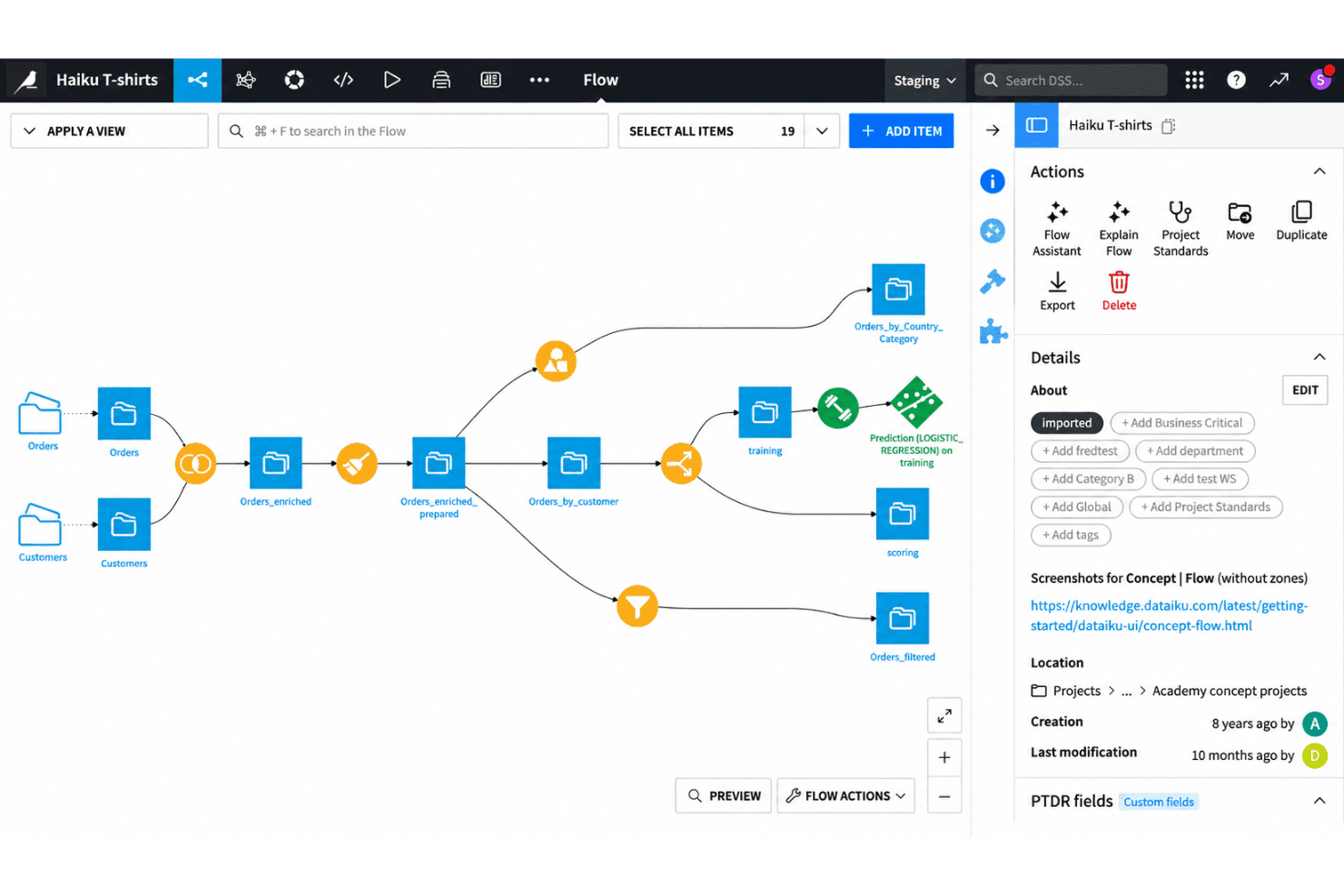
Design, manage, and monitor end-to-end data workflows using a drag-and-drop canvas. This lets both technical and non-technical users build pipelines without writing code.
AutoML for Model Building
Train, compare, and deploy machine learning models using automated workflows. You can adjust algorithms, feature engineering, and validation steps in a visual environment.
Code and No-Code Collaboration
Switch between code-based (Python, R, SQL) and no-code interfaces in the same project. This helps mixed-skill teams contribute to the same workflows without friction.
Governed Project Management
Control versioning, documentation, and project permissions to keep workflows audit-ready. Every step in a pipeline is tracked for transparency and compliance.
Integrated Data Preparation
Clean, enrich, and merge datasets with built-in visual recipes and transformation tools. You can profile data and explore statistics on the fly while prepping for modeling.
Model Deployment and Monitoring
Deploy models to production as APIs or batch jobs directly from the platform. Monitor performance drift and get alerts when retraining is needed.
Ease of Use
Dataiku is easy for new users to pick up, thanks to its visual flow interface and intuitive drag-and-drop tools. You can manage data prep, modeling, and collaboration without heavy scripting or setup. Users regularly highlight the clear onboarding experience and guided analytics flows. Some mention the interface slows down on very large projects, but most say it strikes a good balance between flexibility and user-friendliness, especially in mixed-skill teams.
Integrations
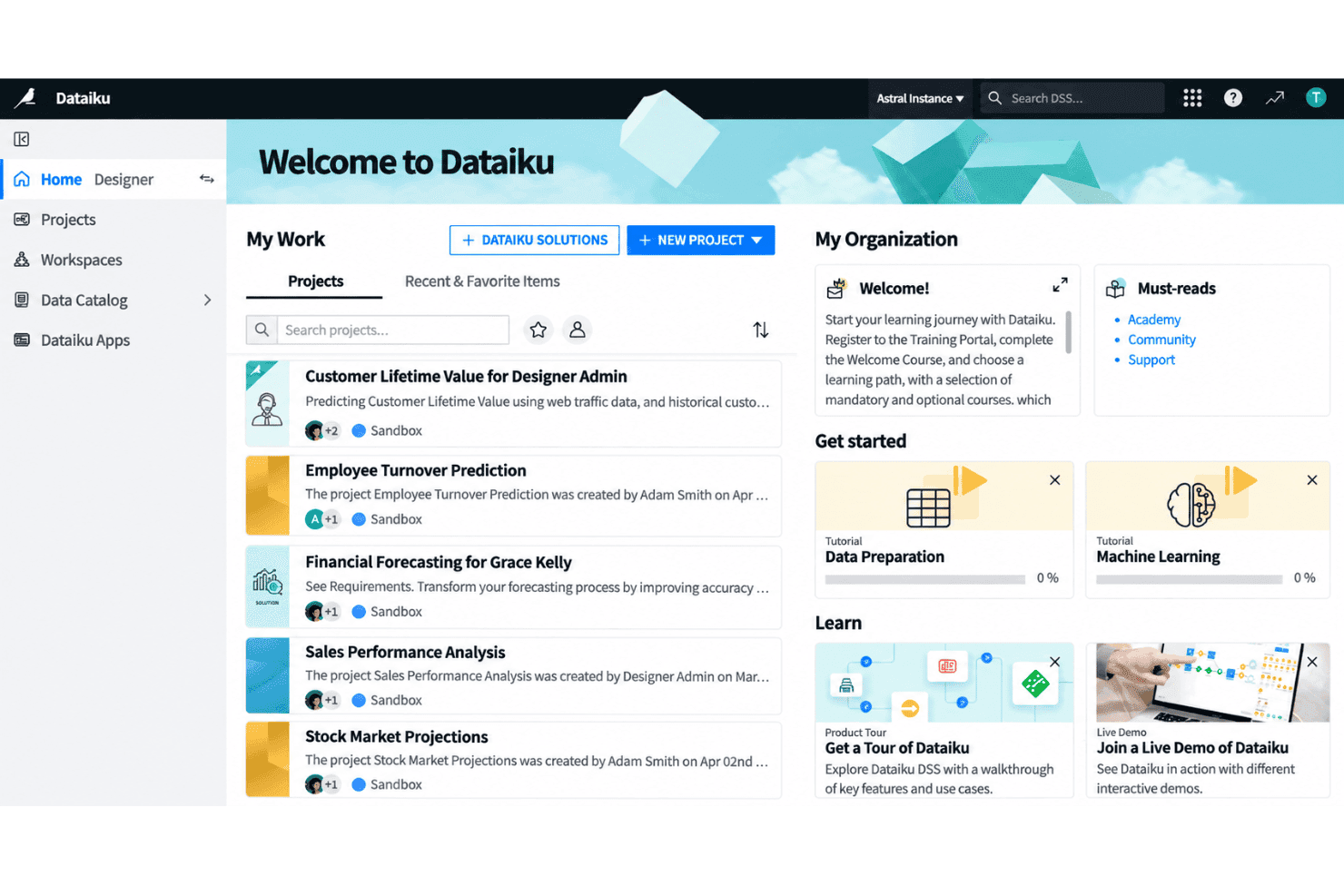
Dataiku integrates with Snowflake, Google BigQuery, Microsoft Azure Blob Storage, Amazon Redshift, Databricks, PostgreSQL, MySQL, Google Cloud Storage, Microsoft SQL Server, and Amazon S3, among others.
Dataiku also supports connections with third-party tools and provides a public API for integrating with external systems and programmatically accessing platform features.
Dataiku Specs
- 2-Factor Authentication: No
- Accounts Payable: No
- Accounts Receivable: No
- API: Yes
- Approval Workflows: No
- Balance Sheet: No
- Billing/Invoicing: No
- Budgeting: No
- Calendar Management: No
- Comparative Reporting: No
- CRM Integration: Yes
- Custom Reports: Yes
- Customer Management: No
- Dashboard: Yes
- Data Export: Yes
- Data Import: Yes
- Data Visualization: Yes
- Expense Tracking: No
- External Integrations: Yes
- Forecasting: Yes
- General Account Ledger: No
- Historical Data Analysis: Yes
- Inventory Tracking: No
- Multi-Currency: No
- Multi-User: Yes
- Notifications: Yes
- P&L: No
- Payroll: No
- Scenario Planning: No
- Scheduling: Yes
- Supplier Management: No
- Tax Management: No
- Time Management: No


