

Finding the right test data management tool can be a challenging task. With so many options available, it’s difficult to determine which one truly meets your needs without wasting valuable time or resources. If you’ve faced issues with tools that are overly complex, fail to scale with your projects, or don’t comply with data privacy regulations, you’re not alone. A great test data management tool should streamline the creation, management, and security of your data sets while integrating seamlessly into your testing workflows.
As a software testing professional with hands-on expertise across dozens of tools, I’ve encountered and overcome the same challenges you’re facing. That’s why I’ve created this guide: to simplify your search and provide a curated list of the best test data management tools available today. Whether your priority is automation, compliance, or scalability, this post will help you make an informed decision.
Why Trust Our Software Recommendations
6,700+
Reviews
20
Industry experts
16+
Evaluation factors
14
Years
Our team has been testing and reviewing software since 2012. As tech leaders ourselves, we know how difficult—and important—it is to choose the right software.
For this guide, we evaluated tools using hands-on testing and independent research, scoring tools using our selection criteria.
Our reviews reflect our human editorial judgment, not a sales pitch.
Expert reviewers:
- Paulo Gardini MiguelTech Director
 Tim FisherVP of AI
 Gabriel RosasTech Lead & Software Architect
 Christhian GruhnTech Lead & Platform Architect

Test Data Management Tools Comparison Table
The table below compares pricing details for my top test data management tools.
| Tool | Best For | Trial Info | Price | ||
|---|---|---|---|---|---|
| 1 | Best for compliance-mapped masking with auto-subsetting | 14-day free trial | Pricing upon request | Website | |
| 2 | Best for CI/CD-native synthetic test data | Free demo available | Pricing upon request | Website | |
| 3 | Best for volume-agnostic, centralized TDM | 14-day free trial | From €15,000/user/year (billed annually) | Website | |
| 4 | Best for full-lifecycle TDM with DB cloning | Free demo available | Pricing upon request | Website | |
| 5 | Best for mainframe-inclusive test data masking | Not available | Pricing upon request | Website | |
| 6 | Best for enterprises with complex environments | 30-day free trial available | Pricing upon request | Website | |
| 7 | Best cross-database subsetting in regulated industries | Free demo available | Pricing upon request | Website | |
| 8 | Best for masking across multi-database pipelines | Free demo available | Pricing upon request | Website | |
| 9 | Best for visual, coverage-driven data design | 14-day free trial | Pricing upon request | Website | |
| 10 | Best for Git-style DB cloning across five engines | Free demo available | Pricing upon request | Website |





Best Test Data Management Tool Reviews
Below are my detailed summaries of the best test data management tools that made it onto my shortlist. My reviews offer a detailed look at the key features, pros & cons, integrations, and ideal use cases of each tool to help you find the best one for you.
 Best for compliance-mapped masking with auto-subsetting
- 14-day free trial
- Pricing upon request
Visit WebsiteCustomer Rating:4.3/5
Tonic masks and de-identifies sensitive database columns for safe test data. My Evaluation Score
- Data Subsetting
- 5/5
- Synthetic Data Generation
- 3/5
- Data Masking/Anonymization
- 5/5
- Test Environment Provisioning
- 4/5
- Pipeline/Toolchain Integration
- 4/5
- Referential Integrity Management
- 5/5
Tonic Structural is a test data management platform that masks, subsets, and provisions production data for non-production environments, with support for relational databases, NoSQL, data warehouses, and file sources.
Who Is Tonic Best For?
Tonic Structural is a strong fit for compliance-focused teams in healthcare and finance that need to mask and subset production data while maintaining audit-ready privacy documentation.
Why I Picked Tonic
Tonic earns its spot on my shortlist because its masking and subsetting capabilities are tightly coupled in a way I rarely see. I love how the Privacy Hub flags every column as At-Risk, Protected, or Not Sensitive, then lets you bulk-apply generators and export a full Privacy Report for audit purposes. The patented subsetter handles virtual foreign keys and circular dependencies automatically, so your masked subset stays referentially intact even across complex, multi-table schemas.
Tonic Key Features
- Structural Agent: An AI chat assistant built into the app that summarizes sensitivity scan results, recommends generators, and applies them automatically to your columns.
- Differential privacy controls: Categorical and continuous generators support differential privacy, with a configurable privacy budget to limit statistical inference from transformed data.
- Container repository output: Structural writes masked, subsetted data directly as container volumes for PostgreSQL, MySQL, and SQL Server, letting you spin up isolated databases on demand.
- Version History: Records every change to workspace configuration—generators, subsetting rules, table modes, and post-job scripts—with attribution and the ability to restore earlier versions.
Tonic Integrations
Tonic offers native integrations with PostgreSQL, MySQL, SQL Server, Oracle, MongoDB, Snowflake, BigQuery, Redshift, Databricks, and Amazon S3. It also supports REST API, GitHub Actions, Kubernetes, Helm, and container registries including Amazon ECR, Google Artifact Registry, and Azure Container Registry.
Pros and Cons
Pros:
- Production-like data retains statistical relationships
- Privacy Hub maps sensitive columns for audits
- Preserves joins across complex schemas
Cons:
- Containerized databases require Kubernetes deployment
- From-scratch synthesis requires separate Fabricate product
Learn more about Tonic: Best for CI/CD-native synthetic test data
- Free demo available
- Pricing upon request
Visit WebsiteCustomer Rating:4.6/5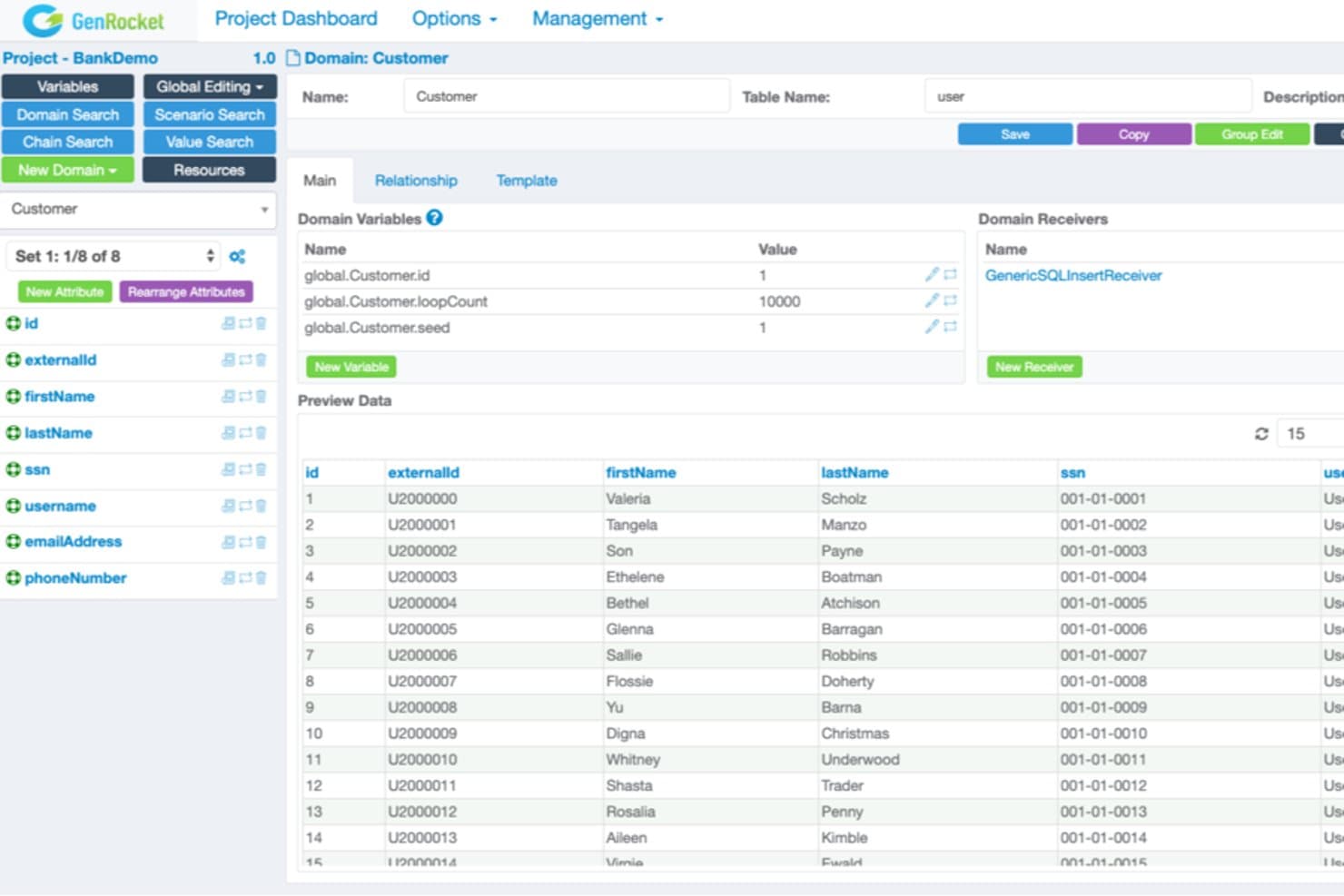
GenRocket lets users preview and configure test data domains visually. My Evaluation Score
- Data Subsetting
- 4/5
- Multi-Source Connectivity
- 5/5
- Synthetic Data Generation
- 5/5
- Data Masking & Anonymization
- 3/5
- CI/CD & Automation Integration
- 5/5
- Test Data Provisioning & Self-Service
- 5/5
GenRocket is a synthetic test data management platform that generates data in real time from metadata and schemas, covering data masking, intelligent subsetting, multi-format output, and self-service provisioning across CI/CD pipelines.
Who Is GenRocket Best For?
GenRocket is a strong fit for QA and DevOps teams that need on-demand synthetic test data generated directly inside CI/CD pipelines, without ever touching production data.
Why I Picked GenRocket
GenRocket earns its spot on my shortlist because it's the only test data platform I've seen built specifically to generate synthetic data in real time, directly inside a CI/CD pipeline, without ever touching production. Its patented referential integrity engine keeps data consistent across multiple schemas and databases simultaneously, which is genuinely rare. I also like that each test case dataset generates in as little as 100 milliseconds, so pipeline execution doesn't stall waiting on data provisioning.
GenRocket Key Features
- G-Delta schema change detection: Automatically identifies database schema changes across MySQL, MS SQL, Oracle, and PostgreSQL, then triggers G-Refactor to update all affected test data cases.
- In-place masking: Replaces sensitive fields in Oracle, MS SQL Server, IBM DB2, PostgreSQL, and MySQL databases with synthetically generated equivalents, without ever reading real production values.
- G-Portal self-service portal: Gives developers and testers a role-based interface to search, request, track, and download test data cases without involving a central data team for every request.
- 750+ intelligent data generators: Covers virtually any data type, domain, or business rule, including conditional logic, cross-field dependencies, and regex constraints.
GenRocket Integrations
GenRocket integrates with Jenkins, Azure DevOps, TeamCity, CircleCI, GitHub, Cucumber, Selenium, JUnit, JMeter, and LoadRunner. It also supports REST API, JDBC, SOAP, TCP/IP sockets, and Docker deployment for custom CI/CD workflows.
Pros and Cons
Pros:
- Unlimited data volume with no refresh cycles
- Real-time data provisioning for CI/CD pipelines
- Synthetic data generation maintains referential integrity
Cons:
- PII detection not fully available until {{year}}
- No format-preserving or reversible masking
Learn more about GenRocket: Best for volume-agnostic, centralized TDM
- 14-day free trial
- From €15,000/user/year (billed annually)
Visit WebsiteCustomer Rating:4.5/5
Data masking helps you keep sensitive customer information private. My Evaluation Score
- Data Subsetting
- 5/5
- Multi-Source Connectivity
- 4/5
- Synthetic Data Generation
- 3/5
- Data Masking & Anonymization
- 5/5
- CI/CD & Automation Integration
- 4/5
- Test Data Provisioning & Self-Service
- 5/5
DATPROF is a test data management platform that combines data masking, subsetting, synthetic data generation, PII discovery, database virtualization, and centralized provisioning across relational, NoSQL, and cloud data sources.
Who Is DATPROF Best For?
DATPROF is a strong fit for data engineers and DBAs at mid-to-large enterprises managing complex, multi-database environments where referential integrity and compliance are non-negotiable.
Why I Picked DATPROF
I picked DATPROF as one of the best because its volume-agnostic licensing model genuinely sets it apart: your license cost stays flat whether you're masking 500 GB or 100 TB, which matters when you're subsetting a production database like the 23 TB one Heineken reduced to 130 GB. The patented foreign-key cycle detection in DATPROF Subset handles complex multi-thousand-table schemas while keeping cross-system referential integrity intact. Pair that with the Runtime portal's centralized orchestration, and every team member can provision their own refreshed environment without waiting on a DBA.
DATPROF Key Features
- Deterministic cross-system masking: Applies consistent masked values for the same input across multiple databases simultaneously, preserving referential integrity for end-to-end test traceability.
- PII discovery and profiling: Scans databases to automatically identify where sensitive data lives, with support for custom detection rules using regular expressions or list-based expressions.
- Self-service provisioning portal: Lets testers and developers log in to DATPROF Runtime and refresh their own test environments independently, without waiting on a DBA.
- Copy-on-write database cloning: DATPROF Virtualize spins up full-size virtual database environments without consuming extra storage, with snapshot rollback completed in under 20 seconds.
DATPROF Integrations
DATPROF supports CI/CD integrations with Jenkins, Azure DevOps, GitLab, and Bamboo, plus test automation integrations with Parasoft and Tosca. Its REST API supports custom integrations, with marketplace listings available through Azure Marketplace and AWS Marketplace.
Pros and Cons
Pros:
- Role-based web portal for self-serve refresh
- Subsetting efficiently reduces massive production datasets
- Masking preserves cross-database referential integrity
Cons:
- No mainframe or broader NoSQL database coverage
- Limited native support for SaaS data sources
Learn more about DATPROF: Best for full-lifecycle TDM with DB cloning
- Free demo available
- Pricing upon request

Enov8 provides executive PII visibility across data sources at a glance. My Evaluation Score
- Data Subsetting
- 4/5
- Multi-Source Connectivity
- 5/5
- Synthetic Data Generation
- 4/5
- Data Masking & Anonymization
- 5/5
- CI/CD & Automation Integration
- 5/5
- Test Data Provisioning & Self-Service
- 5/5
Enov8 is a test data management platform that covers the full TDM lifecycle, including AI-powered data profiling, masking, subsetting, synthetic data generation, and database virtualization via its vME cloning engine.
Who Is Enov8 Best For?
Enov8 is a strong fit for DevOps and QA teams in regulated industries that need a single platform to handle masking, subsetting, synthetic data, and database virtualization together.
Why I Picked Enov8
I picked Enov8 as one of the best because it's the only tool on my list that pairs full-lifecycle TDM with its vME database cloning engine, which spins up production-realistic database copies at roughly 40 MB per clone regardless of source size. I love how masking, subsetting, and synthetic data generation all feed directly into the virtualization layer, so clones are already privacy-safe before they hit a test environment.
Enov8 Key Features
- AI-powered PII discovery: An ML-driven profiling engine automatically scans connected data sources to classify sensitive fields and flag regulatory-risk columns before masking begins.
- Test data reservations: A built-in booking system lets teams reserve and manage datasets centrally, preventing conflicts between concurrent users and environments.
- Post-masking validation scan: An ML-powered validation run confirms masking effectiveness after each securitization pass and generates audit-ready compliance evidence.
- DevOps Manager integration hub: A language-agnostic orchestration layer that houses automation scripts in Python, Bash, Ansible, Java, and more, connecting Enov8 to CI/CD pipelines across Jenkins, GitLab CI/CD, and Azure DevOps.
Enov8 Integrations
Enov8 supports 100+ integrations, including Jenkins, GitLab CI/CD, Azure DevOps, CircleCI, Travis CI, Bitbucket Pipelines, AWS CodeDeploy, and Ansible. Its REST API, webhooks, scheduler, and DevOps Manager support custom CI/CD workflows.
Pros and Cons
Pros:
- Central test data booking prevents allocation conflicts
- AI-driven PII discovery and masking validation
- Database virtualization with tiny 40 MB clones
Cons:
- No third-party compliance attestations listed
- Public review volume is relatively limited
Learn more about Enov8: Best for mainframe-inclusive test data masking
- Not available
- Pricing upon request

Broadcom Test Data Manager tracks import job statuses in one view. My Evaluation Score
- Data Subsetting
- 4/5
- Multi-Source Connectivity
- 4/5
- Synthetic Data Generation
- 5/5
- Data Masking & Anonymization
- 5/5
- CI/CD & Automation Integration
- 4/5
- Test Data Provisioning & Self-Service
- 4/5
Broadcom Test Data Manager is an enterprise test data management platform that combines data masking, synthetic data generation, subsetting, PII discovery, database virtualization, and self-service provisioning—with dedicated support for mainframe environments alongside modern distributed and cloud databases.
Who Is Broadcom Test Data Manager Best For?
Large enterprises running mainframe environments alongside modern distributed systems will get the most from this platform.
Why I Picked Broadcom Test Data Manager
I've included Broadcom Test Data Manager in my top picks because it's the only platform I've seen that handles mainframe environments as a first-class citizen alongside modern distributed systems. Its dedicated CA TDM for Mainframe module lets you mask and subset data across z/OS, VSAM, and IMS through the same UI you use for SQL Server or Oracle. The automated PII heat map scans entire mainframe schemas and flags sensitive fields before you apply a single masking rule, which cuts the manual mapping work that usually bogs down compliance teams.
Broadcom Test Data Manager Key Features
- Self-service data portal: A centralized catalog where testers request, reserve, and release test data on demand using dynamic forms without waiting on DBAs.
- DAVE database virtualization: A copy-on-write cloning engine that spins up independent database clones from a shared base image in minutes with minimal storage overhead.
- Javelin workflow automation: A built-in visual automation engine that orchestrates masking, subsetting, and provisioning tasks and can be triggered via REST API or CI/CD pipelines.
- Referential integrity preservation: Masking and subsetting operations maintain cross-table relationships so test datasets remain functionally coherent for end-to-end testing.
Broadcom Test Data Manager Integrations
Documented integrations include Azure DevOps, CA Release Automation, CA Service Virtualization, CA BlazeMeter, CA Agile Requirements Designer, HP ALM, and CA Agile Central. REST APIs support custom CI/CD workflows, while Docker and Kubernetes support containerized deployments.
Pros and Cons
Pros:
- Copy-on-write database virtualization (DAVE)
- Automated PII discovery and heat maps
- Mainframe-inclusive test data masking
Cons:
- UI feels dated and complex
- No SaaS deployment option available
Learn more about Broadcom Test Data Manager: Best for enterprises with complex environments
- 30-day free trial available
- Pricing upon request
Visit WebsiteCustomer Rating:4.5/5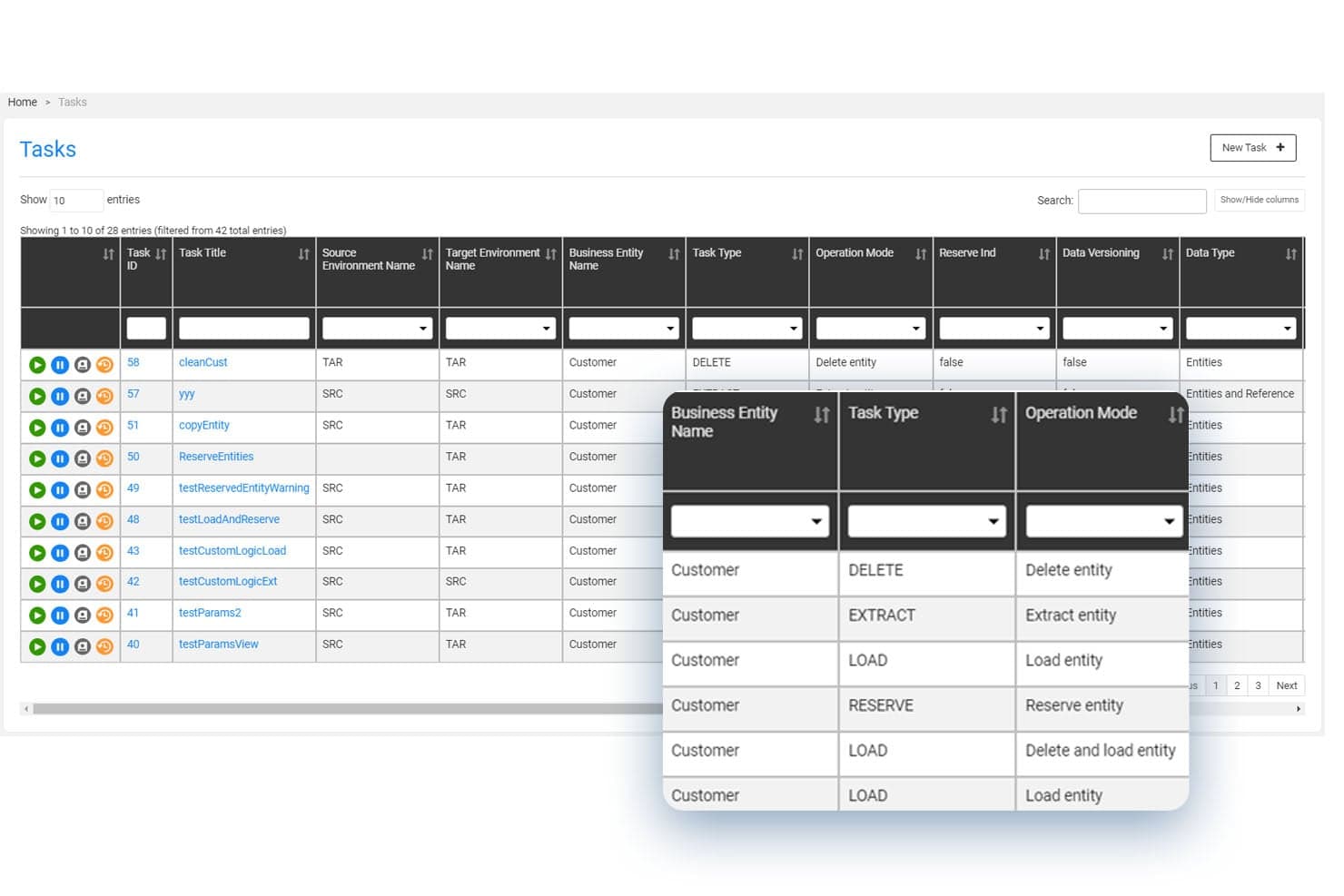
K2View Test Data Management lets users manage and filter data tasks by type and operation mode. My Evaluation Score
- Data Subsetting
- 5/5
- Multi-Source Connectivity
- 5/5
- Synthetic Data Generation
- 5/5
- Data Masking & Anonymization
- 5/5
- CI/CD & Automation Integration
- 4/5
- Test Data Provisioning & Self-Service
- 5/5
K2View Test Data Management is an enterprise TDM platform that unifies data masking, synthetic data generation, subsetting, and self-service provisioning across relational, NoSQL, mainframe, and cloud data sources through a patented Micro-Database™ architecture.
Who Is K2View Test Data Management Best For?
K2View is built for large enterprises managing test data across mixed environments—mainframe, cloud, NoSQL, and relational—all at once.
Why I Picked K2View Test Data Management
K2View earns its spot on my shortlist because its patented Micro-Database™ architecture solves a problem most TDM tools sidestep: maintaining referential integrity across mainframe, NoSQL, and cloud sources simultaneously. I'm particularly impressed by its in-flight masking, which means PII is masked at the point of extraction and never lands unmasked in a test environment. Its entity-centric subsetting lets teams pull a complete customer record spanning Oracle, Kafka, and MongoDB in one operation, without manual join rules.
K2View Test Data Management Key Features
- Self-service TDM portal: A web-based interface that lets testers request, reserve, and rollback test data without involving data or DBA teams.
- Time Machine snapshot and rollback: Saves specific test data states at any point so testers can restore environments to a known configuration instantly.
- Automated PII discovery: Built-in classifiers scan all connected sources, tag sensitive fields, and recommend or apply masking policies automatically.
- Agentic TDM: An AI-driven capability that reads test cases and autonomously assembles compliant, provisioning-ready datasets without manual configuration.
K2View Test Data Management Integrations
K2View offers built-in connectors for Oracle, SQL Server, PostgreSQL, DB2, MongoDB, Snowflake, Salesforce, Amazon S3, Kafka, and mainframe systems. REST, JDBC, and ODBC connectivity supports custom integrations and CI/CD workflows with Jenkins, GitHub Actions, and Azure DevOps.
Pros and Cons
Pros:
- Automated PII discovery built into platform
- Entity-centric subsetting spans mainframe and cloud
- In-flight masking prevents unmasked PII exposure
Cons:
- API-based CI/CD integration requires configuration
- Not designed for small teams
Learn more about K2View Test Data Management: Best cross-database subsetting in regulated industries
- Free demo available
- Pricing upon request

IBM InfoSphere Optim helps you quickly create test data. My Evaluation Score
- Data Subsetting
- 5/5
- Multi-Source Connectivity
- 4/5
- Synthetic Data Generation
- 0/5
- Data Masking & Anonymization
- 5/5
- CI/CD & Automation Integration
- 2/5
- Test Data Provisioning & Self-Service
- 3/5
IBM Test Data Management is an enterprise test data management solution that covers data masking, cross-database subsetting, and on-demand data provisioning across a wide range of relational and mainframe data sources.
Who Is IBM Test Data Management Best For?
IBM Test Data Management is a strong fit for large enterprises in regulated industries—financial services, healthcare, and insurance—running complex, multi-database or mainframe-inclusive environments where data masking and cross-database subsetting are compliance requirements.
Why I Picked IBM Test Data Management
IBM Test Data Management earns its spot on my shortlist because of how it handles cross-database subsetting at the business-object level, pulling referentially intact subsets across multiple connected databases simultaneously. I'm particularly impressed by its federated extraction capability, which lets teams work across heterogeneous data landscapes, including mainframe sources like VSAM and IMS, where almost no competing tool operates. Its 40+ predefined masking rules with format-preserving output make it genuinely useful in GDPR- and HIPAA-regulated environments.
IBM Test Data Management Key Features
- Governance Catalog integration: Drag-and-drop data classification rules directly onto column maps to auto-assign masking routines from a central policy catalog.
- Apache Spark runtime: An embedded Spark engine handles large-scale data processing within automated subsetting and masking workflows.
- Role-based access control: Keycloak-powered RBAC with LDAP, SAML, OIDC, and Kerberos support controls who can access, request, and refresh test datasets.
- Compliance reporting: Built-in reporting validates enforcement of data privacy policies across GDPR- and HIPAA-regulated environments.
IBM Test Data Management Integrations
Documented integrations include IBM Governance Catalog, IBM Cloud Pak for Data, Keycloak, Apache Spark, and databases such as Db2, Oracle, SQL Server, PostgreSQL, Snowflake, SAP, Teradata, Informix, Netezza, and limited MongoDB. Its OpenAPI 2.0 REST API supports custom orchestration and CI/CD workflows, while the z/OS edition connects to VSAM and IMS.
Pros and Cons
Pros:
- Handles VSAM and IMS subsets
- Format-preserving masking supports regulated data
- Preserves referential integrity across databases
Cons:
- Physical copies replace virtual cloning
- No native synthetic data generation
Learn more about IBM Test Data Management: Best for masking across multi-database pipelines
- Free demo available
- Pricing upon request

Tonic.ai lets users manage data masking rules across database tables. My Evaluation Score
- Data Subsetting
- 4/5
- Multi-Source Connectivity
- 4/5
- Synthetic Data Generation
- 5/5
- Data Masking & Anonymization
- 5/5
- CI/CD & Automation Integration
- 5/5
- Test Data Provisioning & Self-Service
- 5/5
Tonic.ai is a test data management platform that covers structured data masking and subsetting, unstructured data redaction, and fully synthetic data generation across relational databases, NoSQL stores, and cloud data warehouses.
Who Is Tonic.ai Best For?
Tonic.ai is a strong fit for data engineers and DBAs managing test data across complex, multi-database environments spanning relational databases, NoSQL stores, and cloud data warehouses.
Why I Picked Tonic.ai
I picked Tonic.ai as one of the best because its deterministic masking engine applies consistent masked values for the same input across PostgreSQL, MongoDB, Snowflake, and every other source in your pipeline simultaneously. That means a customer ID masked in your relational database matches the same masked value in your data warehouse and document store, keeping joins intact across systems. Its patented subsetting engine compounds this by extracting referentially coherent slices, which is how eBay reduced an 8PB dataset to a clean 1GB test environment without breaking any cross-table relationships.
Tonic.ai Key Features
- Automated PII/PHI discovery: Scans connected data sources, detects sensitive fields, and recommends masking transformations without manual column-by-column mapping.
- Tonic Ephemeral: Spins up on-demand, isolated databases within CI/CD pipelines using direct DNS connections, then tears them down automatically after test execution.
- Schema change detection: Identifies new or modified columns and can block data generation automatically to prevent accidental PII leakage into test environments.
- Generator presets: Lets you save and reuse named masking and transformation rules globally across workspaces, keeping masking policies consistent at scale.
Tonic.ai Integrations
Tonic.ai offers a native GitHub Actions integration, plus REST API connectivity for Jenkins and GitLab CI. It connects to PostgreSQL, MySQL, SQL Server, Oracle, MongoDB, DynamoDB, Snowflake, BigQuery, Redshift, and Databricks.
Pros and Cons
Pros:
- Automated PII discovery with AI recommendations
- Deterministic masking across multiple database platforms
- Patented subsetting engine preserves referential integrity
Cons:
- Initial setup can be complex for enterprises
- No native mainframe data source support
Learn more about Tonic.ai: Best for visual, coverage-driven data design
- 14-day free trial
- Pricing upon request

Curiosity Software visualizes data relationships via a radial partition diagram. My Evaluation Score
- Data Subsetting
- 3/5
- Multi-Source Connectivity
- 5/5
- Synthetic Data Generation
- 5/5
- Data Masking & Anonymization
- 5/5
- CI/CD & Automation Integration
- 5/5
- Test Data Provisioning & Self-Service
- 5/5
Curiosity Software is a test data management platform that combines data masking, synthetic data generation, subsetting, virtualization, and self-service provisioning across 250+ source integrations—including mainframe systems like VSAM, IMS, and CICS.
Who Is Curiosity Software Best For?
Curiosity Software suits enterprise QA teams and data engineers working in complex, multi-source environments—especially those supporting mainframe systems or managing compliance-driven test data at scale.
Why I Picked Curiosity Software
I picked Curiosity Software as one of the best because its coverage-driven approach to data design genuinely sets it apart. Instead of manually scripting test data rules, you build visual data flow models that encode business logic and constraints, and the platform automatically identifies coverage gaps and generates synthetic data to fill them. I find the "Find and Make" utility especially useful: it locates existing data your tests need and generates targeted synthetic records only where gaps remain, so you're never over-provisioning or working blind.
Curiosity Software Key Features
- Automated PII discovery: Scans connected data sources to automatically locate and flag sensitive fields before data is provisioned to non-production environments.
- Self-service provisioning portal: A web-based portal lets teams request and provision test data on demand using parameterized, reusable jobs without involving the test data team.
- CI/CD pipeline integration: Test data jobs can be triggered dynamically via API across Jenkins, GitLab, GitHub, Azure DevOps, and Bitbucket for just-in-time data delivery.
- Graph-based data lineage: Stores traceability and cross-source relationship data using Neo4j, producing visual pipeline representations that expose foreign keys, joins, and orphaned references.
Curiosity Software Integrations
Curiosity Software offers 250+ integrations, including Oracle, SQL Server, Snowflake, Salesforce, VSAM, IMS, Jenkins, GitHub, GitLab, and Azure DevOps. Its APIs support custom integrations and CI/CD-triggered, just-in-time test data delivery across cloud, on-premises, and hybrid environments.
Pros and Cons
Pros:
- Automated PII discovery with compliance-driven features
- Mainframe data masking and subsetting included
- Visual model-based test data design
Cons:
- No published SOC 2 or ISO 27001 certifications
- Subsetting options less detailed in documentation
Learn more about Curiosity Software: Best for Git-style DB cloning across five engines
- Free demo available
- Pricing upon request

Redgate SQL Provision lets users manage database clones across multiple SQL instances. My Evaluation Score
- Data Subsetting
- 3/5
- Synthetic Data Generation
- 1/5
- Data Masking/Anonymization
- 4/5
- Test Environment Provisioning
- 4/5
- Pipeline/Toolchain Integration
- 3/5
- Referential Integrity Management
- 3/5
Redgate SQL Provision is a test data management tool that covers data masking, subsetting, and Git-style database cloning across SQL Server, PostgreSQL, MySQL, MariaDB, and Oracle.
Who Is Redgate SQL Provision Best For?
Redgate SQL Provision is a strong fit for DBAs and QA engineers who need fast, version-controlled database cloning and masking across multiple relational engines.
Why I Picked Redgate SQL Provision
I picked Redgate SQL Provision as one of the best because its Git-style database cloning is genuinely unlike anything else I've seen across five engines. Redgate Clone spins up a live data container in seconds regardless of database size, so a 5TB SQL Server database provisions as fast as a 128MB one. You can branch, reset, and save revisions like a Git workflow, which makes it easy to give every tester their own isolated environment without duplicating storage.
Redgate SQL Provision Key Features
- Anonymize CLI (
rganonymize): A three-step command-line tool that classifies PII columns, maps masking rules, and replaces real values across SQL Server, PostgreSQL, MySQL, MariaDB, and Oracle. - Deterministic masking: Masks the same input value to the same output every time using a fixed seed, keeping masked data consistent across related tables.
- Data subsetting: The
rgsubsetCLI pulls a configurable portion of your source database—defaulting to 10%—while following foreign keys to preserve referential integrity. - AI Custom Datasets: Lets you describe the values you need in plain language and generates a reviewable list of up to 1,000 values for use in masking substitution.
Redgate SQL Provision Integrations
Redgate SQL Provision integrates with SQL Server, PostgreSQL, MySQL, MariaDB, Oracle, Docker, AWS CloudFormation, Azure Kubernetes Service, SQL Data Catalog, PowerShell, and dbatools. Its CLIs support scripted CI/CD workflows, but native Jenkins, Azure DevOps, and GitHub Actions plugins aren’t documented.
Pros and Cons
Pros:
- Foreign-key-aware subsetting protects relational integrity
- Deterministic masking preserves cross-table consistency
- Git-style branching refreshes test databases quickly
Cons:
- Product positioning creates buyer uncertainty
- Synthetic data generation stops at value lists
Learn more about Redgate SQL Provision:
Other Test Data Management Tools
Here are some additional test data management tools options that didn’t make it onto my shortlist, but are still worth checking out:
- 11Perforce DelphixBest for virtualizing full production database clones
- 12SynthesizedBest for SAP-native test data masking
- 13Tricentis ToscaBest for AI-powered testing
- 14InformaticaBest for enterprise testing
- 15BMC CompuwareBest for immediate testing
- 16Rocket Data ExpressBest for saving test resources
- 17Accelario Continuous DataOps PlatformBest for CI/CD-triggered DB virtualization
- 18Avo Test Data ManagementBest for rapid and reliable test data generation
- 19SynthoBest for privacy-first synthetic data generation
- 20IRI VoracityBest for masking structured and dark data together
How I Evaluate Test Data Management Tools
I split my evaluation into three parts, with core functionality carrying the most weight: a tool must mask sensitive data and generate realistic synthetic datasets. From there, I look at standout features like sensitive data discovery. Beyond features, I consider deployment flexibility, vendor support, and pricing clarity.
Core Functionality (Table Stakes for This List)
When I'm selecting tools for my list, I score each one on a scale from 0 (does not offer the functionality) to 5 (excels in this area) for each core functionality listed below. I then convert the total into a percentage to help assess each tool's overall fit, with extra weight on any functionalities I've deemed essential.
- Data Masking (Essential): I check whether masking techniques stay consistent across sources—so a masked customer ID in one table matches everywhere it appears.
- Synthetic Data Generation (Essential): I look for tools that produce statistically realistic datasets, not just random strings, so QA teams can catch edge cases during testing.
- Data Subsetting: I evaluate how well a tool carves out smaller datasets while preserving foreign-key relationships across complex, multi-table schemas.
- Test Environment Provisioning: Fast clone-and-refresh cycles matter here. I look at how quickly teams can spin up a fresh environment before each sprint.
- Referential Integrity Management: Broken relationships between tables invalidate test results. I check that joins and constraints hold after masking or subsetting runs.
- Pipeline Integration: I look for native hooks into CI/CD tools like Jenkins or GitLab so data provisioning fires automatically alongside build and deploy steps.
Once I have a list of tools that meet the criteria, I consider what sets each platform apart.
Differentiating Factors (What Sets Vendors Apart)
Here's how I compare and contrast different vendors:
Standout Features
I look for AI-driven data generation that learns production patterns and produces statistically faithful synthetic datasets—no manual rule authoring needed. Sensitive data discovery matters just as much, since auto-classifying PII across sources cuts compliance risk before masking even starts. I also evaluate version-controlled test data, where teams can branch and roll back datasets between sprint cycles.
Beyond Features
I evaluate whether a vendor offers on-premise, cloud, and hybrid deployment models, since teams in regulated industries often need data to stay behind a firewall. Pricing transparency matters just as much—some vendors charge by data volume while others bill per environment, and that distinction shapes whether adoption can scale across multiple product teams. I also check for onboarding support and documentation quality, especially for orgs without deep data engineering bench strength.
How to Choose Test Data Management Tool
It’s easy to get bogged down in long feature lists and complex pricing structures. To help you stay focused as you work through your unique software selection process, here’s a checklist of factors to keep in mind:
| Factor | What to Consider |
|---|---|
| FactorScalability | What to ConsiderWill the tool grow with your team? Consider future data volume and user growth. Look for flexible plans that can accommodate scaling without significant cost increases. |
| FactorIntegrations | What to ConsiderDoes it work with your existing systems? Check compatibility with your current testing tools, databases, and workflows to avoid disruptions. |
| FactorCustomizability | What to ConsiderCan you tailor the tool to your needs? Evaluate if the tool allows for custom data templates and workflows to fit your processes. |
| FactorEase of use | What to ConsiderIs it user-friendly for your team? Consider the learning curve and whether non-technical staff can navigate the tool easily without extensive training. |
| FactorImplementation and onboarding | What to ConsiderHow quickly can you get started? Look for tools offering quick setup, training resources, and support to ensure a smooth transition. |
| FactorCost | What to ConsiderDoes it fit your budget? Compare pricing models and ensure there are no hidden fees. Check if there’s a free trial or demo to test before committing. |
| FactorSecurity safeguards | What to ConsiderHow does it protect your data? Ensure the tool complies with data security standards and offers encryption and access controls to safeguard sensitive information. |
| FactorCompliance requirements | What to ConsiderDoes it meet regulatory needs? Verify if the tool supports compliance with relevant data protection regulations like GDPR or HIPAA, depending on your industry requirements. |
What are Test Data Management Tools?
Test data management tools are software used to generate, manage, and maintain data for software testing purposes. They handle the creation and manipulation of test data, ensuring it is accurate, secure, and suitable for a variety of testing scenarios.
These tools play a vital role in organizing and provisioning data for functional, performance, and regression testing in software development, often working alongside database testing tools to ensure comprehensive data validation.
Features
When selecting test data management tools, keep an eye out for the following key features:
- Data masking: Protects sensitive information by replacing it with fictional data, ensuring privacy compliance.
- Data subsetting: Extracts a subset of data from large datasets, making testing more manageable and efficient.
- Integration capabilities: Connects with existing testing tools and databases, facilitating smooth workflows.
- Custom data templates: Allows users to create templates tailored to their specific testing needs, enhancing flexibility.
- AI-driven data generation: Uses artificial intelligence to generate realistic test data, improving test accuracy.
- Real-time data provisioning: Provides immediate access to required test data, reducing delays in the testing process.
- Multi-cloud support: Enables the tool to work across different cloud environments, offering flexibility in deployment.
- Encryption and access controls: Ensures data security by encrypting data and setting user access permissions.
- Training resources: Offers tutorials, webinars, and other learning materials to support user onboarding and tool adoption.
- Compliance support: Helps ensure that data handling meets industry standards and regulations like GDPR or HIPAA.
Benefits
Implementing test data management tools provides several benefits for your team and your business. Here are a few you can look forward to:
- Improved data privacy: Data masking features help protect sensitive information, ensuring compliance with privacy regulations.
- Enhanced testing efficiency: Real-time data provisioning reduces delays, allowing faster testing cycles.
- Greater data accuracy: AI-driven data generation creates realistic test data, increasing the reliability of test results.
- Cost savings: Data subsetting extracts only necessary data, reducing storage and processing costs.
- Flexibility in deployment: Multi-cloud support allows the tool to function across different environments, adapting to your infrastructure needs.
- User-friendly onboarding: Access to training resources and tutorials supports quick adoption and efficient use of the tool.
- Regulatory compliance: Compliance support features help meet industry standards, reducing the risk of legal issues.
Costs & Pricing
Selecting test data management tools requires an understanding of the various pricing models and plans available. Costs vary based on features, team size, add-ons, and more. The table below summarizes common plans, their average prices, and typical features included in test data management tools solutions:
Plan Comparison Table for Test Data Management Tools
| Plan Type | Average Price | Common Features |
|---|---|---|
| Plan TypeFree Plan | Average Price$0 | Common FeaturesBasic data masking, limited data subsetting, and limited integration capabilities. |
| Plan TypePersonal Plan | Average Price$5-$25/user/month | Common FeaturesEnhanced data privacy, AI-driven data generation, and basic support. |
| Plan TypeBusiness Plan | Average Price$30-$75/user/month | Common FeaturesAdvanced data subsetting, multi-cloud support, and access to training resources. |
| Plan TypeEnterprise Plan | Average Price$100+/user/month | Common FeaturesCustom data templates, comprehensive compliance support, premium customer support, and full integration capabilities. |
Test Data Management Tools FAQs
Here are some answers to common questions about test data management tools:
Should you choose masking or synthetic data features?
Masking protects real data by hiding personal details. Software that generates synthetic data creates fake but realistic datasets. Choose masking if you use production data; synthetic data if you want safer, fully generated test sets.
If you’re still in the “need to gather more test data” phase, try: 10 Best Usability Testing Tools for Real User Feedback.
Why is data security important in TDM tools?
TDM software often handles sensitive production data. Without proper masking or encryption, you risk leaks or compliance issues. Always choose a tool that supports encryption, anonymization, and access controls.
What integrations should a TDM tool support?
It should work with your CI/CD tools like Jenkins, GitLab, or Azure DevOps. Integration with major databases (Oracle, SQL Server, PostgreSQL) and cloud platforms is also key for smooth automation.
How do you test a TDM tool before buying?
Run a small proof of concept. Try cloning, masking, and refreshing data in your real setup. See how fast it runs and whether it fits into your existing workflow.
How can TDM tools help with compliance?
Good tools track every data change, keep audit logs, and ensure masked data stays consistent. This helps your team stay compliant with regulations like GDPR, HIPAA, or CCPA.