

Găsirea instrumentului potrivit pentru gestionarea datelor de testare poate fi o sarcină dificilă. Cu atât de multe opțiuni disponibile, este greu să determini care dintre ele îți îndeplinește cu adevărat nevoile fără să pierzi timp sau resurse valoroase. Dacă te-ai confruntat cu instrumente excesiv de complexe, care nu se pot adapta la extinderea proiectelor tale sau care nu respectă reglementările privind confidențialitatea datelor, nu ești singur. Un instrument excelent de gestionare a datelor de testare ar trebui să simplifice crearea, gestionarea și securizarea seturilor tale de date, integrându-se perfect în fluxurile de lucru pentru testare.
În calitate de specialist în testarea software-ului, cu experiență practică în utilizarea a zeci de instrumente, m-am confruntat cu aceleași provocări cu care te confrunți și tu și am găsit soluții pentru ele. De aceea am creat acest ghid: pentru a-ți simplifica procesul de căutare și a-ți oferi o listă atent selecționată a celor mai bune instrumente de gestionare a datelor de testare disponibile în prezent. Indiferent dacă prioritatea ta este automatizarea, conformitatea sau scalabilitatea, această postare te va ajuta să iei o decizie informată.
Why Trust Our Software Recommendations
6,700+
Reviews
20
Industry experts
16+
Evaluation factors
14
Years
Our team has been testing and reviewing software since 2012. As tech leaders ourselves, we know how difficult—and important—it is to choose the right software.
For this guide, we evaluated tools using hands-on testing and independent research, scoring tools using our selection criteria.
Our reviews reflect our human editorial judgment, not a sales pitch.
Expert reviewers:
- Paulo Gardini MiguelTech Director
 Tim FisherVP of AI
 Gabriel RosasTech Lead & Software Architect
 Christhian GruhnTech Lead & Platform Architect

Tabel comparativ al instrumentelor de gestionare a datelor de testare
Tabelul de mai jos compară detaliile privind prețurile pentru principalele mele instrumente de gestionare a datelor de testare.
Score legend (out of 5)
- Excellent4.5–5
- Good4–4.4
- Average3–3.9
- Below average2–2.9
- Poor1–1.9
Sorted by: Default
| Tool | Starting Price | Website | |||||||||||
|---|---|---|---|---|---|---|---|---|---|---|---|---|---|
Best for compliance-mapped masking with auto-subsetting | Not rated | 5 | 3 | 5 | 4 | 4 | 5 | Not rated | Not rated | Not rated | Not rated | Pricing upon request 14-day free trial | Website |
Best for CI/CD-native synthetic test data | Not rated | 4 | 5 | Not rated | Not rated | Not rated | Not rated | 5 | 3 | 5 | 5 | Pricing upon request Free demo available | Website |
Best for volume-agnostic, centralized TDM | Not rated | 5 | 3 | Not rated | Not rated | Not rated | Not rated | 4 | 5 | 4 | 5 | €15,000/user/year 14-day free trial | Website |
Best for full-lifecycle TDM with DB cloning | Not rated | 4 | 4 | Not rated | Not rated | Not rated | Not rated | 5 | 5 | 5 | 5 | Pricing upon request Free demo available | Website |
Best for mainframe-inclusive test data masking | Not rated | 4 | 5 | Not rated | Not rated | Not rated | Not rated | 4 | 5 | 4 | 4 | Pricing upon request Not available | Website |
Best for enterprises with complex environments | Not rated | 5 | 5 | Not rated | Not rated | Not rated | Not rated | 5 | 5 | 4 | 5 | Pricing upon request 30-day free trial available | Website |
Best cross-database subsetting in regulated industries | Not rated | 5 | Not rated | Not rated | Not rated | Not rated | Not rated | 4 | 5 | 2 | 3 | Pricing upon request Free demo available | Website |
Best for masking across multi-database pipelines | Not rated | 4 | 5 | Not rated | Not rated | Not rated | Not rated | 4 | 5 | 5 | 5 | Pricing upon request Free demo available | Website |
Best for visual, coverage-driven data design | Not rated | 3 | 5 | Not rated | Not rated | Not rated | Not rated | 5 | 5 | 5 | 5 | Pricing upon request 14-day free trial | Website |
Best for Git-style DB cloning across five engines | Not rated | 3 | 1 | 4 | 4 | 3 | 3 | Not rated | Not rated | Not rated | Not rated | Pricing upon request Free demo available | Website |





Recenzii ale celor mai bune instrumente de gestionare a datelor de testare
Mai jos sunt prezentate rezumatele mele detaliate ale celor mai bune instrumente de gestionare a datelor de testare care au ajuns pe lista mea scurtă. Recenziile mele oferă o privire detaliată asupra caracteristicilor principale, avantajelor și dezavantajelor, integrărilor și cazurilor ideale de utilizare pentru fiecare instrument, pentru a te ajuta să îl găsești pe cel mai potrivit pentru tine.
 Best for compliance-mapped masking with auto-subsetting
- 14-day free trial
- Pricing upon request
Visit WebsiteCustomer Rating:4.3/5
Tonic masks and de-identifies sensitive database columns for safe test data. Tonic Structural is a test data management platform that masks, subsets, and provisions production data for non-production environments, with support for relational databases, NoSQL, data warehouses, and file sources.
Who Is Tonic Best For?
Tonic Structural is a strong fit for compliance-focused teams in healthcare and finance that need to mask and subset production data while maintaining audit-ready privacy documentation.
Why I Picked Tonic
Tonic earns its spot on my shortlist because its masking and subsetting capabilities are tightly coupled in a way I rarely see. I love how the Privacy Hub flags every column as At-Risk, Protected, or Not Sensitive, then lets you bulk-apply generators and export a full Privacy Report for audit purposes. The patented subsetter handles virtual foreign keys and circular dependencies automatically, so your masked subset stays referentially intact even across complex, multi-table schemas.
Tonic Key Features
- Structural Agent: An AI chat assistant built into the app that summarizes sensitivity scan results, recommends generators, and applies them automatically to your columns.
- Differential privacy controls: Categorical and continuous generators support differential privacy, with a configurable privacy budget to limit statistical inference from transformed data.
- Container repository output: Structural writes masked, subsetted data directly as container volumes for PostgreSQL, MySQL, and SQL Server, letting you spin up isolated databases on demand.
- Version History: Records every change to workspace configuration—generators, subsetting rules, table modes, and post-job scripts—with attribution and the ability to restore earlier versions.
Tonic Integrations
Tonic offers native integrations with PostgreSQL, MySQL, SQL Server, Oracle, MongoDB, Snowflake, BigQuery, Redshift, Databricks, and Amazon S3. It also supports REST API, GitHub Actions, Kubernetes, Helm, and container registries including Amazon ECR, Google Artifact Registry, and Azure Container Registry.
Pros and Cons
Pros:
- Production-like data retains statistical relationships
- Privacy Hub maps sensitive columns for audits
- Preserves joins across complex schemas
Cons:
- Containerized databases require Kubernetes deployment
- From-scratch synthesis requires separate Fabricate product
Learn more about Tonic: Best for CI/CD-native synthetic test data
- Free demo available
- Pricing upon request
Visit WebsiteCustomer Rating:4.6/5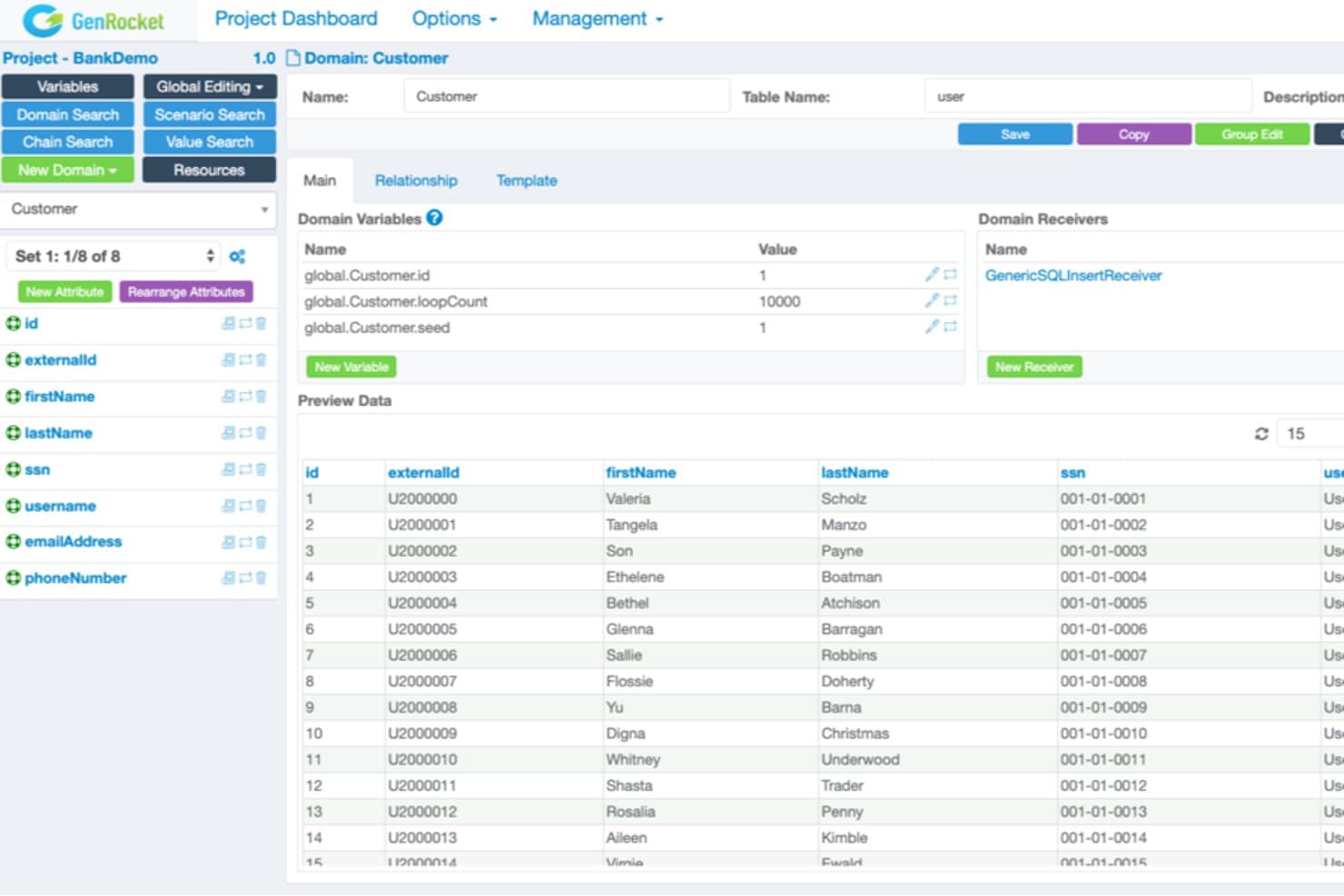
GenRocket lets users preview and configure test data domains visually. GenRocket is a synthetic test data management platform that generates data in real time from metadata and schemas, covering data masking, intelligent subsetting, multi-format output, and self-service provisioning across CI/CD pipelines.
Who Is GenRocket Best For?
GenRocket is a strong fit for QA and DevOps teams that need on-demand synthetic test data generated directly inside CI/CD pipelines, without ever touching production data.
Why I Picked GenRocket
GenRocket earns its spot on my shortlist because it's the only test data platform I've seen built specifically to generate synthetic data in real time, directly inside a CI/CD pipeline, without ever touching production. Its patented referential integrity engine keeps data consistent across multiple schemas and databases simultaneously, which is genuinely rare. I also like that each test case dataset generates in as little as 100 milliseconds, so pipeline execution doesn't stall waiting on data provisioning.
GenRocket Key Features
- G-Delta schema change detection: Automatically identifies database schema changes across MySQL, MS SQL, Oracle, and PostgreSQL, then triggers G-Refactor to update all affected test data cases.
- In-place masking: Replaces sensitive fields in Oracle, MS SQL Server, IBM DB2, PostgreSQL, and MySQL databases with synthetically generated equivalents, without ever reading real production values.
- G-Portal self-service portal: Gives developers and testers a role-based interface to search, request, track, and download test data cases without involving a central data team for every request.
- 750+ intelligent data generators: Covers virtually any data type, domain, or business rule, including conditional logic, cross-field dependencies, and regex constraints.
GenRocket Integrations
GenRocket integrates with Jenkins, Azure DevOps, TeamCity, CircleCI, GitHub, Cucumber, Selenium, JUnit, JMeter, and LoadRunner. It also supports REST API, JDBC, SOAP, TCP/IP sockets, and Docker deployment for custom CI/CD workflows.
Pros and Cons
Pros:
- Unlimited data volume with no refresh cycles
- Real-time data provisioning for CI/CD pipelines
- Synthetic data generation maintains referential integrity
Cons:
- PII detection not fully available until {{year}}
- No format-preserving or reversible masking
Learn more about GenRocket: Best for volume-agnostic, centralized TDM
- 14-day free trial
- From €15,000/user/year (billed annually)
Visit WebsiteCustomer Rating:4.5/5
Data masking helps you keep sensitive customer information private. DATPROF is a test data management platform that combines data masking, subsetting, synthetic data generation, PII discovery, database virtualization, and centralized provisioning across relational, NoSQL, and cloud data sources.
Who Is DATPROF Best For?
DATPROF is a strong fit for data engineers and DBAs at mid-to-large enterprises managing complex, multi-database environments where referential integrity and compliance are non-negotiable.
Why I Picked DATPROF
I picked DATPROF as one of the best because its volume-agnostic licensing model genuinely sets it apart: your license cost stays flat whether you're masking 500 GB or 100 TB, which matters when you're subsetting a production database like the 23 TB one Heineken reduced to 130 GB. The patented foreign-key cycle detection in DATPROF Subset handles complex multi-thousand-table schemas while keeping cross-system referential integrity intact. Pair that with the Runtime portal's centralized orchestration, and every team member can provision their own refreshed environment without waiting on a DBA.
DATPROF Key Features
- Deterministic cross-system masking: Applies consistent masked values for the same input across multiple databases simultaneously, preserving referential integrity for end-to-end test traceability.
- PII discovery and profiling: Scans databases to automatically identify where sensitive data lives, with support for custom detection rules using regular expressions or list-based expressions.
- Self-service provisioning portal: Lets testers and developers log in to DATPROF Runtime and refresh their own test environments independently, without waiting on a DBA.
- Copy-on-write database cloning: DATPROF Virtualize spins up full-size virtual database environments without consuming extra storage, with snapshot rollback completed in under 20 seconds.
DATPROF Integrations
DATPROF supports CI/CD integrations with Jenkins, Azure DevOps, GitLab, and Bamboo, plus test automation integrations with Parasoft and Tosca. Its REST API supports custom integrations, with marketplace listings available through Azure Marketplace and AWS Marketplace.
Pros and Cons
Pros:
- Role-based web portal for self-serve refresh
- Subsetting efficiently reduces massive production datasets
- Masking preserves cross-database referential integrity
Cons:
- No mainframe or broader NoSQL database coverage
- Limited native support for SaaS data sources
Learn more about DATPROF: Best for full-lifecycle TDM with DB cloning
- Free demo available
- Pricing upon request

Enov8 provides executive PII visibility across data sources at a glance. Enov8 is a test data management platform that covers the full TDM lifecycle, including AI-powered data profiling, masking, subsetting, synthetic data generation, and database virtualization via its vME cloning engine.
Who Is Enov8 Best For?
Enov8 is a strong fit for DevOps and QA teams in regulated industries that need a single platform to handle masking, subsetting, synthetic data, and database virtualization together.
Why I Picked Enov8
I picked Enov8 as one of the best because it's the only tool on my list that pairs full-lifecycle TDM with its vME database cloning engine, which spins up production-realistic database copies at roughly 40 MB per clone regardless of source size. I love how masking, subsetting, and synthetic data generation all feed directly into the virtualization layer, so clones are already privacy-safe before they hit a test environment.
Enov8 Key Features
- AI-powered PII discovery: An ML-driven profiling engine automatically scans connected data sources to classify sensitive fields and flag regulatory-risk columns before masking begins.
- Test data reservations: A built-in booking system lets teams reserve and manage datasets centrally, preventing conflicts between concurrent users and environments.
- Post-masking validation scan: An ML-powered validation run confirms masking effectiveness after each securitization pass and generates audit-ready compliance evidence.
- DevOps Manager integration hub: A language-agnostic orchestration layer that houses automation scripts in Python, Bash, Ansible, Java, and more, connecting Enov8 to CI/CD pipelines across Jenkins, GitLab CI/CD, and Azure DevOps.
Enov8 Integrations
Enov8 supports 100+ integrations, including Jenkins, GitLab CI/CD, Azure DevOps, CircleCI, Travis CI, Bitbucket Pipelines, AWS CodeDeploy, and Ansible. Its REST API, webhooks, scheduler, and DevOps Manager support custom CI/CD workflows.
Pros and Cons
Pros:
- Central test data booking prevents allocation conflicts
- AI-driven PII discovery and masking validation
- Database virtualization with tiny 40 MB clones
Cons:
- No third-party compliance attestations listed
- Public review volume is relatively limited
Learn more about Enov8: Best for mainframe-inclusive test data masking
- Not available
- Pricing upon request

Broadcom Test Data Manager tracks import job statuses in one view. Broadcom Test Data Manager is an enterprise test data management platform that combines data masking, synthetic data generation, subsetting, PII discovery, database virtualization, and self-service provisioning—with dedicated support for mainframe environments alongside modern distributed and cloud databases.
Who Is Broadcom Test Data Manager Best For?
Large enterprises running mainframe environments alongside modern distributed systems will get the most from this platform.
Why I Picked Broadcom Test Data Manager
I've included Broadcom Test Data Manager in my top picks because it's the only platform I've seen that handles mainframe environments as a first-class citizen alongside modern distributed systems. Its dedicated CA TDM for Mainframe module lets you mask and subset data across z/OS, VSAM, and IMS through the same UI you use for SQL Server or Oracle. The automated PII heat map scans entire mainframe schemas and flags sensitive fields before you apply a single masking rule, which cuts the manual mapping work that usually bogs down compliance teams.
Broadcom Test Data Manager Key Features
- Self-service data portal: A centralized catalog where testers request, reserve, and release test data on demand using dynamic forms without waiting on DBAs.
- DAVE database virtualization: A copy-on-write cloning engine that spins up independent database clones from a shared base image in minutes with minimal storage overhead.
- Javelin workflow automation: A built-in visual automation engine that orchestrates masking, subsetting, and provisioning tasks and can be triggered via REST API or CI/CD pipelines.
- Referential integrity preservation: Masking and subsetting operations maintain cross-table relationships so test datasets remain functionally coherent for end-to-end testing.
Broadcom Test Data Manager Integrations
Documented integrations include Azure DevOps, CA Release Automation, CA Service Virtualization, CA BlazeMeter, CA Agile Requirements Designer, HP ALM, and CA Agile Central. REST APIs support custom CI/CD workflows, while Docker and Kubernetes support containerized deployments.
Pros and Cons
Pros:
- Copy-on-write database virtualization (DAVE)
- Automated PII discovery and heat maps
- Mainframe-inclusive test data masking
Cons:
- UI feels dated and complex
- No SaaS deployment option available
Learn more about Broadcom Test Data Manager: Best for enterprises with complex environments
- 30-day free trial available
- Pricing upon request
Visit WebsiteCustomer Rating:4.5/5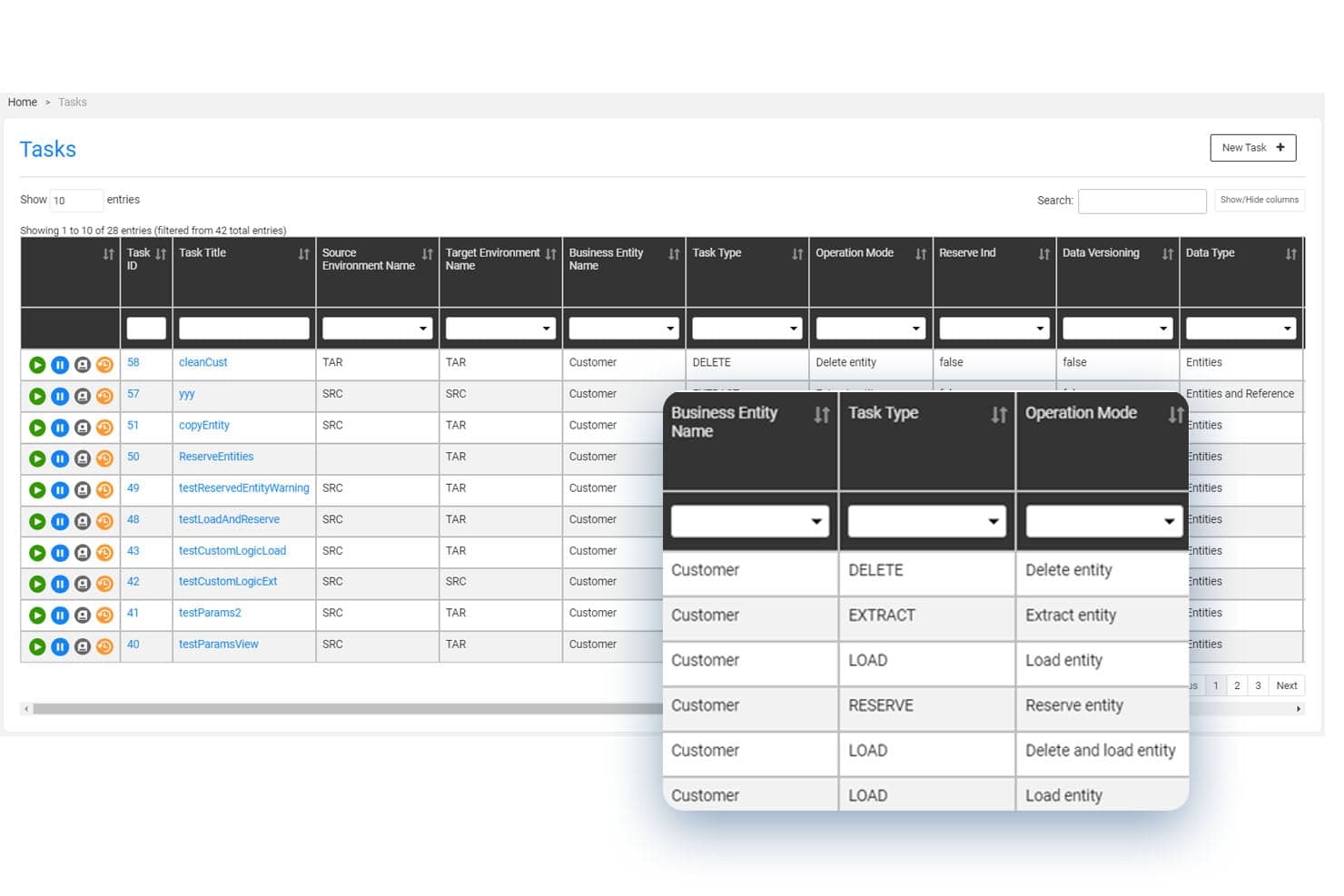
K2View Test Data Management lets users manage and filter data tasks by type and operation mode. K2View Test Data Management is an enterprise TDM platform that unifies data masking, synthetic data generation, subsetting, and self-service provisioning across relational, NoSQL, mainframe, and cloud data sources through a patented Micro-Database™ architecture.
Who Is K2View Test Data Management Best For?
K2View is built for large enterprises managing test data across mixed environments—mainframe, cloud, NoSQL, and relational—all at once.
Why I Picked K2View Test Data Management
K2View earns its spot on my shortlist because its patented Micro-Database™ architecture solves a problem most TDM tools sidestep: maintaining referential integrity across mainframe, NoSQL, and cloud sources simultaneously. I'm particularly impressed by its in-flight masking, which means PII is masked at the point of extraction and never lands unmasked in a test environment. Its entity-centric subsetting lets teams pull a complete customer record spanning Oracle, Kafka, and MongoDB in one operation, without manual join rules.
K2View Test Data Management Key Features
- Self-service TDM portal: A web-based interface that lets testers request, reserve, and rollback test data without involving data or DBA teams.
- Time Machine snapshot and rollback: Saves specific test data states at any point so testers can restore environments to a known configuration instantly.
- Automated PII discovery: Built-in classifiers scan all connected sources, tag sensitive fields, and recommend or apply masking policies automatically.
- Agentic TDM: An AI-driven capability that reads test cases and autonomously assembles compliant, provisioning-ready datasets without manual configuration.
K2View Test Data Management Integrations
K2View offers built-in connectors for Oracle, SQL Server, PostgreSQL, DB2, MongoDB, Snowflake, Salesforce, Amazon S3, Kafka, and mainframe systems. REST, JDBC, and ODBC connectivity supports custom integrations and CI/CD workflows with Jenkins, GitHub Actions, and Azure DevOps.
Pros and Cons
Pros:
- Automated PII discovery built into platform
- Entity-centric subsetting spans mainframe and cloud
- In-flight masking prevents unmasked PII exposure
Cons:
- API-based CI/CD integration requires configuration
- Not designed for small teams
Learn more about K2View Test Data Management: Best cross-database subsetting in regulated industries
- Free demo available
- Pricing upon request

IBM InfoSphere Optim helps you quickly create test data. IBM Test Data Management is an enterprise test data management solution that covers data masking, cross-database subsetting, and on-demand data provisioning across a wide range of relational and mainframe data sources.
Who Is IBM Test Data Management Best For?
IBM Test Data Management is a strong fit for large enterprises in regulated industries—financial services, healthcare, and insurance—running complex, multi-database or mainframe-inclusive environments where data masking and cross-database subsetting are compliance requirements.
Why I Picked IBM Test Data Management
IBM Test Data Management earns its spot on my shortlist because of how it handles cross-database subsetting at the business-object level, pulling referentially intact subsets across multiple connected databases simultaneously. I'm particularly impressed by its federated extraction capability, which lets teams work across heterogeneous data landscapes, including mainframe sources like VSAM and IMS, where almost no competing tool operates. Its 40+ predefined masking rules with format-preserving output make it genuinely useful in GDPR- and HIPAA-regulated environments.
IBM Test Data Management Key Features
- Governance Catalog integration: Drag-and-drop data classification rules directly onto column maps to auto-assign masking routines from a central policy catalog.
- Apache Spark runtime: An embedded Spark engine handles large-scale data processing within automated subsetting and masking workflows.
- Role-based access control: Keycloak-powered RBAC with LDAP, SAML, OIDC, and Kerberos support controls who can access, request, and refresh test datasets.
- Compliance reporting: Built-in reporting validates enforcement of data privacy policies across GDPR- and HIPAA-regulated environments.
IBM Test Data Management Integrations
Documented integrations include IBM Governance Catalog, IBM Cloud Pak for Data, Keycloak, Apache Spark, and databases such as Db2, Oracle, SQL Server, PostgreSQL, Snowflake, SAP, Teradata, Informix, Netezza, and limited MongoDB. Its OpenAPI 2.0 REST API supports custom orchestration and CI/CD workflows, while the z/OS edition connects to VSAM and IMS.
Pros and Cons
Pros:
- Handles VSAM and IMS subsets
- Format-preserving masking supports regulated data
- Preserves referential integrity across databases
Cons:
- Physical copies replace virtual cloning
- No native synthetic data generation
Learn more about IBM Test Data Management: Best for masking across multi-database pipelines
- Free demo available
- Pricing upon request

Tonic.ai lets users manage data masking rules across database tables. Tonic.ai is a test data management platform that covers structured data masking and subsetting, unstructured data redaction, and fully synthetic data generation across relational databases, NoSQL stores, and cloud data warehouses.
Who Is Tonic.ai Best For?
Tonic.ai is a strong fit for data engineers and DBAs managing test data across complex, multi-database environments spanning relational databases, NoSQL stores, and cloud data warehouses.
Why I Picked Tonic.ai
I picked Tonic.ai as one of the best because its deterministic masking engine applies consistent masked values for the same input across PostgreSQL, MongoDB, Snowflake, and every other source in your pipeline simultaneously. That means a customer ID masked in your relational database matches the same masked value in your data warehouse and document store, keeping joins intact across systems. Its patented subsetting engine compounds this by extracting referentially coherent slices, which is how eBay reduced an 8PB dataset to a clean 1GB test environment without breaking any cross-table relationships.
Tonic.ai Key Features
- Automated PII/PHI discovery: Scans connected data sources, detects sensitive fields, and recommends masking transformations without manual column-by-column mapping.
- Tonic Ephemeral: Spins up on-demand, isolated databases within CI/CD pipelines using direct DNS connections, then tears them down automatically after test execution.
- Schema change detection: Identifies new or modified columns and can block data generation automatically to prevent accidental PII leakage into test environments.
- Generator presets: Lets you save and reuse named masking and transformation rules globally across workspaces, keeping masking policies consistent at scale.
Tonic.ai Integrations
Tonic.ai offers a native GitHub Actions integration, plus REST API connectivity for Jenkins and GitLab CI. It connects to PostgreSQL, MySQL, SQL Server, Oracle, MongoDB, DynamoDB, Snowflake, BigQuery, Redshift, and Databricks.
Pros and Cons
Pros:
- Automated PII discovery with AI recommendations
- Deterministic masking across multiple database platforms
- Patented subsetting engine preserves referential integrity
Cons:
- Initial setup can be complex for enterprises
- No native mainframe data source support
Learn more about Tonic.ai: Best for visual, coverage-driven data design
- 14-day free trial
- Pricing upon request

Curiosity Software visualizes data relationships via a radial partition diagram. Curiosity Software is a test data management platform that combines data masking, synthetic data generation, subsetting, virtualization, and self-service provisioning across 250+ source integrations—including mainframe systems like VSAM, IMS, and CICS.
Who Is Curiosity Software Best For?
Curiosity Software suits enterprise QA teams and data engineers working in complex, multi-source environments—especially those supporting mainframe systems or managing compliance-driven test data at scale.
Why I Picked Curiosity Software
I picked Curiosity Software as one of the best because its coverage-driven approach to data design genuinely sets it apart. Instead of manually scripting test data rules, you build visual data flow models that encode business logic and constraints, and the platform automatically identifies coverage gaps and generates synthetic data to fill them. I find the "Find and Make" utility especially useful: it locates existing data your tests need and generates targeted synthetic records only where gaps remain, so you're never over-provisioning or working blind.
Curiosity Software Key Features
- Automated PII discovery: Scans connected data sources to automatically locate and flag sensitive fields before data is provisioned to non-production environments.
- Self-service provisioning portal: A web-based portal lets teams request and provision test data on demand using parameterized, reusable jobs without involving the test data team.
- CI/CD pipeline integration: Test data jobs can be triggered dynamically via API across Jenkins, GitLab, GitHub, Azure DevOps, and Bitbucket for just-in-time data delivery.
- Graph-based data lineage: Stores traceability and cross-source relationship data using Neo4j, producing visual pipeline representations that expose foreign keys, joins, and orphaned references.
Curiosity Software Integrations
Curiosity Software offers 250+ integrations, including Oracle, SQL Server, Snowflake, Salesforce, VSAM, IMS, Jenkins, GitHub, GitLab, and Azure DevOps. Its APIs support custom integrations and CI/CD-triggered, just-in-time test data delivery across cloud, on-premises, and hybrid environments.
Pros and Cons
Pros:
- Automated PII discovery with compliance-driven features
- Mainframe data masking and subsetting included
- Visual model-based test data design
Cons:
- No published SOC 2 or ISO 27001 certifications
- Subsetting options less detailed in documentation
Learn more about Curiosity Software: Best for Git-style DB cloning across five engines
- Free demo available
- Pricing upon request

Redgate SQL Provision lets users manage database clones across multiple SQL instances. Redgate SQL Provision is a test data management tool that covers data masking, subsetting, and Git-style database cloning across SQL Server, PostgreSQL, MySQL, MariaDB, and Oracle.
Who Is Redgate SQL Provision Best For?
Redgate SQL Provision is a strong fit for DBAs and QA engineers who need fast, version-controlled database cloning and masking across multiple relational engines.
Why I Picked Redgate SQL Provision
I picked Redgate SQL Provision as one of the best because its Git-style database cloning is genuinely unlike anything else I've seen across five engines. Redgate Clone spins up a live data container in seconds regardless of database size, so a 5TB SQL Server database provisions as fast as a 128MB one. You can branch, reset, and save revisions like a Git workflow, which makes it easy to give every tester their own isolated environment without duplicating storage.
Redgate SQL Provision Key Features
- Anonymize CLI (
rganonymize): A three-step command-line tool that classifies PII columns, maps masking rules, and replaces real values across SQL Server, PostgreSQL, MySQL, MariaDB, and Oracle. - Deterministic masking: Masks the same input value to the same output every time using a fixed seed, keeping masked data consistent across related tables.
- Data subsetting: The
rgsubsetCLI pulls a configurable portion of your source database—defaulting to 10%—while following foreign keys to preserve referential integrity. - AI Custom Datasets: Lets you describe the values you need in plain language and generates a reviewable list of up to 1,000 values for use in masking substitution.
Redgate SQL Provision Integrations
Redgate SQL Provision integrates with SQL Server, PostgreSQL, MySQL, MariaDB, Oracle, Docker, AWS CloudFormation, Azure Kubernetes Service, SQL Data Catalog, PowerShell, and dbatools. Its CLIs support scripted CI/CD workflows, but native Jenkins, Azure DevOps, and GitHub Actions plugins aren’t documented.
Pros and Cons
Pros:
- Foreign-key-aware subsetting protects relational integrity
- Deterministic masking preserves cross-table consistency
- Git-style branching refreshes test databases quickly
Cons:
- Product positioning creates buyer uncertainty
- Synthetic data generation stops at value lists
Learn more about Redgate SQL Provision:
Alte instrumente de gestionare a datelor de testare
Iată câteva opțiuni suplimentare de instrumente de gestionare a datelor de testare care nu au ajuns pe lista mea scurtă, dar care merită totuși analizate:
- 11Perforce DelphixBest for virtualizing full production database clones
- 12SynthesizedBest for SAP-native test data masking
- 13Tricentis ToscaBest for AI-powered testing
- 14InformaticaBest for enterprise testing
- 15BMC CompuwareBest for immediate testing
- 16Rocket Data ExpressBest for saving test resources
- 17Accelario Continuous DataOps PlatformBest for CI/CD-triggered DB virtualization
- 18Avo Test Data ManagementBest for rapid and reliable test data generation
- 19SynthoBest for privacy-first synthetic data generation
- 20IRI VoracityBest for masking structured and dark data together
How I Evaluate Test Data Management Tools
I split evaluation into three parts, weighting core needs most: mask sensitive data, generate realistic synthetic records, and preserve subset links. Next, I look for differentiators like sensitive-data discovery and versioned test data. Finally, I consider onboarding, support, deployment fit, and pricing.
Core Functionality (Table Stakes For This List)
When I'm selecting tools for my list, I score each one on a scale from 0 (does not offer the functionality) to 5 (excels in this area) for each core functionality listed below. I then convert the total into a percentage to help assess each tool's overall fit, with extra weight on any functionalities I’ve deemed essential.
- Data Masking (Essential): I look for configurable, consistent masking across data types, so teams can share production-like records without exposing customer details.
- Synthetic Data (Essential): I assess whether generated records reflect real data structures and distributions, including edge cases needed for reliable application testing.
- Data Subsetting: I check whether teams can extract smaller datasets while preserving linked records, such as orders and their associated customers.
- Environment Provisioning: I consider how teams clone or refresh test environments, and whether they can repeat those steps across development and QA.
- Referential Integrity: I evaluate how the tool preserves table and system relationships during masking, generation, and subset operations.
- Pipeline Integration: I look for ways to trigger data provisioning from CI/CD or test automation workflows, such as preparing a fresh dataset for each test run.
Once I have a list of tools that meet the criteria, I consider what sets each platform apart.
Differentiating Factors (What Sets Vendors Apart)
Here's how I compare and contrast different vendors:
Standout Features
I look for AI-driven data generation that learns production patterns and produces synthetic datasets without manual rule authoring—useful when a QA team needs realistic edge cases across dozens of tables. Sensitive data discovery matters just as much; I check whether a tool auto-classifies PII across mixed sources, since manual tagging slows onboarding and introduces compliance gaps. I also evaluate version-controlled test data, where teams can snapshot, branch, and roll back datasets the way they manage code, keeping test cycles repeatable after schema changes.
Beyond Features
Deployment flexibility matters because some teams need data behind firewalls while others run cloud-native pipelines. I check whether a vendor offers on-premise, cloud, and hybrid options so data residency policies aren't an afterthought. Scalability is just as important—I evaluate how each tool handles multi-terabyte datasets during masking or subsetting, since slow provisioning stalls CI/CD cycles. I also look at licensing models to understand whether pricing scales by data volume, environments, or seats, which shapes long-term adoption across multiple product teams.
Cum să alegi un instrument de gestionare a datelor de testare
Este ușor să te pierzi în liste lungi de caracteristici și structuri complexe de prețuri. Pentru a te ajuta să rămâi concentrat în timp ce parcurgi procesul unic de selectare a software-ului, iată o listă de factori de care trebuie să ții cont:
| Factor | Aspecte de luat în considerare |
|---|---|
| FactorScalabilitate | Aspecte de luat în considerareVa crește instrumentul odată cu echipa ta? Ține cont de volumul viitor de date și de creșterea numărului de utilizatori. Caută planuri flexibile care pot susține extinderea fără creșteri semnificative ale costurilor. |
| FactorIntegrări | Aspecte de luat în considerareFuncționează cu sistemele tale existente? Verifică compatibilitatea cu instrumentele de testare, bazele de date și fluxurile de lucru actuale pentru a evita întreruperile. |
| FactorPosibilități de personalizare | Aspecte de luat în considerarePoți adapta instrumentul la nevoile tale? Evaluează dacă instrumentul permite șabloane și fluxuri de lucru personalizate pentru a se potrivi proceselor tale. |
| FactorUșurință în utilizare | Aspecte de luat în considerareEste ușor de utilizat pentru echipa ta? Ține cont de curba de învățare și de posibilitatea ca personalul non-tehnic să navigheze cu ușurință în instrument fără instruire extinsă. |
| FactorImplementare și integrare inițială | Aspecte de luat în considerareCât de repede poți începe? Caută instrumente care oferă configurare rapidă, resurse de instruire și asistență pentru a asigura o tranziție fără probleme. |
| FactorCost | Aspecte de luat în considerareSe încadrează în bugetul tău? Compară modelele de tarifare și asigură-te că nu există costuri ascunse. Verifică dacă există o perioadă de testare gratuită sau o demonstrație pe care să le poți folosi înainte de a lua o decizie. |
| FactorMăsuri de securitate | Aspecte de luat în considerareCum îți protejează datele? Asigură-te că instrumentul respectă standardele de securitate a datelor și oferă criptare și controale de acces pentru a proteja informațiile sensibile. |
| FactorCerințe de conformitate | Aspecte de luat în considerareÎndeplinește cerințele de reglementare? Verifică dacă instrumentul sprijină conformitatea cu reglementările relevante privind protecția datelor, precum GDPR sau HIPAA, în funcție de cerințele domeniului tău de activitate. |
Ce sunt instrumentele de gestionare a datelor de testare?
Instrumentele de gestionare a datelor de testare sunt programe software utilizate pentru a genera, gestiona și întreține date în scopul testării software-ului. Acestea gestionează crearea și manipularea datelor de testare, asigurându-se că sunt exacte, securizate și potrivite pentru diverse scenarii de testare.
Aceste instrumente joacă un rol esențial în organizarea și furnizarea datelor pentru testarea funcțională, de performanță și de regresie în dezvoltarea software-ului, colaborând adesea cu instrumentele de testare a bazelor de date pentru a asigura validarea completă a datelor.
Caracteristici
Atunci când alegi instrumente de gestionare a datelor de testare, acordă atenție următoarelor caracteristici esențiale:
- Mascarea datelor: Protejează informațiile sensibile înlocuindu-le cu date fictive, asigurând conformitatea cu cerințele de confidențialitate.
- Subeșantionarea datelor: Extrage un subset de date din seturi de date mari, făcând testarea mai ușor de gestionat și mai eficientă.
- Capacități de integrare: Se conectează la instrumentele de testare și bazele de date existente, facilitând fluxuri de lucru fluide.
- Șabloane de date personalizate: Permite utilizatorilor să creeze șabloane adaptate nevoilor lor specifice de testare, sporind flexibilitatea.
- Generarea datelor bazată pe inteligență artificială: Utilizează inteligența artificială pentru a genera date de testare realiste, îmbunătățind acuratețea testării.
- Furnizarea datelor în timp real: Oferă acces imediat la datele de testare necesare, reducând întârzierile din procesul de testare.
- Compatibilitate cu mai multe medii cloud: Permite instrumentului să funcționeze în diferite medii cloud, oferind flexibilitate la implementare.
- Criptare și controale de acces: Asigură securitatea datelor prin criptarea acestora și stabilirea permisiunilor de acces pentru utilizatori.
- Resurse de instruire: Oferă tutoriale, seminare online și alte materiale de învățare pentru a sprijini integrarea utilizatorilor și adoptarea instrumentului.
- Asistență pentru conformitate: Ajută la asigurarea faptului că gestionarea datelor respectă standardele și reglementările din industrie, precum GDPR sau HIPAA.
Beneficii
Implementarea instrumentelor de gestionare a datelor de testare oferă mai multe beneficii pentru echipa și afacerea dumneavoastră. Iată câteva dintre cele pe care le puteți obține:
- Confidențialitate îmbunătățită a datelor: Funcțiile de mascare a datelor contribuie la protejarea informațiilor sensibile, asigurând conformitatea cu reglementările privind confidențialitatea.
- Eficiență sporită a testării: Furnizarea datelor în timp real reduce întârzierile, permițând cicluri de testare mai rapide.
- Acuratețe mai mare a datelor: Generarea datelor bazată pe inteligență artificială creează date de testare realiste, sporind fiabilitatea rezultatelor testelor.
- Economii de costuri: Subeșantionarea datelor extrage doar datele necesare, reducând costurile de stocare și procesare.
- Flexibilitate la implementare: Compatibilitatea cu mai multe medii cloud permite instrumentului să funcționeze în diferite medii, adaptându-se nevoilor infrastructurii dumneavoastră.
- Integrare ușoară pentru utilizatori: Accesul la resurse de instruire și tutoriale sprijină adoptarea rapidă și utilizarea eficientă a instrumentului.
- Conformitate cu reglementările: Funcțiile de asistență pentru conformitate contribuie la respectarea standardelor din industrie, reducând riscul problemelor juridice.
Costuri & prețuri
Selectarea instrumentelor de gestionare a datelor de testare necesită înțelegerea diferitelor modele și planuri de tarifare disponibile. Costurile variază în funcție de caracteristici, dimensiunea echipei, suplimente și alți factori. Tabelul de mai jos rezumă planurile comune, prețurile medii ale acestora și caracteristicile incluse de obicei în soluțiile de gestionare a datelor de testare:
Tabel comparativ al planurilor pentru instrumentele de gestionare a datelor de testare
| Tipul planului | Preț mediu | Caracteristici comune |
|---|---|---|
| Tipul planuluiPlan gratuit | Preț mediu$0 | Caracteristici comuneMascarea de bază a datelor, subeșantionare limitată a datelor și capacități limitate de integrare. |
| Tipul planuluiPlan personal | Preț mediu$5-$25/utilizator/lună | Caracteristici comuneConfidențialitate îmbunătățită a datelor, generarea datelor bazată pe inteligență artificială și asistență de bază. |
| Tipul planuluiPlan pentru companii | Preț mediu$30-$75/utilizator/lună | Caracteristici comuneSubeșantionare avansată a datelor, compatibilitate cu mai multe medii cloud și acces la resurse de instruire. |
| Tipul planuluiPlan pentru întreprinderi | Preț mediu$100+/utilizator/lună | Caracteristici comuneȘabloane de date personalizate, asistență cuprinzătoare pentru conformitate, asistență premium pentru clienți și capacități complete de integrare. |
Întrebări frecvente despre instrumentele de gestionare a datelor de testare
Iată câteva răspunsuri la întrebările frecvente despre instrumentele de gestionare a datelor de testare:
Ar trebui să alegeți funcțiile de mascare sau date sintetice?
Mascarea protejează datele reale prin ascunderea detaliilor personale. Software-ul care generează date sintetice creează seturi de date false, dar realiste. Alegeți mascarea dacă utilizați date de producție; datele sintetice dacă doriți seturi de testare mai sigure, generate integral.
Dacă încă vă aflați în etapa “trebuie să colectez mai multe date de testare”, încercați: 10 cele mai bune instrumente de testare a uzabilității pentru feedbackul utilizatorilor reali.
De ce este importantă securitatea datelor în instrumentele TDM?
Software-ul TDM gestionează adesea date de producție sensibile. Fără o mascare sau o criptare corespunzătoare, riscați scurgeri de date sau probleme de conformitate. Alegeți întotdeauna un instrument care acceptă criptarea, anonimizarea și controalele de acces.
Ce integrări ar trebui să accepte un instrument TDM?
Ar trebui să funcționeze cu instrumentele CI/CD, precum Jenkins, GitLab sau Azure DevOps. Integrarea cu principalele baze de date (Oracle, SQL Server, PostgreSQL) și platformele cloud este, de asemenea, esențială pentru o automatizare fără probleme.
Cum testați un instrument TDM înainte de a-l cumpăra?
Realizați o demonstrație de concept de mici dimensiuni. Încercați să clonați, să mascați și să reîmprospătați datele în configurația dumneavoastră reală. Verificați cât de rapid rulează și dacă se potrivește fluxului de lucru existent.
Cum pot ajuta instrumentele TDM la asigurarea conformității?
Instrumentele bune urmăresc fiecare modificare a datelor, păstrează jurnale de audit și asigură menținerea consecvenței datelor mascate. Acest lucru ajută echipa să respecte în continuare reglementări precum GDPR, HIPAA sau CCPA.