

O software SBOM ajuda a gerar, gerir e analisar listas de materiais de software para obter uma visão completa de cada componente da sua base de código. Se é responsável pela segurança, conformidade ou auditoria de software, encontrar o melhor software SBOM é essencial para reduzir riscos, defender-se contra vulnerabilidades e responder às exigências regulamentares em evolução.
Este guia vai ajudá-lo a comparar rapidamente as principais soluções SBOM, para que possa escolher a opção mais adequada aos fluxos de trabalho e às prioridades de segurança da sua equipa.
Why Trust Our Software Recommendations
6,700+
Reviews
20
Industry experts
16+
Evaluation factors
14
Years
Our team has been testing and reviewing software since 2012. As tech leaders ourselves, we know how difficult—and important—it is to choose the right software.
For this guide, we evaluated tools using hands-on testing and independent research, scoring tools using our selection criteria.
Our reviews reflect our human editorial judgment, not a sales pitch.
Expert reviewers:
- Paulo Gardini MiguelTech Director
 Tim FisherVP of AI
 Gabriel RosasTech Lead & Software Architect
 Christhian GruhnTech Lead & Platform Architect

Tabela comparativa de software SBOM
Esta tabela comparativa resume os detalhes de preços das minhas principais seleções de software SBOM:
| Tool | Best For | Trial Info | Price | ||
|---|---|---|---|---|---|
| 1 | Best for scanning imported embedded SBOMs | Free plan available | From $350/month | Website | |
| 2 | Best for integrating compliance into pipelines | Free demo available | Up to $1,000/dev/year (billed annually) | Website | |
| 3 | Best for developer-centric vulnerability detection | Free plan + free demo available | From $25/contributing developer/month | Website | |
| 4 | Best for open source risk visibility | Free demo available | Pricing upon request | Website | |
| 5 | Best for multi-point software artifact attestation | Free demo available | Pricing upon request | Website | |
| 6 | Best for continuous vulnerability monitoring | Free demo available | Pricing upon request | Website | |
| 7 | Best for automated component risk identification | Free demo available | From $1,200/year | Website | |
| 8 | Best for supply chain integrity verification | Free demo available | Pricing upon request | Website | |
| 9 | Best for dependency lifecycle management | Free plan + free demo available | Pricing upon request | Website | |
| 10 | Best for verifying supplier component claims | Free demo available | Pricing upon request | Website |


Avaliações do melhor software SBOM
Seguem-se os meus resumos detalhados do melhor software SBOM que entrou na minha seleção. As minhas avaliações apresentam uma análise detalhada das funcionalidades, dos melhores casos de utilização e das integrações de cada plataforma, para o ajudar a encontrar a melhor opção para si.
 Best for scanning imported embedded SBOMs
- Free plan available
- From $350/month
Visit WebsiteCustomer Rating:4.7/5
Aikido Security surfaces CVE details and fix paths per dependency. Aikido Security is a DevSecOps code security platform that combines dependency scanning, SBOM generation, container image scanning, license risk analysis, and vulnerability detection across source code, containers, and embedded systems.
Who Is Aikido Security Best For?
Aikido Security is a strong fit for DevSecOps teams that need to scan, monitor, and export SBOMs across source code, containers, and embedded systems from a single platform.
Why I Picked Aikido Security
I picked Aikido Security as one of the best because it's the only tool I've found that lets you upload self-generated embedded-system SBOMs directly via API, then immediately scans them for CVEs and license risks. That's a real advantage if you're working with Buildroot or Yocto builds, where your software inventory lives outside a standard repo. I also like that CycloneDX exports include optional VEX analysis, so you can flag exactly which vulnerabilities are exploitable and share that context with third parties.
Aikido Security Key Features
- Reachability analysis: Builds a call graph of modules, functions, and data flows to determine whether a vulnerable dependency is actually reachable from your application's entry points.
- CI/CD security gates: Enforces configurable security policies on pull requests and releases, blocking changes that exceed a defined severity threshold across SCA, SAST, IaC, secrets, and license scans.
- Multi-format SBOM export: Generates SBOMs in SPDX 2.3, CycloneDX 1.6, or CSV, with exports scopeable by repository, container image, team, or branch.
- License risk identification: Flags dual licensing, restrictive terms, and other license risks across repositories and container images, with plain-language obligation descriptions and adjustable risk scoring.
Aikido Security Integrations
Aikido Security offers documented marketplace integrations with GitHub, GitLab Cloud, Azure Repos, Bitbucket Cloud, Jira, Linear, GitHub Actions, GitLab CI/CD, Docker Hub, and GitHub Container Registry. Its REST API and webhooks support custom SBOM uploads and integrations.
Pros and Cons
Pros:
- Exports SPDX, CycloneDX, and CSV
- Reachability analysis reduces irrelevant alerts
- Scans imported embedded-system SBOMs
Cons:
- Historical container-image records are limited
- Yocto SBOMs require manual merging
Learn more about Aikido Security: Best for integrating compliance into pipelines
- Free demo available
- Up to $1,000/dev/year (billed annually)
Visit WebsiteCustomer Rating:4.7/5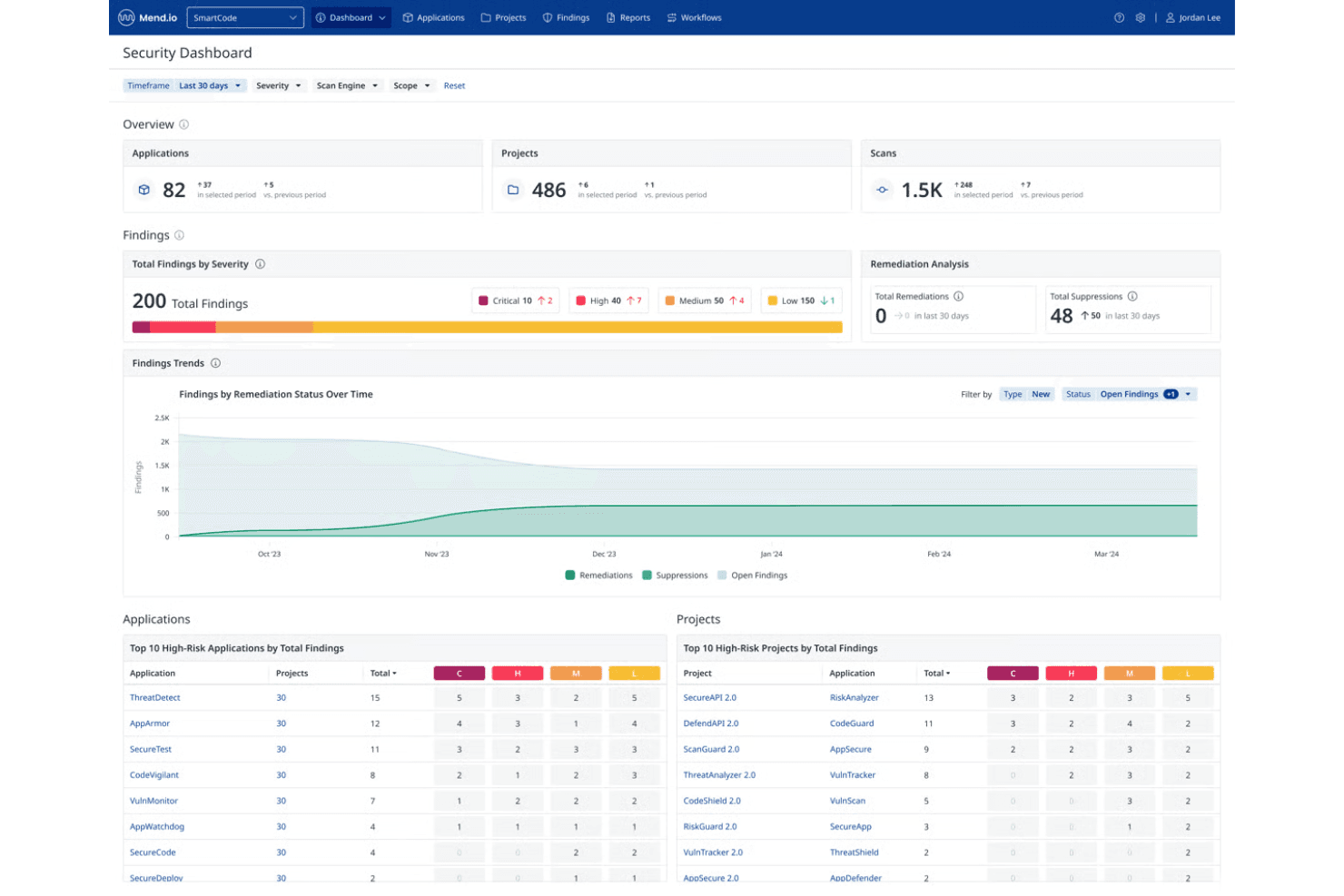
Mend.io maintains SBOMs, VEX data, SPDX/CycloneDX files, and third-party SBOMs. Mend AppSec is an application security platform that unifies SAST, SCA, and container scanning with automated SBOM generation in SPDX and CycloneDX formats, VEX data output, vulnerability prioritization, and license compliance.
Who Is Mend.io Best For?
Mend AppSec is a strong fit for DevSecOps teams and application security engineers who need SBOM generation and vulnerability compliance built directly into their CI/CD pipelines.
Why I Picked Mend.io
I picked Mend.io as one of the best because it builds SBOM compliance directly into the CI/CD pipeline rather than treating it as an afterthought. Every build automatically generates SPDX or CycloneDX SBOMs with VEX data attached, so downstream consumers can immediately see which vulnerabilities are actually exploitable. I also like that the same scan simultaneously feeds vulnerability prioritization using CVSS 4.0, EPSS, and reachability analysis, plus license compliance tracking through the Legal OS Inventory.
Mend.io Key Features
- SBOM generation at org, app, or project scope: Generate dependency SBOMs at organization, application, or project level, with options for per-project or aggregated output across multiple projects.
- Third-party SBOM import: Import SBOMs from tools like cdxgen and Syft in CycloneDX or SPDX formats, with imported projects then monitored for new vulnerabilities.
- Malicious-package detection: Scans open-source dependencies for threats including typosquatting, dependency confusion, data exfiltration, and backdoors.
- Legal OS Inventory: Tracks component licenses with risk scoring, violation alerts, and the ability to assign or override licenses at the organization level.
Mend.io Integrations
Mend.io integrates with GitHub, GitLab, Azure DevOps, Bitbucket, Jenkins, CircleCI, Docker, Amazon ECR, Azure Container Registry, and JFrog Artifactory. It also offers REST APIs for custom integrations and supports CI/CD workflows.
Pros and Cons
Pros:
- Tracks licenses alongside vulnerability triage
- Reachability helps prioritize exploitable dependency findings
- Builds emit SPDX/CycloneDX SBOMs with VEX
Cons:
- False positives can add manual vulnerability triage
- Imports omit source VEX and vulnerability data
Learn more about Mend.io: 3Best for developer-centric vulnerability detection
Snyk
- Free plan + free demo available
- From $25/contributing developer/month
Visit WebsiteCustomer Rating:4.6/5
Snyk scans dependencies, containers, IaC, and exports SBOMs in workflows. Snyk is a developer security platform that scans open source dependencies, containers, and infrastructure-as-code for vulnerabilities while generating and exporting SBOMs directly within developer workflows.
Who Is Snyk Best For?
Snyk is a natural fit for development teams that want security and SBOM generation built into their existing coding and CI/CD workflows.
Why I Picked Snyk
I've included Snyk in my top picks because it's the only tool on this list that surfaces vulnerability findings directly inside the IDE and pull request review, so developers catch open source risks before code ever merges. I particularly like that the Snyk CLI can both generate SBOMs in CycloneDX and SPDX formats and run snyk sbom test against an existing SBOM file to check it for known vulnerabilities.
On top of that, Snyk's Risk Score goes beyond raw CVSS severity by factoring in reachability, exploit maturity, and EPSS scores, which keeps my team focused on what actually matters.
Snyk Key Features
- License compliance scanning: Identifies the license type for every open source package in your project and flags licenses that conflict with your usage policies.
- Dependency graph: Visualizes your full dependency tree, including transitive dependencies, so you can trace exactly where a vulnerable package enters your codebase.
- Automated fix pull requests: Generates pull requests with version upgrades to remediate vulnerable dependencies directly in your repository.
- Container image scanning: Scans Docker and OCI images for vulnerable OS packages and application dependencies layer by layer.
Snyk Integrations
Integrations include GitHub, GitLab, Bitbucket, Azure Repos, Jenkins, CircleCI, GitHub Actions, Azure Pipelines, Jira, and Slack.
Pros and Cons
Pros:
- One-click fix creates PRs for vulnerabilities
- Exports SBOMs in CycloneDX and SPDX formats
- Supports 16 programming languages natively
Cons:
- CLI provides less SBOM detail than UI
- False positives trigger unnecessary vulnerability alerts
Learn more about Snyk: Best for open source risk visibility
- Free demo available
- Pricing upon request

Black Duck SCA identifies OSS components, license issues, and supply risks. Black Duck SCA is a software composition analysis tool that detects open source components across source code, binaries, containers, and code snippets, while managing vulnerability, license compliance, and supply chain risks across the SDLC.
Who Is Black Duck Software Composition Analysis Best For?
Black Duck SCA is a strong fit for enterprise security and legal teams managing large codebases with heavy open source usage across multiple languages and environments.
Why I Picked Black Duck Software Composition Analysis
Black Duck SCA earns its spot on my shortlist because of the depth of its open source risk visibility, which goes further than any other SCA tool I've evaluated.
What sets it apart is the Black Duck Security Advisories (BDSAs), where the Cybersecurity Research Center's analysts validate and augment CVE data, so my team isn't waiting weeks for NVD to catch up on newly disclosed vulnerabilities.
I also rely on its snippet scanning to catch partial open source code that carries license obligations but never shows up in a package manifest.
Black Duck Software Composition Analysis Key Features
- SBOM generation and export: Generate SBOMs in SPDX and CycloneDX formats directly from scan results for compliance reporting and audits.
- Binary scanning: Detect open source components in compiled binaries and containers where source code isn't available.
- Policy management: Define and enforce open source usage policies across teams, flagging violations automatically during builds.
- Upgrade guidance: Surface fix recommendations and suggested version upgrades for vulnerable components directly within scan results.
Black Duck Software Composition Analysis Integrations
Integrations include GitHub, GitLab, Bitbucket, Jenkins, Azure DevOps, GitHub Actions, Jira Software, Slack, Microsoft Teams, and JFrog Artifactory.
Pros and Cons
Pros:
- Policy management enforces open source rules
- Accurate detection of transitive dependencies
- Scans binary files without source code access
Cons:
- Scans run slowly on large codebases
- Initial setup is complex and involved
Learn more about Black Duck Software Composition Analysis: Best for multi-point software artifact attestation
- Free demo available
- Pricing upon request
Visit WebsiteCustomer Rating:1/5
Scribe Security shares SBOMs, signed attestations, VEX, and compliance evidence. Scribe Security Trust Hub is a SaaS platform for software supply chain security that generates, manages, and shares SBOMs alongside cryptographically signed attestations, VEX advisories, and SDLC compliance evidence across software producers and consumers.
Who Is Scribe Security Trust Hub Best For?
Scribe Security Trust Hub suits software development teams that need to prove code integrity and meet supply chain security compliance requirements for their customers or regulators.
Why I Picked Scribe Security Trust Hub
I picked Scribe Security Trust Hub because it's one of the few SBOM platforms that generate cryptographic attestations at every stage of the pipeline, not just at the point of release. What sets it apart is how it captures evidence across source control, CI/CD, and deployment, then aggregates those attestations at the artifact, product, and release levels.
I also like its policy-as-code guardrails, which can block releases that lack required SBOMs or signature verification before they ever reach production.
Scribe Security Trust Hub Key Features
- Centralized SBOM management: Create, store, and share SBOMs alongside associated vulnerabilities, license data, and exploitability scores in one place.
- VEX advisory authoring: Generate and publish Vulnerability Exploitability Exchange (VEX) advisories so consumers know which vulnerabilities in your SBOM are actually exploitable.
- Automated SBOM sharing workflows: Share SBOMs, compliance evidence, and attestations with customers or auditors through controlled, automated distribution workflows.
- SLSA-aligned build metadata tracking: Capture build environment records, including user identity, timestamps, and process metadata, in an audit-ready format to support SLSA and NIST SSDF compliance.
Scribe Security Trust Hub Integrations
Scribe Security Trust Hub integrates with Microsoft Entra ID, Bitbucket, CircleCI, GitHub, GitLab, Jenkins, and Travis CI. It's also available on the AWS Marketplace, and an API is available for custom integrations.
Pros and Cons
Pros:
- Enforces SLSA and SSDF compliance automatically
- Built-in SBOM sharing with external stakeholders
- Attests artifacts across every pipeline stage
Cons:
- English-only interface limits global teams
- Very few third-party user reviews available
Learn more about Scribe Security Trust Hub: Best for continuous vulnerability monitoring
- Free demo available
- Pricing upon request

Cybeats oversees SBOM lifecycles, license risk, vulnerabilities, and vendors. Cybeats is an SBOM lifecycle management platform that covers SBOM generation, storage, vulnerability lifecycle management, license risk assessment, and vendor SBOM ingestion across both SBOM Studio and SBOM Consumer products.
Who Is Cybeats Best For?
Cybeats is a strong fit for security engineers and procurement teams at product-manufacturing companies that need to both manage their own SBOMs and evaluate software risk from third-party vendors.
Why I Picked Cybeats
I picked Cybeats as one of the best because its SBOM Consumer product is built specifically for the vendor side of continuous vulnerability monitoring, which is rare. When a new CVE drops, real-time alerting fires against ingested vendor SBOMs automatically, so my team isn't manually re-checking component lists.
I also like the contextualized threat intelligence layer, which helps prioritize which vulnerabilities actually matter before my team spends time on remediation.
Cybeats Key Features
- SBOM inventory and management: Store, organize, and enrich SBOMs across your entire software portfolio in a centralized repository.
- Vulnerability lifecycle management with VEX and VDP: Track vulnerabilities from identification through remediation using VEX statements and vulnerability disclosure policies.
- Licensing risk assessment: Analyze open source license obligations across all software components to flag compliance issues before they escalate.
- SBOM sharing and exchange: Securely distribute SBOMs to customers or request them from technology providers directly through the platform.
Cybeats Integrations
Cybeats connects SBOM data with existing asset management systems, such as CMDBs or software inventory tools. It integrates with Veracode for SBOM management and offers a GitHub Action to automate SBOM imports into SBOM Studio.
A partnership with Keysight Technologies also brings binary analysis capabilities into the platform. An API is available for custom integrations.
Pros and Cons
Pros:
- Separate products for producers and consumers
- Built-in VEX workflow for vulnerability response
- Supports both CycloneDX and SPDX formats
Cons:
- No publicly listed pricing for budgeting
- Limited third-party native integrations available
Learn more about Cybeats: Best for automated component risk identification
- Free demo available
- From $1,200/year

Sonatype manages SBOM compliance, VEX notes, licenses, and vulnerability risks. Sonatype SBOM Manager is an SBOM compliance platform that automates SBOM ingestion, license management, VEX annotation, and component vulnerability monitoring across first- and third-party software.
Who Is Sonatype SBOM Manager Best For?
Sonatype SBOM Manager is a strong fit for security and compliance teams at software-producing enterprises managing large, complex software supply chains.
Why I Picked Sonatype SBOM Manager
Sonatype SBOM Manager earns its spot on my shortlist because of how it automates component risk identification at scale across both first- and third-party software. I particularly like its VEX annotation workflow, which lets my team track the status and justification of each disclosed vulnerability directly within the SBOM.
Its component intelligence also validates vulnerabilities against Sonatype's own data, so I'm not chasing false positives across a sprawling component inventory.
Sonatype SBOM Manager Key Features
- CycloneDX and SPDX format support: Import and manage SBOMs across both major standard formats, with centralized storage for original and augmented versions.
- AI and Hugging Face model scanning: Inspect AI components and models across first- and third-party SBOMs to surface potential risks before they enter production.
- License obligation workflow: Generates a checklist of actionable tasks for each component and license to resolve open source compliance issues.
- CI/CD pipeline integration: Connects directly into existing pipelines via API to automate SBOM workflows and enforce compliance at every development stage.
Sonatype SBOM Manager Integrations
Integrations include Sonatype Lifecycle, Nexus Repository, Jenkins, GitHub, GitLab, Bitbucket, Jira, CircleCI, Bamboo, and Docker.
Pros and Cons
Pros:
- Built-in AI and Hugging Face scanning
- Supports both CycloneDX and SPDX formats
- Continuous vulnerability monitoring across ingested SBOMs
Cons:
- Policy customization requires a Sonatype Lifecycle license
- No publicly available pricing for budgeting
Learn more about Sonatype SBOM Manager: Best for supply chain integrity verification
- Free demo available
- Pricing upon request

Lineaje secures software supply chains with SBOMs, risk checks, and compliance. Lineaje is a full-lifecycle software supply chain security platform that covers SBOM generation, contextualized risk assessment, self-healing builds, third-party vendor risk management, and regulatory compliance across your entire software portfolio.
Who Is Lineaje Best For?
Lineaje is a strong fit for security and DevSecOps teams at software-producing organizations that need end-to-end visibility into their open source and third-party component risks.
Why I Picked Lineaje
Lineaje earns its spot as one of the best on my shortlist because its supply chain integrity capabilities go well beyond SBOM generation. What I find compelling is geo-provenance tracking, which flags components based on their country of origin and highlights tamper risks before they reach a build.
I also like the self-healing build feature in SBOM360, which auto-fixes vulnerable dependencies in source code and containers rather than just reporting them.
Lineaje Key Features
- SCA360 contextual risk assessment: Scan code and containers within your security boundary, then unify and prioritize vulnerability findings by reachability, severity, exploitability, and maintainability.
- SBOM360 Hub SBOM management: Create, ingest, publish, update, and privately share SBOMs and VEX statements with customers, with search across 170 attributes.
- Third-party risk manager: Ingest and auto-validate vendor SBOMs against industry regulations, track risk across software versions, and identify zero-days in supplier software.
- Gold Open Source catalogue: Access a curated library of vulnerability-free, fully-attested open source packages and container images before they enter your build pipeline.
Lineaje Integrations
Lineaje has a documented partnership with Opsera that combines supply chain intelligence with CI/CD pipeline orchestration, enabling automated vulnerability remediation and secure image delivery. SCA360 is designed to integrate with existing scanning tools to unify findings across source code and containers.
Pros and Cons
Pros:
- Strong federal and regulatory compliance support
- Auto-generates fix plans for vulnerabilities
- Deep provenance and tamper detection capabilities
Cons:
- Multi-product portfolio can feel overwhelming initially
- Limited third-party reviews and community feedback
Learn more about Lineaje: Best for dependency lifecycle management
- Free plan + free demo available
- Pricing upon request

Endor Labs detects dependency risks, SBOM gaps, malicious packages, and secrets. Endor Labs is an application security platform built around software composition analysis (SCA), SBOM generation and management, dependency lifecycle tracking, malicious package detection, and secrets detection across source code, containers, and CI/CD pipelines.
Who Is Endor Labs Best For?
Endor Labs suits AppSec and DevSecOps teams that need SBOM compliance reporting alongside continuous dependency monitoring in a single platform.
Why I Picked Endor Labs
I picked Endor Labs as one of the best because its approach to dependency lifecycle management goes well beyond basic SBOM generation. The SBOM Hub centralizes first- and third-party SBOMs in one place, supports both CycloneDX and SPDX formats, and plugs into CI pipelines to auto-generate an updated SBOM every time a new version ships.
What I find most useful is the continuous risk monitoring: once a dependency is tracked in the Hub, Endor Labs automatically updates its risk profile as new CVEs and security advisories are published, without requiring you to recreate the SBOM from scratch.
Endor Labs Key Features
- Malicious package detection: Scans open source packages for typosquatting, dependency confusion, and obfuscated exfiltration scripts before they're imported into your codebase.
- Package Firewall: Blocks vulnerable and malicious packages before they reach developer machines or CI pipelines, enforcing allow/deny policies at the point of ingestion.
- VEX generation: Produces Vulnerability Exploitability eXchange (VEX) documents alongside SBOMs to declare which vulnerabilities are not exploitable in your specific application context.
- Upgrade impact analysis: Maps the blast radius of a dependency upgrade across your codebase before you apply it, so you can assess breaking changes before committing to a fix.
Endor Labs Integrations
Integrations include GitHub, GitLab, Jenkins, Jira, Slack, Bitbucket, Buildkite, CircleCI, Microsoft Defender for Cloud, and Vanta.
Pros and Cons
Pros:
- Centralized hub for first and third-party SBOMs
- Automated SBOM updates with new advisories
- Reachability analysis filters out unexploitable CVEs
Cons:
- Limited language support compared to some competitors
- Initial onboarding requires significant configuration effort
Learn more about Endor Labs: Best for verifying supplier component claims
- Free demo available
- Pricing upon request

Finite State checks firmware, binaries, SBOMs, VEX docs, and compliance risks. At its core, Finite State is a product security and SBOM platform built around firmware and binary analysis, covering software composition analysis, vulnerability detection, VEX document generation, and compliance reporting.
Who Is Finite State Best For?
Finite State is a strong fit for product security engineers and supply chain risk managers at hardware manufacturers who need to validate the accuracy of third-party supplier SBOMs against what's actually running in firmware.
Why I Picked Finite State
I've included Finite State in my top picks because it's the only SBOM tool I've used that lets my team actually verify what a supplier says is in their firmware against what binary analysis finds. It's binary SCA scans firmware images directly, so I don't have to trust supplier-provided SBOMs at face value.
When there's a mismatch, I can pull component-level evidence to back it up, which is something most source-code-only tools simply can't do.
Finite State Key Features
- VEX document generation: Create Vulnerability Exploitability eXchange documents to communicate the exploitability status of CVEs tied to specific products.
- Multi-format SBOM export: Generate and export SBOMs in both CycloneDX and SPDX formats to meet different regulatory and customer requirements.
- Compliance reporting: Run automated compliance checks against frameworks like FDA cybersecurity guidance and IEC 62443 directly within the platform.
- CVE prioritization: Automatically score and rank vulnerabilities by severity and exploitability to help your team triage findings across large component inventories.
Finite State Integrations
Finite State offers native CI/CD integrations with Jenkins, GitHub Actions, and GitLab CI, along with CLI tools and a REST API for custom integrations. The platform also supports importing third-party scan results from tools like GitLab SAST, DAST, and Container Scan, which lets you consolidate findings from your existing security tooling into one place.
Pros and Cons
Pros:
- Strong regulatory compliance mapping for devices
- Automatic SBOM-to-firmware discrepancy detection
- Binary-level firmware scanning without source code
Cons:
- Scan processing times can be slow
- Limited applicability outside embedded firmware use cases
Learn more about Finite State:
Outro software SBOM
Eis algumas opções adicionais de software SBOM que não entraram na minha seleção, mas que vale a pena conhecer:
- 11ManifestBest for automated supply chain documentation
- 12CybellumBest for product security across device portfolios
- 13XygeniBest for detecting active code tampering
- 14GitLabBest for built-in CI workflow compatibility
- 15CheckmarxBest for AI-powered vulnerability discovery
- 16AnchoreBest for policy-driven compliance automation
- 17FOSSABest for audit-ready due diligence reporting
- 18JFrog XrayBest for deep IDE integration support
- 19ChainguardBest for SLSA-compliant artifact provenance
- 20ONEKEYBest for connected device lifecycle coverage
How I Evaluate SBOM Software
I split my evaluation into two layers—the baseline capabilities a tool must deliver (like generating CycloneDX or SPDX SBOMs from containers and binaries) and the differentiators that determine which tool fits your specific pipeline, compliance mandate, or supply chain risk model.
Core Functionality (Table Stakes For This List)
When I'm selecting tools for my list, I rank each one on a scale from 0 (does not offer the functionality) to 5 (excels in this area) for each core functionality listed below. Then, I calculate the tool's total score into a percentage. Each tool needs to achieve a minimum total score of 65% to be considered for inclusion.
- SBOM Generation: I check whether a tool can scan beyond just source manifests—generating SBOMs from container images, compiled binaries, and build artifacts matters when you're shipping pre-built software.
- Standard Format Support: Each tool should support SPDX and CycloneDX import and export, since customers and regulators will ask for SBOMs in specific formats you can't always predict.
- Vulnerability Detection: I look for correlation against multiple vulnerability databases (NVD, GitHub Advisory, OSV) rather than a single feed, plus clear risk scoring that helps prioritize what to patch first.
- License & Compliance Tracking: Tools earn higher marks when they go beyond detecting license types and offer a policy engine where you can set rules—like flagging AGPL components in proprietary builds automatically.
- SBOM Repository & Lifecycle Management: I evaluate how each tool stores and versions SBOMs over time, including whether you can diff two versions to spot unexpected dependency changes between releases.
- CI/CD & Toolchain Integration: Native plugins for platforms like Jenkins, GitHub Actions, and GitLab CI matter, but I also look for API access that lets platform engineering teams embed SBOM generation into custom pipelines.
Once I have a list of tools that meet this criteria, I consider what sets each platform apart.
Differentiating Factors (What Sets Vendors Apart)
Here's how I compare and contrast different vendors:
Standout Features
VEX support is a major differentiator. When a CVE hits a library you ship but the vulnerable code path isn't reachable, you need a way to communicate that. VEX documents let you tell downstream consumers exactly which vulnerabilities apply, cutting false-positive noise. Binary and container analysis also separates vendors—tools that generate SBOMs from compiled artifacts cover pre-built software that source-only scanning misses. I also evaluate continuous vulnerability monitoring, where the tool alerts you when newly disclosed CVEs affect components in previously shipped releases.
Beyond Features
Deployment flexibility matters a lot in this space. Teams in defense or critical infrastructure often need air-gapped or self-hosted options, so I check whether a vendor supports those models alongside SaaS. Regulatory alignment is another factor I weigh—specifically whether the tool maps outputs to frameworks like EO 14028, NTIA minimum elements, or the EU Cyber Resilience Act. I also look at SBOM sharing capabilities, since many organizations need to distribute SBOMs to customers or ingest them from upstream suppliers to get full supply chain visibility.
Como escolher software SBOM
É fácil perder-se em listas extensas de funcionalidades e estruturas de preços complexas. Para o ajudar a manter o foco enquanto percorre o seu processo específico de seleção de software, eis uma lista de verificação dos fatores a ter em conta:
| Fator | O que considerar |
|---|---|
| FatorEscalabilidade | O que considerarA ferramenta conseguirá acompanhar o crescimento da sua base de código e das dependências ao longo do tempo? Considere a expansão futura do produto e a evolução das necessidades da equipa ou dos requisitos regulamentares. |
| FatorIntegrações | O que considerarEstabelece ligação nativa ao seu CI/CD, repositórios, registos e sistemas de gestão de pedidos? Valide as integrações oficiais com as principais plataformas utilizadas. |
| FatorPersonalização | O que considerarPode adaptar os fluxos de trabalho, as regras de políticas e os relatórios para se ajustarem ao seu processo de segurança? Tenha cuidado com ferramentas rígidas, criadas apenas para fluxos de trabalho simples ou genéricos. |
| FatorFacilidade de utilização | O que considerarAs suas equipas de engenharia, segurança e conformidade conseguirão utilizar a ferramenta sem formação extensa? Teste-a com fluxos de trabalho reais antes de tomar uma decisão. |
| FatorImplementação e integração inicial | O que considerarO processo de implementação é simples ou existem necessidades complexas de infraestrutura? Informe-se sobre a migração, o suporte e o tempo entre a compra e a obtenção de valor. |
| FatorCusto | O que considerarOs níveis de preços são claros e a que ritmo poderão aumentar os custos à medida que adiciona utilizadores, pipelines ou artefactos? Tenha em conta tanto as despesas iniciais como as recorrentes. |
| FatorSalvaguardas de segurança | O que considerarA ferramenta suporta necessidades de implementação segura, como SSO, RBAC ou instalações isoladas? Verifique o registo de auditoria e a conformidade com as políticas internas. |
| FatorRequisitos de conformidade | O que considerarO fornecedor consegue documentar o alinhamento com os requisitos do seu setor, como a EO 14028, a NTIA ou normas internacionais? Solicite provas ou declarações de conformidade devidamente mapeadas. |
O que é o software SBOM?
O software SBOM gera automaticamente uma lista de materiais de software (SBOM) que inventaria todos os componentes, dependências e respetivas licenças numa base de código ou artefacto.
Estas ferramentas ajudam as equipas a acompanhar bibliotecas de código aberto e de terceiros, monitorizar vulnerabilidades e manter a conformidade com os requisitos do setor e regulamentares durante todo o ciclo de vida de desenvolvimento e implementação do software.
Características
Ao selecionar software de SBOM, tenha em atenção as seguintes características principais:
- Geração de SBOM: Produz um inventário atualizado de todos os componentes de software, dependências e metadados através da análise do código-fonte, de contentores ou de binários.
- Suporte de formatos: Permite importar e exportar formatos de SBOM padrão do setor, como SPDX, CycloneDX e SWID, para garantir uma ampla compatibilidade.
- Deteção de vulnerabilidades: Correlaciona os componentes listados com bases de dados de vulnerabilidades, identificando riscos conhecidos e alertando as equipas para problemas ao longo do ciclo de vida do software.
- Monitorização da conformidade das licenças: Identifica e monitoriza licenças de código aberto e proprietárias, ajudando as organizações a detetar potenciais conflitos e a cumprir os requisitos de conformidade.
- Integração com CI/CD: Integra-se em pipelines de compilação, repositórios de código-fonte e registos de artefactos para automatizar a geração de SBOM durante a integração e a implementação contínuas.
- Repositório de SBOM: Disponibiliza armazenamento seguro e centralizado para todas as SBOM geradas, permitindo o controlo de versões, o controlo de acessos e comparações históricas.
- Comparação de componentes: Monitoriza as alterações entre versões de SBOM para destacar componentes adicionados, removidos ou atualizados entre versões.
- Aplicação de políticas personalizadas: Permite às equipas definir e automatizar verificações de segurança e de licenças, bloqueando implementações que não cumpram as normas organizacionais.
- Partilha e distribuição de SBOM: Permite a partilha segura de SBOM com clientes, parceiros ou entidades reguladoras através de portais dedicados ou de mecanismos de distribuição.
Benefícios
A implementação de software de SBOM proporciona vários benefícios à sua equipa e à sua empresa. Eis alguns dos benefícios que pode esperar:
- Maior visibilidade da cadeia de fornecimento: Obtenha informações sobre todos os componentes de software e dependências utilizados nos seus produtos, reduzindo o risco de vulnerabilidades ocultas.
- Resposta mais rápida às vulnerabilidades: Receba alertas em tempo real quando novas CVE afetarem os componentes implementados, para que a sua equipa possa dar prioridade às ameaças e corrigi-las rapidamente.
- Conformidade automatizada: Cumpra os requisitos regulamentares e dos clientes com formatos de SBOM normalizados e monitorização de licenças integrados no seu processo de desenvolvimento.
- Redução dos riscos relacionados com licenças: Identifique rapidamente conflitos e obrigações associados a licenças de código aberto que possam criar exposição jurídica ou problemas de conformidade.
- Colaboração simplificada: Partilhe SBOM atualizadas de forma segura com equipas internas, clientes e auditores para criar confiança e acelerar a comunicação.
- Monitorização das alterações e auditabilidade: Monitorize as alterações aos componentes entre versões, facilitando a auditoria do histórico do software e a demonstração da devida diligência.
- Flexibilidade de implementação: Escolha ferramentas adequadas à sua infraestrutura, quer sejam baseadas na nuvem, instaladas localmente ou isoladas de redes externas, para responder às suas necessidades empresariais e de segurança.
Custos e preços
A seleção de software de SBOM requer uma compreensão dos vários modelos de preços e planos disponíveis. Os custos variam consoante as características, o tamanho da equipa, os complementos, entre outros fatores. A tabela abaixo resume os planos comuns, os respetivos preços médios e as características normalmente incluídas nas soluções de software de SBOM:
Tabela de comparação de planos de software de SBOM
| Tipo de plano | Preço médio | Características comuns |
|---|---|---|
| Tipo de planoPlano gratuito | Preço médio$0 | Características comunsSuporta a geração básica de SBOM, análise limitada de vulnerabilidades, exportações manuais e apoio da comunidade. |
| Tipo de planoPlano pessoal | Preço médio$10-$30/utilizador/mês | Características comunsInclui suporte avançado de formatos, monitorização individual de licenças, verificações básicas de políticas e notificações por e-mail. |
| Tipo de planoPlano empresarial | Preço médio$40-$80/utilizador/mês | Características comunsAdiciona integrações com CI/CD, repositório centralizado de SBOM, alertas de conformidade automatizados, gestão de equipas e acesso à API. |
| Tipo de planoPlano empresarial avançado | Preço médio$100+/utilizador/mês | Características comunsDisponibiliza integração inicial dedicada, aplicação de políticas personalizadas, implementação isolada de redes externas, RBAC avançado e apoio prioritário. |
Perguntas frequentes sobre software SBOM
Eis algumas respostas a perguntas comuns sobre software SBOM:
Preciso de software SBOM se a minha equipa criar tudo de raiz?
Sim, o software SBOM continua a ser valioso mesmo que a sua equipa escreva a maior parte do código internamente. A maioria dos projetos depende de dependências de terceiros, software de código aberto ou estruturas, e as ferramentas SBOM ajudam a monitorizar e gerir estes componentes para fins de segurança e conformidade. É essencial monitorizar todos os pacotes de software, uma vez que podem existir riscos de segurança ocultos em qualquer ecossistema de desenvolvimento.
Com que frequência devemos atualizar os nossos SBOMs?
Deve atualizar os seus SBOMs a cada lançamento e sempre que existam alterações à sua base de código ou às dependências. Isto garante que o seu inventário é exato e permite responder rapidamente às vulnerabilidades quando surgem novas ameaças. Manter esta informação atualizada é uma das principais formas de os SBOMs ajudarem as organizações a defender-se contra ataques sofisticados à cadeia de fornecimento e a lidar com incidentes de segurança.
O software SBOM pode integrar-se nos nossos pipelines de CI/CD existentes?
Sim, a maioria das ferramentas SBOM oferece extensões ou integração baseada em API para ferramentas populares de CI/CD, como Jenkins, GitHub Actions ou GitLab CI. Isto permite a geração automatizada de SBOMs, a monitorização das dependências de software e a verificação de vulnerabilidades de segurança como parte do seu processo de implementação. Esta troca automatizada de dados fornece um inventário legível por máquina de todos os produtos de software que implementa, quer funcionem em Linux ou noutras plataformas.
Que normas regulamentares exigem SBOMs?
Regulamentos como a Ordem Executiva 14028 do Governo dos EUA, as orientações da FDA sobre cibersegurança antes da comercialização e o Regulamento Europeu de Ciber-resiliência estão a impulsionar a utilização de SBOMs. Muitos setores preveem que a especificação dos elementos mínimos de um sistema — incluindo informações sobre licenças — se torne um requisito contratual para as agências federais e para o governo federal em geral.
Quão seguros são os dados geridos pelo software SBOM?
O software SBOM pode ser implementado como SaaS, no local ou em ambientes isolados de redes externas. Procure controlos de acesso baseados em funções, encriptação e certificações de conformidade que estejam alinhados com as políticas de segurança da sua organização e reduzam os riscos de exposição de dados.