

Ao explorar o complexo mundo da autenticação de utilizadores, passei a valorizar o software de autenticação multifator. Com o aumento das violações de dados, é essencial proteger as contas online para além das simples palavras-passe. Isto vai além da combinação tradicional de nome de utilizador e palavra-passe e pode incluir algo que o utilizador sabe, algo que o utilizador possui ou algo inerente ao utilizador.
Estas ferramentas não só garantem que os utilizadores finais obtêm acesso seguro através de códigos de acesso e aprovisionamento autónomo, como também melhoram o acesso remoto, ligando as identidades dos utilizadores baseadas na Web de forma mais segura. Os pontos problemáticos? Gerir várias autenticações de utilizadores, a gestão de identidades e acessos (IAM) e garantir o acesso remoto sem comprometer a segurança. Mas, com o software adequado, estes desafios são resolvidos, reforçando a proteção das suas contas contra violações.
Why Trust Our Software Recommendations
6,700+
Reviews
20
Industry experts
16+
Evaluation factors
14
Years
Our team has been testing and reviewing software since 2012. As tech leaders ourselves, we know how difficult—and important—it is to choose the right software.
For this guide, we evaluated tools using hands-on testing and independent research, scoring tools using our selection criteria.
Our reviews reflect our human editorial judgment, not a sales pitch.
Expert reviewers:
- Paulo Gardini MiguelTech Director
 Tim FisherVP of AI
 Gabriel RosasTech Lead & Software Architect
 Christhian GruhnTech Lead & Platform Architect

Tabela comparativa de software de autenticação multifator
Esta tabela comparativa resume os detalhes de preços das minhas principais seleções de software MFA:
| Tool | Best For | Trial Info | Price | ||
|---|---|---|---|---|---|
| 1 | Best for HR-driven MFA policy and device trust | 14-day free trial | From $8/user/month (billed annually) | Website | |
| 2 | Best for adaptive MFA with multiple authentication factors | Free version available (up to 50 domain users) | From $595 (500 domain users) | Website | |
| 3 | Best with just-in-time privileged access controls | 14-day free trial | Pricing upon request | Website | |
| 4 | Best for combining password management and MFA | 30-day free trial + free plan available | From $3/user/month (billed annually) | Website | |
| 5 | Best for SaaS companies needing rapid integration | 30 Days Free Trial | From $99/month for up to 10 multi-user accounts and 1,000 users. | Website | |
| 6 | Best for adaptive multi-factor authentication | 30-day free trial | From $2/user/month | Website | |
| 7 | Best for achieving passwordless authentication | Free 14-Day Trial | From $8/user/month (billed annually) | Website | |
| 8 | Best for SMS and call verification | From $15/user/month | Website | ||
| 9 | Best for scalable enterprise authentication | Free trial available | From $35/month | Website | |
| 10 | Best for those already in the Salesforce environment | Free plan available | From $25/user/month (billed annually) | Website |


Avaliações do melhor software de autenticação multifator
Seguem-se os meus resumos detalhados dos melhores softwares de autenticação multifator que incluí na minha lista restrita. As minhas avaliações oferecem uma análise detalhada das principais funcionalidades, vantagens & desvantagens, integrações e casos de utilização ideais de cada ferramenta, para o ajudar a encontrar a melhor opção para si.
 Best for HR-driven MFA policy and device trust
- 14-day free trial
- From $8/user/month (billed annually)
Visit WebsiteCustomer Rating:4.7/5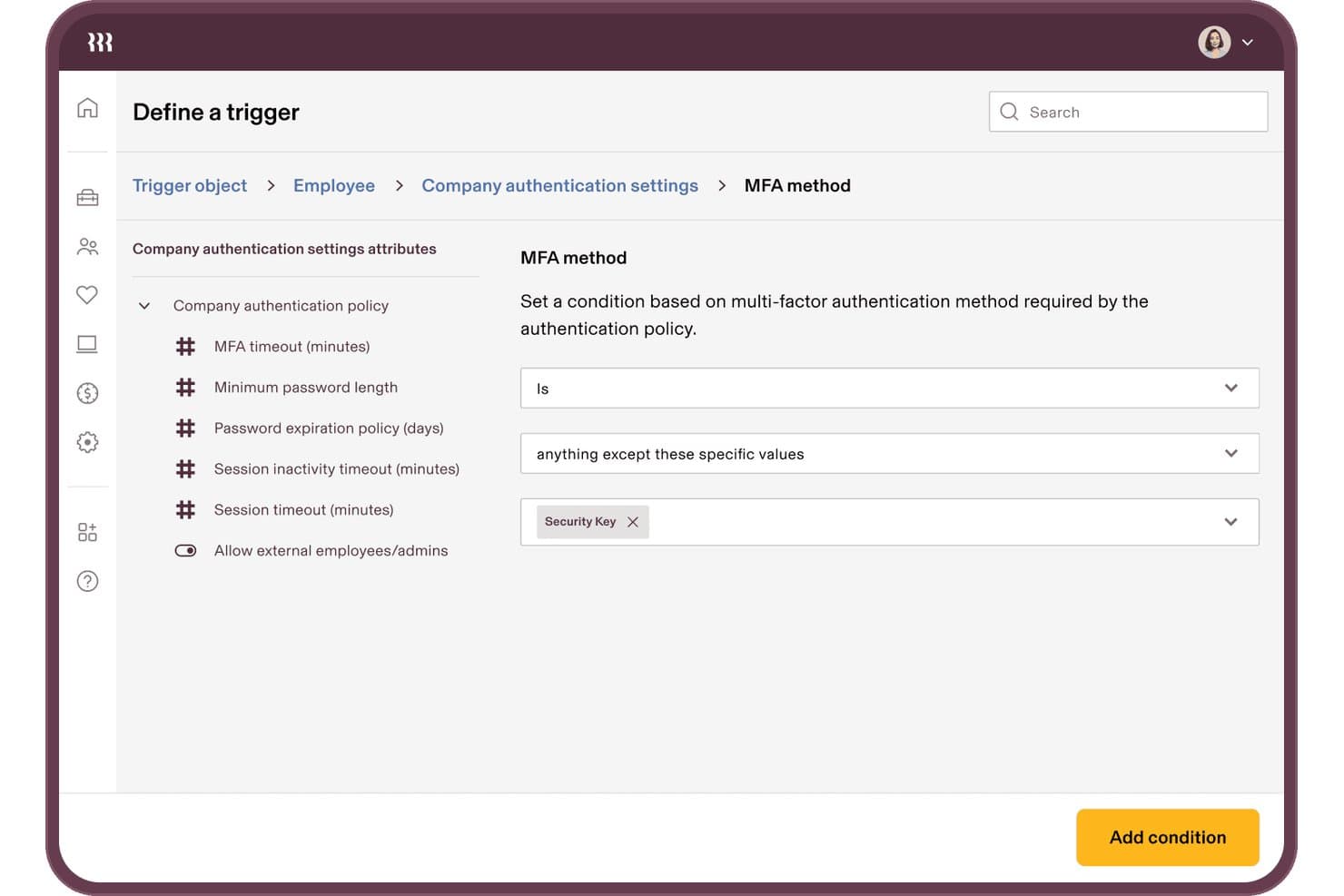
Rippling IT lets users set MFA method conditions for authentication triggers. Rippling IT is an HR-driven identity and access management platform that bundles MFA, SSO, device trust, and lifecycle provisioning into a single system tied directly to your HR data.
Who Is Rippling IT Best For?
Rippling IT fits mid-market companies that want MFA, device trust, and access lifecycle managed from a single HR-connected platform.
Why I Picked Rippling IT
I picked Rippling IT because it's the only MFA solution on this list that ties authentication policy directly to your HR data. When someone changes departments or gets offboarded, their MFA enrollment and access rights update automatically, with no manual intervention needed. I also love that device trust is built in natively: Rippling issues its own device certificates and checks posture at the moment of access, so a laptop missing BitLocker encryption gets blocked before it ever authenticates.
Rippling IT Key Features
- Supergroups policy targeting: Dynamic groups built from HR attributes like department, location, and role let you apply MFA policies to exactly the right users.
- YubiKey ordering and assignment: Order, ship, and assign hardware keys to employees directly from the Rippling console, with automatic alerts if a delivered key goes unused.
- Hosted cloud RADIUS: Employees authenticate to VPN and Wi-Fi using their Rippling credentials through a cloud-hosted RADIUS server.
- Workflow Studio automation: A no-code automation builder lets you monitor MFA enrollment, trigger policy actions, and manage access changes without writing custom scripts.
Rippling IT Integrations
Rippling IT integrates with Active Directory, Microsoft Entra ID, Google Workspace, Okta, and Duo, plus 600–800+ listed SaaS apps. It supports SAML, OIDC, SCIM, LDAP, and RADIUS, with a public API for custom integrations.
Pros and Cons
Pros:
- Supergroups target policies by employee attributes
- Device trust blocks noncompliant endpoints
- HR-driven offboarding updates MFA automatically
Cons:
- Advanced policy configuration takes substantial effort
- MFA depends on adopting Rippling's platform
Learn more about Rippling IT: Best for adaptive MFA with multiple authentication factors
- Free version available (up to 50 domain users)
- From $595 (500 domain users)
Visit WebsiteCustomer Rating:4.4/5
Users have multiple configuration options available for setting up authentication methods in ManageEngine ADSelfService Plus. ManageEngine ADSelfService Plus is a comprehensive self-service password management and single sign-on (SSO) solution designed to streamline IT operations and enhance security. It caters to IT admins and end-users by providing functionalities such as password self-service, multi-factor authentication (MFA), and endpoint security.
Why I Picked ManageEngine ADSelfService Plus: ADSelfService Plus supports various authentication techniques such as biometrics, TOTP codes, push notifications, and security keys, which enhance the security landscape by adding multiple layers of verification beyond the traditional username and password. This adaptability in authentication methods ensures that organizations can tailor their security protocols to meet specific needs and compliance requirements. Furthermore, its adaptive MFA feature dynamically adjusts authentication requirements based on risk factors like user location and device type, providing a nuanced and context-aware security measure.
Standout features & integrations:
Other features include Single Sign-On (SSO), which integrates seamlessly with both on-premises and cloud-based applications, offering a unified and secure login experience across different environments. The tool also has self-service password management capabilities to allow users to reset passwords and unlock accounts independently. Integrations include Zendesk, Freshdesk, Splunk, syslog, and other ManageEngine applications like ManageEngine ADManager Plus and AD360.
Pros and Cons
Pros:
- Extensive reporting features for audits and compliance
- Various MFA options
- Self-service password reset
Cons:
- Free version has limited features
- Can be expensive for smaller organizations
Learn more about ManageEngine ADSelfService Plus: Best with just-in-time privileged access controls
- 14-day free trial
- Pricing upon request
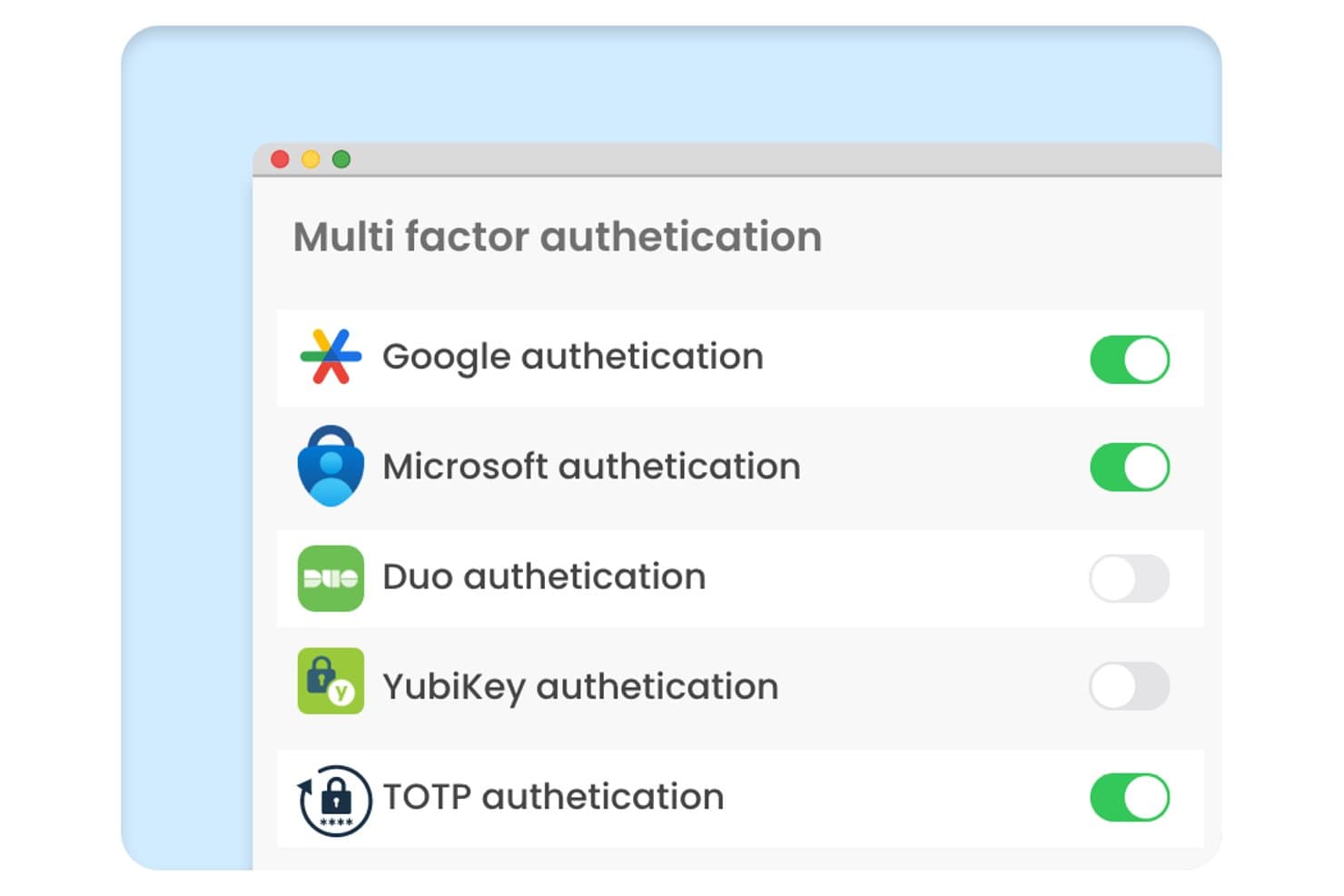
Securden Unified PAM offers a Multi Factor Authentication settings panel with toggle controls for Google, Microsoft, Duo, YubiKey, and TOTP authentication methods. Securden Unified PAM is a privileged access management platform that enforces MFA across privileged accounts, remote sessions, and endpoints through credential vaulting, session recording, and just-in-time access controls.
Who Is Securden Unified PAM Best For?
IT security and IAM teams at mid-to-enterprise organizations that need strict MFA enforcement specifically around privileged accounts, admin credentials, and vendor access.
Why I Picked Securden Unified PAM
I picked Securden Unified PAM because its just-in-time access model ties MFA enforcement directly to the moment a privileged session is requested, not just at login. I also like how adaptive MFA activates based on behavioral anomalies, so a sysadmin connecting to a production server at an unusual hour automatically triggers step-up authentication. On top of that, the platform generates TOTPs for managed accounts directly, closing the MFA gap on shared credentials that typically go unprotected.
Securden Unified PAM Key Features
- Centralized privileged account discovery: Automatically scans your environment to identify unmanaged privileged credentials and accounts.
- Role-based access control: Lets you assign granular permissions using custom user roles and security groups.
- Privileged session recording: Records all privileged sessions for forensic auditing and regulatory compliance.
- SIEM and ITSM integrations: Connects with platforms like Splunk, IBM QRadar, and ServiceNow for unified monitoring and incident response.
Securden Unified PAM Integrations
Securden Unified PAM offers native integrations with Active Directory, Microsoft Entra ID, Okta, OneLogin, Ping Identity, Splunk, IBM QRadar, and ServiceNow. An API is available for custom integrations.
Pros and Cons
Pros:
- Behavioral anomaly detection triggers step-up authentication
- MFA enforced natively on shared admin credentials
- Just-in-time access reduces standing privilege exposure
Cons:
- Reporting dashboards lack visual customization options
- Setup complexity increases for large-scale deployments
Learn more about Securden Unified PAM: Best for combining password management and MFA
- 30-day free trial + free plan available
- From $3/user/month (billed annually)
Visit WebsiteCustomer Rating:4.6/5
Image 10: LastPass passwordless authentication interface LastPass functions as a comprehensive tool designed to both manage passwords securely and offer multi-factor authentication (MFA). It has cleverly combined these two essential features, making it an ideal choice for those who prioritize both password management and improved authentication.
Why I Picked LastPass: During my selection process, LastPass distinctly stood out because of its dual capability: managing passwords while also offering MFA. Comparing it with other tools, its comprehensive approach to security is what I found to be unique. My judgment is that for individuals or businesses that see the value in uniting password management with MFA, LastPass is a fitting choice.
Standout features & integrations:
LastPass provides a secure vault for storing passwords, notes, and other credentials, all of which are encrypted locally on the user's device. Additionally, its MFA functionality is robust, integrating biometric and contextual factors for improved security. Integration-wise, LastPass can be coupled with numerous web browsers, and platforms, and has extensions that ensure its functionality is easily accessible across devices.
Pros and Cons
Pros:
- Wide range of browser and platform integrations
- Local encryption ensures user data remains private
- Combines password management and MFA in one platform
Cons:
- Some advanced features are only available in higher-priced tiers
- The user interface might be challenging for non-tech-savvy individuals
- Annual billing may not appeal to all users
Learn more about LastPass: Best for SaaS companies needing rapid integration
- 30 Days Free Trial
- From $99/month for up to 10 multi-user accounts and 1,000 users.
Visit WebsiteCustomer Rating:4.8/5
Image 6: Frontegg's authentication builder style overview Frontegg is a platform designed to empower SaaS companies with pre-built, fully customizable functionalities to enhance their applications. This approach significantly accelerates integration processes, making it particularly advantageous for SaaS firms aiming for swift incorporation of essential features.
Why I Picked Frontegg: In the process of determining the most valuable tools for this list, Frontegg caught my attention due to its targeted approach to serving SaaS companies. Its capability to provide rapid integration truly differentiates it from other platforms. I judged that Frontegg is indeed the top choice for SaaS entities requiring quick feature integration.
Standout features & integrations:
Frontegg offers a suite of pre-built SaaS functionalities, ranging from user management, and notifications, to security and auditing capabilities. Their approach allows companies to skip lengthy development processes and immediately tap into proven features. Furthermore, Frontegg's integrations with popular platforms like Slack, Azure, and AWS ensure its functionalities can easily complement existing tech stacks.
Pros and Cons
Pros:
- Extensive integration options with major platforms
- Pre-built functionalities eliminate lengthy development times
- Tailored solutions specifically for SaaS companies
Cons:
- Pricing transparency could be improved
- Customizability could come with a learning curve for some
- Might not be suitable for non-SaaS companies
Learn more about Frontegg: Best for adaptive multi-factor authentication
- 30-day free trial
- From $2/user/month
Visit WebsiteCustomer Rating:4.5/5
miniOrange IDP dashboard showing centralized identity management, SSO configuration, and multi-factor authentication setup from a single admin console. For those seeking a multi-factor authentication solution that combines security with ease of use, miniOrange IDP offers a compelling choice. It caters to businesses across various industries looking to enhance their security measures without complicating user access. By integrating additional verification methods, miniOrange IDP helps organizations safeguard sensitive information while maintaining a user-friendly login experience.
Why I Picked miniOrange IDP
I picked miniOrange IDP for its adaptive multi-factor authentication, which intelligently adjusts security measures based on user behaviour and risk levels. This feature ensures that your team remains secure without unnecessary interruptions. Additionally, the platform's extensive integration capabilities with over 6000 applications make it a versatile choice for businesses looking to streamline their access management. miniOrange IDP's centralized dashboard allows administrators to efficiently manage user access and monitor security policies, addressing common concerns around managing diverse user environments.
miniOrange IDP Key Features
In addition to its adaptive multi-factor authentication and integration capabilities, I also found the following useful:
- Multiple MFA Methods: Supports push notifications, OTP via SMS and email, Google Authenticator, hardware tokens, biometrics, and security questions.
- Passwordless Authentication: Enables passwordless login using FIDO2, biometrics, and push-based authentication methods.
- Conditional Access Policies: Applies authentication requirements based on user behaviour, device, location, and risk level.
- Self-Service Options: Allows users to reset passwords and configure their own MFA methods, which can help reduce IT support requests.
- Endpoint & VPN Protection: Secures VPN access as well as Windows, macOS, and Linux logins.
miniOrange IDP Integrations
Integrations include Microsoft 365, Google Workspace, AWS, Salesforce, Slack, Zoom, ServiceNow, Atlassian, GitHub, Dropbox, and WordPress. The platform supports integration with over 6,000 cloud, on-prem, and legacy applications. An API is also available for custom or proprietary application integrations.
Pros and Cons
Pros:
- Supports branded, customizable logins
- Centralized dashboard for user and policy management
- Robust adaptive MFA and security features
Cons:
- Initial setup can be complex, especially for small organizations
- Restrictive refund policies
Learn more about miniOrange: Best for achieving passwordless authentication
- Free 14-Day Trial
- From $8/user/month (billed annually)
Visit WebsiteCustomer Rating:4.4/5
Image 4: Uniqkey dashboard preview Uniqkey is a robust authentication solution designed to offer users the convenience and security of passwordless authentication. Uniqkey stands as a formidable option to bridge this transition, particularly for those who prioritize passwordless solutions.
Why I Picked Uniqkey: In the process of determining the best tools for this list, Uniqkey grabbed my attention because of its dedication to a passwordless environment. Its focus on such a specific and critical area of cybersecurity made it different from many others I compared. I judged it as the best tool for those who are looking to achieve passwordless authentication, given its specialized approach and effectiveness in this domain.
Standout features & integrations:
Uniqkey's primary strength is its adaptive authentication which analyzes risk factors in real-time to determine the necessary level of verification. Moreover, it offers biometric verification options and a secure password vault for users who might still have some passwords to manage. For integrations, Uniqkey is compatible with a range of enterprise systems, ensuring businesses can incorporate it without causing disruptions to existing workflows.
Pros and Cons
Pros:
- Secure vault for residual passwords
- Adaptive authentication based on real-time risks
- Dedicated to a passwordless environment
Cons:
- Relatively new in the market, which might concern some users seeking established brands
- Limited to certain platforms and devices
- Might have a learning curve for those new to passwordless systems
Learn more about Uniqkey:

Image 2: RingCaptcha sample dashboard RingCaptcha stands as a specialized tool geared towards ensuring reliable user verification via SMS and voice calls. As businesses today seek tighter security measures, especially during user onboarding, RingCaptcha emerges as a frontrunner with its focus on mobile verification, aligning it perfectly with the title of being the best in SMS and call verification.
Why I Picked RingCaptcha: In the process of choosing the right tools for this list, RingCaptcha caught my attention due to its sheer specificity and prowess in mobile-based verification. RingCaptcha's specialization in SMS and call verification made it distinct. This dedication to mobile verification is why I determined it's the best for businesses relying heavily on these methods.
Standout features & integrations:
RingCaptcha's core strength lies in its rapid SMS delivery, robust voice call verification, and user-friendly dashboard to track and manage verifications. Regarding integration, RingCaptcha is versatile, integrating smoothly with platforms like Shopify, WordPress, and WooCommerce, ensuring a wider reach and applicability across different business models.
Pros and Cons
Pros:
- User-centric dashboard for tracking
- Rapid SMS delivery mechanism
- Specializes in SMS and voice call verifications
Cons:
- Limited features beyond mobile verification
- Higher price point compared to some competitors
- Might be over-specific for businesses needing varied verification methods
Learn more about RingCaptcha:

Image 1: Auth0 multi factor authentication software Auth0 is a leading identity management platform designed to simplify authentication and authorization for businesses of all sizes. Tailored especially for enterprises, it ensures that as businesses grow, their security measures scale with them, making it a top pick for scalable enterprise authentication.
Why I Picked Auth0: When I was selecting an authentication tool, Auth0 consistently emerged at the forefront of the options. Its reputation for robustness and adaptability in the identity management space set it apart from its peers. In comparing it to other tools, its scalability especially for larger corporations cemented its position as the best for scalable enterprise authentication in my opinion.
Standout features & integrations:
Among its myriad of features, Auth0's Single Sign-On, Adaptive Multifactor Authentication, and user-friendly administration dashboard are particularly noteworthy. When considering integrations, Auth0 shines with its compatibility across a range of platforms such as AWS, Slack, Salesforce, and Zendesk, ensuring businesses have a cohesive and integrated workflow.
Pros and Cons
Pros:
- Comprehensive security tools
- Wide range of third-party integrations
- Adaptable for various business sizes
Cons:
- Starting price might be steep for some budgets
- Some customizations can demand technical know-how
- Potential complexity for smaller businesses
Learn more about Auth0: Best for those already in the Salesforce environment
- Free plan available
- From $25/user/month (billed annually)

Image 5: Salesforce Platform Multi Factor Authentication Assistant The Salesforce Platform provides an extensive suite of tools and services designed to enable businesses to build and scale applications quickly. It is tailored especially for companies and teams that are already immersed in the Salesforce ecosystem.
Why I Picked Salesforce Platform: Selecting tools for this list, I was drawn to the Salesforce Platform because of its deep integration capabilities and the comprehensive solutions it offers. This platform provides the most aligned and synergistic approach. That's why I believe it's best for those already in the Salesforce environment.
Standout features & integrations:
The Salesforce Platform is notable for its low-code development capabilities, allowing businesses to create applications swiftly. It also boasts AI-powered analytics and a robust security model to protect sensitive data. When it comes to integrations, the platform naturally works well with other Salesforce offerings like Sales Cloud, Service Cloud, and Marketing Cloud, ensuring a cohesive experience for users.
Pros and Cons
Pros:
- Strong security features
- Low-code development accelerates application creation
- Deep integration with other Salesforce products
Cons:
- Requires investment in learning and training for optimal use
- Pricing can become high as more features are added
- Might be overwhelming for those new to Salesforce
Learn more about Salesforce Platform:
Outro software de autenticação multifator
Segue-se uma lista de softwares adicionais de autenticação multifator que incluí na minha lista restrita, mas que não chegaram aos 12 primeiros. Vale definitivamente a pena conhecê-los.
- 11IBM Security VerifyBest for businesses in hybrid cloud scenarios
- 12Microsoft AuthenticatorBest for users within the Microsoft ecosystem
- 13Google AuthenticatorBest for users of Google's suite of services
- 14Twilio Verify APIBest for developers needing customizable verification
- 15WatchGuard AuthPointBest for ensuring mobile-based security
- 16ManageEngine ADManager PlusBest for diverse authentication methods
- 17OneLoginGood for streamlined cloud identity management
- 18Duo SecurityBest for comprehensive endpoint protection
- 19CyberArk IdentityGood for privileged access management integration
- 20YubicoGood for hardware-based authentication keys
- 21Thales SafeNet Trusted AccessGood for cloud and on-premises integrations
- 22ProveGood for phone-centric identity verification
- 23SilverfortGood for adaptive authentication across environments
- 24SecureIDGood for risk-based dynamic access decisions
- 25Azure Multi-Factor AuthenticationGood for Azure users needing native MFA
- 26PingIDGood for mobile biometric verification
- 27AuthN by IDEEGood for passwordless multi-factor authentication
How I Evaluate Multi Factor Authentication Software
I split my evaluation into two layers—the baseline capabilities every tool must offer, like multi-factor support and IdP integration, and the differentiators that matter for specific IT environments and compliance needs.
Core Functionality (Table Stakes For This List)
When I'm selecting tools for my list, I rank each one on a scale from 0 (does not offer the functionality) to 5 (excels in this area) for each core functionality listed below. Then, I calculate the tool's total score into a percentage. Each tool needs to achieve a minimum total score of 75% to be considered for inclusion.
- Multiple Authentication Factors: I check whether a tool supports a broad range of second factors—push notifications, TOTP, FIDO2 keys, biometrics, and SMS—so teams can match factor types to risk levels.
- Directory & IdP Integration: Each tool should connect to identity sources like Active Directory, Entra ID, Okta, and Google Workspace, so enrollment and deprovisioning stay tied to your existing user lifecycle.
- Application & Protocol Coverage: I evaluate how many apps and protocols a tool protects, from SaaS apps via SAML/OIDC to VPNs, RDP, and SSH sessions over RADIUS or native connectors.
- Adaptive & Risk-Based Policies: Context-aware rules matter—I look for tools that adjust authentication prompts based on device posture, network location, or login behavior rather than applying blanket challenges.
- Admin Policy Management: A centralized console where you can scope policies by user group, application, or device type makes day-to-day operations far easier to manage at scale.
- Audit Logging & Reporting: I look for exportable authentication logs and prebuilt compliance reports that map to frameworks like SOC 2, PCI-DSS, or HIPAA, plus SIEM forwarding for real-time visibility.
Once I have a list of tools that meet the criteria, I consider what sets each platform apart.
Differentiating Factors (What Sets Vendors Apart)
Here's how I compare and contrast different vendors:
Standout Features
Passwordless login via FIDO2 or biometrics is a major differentiator—it removes phishing risk and cuts down password reset tickets for your helpdesk. I also evaluate device trust capabilities, where the tool checks endpoint health like encryption status or EDR presence before granting access. For DevOps teams, API and SDK availability matters. Embedding MFA into custom apps or CI/CD pipelines requires well-documented REST endpoints and client libraries that tools like Duo and Okta provide.
Beyond Features
Compliance certifications like SOC 2 Type II and FedRAMP tell me a vendor takes its own security seriously—this matters when the tool itself is the gatekeeper to your environment. Deployment flexibility is another factor I weigh, since teams in regulated industries often need on-premise or air-gapped options alongside cloud hosting. I also look at ecosystem depth, checking for prebuilt integrations with SIEMs like Splunk, MDMs like Jamf, and PAM tools like CyberArk, because MFA rarely lives in isolation from the rest of your security stack.
Como escolher um software de autenticação multifator
É fácil ficar preso a listas extensas de funcionalidades e estruturas de preços complexas. Para o ajudar a manter o foco enquanto percorre o seu processo específico de seleção de software, segue-se uma lista de verificação dos fatores a ter em conta:
| Fator | O que considerar |
|---|---|
| FatorEscalabilidade | O que considerarO software crescerá com a sua equipa? Considere os limites de utilizadores e as capacidades de expansão. Certifique-se de que acomoda o crescimento futuro sem exigir uma reformulação completa ou atualizações dispendiosas. |
| FatorIntegrações | O que considerarFunciona com as suas ferramentas existentes? Verifique a compatibilidade com os seus sistemas atuais, como CRM, clientes de e-mail ou serviços na nuvem, para evitar interrupções nos fluxos de trabalho. |
| FatorPersonalização | O que considerarPode adaptá-lo às suas necessidades? Procure opções para ajustar definições, políticas e interfaces de utilizador de modo a satisfazer os seus requisitos específicos. Evite soluções rígidas que o obriguem a adotar uma abordagem única para todos. |
| FatorFacilidade de utilização | O que considerarA sua equipa conseguirá começar a utilizá-lo rapidamente? Avalie o design da interface e a experiência do utilizador. Um sistema complicado pode atrasar a adoção e frustrar os utilizadores. |
| FatorImplementação e integração inicial | O que considerarA transição é simples? Analise o suporte disponível para a configuração, como guias, recursos de formação e assistência dedicada à integração inicial, para garantir uma mudança tranquila do seu sistema atual. |
| FatorCusto | O que considerarEstá dentro do seu orçamento? Avalie o modelo de preços, incluindo taxas ocultas, suplementos e custos a longo prazo. Compare-o com as limitações do seu orçamento para encontrar o equilíbrio certo entre custo e funcionalidade. |
| FatorMedidas de segurança | O que considerarOs seus dados e as identidades dos utilizadores estão protegidos? Verifique as normas de encriptação, as práticas de armazenamento de dados e a conformidade com protocolos de segurança como o RGPD ou a HIPAA. |
| FatorRequisitos de conformidade | O que considerarCumpre as normas do setor? Certifique-se de que o software está alinhado com os requisitos legais e regulamentares relevantes para o seu setor, como o PCI-DSS para o processamento de pagamentos. |
O que é um software de autenticação multifator?
O software de autenticação multifator fornece uma camada adicional de segurança ao exigir que os utilizadores forneçam dois ou mais métodos de verificação antes de conceder acesso a uma conta ou sistema. Este software disponibiliza vários fatores de autenticação – desde OTPs para Windows, Linux e MAC/macOS até à autenticação biométrica para aplicações móveis em Android e Apple iOS. Com estas ferramentas, obtém notificações push, aplicações de autenticação e tokens de software que funcionam facilmente com o diretório ativo.
As organizações e os particulares utilizam estas ferramentas para reforçar a segurança, sobretudo numa época em que as ciberameaças são generalizadas. Esta abordagem minimiza o risco de acesso não autorizado, mesmo que agentes mal-intencionados obtenham a palavra-passe de um utilizador, garantindo que os dados e sistemas sensíveis permanecem protegidos.
Funcionalidades
Eis as principais funcionalidades que qualquer excelente software MFA deve ter:
- Autenticação de dois fatores: Fornece uma camada adicional de segurança ao exigir uma segunda forma de verificação, como uma mensagem de texto ou um código enviado por e-mail.
- Capacidades de integração: Permite uma ligação perfeita a sistemas existentes, como CRM e clientes de e-mail, para evitar interrupções nos fluxos de trabalho.
- Autenticação biométrica: Utiliza impressões digitais ou reconhecimento facial para verificar a identidade, proporcionando uma experiência de utilizador mais segura e conveniente.
- Autenticação baseada no risco: Adapta as medidas de segurança com base no comportamento e na localização do utilizador para reforçar a proteção sem comprometer a facilidade de utilização.
- Autenticação sem palavra-passe: Elimina a necessidade de palavras-passe, reduzindo o risco de violações causadas por credenciais fracas ou roubadas.
- Políticas de utilizador personalizáveis: Permite a criação de protocolos de segurança adaptados para satisfazer necessidades organizacionais específicas e requisitos de conformidade.
- Monitorização em tempo real: Fornece alertas instantâneos e informações sobre tentativas de acesso não autorizado, permitindo uma resposta rápida a potenciais ameaças.
- Rastreio da geolocalização: Monitoriza as localizações dos utilizadores para impedir o acesso a partir de regiões suspeitas ou não autorizadas.
- Interface de fácil utilização: Garante facilidade de utilização através de um design intuitivo, reduzindo o tempo de formação e melhorando a adoção pelos utilizadores.
- Suporte à conformidade: Está alinhado com normas do setor, como o RGPD e a HIPAA, garantindo o cumprimento das obrigações legais e regulamentares.
Benefícios
A implementação de software MFA proporciona vários benefícios à sua equipa e à sua empresa. Eis alguns dos benefícios que pode esperar:
- Segurança reforçada: Fornece camadas adicionais de proteção através de funcionalidades como a autenticação de dois fatores e biométrica, para reduzir o acesso não autorizado.
- Risco reduzido de violações: Minimiza as probabilidades de violações de dados através da utilização de autenticação sem palavra-passe e monitorização em tempo real para detetar atividades suspeitas.
- Conformidade melhorada: Ajuda a cumprir as regulamentações do setor através do suporte à conformidade, assegurando que a sua organização cumpre as normas legais.
- Maior confiança dos utilizadores: Reforça a confiança dos utilizadores ao proteger informações sensíveis e dados pessoais.
- Gestão flexível do acesso: Disponibiliza políticas de utilizadores personalizáveis, permitindo adaptar as medidas de segurança às suas necessidades específicas.
- Resposta eficiente às ameaças: Permite agir rapidamente perante potenciais ameaças através de alertas instantâneos e rastreio de geolocalização.
- Experiência de utilização simplificada: Garante facilidade de utilização através de uma interface intuitiva, facilitando a adoção e utilização eficaz do software pela sua equipa.
Custos e preços
A seleção de software de autenticação multifator requer uma compreensão dos vários modelos de preços e planos disponíveis. Os custos variam consoante as funcionalidades, o tamanho da equipa, os complementos, entre outros fatores. A tabela abaixo resume os planos comuns, os respetivos preços médios e as funcionalidades normalmente incluídas nas soluções de MFA:
Tabela de comparação de planos de software de autenticação multifator
| Tipo de plano | Preço médio | Funcionalidades comuns |
|---|---|---|
| Tipo de planoPlano gratuito | Preço médio$0 | Funcionalidades comunsAutenticação básica de dois fatores, integrações limitadas e suporte da comunidade. |
| Tipo de planoPlano pessoal | Preço médio$5-$10/utilizador/mês | Funcionalidades comunsAutenticação de dois fatores, suporte por e-mail e integrações básicas com aplicações. |
| Tipo de planoPlano empresarial | Preço médio$15-$25/utilizador/mês | Funcionalidades comunsSuporte para vários dispositivos, integrações avançadas, autenticação baseada no risco e suporte prioritário. |
| Tipo de planoPlano empresarial avançado | Preço médio$30-$50/utilizador/mês | Funcionalidades comunsPolíticas personalizáveis, autenticação biométrica, um gestor de conta dedicado e suporte à conformidade. |
Perguntas frequentes
Eis algumas respostas a perguntas comuns sobre o software de MFA:
É possível utilizar software de autenticação multifator com tokens de hardware?
Sim, muitas soluções de autenticação multifator suportam tokens de hardware como camada adicional de segurança. Esta funcionalidade é útil se a sua equipa preferir dispositivos físicos em vez de métodos digitais. Certifique-se de que o software que está a considerar é compatível com os tokens que pretende utilizar.
O que devo fazer se não estiver a receber códigos de verificação?
Se não estiver a receber códigos de verificação por mensagem de texto, a causa poderá estar relacionada com problemas da operadora ou com aplicações de segurança. Mudar para uma aplicação de autenticação pode melhorar a fiabilidade. Verifique se o seu software disponibiliza métodos de verificação alternativos para evitar interrupções no acesso.
Os dados dos utilizadores são armazenados na nuvem?
O tratamento dos dados dos utilizadores varia consoante o fornecedor. Algumas soluções armazenam os dados localmente, enquanto outras utilizam a nuvem. É importante compreender onde os seus dados são armazenados e como são protegidos. Procure software que ofereça comunicações seguras para os pedidos de autenticação.
Que opções de suporte estão disponíveis para a resolução de problemas?
A maioria dos fornecedores disponibiliza várias opções de suporte, incluindo passos para resolver problemas comuns e assistência direta. Procure software que forneça documentação detalhada, fóruns de utilizadores e canais de suporte direto, como chat ou telefone, para obter ajuda rápida.
Qual é o software conhecido por ser o mais acessível?
Embora os preços exatos possam variar, o OneLogin e o Azure Multi-Factor Authentication têm sido historicamente algumas das opções mais acessíveis do mercado.
Que software tende a ser o mais caro?
As soluções premium, como o CyberArk Identity e o Thales SafeNet Trusted Access, têm frequentemente um preço mais elevado devido às suas funcionalidades avançadas e capacidades de nível empresarial.