

Uma plataforma de agentes de IA é um software que ajuda a criar, implementar e gerir equipas de agentes dotados de IA para automatizar e coordenar processos empresariais complexos em grande escala. Se está a comparar as melhores plataformas de agentes de IA, é provável que esteja a lidar com a pressão de orquestrar tudo, desde a experiência do cliente às operações de TI, sem perder supervisão, flexibilidade ou conformidade. Neste guia, explico como as principais soluções suportam fluxos de trabalho multiagente, governação e automatização, para que possa encontrar uma plataforma adequada tanto ao seu ambiente técnico como às suas exigências operacionais.
Why Trust Our Software Recommendations
6,700+
Reviews
20
Industry experts
16+
Evaluation factors
14
Years
Our team has been testing and reviewing software since 2012. As tech leaders ourselves, we know how difficult—and important—it is to choose the right software.
For this guide, we evaluated tools using hands-on testing and independent research, scoring tools using our selection criteria.
Our reviews reflect our human editorial judgment, not a sales pitch.
Expert reviewers:
- Paulo Gardini MiguelTech Director
 Tim FisherVP of AI
 Gabriel RosasTech Lead & Software Architect
 Christhian GruhnTech Lead & Platform Architect

Tabela de comparação de plataformas de agentes de IA
Esta tabela de comparação resume os detalhes de preços das minhas principais seleções de plataformas de agentes de IA:
| Tool | Best For | Trial Info | Price | ||
|---|---|---|---|---|---|
| 1 | Best for guarded DevOps infrastructure agents | Free demo available | From $3,500/month | Website | |
| 2 | Best for RPA-plus-agent automation in enterprise | Free plan available | From $25/month | Website | |
| 3 | Best for self-hosted multi-agent automation | Free trial available | From €20/month (billed annually) | Website | |
| 4 | Best for enterprise multi-agent IT automation | Free plan available | Pricing upon request | Website | |
| 5 | Best for governing agents across the enterprise | 14-day free trial | Pricing upon request | Website | |
| 6 | Best for graph-based multi-agent orchestration | Free plan + free trial + free demo available | From $39/user/month | Website | |
| 7 | Best for no-code multi-agent workforce builds | Free demo available | Pricing upon request | Website | |
| 8 | Best for Python-native multi-agent collaboration | Free plan + free trial available | Pricing upon request | Website | |
| 9 | Best for Microsoft-native multi-agent deployments | 30-day free trial available | From $0.165 per 1M input tokens | Website | |
| 10 | Best for multi-agent orchestration on Google Cloud | Free demo available | Pricing upon request | Website |


Avaliações de plataformas de agentes de IA
Apresento abaixo os meus resumos detalhados das melhores plataformas de agentes de IA que chegaram à minha lista restrita. As minhas avaliações oferecem uma análise detalhada das funcionalidades, dos melhores casos de utilização e das capacidades de cada plataforma, para o ajudar a encontrar a melhor opção para si.
 Best for guarded DevOps infrastructure agents
- Free demo available
- From $3,500/month
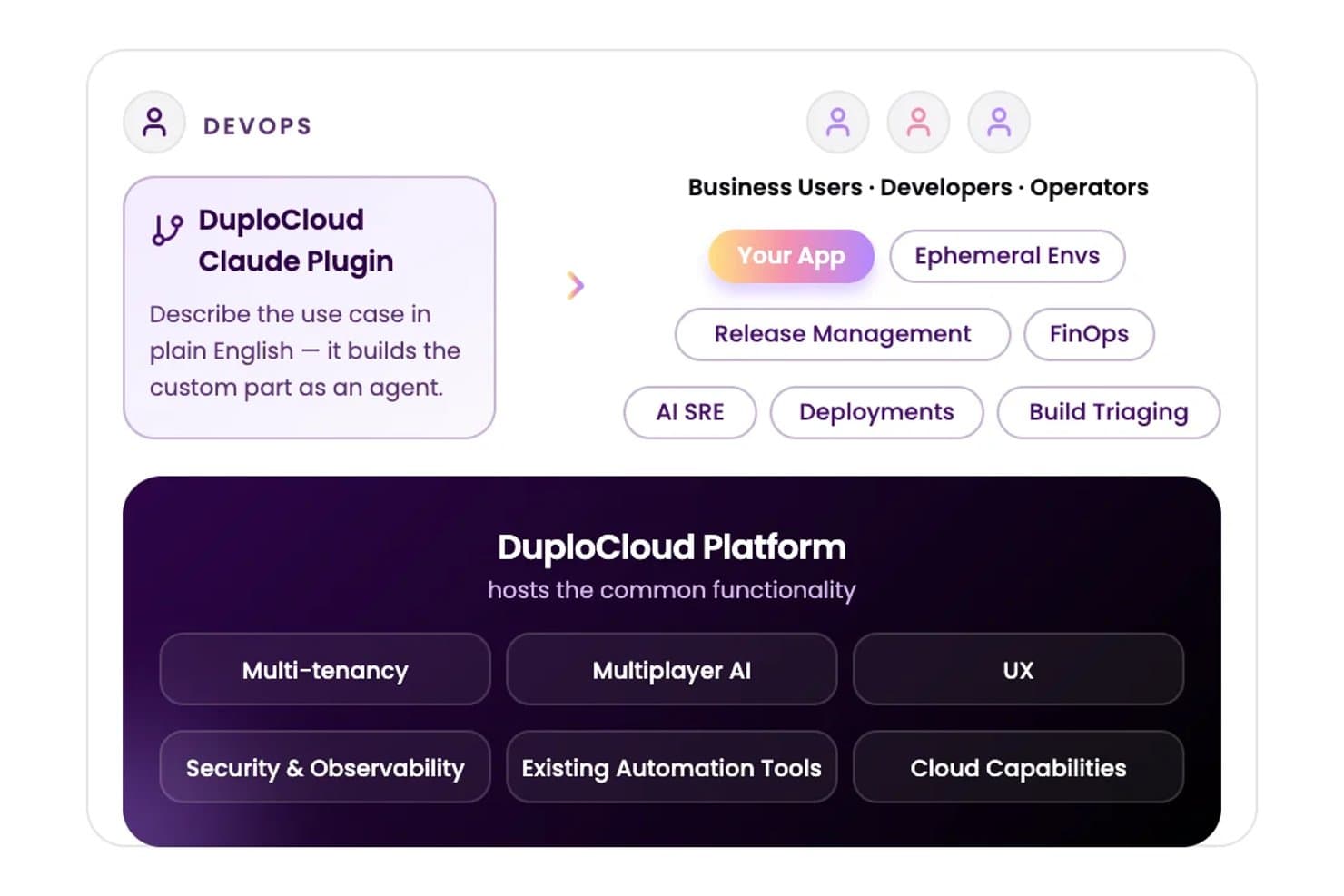
DuploCloud lets users build AI agent workflows via plain English descriptions. DuploCloud is an agentic DevOps platform that combines AI-powered infrastructure automation, Kubernetes and multi-cloud management, CI/CD orchestration, and built-in security and compliance workflows.
Who Is DuploCloud Best For?
DuploCloud is a strong fit for DevOps and platform engineering teams that need AI-driven infrastructure automation across Kubernetes and multi-cloud environments with built-in compliance guardrails.
Why I Picked DuploCloud
I picked DuploCloud as one of the best because its guardrails aren't bolted on as an afterthought—they're built into every layer of how agents act. Every infrastructure change requires human approval before execution, MCP tool calls gate individually with no "always allow" bypass, and shell commands run against approve/reject patterns so nothing slips through unchecked. I especially like that the built-in DevOps agent handles the full Kubernetes and cloud lifecycle, from provisioning to drift detection and security remediation, within that same governed framework.
DuploCloud Key Features
- Multi-cloud infrastructure agent: A built-in DevOps agent provisions and manages resources across AWS, GCP, and Azure, including VPCs, Kubernetes clusters, RDS, and load balancers.
- Workspace-scoped memory and knowledge base: Each workspace maintains persistent context across tickets, with support for ingesting PDF, Office, HTML, and text files up to 2 GB for agent search during conversations.
- Model router: Routes agent execution across Claude, OpenAI, Gemini, and open-source models, with model selection configurable at the project, workspace, or platform level.
- Token and spend quota controls: Administrators can set USD-denominated spend limits at the workspace, project, ticket, user, or platform scope to cap LLM costs.
DuploCloud Integrations
DuploCloud integrates with GitHub, GitLab, CircleCI, Terraform, Kubernetes, AWS, Google Cloud, Microsoft Azure, Datadog, and Prometheus. It supports REST APIs, MCP connections, and workflows through Jira and Slack.
Pros and Cons
Pros:
- Built-in compliance controls support safer operations
- Human approvals gate infrastructure changes
- Self-service cuts infrastructure wait times
Cons:
- Cloud-native feature updates can lag
- No documented autonomous agent-to-agent delegation
Learn more about DuploCloud: Best for RPA-plus-agent automation in enterprise
- Free plan available
- From $25/month
Visit WebsiteCustomer Rating:4.6/5
UiPath lets users build AI agent orchestration flows visually. UiPath is an agentic automation platform that combines RPA robots, multi-agent orchestration, LLM integration, and human-in-the-loop controls to automate complex, multi-step enterprise workflows.
Who Is UiPath Best For?
UiPath is a strong fit for enterprise IT and automation engineering teams managing complex, multi-system workflows that mix legacy infrastructure with modern AI agents.
Why I Picked UiPath
UiPath earns its spot on my shortlist because no other platform in this category converges RPA robots and AI agents the way it does. I love that Maestro orchestrates agents, robots, and human approvals within a single BPMN workflow, so your team can automate across both modern APIs and legacy systems that have no APIs at all. Agent Builder lets you configure multi-agent logic visually or in code, while the AI Trust Layer governs every LLM call across providers like Azure OpenAI, Anthropic, and AWS Bedrock from one centralized policy layer.
UiPath Key Features
- Context Grounding: Retrieves information from permissioned, access-controlled knowledge bases using vector databases like FAISS and Pinecone for RAG-style workflows.
- Action Center HITL controls: Pauses agent execution at defined checkpoints so human reviewers can approve, reject, or redirect decisions before high-risk actions proceed.
- MCP-native tool integration: Connects agents to external systems through four MCP integration types in Orchestrator, covering pre-built, coded, command-based, and remote server options.
- Maestro Case Management: Models complex, adaptive workflows with stages, SLA tracking, escalation rules, and exception handling across agents, robots, and human participants.
UiPath Integrations
UiPath offers native integrations with Azure OpenAI, Anthropic, Google Vertex AI, AWS Bedrock, Snowflake, Databricks, Salesforce, and CyberArk. An API is available for custom integrations.
Pros and Cons
Pros:
- Integrates agentic automation with legacy systems
- Advanced audit trails and governance features
- Orchestrates agents, robots, and humans together
Cons:
- Limited independent container deployment
- Needs significant hardware resources
Learn more about UiPath: 3Best for self-hosted multi-agent automation
n8n
- Free trial available
- From €20/month (billed annually)
Visit WebsiteCustomer Rating:4.7/5
n8n lets users build AI agent workflows with tools, memory, and branching logic. n8n is an open-source AI agent platform that combines a visual workflow canvas with embedded JavaScript and Python support to build, orchestrate, and deploy single-agent and multi-agent automation pipelines.
Who Is n8n Best For?
n8n is a strong fit for DevOps and IT engineering teams that need full control over their infrastructure and want to run AI agent workflows on their own servers.
Why I Picked n8n
I've included n8n in my top picks because it's the only tool on this list where you can run the entire agent runtime on your own infrastructure, including air-gapped environments, with no data leaving your network. I particularly like the supervisor/worker multi-agent architecture, which lets you build hierarchical pipelines where a coordinating agent delegates tasks to specialized sub-agents for research, QA, or execution. The built-in human-in-the-loop approval gates are also a genuine differentiator, letting you embed manual checkpoints before any high-risk agent action runs.
n8n Key Features
- Model-agnostic LLM routing: Connect multiple LLM providers—OpenAI, Anthropic, Gemini, and self-hosted models—within a single workflow and route tasks to different models based on logic you define.
- AI Evaluations framework: Run pre-deployment regression tests on agent workflows using real data to track correctness, token usage, and response quality before pushing changes to production.
- Git-based version control: Manage workflow definitions as code with full version history, staging and production environment separation, and side-by-side workflow diffs for auditable change management.
- Vector database integration: Connect natively to Pinecone, Qdrant, Weaviate, and other vector stores to build RAG pipelines that let agents query internal knowledge bases, documents, and wikis.
n8n Integrations
n8n offers 500+ native integration nodes, including OpenAI, Anthropic, Google Gemini, Pinecone, Qdrant, Weaviate, Salesforce, HubSpot, Slack, and GitHub. An API is available for custom integrations.
Pros and Cons
Pros:
- Manages vector database queries
- Commits workflow versions directly
- Fully self-hosted in air-gapped environments
Cons:
- Workflow editor lacks auto-save functionality
- Visual canvas gets cluttered on large workflows
Learn more about n8n: Best for enterprise multi-agent IT automation
- Free plan available
- Pricing upon request
Visit WebsiteCustomer Rating:4.6/5
Kore.ai lets users build and validate multi-agent AI workflows visually. Kore.ai is an enterprise AI agent platform that lets you build, orchestrate, and govern multi-agent systems using a visual studio, a compiled declarative agent language, and an AI-generated agent architect.
Who Is Kore.ai Best For?
Kore.ai is a strong fit for large enterprises in regulated industries—banking, healthcare, insurance, and government—that need to deploy multi-agent IT automation with strict compliance and governance requirements.
Why I Picked Kore.ai
I picked Kore.ai as one of the best because it's built specifically for the kind of multi-agent IT automation that large enterprises actually need—think coordinating ServiceNow ticket resolution, BMC Helix alerts, and Jira updates across a single workflow without manual handoffs. I'm particularly impressed by its six natively compiled orchestration patterns, which let you run supervisor, fan-out, and delegation logic as first-class constructs rather than workarounds. The engine-enforced guardrails and FedRAMP Moderate authorization make it the right call for regulated environments where governance isn't optional.
Kore.ai Key Features
- Agent Blueprint Language (ABL): A compiled, declarative DSL that lets you define agent goals, tools, memory, and guardrail logic as Git-native YAML artifacts with full CI/CD pipeline support.
- Model Hub: A model-agnostic routing layer that supports OpenAI, Anthropic, Cohere, NVIDIA, Meta LLaMA 2, Hugging Face open-source models, and bring-your-own-model configurations.
- Auto Loop™: A continuous optimization engine that monitors production agent outcomes and auto-tunes prompts, tools, and workflows without manual re-engineering cycles.
- Agent Evals: An automated testing framework that runs multi-scenario quality and safety evaluations with regression tracking integrated directly into deployment pipelines.
Kore.ai Integrations
Kore.ai offers native integrations with ServiceNow, BMC Helix, Jira, Ivanti, Salesforce, SAP, Workday, ADP, Slack, and Microsoft Teams. An API is available for custom integrations.
Pros and Cons
Pros:
- CI/CD-native agent versioning with full audit trails
- Recompiles execution paths automatically
- Agent orchestration patterns are natively compiled
Cons:
- Knowledge base refresh is not fully automatic
- Steep platform engineering requirements for advanced use
Learn more about Kore.ai: Best for governing agents across the enterprise
- 14-day free trial
- Pricing upon request
Visit WebsiteCustomer Rating:4.6/5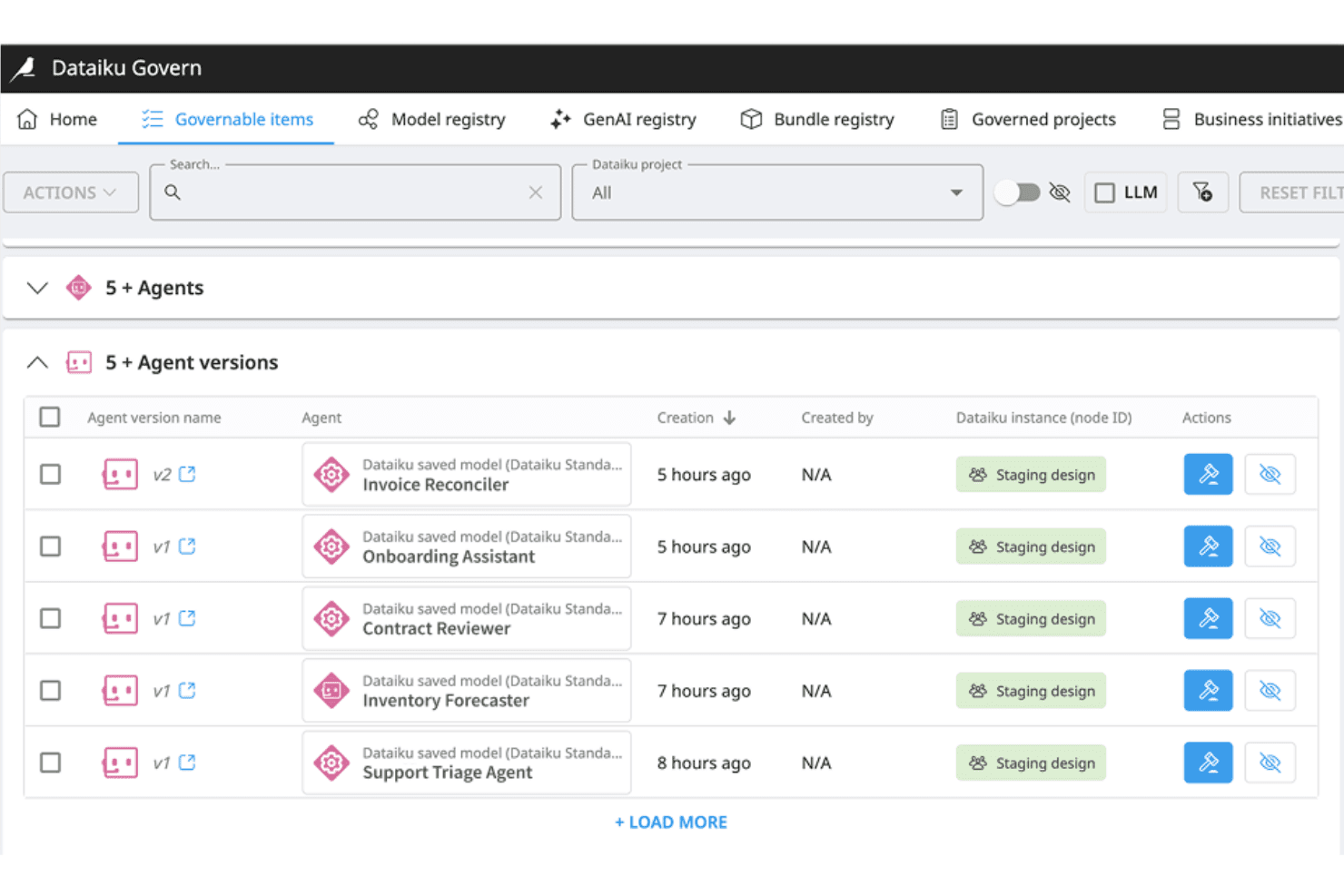
Dataiku Govern tracks AI agent versions across staging environments. Dataiku is an enterprise AI agent platform that combines visual and code-based agent building, multi-agent orchestration, model-agnostic LLM routing, and built-in governance tools including guardrails, approval workflows, and audit trails.
Who Is Dataiku Best For?
Dataiku is a strong fit for large enterprises that need to build, deploy, and govern AI agents across multiple teams, platforms, and compliance requirements from a single platform.
Why I Picked Dataiku
Dataiku earns its spot on my shortlist because no other platform matches its depth of built-in governance across the full agent lifecycle. I particularly like the LLM Guard Services layer, which combines Cost Guard, Safe Guard, and Quality Guard to enforce budget limits, detect PII, and block prompt injection before agents ever reach production. Pair that with Dataiku Govern's approval workflows and audit trails, and you have end-to-end oversight that most agent frameworks can't replicate natively.
Dataiku Key Features
- LLM Mesh routing: A model-agnostic gateway that connects to 10+ LLM providers—including OpenAI, Anthropic, and Mistral—with dynamic routing, response caching, and cost tracking built in.
- Visual and code agent builder: Dual-path agent creation lets non-technical users build agents with a no-code visual flow builder while engineers write full-code agents using the SDK.
- ReAct loop execution: Simple Visual Agents apply a native Reason-and-Act loop, autonomously selecting tools, executing actions, observing results, and iterating until task completion.
- Agent Run Inspector: A step-by-step debugging interface that surfaces warnings and errors at each stage of an agent's execution for diagnosing unexpected behaviour.
Dataiku Integrations
Dataiku offers native integrations with OpenAI, Anthropic, Mistral, AWS Bedrock, Azure OpenAI, Databricks, Snowflake Cortex, Salesforce, ServiceNow, and Jira, plus Slack and Microsoft Teams for agent deployment. It also supports Model Context Protocol (MCP) servers and OpenAPI for custom tool and API connections.
Pros and Cons
Pros:
- Centralized observability for multi-platform agents
- Built-in LLM guardrails and approval workflows
- Visual and code agents in one platform
Cons:
- UI can be clunky for complex workflows
- Agent management module not yet available
Learn more about Dataiku: Best for graph-based multi-agent orchestration
- Free plan + free trial + free demo available
- From $39/user/month
Visit WebsiteCustomer Rating:4.4/5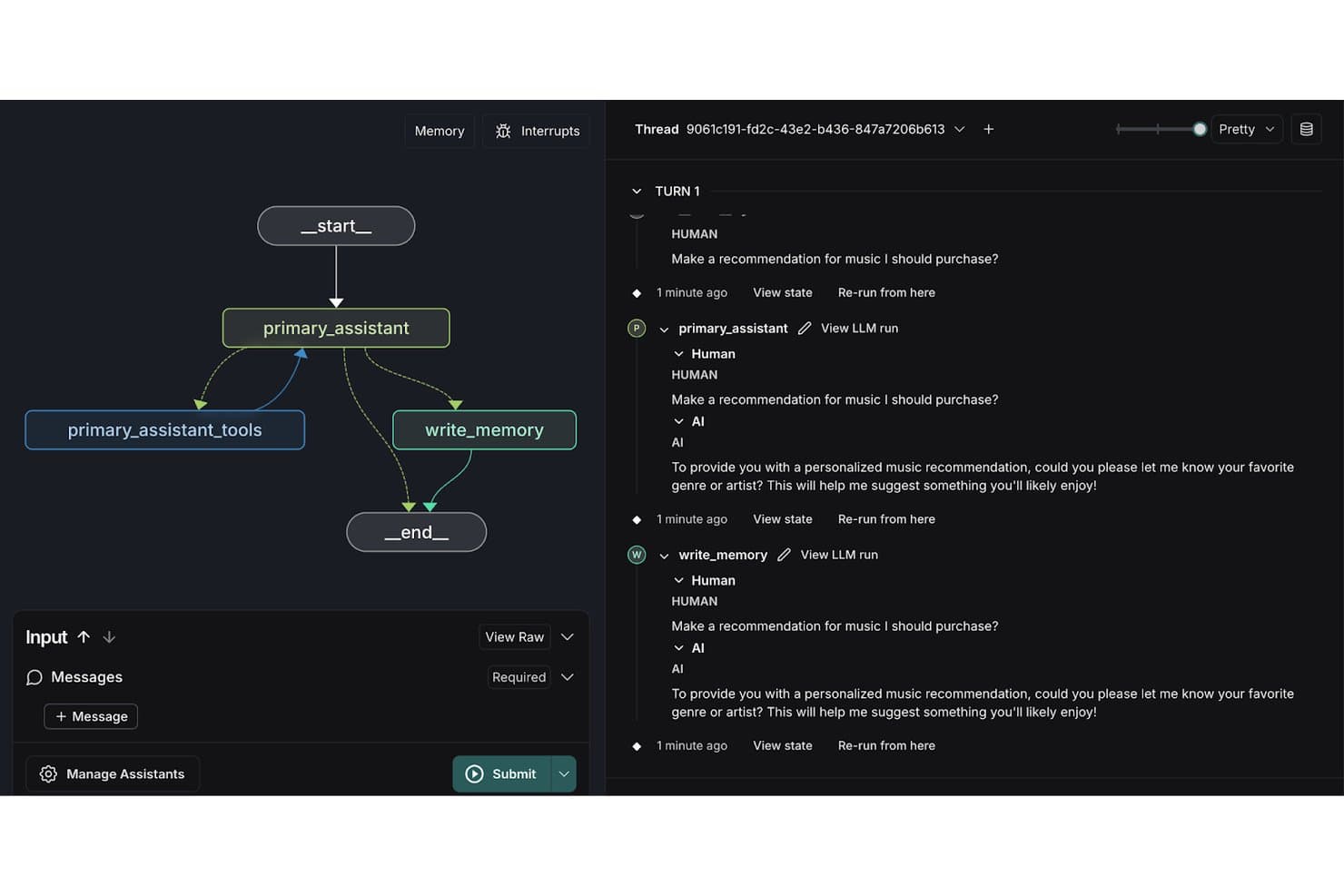
LangChain LangGraph visualizes agent workflows with memory and tool nodes. LangChain LangGraph is a graph-based AI agent framework that supports stateful, multi-step agent workflows, multi-agent orchestration, human-in-the-loop controls, and long-term memory management across Python and JavaScript/TypeScript environments.
Who Is LangChain LangGraph Best For?
LangChain LangGraph is a strong fit for engineering teams building complex, stateful AI agents that require fine-grained control over multi-step workflows and multi-agent coordination.
Why I Picked LangChain LangGraph
LangChain LangGraph earns its spot on my shortlist because its
StateGraphmodel gives you explicit, node-by-node control over how agents think, branch, retry, and loop—something linear chain-based frameworks simply can't replicate. I particularly like its supervisor/worker architecture for multi-agent orchestration, where a top-level agent decomposes tasks and delegates to specialized subagents running in parallel. Built-in checkpointing at every graph node means long-running agents can pause for human approval, resume after a failure, or rewind to any prior state for debugging.LangChain LangGraph Key Features
- LangSmith tracing: Captures distributed traces of every agent step, LLM call, and tool invocation so you can inspect exactly what happened inside a running agent.
- Human-in-the-loop interrupt gates: Pauses agent execution at defined graph nodes to request human approval or input before proceeding to the next step.
- Long-term memory store: Persists agent state and conversation context across sessions using a built-in memory store with semantic search support.
- LangGraph Studio: A visual IDE for inspecting, debugging, and iterating on agent execution graphs in real time during development.
LangChain LangGraph Integrations
LangChain LangGraph offers native integrations with OpenAI, Anthropic, Google Gemini, Mistral, Pinecone, Weaviate, Chroma, pgvector, PostgreSQL, and Redis. An API is available for custom integrations.
Pros and Cons
Pros:
- First-class human-in-the-loop interrupt gates
- Stores semantic historical interactions
- Fine-grained control over agent workflows
Cons:
- High scaling can trigger memory issues
- Predefined static graph state design is required
Learn more about LangChain LangGraph: Best for no-code multi-agent workforce builds
- Free demo available
- Pricing upon request
Visit WebsiteCustomer Rating:4.3/5
Relevance AI lets users build and manage AI agents from one dashboard. Relevance AI is an AI agent platform built around a visual multi-agent canvas, letting you design, deploy, and govern autonomous agent workforces with built-in LLM orchestration, a 2,700+ integration library, hybrid RAG memory, and a native eval and observability system.
Who Is Relevance AI Best For?
Relevance AI is a strong fit for operations and automation teams that need to deploy multi-agent workflows without writing infrastructure code from scratch.
Why I Picked Relevance AI
I picked Relevance AI as one of the best because the visual Workflows canvas lets you assemble entire multi-agent pipelines without writing a line of infrastructure code. You can connect specialist agents with defined handoffs, parallel execution streams, and built-in approval gates, all from a drag-and-drop interface. I also love that every agent ships with an auto-generated eval suite that scores live production runs and blocks failing versions from deploying.
Relevance AI Key Features
- Hybrid RAG memory: Connect agents to internal knowledge bases with semantic search, auto-syncing with Google Drive, SharePoint, Notion, and Confluence.
- Sandboxed code execution: Run Python and JavaScript natively within agent tool steps in an isolated sandbox environment.
- LLM routing: Route tasks across multiple providers—including Anthropic, OpenAI, and Google—with fallback models and per-task cost-optimized model selection.
- Human-in-the-loop approval gates: Pause agent execution at configurable checkpoints for human sign-off before high-stakes actions proceed.
Relevance AI Integrations
Relevance AI offers native integrations with Salesforce, HubSpot, Slack, Google Drive, SharePoint, Notion, Confluence, GitHub, Snowflake, and DataDog. An API is available for custom integrations.
Pros and Cons
Pros:
- Embeds secure script execution spaces
- Integrated evaluation gates and agent versioning
- Visual workforce canvas for multi-agent workflows
Cons:
- No self-hosted or on-premises deployment option
- GTM and sales templates dominate use cases
Learn more about Relevance AI: Best for Python-native multi-agent collaboration
- Free plan + free trial available
- Pricing upon request
Visit WebsiteCustomer Rating:4.2/5
CrewAI lets users build AI automations from natural language descriptions. CrewAI is a Python-native AI agent platform that lets you build, orchestrate, and deploy multi-agent systems using a code-first SDK, a visual studio editor, and a suite of tools for memory management, LLM routing, and workflow automation.
Who Is CrewAI Best For?
CrewAI is a strong fit for engineering teams that need to build and govern multi-agent AI systems in Python, particularly in organizations with compliance or security requirements.
Why I Picked CrewAI
I picked CrewAI as one of the best because it's built Python-first, which means agent definitions, tool bindings, and orchestration logic all live in code your team already versions and reviews. I especially like how it separates Crews (autonomous, role-based agents that delegate tasks between themselves) from Flows (deterministic, event-driven pipelines with conditional branching and typed state), letting you blend both patterns in a single runtime depending on how much autonomy a given workflow needs.
CrewAI Key Features
- LLM routing per agent: Assign a different LLM to each agent in a crew, including a separate model dedicated specifically to tool/function calls.
- Human-in-the-loop gates: The
@human_feedbackdecorator pauses flow execution at defined checkpoints so a human can review, override, or approve before the next step runs. - Enterprise connector repository: Pre-built connectors for Salesforce, Jira, Snowflake, Microsoft 365, Google Workspace, Slack, and Zendesk pipe real system data directly into agent workflows.
- PII redaction at runtime: A governance hook automatically strips personally identifiable information at every LLM and tool call before data leaves your environment.
CrewAI Integrations
CrewAI offers native integrations with Salesforce, HubSpot, Snowflake, Jira, Zendesk, Slack, Gmail, Microsoft 365, Teams, and Google Workspace. An API is available for custom integrations.
Pros and Cons
Pros:
- Per-agent LLM assignment for advanced orchestration
- Hierarchical memory structure with composite scoring
- Native Python SDK with code and visual builder
Cons:
- Complex automation setup requires strong Python skills
- Consumes high local memory
Learn more about CrewAI: Best for Microsoft-native multi-agent deployments
- 30-day free trial available
- From $0.165 per 1M input tokens

Microsoft Foundry lets users build multi-agent sequential workflows visually. Microsoft Foundry is an AI agent platform built on Azure that lets you build, deploy, and orchestrate agents using a 10,000+ model catalogue, multi-agent workflows, and native integrations across the Microsoft ecosystem.
Who Is Microsoft Foundry Best For?
Microsoft Foundry is the right fit for enterprise IT and engineering teams already running on Azure who need to build and orchestrate multi-agent AI workflows across the Microsoft ecosystem.
Why I Picked Microsoft Foundry
Microsoft Foundry earns its spot on my shortlist because of how deeply it's wired into the Azure ecosystem for multi-agent deployments. I love that Connected Agents lets one agent call another as a specialized sub-agent, so you can decompose something like an IT incident response workflow into discrete agents handling detection, diagnosis, and remediation in parallel. The Agent Harness adds planning and to-do tracking on top of that, keeping long-running autonomous runs on course without constant human intervention.
Microsoft Foundry Key Features
- Model benchmark leaderboard: Compare 10,000+ models side by side on quality, latency, throughput, and cost before committing to a deployment.
- PyRIT red teaming: Run automated adversarial simulations against your agents to surface safety and security vulnerabilities before going to production.
- Provisioned Throughput Units (PTUs): Reserve dedicated model processing capacity on a monthly or annual basis for predictable latency on high-volume workloads.
- Per-agent Entra identity: Each hosted agent is automatically assigned its own Microsoft Entra identity, giving you granular access control at the individual agent level.
Microsoft Foundry Integrations
Microsoft Foundry offers native integrations with Microsoft 365, Teams, SharePoint, Fabric, Entra, Cosmos DB, Key Vault, Azure Functions, and GitHub. An API is available for custom integrations.
Pros and Cons
Pros:
- Per-agent Entra identity enables granular access
- MSC/LLM model benchmark leaderboard built in
- Integrated multi-agent orchestration with A2A protocol
Cons:
- Needs proprietary cloud infrastructure
- No built-in disaster recovery for agent state
Learn more about Microsoft Foundry: Best for multi-agent orchestration on Google Cloud
- Free demo available
- Pricing upon request
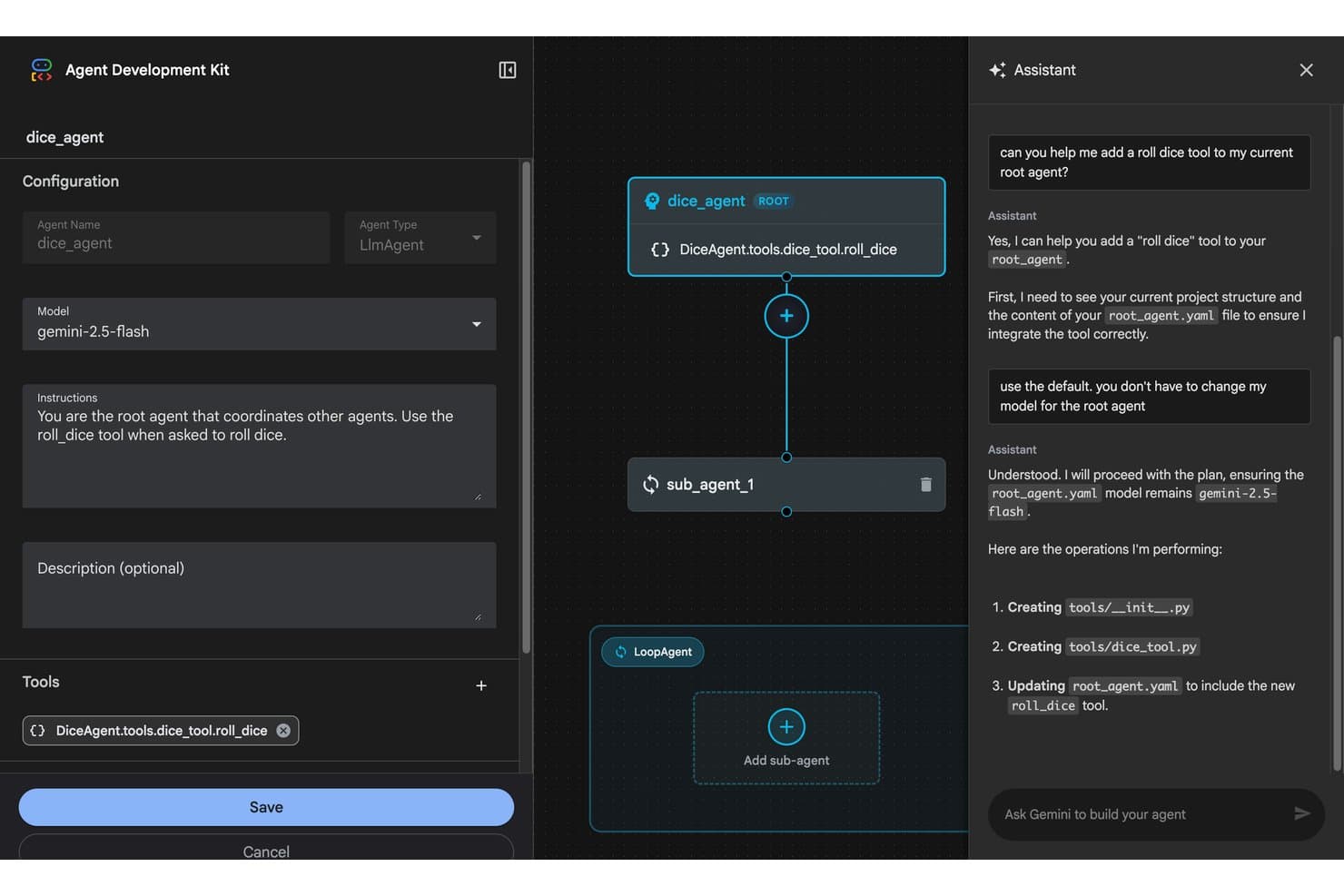
Agent Development Kit (ADK) lets users build agents visually with AI chat assistance. Google ADK is an open-source, code-first AI agent framework with multi-language SDKs (Python, TypeScript, Go, Java, and Kotlin) for building, evaluating, and deploying single agents, multi-agent pipelines, and graph-based workflows with built-in support for MCP, A2A protocol, and sandboxed code execution.
Who Is Agent Development Kit (ADK) Best For?
ADK is a strong fit for engineering teams already running infrastructure on Google Cloud who need to build and orchestrate production-grade multi-agent systems at scale.
Why I Picked Agent Development Kit (ADK)
ADK earns its spot on my shortlist because of how naturally it handles multi-agent orchestration on Google Cloud infrastructure. I love that ADK 2.0 introduced graph-based and collaborative workflow patterns, where a coordinator agent dynamically delegates tasks to specialized sub-agents, letting teams decompose complex IT and DevOps pipelines across purpose-built agents. Per-agent model assignment means each sub-agent runs the right model for its task, and native A2A protocol support lets those agents talk across frameworks without custom plumbing.
Agent Development Kit (ADK) Key Features
- Multi-language SDK support: Build agents in Python, TypeScript, Go, Java, or Kotlin using consistent APIs across all five languages.
- ADK Eval framework: Run test files, evalset, and conformance evaluations with LLM-as-judge scoring, hallucination detection, and automated user simulation for production agent reliability testing.
- Human-in-the-loop controls: Pause and resume agent execution mid-workflow using
RequestedInputevents and tool confirmation flows before high-risk actions execute. - Sandboxed code execution: Run agent-generated code and shell commands in isolated server-side sandboxes via the Code Execution Tool, Daytona integration, or Bash Tool.
Agent Development Kit (ADK) Integrations
Agent Development Kit offers native integrations with Gemini, Claude, BigQuery, Firestore, Datadog, Jira, Confluence, Cloud Run, and GKE. An API is available for custom integrations.
Pros and Cons
Pros:
- Native support for open agent communication protocols
- Interprets local shell commands safely
- Multi-language SDKs for Python, Go, Java, TypeScript, Kotlin
Cons:
- Most production deployments remain Google Cloud-only
- State management in multi-turn agents is complex
Learn more about Agent Development Kit (ADK):
Outras plataformas de agentes de IA
Eis algumas opções adicionais de plataformas de agentes de IA que não chegaram à minha lista restrita, mas que ainda vale a pena conhecer:
- 11LangChain LangSmithBest for agent observability and eval workflows
- 12NiCE Cognigy.AIBest for enterprise CX agent deployments at scale
- 13Amazon Bedrock AgentCoreBest for AWS-native multi-agent deployments
- 14RasaBest for self-hosted conversational agents
- 15WriterBest for enterprise knowledge-work agent governance
- 16AgentforceBest for Salesforce-native enterprise agent deployment
- 17Microsoft Copilot StudioBest for Microsoft 365-native multi-agent workflows
- 18Botpress StudioBest for visual and code-based multi-agent builds
- 19VellumBest for version-controlled agent evaluation
- 20Sema4.aiBest for back-office agents on Snowflake data
Related Reviews
How I Evaluate AI Agent Platforms
To make this list, a platform has to deliver real, measurable AI value—whether that means autonomously resolving IT incidents, orchestrating multi-step DevOps workflows, or coordinating specialized agents across business functions. I split my evaluation into two layers: core functionality every platform must meet to qualify, and the differentiating factors that separate the best from the rest.
Core Functionality (Table Stakes For This List)
When I'm selecting tools for my list, I rank each one on a scale from 0 (does not offer the functionality) to 5 (excels in this area) for each core functionality listed below. I then calculate the tool's total score as a percentage, using 75% as a benchmark to help assess its overall fit for the list.
- Agent building framework: I evaluate whether a platform offers SDK-based, visual, or hybrid agent design with support for defining roles, goals, and multi-agent hierarchies.
- LLM orchestration: I look for flexibility across model providers, including per-agent model routing and the ability to swap between proprietary and open-source LLMs at runtime.
- Tool and API integration: The connector ecosystem matters here—I check for native integrations, custom function calling, and secure auth handling for enterprise systems like databases and internal APIs.
- Memory and context management: I evaluate how each platform handles short-term and long-term memory, including RAG pipelines, vector store support, and shared context across agents.
- Multi-step reasoning and autonomy: Platforms need to go beyond simple prompt chains. I look for autonomous planning, self-correction loops, and the ability to handle long-running, multi-step tasks without constant human input.
- Agent observability and governance: I check for tracing, evaluation tooling, cost and token tracking, guardrails, and audit controls that let you monitor and govern agent behaviour in production.
Once I have a list of tools that meet the criteria, I consider what sets each platform apart.
Differentiating Factors (What Sets Vendors Apart)
Here's how I compare and contrast different vendors:
Standout Features
I look for human-in-the-loop controls that go beyond simple approval buttons—things like staged escalation workflows and intervention points before high-risk actions like production deployments or database writes. Prompt and agent versioning is equally important; I check whether a platform supports git-style rollback and A/B testing so teams can iterate safely. I also evaluate each platform's evaluation and simulation harness, since replaying production traces against golden datasets before shipping changes catches failures that unit tests miss.
Beyond Features
I evaluate each platform's deployment model and data residency options, since teams in regulated industries need self-hosted or VPC deployments where agent traces and LLM traffic stay within controlled boundaries. Pricing transparency matters just as much—autonomous agents can generate unpredictable compute costs, so I check for built-in token budgets and rate limits that prevent runaway loops in production. I also look at ecosystem maturity, including SDK quality, documentation depth, and community activity, because a platform with strong CI/CD integration and pre-built agent templates gets your team to production faster.
Como escolher uma plataforma de agentes de IA
Ao escolher uma plataforma de agentes de IA, concentre-se nas suas prioridades operacionais e nas áreas em que a automatização por agentes terá maior impacto na sua empresa:
| Se a sua prioridade é… | Procure… |
|---|---|
| Se a sua prioridade é…Observabilidade e conformidade completas dos agentes | Procure…Rastreio, registos de auditoria e controlo de versões |
| Se a sua prioridade é…Governação dos agentes em toda a empresa | Procure…Políticas e controlo de acesso centralizados |
| Se a sua prioridade é…Requisitos de residência de dados na nuvem ou no local | Procure…Opções de implementação em VPC ou autoalojadas |
| Se a sua prioridade é…Orquestração multiagente para fluxos de trabalho de TI | Procure…Conectores nativos para ITSM, RPA e APIs |
| Se a sua prioridade é…Adoção sem código por parte dos utilizadores empresariais | Procure…Construtores de fluxos de trabalho ou de arrastar e largar |
Como avaliar a sua lista restrita
- Teste o rastreio de agentes em tempo real: Inicie um fluxo de trabalho e analise os artefactos de auditoria/rastreio para obter registos completos do raciocínio e das ações dos agentes.
- Solicite um documento técnico de segurança: Peça a documentação mais recente, incluindo informações sobre residência de dados, subprocessadores terceiros e fluxo de tráfego do LLM.
- Experimente as funcionalidades de avaliação de agentes: Execute um conjunto de testes com as suas próprias conversas ou fluxos de trabalho de exemplo e analise as capacidades da estrutura de avaliação.
- Verifique as opções de implementação: Solicite uma cópia das instruções de configuração do autoalojamento ou da VPC, ou marque uma demonstração no prazo de duas semanas.
- Compromisso entre a integração nativa com a pilha tecnológica e um ecossistema aberto: Decida se a compatibilidade profunda com os sistemas de nuvem/RPA existentes é mais importante do que SDKs abrangentes e flexibilidade para extensões personalizadas.
O que são plataformas de agentes de IA?
As plataformas de agentes de IA são sistemas de software que permitem conceber, implementar e gerir equipas de agentes autónomos de IA para automatizar e coordenar processos empresariais complexos. Estas plataformas fornecem estruturas para criar fluxos de trabalho multiagente, estabelecer ligações a APIs e gerir memória, contexto e observabilidade. As equipas utilizam-nas para manter a supervisão, aplicar a governação e expandir com segurança a automatização orientada por IA em toda a sua infraestrutura e operações.
Funcionalidades das plataformas de agentes de IA
Ao selecionar uma plataforma de agentes de IA, tenha em atenção as seguintes funcionalidades essenciais:
- Estrutura de desenvolvimento de agentes: Permite-lhe criar agentes personalizados, definindo as respetivas funções, comportamentos e lógica de interação. Suporta SDKs, construtores visuais ou abordagens híbridas, para que possa conceber equipas de agentes simples ou complexas, adaptadas às suas necessidades.
- Orquestração de LLM: Disponibiliza ferramentas para encaminhar consultas entre diferentes modelos de linguagem de grande dimensão, incluindo suporte para trocar de modelo durante a execução. Isto permite otimizar os custos e a precisão, garantindo que os seus agentes utilizam o melhor modelo de linguagem para cada cenário.
- Integração de API e ferramentas: Oferece conectores integrados e estruturas de integração seguras para ligar agentes a bases de dados, plataformas SaaS e sistemas internos. Permite que os seus agentes executem ações reais, acedam a dados empresariais e acionem automatizações em toda a sua infraestrutura.
- Gestão de memória e contexto: Suporta a retenção de contexto a curto e a longo prazo através de bases de dados vetoriais, geração aumentada por recuperação (RAG) ou sistemas de memória personalizados. Isto permite aos agentes manter conversas contínuas, consultar dados anteriores e melhorar a tomada de decisões ao longo do tempo.
- Orquestração de fluxos de trabalho multiagente: Permite coordenar grupos de agentes para realizar tarefas com várias etapas, delegar trabalho e partilhar informações. É útil para implementar agentes que gerem processos empresariais complexos ou que precisam de colaborar em projetos de maior dimensão.
- Observabilidade e governação: Inclui funcionalidades como registos de rastreio, trilhos de auditoria, ferramentas de avaliação e controlos de acesso. Proporciona visibilidade sobre as ações dos agentes, permite assegurar a conformidade e ajuda a monitorizar o desempenho da IA em ambientes de produção.
- Planeamento autónomo de tarefas: Fornece aos agentes capacidades de planeamento, autocorreção e raciocínio iterativo. Ajuda os agentes a realizar tarefas complexas ou de longa duração sem solicitações humanas constantes.
- Controlo de versões e reversão: Permite acompanhar, testar e reverter alterações às instruções, à lógica ou aos fluxos de trabalho dos agentes — essencial para atualizações seguras, testes A/B e requisitos de conformidade.
- Flexibilidade de implementação: Disponibiliza opções de implementação na nuvem, autoalojadas ou numa VPC. É essencial para equipas com requisitos de residência dos dados, segurança ou regulamentação que necessitam de controlo total sobre a infraestrutura e o tráfego dos agentes.
- Estrutura de avaliação e testes: Oferece ferramentas de simulação, funcionalidades de reprodução ou avaliações com conjuntos de dados de referência para testar rigorosamente os agentes antes do lançamento. Ajuda a detetar falhas na lógica e a garantir a fiabilidade antes de os agentes interagirem com dados reais ou utilizadores.
Vantagens das plataformas de agentes de IA
A implementação de plataformas de agentes de IA proporciona várias vantagens à sua equipa e à sua empresa. Eis algumas das que pode esperar:
- Automatização melhorada dos fluxos de trabalho: Coordene sistemas multiagente para automatizar processos empresariais e de TI complexos, reduzindo as tarefas manuais e os erros humanos.
- Observabilidade e governação melhoradas: Aceda a funcionalidades como trilhos de auditoria, registos de rastreio e ferramentas de avaliação para monitorizar as ações dos agentes e manter a conformidade com as políticas internas.
- Integração direta com sistemas empresariais: Ligue agentes a APIs, bases de dados e plataformas SaaS através de conectores integrados e autenticação segura, permitindo que os seus agentes atuem sobre dados empresariais reais.
- Implementação flexível e residência dos dados: Escolha entre implementações na nuvem, autoalojadas ou numa nuvem privada virtual para cumprir os requisitos de segurança e regulamentação da sua organização.
- Controlo de versões e capacidades de reversão: Faça iterações de forma segura com o controlo de versões integrado para instruções e fluxos de trabalho, podendo testar, aprovar e reverter alterações conforme necessário.
- Controlo humano no processo: Insira etapas de aprovação, escalamentos ou pontos de intervenção antes de ações de alto risco, garantindo supervisão quando esta é mais importante.
- Gestão avançada de memória e contexto: Permita que os agentes mantenham memória a curto e a longo prazo através de armazenamentos vetoriais ou de geração aumentada por recuperação, tornando as interações mais relevantes e conscientes do contexto ao longo do tempo.
Custos e preços das plataformas de agentes de IA
A seleção de plataformas de agentes de IA exige uma compreensão dos vários modelos de preços e planos disponíveis. Os custos variam consoante as funcionalidades, a dimensão da equipa, os complementos e outros fatores. A tabela abaixo resume os planos mais comuns, os respetivos preços médios e as funcionalidades normalmente incluídas nas soluções de plataformas de agentes de IA:
Tabela de comparação de planos para plataformas de agentes de IA
| Tipo de plano | Preço médio | Funcionalidades comuns |
|---|---|---|
| Tipo de planoPlano gratuito | Preço médio$0 | Funcionalidades comunsFerramentas básicas de criação de agentes, fluxos de trabalho limitados, suporte da comunidade e acesso a integrações padrão. |
| Tipo de planoPlano pessoal | Preço médio$20–$40/utilizador/mês | Funcionalidades comunsConstrutores visuais, implementação de um único agente, modelos de fluxos de trabalho, apoio ao cliente e ferramentas básicas de observabilidade. |
| Tipo de planoPlano empresarial | Preço médio$50–$150/utilizador/mês | Funcionalidades comunsOrquestração de vários agentes, conectores avançados, gestão de memória e contexto, controlo de versões e controlos de acesso baseados em funções. |
| Tipo de planoPlano empresarial avançado | Preço médio$200+/utilizador/mês | Funcionalidades comunsOpções de implementação personalizadas, VPC ou alojamento próprio, governação avançada, registos de auditoria, SLAs e apoio dedicado à integração. |
Perguntas frequentes sobre plataformas de agentes de IA
Eis algumas respostas a perguntas comuns sobre plataformas de agentes de IA:
Como é que as plataformas de agentes de IA lidam com a segurança e a conformidade?
As plataformas de agentes de IA disponibilizam normalmente funcionalidades de segurança de dados, como registos de auditoria, controlo de acesso baseado em funções e encriptação de dados. Para equipas com necessidades rigorosas de conformidade, procure plataformas com opções de implementação em alojamento próprio ou VPC e documentação detalhada sobre a localização dos dados. É importante verificar o suporte para SOC 2, HIPAA, GDPR ou normas específicas do setor, caso a sua empresa tenha requisitos regulamentares.
É possível integrar plataformas de agentes de IA com sistemas informáticos existentes?
Sim, uma boa plataforma de automatização de fluxos de trabalho disponibiliza conectores ou estruturas de API para integrar os seus agentes de IA. Pode ligar os agentes a ferramentas ITSM, plataformas RPA, fontes de dados ou aplicações SaaS. Algumas plataformas têm integrações nativas, enquanto outras permitem criar ligações personalizadas utilizando chamadas de funções, execução de código ou webhooks para potenciar fluxos de trabalho automatizados. Verifique sempre a existência de métodos seguros de autenticação e autorização.
Que modelos de implementação são suportados pelas plataformas de agentes de IA?
Encontrará opções de implementação na nuvem, em alojamento próprio e numa nuvem privada virtual (VPC). Os modelos na nuvem proporcionam o caminho mais rápido para obter valor, mas as implementações em alojamento próprio e VPC são mais adequadas se necessitar de um controlo rigoroso da rede para os seus modelos de IA e LLMs. Solicite uma estrutura de código aberto ou documentos técnicos para garantir que a sua infraestrutura cumpre os requisitos da plataforma.
Como podem as equipas avaliar o desempenho dos agentes antes de os implementarem em produção?
A maioria das principais plataformas inclui estruturas de avaliação, registos de rastreio e um editor visual para o controlo de versões. Pode testar instruções do sistema, executar agentes personalizados com conjuntos de dados de teste e utilizar mecanismos de proteção com intervenção humana antes de entrar em produção. Isto permite detetar erros lógicos, avaliar a precisão e testar a fiabilidade em cenários do mundo real — algo crucial para ambientes de produção.
Quais são os sinais típicos de que precisa de uma plataforma de agentes de IA em vez de ferramentas de automatização tradicionais?
Se a sua equipa necessita de fluxos de trabalho baseados em agentes, delegação de tarefas e tomada de decisões autónoma em sistemas complexos com vários agentes, uma plataforma de agentes de IA é mais adequada do que as ferramentas de automatização tradicionais. As plataformas também são úteis quando necessita de memória, gestão de contexto ou observabilidade que os chatbots básicos e a automatização tradicional de fluxos de trabalho não conseguem disponibilizar.