

Encontrar a ferramenta certa de gestão de dados de teste pode ser uma tarefa desafiante. Com tantas opções disponíveis, é difícil determinar qual satisfaz verdadeiramente as suas necessidades sem desperdiçar tempo ou recursos valiosos. Se já se deparou com problemas relacionados com ferramentas demasiado complexas, que não acompanham o crescimento dos seus projetos ou que não cumprem os regulamentos de privacidade de dados, não está sozinho. Uma excelente ferramenta de gestão de dados de teste deve simplificar a criação, a gestão e a segurança dos seus conjuntos de dados, integrando-se de forma harmoniosa nos seus fluxos de trabalho de testes.
Enquanto profissional de testes de software com experiência prática em dezenas de ferramentas, deparei-me e superei os mesmos desafios que enfrenta. Foi por isso que criei este guia: para simplificar a sua pesquisa e fornecer uma lista selecionada das melhores ferramentas de gestão de dados de teste disponíveis atualmente. Quer a sua prioridade seja a automatização, a conformidade ou a escalabilidade, esta publicação ajudá-lo-á a tomar uma decisão informada.
Why Trust Our Software Recommendations
6,700+
Reviews
20
Industry experts
16+
Evaluation factors
14
Years
Our team has been testing and reviewing software since 2012. As tech leaders ourselves, we know how difficult—and important—it is to choose the right software.
For this guide, we evaluated tools using hands-on testing and independent research, scoring tools using our selection criteria.
Our reviews reflect our human editorial judgment, not a sales pitch.
Expert reviewers:
- Paulo Gardini MiguelTech Director
 Tim FisherVP of AI
 Gabriel RosasTech Lead & Software Architect
 Christhian GruhnTech Lead & Platform Architect

Tabela comparativa das ferramentas de gestão de dados de teste
A tabela abaixo compara os detalhes de preços das minhas principais ferramentas de gestão de dados de teste.
| Tool | Best For | Trial Info | Price | ||
|---|---|---|---|---|---|
| 1 | Best for compliance-mapped masking with auto-subsetting | 14-day free trial | Pricing upon request | Website | |
| 2 | Best for CI/CD-native synthetic test data | Free demo available | Pricing upon request | Website | |
| 3 | Best for volume-agnostic, centralized TDM | 14-day free trial | From €15,000/user/year (billed annually) | Website | |
| 4 | Best for full-lifecycle TDM with DB cloning | Free demo available | Pricing upon request | Website | |
| 5 | Best for mainframe-inclusive test data masking | Not available | Pricing upon request | Website | |
| 6 | Best for enterprises with complex environments | 30-day free trial available | Pricing upon request | Website | |
| 7 | Best cross-database subsetting in regulated industries | Free demo available | Pricing upon request | Website | |
| 8 | Best for masking across multi-database pipelines | Free demo available | Pricing upon request | Website | |
| 9 | Best for visual, coverage-driven data design | 14-day free trial | Pricing upon request | Website | |
| 10 | Best for Git-style DB cloning across five engines | Free demo available | Pricing upon request | Website |





Avaliações das melhores ferramentas de gestão de dados de teste
Abaixo encontram-se os meus resumos detalhados das melhores ferramentas de gestão de dados de teste que entraram na minha lista restrita. As minhas avaliações apresentam uma análise detalhada das principais funcionalidades, vantagens & desvantagens, integrações e casos de utilização ideais de cada ferramenta, para o ajudar a encontrar a melhor opção para si.
 Best for compliance-mapped masking with auto-subsetting
- 14-day free trial
- Pricing upon request
Visit WebsiteCustomer Rating:4.3/5
Tonic masks and de-identifies sensitive database columns for safe test data. Tonic Structural is a test data management platform that masks, subsets, and provisions production data for non-production environments, with support for relational databases, NoSQL, data warehouses, and file sources.
Who Is Tonic Best For?
Tonic Structural is a strong fit for compliance-focused teams in healthcare and finance that need to mask and subset production data while maintaining audit-ready privacy documentation.
Why I Picked Tonic
Tonic earns its spot on my shortlist because its masking and subsetting capabilities are tightly coupled in a way I rarely see. I love how the Privacy Hub flags every column as At-Risk, Protected, or Not Sensitive, then lets you bulk-apply generators and export a full Privacy Report for audit purposes. The patented subsetter handles virtual foreign keys and circular dependencies automatically, so your masked subset stays referentially intact even across complex, multi-table schemas.
Tonic Key Features
- Structural Agent: An AI chat assistant built into the app that summarizes sensitivity scan results, recommends generators, and applies them automatically to your columns.
- Differential privacy controls: Categorical and continuous generators support differential privacy, with a configurable privacy budget to limit statistical inference from transformed data.
- Container repository output: Structural writes masked, subsetted data directly as container volumes for PostgreSQL, MySQL, and SQL Server, letting you spin up isolated databases on demand.
- Version History: Records every change to workspace configuration—generators, subsetting rules, table modes, and post-job scripts—with attribution and the ability to restore earlier versions.
Tonic Integrations
Tonic offers native integrations with PostgreSQL, MySQL, SQL Server, Oracle, MongoDB, Snowflake, BigQuery, Redshift, Databricks, and Amazon S3. It also supports REST API, GitHub Actions, Kubernetes, Helm, and container registries including Amazon ECR, Google Artifact Registry, and Azure Container Registry.
Pros and Cons
Pros:
- Production-like data retains statistical relationships
- Privacy Hub maps sensitive columns for audits
- Preserves joins across complex schemas
Cons:
- Containerized databases require Kubernetes deployment
- From-scratch synthesis requires separate Fabricate product
Learn more about Tonic: Best for CI/CD-native synthetic test data
- Free demo available
- Pricing upon request
Visit WebsiteCustomer Rating:4.6/5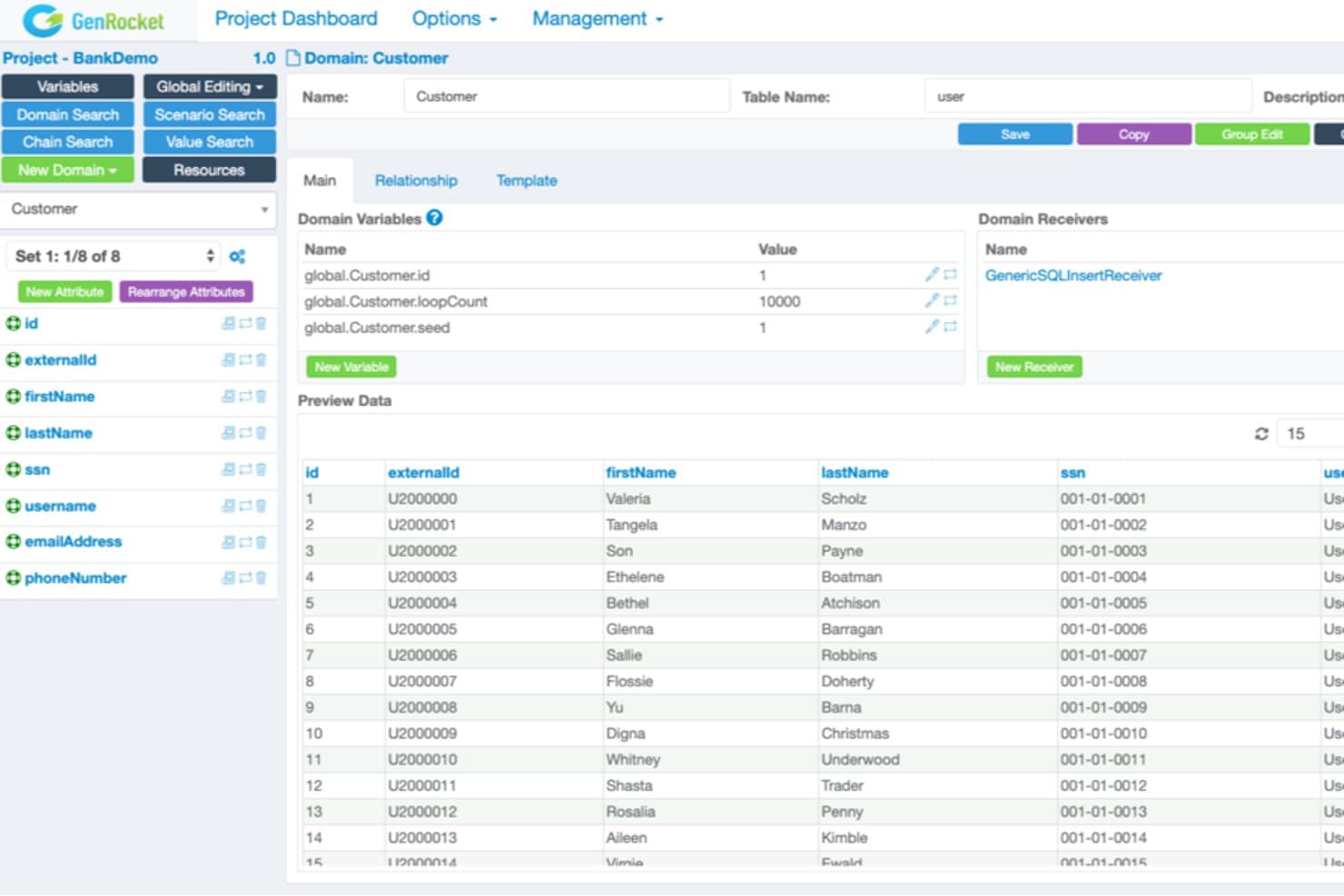
GenRocket lets users preview and configure test data domains visually. GenRocket is a synthetic test data management platform that generates data in real time from metadata and schemas, covering data masking, intelligent subsetting, multi-format output, and self-service provisioning across CI/CD pipelines.
Who Is GenRocket Best For?
GenRocket is a strong fit for QA and DevOps teams that need on-demand synthetic test data generated directly inside CI/CD pipelines, without ever touching production data.
Why I Picked GenRocket
GenRocket earns its spot on my shortlist because it's the only test data platform I've seen built specifically to generate synthetic data in real time, directly inside a CI/CD pipeline, without ever touching production. Its patented referential integrity engine keeps data consistent across multiple schemas and databases simultaneously, which is genuinely rare. I also like that each test case dataset generates in as little as 100 milliseconds, so pipeline execution doesn't stall waiting on data provisioning.
GenRocket Key Features
- G-Delta schema change detection: Automatically identifies database schema changes across MySQL, MS SQL, Oracle, and PostgreSQL, then triggers G-Refactor to update all affected test data cases.
- In-place masking: Replaces sensitive fields in Oracle, MS SQL Server, IBM DB2, PostgreSQL, and MySQL databases with synthetically generated equivalents, without ever reading real production values.
- G-Portal self-service portal: Gives developers and testers a role-based interface to search, request, track, and download test data cases without involving a central data team for every request.
- 750+ intelligent data generators: Covers virtually any data type, domain, or business rule, including conditional logic, cross-field dependencies, and regex constraints.
GenRocket Integrations
GenRocket integrates with Jenkins, Azure DevOps, TeamCity, CircleCI, GitHub, Cucumber, Selenium, JUnit, JMeter, and LoadRunner. It also supports REST API, JDBC, SOAP, TCP/IP sockets, and Docker deployment for custom CI/CD workflows.
Pros and Cons
Pros:
- Unlimited data volume with no refresh cycles
- Real-time data provisioning for CI/CD pipelines
- Synthetic data generation maintains referential integrity
Cons:
- PII detection not fully available until {{year}}
- No format-preserving or reversible masking
Learn more about GenRocket: Best for volume-agnostic, centralized TDM
- 14-day free trial
- From €15,000/user/year (billed annually)
Visit WebsiteCustomer Rating:4.5/5
Data masking helps you keep sensitive customer information private. DATPROF is a test data management platform that combines data masking, subsetting, synthetic data generation, PII discovery, database virtualization, and centralized provisioning across relational, NoSQL, and cloud data sources.
Who Is DATPROF Best For?
DATPROF is a strong fit for data engineers and DBAs at mid-to-large enterprises managing complex, multi-database environments where referential integrity and compliance are non-negotiable.
Why I Picked DATPROF
I picked DATPROF as one of the best because its volume-agnostic licensing model genuinely sets it apart: your license cost stays flat whether you're masking 500 GB or 100 TB, which matters when you're subsetting a production database like the 23 TB one Heineken reduced to 130 GB. The patented foreign-key cycle detection in DATPROF Subset handles complex multi-thousand-table schemas while keeping cross-system referential integrity intact. Pair that with the Runtime portal's centralized orchestration, and every team member can provision their own refreshed environment without waiting on a DBA.
DATPROF Key Features
- Deterministic cross-system masking: Applies consistent masked values for the same input across multiple databases simultaneously, preserving referential integrity for end-to-end test traceability.
- PII discovery and profiling: Scans databases to automatically identify where sensitive data lives, with support for custom detection rules using regular expressions or list-based expressions.
- Self-service provisioning portal: Lets testers and developers log in to DATPROF Runtime and refresh their own test environments independently, without waiting on a DBA.
- Copy-on-write database cloning: DATPROF Virtualize spins up full-size virtual database environments without consuming extra storage, with snapshot rollback completed in under 20 seconds.
DATPROF Integrations
DATPROF supports CI/CD integrations with Jenkins, Azure DevOps, GitLab, and Bamboo, plus test automation integrations with Parasoft and Tosca. Its REST API supports custom integrations, with marketplace listings available through Azure Marketplace and AWS Marketplace.
Pros and Cons
Pros:
- Role-based web portal for self-serve refresh
- Subsetting efficiently reduces massive production datasets
- Masking preserves cross-database referential integrity
Cons:
- No mainframe or broader NoSQL database coverage
- Limited native support for SaaS data sources
Learn more about DATPROF: Best for full-lifecycle TDM with DB cloning
- Free demo available
- Pricing upon request

Enov8 provides executive PII visibility across data sources at a glance. Enov8 is a test data management platform that covers the full TDM lifecycle, including AI-powered data profiling, masking, subsetting, synthetic data generation, and database virtualization via its vME cloning engine.
Who Is Enov8 Best For?
Enov8 is a strong fit for DevOps and QA teams in regulated industries that need a single platform to handle masking, subsetting, synthetic data, and database virtualization together.
Why I Picked Enov8
I picked Enov8 as one of the best because it's the only tool on my list that pairs full-lifecycle TDM with its vME database cloning engine, which spins up production-realistic database copies at roughly 40 MB per clone regardless of source size. I love how masking, subsetting, and synthetic data generation all feed directly into the virtualization layer, so clones are already privacy-safe before they hit a test environment.
Enov8 Key Features
- AI-powered PII discovery: An ML-driven profiling engine automatically scans connected data sources to classify sensitive fields and flag regulatory-risk columns before masking begins.
- Test data reservations: A built-in booking system lets teams reserve and manage datasets centrally, preventing conflicts between concurrent users and environments.
- Post-masking validation scan: An ML-powered validation run confirms masking effectiveness after each securitization pass and generates audit-ready compliance evidence.
- DevOps Manager integration hub: A language-agnostic orchestration layer that houses automation scripts in Python, Bash, Ansible, Java, and more, connecting Enov8 to CI/CD pipelines across Jenkins, GitLab CI/CD, and Azure DevOps.
Enov8 Integrations
Enov8 supports 100+ integrations, including Jenkins, GitLab CI/CD, Azure DevOps, CircleCI, Travis CI, Bitbucket Pipelines, AWS CodeDeploy, and Ansible. Its REST API, webhooks, scheduler, and DevOps Manager support custom CI/CD workflows.
Pros and Cons
Pros:
- Central test data booking prevents allocation conflicts
- AI-driven PII discovery and masking validation
- Database virtualization with tiny 40 MB clones
Cons:
- No third-party compliance attestations listed
- Public review volume is relatively limited
Learn more about Enov8: Best for mainframe-inclusive test data masking
- Not available
- Pricing upon request

Broadcom Test Data Manager tracks import job statuses in one view. Broadcom Test Data Manager is an enterprise test data management platform that combines data masking, synthetic data generation, subsetting, PII discovery, database virtualization, and self-service provisioning—with dedicated support for mainframe environments alongside modern distributed and cloud databases.
Who Is Broadcom Test Data Manager Best For?
Large enterprises running mainframe environments alongside modern distributed systems will get the most from this platform.
Why I Picked Broadcom Test Data Manager
I've included Broadcom Test Data Manager in my top picks because it's the only platform I've seen that handles mainframe environments as a first-class citizen alongside modern distributed systems. Its dedicated CA TDM for Mainframe module lets you mask and subset data across z/OS, VSAM, and IMS through the same UI you use for SQL Server or Oracle. The automated PII heat map scans entire mainframe schemas and flags sensitive fields before you apply a single masking rule, which cuts the manual mapping work that usually bogs down compliance teams.
Broadcom Test Data Manager Key Features
- Self-service data portal: A centralized catalog where testers request, reserve, and release test data on demand using dynamic forms without waiting on DBAs.
- DAVE database virtualization: A copy-on-write cloning engine that spins up independent database clones from a shared base image in minutes with minimal storage overhead.
- Javelin workflow automation: A built-in visual automation engine that orchestrates masking, subsetting, and provisioning tasks and can be triggered via REST API or CI/CD pipelines.
- Referential integrity preservation: Masking and subsetting operations maintain cross-table relationships so test datasets remain functionally coherent for end-to-end testing.
Broadcom Test Data Manager Integrations
Documented integrations include Azure DevOps, CA Release Automation, CA Service Virtualization, CA BlazeMeter, CA Agile Requirements Designer, HP ALM, and CA Agile Central. REST APIs support custom CI/CD workflows, while Docker and Kubernetes support containerized deployments.
Pros and Cons
Pros:
- Copy-on-write database virtualization (DAVE)
- Automated PII discovery and heat maps
- Mainframe-inclusive test data masking
Cons:
- UI feels dated and complex
- No SaaS deployment option available
Learn more about Broadcom Test Data Manager: Best for enterprises with complex environments
- 30-day free trial available
- Pricing upon request
Visit WebsiteCustomer Rating:4.5/5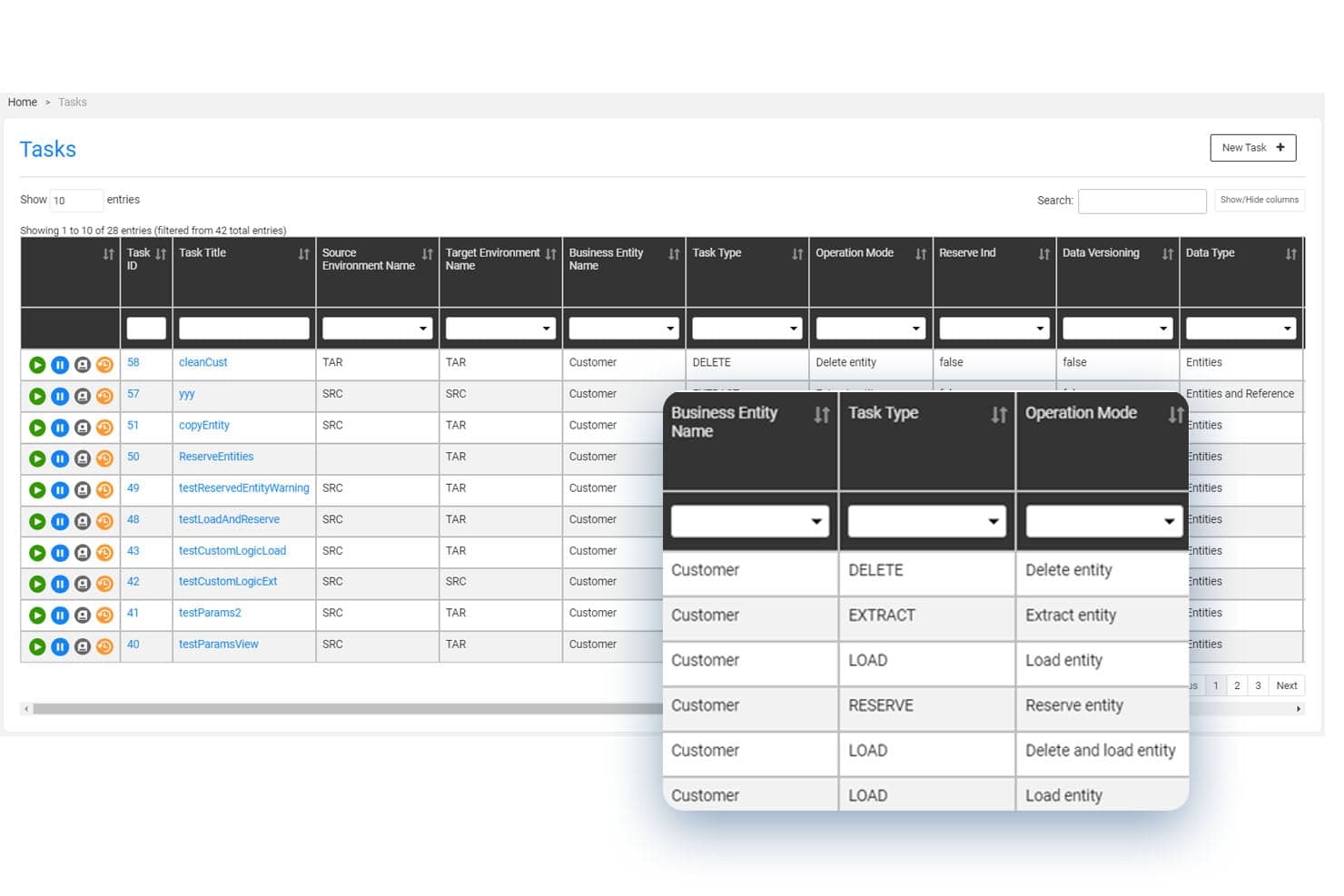
K2View Test Data Management lets users manage and filter data tasks by type and operation mode. K2View Test Data Management is an enterprise TDM platform that unifies data masking, synthetic data generation, subsetting, and self-service provisioning across relational, NoSQL, mainframe, and cloud data sources through a patented Micro-Database™ architecture.
Who Is K2View Test Data Management Best For?
K2View is built for large enterprises managing test data across mixed environments—mainframe, cloud, NoSQL, and relational—all at once.
Why I Picked K2View Test Data Management
K2View earns its spot on my shortlist because its patented Micro-Database™ architecture solves a problem most TDM tools sidestep: maintaining referential integrity across mainframe, NoSQL, and cloud sources simultaneously. I'm particularly impressed by its in-flight masking, which means PII is masked at the point of extraction and never lands unmasked in a test environment. Its entity-centric subsetting lets teams pull a complete customer record spanning Oracle, Kafka, and MongoDB in one operation, without manual join rules.
K2View Test Data Management Key Features
- Self-service TDM portal: A web-based interface that lets testers request, reserve, and rollback test data without involving data or DBA teams.
- Time Machine snapshot and rollback: Saves specific test data states at any point so testers can restore environments to a known configuration instantly.
- Automated PII discovery: Built-in classifiers scan all connected sources, tag sensitive fields, and recommend or apply masking policies automatically.
- Agentic TDM: An AI-driven capability that reads test cases and autonomously assembles compliant, provisioning-ready datasets without manual configuration.
K2View Test Data Management Integrations
K2View offers built-in connectors for Oracle, SQL Server, PostgreSQL, DB2, MongoDB, Snowflake, Salesforce, Amazon S3, Kafka, and mainframe systems. REST, JDBC, and ODBC connectivity supports custom integrations and CI/CD workflows with Jenkins, GitHub Actions, and Azure DevOps.
Pros and Cons
Pros:
- Automated PII discovery built into platform
- Entity-centric subsetting spans mainframe and cloud
- In-flight masking prevents unmasked PII exposure
Cons:
- API-based CI/CD integration requires configuration
- Not designed for small teams
Learn more about K2View Test Data Management: Best cross-database subsetting in regulated industries
- Free demo available
- Pricing upon request

IBM InfoSphere Optim helps you quickly create test data. IBM Test Data Management is an enterprise test data management solution that covers data masking, cross-database subsetting, and on-demand data provisioning across a wide range of relational and mainframe data sources.
Who Is IBM Test Data Management Best For?
IBM Test Data Management is a strong fit for large enterprises in regulated industries—financial services, healthcare, and insurance—running complex, multi-database or mainframe-inclusive environments where data masking and cross-database subsetting are compliance requirements.
Why I Picked IBM Test Data Management
IBM Test Data Management earns its spot on my shortlist because of how it handles cross-database subsetting at the business-object level, pulling referentially intact subsets across multiple connected databases simultaneously. I'm particularly impressed by its federated extraction capability, which lets teams work across heterogeneous data landscapes, including mainframe sources like VSAM and IMS, where almost no competing tool operates. Its 40+ predefined masking rules with format-preserving output make it genuinely useful in GDPR- and HIPAA-regulated environments.
IBM Test Data Management Key Features
- Governance Catalog integration: Drag-and-drop data classification rules directly onto column maps to auto-assign masking routines from a central policy catalog.
- Apache Spark runtime: An embedded Spark engine handles large-scale data processing within automated subsetting and masking workflows.
- Role-based access control: Keycloak-powered RBAC with LDAP, SAML, OIDC, and Kerberos support controls who can access, request, and refresh test datasets.
- Compliance reporting: Built-in reporting validates enforcement of data privacy policies across GDPR- and HIPAA-regulated environments.
IBM Test Data Management Integrations
Documented integrations include IBM Governance Catalog, IBM Cloud Pak for Data, Keycloak, Apache Spark, and databases such as Db2, Oracle, SQL Server, PostgreSQL, Snowflake, SAP, Teradata, Informix, Netezza, and limited MongoDB. Its OpenAPI 2.0 REST API supports custom orchestration and CI/CD workflows, while the z/OS edition connects to VSAM and IMS.
Pros and Cons
Pros:
- Handles VSAM and IMS subsets
- Format-preserving masking supports regulated data
- Preserves referential integrity across databases
Cons:
- Physical copies replace virtual cloning
- No native synthetic data generation
Learn more about IBM Test Data Management: Best for masking across multi-database pipelines
- Free demo available
- Pricing upon request

Tonic.ai lets users manage data masking rules across database tables. Tonic.ai is a test data management platform that covers structured data masking and subsetting, unstructured data redaction, and fully synthetic data generation across relational databases, NoSQL stores, and cloud data warehouses.
Who Is Tonic.ai Best For?
Tonic.ai is a strong fit for data engineers and DBAs managing test data across complex, multi-database environments spanning relational databases, NoSQL stores, and cloud data warehouses.
Why I Picked Tonic.ai
I picked Tonic.ai as one of the best because its deterministic masking engine applies consistent masked values for the same input across PostgreSQL, MongoDB, Snowflake, and every other source in your pipeline simultaneously. That means a customer ID masked in your relational database matches the same masked value in your data warehouse and document store, keeping joins intact across systems. Its patented subsetting engine compounds this by extracting referentially coherent slices, which is how eBay reduced an 8PB dataset to a clean 1GB test environment without breaking any cross-table relationships.
Tonic.ai Key Features
- Automated PII/PHI discovery: Scans connected data sources, detects sensitive fields, and recommends masking transformations without manual column-by-column mapping.
- Tonic Ephemeral: Spins up on-demand, isolated databases within CI/CD pipelines using direct DNS connections, then tears them down automatically after test execution.
- Schema change detection: Identifies new or modified columns and can block data generation automatically to prevent accidental PII leakage into test environments.
- Generator presets: Lets you save and reuse named masking and transformation rules globally across workspaces, keeping masking policies consistent at scale.
Tonic.ai Integrations
Tonic.ai offers a native GitHub Actions integration, plus REST API connectivity for Jenkins and GitLab CI. It connects to PostgreSQL, MySQL, SQL Server, Oracle, MongoDB, DynamoDB, Snowflake, BigQuery, Redshift, and Databricks.
Pros and Cons
Pros:
- Automated PII discovery with AI recommendations
- Deterministic masking across multiple database platforms
- Patented subsetting engine preserves referential integrity
Cons:
- Initial setup can be complex for enterprises
- No native mainframe data source support
Learn more about Tonic.ai: Best for visual, coverage-driven data design
- 14-day free trial
- Pricing upon request

Curiosity Software visualizes data relationships via a radial partition diagram. Curiosity Software is a test data management platform that combines data masking, synthetic data generation, subsetting, virtualization, and self-service provisioning across 250+ source integrations—including mainframe systems like VSAM, IMS, and CICS.
Who Is Curiosity Software Best For?
Curiosity Software suits enterprise QA teams and data engineers working in complex, multi-source environments—especially those supporting mainframe systems or managing compliance-driven test data at scale.
Why I Picked Curiosity Software
I picked Curiosity Software as one of the best because its coverage-driven approach to data design genuinely sets it apart. Instead of manually scripting test data rules, you build visual data flow models that encode business logic and constraints, and the platform automatically identifies coverage gaps and generates synthetic data to fill them. I find the "Find and Make" utility especially useful: it locates existing data your tests need and generates targeted synthetic records only where gaps remain, so you're never over-provisioning or working blind.
Curiosity Software Key Features
- Automated PII discovery: Scans connected data sources to automatically locate and flag sensitive fields before data is provisioned to non-production environments.
- Self-service provisioning portal: A web-based portal lets teams request and provision test data on demand using parameterized, reusable jobs without involving the test data team.
- CI/CD pipeline integration: Test data jobs can be triggered dynamically via API across Jenkins, GitLab, GitHub, Azure DevOps, and Bitbucket for just-in-time data delivery.
- Graph-based data lineage: Stores traceability and cross-source relationship data using Neo4j, producing visual pipeline representations that expose foreign keys, joins, and orphaned references.
Curiosity Software Integrations
Curiosity Software offers 250+ integrations, including Oracle, SQL Server, Snowflake, Salesforce, VSAM, IMS, Jenkins, GitHub, GitLab, and Azure DevOps. Its APIs support custom integrations and CI/CD-triggered, just-in-time test data delivery across cloud, on-premises, and hybrid environments.
Pros and Cons
Pros:
- Automated PII discovery with compliance-driven features
- Mainframe data masking and subsetting included
- Visual model-based test data design
Cons:
- No published SOC 2 or ISO 27001 certifications
- Subsetting options less detailed in documentation
Learn more about Curiosity Software: Best for Git-style DB cloning across five engines
- Free demo available
- Pricing upon request

Redgate SQL Provision lets users manage database clones across multiple SQL instances. Redgate SQL Provision is a test data management tool that covers data masking, subsetting, and Git-style database cloning across SQL Server, PostgreSQL, MySQL, MariaDB, and Oracle.
Who Is Redgate SQL Provision Best For?
Redgate SQL Provision is a strong fit for DBAs and QA engineers who need fast, version-controlled database cloning and masking across multiple relational engines.
Why I Picked Redgate SQL Provision
I picked Redgate SQL Provision as one of the best because its Git-style database cloning is genuinely unlike anything else I've seen across five engines. Redgate Clone spins up a live data container in seconds regardless of database size, so a 5TB SQL Server database provisions as fast as a 128MB one. You can branch, reset, and save revisions like a Git workflow, which makes it easy to give every tester their own isolated environment without duplicating storage.
Redgate SQL Provision Key Features
- Anonymize CLI (
rganonymize): A three-step command-line tool that classifies PII columns, maps masking rules, and replaces real values across SQL Server, PostgreSQL, MySQL, MariaDB, and Oracle. - Deterministic masking: Masks the same input value to the same output every time using a fixed seed, keeping masked data consistent across related tables.
- Data subsetting: The
rgsubsetCLI pulls a configurable portion of your source database—defaulting to 10%—while following foreign keys to preserve referential integrity. - AI Custom Datasets: Lets you describe the values you need in plain language and generates a reviewable list of up to 1,000 values for use in masking substitution.
Redgate SQL Provision Integrations
Redgate SQL Provision integrates with SQL Server, PostgreSQL, MySQL, MariaDB, Oracle, Docker, AWS CloudFormation, Azure Kubernetes Service, SQL Data Catalog, PowerShell, and dbatools. Its CLIs support scripted CI/CD workflows, but native Jenkins, Azure DevOps, and GitHub Actions plugins aren’t documented.
Pros and Cons
Pros:
- Foreign-key-aware subsetting protects relational integrity
- Deterministic masking preserves cross-table consistency
- Git-style branching refreshes test databases quickly
Cons:
- Product positioning creates buyer uncertainty
- Synthetic data generation stops at value lists
Learn more about Redgate SQL Provision:
Outras ferramentas de gestão de dados de teste
Eis algumas opções adicionais de ferramentas de gestão de dados de teste que não entraram na minha lista restrita, mas que ainda vale a pena conhecer:
- 11Perforce DelphixBest for virtualizing full production database clones
- 12SynthesizedBest for SAP-native test data masking
- 13Tricentis ToscaBest for AI-powered testing
- 14InformaticaBest for enterprise testing
- 15BMC CompuwareBest for immediate testing
- 16Rocket Data ExpressBest for saving test resources
- 17Accelario Continuous DataOps PlatformBest for CI/CD-triggered DB virtualization
- 18Avo Test Data ManagementBest for rapid and reliable test data generation
- 19SynthoBest for privacy-first synthetic data generation
- 20IRI VoracityBest for masking structured and dark data together
How I Evaluate Test Data Management Tools
I split evaluation into three parts, weighting core needs most: mask sensitive data, generate realistic synthetic records, and preserve subset links. Next, I look for differentiators like sensitive-data discovery and versioned test data. Finally, I consider onboarding, support, deployment fit, and pricing.
Core Functionality (Table Stakes For This List)
When I'm selecting tools for my list, I score each one on a scale from 0 (does not offer the functionality) to 5 (excels in this area) for each core functionality listed below. I then convert the total into a percentage to help assess each tool's overall fit, with extra weight on any functionalities I’ve deemed essential.
- Data Masking (Essential): I look for configurable, consistent masking across data types, so teams can share production-like records without exposing customer details.
- Synthetic Data (Essential): I assess whether generated records reflect real data structures and distributions, including edge cases needed for reliable application testing.
- Data Subsetting: I check whether teams can extract smaller datasets while preserving linked records, such as orders and their associated customers.
- Environment Provisioning: I consider how teams clone or refresh test environments, and whether they can repeat those steps across development and QA.
- Referential Integrity: I evaluate how the tool preserves table and system relationships during masking, generation, and subset operations.
- Pipeline Integration: I look for ways to trigger data provisioning from CI/CD or test automation workflows, such as preparing a fresh dataset for each test run.
Once I have a list of tools that meet the criteria, I consider what sets each platform apart.
Differentiating Factors (What Sets Vendors Apart)
Here's how I compare and contrast different vendors:
Standout Features
I look for AI-driven data generation that learns production patterns and produces synthetic datasets without manual rule authoring—useful when a QA team needs realistic edge cases across dozens of tables. Sensitive data discovery matters just as much; I check whether a tool auto-classifies PII across mixed sources, since manual tagging slows onboarding and introduces compliance gaps. I also evaluate version-controlled test data, where teams can snapshot, branch, and roll back datasets the way they manage code, keeping test cycles repeatable after schema changes.
Beyond Features
Deployment flexibility matters because some teams need data behind firewalls while others run cloud-native pipelines. I check whether a vendor offers on-premise, cloud, and hybrid options so data residency policies aren't an afterthought. Scalability is just as important—I evaluate how each tool handles multi-terabyte datasets during masking or subsetting, since slow provisioning stalls CI/CD cycles. I also look at licensing models to understand whether pricing scales by data volume, environments, or seats, which shapes long-term adoption across multiple product teams.
Como escolher uma ferramenta de gestão de dados de teste
É fácil perder-se em listas extensas de funcionalidades e estruturas de preços complexas. Para o ajudar a manter-se concentrado enquanto percorre o seu processo específico de seleção de software, eis uma lista de verificação dos fatores a ter em conta:
| Fator | O que deve considerar |
|---|---|
| FatorEscalabilidade | O que deve considerarA ferramenta acompanhará o crescimento da sua equipa? Considere o volume de dados e o crescimento do número de utilizadores no futuro. Procure planos flexíveis que permitam acompanhar o crescimento sem aumentos significativos dos custos. |
| FatorIntegrações | O que deve considerarFunciona com os seus sistemas existentes? Verifique a compatibilidade com as suas ferramentas de teste, bases de dados e fluxos de trabalho atuais para evitar interrupções. |
| FatorPersonalização | O que deve considerarPode adaptar a ferramenta às suas necessidades? Avalie se a ferramenta permite criar modelos de dados e fluxos de trabalho personalizados que se adequem aos seus processos. |
| FatorFacilidade de utilização | O que deve considerarÉ fácil de utilizar pela sua equipa? Considere a curva de aprendizagem e se os colaboradores sem conhecimentos técnicos conseguem utilizar a ferramenta facilmente sem formação extensa. |
| FatorImplementação e integração inicial | O que deve considerarCom que rapidez pode começar? Procure ferramentas que ofereçam uma configuração rápida, recursos de formação e apoio para garantir uma transição tranquila. |
| FatorCusto | O que deve considerarEnquadra-se no seu orçamento? Compare os modelos de preços e certifique-se de que não existem custos ocultos. Verifique se existe um período de avaliação gratuito ou uma demonstração para testar a ferramenta antes de assumir um compromisso. |
| FatorMedidas de segurança | O que deve considerarComo protege os seus dados? Certifique-se de que a ferramenta cumpre as normas de segurança de dados e oferece encriptação e controlos de acesso para proteger informações sensíveis. |
| FatorRequisitos de conformidade | O que deve considerarCumpre as necessidades regulamentares? Confirme se a ferramenta é compatível com os regulamentos relevantes de proteção de dados, como o GDPR ou o HIPAA, consoante os requisitos do seu setor. |
O que são ferramentas de gestão de dados de teste?
As ferramentas de gestão de dados de teste são soluções de software utilizadas para gerar, gerir e manter dados para fins de testes de software. Tratam da criação e manipulação de dados de teste, garantindo que estes são precisos, seguros e adequados a vários cenários de teste.
Estas ferramentas desempenham um papel vital na organização e no aprovisionamento de dados para testes funcionais, de desempenho e de regressão no desenvolvimento de software, trabalhando frequentemente em conjunto com ferramentas de teste de bases de dados para garantir uma validação abrangente dos dados.
Funcionalidades
Ao selecionar ferramentas de gestão de dados de teste, tenha em atenção as seguintes funcionalidades importantes:
- Mascaramento de dados: Protege informações sensíveis, substituindo-as por dados fictícios e garantindo a conformidade com os requisitos de privacidade.
- Subconjuntos de dados: Extrai um subconjunto de dados de grandes conjuntos de dados, tornando os testes mais fáceis de gerir e eficientes.
- Capacidades de integração: Liga-se às ferramentas de teste e bases de dados existentes, facilitando fluxos de trabalho uniformes.
- Modelos de dados personalizados: Permite aos utilizadores criar modelos adaptados às suas necessidades específicas de teste, aumentando a flexibilidade.
- Geração de dados orientada por IA: Utiliza inteligência artificial para gerar dados de teste realistas, melhorando a precisão dos testes.
- Aprovisionamento de dados em tempo real: Fornece acesso imediato aos dados de teste necessários, reduzindo os atrasos no processo de teste.
- Suporte multicloud: Permite que a ferramenta funcione em diferentes ambientes de nuvem, oferecendo flexibilidade na implementação.
- Encriptação e controlos de acesso: Garante a segurança dos dados através da encriptação dos dados e da definição de permissões de acesso dos utilizadores.
- Recursos de formação: Oferece tutoriais, seminários online e outros materiais de aprendizagem para apoiar a integração dos utilizadores e a adoção da ferramenta.
- Suporte à conformidade: Ajuda a garantir que o tratamento dos dados cumpre as normas e os regulamentos do setor, como o GDPR ou a HIPAA.
Benefícios
A implementação de ferramentas de gestão de dados de teste proporciona vários benefícios à sua equipa e à sua empresa. Eis alguns dos benefícios que pode esperar:
- Maior privacidade dos dados: As funcionalidades de mascaramento de dados ajudam a proteger informações sensíveis, garantindo a conformidade com os regulamentos de privacidade.
- Maior eficiência dos testes: O aprovisionamento de dados em tempo real reduz os atrasos, permitindo ciclos de teste mais rápidos.
- Maior precisão dos dados: A geração de dados orientada por IA cria dados de teste realistas, aumentando a fiabilidade dos resultados dos testes.
- Redução de custos: A criação de subconjuntos de dados extrai apenas os dados necessários, reduzindo os custos de armazenamento e processamento.
- Flexibilidade na implementação: O suporte multicloud permite que a ferramenta funcione em diferentes ambientes, adaptando-se às necessidades da sua infraestrutura.
- Integração simples para os utilizadores: O acesso a recursos de formação e tutoriais facilita a adoção rápida e a utilização eficiente da ferramenta.
- Conformidade regulamentar: As funcionalidades de suporte à conformidade ajudam a cumprir as normas do setor, reduzindo o risco de problemas legais.
Custos e preços
A seleção de ferramentas de gestão de dados de teste requer uma compreensão dos vários modelos de preços e planos disponíveis. Os custos variam consoante as funcionalidades, o tamanho da equipa, os complementos e outros fatores. A tabela abaixo resume os planos comuns, os respetivos preços médios e as funcionalidades normalmente incluídas nas soluções de ferramentas de gestão de dados de teste:
Tabela de comparação de planos para ferramentas de gestão de dados de teste
| Tipo de plano | Preço médio | Funcionalidades comuns |
|---|---|---|
| Tipo de planoPlano gratuito | Preço médio$0 | Funcionalidades comunsMascaramento básico de dados, criação limitada de subconjuntos de dados e capacidades de integração limitadas. |
| Tipo de planoPlano pessoal | Preço médio$5-$25/utilizador/mês | Funcionalidades comunsMaior privacidade dos dados, geração de dados orientada por IA e suporte básico. |
| Tipo de planoPlano empresarial | Preço médio$30-$75/utilizador/mês | Funcionalidades comunsCriação avançada de subconjuntos de dados, suporte multicloud e acesso a recursos de formação. |
| Tipo de planoPlano empresarial avançado | Preço médio$100+/utilizador/mês | Funcionalidades comunsModelos de dados personalizados, suporte abrangente à conformidade, suporte premium ao cliente e capacidades de integração completas. |
Perguntas frequentes sobre ferramentas de gestão de dados de teste
Eis algumas respostas a perguntas comuns sobre ferramentas de gestão de dados de teste:
Deve escolher funcionalidades de mascaramento ou dados sintéticos?
O mascaramento protege os dados reais ao ocultar os dados pessoais. O software que gera dados sintéticos cria conjuntos de dados falsos, mas realistas. Escolha o mascaramento se utilizar dados de produção; escolha dados sintéticos se pretender conjuntos de dados de teste mais seguros e totalmente gerados.
Se ainda estiver na fase de “preciso de recolher mais dados de teste”, experimente: 10 melhores ferramentas de teste de usabilidade para obter opiniões de utilizadores reais.
Porque é importante a segurança dos dados nas ferramentas de GDT?
O software de GDT gere frequentemente dados de produção sensíveis. Sem o mascaramento ou a encriptação adequados, corre o risco de fugas de dados ou problemas de conformidade. Escolha sempre uma ferramenta que suporte encriptação, anonimização e controlos de acesso.
Que integrações deve suportar uma ferramenta de GDT?
Deve funcionar com as suas ferramentas de CI/CD, como Jenkins, GitLab ou Azure DevOps. A integração com as principais bases de dados (Oracle, SQL Server, PostgreSQL) e plataformas de nuvem também é essencial para uma automatização sem problemas.
Como testar uma ferramenta de GDT antes de a comprar?
Execute uma pequena prova de conceito. Experimente clonar, mascarar e atualizar os dados na sua configuração real. Verifique a rapidez de execução e se a ferramenta se integra no seu fluxo de trabalho existente.
Como podem as ferramentas de GDT ajudar na conformidade?
As boas ferramentas registam todas as alterações aos dados, mantêm registos de auditoria e garantem a consistência dos dados mascarados. Isto ajuda a sua equipa a cumprir regulamentos como o RGPD, a HIPAA ou a CCPA.