

Setyl-beoordeling 2026: Voordelen, Nadelen, Functies & Prijzen

We review tools independently, and commissions help fund our testing. See our transparency policy, our methodology, or suggest a tool.
Losing track of laptops, hunting down software licenses, and relying on messy spreadsheets can waste time and money. Setyl is an IT asset management software that tackles those problems by giving you a clear view of every device, license, and user. It’s a strong fit for midsize organizations across various industries, like finance, professional services, and tech, where assets move often and accountability matters. In this review, I’ll cover Setyl’s features, pros and cons, best and worst use cases, pricing, and more—so you can see if it makes your daily IT work easier and your team more efficient and accurate.
Setyl Evaluation Summary

4.9/5
- From $300/month
- Free demo available
Waarom u onze softwareaanbevelingen kunt vertrouwen
6,700+
Reviews
20
Industry experts
16+
Evaluation factors
14
Years
Ons team test en beoordeelt software sinds 2012. Als technologieleiders weten we zelf hoe moeilijk — en belangrijk — het is om de juiste software te kiezen.
Voor deze gids hebben we tools geëvalueerd met behulp van praktijktests en onafhankelijk onderzoek, waarbij we tools beoordeeden aan de hand van onze selectiecriteria.
Onze reviews weerspiegelen ons menselijke redactionele oordeel, geen verkooppraatje.
Deskundige beoordelaars:
- Paulo Gardini MiguelTechnisch directeur
 Tim FisherVP AI
 Gabriel RosasTech Lead & software-architect
 Christhian GruhnTech Lead & platformarchitect

Setyl Overview
Setyl gives IT teams a clear way to manage hardware, software, and users in one place, which makes day-to-day tracking easier. It focuses on ease of use, so even non-technical staff can pick it up quickly. Overall, it's suitable for teams that are looking to upgrade from basic tracking tools and spreadsheets, but are not quite ready for highly complex enterprise solutions.
Pros
- You can easily track and manage a large number of IT assets in one place.
- You can track the full history of each asset, which makes audits easier.
- Alerts help you catch expiring warranties or licenses before they lapse.
Cons
- Reports feel limited if you need deep, custom insights.
- Visual customization is limited if you want tailored dashboards.
- Doesn’t offer the complex functionalities that may be needed for large enterprise organizations
Is Setyl Right For Your Needs?
Who Would be a Good Fit for Setyl?
Setyl is best suited for midsize organizations that need clear visibility and control across both hardware and software assets without the complexity of legacy enterprise systems. It’s ideal for IT, finance, and operations leaders who want to streamline workflows, automate onboarding and offboarding, and maintain compliance as teams and technology stacks grow. Companies in tech, professional services, and finance particularly benefit from Setyl’s unified approach to asset, license, and spend management.
- Tech & Professional Services FirmsIdeal for fast-scaling teams managing distributed staff, shared software, and multiple client environments.
- Finance TeamsSpend visibility, renewal tracking, and license utilization metrics help control budgets.
- Midsize OrganizationsBuilt for midsize companies that need comprehensive visibility without the overhead of legacy systems.
- Remote/Hybrid TeamsYou can track devices and licenses even when teams span different locations.
- IT & Security TeamsYou’ll have audit trails, compliance readiness, and insights into shadow IT.
- HR/Ops DepartmentsYou can tie onboarding/offboarding workflows to asset allocations, reducing gaps.
Who Would be a Bad Fit for Setyl?
Setyl may not be the right choice for organizations at the extreme ends of the spectrum—either too small to need structured IT management or so large and regulated that they require fully customized, certified enterprise systems. Highly specialized industries like engineering, defense, or large-scale financial institutions may also find their requirements exceed Setyl’s current focus and flexibility.
- Massive EnterprisesYou’ll likely outgrow its depth and need enterprise-grade custom workflows.
- Enterprises with On-Prem RequirementsSetyl currently only offers a cloud-based solution.
- Defense/Government OrganizationsStrict controls and certifications may exceed what Setyl supports today.
- Heavy Engineering and Industrial OperationsManaging complex machinery, maintenance schedules, and physical plant assets typically requires niche industry tools.
- Very Small BusinessesTeams with only a few employees and devices will find Setyl more powerful than necessary for their scale.
- Custom Platform DevelopersIf you need highly specialized asset modeling or custom-built workflows, Setyl’s structured framework may feel restrictive.
Our Review Methodology
How We Test & Score Tools
We’ve spent years building, refining, and improving our software testing and scoring system. The rubric is designed to capture the nuances of software selection and what makes a tool effective, focusing on critical aspects of the decision-making process.
Below, you can see exactly how our testing and scoring works across seven criteria. It allows us to provide an unbiased evaluation of the software based on core functionality, standout features, ease of use, onboarding, customer support, integrations, customer reviews, and value for money.
Core Functionality (25% of final scoring)
The starting point of our evaluation is always the core functionality of the tool. Does it have the basic features and functions that a user would expect to see? Are any of those core features locked to higher-tiered pricing plans? At its core, we expect a tool to stand up against the baseline capabilities of its competitors.
Standout Features (25% of final scoring)
Next, we evaluate uncommon standout features that go above and beyond the core functionality typically found in tools of its kind. A high score reflects specialized or unique features that make the product faster, more efficient, or offer additional value to the user.
We also evaluate how easy it is to integrate with other tools typically found in the tech stack to expand the functionality and utility of the software. Tools offering plentiful native integrations, 3rd party connections, and API access to build custom integrations score best.
Ease of Use (10% of final scoring)
We consider how quick and easy it is to execute the tasks defined in the core functionality using the tool. High scoring software is well designed, intuitive to use, offers mobile apps, provides templates, and makes relatively complex tasks seem simple.
Onboarding (10% of final scoring)
We know how important rapid team adoption is for a new platform, so we evaluate how easy it is to learn and use a tool with minimal training. We evaluate how quickly a team member can get set up and start using the tool with no experience. High scoring solutions indicate little or no support is required.
Customer Support (10% of final scoring)
We review how quick and easy it is to get unstuck and find help by phone, live chat, or knowledge base. Tools and companies that provide real-time support score best, while chatbots score worst.
Customer Reviews (10% of final scoring)
Beyond our own testing and evaluation, we consider the net promoter score from current and past customers. We review their likelihood, given the option, to choose the tool again for the core functionality. A high scoring software reflects a high net promoter score from current or past customers.
Value for Money (10% of final scoring)
Lastly, in consideration of all the other criteria, we review the average price of entry level plans against the core features and consider the value of the other evaluation criteria. Software that delivers more, for less, will score higher.
Core Features
Hardware and Software Asset Tracking
You can log every laptop, phone, or piece of software and see who has it at any time. It keeps a full history, so you never lose track.
User Management
You can assign assets to people and know who’s responsible. This makes onboarding, offboarding, and accountability easy.
Lifecycle Tracking
You can follow assets from purchase to disposal. This helps you plan upgrades and avoid surprise failures.
Warranty & License Alerts
You’ll get reminders before contracts expire. That way you don’t overspend or miss renewals.
Reporting & Audits
You can record and track all compliance information, ensuring you are always audit-ready. It saves you from digging through spreadsheets.
Multi-Site Visibility
You can manage assets across offices or regions in one view. It keeps everything consistent, no matter the location.

Ease of Use
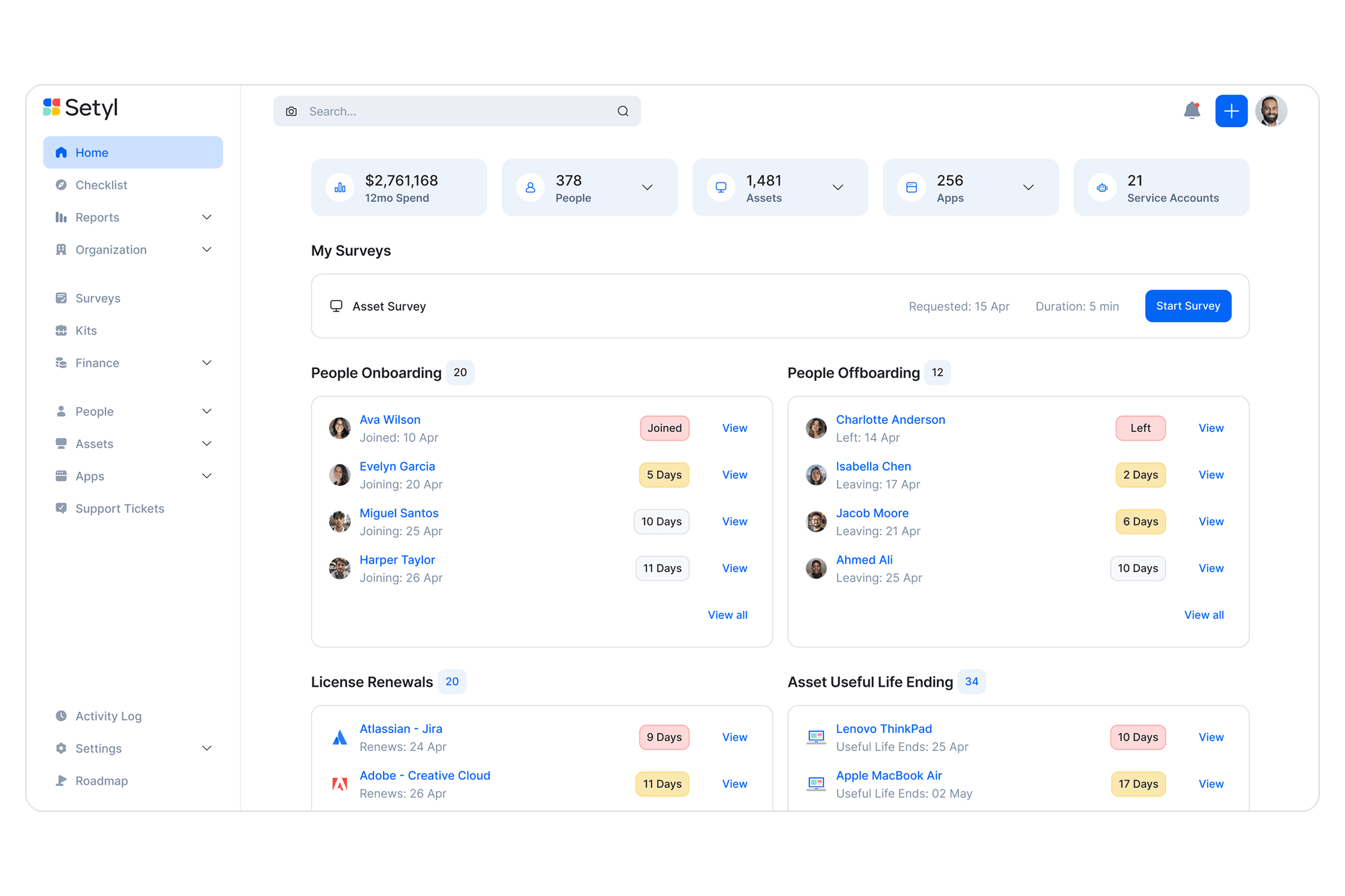
Setyl’s layout is clean and intuitive, so you and your team can pick it up quickly without tons of training. Tasks like assigning assets or pulling reports feel straightforward, and you don’t get lost in cluttered menus. Some advanced settings take a little practice, but overall, it makes tracking assets less of a chore and more of a routine you can trust.
Integrations
Setyl integrates natively with Intune, Jamf, Iru (Kandji), Landsweeper, Meraki, Zendesk, Jira Service Management, Okta, Microsoft 365, Google Workspace, Slack, Zoom, NetSuite, Xero, and BambooHR.
Setyl also provides an API and connects with third-party integration tools like Zapier.

Setyl Specs
- 2-Factor Authentication: Yes
- API: Yes
- Asset Tagging: Yes
- Dashboard: Yes
- Data Export: Yes
- Data Import: Yes
- Data Visualization: Yes
- Database: Yes
- Document Management: Yes
- External Integrations: Yes
- Hardware Integration: No
- Hardware Modernization: No
- Inventory Tracking: Yes
- Multi-User: Yes
- Network Device Performance Monitoring: No
- Network Traffic Monitoring: No
- Network Visualization: Yes
- Notifications: Yes
- Scheduling: Yes
- Status Notifications: Yes
- Third-Party Plugins/Add-Ons: Yes
- Workflow Management: Yes


