

Databricks versus Cloudera: Vergelijking en beoordelingen voor 2026
De keuze tussen Databricks en Cloudera hangt af van de manier waarop uw team gegevens beheert in cloud- en hybride omgevingen. Ik vergelijk hun sterke punten, compromissen en meest geschikte gebruikssituaties.

We review tools independently, and commissions help fund our testing. See our transparency policy, our methodology, or suggest a tool.
As data environments spread across cloud, on-premises systems, and multiple pipelines, keeping ingestion and transformation workflows consistent gets harder. The right DataOps tool should help teams manage that complexity without creating more operational overhead.
Databricks and Cloudera both support large-scale data engineering and analytics, but they solve the problem from different starting points. Databricks centers on a lakehouse model with managed pipelines, streaming, governance, and AI, while Cloudera emphasizes hybrid data operations across cloud, data center, and edge environments.
In this article, I compare Databricks and Cloudera across features, pricing, security, ease of use, and best-fit scenarios to help you decide which platform suits your data strategy and infrastructure.
Databricks
4.5/5
- Free edition available + 14-day free trial
- From $0.15/DBU
Cloudera
4.1/5
- 60-day free trial
- From $0.04/CCU/hour
Waarom u onze softwareaanbevelingen kunt vertrouwen
6,700+
Reviews
20
Industry experts
16+
Evaluation factors
14
Years
Ons team test en beoordeelt software sinds 2012. Als technologieleiders weten we zelf hoe moeilijk — en belangrijk — het is om de juiste software te kiezen.
Voor deze gids hebben we tools geëvalueerd met behulp van praktijktests en onafhankelijk onderzoek, waarbij we tools beoordeeden aan de hand van onze selectiecriteria.
Onze reviews weerspiegelen ons menselijke redactionele oordeel, geen verkooppraatje.
Deskundige beoordelaars:
- Paulo Gardini MiguelTechnisch directeur
 Tim FisherVP AI
 Gabriel RosasTech Lead & software-architect
 Christhian GruhnTech Lead & platformarchitect

| Databricks | Cloudera | |
|---|---|---|
| Free Trial | Free edition available + 14-day free trial | 60-day free trial |
| Pricing | From $0.15/DBU | From $0.04/CCU/hour |
Prijzen en verborgen kosten van Databricks versus Cloudera
Databricks hanteert verbruiksgebaseerde prijzen voor data-engineering, datawarehousing, AI en andere workloads. De kosten worden bepaald door het computegebruik en door cloudinfrastructuur, opslag, netwerken en ondersteuning. Cloudera hanteert een hybride aanpak: de cloudservices worden op basis van verbruik gefactureerd via Cloudera Compute Units (CCU's), terwijl implementaties op locatie gebruikmaken van jaarabonnementen. In beide gevallen kunnen infrastructuur en netwerken de totale kosten boven op de basisplatformkosten verhogen.
Bij het vergelijken van de twee oplossingen is het nuttig om verder te kijken dan de hoofdlijnen van de prijsstelling en in kaart te brengen waar je workloads worden uitgevoerd en hoe vaak pipelines, streamingtaken en transformaties worden uitgevoerd. Bij Databricks kunnen inefficiënte of langlopende compute en gegevensoverdracht de kosten verhogen. Cloudera kan ondertussen extra kosten met zich meebrengen voor infrastructuur, netwerken, Private Link, observability en services zoals Data Flow of Lakehouse Optimizer. Door rekening te houden met het implementatiemodel, het workloadvolume, ondersteuning en schaalbaarheidsbehoeften krijg je een realistischer beeld van de kosten op lange termijn.
| Databricks | Cloudera | |
|---|---|---|
| A/B Testing | No | No |
| Analytics | Yes | Yes |
| API | Yes | Yes |
| Conversion Tracking | No | No |
| Custom Reports | Yes | Yes |
| Dashboards | Yes | Yes |
| Data Export | Yes | Yes |
| Data Import | Yes | Yes |
| Data Mining | Yes | Yes |
| Data Visualization | Yes | Yes |
| External Integrations | Yes | Yes |
| Forecasting | Yes | Yes |
| Keyword Tracking | No | No |
| Link Tracking | No | No |
| Multi-User | Yes | Yes |
| Notifications | Yes | Yes |
| Reports | Yes | Yes |
| Scenario Planning | No | No |
| SEO | No | No |
| Visualization | Yes | Yes |
| Integratie | Databricks | Cloudera |
|---|---|---|
| IntegratieMicrosoft Azure | Databricks✅ | Cloudera✅ |
| IntegratieAmazon Web Services | Databricks✅ | Cloudera✅ |
| IntegratieGoogle Cloud Platform | Databricks✅ | Cloudera✅ |
| IntegratieTableau | Databricks✅ | Cloudera✅ |
| IntegratieInformatica | Databricks✅ | Cloudera✅ |
| IntegratieSalesforce | Databricks✅ | Cloudera✅ |
| IntegratieQlik | Databricks✅ | Cloudera✅ |
| IntegratieOracle Database | Databricks✅ | Cloudera✅ |
| IntegratieMongoDB | Databricks✅ | Cloudera✅ |
| IntegratieAPI | Databricks✅ | Cloudera✅ |
| IntegratieZapier | Databricks✅ | Cloudera❌ |
Zowel Databricks als Cloudera ondersteunen uitgebreide ecosystemen met cloudplatforms, databases, BI-tools, API's en dataservices. Databricks integreert deze verbindingen in Lakeflow, Partner Connect en de beheerde data-engineeringworkflows, terwijl Cloudera de nadruk legt op connectiviteit tussen cloud-, on-premises- en hybride omgevingen.
| Aspect | Databricks | Cloudera |
|---|---|---|
| AspectVersleuteling | DatabricksVersleutelt gegevens in rust en tijdens overdracht, met ondersteuning voor door de klant beheerde sleutels, cloudnative sleutelbeheer en gedetailleerde bescherming voor beheerde gegevens- en AI-middelen. | ClouderaOndersteunt versleuteling van gegevens in rust en tijdens overdracht, sleutelbeheer en beveiligingscontroles in cloud- en on-premises-omgevingen. |
| AspectToegangsbeheer | DatabricksUnity Catalog centraliseert gedetailleerd toegangsbeleid voor gegevens, modellen, applicaties en AI-middelen, met SSO, identiteitsintegraties, rij- en kolomcontroles en werkruimtebindingen. | ClouderaMaakt gebruik van Apache Ranger, Knox en identiteitsintegraties voor het beheren van authenticatie, autorisatie, SSO en gedetailleerde toegang in hybride omgevingen. |
| AspectRegelgevingsnaleving | DatabricksBeschikt over SOC 1 Type II-, SOC 2 Type II-, ISO 27001-, ISO 27017- en ISO 27018-certificeringen, met ondersteuning voor HIPAA, PCI DSS, HITRUST en FedRAMP Moderate en High, afhankelijk van cloud, regio en configuratie. | ClouderaBeschikt over certificeringen en programma’s waaronder SOC 2 Type II, ISO 27001, PCI DSS en FedRAMP Moderate voor in aanmerking komende Cloudera-omgevingen. |
| AspectBetrouwbaarheid | DatabricksOndersteunt automatisch schalen, serverloze en beheerde rekenkracht, werklastisolatie en cloudnative beschikbaarheid in AWS, Azure en Google Cloud, met herstelstrategieën die zijn afgestemd op de vereisten van de werklast. | ClouderaOndersteunt implementaties in meerdere zones, redundante infrastructuur, automatische omschakeling en rampenherstel in cloud- en hybride implementaties. |
| AspectDatagovernance | DatabricksUnity Catalog biedt gecentraliseerde auditing, ontdekking, classificatie en geautomatiseerde gegevensherkomst van brongegevens via notebooks, taken, modellen, services en dashboards. | ClouderaSDX combineert Apache Ranger en Atlas om beleid, auditing, metadatabeheer, classificatie en gegevensherkomst toe te passen op gegevens in de cloud en op locatie. |
Beide platforms bieden beveiliging en governance op ondernemingsniveau, maar de nadruk verschilt. Databricks brengt toegangsbeheer, auditing, classificatie en gegevensherkomst samen via Unity Catalog voor gegevens- en AI-werklasten, terwijl Cloudera gecentraliseerde governance uitbreidt naar hybride en on-premises-omgevingen via SDX, Ranger en Atlas.
| Aspect | Databricks | Cloudera |
|---|---|---|
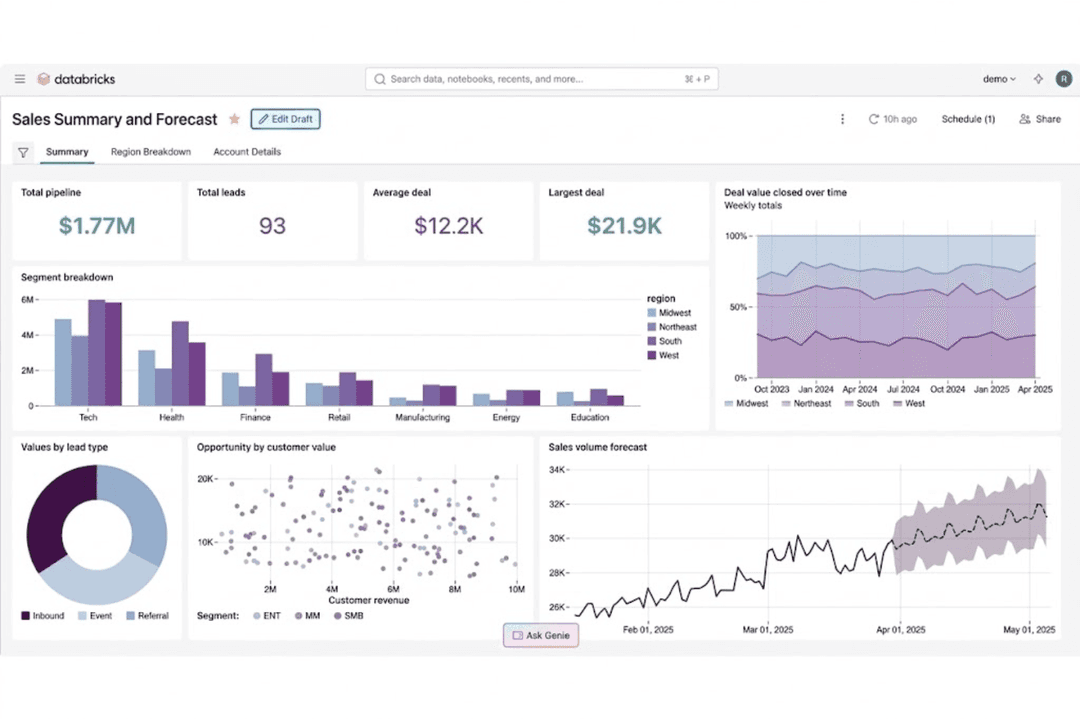
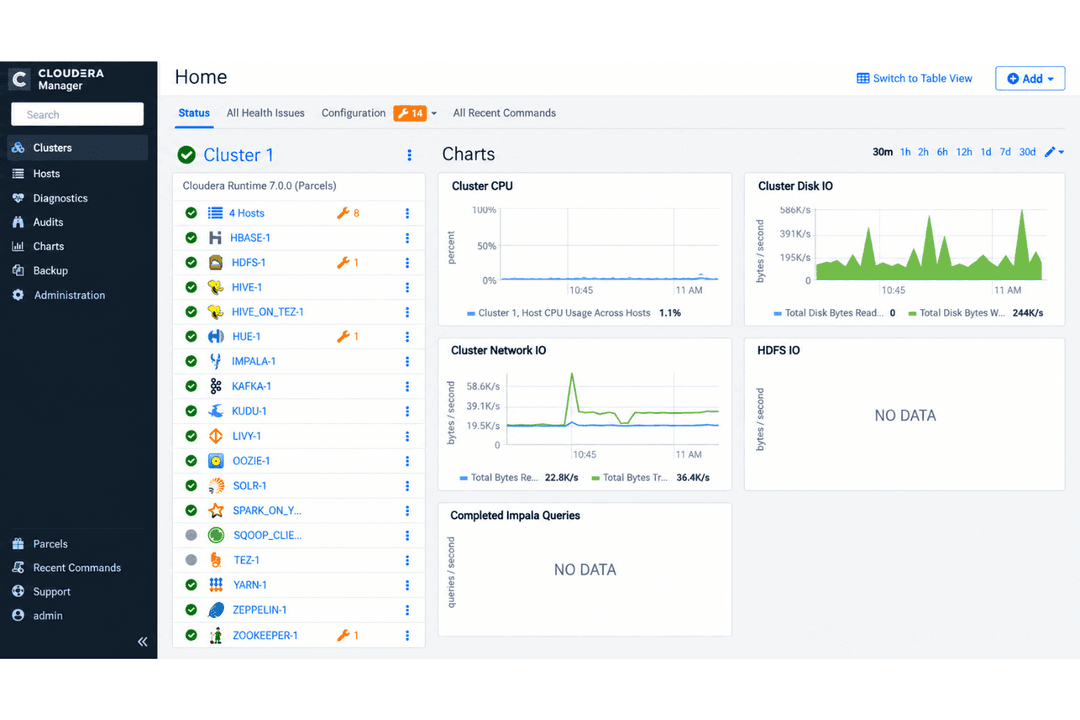
| AspectGebruikersinterface | DatabricksCombineert samenwerkende notebooks, SQL-tools, dashboards en visuele werkstromen in één werkruimte voor engineering-, analyse- en AI-teams. | ClouderaMaakt gebruik van beheerconsoles en servicespecifieke interfaces voor het beheren van gegevens en hybride infrastructuur. |
| AspectInstallatieproces | DatabricksCloudwerkruimten kunnen snel worden ingericht, terwijl serverloze en beheerde rekenkracht de infrastructuurconfiguratie voor veelvoorkomende werklasten vermindert. | ClouderaDe installatie is afhankelijk van het implementatiemodel, met extra configuratie voor hybride en on-premises-omgevingen. |
| AspectInwerken | DatabricksBiedt begeleide installatie, voorbeeldnotebooks, training en beheerde services waarmee teams van eerste experimenten naar beheerde productiewerkstromen kunnen gaan. | ClouderaVereist vertrouwdheid met het bredere ecosysteem, vooral wanneer teams werken met technologieën zoals NiFi, Spark, Ranger en hybride infrastructuur. |
| AspectDocumentatie | DatabricksBiedt uitgebreide documentatie, zelfstudies, implementatierichtlijnen en training voor data-engineering, governance, analyse en AI. | ClouderaBiedt technische documentatie voor cloud, on-premises, beveiliging en platformbeheer. |
| AspectToegang tot ondersteuning | DatabricksBiedt openbare bronnen en gelaagde betaalde ondersteuning met technische contactpersonen, escalatiepaden en dekking voor kritieke problemen bij bedrijfsimplementaties. | ClouderaOmvat bedrijfsondersteuning en technische bronnen voor cloud- en on-premises-aanbiedingen. |
Wat gebruiksgemak betreft, combineert Databricks een technische ontwikkelomgeving met beheerde services die het infrastructuurwerk voor datapijplijnen, analyse en AI verminderen. Cloudera ondersteunt cloud-, on-premises- en hybride omgevingen, wat extra aandachtspunten voor implementatie met zich meebrengt. Voor cloudgerichte datateams biedt Databricks een samenhangende werkstroom van ontwikkeling tot productie, terwijl Cloudera geschikt is voor organisaties die met verschillende infrastructuren moeten werken.
Databricks
- Unifies data engineering, analytics, governance, and AI workloads, reducing the need to maintain separate platforms and duplicate data
- Built on open technologies like Delta Lake and Apache Spark, giving teams more flexibility and portability than proprietary data formats
- Unity Catalog applies governance and access policies consistently across data and workloads, which is useful for complex or multi-cloud environments
- Usage-based pricing can become difficult to predict as workloads grow, especially without careful compute and query optimization
- Requires strong technical expertise in areas like SQL, Python, Spark, and data engineering to get full value from the platform
- Can be excessive for teams with simple reporting or low-volume analytics needs, where the platform’s complexity may outweigh the benefits
Cloudera
- Handles petabyte-scale datasets with strong data governance tools
- Flexible deployment across on-premises, private, and public clouds
- Open-source architecture with full control over data location
- Interface is complex for smaller or less technical teams
- Initial setup and onboarding can be time-consuming
- Performance tuning requires deep technical expertise
Databricks
- Large EnterprisesOrganizations with multiple data teams and high-volume workloads can use Databricks to centralize data engineering, analytics, governance, and AI while reducing duplicated data and tooling.
- Financial ServicesBanks, insurers, and other financial organizations can use Databricks for governed analytics, fraud detection, risk modeling, and machine learning across sensitive datasets.
- Healthcare and Life SciencesHealthcare and life sciences teams can manage large, sensitive datasets while applying centralized governance to analytics, research, and AI workloads.
- Retail and Consumer GoodsRetailers can combine customer, transaction, inventory, and operational data for forecasting, personalization, supply chain analytics, and machine learning.
- ManufacturingManufacturers can bring together operational, IoT, and enterprise data for predictive maintenance, production analytics, forecasting, and AI-driven optimization.
- Technology and SoftwareTechnology companies with data-intensive products or services can use Databricks for large-scale pipelines, real-time analytics, ML development, and AI applications.
Cloudera
- Financial ServicesCloudera’s advanced governance, lineage, and security features make it a reliable fit for meeting banking and financial regulatory demands.
- Healthcare & Life SciencesStrict data governance, in-depth audit trails, and hybrid cloud options match healthcare’s compliance and privacy requirements.
- TelecommunicationsManaging massive data pipelines is easier with Cloudera’s Apache Spark, Kafka, and NiFi integrations.
- Large EnterprisesCloudera’s hybrid deployment support and control over complex infrastructures suit organizations with diverse, global operations.
- Data Engineering TeamsNative integration with tools like Apache Airflow, Impala, and Hive gives data engineers extensive workflow and processing flexibility.
- Government AgenciesFull data residency control, advanced security controls, and detailed auditing cater to public sector compliance standards.
Wie zou Databricks moeten gebruiken en wie Cloudera?
Als je op zoek bent naar een DataOps-platform dat data-engineering, analyse, governance en AI samenbrengt in dezelfde cloudgerichte omgeving, is Databricks waarschijnlijk de betere keuze. Het is vooral nuttig voor teams die beheerde pijplijnen, samenwerkende notebooks, ondersteuning voor streaming en gecentraliseerde governance willen, zonder zelf zoveel infrastructuur te hoeven beheren.
Als u daarentegen dataworkflows moet uitvoeren in cloud-, on-premises- en hybrideomgevingen, past Cloudera mogelijk beter bij uw infrastructuur. Het is een sterke keuze voor ondernemingen met strenge compliance- of vereisten voor gegevenslokalisatie, gevestigde opensource-ecosystemen en teams die gedistribueerde dataplatforms in meerdere omgevingen beheren.
| Databricks | Cloudera | |
|---|---|---|
| Compute & Development | Databricks Workload-aware compute, autoscaling, and collaborative notebooks support engineering, SQL, and AI workloads without provisioning everything for peak demand. | Cloudera Provides configurable compute and data services designed to operate across cloud and on-premises infrastructure. |
| Data Intelligence | Databricks Its Data Intelligence Engine uses organizational metadata and context to improve discovery, governance, optimization, analytics, and AI workflows. | Cloudera Uses metadata, cataloging, and platform services to manage data and analytics across distributed environments. |
| Deployment Model | Databricks Runs as a cloud-native platform across AWS, Azure, and Google Cloud, with managed and serverless compute reducing infrastructure work across data and AI workloads. | Cloudera Extends across public cloud, private cloud, on-premises data centers, and edge environments. |
| Governance Model | Databricks Unity Catalog centralizes access policies, auditing, discovery, and lineage across data, models, applications, and AI assets. | Cloudera SDX combines technologies such as Apache Ranger and Atlas for policy enforcement, auditing, metadata, and lineage. |
| Lakehouse Foundation | Databricks Combines warehousing, engineering, BI, ML, and AI on a lakehouse built around open technologies such as Delta Lake and Apache Spark. | Cloudera Uses an open lakehouse approach based on technologies such as Apache Iceberg, HDFS, and the broader Apache ecosystem. |
| Analytics & Machine Learning | Both support SQL analytics, data science, machine learning, and AI workloads within their broader data platforms. |
|---|---|
| Apache Spark Support | Both use Apache Spark for distributed data processing and large-scale engineering workloads. |
| Batch & Streaming | Both process batch and real-time data for analytics, operational workflows, and downstream applications. |
| Data Integration & ETL | Both support ingestion, transformation, orchestration, and monitoring for large-scale data pipelines. |
| Integrations & APIs | Both connect with major cloud platforms, databases, BI tools, and enterprise systems and provide APIs for extending workflows. |