
Avis sur Resolve 2026 : fonctionnalités d’automatisation informatique, tarification, avantages et inconvénients
Resolve combines IT automation and orchestration to help enterprise IT teams automate service workflows across complex environments. Find out whether Resolve is the right fit for your IT operations and service management needs in my expert review.

Nous évaluons les outils indépendamment ; les commissions aident à financer nos tests. Consultez notre politique de transparence et notre méthodologie.
Managing IT services across a hybrid environment gets complicated when workflows span ticketing, monitoring, cloud, and legacy systems. As incidents grow, IT teams need more than alerts and routing—they need automation that can actually act across the stack.
Resolve is an IT automation and service management software designed to orchestrate workflows across ITSM, observability, cloud, networking, and on-premises systems. I see its biggest appeal in complex enterprise environments where teams want to automate remediation and service workflows without being tied to a single ITSM ecosystem.
In this review, I cover Resolve’s features, pricing, strengths, limitations, and best use cases to help you decide if it fits your IT operations.
Resolve Evaluation Summary
5/5
- Pricing upon request
- Free demo available
Pourquoi faire confiance à nos recommandations de logiciels
6,700+
Reviews
20
Industry experts
16+
Evaluation factors
14
Years
Notre équipe teste et évalue des logiciels depuis 2012. En tant que leaders technologiques nous-mêmes, nous savons à quel point il est difficile — et important — de choisir le bon logiciel.
Pour ce guide, nous avons évalué les outils grâce à des tests pratiques et une recherche indépendante, en notant les outils selon nos critères de sélection.
Nos avis reflètent notre jugement éditorial humain, et non un argumentaire de vente.
Réviseurs experts:
- Paulo Gardini MiguelDirecteur technique
 Tim FisherVP de l'IA
 Gabriel RosasTech Lead et architecte logiciel
 Christhian GruhnTech Lead et architecte plateforme

Resolve Overview
In my opinion, Resolve is a strong fit for enterprise IT teams that need automation across complex hybrid environments. Its platform-agnostic orchestration, governed AI agents, deterministic workflows, and broad integrations support incident remediation and service automation across ITSM, cloud, network, and legacy systems. The main tradeoff is that it lacks native ticketing and monitoring.
Pros
- Orchestrates workflows across ITSM, observability, cloud, network, and legacy systems
- Combines deterministic workflows with governed AI agents for more predictable execution
- Uses flat pricing that avoids variable usage- or token-based automation costs
Cons
- No native ticketing, so teams still need a separate ITSM platform
- No built-in monitoring, requiring existing observability tools
- Smaller market presence than larger vendors like ServiceNow and BMC
Is Resolve Right For Your Needs?
Who Would be a Good Fit for Resolve?
Resolve is best suited to organizations with 1,000+ employees and complex hybrid IT environments spanning cloud, on-premises, and legacy systems. I see the strongest fit in enterprises that need automation to work across multiple IT tools rather than stay confined to a single platform.
- Large EnterprisesOrganizations with large, complex IT environments can use Resolve to automate workflows across ITSM, cloud, infrastructure, and legacy systems.
- Financial ServicesBanks and financial institutions can automate incident response, access management, compliance workflows, and other processes where uptime and auditability matter.
- ManufacturingManufacturers can automate service requests, infrastructure remediation, and cross-system workflows across plants, sites, and enterprise systems.
- PharmaceuticalsPharmaceutical companies can use governed automation across regulated environments, including access, incident, infrastructure, and service workflows.
- RetailLarge retailers can automate IT operations across distributed stores, e-commerce systems, infrastructure, and service desks.
- TelecommunicationsTelecom teams managing large networks and hybrid environments can automate operational workflows, remediation, and service processes across multiple systems.
Who Would be a Bad Fit for Resolve?
Resolve is less suitable for smaller organizations with limited IT budgets or relatively simple technology environments. It may also be a poor fit for teams that want native ticketing, monitoring, or a quick self-service setup rather than an automation layer built around existing enterprise systems.
- Small and Midsize BusinessesSMBs with limited IT budgets may struggle to justify a platform designed for larger, more complex environments.
- Organizations With Simple IT StacksCompanies using only a few systems may have little need for Resolve’s cross-platform orchestration capabilities.
- Businesses Seeking an All-in-One ITSM PlatformTeams that want built-in ticketing will still need a separate ITSM system alongside Resolve.
- Organizations Without Existing Monitoring ToolsTeams that need native monitoring or observability will require additional tools, since Resolve does not provide these capabilities itself.
- Companies With Limited Automation NeedsOrganizations with only a few repeatable IT workflows may not get enough value from Resolve’s enterprise automation capabilities.
- Teams Wanting Self-Service SetupResolve’s guided onboarding and integration requirements may be more involved than teams looking for a lightweight, plug-and-play tool need.
Notre méthodologie d'évaluation
Comment nous testons et notons les outils
Nous avons passé des années à développer, affiner et améliorer notre système de test et de notation des logiciels. Cette grille d’évaluation est conçue pour saisir les subtilités de la sélection des logiciels et ce qui rend un outil efficace, en se concentrant sur les aspects critiques du processus de décision.
Vous trouverez ci-dessous le détail de notre processus de test et de notation sur sept critères. Cela nous permet de fournir une évaluation impartiale du logiciel basée sur les fonctionnalités principales, les caractéristiques distinctives, la facilité d’utilisation, l’intégration, l’accompagnement lors de la prise en main, le support client, les avis utilisateurs et le rapport qualité-prix.
Fonctionnalité principale (25% de la note finale)
Le point de départ de notre évaluation est toujours la fonctionnalité principale de l’outil. Possède-t-il les fonctions de base auxquelles un utilisateur s’attend ? Certaines de ces fonctionnalités principales sont-elles limitées à des forfaits plus chers ? Nous attendons d’un outil qu’il soit au moins à la hauteur des capacités de base de ses concurrents.
Fonctionnalités remarquables (25% de la note finale)
Ensuite, nous évaluons les fonctionnalités exceptionnelles qui dépassent la fonctionnalité de base habituellement trouvée dans ce type d’outil. Un score élevé reflète des fonctionnalités spécialisées ou uniques rendant le produit plus rapide, plus efficace ou apportant une valeur ajoutée à l’utilisateur.
Nous évaluons aussi la facilité d’intégration avec d’autres outils courants dans la pile technologique pour élargir les fonctionnalités et l’utilité du logiciel. Les outils dotés de nombreuses intégrations natives, de connexions tierces et d’un accès API facilitant des intégrations personnalisées obtiennent les meilleurs scores.
Facilité d’utilisation (10% de la note finale)
Nous considérons la rapidité et la simplicité d’exécution des tâches principales avec l’outil. Les logiciels les mieux notés sont bien conçus, intuitifs, proposent des applications mobiles, offrent des modèles et rendent des tâches relativement complexes très simples.
Accompagnement lors de la prise en main (10% de la note finale)
Nous savons que l’adoption rapide d’une nouvelle plateforme au sein d’une équipe est cruciale. Nous évaluons donc la facilité avec laquelle un nouvel utilisateur peut apprendre et utiliser un outil avec un minimum de formation. Les meilleures solutions permettent une mise en route rapide, sans nécessité de support.
Support client (10% de la note finale)
Nous analysons la facilité et la rapidité avec lesquelles il est possible d’obtenir de l’aide par téléphone, chat en direct ou base de connaissances. Les outils et entreprises offrant une assistance en temps réel obtiennent les meilleurs scores, tandis que les chatbots sont moins bien notés.
Avis utilisateurs (10% de la note finale)
Au-delà de nos propres tests et évaluations, nous tenons compte du net promoter score des utilisateurs actuels et passés. Nous regardons la probabilité qu’ils choisiraient à nouveau l’outil pour ses fonctionnalités principales. Un logiciel bien noté reflète un net promoter score élevé.
Rapport qualité-prix (10% de la note finale)
Enfin, en tenant compte de tous les autres critères, nous examinons le prix moyen des forfaits d’entrée de gamme par rapport aux fonctionnalités principales et à la valeur des autres critères. Un logiciel offrant plus, pour moins cher, obtiendra un meilleur score.
Core Features
Workflow Orchestration
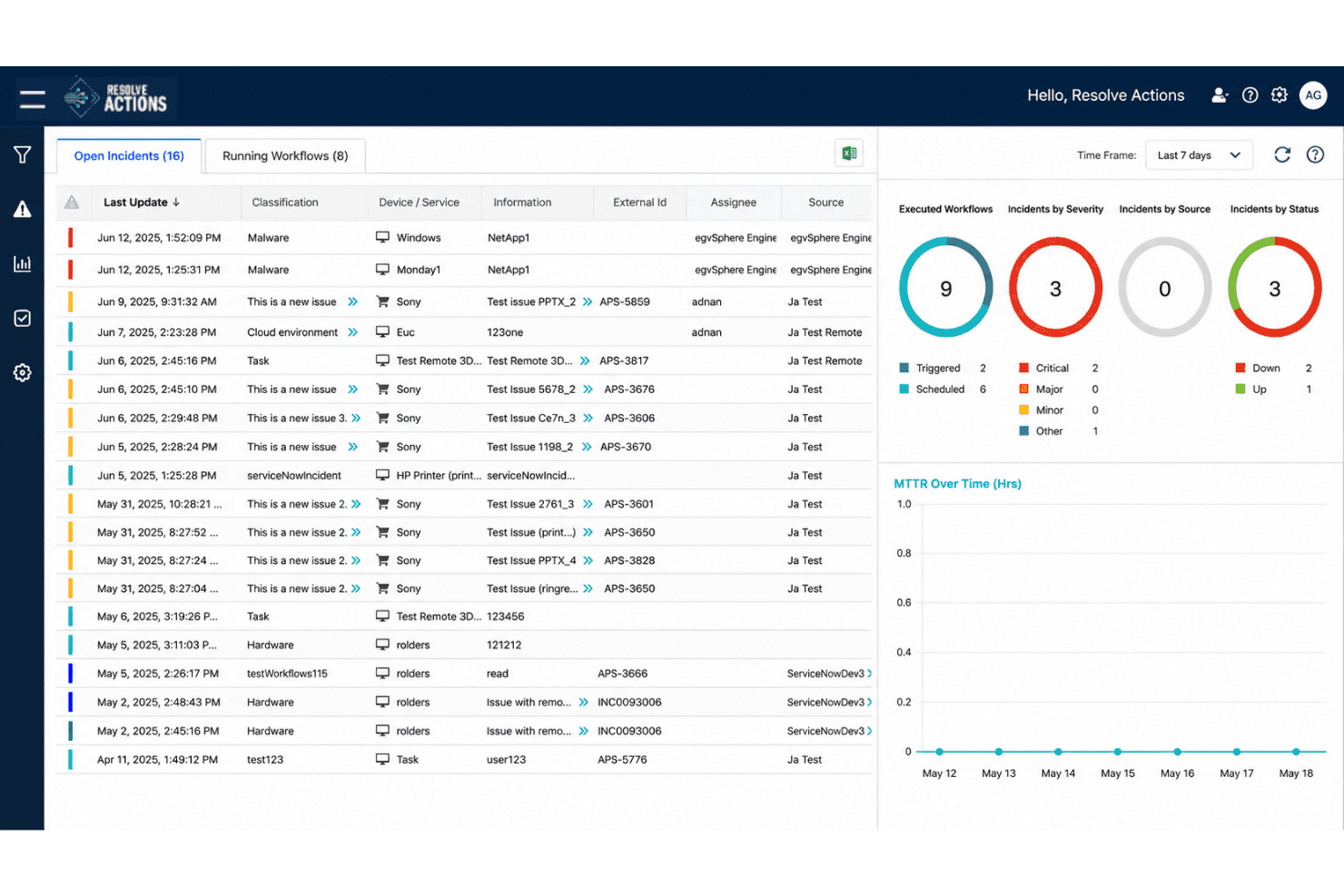
Coordinate workflows across ITSM, observability, networking, cloud, and on-premises systems without tying automation to one vendor. I like this for teams whose processes already span several tools.
Automation Agent
The Automation Agent executes approved workflows to diagnose and resolve IT issues. This helps teams use AI while keeping repeatable actions governed and predictable.
Agent Assist
Agent Assist gives service desk technicians diagnostics, context, and recommended actions during incidents. It can also surface approved automations to speed up resolution.
Employee Assistant
Employees can use conversational support for common IT questions and service requests. Where automation is available, it can take action instead of just pointing users to documentation.
Pre-Built Integrations & APIs
Pre-built integrations connect ITSM, observability, cloud, networking, security, and infrastructure tools. APIs and an open integration framework also support custom and legacy systems.
No-Code/Low-Code Workflow Building
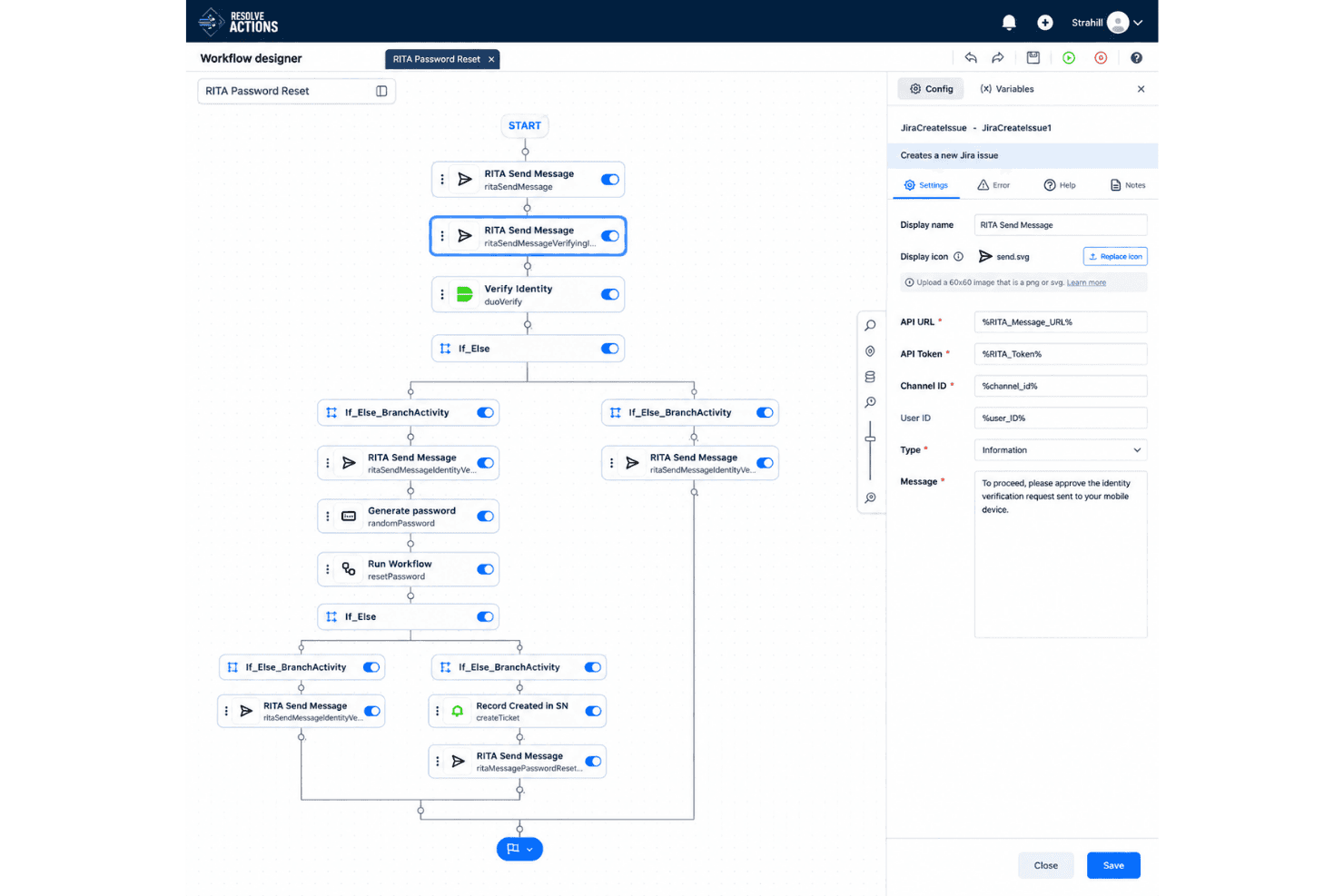
Teams can build automations visually, use AI-assisted workflow creation, or bring in existing scripts and code. This works for both simple service workflows and more technical automation.
Standout Features
AgentLab
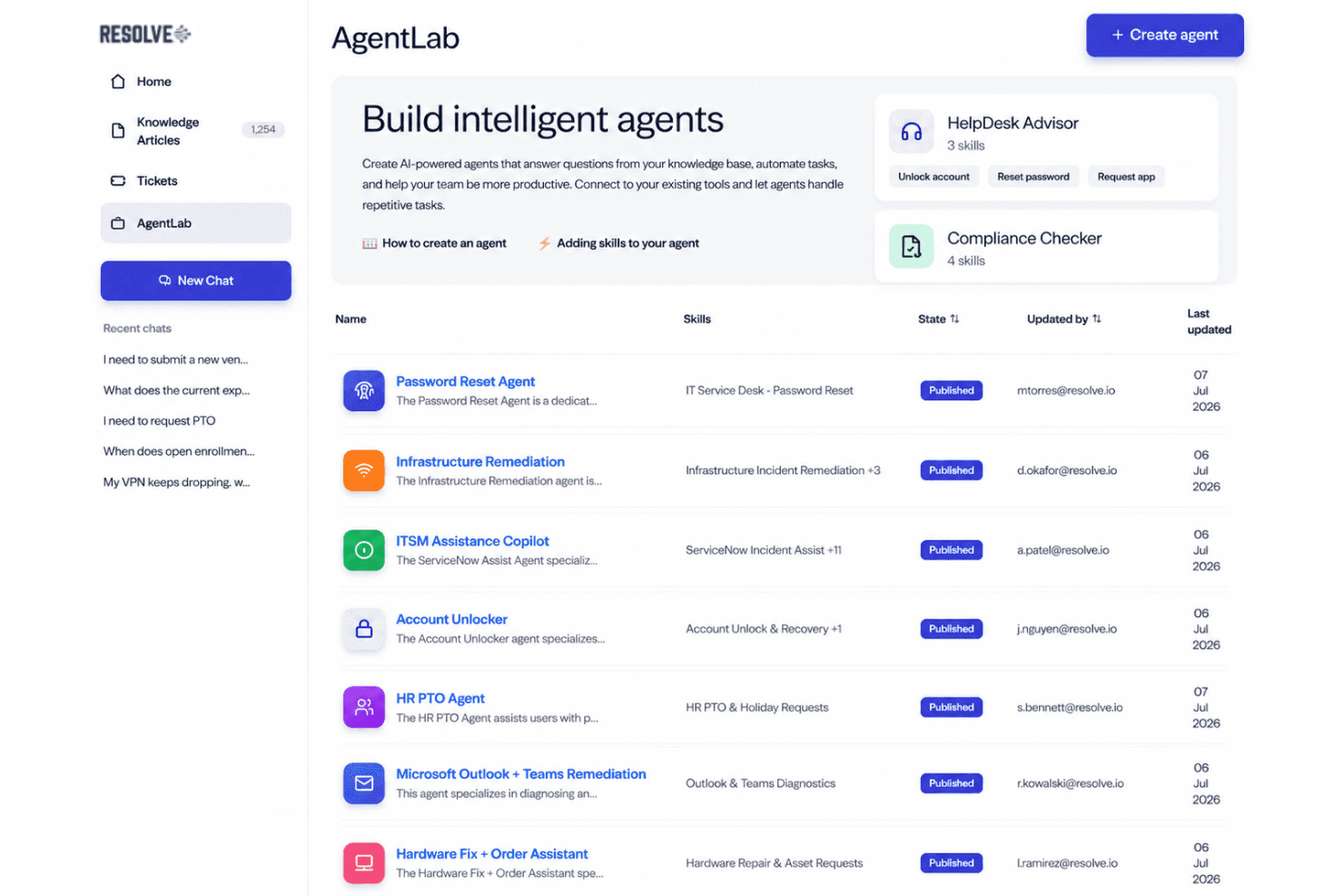
AgentLab lets teams create limited-scope AI agents using natural language while setting skills, permissions, and guardrails. I like the focus on controlled execution rather than just AI-generated suggestions.
Automation Exchange & Governance
Automation Exchange gives teams reusable workflows and automation content they can adapt instead of starting from scratch. Governance controls around permissions, approvals, and audit trails help keep those automations controlled.
Ease of Use
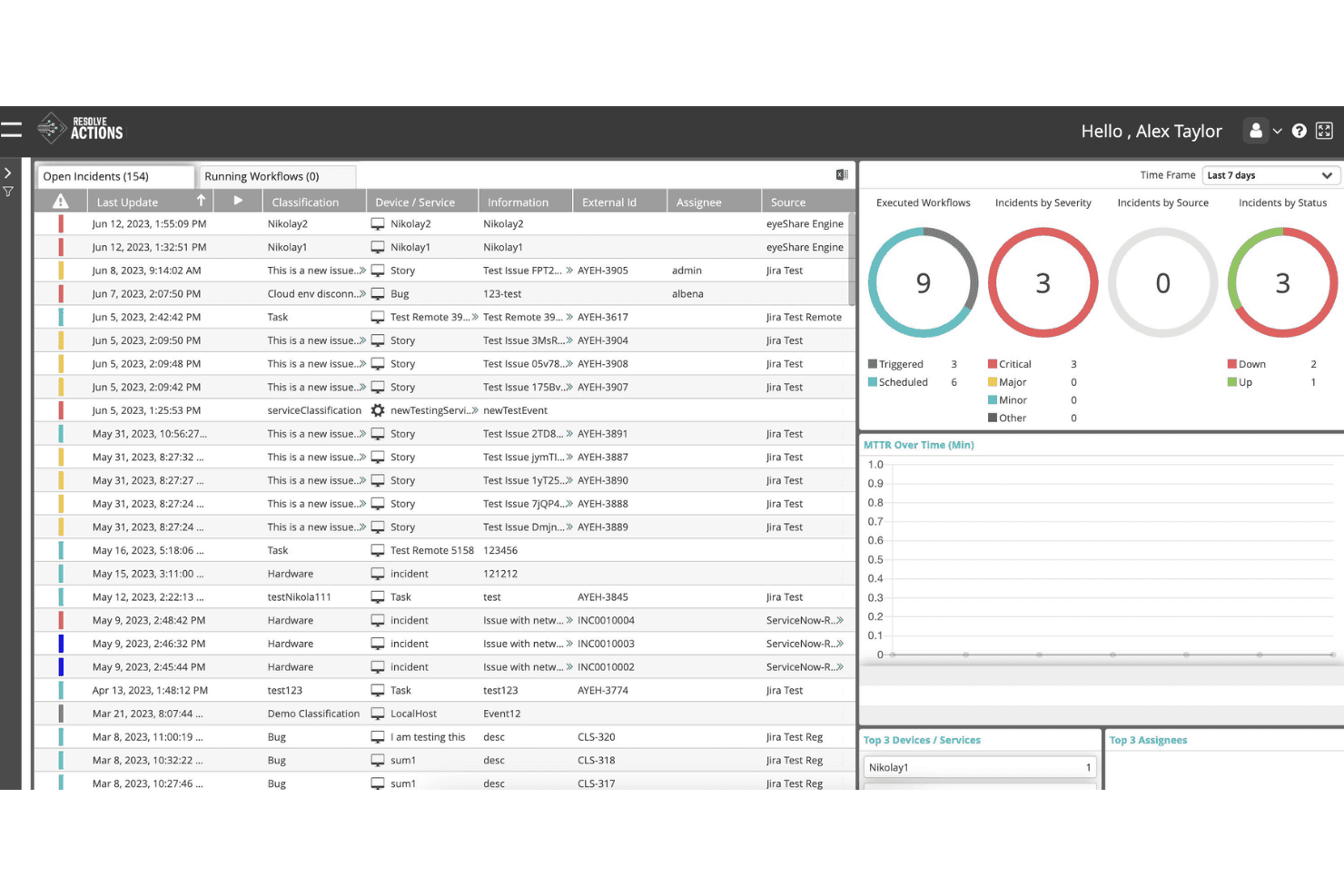
Resolve’s ease of use depends on the complexity of your IT environment and the integrations involved. Setup complexity varies depending on the number and depth of integrations involved. Dedicated onboarding support helps here, with Resolve assisting customers in setting up their first use cases and integrations.
Onboarding
Resolve takes a guided approach to onboarding, with a professional services team member helping set up the first five use cases or agents at no extra cost. The process typically takes five days to one month, depending on company size, environment complexity, and the integrations that need to be configured. This hands-on support should be especially useful for teams working across hybrid or legacy systems.
Resolve also offers an Employee Adoption Program that supports rollout planning, employee communications, training assets, and ongoing engagement to help organizations drive adoption after implementation.
Customer Support
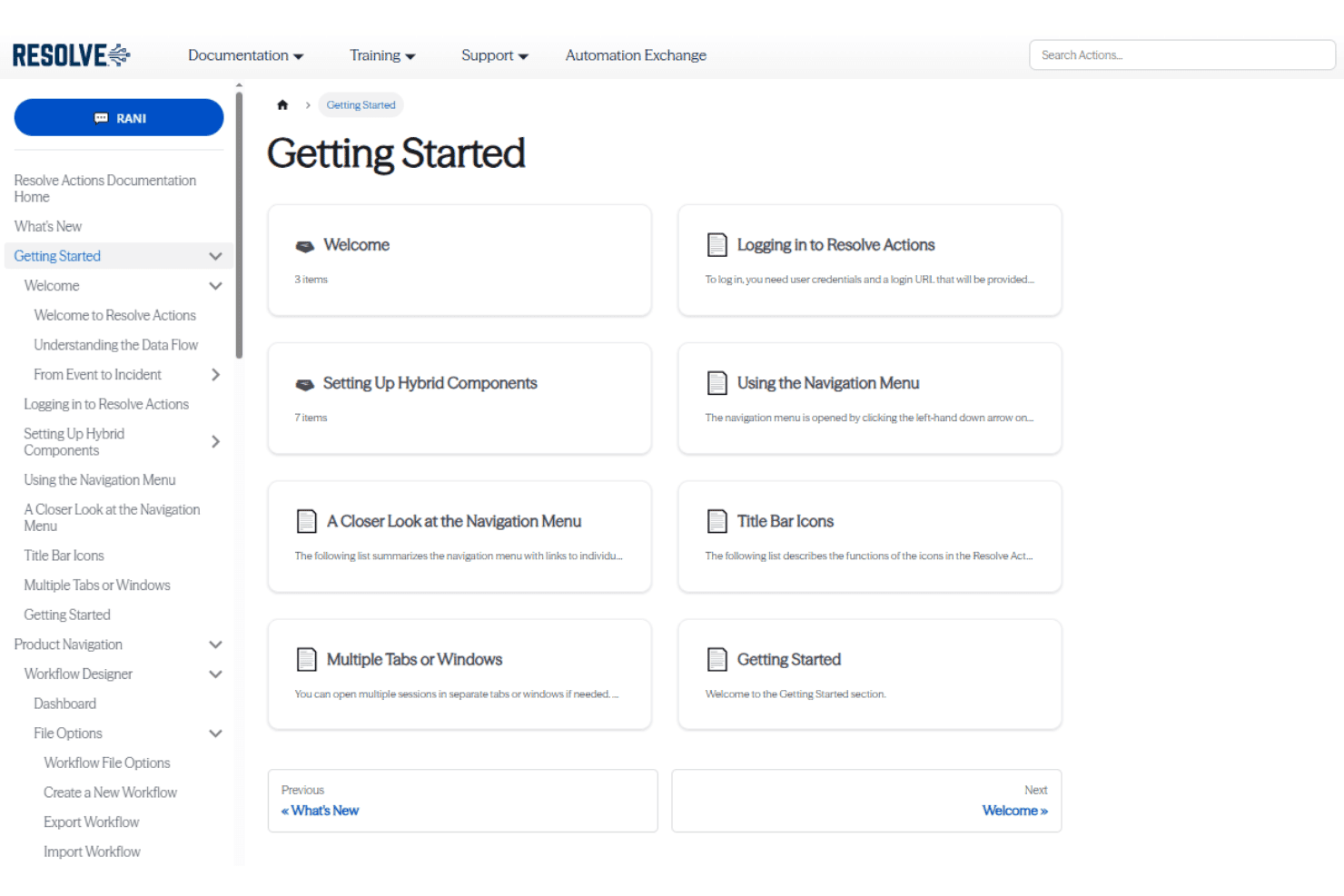
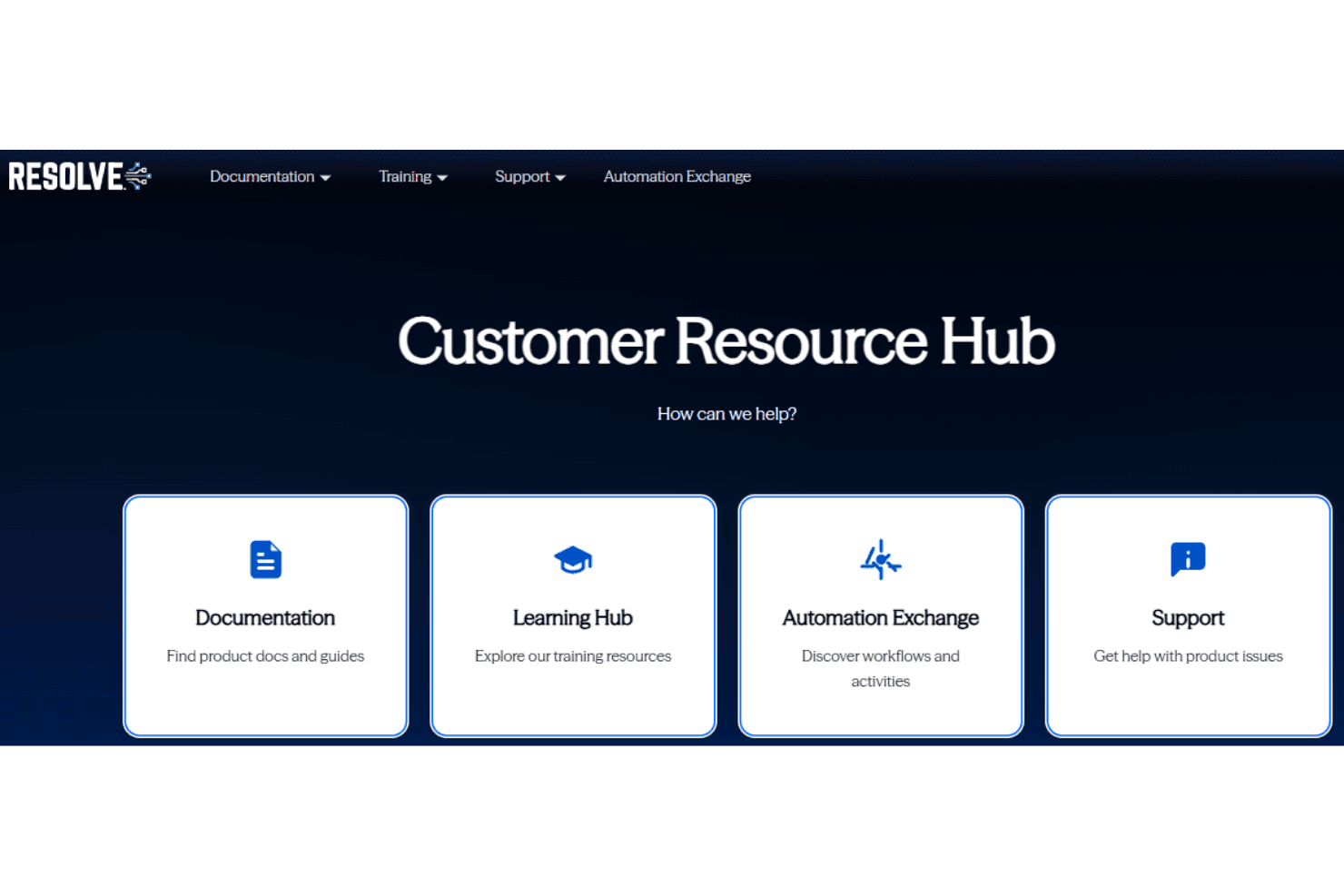
Resolve provides several customer support resources, including a dedicated support portal, product documentation, training materials, and technical guidance for troubleshooting and platform use. Customers also receive hands-on professional services during onboarding, with support for configuring their first use cases, agents, and integrations. This is especially useful for larger teams working through more complex hybrid environments and automation requirements.
Integrations
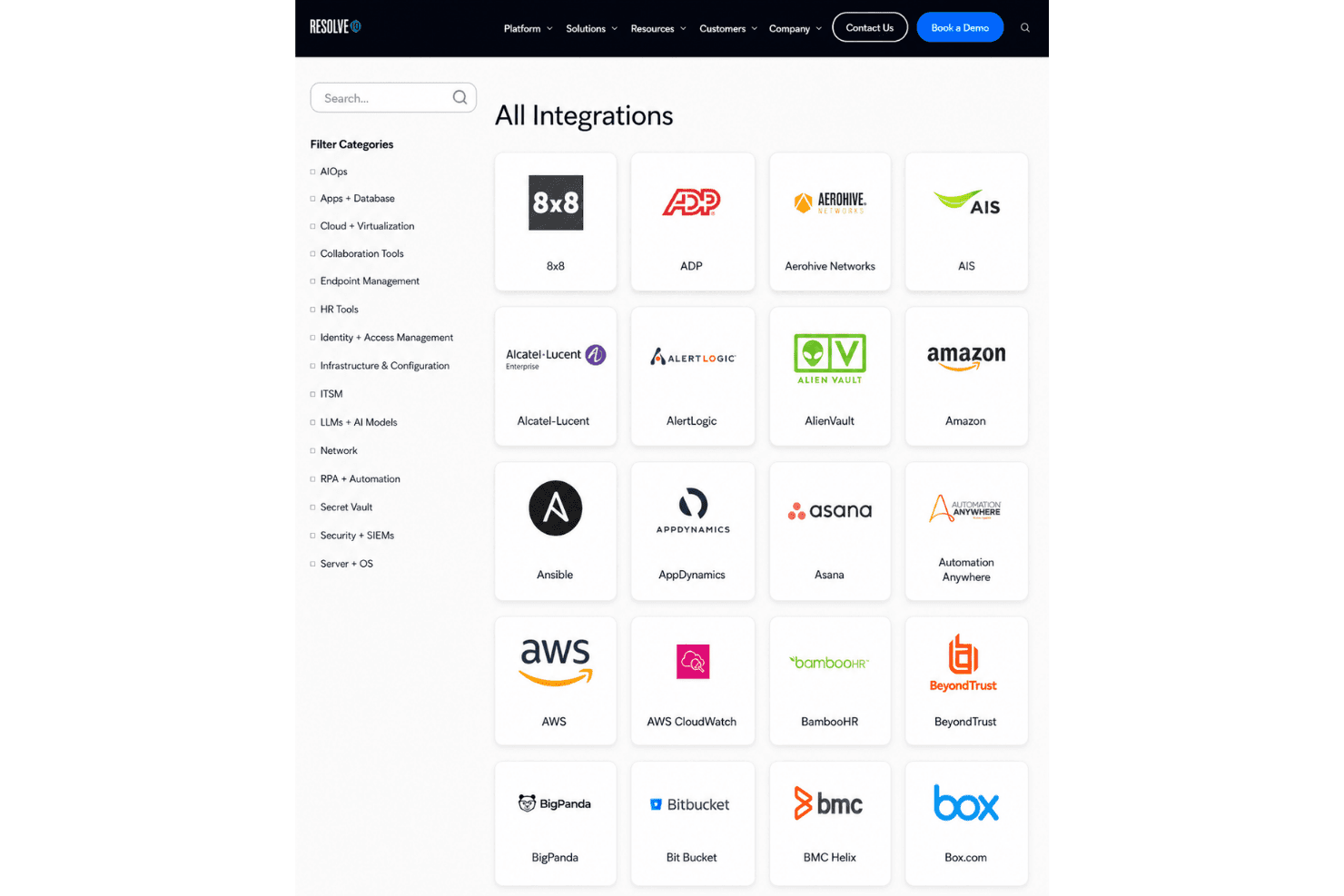
Integrations include ServiceNow, Jira, Microsoft 365 and Active Directory, Microsoft Exchange, Azure, Intune, Microsoft Teams, Slack, Workday, Datadog, Splunk, AWS, and more. An API is available through Resolve’s open integration framework, which also supports custom and legacy connections via REST APIs, SNMP, SSH, TCP, SMTP, and SOAP.
Value for Money
Resolve’s value is strongest for larger IT teams that can make full use of its cross-domain automation and orchestration capabilities. I like that its pricing is positioned as flat and predictable, avoiding per-user, per-ticket, workflow, or AI token fees that can make automation costs harder to forecast.
Specific pricing is not published publicly, so organizations need to contact Resolve for a custom quote. Given its enterprise focus and ideal fit for organizations with 1,000+ employees, smaller teams or companies with limited automation needs may find it harder to justify the investment.
Resolve Specs
- API: Yes
- Approval Workflows: Yes
- Batch Permissions & Access: Yes
- Compliance Tracking: Yes
- Contact Management: No
- Custom Reports: Yes
- Dashboard: Yes
- Data Export: Yes
- Data Import: Yes
- Data Visualization: Yes
- Document Management: No
- External Integrations: Yes
- Inventory Tracking: No
- Marketing Automation: No
- Notifications: Yes
- Process Modeling: Yes
- Process Reporting: Yes
- Project Management: No
- Roadmapping: No
- Sales Automation: No
- Supplier Management: No
- Third-Party Plugins/Add-Ons: Yes
- Workflow Management: Yes
Resolve FAQs
Resolve Company Overview & History
Resolve Systems is an IT automation and orchestration software company founded in Irvine, California, and currently headquartered in Campbell, California. Established under the Resolve Systems name in 2014 following the rebrand of gen-E, the company focuses on automating incident response, service management, network operations, and other IT workflows. Today, Resolve serves large enterprises across industries including financial services, retail, manufacturing, pharmaceuticals, and telecommunications and is majority-owned by Insight Partners.
Resolve Major Milestones
- 2014: gen-E rebranded as Resolve Systems as the company shifted its focus from software consulting to incident resolution and automation software.
- 2015: Resolve earned ServiceNow certification for its platform integration, expanding its role in IT service management automation.
- 2017: Insight Venture Partners, now Insight Partners, acquired Resolve Systems to support further product development and growth.
- 2021: Acquired Ayehu, expanding its no-code and intelligent IT automation capabilities.
- 2022: Launched its IT Automation as a Service offering, providing a SaaS option for enterprise automation.
- 2025: Acquired Espressive, adding conversational and agentic AI capabilities to its automation portfolio.
Resolve Partner Spotlight

Comment Resolve associe le raisonnement de l’IA à des flux de travail déterministes pour une résolution informatique encadrée
Comment la plateforme Resolve fait passer le travail informatique de l’intention à une résolution vérifiée.