

In Short:
- ITSM platforms are essential systems of record for incidents, requests, changes, approvals, and service processes.
- They are not always designed to coordinate complex execution across cloud, network, identity, endpoint, observability, security, and other enterprise systems.
- Resolve fills that gap as a platform-agnostic execution layer, combining the Automation Agent, Jarvis, and Audit Trail to turn requests, alerts, and decisions into governed action.
- The goal is to let ITSM manage record-keeping while Resolve executes and verifies the resolution.
ITSM Manages the Work Record, Resolve Executes the Work
An ITSM platform plays a critical role in enterprise IT. It gives teams a structured way to capture incidents and requests, assign ownership, manage approvals, track status, and document outcomes.
But recording work and executing work are different capabilities.
An ITSM platform can show that a network incident is open, who owns it, and whether it has been resolved. Fixing that incident may require collecting diagnostics from several devices, querying monitoring tools, validating configurations, interacting with network infrastructure, applying remediation, confirming service health, and updating the original record.
That sequence is orchestration, even when people perform it manually.
Resolve turns it into a governed, repeatable process. It connects the systems involved, applies approved logic, executes automation, requests human input where necessary, verifies the result, and returns the outcome to the ITSM platform.
How ITSM and Orchestration Are Different
| Capability | ITSM platform | Resolve |
|---|---|---|
| CapabilityCreate and manage incidents, requests, and changes | ITSM platformPrimary role | ResolveIntegrates with and updates the record |
| CapabilityTrack ownership, status, approvals, and service history | ITSM platformPrimary role | ResolveUses this context during execution |
| CapabilityInterpret unstructured requests and operational context | ITSM platformMay require additional AI capabilities | ResolveAutomation Agent applies AI reasoning and context |
| CapabilityCoordinate actions across multiple IT domains | ITSM platformOften requires custom development and platform-specific integrations | ResolveOrchestrates across ITSM, cloud, network, identity, security, observability, and enterprise systems |
| CapabilityExecute repeatable remediation | ITSM platformMay support workflows within its own ecosystem | ResolveRuns governed, deterministic processes |
| CapabilityValidate that the underlying issue is resolved | ITSM platformOften depends on external checks or manual confirmation | ResolvePerforms explicit validation |
| CapabilityPreserve execution visibility | ITSM platformRecords the service-management history | ResolveAudit Trail provides visibility into workflow activity |
This division allows each platform to do what it does best. ITSM remains the system of record. Resolve becomes the execution layer that moves the work from detection or request to verified resolution.
A Network Incident Shows Why the Distinction Matters
Consider a monitoring tool that detects degraded performance across several network devices. The ITSM platform can create an incident, assign it to the network team, apply the correct priority, and track its progress.
Those steps manage the incident, but they don’t restore the service.
Resolution may require actions across monitoring, network management, configuration, collaboration, and ITSM systems.
Resolve coordinates those actions through one governed flow:
1. Receives the Operational Signal
The process can begin with an event from a monitoring platform or an incident created in ITSM. Resolve uses that trigger to start the appropriate diagnostic workflow without requiring an engineer to manually move information between tools.
Audit Trail provides visibility into the workflow activity from the beginning of the process.
2. Interprets Available Context
If the event or incident contains incomplete or unstructured information, The Automation Agent can interpret the signal, correlate the context made available to it, and identify the likely next approved action.
AI is used where interpretation adds value. It does not receive unrestricted authority to make production changes.
3. Automation Gathers Diagnostics
An automation runs an approved sequence to collect device health, recent alerts, configuration data, interface status, and other required evidence from the relevant systems.
Instead of asking an engineer to open several tools and repeat the same diagnostic steps, Resolve executes the process consistently.
4. Selects the Governed Remediation Path
Agentic workflow steps can help determine which approved response fits the available evidence. Resolve then applies the defined logic, permissions, approval requirements, and failure handling for that path.
Resolve does not ask an AI model to invent a remediation procedure during a live incident. Execution follows a workflow the IT team has already designed and governed.
5. Executes and Verifies the Fix
The workflow performs the approved remediation and then checks whether it worked. That validation might include confirming device availability, checking the expected configuration, reviewing current alerts, or testing service health.
Completing an action is not the same as resolving an incident. Resolve makes verification part of the workflow.
6. Audit Trail Supports Closure or Escalation
If validation succeeds, Resolve updates the ITSM record with the outcome. If the issue remains, the workflow follows the approved escalation path.
The responding engineer receives the diagnostics, actions, and results already collected. Audit Trail provides visibility into workflow activity, so the engineer can focus on the exception instead of repeating the initial investigation.
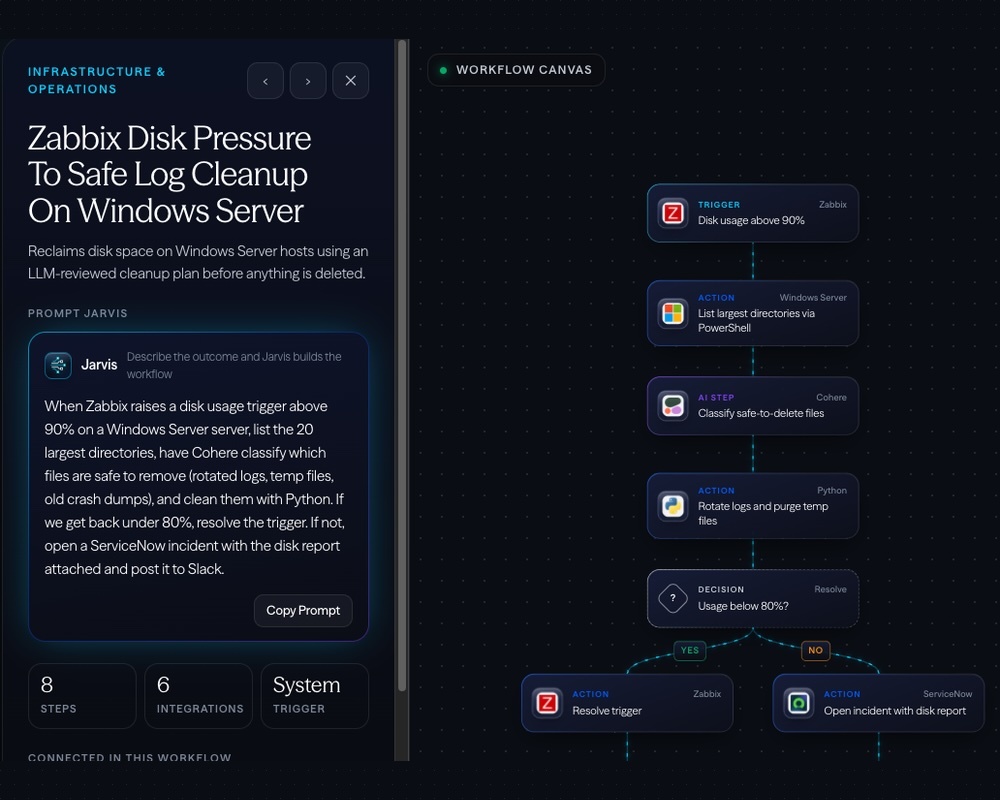
Use One Operating Model Across Requests Incidents and Alerts
The same division of responsibility applies beyond network incidents.
For an access request, ITSM can retain the request and approval history. Resolve can validate the user and approval, update permissions in the identity system, confirm the change, and return the result.
For an infrastructure alert, an observability platform can detect the condition. Resolve can collect diagnostics, apply an approved remediation, verify service recovery, and create or update an ITSM record when one is needed.
For an employee support request, the employee facing agent, RITA, can interpret the request and gather context. The Automation Agent can fulfill it through a governed process. ITSM can retain the service history without becoming the execution environment for every connected system.
A practical way to decide which platform should handle each part is to ask:
- Is the work about recording, assigning, approving, or tracking a service process? Keep it in ITSM.
- Does the process need to execute actions across multiple systems? Orchestrate it with Resolve.
- Is the input ambiguous or dependent on context? Use the Automation Agent to interpret it.
- Must the action follow predictable rules, permissions, and safeguards? Run it through a deterministic workflow.
- Does the organization need to verify and review what happened? Build validation into the workflow and use Audit Trail for visibility.
Agentic AI Makes an Execution Layer More Important
Agentic AI adds another reason to separate service management from execution.
An AI agent can understand a request, analyze context, and identify a likely next action. Enterprise IT still needs to control how that decision reaches an identity platform, network device, cloud service, or production system.
Allowing non-deterministic AI to handle the entire process can introduce unpredictable outcomes, hallucination risk, and unnecessary model consumption. Restricting AI to recommendations, however, leaves people responsible for executing the repetitive work.
Resolve connects the two.
The Automation Agent applies flexible AI reasoning where interpretation is valuable and hands production execution to governed, deterministic workflows. Audit Trail makes the resulting workflow activity visible. Role-based permissions, approvals, validation, and policy enforcement help organizations increase autonomy without giving up control.
Resolve Extends ITSM Without Locking Execution Inside It
ITSM platforms are strong at managing requests and workflows within their own ecosystems. As automation expands across cloud, network, identity, observability, security, and infrastructure, cross-domain execution can require more custom development, duplicated logic, and platform-specific expertise.
Resolve provides a platform-agnostic orchestration layer across the broader IT environment. It connects with more than 500 ITSM, cloud, AIOps, security, network, identity, and enterprise applications, allowing teams to reuse workflows and manage execution consistently without locking every automation into one platform.
That creates a clearer architecture:
- ITSM manages the service record.
- Automation Agent interprets requests and operational context, executes approved cross-system processes and verifies the outcome.
- Audit Trail provides visibility into workflow activity.
The result is a governed path from request, alert, or decision to verified resolution.
Frequently Asked Questions
Does Resolve Replace an ITSM Platform?
No. Resolve complements the ITSM platform. ITSM remains the system of record for incidents, requests, changes, approvals, and service history. Resolve coordinates and executes the work required across the broader IT environment.
Can ITSM Platforms Automate Workflows?
Yes. ITSM platforms can be effective at automating processes within their ecosystems. Cross-domain orchestration, however, may require additional development, custom integrations, duplicated logic, and specialized platform expertise. Resolve is designed to coordinate execution across those domains.
Why Not Build Orchestration Directly in the ITSM Platform?
That approach may work for limited use cases. As automation expands across cloud, network, identity, security, infrastructure, and observability, concentrating execution in one platform can increase customization and dependency on that vendor. Resolve provides a reusable, platform-agnostic execution layer.
What Role Does AI Play in Resolve?
The Automation Agent uses AI reasoning to interpret requests and operational context, identify intent, and determine the appropriate next approved action through a governed, deterministic process.
Can Resolve Start Work Without an ITSM Ticket?
Yes. A request, alert, event, or AI decision can trigger a Resolve workflow directly. The workflow can create or update an ITSM record when the process or policy requires one.
Move from Managing Tickets to Resolving Work
Your ITSM platform should remain central to service management. It should not have to serve as the execution engine for every system and operational process in the enterprise.
Resolve adds the governed orchestration layer needed to connect those systems, execute approved actions, verify outcomes, and keep the ITSM record current.
That is how teams move beyond automating the ticket and begin automating the resolution.

