

Creatio Studio -arvostelu: hyvät ja huonot puolet, ominaisuudet ja hinnoittelu
Creatio Studio on erinomainen vähän koodia vaativa työkalu yrityksille, jotka haluavat kehittää sovelluksia nopeasti ilman laajaa ohjelmointiosaamista.

We review tools independently, and commissions help fund our testing. See our transparency policy, our methodology, or suggest a tool.
Creatio Studio is a low code development platform for building custom applications and automating business workflows without writing extensive code. I'd consider it if your team needs to create process-driven apps that connect CRM, operations, and back-office data in one place. If Microsoft Power Apps feels too constrained for complex, multi-step workflows, Creatio Studio gives developers and business analysts more room to model processes visually while still supporting custom code where it's needed.
Creatio Studio Evaluation Summary
4.7/5
- $25/user/month
- $85/user/month
Why Trust Our Software Recommendations
6,700+
Reviews
20
Industry experts
16+
Evaluation factors
14
Years
Our team has been testing and reviewing software since 2012. As tech leaders ourselves, we know how difficult—and important—it is to choose the right software.
For this guide, we evaluated tools using hands-on testing and independent research, scoring tools using our selection criteria.
Our reviews reflect our human editorial judgment, not a sales pitch.
Expert reviewers:
- Paulo Gardini MiguelTech Director
 Tim FisherVP of AI
 Gabriel RosasTech Lead & Software Architect
 Christhian GruhnTech Lead & Platform Architect

Creatio Studio Overview
In my opinion, Creatio Studio is a solid choice for businesses that need a flexible low-code or no-code platform to automate their CRM and workflow. Its standout features and customer support set it apart from others. While it could be easier to use, the onboarding process is decent and helps teams get up to speed. Creatio Studio's pricing is competitive, offering good value for companies looking to enhance their development capabilities without heavy coding. It's best suited for industries like finance and healthcare, where quick deployment is key. If you're deciding on a low-code tool, Creatio Studio's seamless integration and support are worth considering.
Pros
- You can quickly develop apps without extensive coding knowledge.
- Strong customer support for your team.
- Tools to enhance productivity.
Cons
- Less intuitive interface compared to other software.
- Steep learning curve for some users.
- Advanced customization and automation features require more training.
Is Creatio Studio Right For Your Needs?
Who Would be a Good Fit for Creatio Studio?
Creatio Studio is a great fit for businesses that need to quickly develop CRM software or process automation without heavy coding. It's one of the best CRM builders for sales and marketing teams who want to enhance productivity. Strongly regulated industries like finance and healthcare will also benefit from Creatio Studio’s fast deployment. Creatio Studio's strong customer support ensures your team gets help when needed, making it suitable for departments that rely on responsive service. The platform's standout features make it a good choice for companies aiming to boost efficiency in their operations.
- Finance IndustryFinancial service providers can create custom financial applications quickly, improving their service delivery and customer experience.
- Healthcare SectorYour work benefits from Creatio Studio’s ability to streamline patient management systems with minimal coding.
- Sales TeamsCreatio Studio enhances your lead management , sales forecasting, and opportunity management with automation tools.
- Marketing DepartmentsYou can use Creatio to develop and optimize apps that help track marketing campaigns and customer interactions.
- Medium-Sized CompaniesCreatio Studio’s balance of features and support suits your needs for scalable marketing automation and CRM solutions.
- Project ManagersYour team can manage projects more efficiently with Creatio Studio's CRM tools designed for rapid app development.
Who Would be a Bad Fit for Creatio Studio?
Creatio Studio may not be the best choice for teams that need developer-centric environments or large volumes of custom code rather than no-code workflows. Large enterprises with well-established IT teams and processes may find Creatio Studio's features offer less value. Small businesses expecting out-of-the-box simplicity may also find Creatio Studio’s process-driven features overwhelming. Startups with tight budgets might struggle with the cost of Studio Creatio, even if it's competitive. Teams needing extensive offline capabilities should consider alternatives, as Creatio Studio's features don't fully support this need.
- Tech StartupsYour team may need an engineering-centric development environment that Creatio Studio doesn’t offer.
- Large EnterprisesYour IT department might already operate with developer-focused platforms, which overlap with Creatio Studio's features.
- Software DevelopersIf your work requires custom coding, Creatio Studio's low-code approach may not be flexible enough.
- Small StartupsYour budget constraints might make Creatio Studio's cost a challenge, despite its competitive pricing.
- Offline-Heavy IndustriesCreatio Studio doesn't fully support offline capabilities, which could limit your team's functionality.
- Highly Specialized SectorsYour industry might require domain-specific tools not available in Creatio Studio's current feature set.
Our Review Methodology
How We Test & Score Tools
We’ve spent years building, refining, and improving our software testing and scoring system. The rubric is designed to capture the nuances of software selection and what makes a tool effective, focusing on critical aspects of the decision-making process.
Below, you can see exactly how our testing and scoring works across seven criteria. It allows us to provide an unbiased evaluation of the software based on core functionality, standout features, ease of use, onboarding, customer support, integrations, customer reviews, and value for money.
Core Functionality (25% of final scoring)
The starting point of our evaluation is always the core functionality of the tool. Does it have the basic features and functions that a user would expect to see? Are any of those core features locked to higher-tiered pricing plans? At its core, we expect a tool to stand up against the baseline capabilities of its competitors.
Standout Features (25% of final scoring)
Next, we evaluate uncommon standout features that go above and beyond the core functionality typically found in tools of its kind. A high score reflects specialized or unique features that make the product faster, more efficient, or offer additional value to the user.
We also evaluate how easy it is to integrate with other tools typically found in the tech stack to expand the functionality and utility of the software. Tools offering plentiful native integrations, 3rd party connections, and API access to build custom integrations score best.
Ease of Use (10% of final scoring)
We consider how quick and easy it is to execute the tasks defined in the core functionality using the tool. High scoring software is well designed, intuitive to use, offers mobile apps, provides templates, and makes relatively complex tasks seem simple.
Onboarding (10% of final scoring)
We know how important rapid team adoption is for a new platform, so we evaluate how easy it is to learn and use a tool with minimal training. We evaluate how quickly a team member can get set up and start using the tool with no experience. High scoring solutions indicate little or no support is required.
Customer Support (10% of final scoring)
We review how quick and easy it is to get unstuck and find help by phone, live chat, or knowledge base. Tools and companies that provide real-time support score best, while chatbots score worst.
Customer Reviews (10% of final scoring)
Beyond our own testing and evaluation, we consider the net promoter score from current and past customers. We review their likelihood, given the option, to choose the tool again for the core functionality. A high scoring software reflects a high net promoter score from current or past customers.
Value for Money (10% of final scoring)
Lastly, in consideration of all the other criteria, we review the average price of entry level plans against the core features and consider the value of the other evaluation criteria. Software that delivers more, for less, will score higher.
Core Features
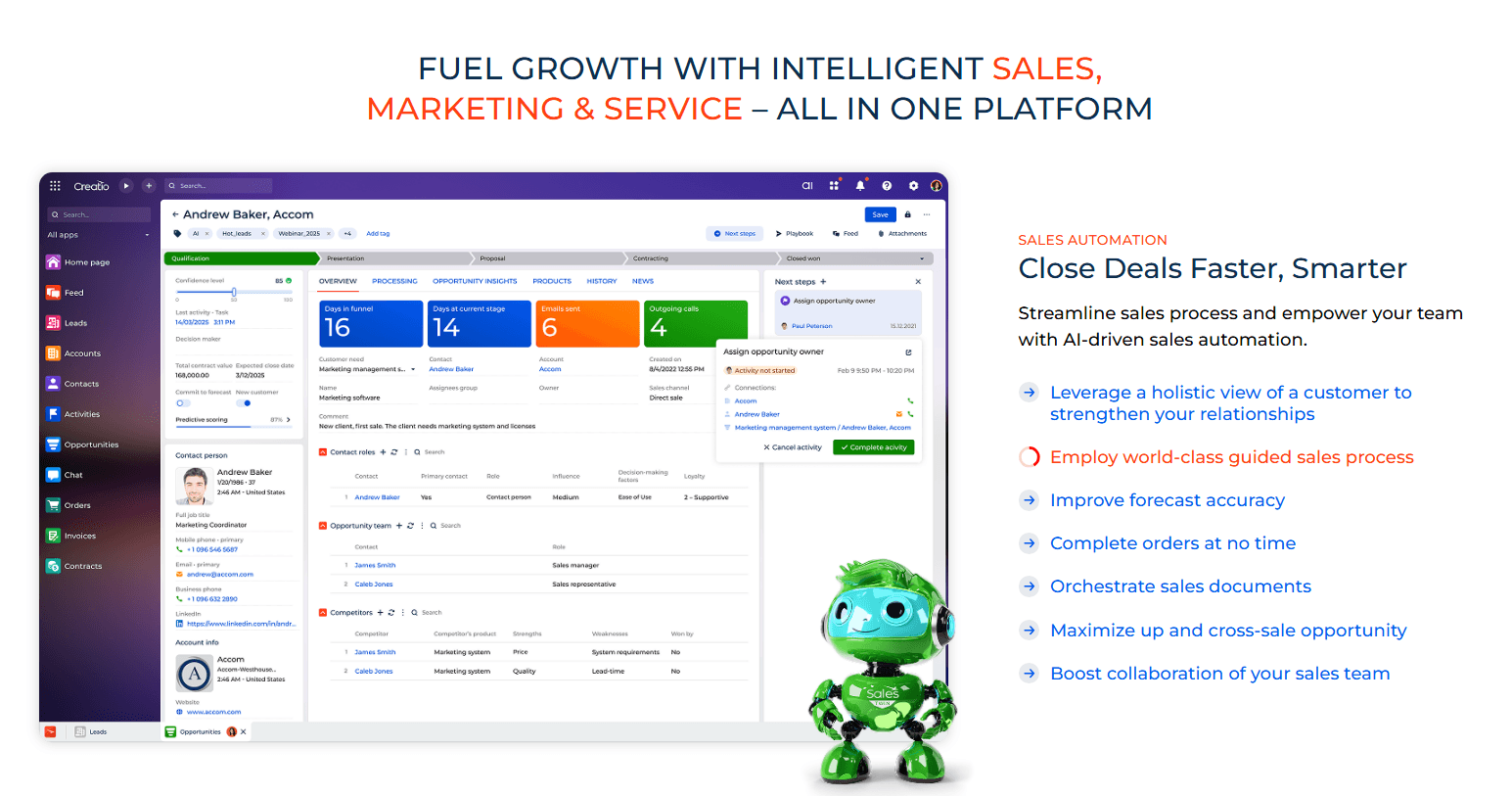
Drag-and-Drop Interface: Creatio Studio lets you build applications with a simple drag-and-drop tool, making it easy for your team to design workflows without coding. You can quickly brainstorm and visualize processes.
Visual Process Designer: You can map out complex business processes with Creatio Studio's visual designer, which simplifies the creation of automated workflows. This tool stands out by offering a clear view of your process paths.
Customizable Dashboards: Creatio Studio provides dashboards that you can tailor to fit your team's needs, offering real-time insights into your operations. Create a dashboard that expedite decisions with metrics that matter.
User Access Management: You can control who accesses what within the platform, ensuring your data stays secure. Security teams will find this feature helpful for maintaining privacy across departments.
Pre-Built Templates: Creatio Studio offers a variety of templates to kickstart your app development, saving you time in the initial setup. Whether it's email marketing, productivity, or sales, you can download a template from its marketplace.
Mobile Accessibility: Your team can access Creatio Studio on mobile devices, allowing work to continue on the go. This feature enhances productivity by keeping you connected wherever you are.

Ease of Use
Creatio Studio's user-friendliness is solid, thanks to its intuitive drag-and-drop interface and visual process designer, which help your team build apps without coding expertise. While it might feel less user-friendly than some competitors, its customizable dashboards and pre-built templates ease the learning curve. Your team can quickly adapt to its functionalities, though some may find the platform complex initially. Overall, it's a reliable choice for teams looking to enhance productivity with minimal fuss.

Integrations
Creatio Studio integrates with Microsoft Exchange, Microsoft Office 365, QuickBooks, Google Calendar, Webitel, Asterisk, Cisco Finesse, TAPI, and more. Creatio Studio also offers an application programming interface (API) and connects with third-party integration tools to support additional integration needs.

Creatio Studio Specs
- A/B Testing: No
- Access Management: No
- API: Yes
- Bug Tracking: No
- Cloud Deployment: No
- Code Transformation: No
- Collaboration Support: No
- Data Export: Yes
- Data Import: Yes
- Data Visualization: Yes
- Document Management: No
- External Integrations: Yes
- Form Builder: No
- History/Version Control: No
- Migration to Cloud: No
- Multi-User: Yes
- Notifications: Yes
- Process Modeling: No
- Re-Platforming: No
- Software Integration: No
- Status Notifications: No
- Template Designer: No
- Third-Party Plugins/Add-Ons: Yes
- Workflow Management: No


