


Trustible vs. Credo AI: Comparison & Expert Reviews for 2026
I break down exactly how Trustible and Credo AI stack up for real-world AI governance—revealing what actually matters when picking the right compliance tool.

We review tools independently, and commissions help fund our testing. See our transparency policy, our methodology, or suggest a tool.
The trouble with AI governance rarely announces itself upfront. It surfaces months later, in the audit you weren't ready for or the model decision no one can explain. Choosing the right platform now is what keeps that quiet risk from becoming a loud problem.
If you’re struggling to keep your AI projects compliant, secure, and explainable, you’re not alone. Choosing between Trustible and Credo AI might feel overwhelming, especially with so many AI governance tools claiming to solve the same challenges. You want confidence that your pick will work for your organization—without surprises later on.
In this article, you’ll get a side-by-side comparison of Trustible and Credo AI. I’ll outline the strengths, drawbacks, core use cases, pricing details, security features, and what it’s actually like to use each tool.
Trustible
5/5
- Free demo available
- Pricing upon request
Credo AI

4.2/5
- Free demo available
- Pricing upon request
Why Trust Our Software Recommendations
6,700+
Reviews
20
Industry experts
16+
Evaluation factors
14
Years
Our team has been testing and reviewing software since 2012. As tech leaders ourselves, we know how difficult—and important—it is to choose the right software.
For this guide, we evaluated tools using hands-on testing and independent research, scoring tools using our selection criteria.
Our reviews reflect our human editorial judgment, not a sales pitch.
Expert reviewers:
- Paulo Gardini MiguelTech Director
 Tim FisherVP of AI
 Gabriel RosasTech Lead & Software Architect
 Christhian GruhnTech Lead & Platform Architect

| Trustible | Credo AI | |
|---|---|---|
| Free Trial | Free demo available | Free demo available |
| Pricing | Pricing upon request | Pricing upon request |
Trustible vs. Credo AI Pricing & Hidden Costs
Neither vendor publishes public pricing. Both are enterprise, quote-based, and start with a demo. Trustible scales to the size of your AI deployment and the level of support, with custom enterprise packages, and leans on fast time-to-value, since most customers reach production within about 30 days. Credo AI is modular by design: you start with the module you need—say, the AI Registry—and expand into risk intelligence and runtime governance as adoption grows. With both, costs track with scope; more systems, deeper integrations, added modules, or premium support, so it pays to confirm exactly what’s included.
Look closely at your deployment volume, compliance obligations, and expected growth before choosing a vendor. Evaluate not just initial pricing, but also the potential for added expenses as your requirements evolve; like more users, extra integrations, or audits. Asking for a transparent, written breakdown of all possible fees and aligning vendor SLAs with your risk profile helps you avoid surprises down the road.
| Trustible | Credo AI | |
|---|---|---|
| A/B Testing | Yes | Yes |
| AI Integration | Yes | Yes |
| Analytics | Yes | Yes |
| API | Yes | Yes |
| Calendar Management | Yes | Yes |
| Comparative Reporting | Yes | Yes |
| Custom Reports | Yes | Yes |
| Dashboard | Yes | Yes |
| Data Export | Yes | Yes |
| Data Import | Yes | Yes |
| Data Mining | Yes | Yes |
| Data Visualization | Yes | Yes |
| External Integrations | Yes | Yes |
| Forecasting | Yes | Yes |
| Historical Data Analysis | Yes | Yes |
| Multi-User | Yes | Yes |
| Notifications | Yes | Yes |
| Process Reporting | Yes | Yes |
| Real-time Alerts | Yes | Yes |
| Scenario Planning | Yes | Yes |
| Scheduling | Yes | Yes |
| Sentiment Analysis | Yes | Yes |
| SEO | Yes | Yes |
| Time Series Modeling | Yes | Yes |
| Workflow Management | Yes | Yes |
| Integration | Trustible | Credo AI |
|---|---|---|
| IntegrationAzure AI Foundry | Trustible❌ | Credo AI✅ |
| IntegrationSalesforce | Trustible❌ | Credo AI✅ |
| IntegrationMicrosoft Forms | Trustible❌ | Credo AI❌ |
| IntegrationVisual Studio Code | Trustible❌ | Credo AI✅ |
| IntegrationJupyterLab | Trustible❌ | Credo AI✅ |
| IntegrationMLflow | Trustible❌ | Credo AI✅ |
| IntegrationOkta | Trustible✅ | Credo AI❌ |
| IntegrationJira | Trustible✅ | Credo AI✅ |
| IntegrationAPI | Trustible❌ | Credo AI✅ |
| IntegrationZapier | Trustible❌ | Credo AI❌ |
Credo AI has the broader library by a wide margin, with ecosystem partners spanning cloud and AI ops such asAzure, GCP, Databricks, and Snowflake. It also exposes an API and SDK for custom integrations. Trustible’s native integrations are more focused and still growing, with additional connectors on the roadmap—and it does not advertise a public API. Out of the box, Credo AI reaches deeper into an existing enterprise stack.
| Factor | Trustible | Credo AI |
|---|---|---|
| FactorCertifications | TrustibleSOC 2 Type II certified; ISO 27001 expected in Q4 2026. | Credo AISOC 2 Type II, maintained through its public Trust Center. |
| FactorRegulatory Frameworks | TrustibleMaps governance once to the EU AI Act, NIST AI RMF, ISO 42001, and more. | Credo AIPre-built policy packs for the EU AI Act, NIST AI RMF, ISO 42001, and SOC 2. |
| FactorAccess Control | TrustibleAccess controls and activity logging across the platform. | Credo AIRole-based access with full audit trails and recorded evidence. |
| FactorMonitoring & Audit | TrustibleSecure evidence storage with exportable, audit-ready reporting. | Credo AIContinuous compliance monitoring with automated evidence generation. |
Both platforms are built for enterprise-grade compliance and are SOC 2 Type II certified. Trustible adds access controls, activity logging, and secure evidence storage, hosts multi-tenant data in the US, with any AWS region available for enterprise customers, and expects ISO 27001 certification in Q4 2026. Credo AI leans on pre-built policy packs, including EU AI Act, NIST AI RMF, ISO 42001, and SOC 2, with automated evidence generation and continuous compliance monitoring, making it a strong pick if you want turnkey, audit-ready regulatory coverage.
| Factor | Trustible | Credo AI |
|---|---|---|
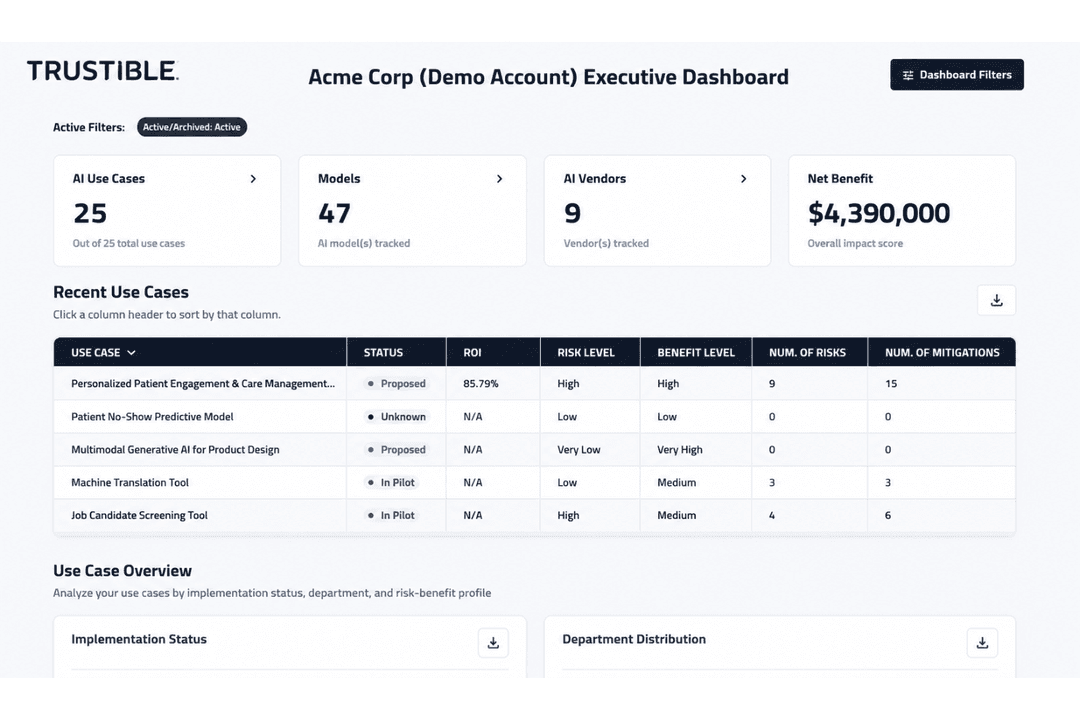
| FactorUser Interface | TrustibleClear dashboard with guided workflows and visual risk and policy status. | Credo AISingle pane of glass across registry, risk, and compliance, with the GAIA assistant. |
| FactorOnboarding | TrustibleGuided by a dedicated customer success team on a 30-60-90 day plan, with most customers live in about 30 days. | Credo AIModular land-and-expand; GAIA compresses weeks of setup into hours. |
| FactorLearning Curve | TrustibleLow—pre-loaded taxonomies and templates; no IT or engineering required. | Credo AIEased by GAIA and forward-deployed advisory experts. |
| FactorCustomer Support | TrustibleDedicated customer success team and a named advisor. | Credo AIAdvisory services and forward-deployed governance experts. |
| FactorReporting Workflow | TrustibleExportable, audit-ready compliance reports and executive dashboards. | Credo AIAutomated evidence generation and audit-ready reporting. |
Both tools are designed to be run by governance teams, not just engineers. Trustible works best for teams that want a straightforward, no-fuss setup: it’s cloud-hosted, needs no deep technical integration, comes pre-loaded with taxonomies and templates, and is guided by a dedicated customer success team on a 30-60-90 day plan. Credo AI leans on GAIA, its AI governance assistant that compresses weeks of governance work into hours, plus modular adoption and forward-deployed advisory experts—ideal if you want hands-on guidance while standing up a program at scale.
Trustible
- Automates regulatory mapping across major AI standards and frameworks
- Embeds expert-curated risk taxonomies, mitigation recommendations, and regulatory guidance
- Covers the full AI lifecycle in one platform
- Native integrations are limited
- No dedicated mobile app
- Enforces policy at the governance layer, not the technical layer, so it can’t block a model deployment or a non-compliant output at runtime
Credo AI
- Policy management workflows adapt to different risk levels.
- Automated reports simplify regulatory and executive reviews.
- Model card framework supports detailed AI model documentation.
- Pricing may be too high for some mid-sized teams.
- Limited pre-built templates for specialized industry compliance.
- No mobile interface for on-the-go policy oversight.
Trustible
- Financial Services ComplianceTrustible’s multi-framework mapping and audit-ready trails help banks and financial institutions meet demanding oversight and reporting obligations.
- InsuranceInsurers use Trustible to govern high-stakes models like pricing and underwriting, against evolving regulations and to document every risk decision.
- HealthcareBuilt-in privacy and risk checks support healthcare teams complying with complex patient-data and algorithm-transparency requirements.
- Public Sector & GovernmentTemplates for regulatory and ethical review speed up public sector assessments, approvals, and reporting.
- TechnologyTechnology companies shipping AI features rely on Trustible to govern use cases without slowing product delivery.
- Enterprise OrganizationsLarge, often global enterprises use Trustible’s centralized inventory and policy tools to manage AI deployments across multiple legal environments.
Credo AI
- Financial ServicesStrict regulatory reporting and risk controls are built into workflows, making compliance manageable at scale.
- Healthcare OrganizationsCredo AI’s evidence collection and fairness assessments support compliance with patient safety and privacy rules.
- Public Sector TeamsThe platform maps decisions to transparency standards, which is crucial for public trust and regulatory mandates.
- Global EnterprisesMulti-jurisdictional compliance mapping and custom workflows make cross-country governance straightforward.
- Responsible AI CommitteesDetailed model documentation and workflow routing help track decision logic and accountability across teams.
- Data Science DepartmentsAutomated risk scoring and model monitoring enable teams to focus on development without sacrificing compliance.
Who Should Use Trustible, and Who Should Use Credo AI?
Trustible is a great fit for regulated enterprises in financial services, insurance, healthcare, the public sector, and technology that want to stand up lifecycle AI governance quickly, without a heavy technical lift. If your team values expert-curated, ready-to-run governance and fast time-to-value, you’ll appreciate Trustible most. Credo AI, on the other hand, is ideal for enterprises governing AI at scale, especially where shadow-AI discovery, deep stack integrations, and runtime oversight matter; it’s used across insurance, financial services, federal, and healthcare.
| Trustible | Credo AI | |
|---|---|---|
| Agents & Runtime | Trustible Governs at the intake, risk, and reporting layers; no runtime enforcement. | Credo AI Agent Registry plus runtime governance that evaluates agent traces in production. |
| Integrations | Trustible Focused native set of SSO providers, Jira, and Microsoft Forms. | Credo AI 300+ integrations across cloud, MLOps, GRC, and agent platforms. |
| Regulatory Content | Trustible Embedded, expert-curated taxonomies and mappings applied automatically. | Credo AI “Policy-to-code” pre-built policy packs authored alongside standards bodies. |
| Time to Value | Trustible Around 30 days to production on a 30-60-90 day plan. | Credo AI Modular land-and-expand; GAIA compresses weeks of work into hours. |
| AI Governance | Both are dedicated AI governance platforms, not GRC tools retrofitted for AI. |
|---|---|
| Centralized AI inventory | Both catalog every AI system, model, and vendor in one place. |
| Multi-Framework Compliance Coverage | Both map governance to the EU AI Act, NIST AI RMF, and ISO 42001 with audit-ready evidence. |
| Risk assessment & scoring | Both run structured, control-mapped risk Factor Similarity assessments on AI systems. |