


Roboflow vs. Encord: Comparison & Expert Reviews for 2026

We review tools independently, and commissions help fund our testing. See our transparency policy, our methodology, or suggest a tool.
As an AI or machine learning developer, you know how challenging it can be to manage datasets, maintain annotation quality, and move models into production—especially as projects scale. Tools that help you organize data, automate labeling, and integrate smoothly into your workflow are essential.
In this guide, I’ll walk you through Roboflow and Encord, two leading machine learning platforms. I’ll break down their features, strengths, pricing, and use cases so you can decide which one best fits your development workflow.
Roboflow
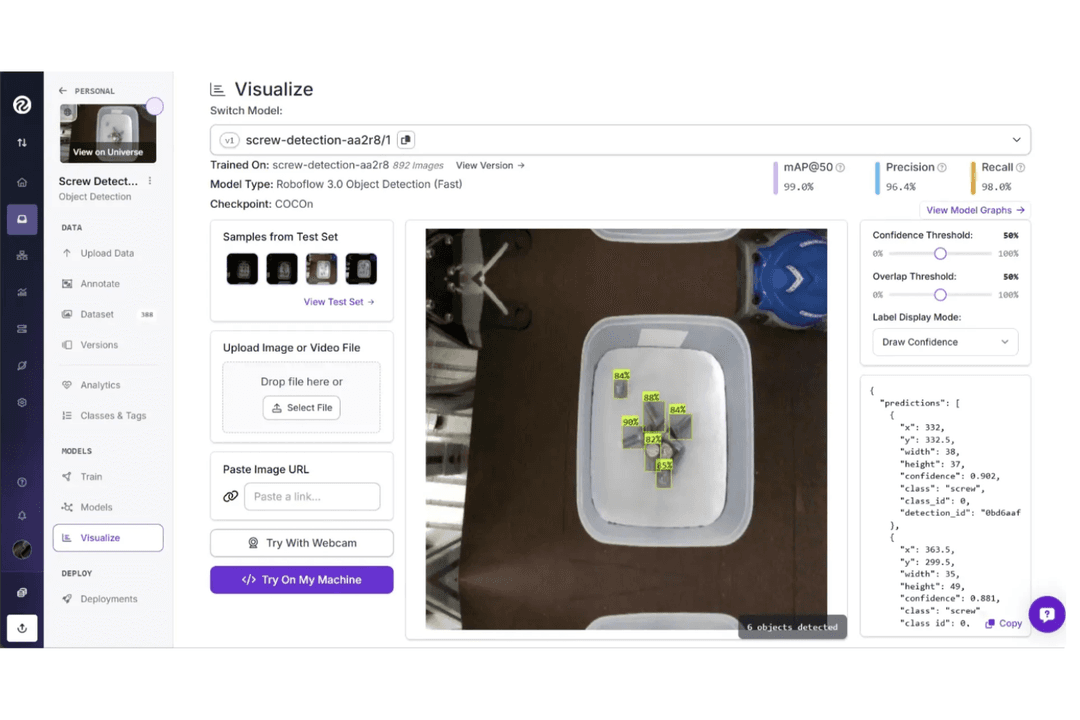
4.8/5
- Free plan + free trial + free demo available
- From $99/month
Encord
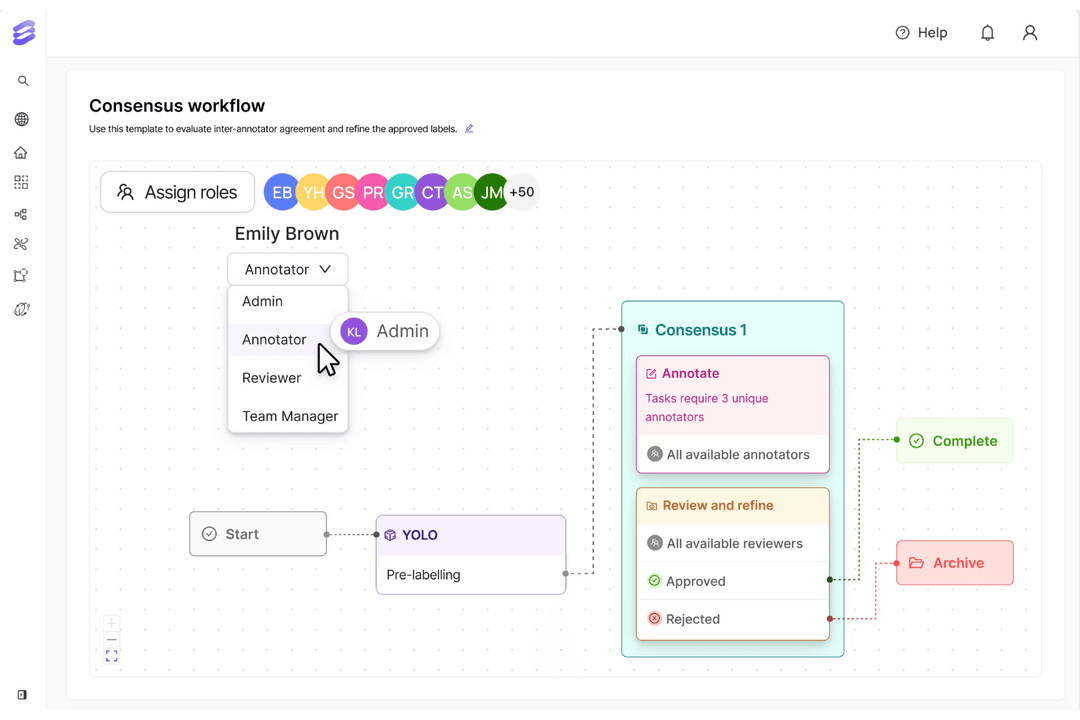
4.8/5
- Free demo available
- Pricing upon request
Why Trust Our Software Recommendations
6,700+
Reviews
20
Industry experts
16+
Evaluation factors
14
Years
Our team has been testing and reviewing software since 2012. As tech leaders ourselves, we know how difficult—and important—it is to choose the right software.
For this guide, we evaluated tools using hands-on testing and independent research, scoring tools using our selection criteria.
Our reviews reflect our human editorial judgment, not a sales pitch.
Expert reviewers:
- Paulo Gardini MiguelTech Director
 Tim FisherVP of AI
 Gabriel RosasTech Lead & Software Architect
 Christhian GruhnTech Lead & Platform Architect

| Roboflow | Encord | |
|---|---|---|
| Free Trial | Free plan + free trial + free demo available | Free demo available |
| Pricing | From $99/month | Pricing upon request |
Roboflow vs. Encord Pricing & Hidden Costs
Roboflow uses a tier-based pricing model with a free option and paid tiers that expand dataset limits, collaboration features, and deployment capabilities. Costs can rise with increased usage, particularly around training, storage, and API inference. Encord also follows a tiered structure that scales based on team size, data volume, and access to advanced features such as automation, model evaluation, and enterprise infrastructure. For both platforms, larger production workloads and enterprise support can increase overall spend.
When deciding, consider how your dataset size, annotation volume, and team collaboration needs are likely to grow. Review usage limits, infrastructure options, and support inclusions to avoid unexpected scaling costs.
| Roboflow | Encord | |
|---|---|---|
| A/B Testing | No | No |
| Analytics | Yes | Yes |
| API | Yes | Yes |
| Dashboard | Yes | Yes |
| Data Export | Yes | Yes |
| Data Import | Yes | Yes |
| Data Mining | Yes | Yes |
| Data Visualization | Yes | Yes |
| External Integrations | Yes | Yes |
| Multi-User | Yes | Yes |
| Sentiment Analysis | No | No |
| Integration | Roboflow | Encord |
|---|---|---|
| IntegrationAWS S3 | Roboflow✅ | Encord✅ |
| IntegrationGoogle Cloud Storage | Roboflow✅ | Encord✅ |
| IntegrationAzure Blob Storage | Roboflow✅ | Encord✅ |
| IntegrationLabelbox | Roboflow✅ | Encord❌ |
| IntegrationCVAT | Roboflow✅ | Encord✅ |
| IntegrationYOLOv8* | Roboflow✅ | Encord❌ |
| IntegrationTensorFlow* | Roboflow✅ | Encord✅ |
| IntegrationPyTorch* | Roboflow✅ | Encord✅ |
| IntegrationAPI | Roboflow✅ | Encord✅ |
| IntegrationZapier | Roboflow✅ | Encord❌ |
*Framework = Support refers to model or dataset compatibility.
Both Roboflow and Encord support major cloud storage providers and machine learning frameworks, helping you move data and models across your pipeline. Roboflow emphasizes developer-friendly integrations and automation tools, while Encord focuses on enterprise data ecosystem compatibility.
| Factor | Roboflow | Encord |
|---|---|---|
| FactorData Privacy | RoboflowProvides workspace and project-level access controls to manage dataset visibility and collaboration. | EncordOffers role-based permissions and detailed audit logging for user actions. |
| FactorRegulatory Compliance | RoboflowMaintains SOC 2 Type II compliance and offers HIPAA-aligned infrastructure with BAA under agreement. | EncordProvides SOC 2, GDPR, and HIPAA-compliant infrastructure, with security and privacy controls verified through Vanta. |
| FactorEncryption | RoboflowEncrypts data in transit and at rest, with SSL transport rated A+ by Qualys. | EncordUses AES-256 encryption for data at rest and secure encryption protocols for data in transit. |
| FactorUptime & Reliability | RoboflowPublishes service status updates and may provide SLAs for enterprise customers. | EncordOffers high-availability infrastructure with enterprise SLAs available. |
| FactorAuditability | RoboflowTracks dataset versioning and user activity for traceability. | EncordMaintains comprehensive audit logs for project and annotation activity. |
| FactorInfrastructure Options | RoboflowSupports cloud and private deployment options on enterprise plans. | EncordOffers VPC and on-prem deployment options for enterprise customers. |
Both Roboflow and Encord provide core security features, including encryption, access controls, and activity tracking. Roboflow focuses on practical, secure model development and deployment, while Encord emphasizes enterprise governance and compliance. As a result, Encord may suit regulated environments, whereas Roboflow fits secure, production-ready vision workflows.
| Factor | Roboflow | Encord |
|---|---|---|
| FactorUser Interface | RoboflowClean, intuitive interface with drag-and-drop dataset tools and simple navigation. | EncordMore advanced interface with configurable annotation panels and workflow controls. |
| FactorOnboarding | RoboflowGuided tutorials, documentation, and sample projects support quick setup for new users. | EncordProvides learning resources and guided setup, with dedicated onboarding support for Teams and Enterprise users. |
| FactorSetup Process | RoboflowAllows fast project setup with prebuilt workflows and integrations. | EncordRequires more configuration but supports complex, custom workflows. |
| FactorSupport Resources | RoboflowMaintains an active community forum and extensive documentation. | EncordFeatures email support, an AI documentation assistant, and detailed technical docs, with enterprise assistance available. |
| FactorCollaboration | RoboflowEnables easy team invites and shared project spaces. | EncordSupports granular role assignments and real-time annotation review. |
Roboflow is generally easier for new users to adopt, with fast setup and a straightforward interface. Encord is built for teams that need deeper customization and structured collaboration. While it may require more setup, it supports structured review processes and granular role assignments suited for larger annotation teams.
Roboflow
- AI-assisted annotation speeds up labeling large datasets.
- Supports deployment to edge devices, cloud, or on-premises.
- Offers open source tools and public datasets for experimentation.
- Costs can scale quickly with high-volume training and inference.
- Limited low-level customization compared to fully custom ML pipelines.
- Performance and latency vary by deployment method.
Encord
- Advanced video and multimodal annotation tools.
- Strong workflow automation for large-scale projects.
- Detailed ontology and taxonomy management features.
- Limited model training capabilities compared to some platforms.
- Occasional performance lags with very large datasets.
- Pricing may be high for small teams or startups.
Roboflow
- ManufacturingDeploy vision AI to automate quality inspections, detect defects, track inventory, and improve efficiency across modern manufacturing operations.
- Industrial ManufacturingUse vision AI to monitor equipment performance, prevent downtime, automate inspections, and optimize complex industrial production environments at scale.
- Healthcare & MedicineApply vision AI to analyze medical imagery, monitor patients, automate workflows, and improve diagnostic accuracy and healthcare outcomes.
- AutomotiveEnhance automotive manufacturing with vision AI that detects defects, monitors assembly lines, optimizes processes, and prevents costly production downtime.
- Aerospace & DefenseUse vision AI to inspect components, verify assembly accuracy, monitor safety compliance, and ensure quality across aerospace manufacturing operations.
- Consumer GoodsProtect product quality and brand trust using vision AI to inspect packaging, verify labels, detect defects, and optimize production.
Encord
- AI Research & Model Development DepartmentsGroups building generative or frontier models benefit from structured evaluation and post-training alignment workflows.
- Computer Vision & Data Engineering TeamsDepartments managing large-scale image and video datasets can leverage collaborative annotation and version control.
- Healthcare AI & Clinical Data DivisionsRegulated environments benefit from audit trails, governance controls, and traceable annotation pipelines.
- Robotics & Physical AI ProgramsEngineering units working with multimodal or sequential sensor data can manage complex real-world datasets.
- Data Operations & MLOps FunctionsTeams responsible for dataset orchestration, versioning, and workflow automation gain better coordination and oversight.
- Enterprise AI Strategy & Innovation OfficesOrganizations scaling AI across business units benefit from centralized governance and collaboration infrastructure.
Who Should Use Roboflow, and Who Should Use Encord?
If you want to move quickly from data to deployed computer vision models, Roboflow is likely the better fit. It works best when you need simple workflows, fast setup, and an all-in-one platform for dataset management, annotation, training, and deployment. This makes it a practical choice for developers building real-world vision applications without managing complex ML infrastructure.
If your priority is building high-quality training data for complex or multimodal AI, Encord may suit you better. It is better suited for teams needing structured annotation workflows, strong collaboration, and deeper data governance for large-scale AI systems.
| Roboflow | Encord | |
|---|---|---|
| Collaboration | Roboflow Shared workspaces and simple team collaboration for dataset and model workflows. | Encord Granular roles, structured review pipelines, and collaboration built for large annotation teams. |
| Core Focus | Roboflow End-to-end computer vision pipeline from dataset to model deployment. | Encord Focuses on enterprise-grade annotation, data curation, and QA workflows. |
| Dataset Management | Roboflow Provides dataset versioning and simple data organization for iterative model training and experimentation. | Encord Offers advanced data management, including dataset governance, audit trails, and quality monitoring, across large-scale pipelines. |
| Modalities Supported | Roboflow Primarily images and video (with plugins/export). | Encord Multimodal, including LiDAR, DICOM/medical, audio, and documents. |
| Pricing Model | Roboflow Tiered subscription with free and paid plans based on usage and features. | Encord Tiered and usage-based pricing, often customized for enterprise data and workflow needs. |
| Annotation Capabilities | Both provide image and video annotation tools with support for multiple labeling formats, automation assistance, and quality control features for building high-quality datasets. |
|---|---|
| API Availability | Both offer robust APIs that allow teams to automate dataset management, integrate with ML pipelines, and build custom workflows. |
| Cloud Storage | Both integrate with major cloud storage providers such as AWS S3, Google Cloud Storage, and Azure Blob Storage for importing, syncing, and exporting datasets. |
| Computer Vision | Both provide tools to prepare visual data for computer vision workflows. |
| Data Security | Both implement enterprise-grade security practices, including encryption at rest and in transit, to ensure safe handling of datasets. |