


Resolve vs. BMC Helix: Comparison & Reviews in 2026
Resolve and BMC Helix are service management platforms with different strengths in automation and IT operations. Learn how they compare on ITSM, AIOps, orchestration, and support for complex IT environments.

We review tools independently, and commissions help fund our testing. See our transparency policy, our methodology, or suggest a tool.
IT service issues become harder to manage when workflows span multiple systems and teams. Without the right automation, incidents take longer to resolve and service teams spend more time coordinating work.
If you’re comparing Resolve and BMC Helix, you’re likely looking for service management software that can reduce manual work and improve incident response. Resolve focuses on IT automation and orchestration across complex environments, while BMC Helix takes an AI-powered approach to IT service management and operations.
In this article, I compare their features, pricing, security, usability, and best use cases to help you choose the better fit.
Resolve
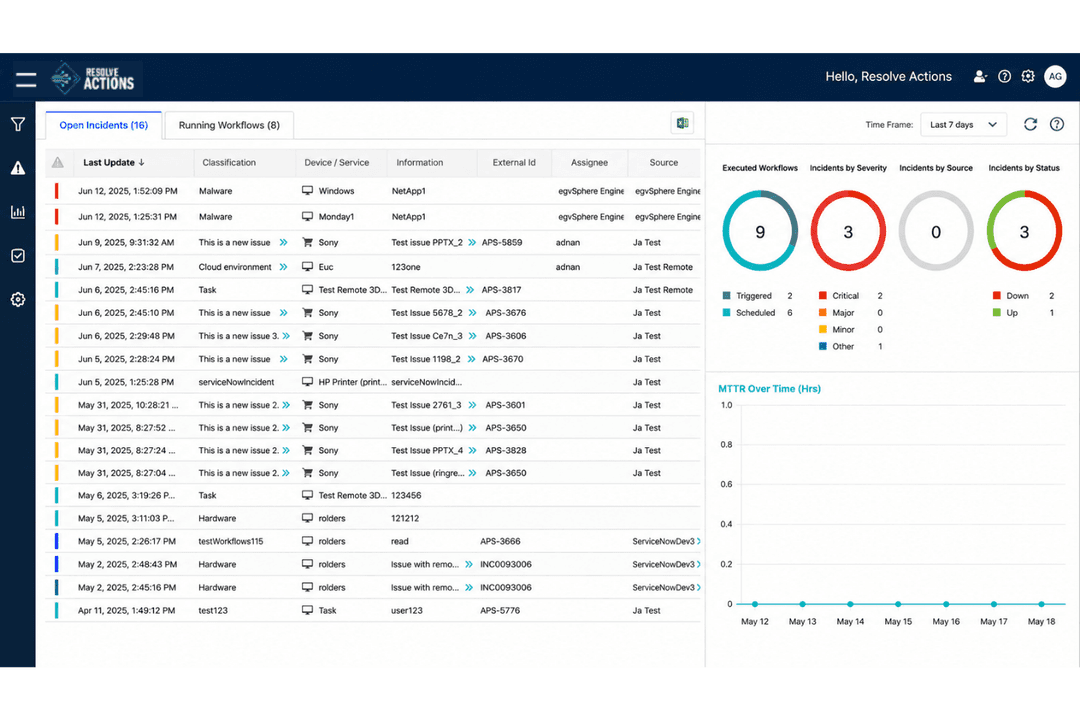
5/5
- Free demo available
- Pricing upon request
BMC Helix ITSM

4.1/5
- Free demo available
- Pricing upon request
Why Trust Our Software Recommendations
6,700+
Reviews
20
Industry experts
16+
Evaluation factors
14
Years
Our team has been testing and reviewing software since 2012. As tech leaders ourselves, we know how difficult—and important—it is to choose the right software.
For this guide, we evaluated tools using hands-on testing and independent research, scoring tools using our selection criteria.
Our reviews reflect our human editorial judgment, not a sales pitch.
Expert reviewers:
- Paulo Gardini MiguelTech Director
 Tim FisherVP of AI
 Gabriel RosasTech Lead & Software Architect
 Christhian GruhnTech Lead & Platform Architect

| Resolve | BMC Helix ITSM | |
|---|---|---|
| Free Trial | Free demo available | Free demo available |
| Pricing | Pricing upon request | Pricing upon request |
Resolve vs. BMC Helix Pricing & Hidden Costs
Resolve uses custom, flat pricing designed to stay predictable as automation scales, without usage- or token-based automation fees. BMC Helix also uses custom pricing, with quotes based on the products, deployment scope, and requirements involved. Since neither publishes exact pricing publicly, you’ll need to contact both vendors for a tailored quote.
The main difference is cost predictability. Resolve includes professional services for the first five use cases or agents and avoids variable automation costs, while BMC Helix pricing varies with product mix, implementation scope, and selected capabilities. I’d compare integration, onboarding, support, and future expansion costs alongside the initial quote.
| Resolve | BMC Helix ITSM | |
|---|---|---|
| API | Yes | Yes |
| Data Export | Yes | Yes |
| Data Import | Yes | Yes |
| External Integrations | Yes | Yes |
| Notifications | Yes | Yes |
| Project Management | No | Yes |
| Integration | Resolve | BMC Helix |
|---|---|---|
| IntegrationServiceNow | Resolve✅ | BMC Helix✅ |
| IntegrationMicrosoft Teams | Resolve✅ | BMC Helix✅ |
| IntegrationSlack | Resolve✅ | BMC Helix✅ |
| IntegrationJira | Resolve✅ | BMC Helix✅ |
| IntegrationSalesforce | Resolve✅ | BMC Helix✅ |
| IntegrationWorkday | Resolve✅ | BMC Helix✅ |
| IntegrationSplunk | Resolve✅ | BMC Helix✅ |
| IntegrationAWS | Resolve✅ | BMC Helix✅ |
| IntegrationGoogle Cloud Platform | Resolve✅ | BMC Helix✅ |
| IntegrationVMware | Resolve✅ | BMC Helix✅ |
| IntegrationAPI | Resolve✅ | BMC Helix✅ |
Both Resolve and BMC Helix integrate with a wide range of ITSM, collaboration, cloud, observability, and infrastructure tools, making either suitable for established enterprise environments. Resolve uses those connections to execute automation and remediation across systems, helping teams coordinate work without replacing their existing stack. Meanwhile, BMC Helix uses integrations to support ITSM, ITOM, and AIOps workflows within its service operations environment. Overall, Resolve emphasizes cross-system execution, while BMC Helix keeps connected workflows centered within the Helix platform.
| Factor | Resolve | BMC Helix |
|---|---|---|
| FactorAccess Controls | ResolveUses RBAC, approval gates, segregation of duties, and policy controls for users, agents, and automated actions. | BMC HelixUses role-based access, authentication controls, and security policies to manage platform access. |
| FactorData Encryption | ResolveProtects data and system connections with encryption controls across automation and integration workflows. | BMC HelixProtects data at rest and in transit with enterprise encryption and secure communication protocols. |
| FactorRegulatory Compliance | ResolveSupports SOC 2, ISO 27001, GDPR, EU-US DPF, HIPAA/HITRUST, and CCPA, plus GovCloud and global data residency. | BMC HelixSupports SOC 2, ISO 27001, GDPR, HIPAA/HITECH, and other enterprise compliance requirements. |
| FactorAutomation & AI Governance | ResolveUses approval gates, rollback rules, audit trails, and policy-bound execution to govern automated and AI-driven actions. | BMC HelixUses governance and policy controls to manage AI-driven workflows and service management processes. |
| FactorReliability | ResolveUses self-healing automation, event-driven remediation, and failover capabilities to detect issues and support service recovery. | BMC HelixSupports business continuity, disaster recovery, and availability controls across its cloud service environment. |
Overall, both platforms support enterprise security and compliance, but Resolve gives IT leaders direct control over how automated and AI-driven actions execute across the stack. Its governed agents, approval gates, rollback rules, audit trails, GovCloud hosting, global data residency, and self-healing remediation are particularly useful for sensitive or regulated IT environments. Meanwhile, BMC Helix applies established security and compliance controls across its service management environment.
| Factor | Resolve | BMC Helix |
|---|---|---|
| FactorUser Interface | ResolveCombines AgentLab, visual automation tools, and low-code workflow building for managing agents and IT processes. | BMC HelixProvides a configurable ITSM interface for managing service workflows, incidents, assets, and operations. |
| FactorOnboarding | ResolveIncludes dedicated professional services for the first five use cases or agents, with onboarding typically taking five days to one month. | BMC HelixProvides implementation guidance and training resources, with setup effort depending on configuration and deployment complexity. |
| FactorWorkflow Setup | ResolveOffers 5,000+ prebuilt automations alongside visual, AI-assisted, and bring-your-own-code workflow building. | BMC HelixSupports configurable workflows and automation across its ITSM, ITOM, and service operations environment. |
| FactorCustomization | ResolveSupports deterministic workflows, governed agents, APIs, integrations, and custom code for complex automation needs. | BMC HelixSupports configurable service processes, forms, rules, and workflows within the Helix platform. |
| FactorSupport | ResolveProvides a dedicated support portal, documentation, training resources, and hands-on professional services during onboarding. | BMC HelixProvides documentation, training, and technical support resources for implementation and ongoing platform use. |
From an ease-of-use perspective, Resolve combines guided onboarding, 5,000+ prebuilt automations, and flexible workflow-building options that reduce build-from-scratch work. Meanwhile, BMC Helix uses a configurable ITSM environment supported by implementation guidance and training resources. Overall, Resolve suits teams focused on cross-system automation and hands-on onboarding, while BMC Helix fits teams that prefer service workflows managed within its ITSM platform.
Resolve
- Orchestrates workflows across ITSM, observability, cloud, network, and legacy systems
- Combines deterministic workflows with governed AI agents for more predictable execution
- Uses flat pricing that avoids variable usage- or token-based automation costs
- No native ticketing, so teams still need a separate ITSM platform
- No built-in monitoring, requiring existing observability tools
- Smaller market presence than larger vendors like ServiceNow and BMC
BMC Helix ITSM
- Automated incident and change management capabilities are highly configurable.
- It excels in incident and service management, ensuring smooth handling of IT tasks.
- Strong audit trails support compliance in regulated industries.
- Interface complexity can slow down adoption for new teams.
- Advanced reporting requires detailed configuration and training.
- Some system updates disrupt customizations during deployment.
Resolve
- Large EnterprisesOrganizations with large, complex IT environments can use Resolve to automate workflows across ITSM, cloud, infrastructure, and legacy systems.
- Financial ServicesBanks and financial institutions can automate incident response, access management, compliance workflows, and other processes where uptime and auditability matter.
- ManufacturingManufacturers can automate service requests, infrastructure remediation, and cross-system workflows across plants, sites, and enterprise systems.
- PharmaceuticalsPharmaceutical companies can use governed automation across regulated environments, including access, incident, infrastructure, and service workflows.
- RetailLarge retailers can automate IT operations across distributed stores, e-commerce systems, infrastructure, and service desks.
- TelecommunicationsTelecom teams managing large networks and hybrid environments can automate operational workflows, remediation, and service processes across multiple systems.
BMC Helix ITSM
- Financial ServicesStrict audit trails, robust compliance modules, and granular change management support regulatory demands and reduce operational risk.
- Global EnterprisesMulti-language support and broad integration capabilities let internationally distributed teams collaborate on service management processes.
- Healthcare OrganizationsThe software’s asset discovery capabilities help you manage and track financial IT assets effectively.
- Government ITExtensive reporting, access controls, and documentation features support public sector compliance, transparency, and oversight needs.
- IT Departments Over 100 LargeIT teams benefit from advanced automation, self-service portals, and customizable workflows optimized for high-volume service operations.
- Hybrid Cloud EnvironmentsCentralized service management and cognitive automation help coordinate resources, tickets, and assets across cloud and on-prem infrastructure.
Who Should Use Resolve, and Who Should Use BMC Helix?
Resolve is best suited to large enterprises with complex hybrid environments, particularly in financial services, retail, manufacturing, pharmaceuticals, and telecommunications. I’d choose it for IT operations and service teams that need governed automation, end-to-end remediation, and orchestration across ITSM, observability, cloud, network, and legacy systems.
Meanwhile, BMC Helix fits large organizations with dedicated ITSM functions, including financial services, healthcare, government, and global enterprises managing multi-cloud environments. Overall, Resolve suits teams prioritizing cross-system automation and execution, while BMC Helix fits organizations that want ITSM, ITOM, and AIOps managed within the Helix environment.
| Resolve | BMC Helix ITSM | |
|---|---|---|
| Automation Model | Resolve Combines governed AI agents with deterministic workflows so repeatable processes can execute predictably without constant AI reasoning. | BMC Helix ITSM Uses AI-driven service and operations workflows for incident handling, event analysis, and service optimization. |
| Native Service Management | Resolve Does not include native ticketing or monitoring, so teams keep their existing ITSM and observability platforms. | BMC Helix ITSM Includes native incident, problem, change, request, asset, configuration, and knowledge management capabilities. |
| Pre-Built Automation | Resolve Provides 5,000+ prebuilt automations and activities that teams can deploy or adapt across complex IT environments. | BMC Helix ITSM Provides configurable workflows and automation within its ITSM, ITOM, and AIOps applications. |
| Pricing Approach | Resolve Uses flat, custom pricing designed to avoid per-user, per-ticket, per-workflow, or AI token fees as automation scales. | BMC Helix ITSM Uses custom, quote-based pricing for BMC Helix products, deployment scope, and required capabilities. |
| Primary Platform Role | Resolve Acts as a platform-agnostic automation and orchestration layer across ITSM, observability, cloud, network, and legacy systems. | BMC Helix ITSM Combines native ITSM, ITOM, and AIOps capabilities within the BMC Helix service operations environment. |
| AI-Assisted Operations | Both use AI to reduce manual work, support incident resolution, and improve responses to operational issues. |
|---|---|
| Enterprise Focus | Both support large organizations managing complex IT operations, distributed infrastructure, and high service volumes. |
| Hybrid Environment Support | Both work across cloud, on-premises, and hybrid infrastructure environments with multiple systems and technology domains. |
| Security & Governance | Both provide role-based controls, governance capabilities, and compliance support for sensitive enterprise IT operations. |
| Workflow Building | Both provide tools for creating and adapting automated workflows to match enterprise IT processes and requirements. |