


QA.tech vs. Mabl: Comparison and Expert Reviews for 2026
Here’s my take on QA.tech vs. Mabl. See how these AI-powered end-to-end testing tools compare, who they’re best for, and what sets them apart in 2026.

We review tools independently, and commissions help fund our testing. See our transparency policy, our methodology, or suggest a tool.
Keeping end-to-end test coverage reliable becomes more difficult as applications grow and testing demands increase. The right testing platform should reduce manual maintenance while helping teams catch issues before they reach production.
If you're comparing end-to-end testing tools, QA.tech and Mabl both use AI to improve software quality, but they take different approaches. QA.tech uses autonomous AI agents that create and run tests based on application context, while Mabl combines low-code test automation with AI-powered capabilities for testing web, mobile, and API applications.
In this comparison, I'll break down QA.tech and Mabl across features, pricing, security, usability, and use cases to help you decide which platform best fits your team's testing needs.
QA.tech
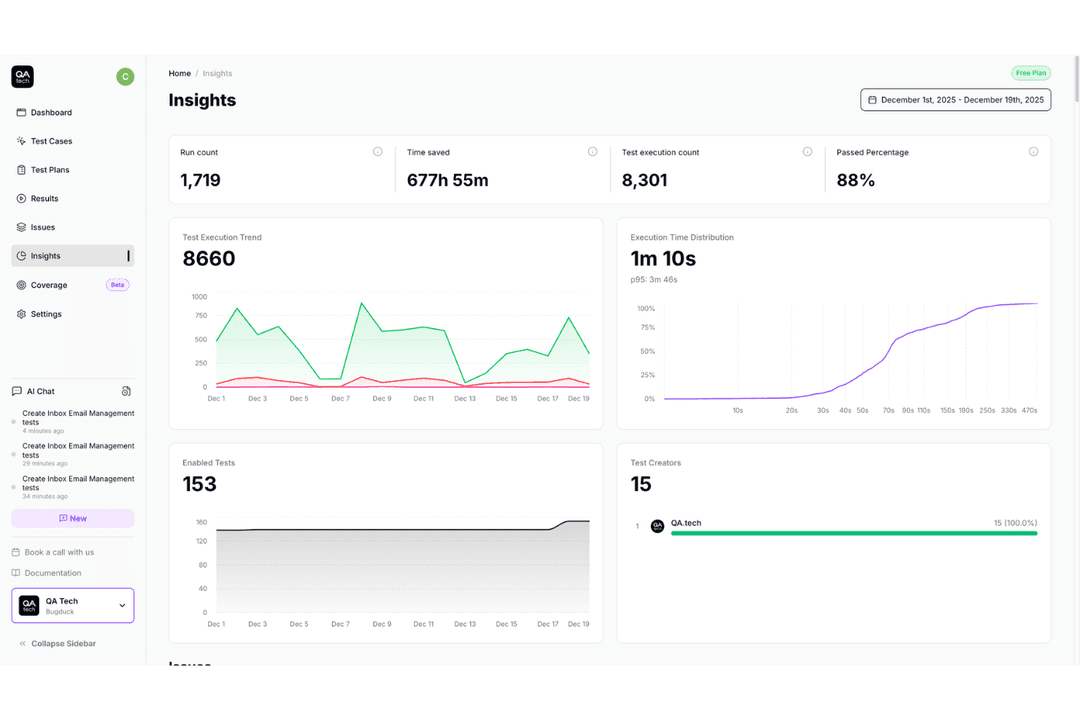
4.7/5
- Free demo available
- Pricing upon request
Mabl

4.2/5
- 14-day free trial + free demo available
- Pricing upon request
Why Trust Our Software Recommendations
6,700+
Reviews
20
Industry experts
16+
Evaluation factors
14
Years
Our team has been testing and reviewing software since 2012. As tech leaders ourselves, we know how difficult—and important—it is to choose the right software.
For this guide, we evaluated tools using hands-on testing and independent research, scoring tools using our selection criteria.
Our reviews reflect our human editorial judgment, not a sales pitch.
Expert reviewers:
- Paulo Gardini MiguelTech Director
 Tim FisherVP of AI
 Gabriel RosasTech Lead & Software Architect
 Christhian GruhnTech Lead & Platform Architect

| QA.tech | Mabl | |
|---|---|---|
| Free Trial | Free demo available | 14-day free trial + free demo available |
| Pricing | Pricing upon request | Pricing upon request |
QA.tech vs. Mabl Pricing & Hidden Costs
QA.tech and Mabl both use quote-based pricing that scales with testing needs and required capabilities. QA.tech offers Starter, Growth, and Enterprise plans, with higher tiers adding capabilities like more parallel test runs, mobile testing, PR testing, built-in integrations, advanced security, and dedicated support. Meanwhile, Mabl provides customized pricing across its testing capabilities, with add-ons available for mobile app testing and Technical Account Manager support.
When comparing costs, consider more than the starting plan. QA.tech users should evaluate needs around test volume, parallel execution, environments, and enterprise features, while Mabl buyers should factor in advanced support needs and optional add-ons. I’d recommend mapping your testing scope, release frequency, and required capabilities before choosing, so your plan can support growth without paying for features your team won’t use.
| QA.tech | Mabl | |
|---|---|---|
| A/B Testing | No | No |
| API | Yes | Yes |
| Automated Testing | Yes | Yes |
| Browser Compatibility Testing | Yes | Yes |
| Bug Tracking | Yes | Yes |
| Calendar Management | No | No |
| CI/CD Integration | Yes | Yes |
| Dashboard | Yes | Yes |
| Data Export | Yes | Yes |
| Data Import | Yes | Yes |
| Data Visualization | Yes | Yes |
| Developer Tools | Yes | No |
| External Integrations | Yes | Yes |
| History/Version Control | Yes | No |
| Manual Testing | No | No |
| Multi-User | Yes | Yes |
| Notifications | Yes | Yes |
| Performance Testing | No | Yes |
| Regression Testing | Yes | Yes |
| Scheduling | Yes | Yes |
| Status Notifications | Yes | Yes |
| Third-Party Plugins/Add-Ons | Yes | Yes |
| Integration | QA.tech | Mabl |
|---|---|---|
| IntegrationJira | QA.tech✅ | Mabl✅ |
| IntegrationSlack | QA.tech✅ | Mabl✅ |
| IntegrationGitHub | QA.tech✅ | Mabl✅ |
| IntegrationGitLab | QA.tech✅ | Mabl✅ |
| IntegrationMicrosoft Teams | QA.tech✅ | Mabl✅ |
| IntegrationBitbucket | QA.tech✅ | Mabl✅ |
| IntegrationJenkins | QA.tech✅ | Mabl✅ |
| IntegrationAzure DevOps | QA.tech✅ | Mabl✅ |
| IntegrationLinear | QA.tech✅ | Mabl❌ |
| IntegrationTrello | QA.tech✅ | Mabl❌ |
| IntegrationZapier | QA.tech❌ | Mabl✅ |
| IntegrationAPI | QA.tech✅ | Mabl✅ |
Both QA.tech and Mabl connect with common development, collaboration, and CI/CD tools to help teams fit automated testing into existing workflows. QA.tech focuses heavily on engineering workflows, including PR testing, API-driven testing, issue-tracking integrations, and connections across modern development pipelines.
Mabl, meanwhile, also supports a strong integration ecosystem for quality teams, connecting test automation with development tools and collaboration platforms. Teams focused on agent-driven testing workflows may prefer QA.tech, while teams seeking broader AI-powered test automation across QA workflows may lean toward Mabl.
| Factor | QA.tech | Mabl |
|---|---|---|
| FactorData Encryption | QA.techAES-256 encryption at rest and TLS 1.2/1.3 encryption in transit. | MablEncrypts data at rest and in transit to protect testing and application data. |
| FactorCompliance & Certifications | QA.techSOC 2 Type II attested, GDPR compliant, EU-only data residency, with ISO 27001 on the roadmap. | MablSOC 2 Type II compliant with GDPR support. |
| FactorUser Access Controls | QA.techEnforced MFA, SAML SSO, role-based access controls, and managed team access. | MablSSO, role-based permissions, audit logging, and user management controls. |
| FactorReliability | QA.techSLA-backed support, managed parallel test execution, and Enterprise reliability engineering. | MablScalable cloud execution, unlimited cloud concurrency, and monitored infrastructure. |
| FactorSecurity Management | QA.techFull ISMS, custom security reviews, and external testing without source code access. | MablEnterprise security controls, monitoring, and governance features. |
Both QA.tech and Mabl provide enterprise-grade security controls for teams managing automated testing workflows. QA.tech stands out for SOC 2 Type II attestation, GDPR compliance, EU-only data residency, enforced MFA, and an external testing approach that does not require access to source code. Mabl also offers strong compliance, access management, scalable cloud execution, and enterprise support options.
Both platforms are built for secure testing at scale, with QA.tech leaning toward autonomous AI-driven testing and Mabl focusing on broader AI-powered testing workflows.
| Factor | QA.tech | Mabl |
|---|---|---|
| FactorUser Interface | QA.techConversational workspace for creating, editing, and managing tests with AI agents. | MablIntuitive interface with low-code test creation, visual workflows, and reporting tools. |
| FactorOnboarding | QA.techGuided onboarding with solutions engineers, workshops, and setup support. | MablGuided onboarding, Mabl University training, and Customer Success support. |
| FactorTest Creation | QA.techAI agents create tests from user goals and application context without scripts. | MablLow-code test builder with self-healing, visual testing, and reusable workflows. |
| FactorSupport Resources | QA.techEmail, Slack/Teams channels, solutions engineers, and Enterprise support options. | Mabl24/5 live support, documentation, CSM, and optional TAM support. |
| FactorSetup Time | QA.techProduct crawl and initial setup help agents build accurate test context. | MablCloud setup built for scaling test coverage across teams and applications. |
From an ease-of-use perspective, Mabl emphasizes accessible AI-powered testing through its low-code interface, visual workflows, and training resources, helping teams create and manage tests across different skill levels. QA.tech focuses on an autonomous agent-driven experience that shifts more test creation work to AI agents, though teams may need time to adjust to guiding tests through goals and application context.
QA.tech
- AI agents automate end-to-end test creation and execution
- Strong CI/CD integrations with automated pull request testing
- Parallel test execution speeds up regression testing workflows
- Limited cross-browser testing beyond Chromium
- Tests cannot be exported as code-based scripts
- Teams may need time to adapt to autonomous testing workflows
Mabl
- Mabl makes automated testing accessible with its intuitive user interface.
- It reduces manual testing time, allowing your team to focus on development.
- Mabl's smart analytics help you identify and fix issues quickly.
- Some users find Mabl's advanced features require a learning curve.
- It can be less flexible for highly customized testing scenarios.
- Users sometimes report delays in receiving support responses.
QA.tech
- B2B SaaS CompaniesSaaS companies can use QA.tech to maintain test coverage across frequent product releases and changing application workflows.
- Software Development CompaniesDevelopment teams can automate end-to-end testing and integrate quality checks directly into CI/CD and pull request workflows.
- Fintech CompaniesFintech companies can validate critical user flows involving accounts, transactions, and complex authentication requirements.
- Healthtech PlatformsHealthtech platforms can automate regression testing as their applications, features, and user workflows continue to evolve.
- HR Tech and Recruiting PlatformsHR and recruiting platforms can test multi-step processes like onboarding, profiles, and user management across different roles.
- Ecommerce BusinessesEcommerce businesses can validate important customer journeys like account flows and checkout experiences during frequent updates.
Mabl
- Tech StartupsMabl’s ease of use helps small teams automate testing without needing extensive resources.
- E-Commerce PlatformsIt ensures your website functions smoothly, enhancing the customer experience.
- Financial ServicesMabl’s accuracy and reliability are vital for maintaining secure, error-free transactions.
- QA DepartmentsYour team can reduce manual testing time and focus on boosting software quality.
- Agile Development TeamsMabl supports fast-paced environments with its quick test execution and results.
- Product ManagersGain insights into software performance, helping you make informed decisions quickly.
Who Should Use QA.tech, and Who Should Use Mabl?
QA.tech is best suited for mid-market and enterprise engineering teams that need autonomous, end-to-end testing to support fast release cycles. I recommend QA.tech if your team uses modern CI/CD workflows and wants AI agents to create tests, validate pull requests, and reduce manual test maintenance. B2B SaaS, fintech, healthtech, HR tech, and other software-driven teams may benefit most from its engineering-focused approach.
Mabl is a better fit if you want an AI-powered end-to-end testing platform that balances automation with accessible test creation. I’d recommend it for agile development teams, QA teams, and product teams that need scalable testing across web, mobile, API, accessibility, and performance workflows.
| QA.tech | Mabl | |
|---|---|---|
| Test Creation | QA.tech Generates tests through AI agents with minimal manual scripting. | Mabl Supports low-code test creation with AI-assisted maintenance and reusable workflows. |
| Testing Approach | QA.tech Uses autonomous AI agents that create and execute end-to-end tests based on goals and application context. | Mabl Uses agentic AI and low-code automation to create, maintain, and scale end-to-end tests. |
| Testing Coverage | QA.tech Focuses on autonomous end-to-end testing across application workflows with AI-driven validation. | Mabl Covers end-to-end testing across web, mobile, API, accessibility, performance, and visual workflows. |
| User Involvement | QA.tech Teams guide AI agents by defining goals and reviewing results. | Mabl Teams build and manage tests through low-code workflows supported by AI. |
| Workflow Focus | QA.tech Built around engineering workflows, CI/CD pipelines, and PR validation. | Mabl Supports collaborative testing workflows across QA and development teams. |
| CI/CD Integrations | Both integrate with popular tools such as GitHub, GitLab, Bitbucket, and Jenkins to support automated testing in CI/CD workflows. |
|---|---|
| Cloud-Based Testing | Both provide cloud-based test execution, helping teams scale testing without managing testing infrastructure. |
| Enterprise Support | Both offer onboarding resources, customer support options, and enterprise-level assistance for larger teams. |
| Issue Management | Both help teams track testing issues and connect quality workflows with development processes. |
| Mobile Testing | Both support mobile application testing, helping teams validate experiences across web and mobile products. |