


PowerDMARC vs. Valimail: Expert Reviews and Comparison for 2026
PowerDMARC and Valimail both strengthen DMARC and email authentication, but differ in monitoring, enforcement, and management. Compare their features, pricing, and best-fit use cases to see which better fits your security needs.

We review tools independently, and commissions help fund our testing. See our transparency policy, our methodology, or suggest a tool.
Email spoofing and authentication gaps rarely come from one obvious failure—they build up when teams lack visibility into legitimate senders, misconfigured records, and policy readiness. Without the right controls, it becomes harder to know which domains are exposed, which sources are failing authentication, and when it’s safe to move toward enforcement.
If you’re dealing with spoofing risks, inconsistent authentication, or too much manual DNS work, choosing between PowerDMARC and Valimail can feel tricky. Both are DMARC software options built to strengthen email authentication, but they differ in how they approach monitoring, enforcement, automation, and ongoing management.
In this article, I’ll compare PowerDMARC and Valimail across pros and cons, core features, pricing, security, ease of use, and best-fit use cases so you can decide which one better fits your team.
PowerDMARC
4.8/5
- Free plan available
- From $8/month (billed annually)
Valimail
4.5/5
- Free plan available
- Pricing upon request
Why Trust Our Software Recommendations
6,700+
Reviews
20
Industry experts
16+
Evaluation factors
14
Years
Our team has been testing and reviewing software since 2012. As tech leaders ourselves, we know how difficult—and important—it is to choose the right software.
For this guide, we evaluated tools using hands-on testing and independent research, scoring tools using our selection criteria.
Our reviews reflect our human editorial judgment, not a sales pitch.
Expert reviewers:
- Paulo Gardini MiguelTech Director
 Tim FisherVP of AI
 Gabriel RosasTech Lead & Software Architect
 Christhian GruhnTech Lead & Platform Architect

| PowerDMARC | Valimail | |
|---|---|---|
| Free Trial | Free plan available | Free plan available |
| Pricing | From $8/month (billed annually) | Pricing upon request |
PowerDMARC vs. Valimail Pricing & Hidden Costs
PowerDMARC uses a tiered pricing model with a free option, published self-service pricing, and custom plans for more advanced needs. Costs increase as teams move into capabilities such as deeper analytics, API access, SIEM support, reputation monitoring, and other enterprise features. Meanwhile, Valimail offers a free monitoring product, while its enforcement and BIMI offerings are priced separately and generally require contacting sales for a quote.
Choosing between the two largely comes down to whether you prefer PowerDMARC’s more transparent self-service entry point or Valimail’s product-based approach, where monitoring, enforcement, and BIMI are split across separate offerings.
| PowerDMARC | Valimail | |
|---|---|---|
| 2-Factor Authentication | Yes | Yes |
| API | Yes | Yes |
| Dashboard | Yes | Yes |
| Data Export | Yes | Yes |
| Data Import | Yes | Yes |
| External Integrations | Yes | Yes |
| Multi-User | Yes | Yes |
| Notifications | Yes | Yes |
| Integration | PowerDMARC | Valimail |
|---|---|---|
| IntegrationMicrosoft Sentinel | PowerDMARC✅ | Valimail✅ |
| IntegrationSplunk | PowerDMARC✅ | Valimail✅ |
| IntegrationElastic | PowerDMARC✅ | Valimail❌ |
| IntegrationFortiSIEM | PowerDMARC✅ | Valimail❌ |
| IntegrationCisco Threat Grid | PowerDMARC✅ | Valimail❌ |
| IntegrationFortinet | PowerDMARC✅ | Valimail✅ |
| IntegrationConnectWise | PowerDMARC✅ | Valimail❌ |
| IntegrationHaloPSA | PowerDMARC✅ | Valimail❌ |
| IntegrationGradient MSP | PowerDMARC✅ | Valimail❌ |
| IntegrationAWS Marketplace | PowerDMARC✅ | Valimail✅ |
| IntegrationEntri | PowerDMARC✅ | Valimail❌ |
| IntegrationAPI | PowerDMARC✅ | Valimail✅ |
Both PowerDMARC and Valimail support integrations that help email authentication fit into existing IT and security workflows. PowerDMARC places more emphasis on connecting with SIEM, PSA, threat intelligence, DNS, and developer tools, giving teams more options to extend monitoring and management across their wider security stack. Valimail, by contrast, focuses its integration strategy around email authentication, cloud services, and enforcement workflows. Overall, PowerDMARC leans toward broader operational connectivity, while Valimail keeps integrations more closely centered on DMARC and authentication management.
| Factor | PowerDMARC | Valimail |
|---|---|---|
| FactorData Privacy & Compliance | PowerDMARCISO/IEC 27001:2022 certification, SOC 2 Type 1 and Type 2 reports, SOC 3 reporting, GDPR support, and custom data protection agreements give regulated teams a fairly broad compliance foundation. | ValimailSOC 2 Type 2 certification and support for FedRAMP, PCI, GDPR, CCPA, and HIPAA-related requirements cover common enterprise and government needs. |
| FactorData Protection | PowerDMARCCustomer data is hosted on AWS, encrypted in transit and at rest, transferred over HTTPS, and protected with AES-256 encryption and restricted production access. | ValimailData is protected through AWS and Microsoft Azure infrastructure, formal security controls, and regular third-party penetration testing. |
| FactorAccess Controls | PowerDMARCHigher tiers add MFA, SAML 2.0 SSO, SCIM provisioning, customizable role-based access, audit logs, PGP encryption for failure reports, and SIEM integrations with Splunk, Sentinel, and QRadar. | ValimailMFA is available across plans, with forced MFA, SAML SSO, and additional identity controls on higher tiers. |
| FactorPolicy Enforcement | PowerDMARCHosted DMARC, SPF, DKIM, MTA-STS, TLS-RPT, and BIMI reduce repeated DNS work, while AI-assisted guidance helps administrators move domains toward quarantine or reject. | ValimailAutomated sender authorization and DMARC enforcement reduce manual policy management and ongoing configuration work. |
| FactorMonitoring & Reliability | PowerDMARCDMARC alerts, DNS security checks, reputation monitoring, threat intelligence, failure reports, audit logs, and enterprise SLA commitments support ongoing monitoring, while AWS Qualified Software status reflects completion of the AWS Foundational Technical Review. | ValimailContinuous authentication monitoring, sender visibility, security alerts, globally distributed infrastructure, and a fail-open architecture support ongoing protection and availability. |
Overall, PowerDMARC emphasizes broad email authentication coverage, detailed monitoring, granular access controls, and enterprise security features such as SAML SSO, SCIM, audit logs, PGP-protected failure reports, and SIEM integration. Valimail leans on automated DMARC enforcement, continuous sender discovery, identity-based authentication, and highly available infrastructure designed to reduce ongoing administration. Both provide strong security and compliance foundations, but PowerDMARC highlights configurability, visibility, and operational control, while Valimail prioritizes automation, enforcement efficiency, and infrastructure resilience.
| Factor | PowerDMARC | Valimail |
|---|---|---|
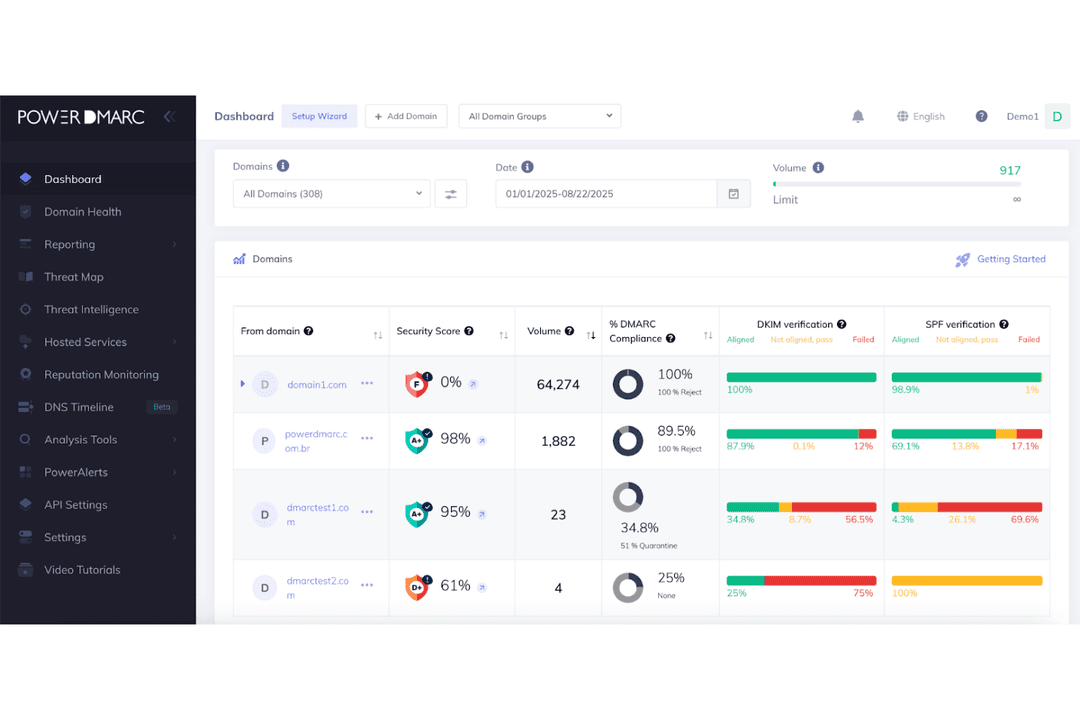
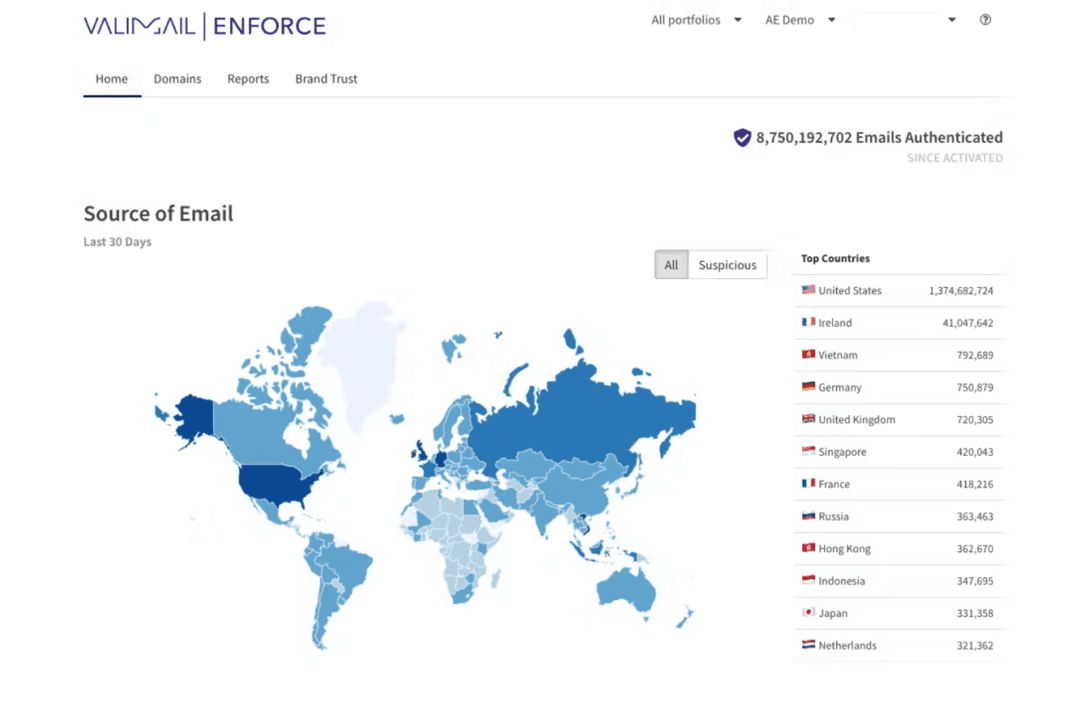
| FactorUser Interface | PowerDMARCStructured dashboards organize authentication reports, alerts, domain health, and policy status, while the AI Agent helps explain issues in plain language. | ValimailDashboards surface sender activity, authentication status, and policy information in a straightforward layout. |
| FactorSetup Process | PowerDMARCSelf-serve onboarding starts with a domain assessment and guided record setup, while One-Click Auto DNS Publishing supports record publishing across 40+ DNS providers. | ValimailGuided onboarding helps teams identify sending services, configure authentication, and work toward enforcement. |
| FactorPolicy Management | PowerDMARCHosted DMARC and related authentication services reduce repeated DNS changes, while policy guidance helps admins decide when to move from monitoring to quarantine or reject. | ValimailPolicy controls support DMARC monitoring, sender authorization, and enforcement without requiring constant manual DNS changes. |
| FactorSupport Access | PowerDMARC24/7 human support, a knowledge base, ticket-based help, and higher-tier account management give teams several ways to resolve setup or authentication issues. | ValimailDocumentation and support resources are available for deployment, authentication issues, and ongoing management. |
| FactorLearning Curve | PowerDMARCGuided setup, inline recommendations, and AI-assisted explanations make common tasks approachable, although the platform’s broad feature set can take time to learn. | ValimailAutomated sender discovery and guided workflows reduce the amount of manual configuration required during routine DMARC management. |
From an ease-of-use perspective, PowerDMARC leans into guided administration, with structured dashboards, inline recommendations, hosted authentication, and an AI Agent that helps explain configuration issues without forcing teams to parse raw DMARC data. Valimail focuses more on automated sender discovery, policy enforcement, and guided workflows that reduce the amount of ongoing manual management. Teams that want more visibility and control across a broader authentication stack may prefer PowerDMARC, while teams looking to minimize day-to-day DMARC administration may find Valimail’s automation-focused approach a better fit.
PowerDMARC
- AI-assisted analysis helps identify authentication issues, policy blockers, and unusual sending activity without requiring deep DMARC expertise.
- Hosted DMARC, PowerSPF, DKIM, BIMI, MTA-STS, and TLS-RPT reduce repeated DNS work and simplify authentication management.
- Multi-tenant controls, white labeling, domain grouping, and partner tools support MSPs and organizations managing large domain portfolios.
- The breadth of features can create a steeper learning curve for teams that only need basic DMARC reporting.
- Advanced capabilities such as MCP access, threat intelligence, reputation monitoring, API access, and SIEM support are limited to higher-tier plans.
- Teams that only need basic DMARC reporting may find the platform’s broader authentication and security feature set more than they need.
Valimail
- Automates SPF and DKIM management for rapid DMARC enforcement
- Provides detailed sender discovery diagnostics for unknown sources
- Responsive support team assists with complex domain configurations
- Limited customization for advanced reporting dashboards
- Premium pricing compared to direct competitors in the market
- Some users report delays in processing DNS changes
PowerDMARC
- MSPs and MSSPsService providers can leverage the multi-tenant control panel, white labeling, tenant-level API, PSA integrations, and centralized domain management to manage authentication for multiple clients.
- Enterprises With Multiple DomainsLarge organizations can monitor authentication centrally, organize domains into groups, delegate access, and manage policies across complex domain portfolios.
- Financial Services and InsuranceBanks and insurers can use powerful reporting, access controls, audit logs, SIEM integrations, and PGP-protected reports to meet strict governance needs.
- Technology and SaaS CompaniesTech teams with multiple products or services can utilize hosted authentication protocols to maintain control as infrastructure changes.
- Retail and Ecommerce BrandsHigh-volume senders can track DMARC and sender reputation, gather threat intelligence, and distinguish legitimate sources from spoofing attempts.
- Teams Without Dedicated DMARC ExpertiseIT admins can use AI guidance, hosted services, and recommendations to troubleshoot and achieve enforcement without a DMARC specialist.
Valimail
- Financial ServicesValimail’s focus on compliance and automation helps financial institutions secure customer communications and meet regulatory standards.
- Large EnterprisesCentralized management of sender policies, scalability, and workflow delegation tools support complex IT environments with many domains and stakeholders.
- Higher EducationEasy onboarding and discovery features simplify DMARC adoption for universities with distributed IT and diverse email sources.
- Healthcare ProvidersAutomated compliance monitoring and granular reporting address HIPAA-driven security and privacy mandates in medical organizations.
- IT DepartmentsValimail automates sender discovery and policy setup, which saves manual effort and reduces ongoing maintenance.
- SaaS ProvidersFrequent integration with multiple platforms and outbound tools makes Valimail’s third-party sender management especially useful.
Who Should Use PowerDMARC, and Who Should Use Valimail?
If you want a DMARC solution with broader authentication coverage, more hands-on control, and tools that go beyond basic monitoring, PowerDMARC is likely the better fit for your team. It’s especially well suited to IT and security teams managing multiple domains, complex sending environments, or MSP/MSSP clients, with hosted authentication, AI-assisted troubleshooting, DNS security monitoring, APIs, and SIEM support all adding more depth.
If, instead, you want to reduce ongoing DMARC administration through automated sender discovery and guided enforcement, Valimail may be the better choice. It fits organizations with large multi-domain environments, regulated industries, and teams that want clear visibility into third-party senders without spending as much time on day-to-day policy management.
| PowerDMARC | Valimail | |
|---|---|---|
| BIMI Certificate Services | PowerDMARC Supports BIMI implementation alongside VMC and CMC procurement, logo conversion, validation, and inbox simulation tools. | Valimail Uses Amplify as its dedicated BIMI offering, helping organizations display verified brand logos once DMARC enforcement requirements are met. |
| Compliance and Deployment Services | PowerDMARC Offers dedicated deployment services and support for meeting Google and Yahoo bulk-sender requirements in addition to its core platform. | Valimail Supports sender compliance through authentication monitoring, sender discovery, and automated DMARC enforcement workflows. |
| Free Tools and Training | PowerDMARC Provides dozens of free DMARC, SPF, DKIM, BIMI, DNS, deliverability, and threat-analysis tools, plus a dedicated training academy and certification resources. | Valimail Provides free Monitor access alongside email authentication guides, checkers, documentation, and educational resources. |
| Managed Services | PowerDMARC Offers one-time deployment plus ongoing managed monitoring with 8x5 and 24x7 service options for teams that want operational help beyond the software itself. | Valimail Uses guided implementation and automated enforcement workflows to support deployment and ongoing authentication management. |
| Partner and Channel Programs | PowerDMARC Supports MSP/MSSP, reseller, OEM, and hosting/domain-provider programs, giving partners several ways to manage, resell, or embed its authentication services. | Valimail Offers MSP, channel, technology, and ESP partner programs focused on extending its email authentication and enforcement capabilities through partner ecosystems. |
| Authentication Reporting | Both give teams reporting and visibility into authentication results, sending sources, and domain activity so they can investigate issues and improve enforcement readiness. |
|---|---|
| DMARC Monitoring | Both provide ongoing visibility into sending sources, authentication results, unauthorized domain use, and policy readiness so teams can spot issues before moving toward stronger enforcement. |
| Enterprise Security | Both offer enterprise-focused access controls, security documentation, and compliance support for organizations that need stronger governance, oversight, and protection around email authentication. |
| Multi-Domain Management | Both support organizations managing multiple domains, sending services, and more complex email environments without forcing administrators to treat each domain as a completely separate workflow. |
| SPF and DKIM Support | Each helps teams identify SPF and DKIM failures, verify legitimate senders, and resolve authentication problems that could interfere with successful DMARC enforcement. |