

Google Drive Review: Pros, Cons, Features, and Pricing
Google Drive excels with seamless integration, making it ideal for teams needing efficient collaboration and easy access to shared documents.

We review tools independently, and commissions help fund our testing. See our transparency policy, our methodology, or suggest a tool.
Google Drive is a cloud storage software built around Google Workspace, with integrated document editing, real-time co-editing, and shared drive management built in. It's worth considering if your team already runs on Gmail and Google Docs, or if multiple people need to work in the same files at the same time. Compared to Dropbox, Google Drive gives you native document creation and deeper collaboration tools without needing a separate office suite on top of it.
Google Drive Evaluation Summary
4.6/5
- From CAD $9.20/user/month (billed annually)
- Free plan + 14-day free trial available
Why Trust Our Software Recommendations
6,700+
Reviews
20
Industry experts
16+
Evaluation factors
14
Years
Our team has been testing and reviewing software since 2012. As tech leaders ourselves, we know how difficult—and important—it is to choose the right software.
For this guide, we evaluated tools using hands-on testing and independent research, scoring tools using our selection criteria.
Our reviews reflect our human editorial judgment, not a sales pitch.
Expert reviewers:
- Paulo Gardini MiguelTech Director
 Tim FisherVP of AI
 Gabriel RosasTech Lead & Software Architect
 Christhian GruhnTech Lead & Platform Architect

Google Drive Overview
In my opinion, Google Drive stands out as a strong cloud storage software for its smooth integration with Google's suite of tools. It's a good choice for teams that rely on Google Workspace for collaboration. While the onboarding process could be smoother and customer support more accessible, it provides solid core functions. Google Drive is best suited for groups such as educational institutions and remote teams that need efficient file sharing and collaboration. Its pricing is competitive, making it a worthwhile consideration compared to alternatives like Dropbox or OneDrive, especially for those already invested in Google's ecosystem.
Pros
- You can collaborate in real-time with your team on shared documents.
- It offers generous free storage compared to many competitors.
- You can easily access files from any device with an internet connection.
Cons
- Your team might find the offline access features limited.
- It can be difficult to organize files effectively with larger teams.
- You might experience occasional syncing issues with certain file types.
Is Google Drive Right For Your Needs?
Who Would be a Good Fit for Google Drive?
Google Drive is a good fit for educational institutions, marketing teams, and remote workers who need to work together effectively. Its real-time document editing and sharing tools make it ideal for projects requiring teamwork. Drive integrates smoothly with Google Workspace, further enhancing your productivity if you already use the platform. The generous free storage and easy drag and drop uploads are also an advantage for small teams or startups needing cost-effective solutions.
- Educational InstitutionsYou can use Google Drive to easily share resources, sync files, and coordinate on projects with students and faculty across different operating systems.
- Marketing TeamsDrive's real-time collaboration tools let your team work on campaigns together without version control issues, even when handling large file size assets.
- Remote WorkersAccess your Google drive files from anywhere, making it convenient for teams working from different locations.
- Small StartupsTake advantage of the free storage and document sharing tools to manage your resources efficiently.
- Creative AgenciesEffortlessly share large files and creative assets with clients and team members.
- Non-ProfitsManage your documents and work with team members across various locations without worrying about storage costs.
Who Would be a Bad Fit for Google Drive?
Google Drive might not suit large enterprises with complex data security needs. If your work involves handling sensitive information, Drive’s security measures may not meet stringent industry standards. Teams that need detailed file management and advanced workflow automation might find Drive lacking. If your organization relies heavily on non-Google ecosystems, integration challenges could arise, impacting your workflow efficiency.
- Large EnterprisesYour organization might need more powerful data security capabilities than Google Drive offers for sensitive information.
- Financial InstitutionsGoogle Drive's security features might not meet your industry's strict compliance and regulatory requirements.
- Legal DepartmentsYou might find the file management options inadequate for handling and organizing large volumes of legal documents.
- Healthcare ProvidersIf you handle patient data, Google Drive's security may not fully comply with healthcare regulations like HIPAA.
- Manufacturing CompaniesYour team might struggle with limited workflow automation options needed for complex manufacturing processes.
- Non-Google Ecosystem UsersIf your work relies heavily on Microsoft, Apple, or other ecosystems, integration with Google Drive might be cumbersome.
Our Review Methodology
How We Test & Score Tools
We’ve spent years building, refining, and improving our software testing and scoring system. The rubric is designed to capture the nuances of software selection and what makes a tool effective, focusing on critical aspects of the decision-making process.
Below, you can see exactly how our testing and scoring works across seven criteria. It allows us to provide an unbiased evaluation of the software based on core functionality, standout features, ease of use, onboarding, customer support, integrations, customer reviews, and value for money.
Core Functionality (25% of final scoring)
The starting point of our evaluation is always the core functionality of the tool. Does it have the basic features and functions that a user would expect to see? Are any of those core features locked to higher-tiered pricing plans? At its core, we expect a tool to stand up against the baseline capabilities of its competitors.
Standout Features (25% of final scoring)
Next, we evaluate uncommon standout features that go above and beyond the core functionality typically found in tools of its kind. A high score reflects specialized or unique features that make the product faster, more efficient, or offer additional value to the user.
We also evaluate how easy it is to integrate with other tools typically found in the tech stack to expand the functionality and utility of the software. Tools offering plentiful native integrations, 3rd party connections, and API access to build custom integrations score best.
Ease of Use (10% of final scoring)
We consider how quick and easy it is to execute the tasks defined in the core functionality using the tool. High scoring software is well designed, intuitive to use, offers mobile apps, provides templates, and makes relatively complex tasks seem simple.
Onboarding (10% of final scoring)
We know how important rapid team adoption is for a new platform, so we evaluate how easy it is to learn and use a tool with minimal training. We evaluate how quickly a team member can get set up and start using the tool with no experience. High scoring solutions indicate little or no support is required.
Customer Support (10% of final scoring)
We review how quick and easy it is to get unstuck and find help by phone, live chat, or knowledge base. Tools and companies that provide real-time support score best, while chatbots score worst.
Customer Reviews (10% of final scoring)
Beyond our own testing and evaluation, we consider the net promoter score from current and past customers. We review their likelihood, given the option, to choose the tool again for the core functionality. A high scoring software reflects a high net promoter score from current or past customers.
Value for Money (10% of final scoring)
Lastly, in consideration of all the other criteria, we review the average price of entry level plans against the core features and consider the value of the other evaluation criteria. Software that delivers more, for less, will score higher.
Core Features
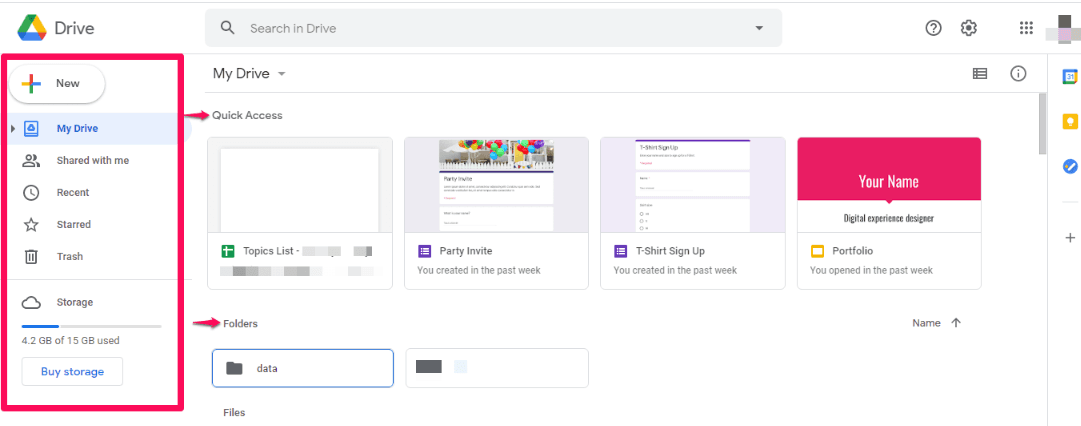
File Storage: Drive offers 15 GB of free storage space for your documents, Google photos, and videos. You can upgrade for more space as needed.
File Sharing: Easily share important files with your team or external partners with just a link. You control access levels to ensure the privacy you need.
Real-Time Collaboration: Work simultaneously on documents with your team. See edits happen live, which makes teamwork effortless.
Document Management: Organize your files into folders and subfolders. Use search to quickly find what you need.
Offline Access: Access and edit your files without an internet connection. Changes sync once you're back online.
Version History: Track changes and revert to previous file versions. This helps when you need to undo edits.

Integrations
Google Drive integrates with Google Sheets, Forms, Docs, Gmail, YouTube, Asana, Slack, Trello, Salesforce, and Zoom.
It also has an API that allows for custom integrations and connects with third-party integration tools.

Google Drive Specs
- 2-Factor Authentication: Yes
- API: Yes
- Chat: Yes
- Dashboard: Yes
- Data Export: Yes
- Data Import: Yes
- Document Comparison: Yes
- External Integrations: Yes
- File Sharing: Yes
- File Transfer: Yes
- History/Version Control: Yes
- Multi-User: Yes
- Network Traffic Monitoring: Yes
- Notifications: Yes
- Project Management: Yes


