5 Common Patterns That Cause AI Failures
Adam Horner
Founder of The CTO Playbook

Discover the common causes of AI adoption failures and how technology leaders can improve outcomes through better context, communication, and decision-making.
Key Takeaways
CTO Challenges: CTOs face common AI integration challenges, requiring leadership through significant organizational transformations.
AI Impact: AI changes the scope of engineering work, enhancing decision-making beyond technical problem-solving.
AI Triage Cycle: AI streamlines triage and fix cycles, reducing customer support delays and enhancing team focus.
Usage Risks: Uncontrolled AI tool use can increase data risks; organizations must manage AI policy and oversight.
Small Teams: AI shifts team dynamics, enabling smaller teams to work efficiently with AI-assisted development.
Adam Horner has built engineering teams across fintech and enterprise software. He is now the founder of The CTO Playbook, where he educates and works as a fractional CTO.
We sat down with him to learn what patterns he's seeing beneath the successes and failures in AI integration. Here's what he told us.
Some version of the same challenge
I'm Adam Horner, CTO coach and fractional CTO at The CTO Playbook. I spent the earlier part of my career as an engineer and cofounding CTO, building and leading engineering teams across fintech and enterprise software, including several years at Palantir as one of their first UK hires.
The move into coaching came from a simple observation: Becoming an effective technology executive is genuinely hard, and most people navigate it without a roadmap or anyone in their corner who's been through it. That's the work I do now, helping CTOs cross what I call the CTO chasm.
The AI angle, for me, isn't a separate thread. It runs through almost every coaching conversation I have, because every CTO I work with is navigating some version of the same challenge: How do you lead an organization through a transformation of this magnitude, at your specific stage, with your specific team, and come out of it a stronger business?
More Articles
The Messy Middle of the Growth Curve

My own organization is small and deliberately lean, a founding team of four building entirely AI-first, where we are using that experience to stay close to the realities of early-stage product development. I also work as a fractional CTO with a pre-accreditation fintech startup, navigating the particular pressures of getting a regulated product to market with an external build team.
But the broader picture, and where the real depth of organizational exposure comes from, is the CTOs I coach. That ranges from founding teams and early bootstrapped startups through high-growth VC and PE-backed scaleups, into mid-size businesses managing real organizational complexity, and up to multi-department enterprises operating at scale.
The messy middle of the growth curve is where I spend most of my time, and it is where the leadership challenges tend to be sharpest.
How AI Allows Engineers to Look at the Bigger Picture
For me, the most significant change hasn't been a tool or a process; it has been an expectation. As a leader, when you give the team permission — and more importantly, the obligation — to reassess the entire delivery lifecycle from the ground up, the scope of that reassessment matters. Not just how code gets written or deployed, but everything the delivery process touches: customer support, user value, and the business intent sitting behind any given piece of work.
When the cost of writing and maintaining code was high, keeping engineers focused tightly on the technical problem made a certain kind of sense. But that cost has collapsed. The limiting factor is no longer how fast you can build; it is how clearly everyone involved understands what is actually worth building and why.
Engineers who understand the product, the customer, and the business goals behind a change can make decisions and move in ways that simply weren't possible before. What improved was not a metric. It was the quality of the questions that the team started asking before writing a single line.

Adam's Thoughts
The limiting factor is no longer how fast you can build; it is how clearly everyone involved understands what is actually worth building and why.
How Triage and Fix Cycles Can Be Collapsed With AI
One example involved rethinking how customer support and engineering interacted around confirmed bugs. Previously, triage and fix cycles were measured in days or weeks, with support teams managing frustrated customers throughout and engineers absorbing the distraction cost of live issues alongside their other work. When the delivery lifecycle was reassessed with AI-assisted development in the picture, fix cycles compressed dramatically, and much of the process became automated.
It put more work on the support function upfront, capturing and categorizing issues clearly, but the payoff was resolution in hours rather than days. Engineers stayed focused. Customers got answers faster. The interface between two functions that had always just been accepted as slow turned out to be entirely renegotiable.
Why Organizations Should Not Throw AI at Everything
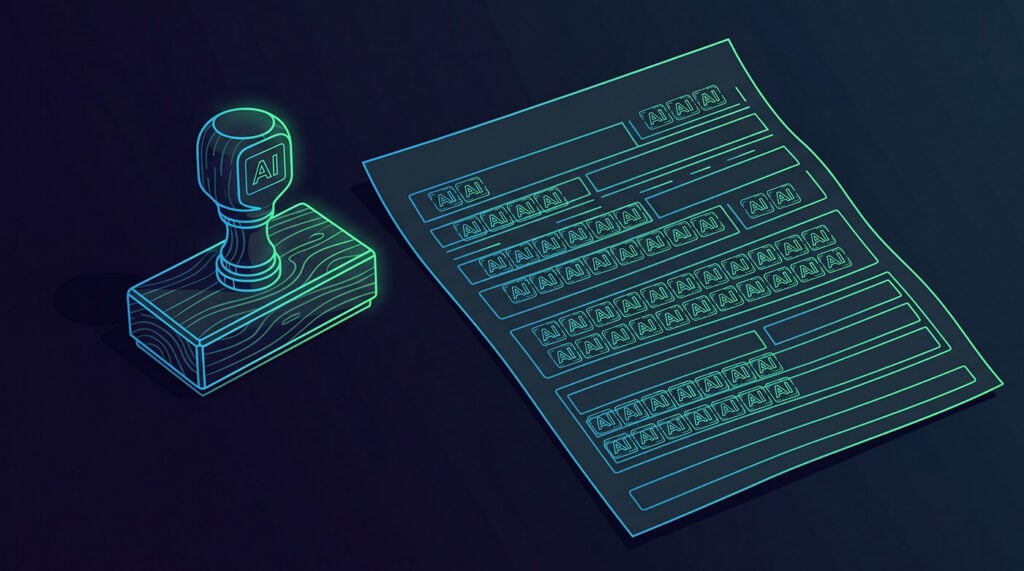
As for what should be a human task vs an AI task, it's different for every organization. The right starting point is not a list of activities but a clear understanding of where your value lives and where your risk is concentrated.
The parts of the process that are core to what the business does — the logic, the differentiation, the areas where failure is visible or expensive — warrant human generation and human oversight. Everything else sits on a spectrum.
A cybersecurity company will put significant human attention into the security properties of their code, because that is the business. A workflow automation company may focus that same scrutiny on the decision-making logic inside a critical workflow, while treating security tooling as something AI can handle adequately.
What is wrong is applying a blanket policy in either direction. The question to ask is not "Can AI do this?" It is "What is the cost if this goes wrong?"
And here's another thing: A surprising amount of the complexity people want to automate is actually unresolved process debt. Sort that first. It will make adopting AI cleaner and cheaper later.
Adam Shares
The right starting point is not a list of activities but a clear understanding of where your value lives and where your risk is concentrated.
Why CTOs Must start By Automating Delivery, Not Code
It's genuinely difficult to compare AI outcomes across organizations because most leaders, in technology and in the wider business, are still struggling to measure the impact and ROI of their AI investments clearly. Without that, it is hard to know what good actually looks like, and harder still to make the case for doing more of it.
But overall, the range of AI outcomes is wide. At one end, I've worked with organizations that have effectively eliminated their backlog and now work directly against customer value and business intent, which represents a fundamental change in how engineering relates to the rest of the business.
I noticed a common pattern in the organizations that achieved this: None of them started at the left-hand side of the software development lifecycle. They didn't begin with code generation. They started at the right: CI/CD pipelines, deployment confidence, automated code review. Getting the delivery end of the process robust and trustworthy first is what created the conditions for everything else. From there, the focus shifted to tests, constraints, and checks before generation, and to structure over speed.
The teams that made the most progress were the ones operating most autonomously, not because they had removed human judgment but because they had encoded enough of it into their process that they could take on significantly larger chunks of work with confidence. The backlog didn't disappear because they wrote code faster. It disappeared because the entire relationship between intent and delivery became unambiguous.
At the other end, I've seen real staff attrition driven by the growing gap between those moving quickly with AI and those who aren't. When AI adoption begins, there is almost always a small group who move fast and a larger group who don't, and the natural instinct is to let the fast movers run. What that creates, quietly and quickly, is friction, distrust, and suspicion between teams that erodes the gains faster than the early progress can accumulate them. The advice I now give at the start of every engagement is the same: don't leave anybody behind. The pace of adoption should be set by how fast you can bring the whole organization with you, not by how fast your most enthusiastic engineers can move individually.
A two-speed organisation feels like progress from the front. From the back, it feels like being left behind, and that feeling has consequences.
When AI adoption begins, there is almost always a small group who move fast and a larger group who don’t, and the natural instinct is to let the fast movers run. What that creates, quietly and quickly, is friction, distrust, and suspicion between teams that erodes the gains faster than the early progress can accumulate them.
Why an Organization's Knowledge Base Must Be Redesigned for AI
The clearest gap I've seen in AI's abilities is in decision-making under uncertainty.
AI is fundamentally a prediction engine, and prediction is not the same as judgment. It has no skin in the game, no sense of consequence, no ownership of the outcome. Expecting it to make decisions on your behalf will only ever be as good as its ability to predict, which in genuinely uncertain or novel situations is limited. The organizations that have been most disappointed by AI are usually the ones that leaned on it in exactly those moments.
The other area where impact falls short, more quietly but just as significantly, is where the implications of context windows are poorly understood. Feed an AI incomplete or poorly structured context, and it will still give you a confident answer. Knowing the difference between a well-informed output and a plausible-sounding one requires human judgment that not enough teams have developed yet.
Because of this, an organization's knowledge base is critical. By that, I mean all of the context that currently lives in people's heads: the way things have always been done, the default approaches, the unwritten rules of how the organization actually operates. AI cannot work with institutional knowledge that has never been externalized, and most organizations are sitting on an enormous amount of it.
The good news is that getting it out doesn't require it to be perfectly structured. Multi-modal AI means a video walkthrough, a rough diagram, and an unedited document are all meaningful input. The priority is externalization first, structure second.
What I consistently find is that the act of getting this context out of people's heads and into any form of documentation is valuable in itself, before AI touches it at all. It surfaces discrepancies, exposes poor assumptions, and reveals broken workflows that nobody had noticed because they were too embedded in them.
That foundation then multiplies everything AI can do afterwards. It is one of the highest-leverage things a CTO can invest time in right now, and one of the most consistently overlooked, despite the fact that Business Process Automation salespeople have been telling us this for years!
How to Prevent Skeptical Developers From Slowing an Organization Down

A common problem I see isn't really a failure of AI. It is a failure of adoption, and it tends to follow a recognizable pattern.
A skeptical developer — and there is a surprisingly large number of them — makes a half-hearted attempt with minimal context, gets a poor result, and presents that result as evidence that AI can't do the job. The conclusion is stated with confidence. The methodology is rarely examined. What makes this more than just an individual frustration is the downstream effect.
AI integration into a team or a development lifecycle is a team sport, and a few engineers who are motivated to demonstrate that it doesn't work can slow the whole organization down, not just their own output.
The lesson I draw from this isn't about AI's limitations. It is that adoption is a leadership challenge as much as a technical one. The quality of what AI produces is inseparable from the quality of the context and intent you bring to it, and building that understanding across a team requires the same deliberate effort as any other significant change to how people work. That's how we move the perception from flawed "magic" to usable "advanced technology."
Adam Shares
A skeptical developer makes a half-hearted attempt with minimal context, gets a poor result, and presents that result as evidence that AI can’t do the job. The conclusion is stated with confidence. The methodology is rarely examined.
Why Small Teams Are an Advantage With AI
The assumption that a functioning, productive engineering team needed a certain headcount to carry enough context and move at a meaningful pace has not survived contact with how AI-assisted development actually works.
The limiting factor in any team has always been cognitive: how much context each person can hold, how clearly they can communicate it to the people around them, and how much energy that communication consumes. What has changed is that the unit doing the work is no longer just a person. Each person on the team is running multiple agents, and those agents carry and apply context in ways that change the arithmetic entirely. Amazon's two-pizza rule was a reasonable heuristic for a pre-AI world.
Here's an example.
One organization I work with had always wanted an internal administration interface for their platform, but could never justify the investment. They had previously costed it as a multi-month, full-team effort. Instead, they put two people on it: Both with deep knowledge of the business and the existing platform, high autonomy, and a clear set of constraints to work within. Six weeks later, they had a working first version.
The business familiarity of those two people turned out to be as important as the AI tooling. Fewer questions, less overhead, faster decisions. But the more valuable outcome wasn't the tool itself. It was what the organization learned about how to work this way.
The teams I'm seeing operate most effectively now are between two and three people, each running multiple agents, and that is not a constraint. For the right kind of work, it is an advantage.
Why Frequent Communication Is Critical With AI-Powered Workflows
Collaboration can become difficult with AI.
Much more frequent communication is needed because everything moves faster. It is one of the reasons why smaller teams work better as it stands at the moment.
It seems to be just too exhausting to maintain state and consistency with a large team and multiple parallel agentic coding processes per person. Some teams I work with have switched to two standups per day to maintain consistency.
Why CTOs Must Watch for Shadow AI
Shadow AI is the previously observed problem of shadow IT with a new budget and a new name.
Uncontrolled and unconstrained usage of AI tools across the enterprise can easily increase the risks of data and IP loss — "exfiltration" as the CISO calls it — often entirely unintentionally by the users.
Most organizations are rapidly moving out of stage 1 on the CMM (the "wild west" experimentation phase) to put in place policies and technical constraints to reduce the risks.
Why CTOs Must Focus on Their Own Development
Adam's Thoughts
The leaders who will come out of this period strongest are not necessarily the ones with the best tools or the biggest teams. They are the ones who are building the judgment, the influence, and the clarity of thinking to lead well when nobody has a clear map.
There is a lot of anxiety in the industry right now about what AI means for engineering teams, for headcount, for the role itself.
Whether that anxiety is justified is almost beside the point. What matters is that we are in a period of significant and rapid change, and navigating it well requires leaders who are actively developing their own capabilities, not just managing the change around them.
What still surprises me, given everything that is happening, is how many CTOs and senior technology leaders are operating without any dedicated investment in their own growth. No coach, no structured development, no thinking partner. I made that mistake once before, and the mistakes I made and the time I lost were not inevitable.
The leaders who will come out of this period strongest are not necessarily the ones with the best tools or the biggest teams. They are the ones who are building the judgment, the influence, and the clarity of thinking to lead well when nobody has a clear map.
Follow Along
You can follow Adam Horner's work on LinkedIn. For 1:1 coaching, cohort courses, and the podcast, go to The CTO Playbook. And for a free 5-day email course for early-stage CTOs, head to Early CTO Map.
More expert interviews to come on The CTO Club!