

O platformă pentru agenți AI este un software care vă ajută să creați, să implementați și să gestionați echipe de agenți bazați pe AI pentru a automatiza și coordona procese de afaceri complexe la scară largă. Dacă comparați cele mai bune platforme pentru agenți AI, probabil că trebuie să coordonați totul, de la experiența clienților până la operațiunile IT, fără să pierdeți controlul, flexibilitatea sau conformitatea. În acest ghid, explic modul în care soluțiile de top acceptă fluxuri de lucru cu mai mulți agenți, guvernanța și automatizarea, astfel încât să găsiți o platformă potrivită atât pentru infrastructura tehnică, cât și pentru cerințele operaționale.
Why Trust Our Software Recommendations
6,700+
Reviews
20
Industry experts
16+
Evaluation factors
14
Years
Our team has been testing and reviewing software since 2012. As tech leaders ourselves, we know how difficult—and important—it is to choose the right software.
For this guide, we evaluated tools using hands-on testing and independent research, scoring tools using our selection criteria.
Our reviews reflect our human editorial judgment, not a sales pitch.
Expert reviewers:
- Paulo Gardini MiguelTech Director
 Tim FisherVP of AI
 Gabriel RosasTech Lead & Software Architect
 Christhian GruhnTech Lead & Platform Architect

Tabel comparativ al platformelor pentru agenți AI
Acest tabel comparativ sintetizează detaliile de preț pentru selecțiile mele principale de platforme pentru agenți AI:
Score legend (out of 5)
- Excellent4.5–5
- Good4–4.4
- Average3–3.9
- Below average2–2.9
- Poor1–1.9
Sorted by: Default
| Tool | Starting Price | Website | ||||||||||||
|---|---|---|---|---|---|---|---|---|---|---|---|---|---|---|
Best for guarded DevOps infrastructure agents | Not rated | 5 | 3 | 2 | 4 | 4 | 4 | Not rated | Not rated | Not rated | Not rated | Not rated | $3,500/month Free demo available | Website |
Best for RPA-plus-agent automation in enterprise | Not rated | Not rated | Not rated | Not rated | Not rated | 4 | Not rated | 5 | 5 | 5 | 5 | 5 | $25/month Free plan available | Website |
Best for self-hosted multi-agent automation | Not rated | Not rated | Not rated | Not rated | Not rated | 4 | Not rated | 5 | 5 | 5 | 5 | 5 | €20/month Free trial available | Website |
Best for enterprise multi-agent IT automation | Not rated | Not rated | Not rated | Not rated | Not rated | 4 | Not rated | 5 | 5 | 5 | 5 | 5 | Pricing upon request Free plan available | Website |
Best for governing agents across the enterprise | Not rated | Not rated | Not rated | Not rated | Not rated | 4 | Not rated | 5 | 5 | 5 | 5 | 5 | Pricing upon request 14-day free trial | Website |
Best for graph-based multi-agent orchestration | Not rated | Not rated | Not rated | Not rated | Not rated | 5 | Not rated | 5 | 5 | 5 | 5 | 5 | $39/user/month Free plan + free trial + free demo available | Website |
Best for no-code multi-agent workforce builds | Not rated | Not rated | Not rated | Not rated | Not rated | 5 | Not rated | 4 | 5 | 5 | 5 | 5 | Pricing upon request Free demo available | Website |
Best for Python-native multi-agent collaboration | Not rated | Not rated | Not rated | Not rated | Not rated | 5 | Not rated | 5 | 5 | 5 | 5 | 5 | Pricing upon request Free plan + free trial available | Website |
Best for Microsoft-native multi-agent deployments | Not rated | Not rated | Not rated | Not rated | Not rated | 5 | Not rated | 5 | 5 | 5 | 5 | 5 | $0.165 per 1M input tokens 30-day free trial available | Website |
Best for multi-agent orchestration on Google Cloud | Not rated | Not rated | Not rated | Not rated | Not rated | 5 | Not rated | 5 | 5 | 5 | 5 | 5 | Pricing upon request Free demo available | Website |


Recenzii ale platformelor pentru agenți AI
Mai jos sunt rezumatele mele detaliate ale celor mai bune platforme pentru agenți AI care au ajuns pe lista mea scurtă. Recenziile mele oferă o privire detaliată asupra funcțiilor, celor mai bune cazuri de utilizare și capabilităților fiecărei platforme, pentru a vă ajuta să o găsiți pe cea mai potrivită pentru dumneavoastră.
 Best for guarded DevOps infrastructure agents
- Free demo available
- From $3,500/month
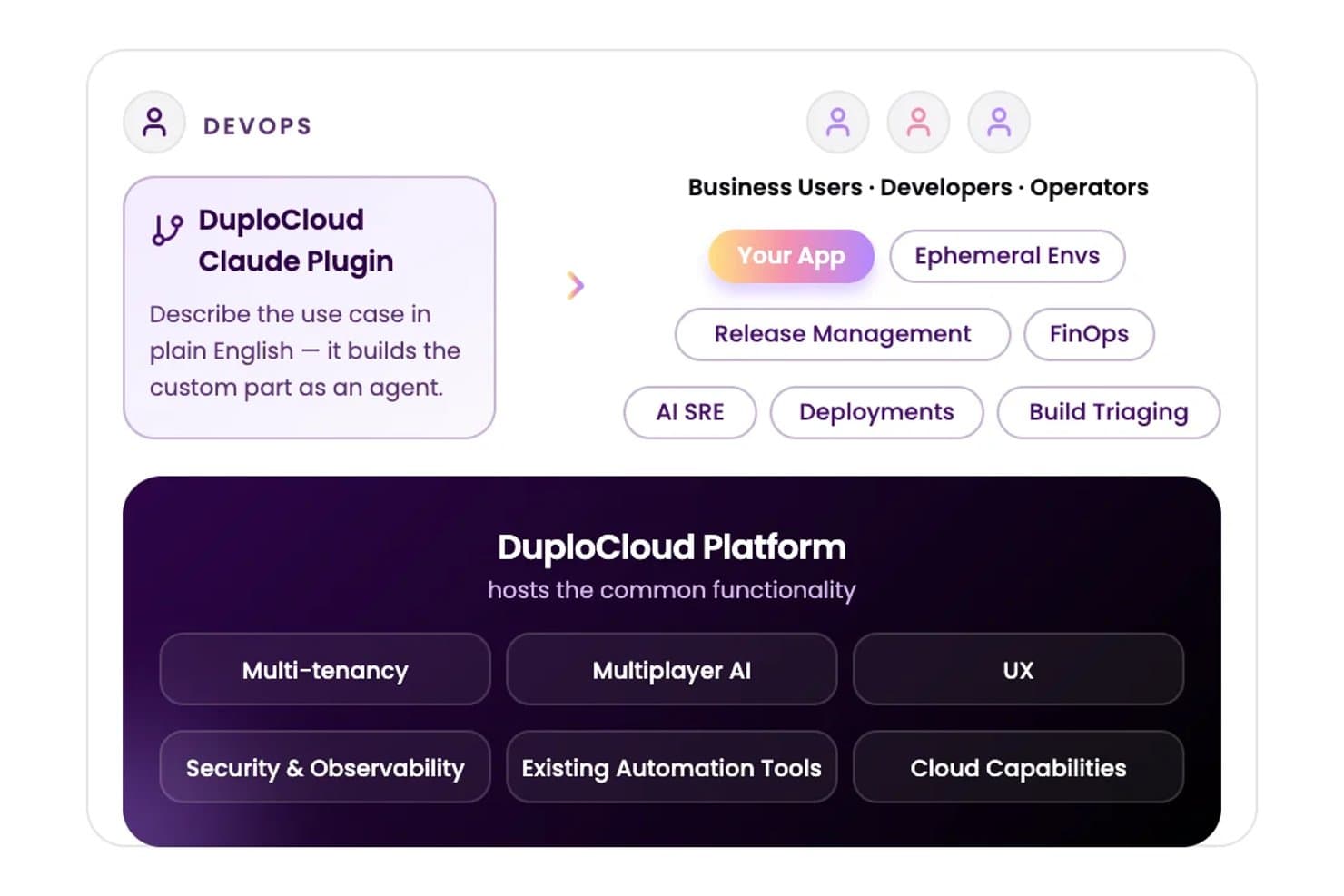
DuploCloud lets users build AI agent workflows via plain English descriptions. DuploCloud is an agentic DevOps platform that combines AI-powered infrastructure automation, Kubernetes and multi-cloud management, CI/CD orchestration, and built-in security and compliance workflows.
Who Is DuploCloud Best For?
DuploCloud is a strong fit for DevOps and platform engineering teams that need AI-driven infrastructure automation across Kubernetes and multi-cloud environments with built-in compliance guardrails.
Why I Picked DuploCloud
I picked DuploCloud as one of the best because its guardrails aren't bolted on as an afterthought—they're built into every layer of how agents act. Every infrastructure change requires human approval before execution, MCP tool calls gate individually with no "always allow" bypass, and shell commands run against approve/reject patterns so nothing slips through unchecked. I especially like that the built-in DevOps agent handles the full Kubernetes and cloud lifecycle, from provisioning to drift detection and security remediation, within that same governed framework.
DuploCloud Key Features
- Multi-cloud infrastructure agent: A built-in DevOps agent provisions and manages resources across AWS, GCP, and Azure, including VPCs, Kubernetes clusters, RDS, and load balancers.
- Workspace-scoped memory and knowledge base: Each workspace maintains persistent context across tickets, with support for ingesting PDF, Office, HTML, and text files up to 2 GB for agent search during conversations.
- Model router: Routes agent execution across Claude, OpenAI, Gemini, and open-source models, with model selection configurable at the project, workspace, or platform level.
- Token and spend quota controls: Administrators can set USD-denominated spend limits at the workspace, project, ticket, user, or platform scope to cap LLM costs.
DuploCloud Integrations
DuploCloud integrates with GitHub, GitLab, CircleCI, Terraform, Kubernetes, AWS, Google Cloud, Microsoft Azure, Datadog, and Prometheus. It supports REST APIs, MCP connections, and workflows through Jira and Slack.
Pros and Cons
Pros:
- Built-in compliance controls support safer operations
- Human approvals gate infrastructure changes
- Self-service cuts infrastructure wait times
Cons:
- Cloud-native feature updates can lag
- No documented autonomous agent-to-agent delegation
Learn more about DuploCloud: Best for RPA-plus-agent automation in enterprise
- Free plan available
- From $25/month
Visit WebsiteCustomer Rating:4.6/5
UiPath lets users build AI agent orchestration flows visually. UiPath is an agentic automation platform that combines RPA robots, multi-agent orchestration, LLM integration, and human-in-the-loop controls to automate complex, multi-step enterprise workflows.
Who Is UiPath Best For?
UiPath is a strong fit for enterprise IT and automation engineering teams managing complex, multi-system workflows that mix legacy infrastructure with modern AI agents.
Why I Picked UiPath
UiPath earns its spot on my shortlist because no other platform in this category converges RPA robots and AI agents the way it does. I love that Maestro orchestrates agents, robots, and human approvals within a single BPMN workflow, so your team can automate across both modern APIs and legacy systems that have no APIs at all. Agent Builder lets you configure multi-agent logic visually or in code, while the AI Trust Layer governs every LLM call across providers like Azure OpenAI, Anthropic, and AWS Bedrock from one centralized policy layer.
UiPath Key Features
- Context Grounding: Retrieves information from permissioned, access-controlled knowledge bases using vector databases like FAISS and Pinecone for RAG-style workflows.
- Action Center HITL controls: Pauses agent execution at defined checkpoints so human reviewers can approve, reject, or redirect decisions before high-risk actions proceed.
- MCP-native tool integration: Connects agents to external systems through four MCP integration types in Orchestrator, covering pre-built, coded, command-based, and remote server options.
- Maestro Case Management: Models complex, adaptive workflows with stages, SLA tracking, escalation rules, and exception handling across agents, robots, and human participants.
UiPath Integrations
UiPath offers native integrations with Azure OpenAI, Anthropic, Google Vertex AI, AWS Bedrock, Snowflake, Databricks, Salesforce, and CyberArk. An API is available for custom integrations.
Pros and Cons
Pros:
- Integrates agentic automation with legacy systems
- Advanced audit trails and governance features
- Orchestrates agents, robots, and humans together
Cons:
- Limited independent container deployment
- Needs significant hardware resources
Learn more about UiPath: 3Best for self-hosted multi-agent automation
n8n
- Free trial available
- From €20/month (billed annually)
Visit WebsiteCustomer Rating:4.7/5
n8n lets users build AI agent workflows with tools, memory, and branching logic. n8n is an open-source AI agent platform that combines a visual workflow canvas with embedded JavaScript and Python support to build, orchestrate, and deploy single-agent and multi-agent automation pipelines.
Who Is n8n Best For?
n8n is a strong fit for DevOps and IT engineering teams that need full control over their infrastructure and want to run AI agent workflows on their own servers.
Why I Picked n8n
I've included n8n in my top picks because it's the only tool on this list where you can run the entire agent runtime on your own infrastructure, including air-gapped environments, with no data leaving your network. I particularly like the supervisor/worker multi-agent architecture, which lets you build hierarchical pipelines where a coordinating agent delegates tasks to specialized sub-agents for research, QA, or execution. The built-in human-in-the-loop approval gates are also a genuine differentiator, letting you embed manual checkpoints before any high-risk agent action runs.
n8n Key Features
- Model-agnostic LLM routing: Connect multiple LLM providers—OpenAI, Anthropic, Gemini, and self-hosted models—within a single workflow and route tasks to different models based on logic you define.
- AI Evaluations framework: Run pre-deployment regression tests on agent workflows using real data to track correctness, token usage, and response quality before pushing changes to production.
- Git-based version control: Manage workflow definitions as code with full version history, staging and production environment separation, and side-by-side workflow diffs for auditable change management.
- Vector database integration: Connect natively to Pinecone, Qdrant, Weaviate, and other vector stores to build RAG pipelines that let agents query internal knowledge bases, documents, and wikis.
n8n Integrations
n8n offers 500+ native integration nodes, including OpenAI, Anthropic, Google Gemini, Pinecone, Qdrant, Weaviate, Salesforce, HubSpot, Slack, and GitHub. An API is available for custom integrations.
Pros and Cons
Pros:
- Manages vector database queries
- Commits workflow versions directly
- Fully self-hosted in air-gapped environments
Cons:
- Workflow editor lacks auto-save functionality
- Visual canvas gets cluttered on large workflows
Learn more about n8n: Best for enterprise multi-agent IT automation
- Free plan available
- Pricing upon request
Visit WebsiteCustomer Rating:4.6/5
Kore.ai lets users build and validate multi-agent AI workflows visually. Kore.ai is an enterprise AI agent platform that lets you build, orchestrate, and govern multi-agent systems using a visual studio, a compiled declarative agent language, and an AI-generated agent architect.
Who Is Kore.ai Best For?
Kore.ai is a strong fit for large enterprises in regulated industries—banking, healthcare, insurance, and government—that need to deploy multi-agent IT automation with strict compliance and governance requirements.
Why I Picked Kore.ai
I picked Kore.ai as one of the best because it's built specifically for the kind of multi-agent IT automation that large enterprises actually need—think coordinating ServiceNow ticket resolution, BMC Helix alerts, and Jira updates across a single workflow without manual handoffs. I'm particularly impressed by its six natively compiled orchestration patterns, which let you run supervisor, fan-out, and delegation logic as first-class constructs rather than workarounds. The engine-enforced guardrails and FedRAMP Moderate authorization make it the right call for regulated environments where governance isn't optional.
Kore.ai Key Features
- Agent Blueprint Language (ABL): A compiled, declarative DSL that lets you define agent goals, tools, memory, and guardrail logic as Git-native YAML artifacts with full CI/CD pipeline support.
- Model Hub: A model-agnostic routing layer that supports OpenAI, Anthropic, Cohere, NVIDIA, Meta LLaMA 2, Hugging Face open-source models, and bring-your-own-model configurations.
- Auto Loop™: A continuous optimization engine that monitors production agent outcomes and auto-tunes prompts, tools, and workflows without manual re-engineering cycles.
- Agent Evals: An automated testing framework that runs multi-scenario quality and safety evaluations with regression tracking integrated directly into deployment pipelines.
Kore.ai Integrations
Kore.ai offers native integrations with ServiceNow, BMC Helix, Jira, Ivanti, Salesforce, SAP, Workday, ADP, Slack, and Microsoft Teams. An API is available for custom integrations.
Pros and Cons
Pros:
- CI/CD-native agent versioning with full audit trails
- Recompiles execution paths automatically
- Agent orchestration patterns are natively compiled
Cons:
- Knowledge base refresh is not fully automatic
- Steep platform engineering requirements for advanced use
Learn more about Kore.ai: Best for governing agents across the enterprise
- 14-day free trial
- Pricing upon request
Visit WebsiteCustomer Rating:4.6/5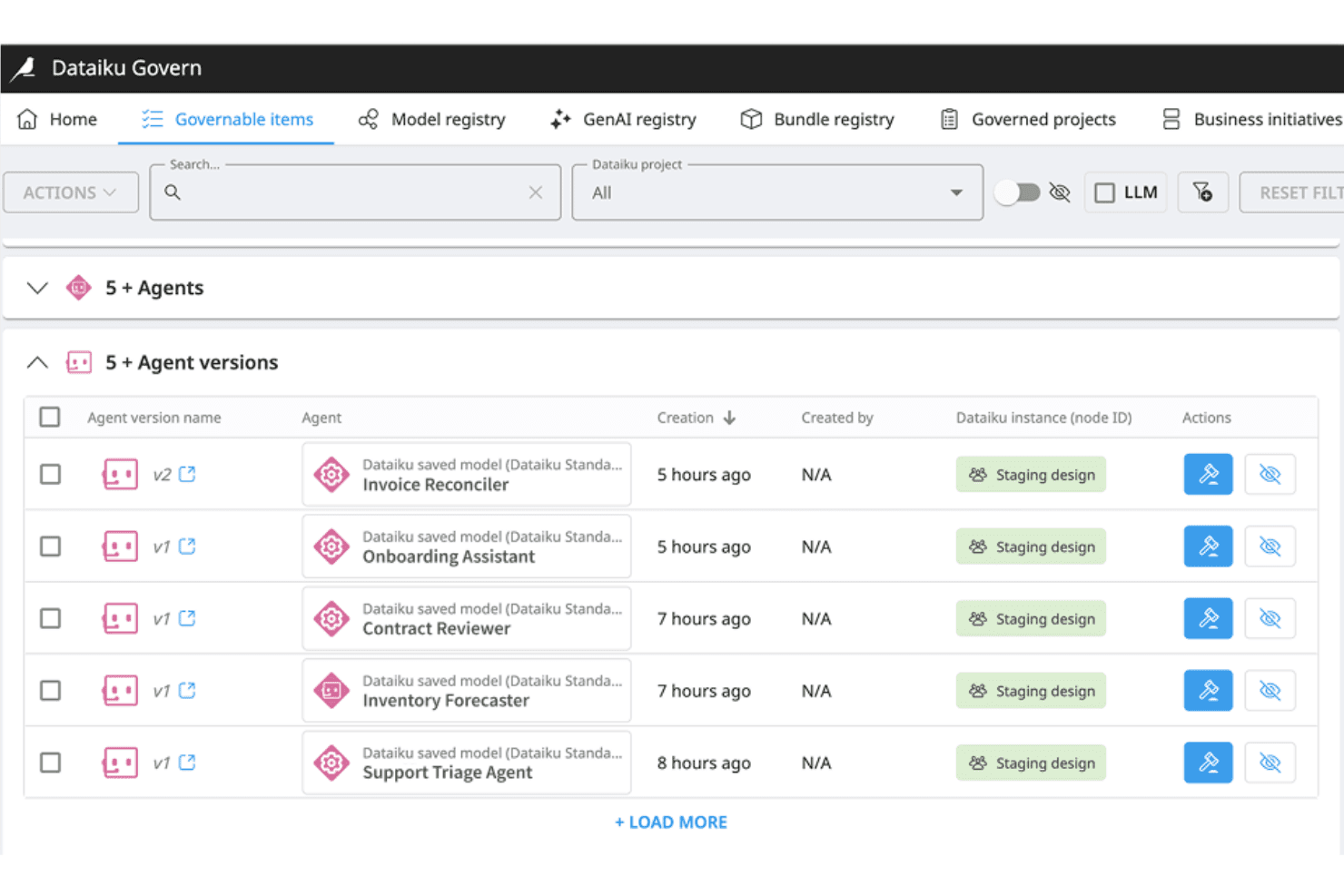
Dataiku Govern tracks AI agent versions across staging environments. Dataiku is an enterprise AI agent platform that combines visual and code-based agent building, multi-agent orchestration, model-agnostic LLM routing, and built-in governance tools including guardrails, approval workflows, and audit trails.
Who Is Dataiku Best For?
Dataiku is a strong fit for large enterprises that need to build, deploy, and govern AI agents across multiple teams, platforms, and compliance requirements from a single platform.
Why I Picked Dataiku
Dataiku earns its spot on my shortlist because no other platform matches its depth of built-in governance across the full agent lifecycle. I particularly like the LLM Guard Services layer, which combines Cost Guard, Safe Guard, and Quality Guard to enforce budget limits, detect PII, and block prompt injection before agents ever reach production. Pair that with Dataiku Govern's approval workflows and audit trails, and you have end-to-end oversight that most agent frameworks can't replicate natively.
Dataiku Key Features
- LLM Mesh routing: A model-agnostic gateway that connects to 10+ LLM providers—including OpenAI, Anthropic, and Mistral—with dynamic routing, response caching, and cost tracking built in.
- Visual and code agent builder: Dual-path agent creation lets non-technical users build agents with a no-code visual flow builder while engineers write full-code agents using the SDK.
- ReAct loop execution: Simple Visual Agents apply a native Reason-and-Act loop, autonomously selecting tools, executing actions, observing results, and iterating until task completion.
- Agent Run Inspector: A step-by-step debugging interface that surfaces warnings and errors at each stage of an agent's execution for diagnosing unexpected behaviour.
Dataiku Integrations
Dataiku offers native integrations with OpenAI, Anthropic, Mistral, AWS Bedrock, Azure OpenAI, Databricks, Snowflake Cortex, Salesforce, ServiceNow, and Jira, plus Slack and Microsoft Teams for agent deployment. It also supports Model Context Protocol (MCP) servers and OpenAPI for custom tool and API connections.
Pros and Cons
Pros:
- Centralized observability for multi-platform agents
- Built-in LLM guardrails and approval workflows
- Visual and code agents in one platform
Cons:
- UI can be clunky for complex workflows
- Agent management module not yet available
Learn more about Dataiku: Best for graph-based multi-agent orchestration
- Free plan + free trial + free demo available
- From $39/user/month
Visit WebsiteCustomer Rating:4.4/5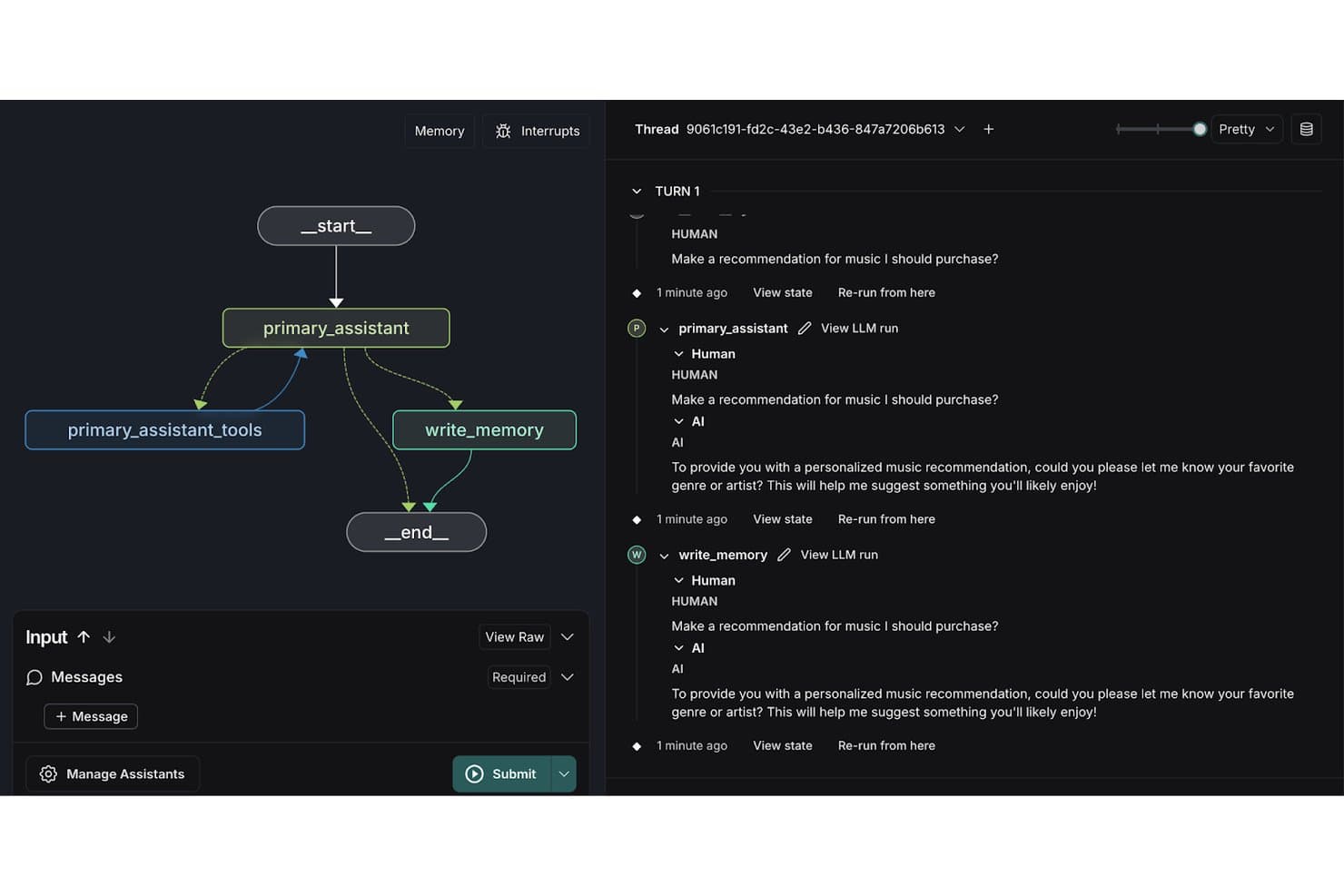
LangChain LangGraph visualizes agent workflows with memory and tool nodes. LangChain LangGraph is a graph-based AI agent framework that supports stateful, multi-step agent workflows, multi-agent orchestration, human-in-the-loop controls, and long-term memory management across Python and JavaScript/TypeScript environments.
Who Is LangChain LangGraph Best For?
LangChain LangGraph is a strong fit for engineering teams building complex, stateful AI agents that require fine-grained control over multi-step workflows and multi-agent coordination.
Why I Picked LangChain LangGraph
LangChain LangGraph earns its spot on my shortlist because its
StateGraphmodel gives you explicit, node-by-node control over how agents think, branch, retry, and loop—something linear chain-based frameworks simply can't replicate. I particularly like its supervisor/worker architecture for multi-agent orchestration, where a top-level agent decomposes tasks and delegates to specialized subagents running in parallel. Built-in checkpointing at every graph node means long-running agents can pause for human approval, resume after a failure, or rewind to any prior state for debugging.LangChain LangGraph Key Features
- LangSmith tracing: Captures distributed traces of every agent step, LLM call, and tool invocation so you can inspect exactly what happened inside a running agent.
- Human-in-the-loop interrupt gates: Pauses agent execution at defined graph nodes to request human approval or input before proceeding to the next step.
- Long-term memory store: Persists agent state and conversation context across sessions using a built-in memory store with semantic search support.
- LangGraph Studio: A visual IDE for inspecting, debugging, and iterating on agent execution graphs in real time during development.
LangChain LangGraph Integrations
LangChain LangGraph offers native integrations with OpenAI, Anthropic, Google Gemini, Mistral, Pinecone, Weaviate, Chroma, pgvector, PostgreSQL, and Redis. An API is available for custom integrations.
Pros and Cons
Pros:
- First-class human-in-the-loop interrupt gates
- Stores semantic historical interactions
- Fine-grained control over agent workflows
Cons:
- High scaling can trigger memory issues
- Predefined static graph state design is required
Learn more about LangChain LangGraph: Best for no-code multi-agent workforce builds
- Free demo available
- Pricing upon request
Visit WebsiteCustomer Rating:4.3/5
Relevance AI lets users build and manage AI agents from one dashboard. Relevance AI is an AI agent platform built around a visual multi-agent canvas, letting you design, deploy, and govern autonomous agent workforces with built-in LLM orchestration, a 2,700+ integration library, hybrid RAG memory, and a native eval and observability system.
Who Is Relevance AI Best For?
Relevance AI is a strong fit for operations and automation teams that need to deploy multi-agent workflows without writing infrastructure code from scratch.
Why I Picked Relevance AI
I picked Relevance AI as one of the best because the visual Workflows canvas lets you assemble entire multi-agent pipelines without writing a line of infrastructure code. You can connect specialist agents with defined handoffs, parallel execution streams, and built-in approval gates, all from a drag-and-drop interface. I also love that every agent ships with an auto-generated eval suite that scores live production runs and blocks failing versions from deploying.
Relevance AI Key Features
- Hybrid RAG memory: Connect agents to internal knowledge bases with semantic search, auto-syncing with Google Drive, SharePoint, Notion, and Confluence.
- Sandboxed code execution: Run Python and JavaScript natively within agent tool steps in an isolated sandbox environment.
- LLM routing: Route tasks across multiple providers—including Anthropic, OpenAI, and Google—with fallback models and per-task cost-optimized model selection.
- Human-in-the-loop approval gates: Pause agent execution at configurable checkpoints for human sign-off before high-stakes actions proceed.
Relevance AI Integrations
Relevance AI offers native integrations with Salesforce, HubSpot, Slack, Google Drive, SharePoint, Notion, Confluence, GitHub, Snowflake, and DataDog. An API is available for custom integrations.
Pros and Cons
Pros:
- Embeds secure script execution spaces
- Integrated evaluation gates and agent versioning
- Visual workforce canvas for multi-agent workflows
Cons:
- No self-hosted or on-premises deployment option
- GTM and sales templates dominate use cases
Learn more about Relevance AI: Best for Python-native multi-agent collaboration
- Free plan + free trial available
- Pricing upon request
Visit WebsiteCustomer Rating:4.2/5
CrewAI lets users build AI automations from natural language descriptions. CrewAI is a Python-native AI agent platform that lets you build, orchestrate, and deploy multi-agent systems using a code-first SDK, a visual studio editor, and a suite of tools for memory management, LLM routing, and workflow automation.
Who Is CrewAI Best For?
CrewAI is a strong fit for engineering teams that need to build and govern multi-agent AI systems in Python, particularly in organizations with compliance or security requirements.
Why I Picked CrewAI
I picked CrewAI as one of the best because it's built Python-first, which means agent definitions, tool bindings, and orchestration logic all live in code your team already versions and reviews. I especially like how it separates Crews (autonomous, role-based agents that delegate tasks between themselves) from Flows (deterministic, event-driven pipelines with conditional branching and typed state), letting you blend both patterns in a single runtime depending on how much autonomy a given workflow needs.
CrewAI Key Features
- LLM routing per agent: Assign a different LLM to each agent in a crew, including a separate model dedicated specifically to tool/function calls.
- Human-in-the-loop gates: The
@human_feedbackdecorator pauses flow execution at defined checkpoints so a human can review, override, or approve before the next step runs. - Enterprise connector repository: Pre-built connectors for Salesforce, Jira, Snowflake, Microsoft 365, Google Workspace, Slack, and Zendesk pipe real system data directly into agent workflows.
- PII redaction at runtime: A governance hook automatically strips personally identifiable information at every LLM and tool call before data leaves your environment.
CrewAI Integrations
CrewAI offers native integrations with Salesforce, HubSpot, Snowflake, Jira, Zendesk, Slack, Gmail, Microsoft 365, Teams, and Google Workspace. An API is available for custom integrations.
Pros and Cons
Pros:
- Per-agent LLM assignment for advanced orchestration
- Hierarchical memory structure with composite scoring
- Native Python SDK with code and visual builder
Cons:
- Complex automation setup requires strong Python skills
- Consumes high local memory
Learn more about CrewAI: Best for Microsoft-native multi-agent deployments
- 30-day free trial available
- From $0.165 per 1M input tokens

Microsoft Foundry lets users build multi-agent sequential workflows visually. Microsoft Foundry is an AI agent platform built on Azure that lets you build, deploy, and orchestrate agents using a 10,000+ model catalogue, multi-agent workflows, and native integrations across the Microsoft ecosystem.
Who Is Microsoft Foundry Best For?
Microsoft Foundry is the right fit for enterprise IT and engineering teams already running on Azure who need to build and orchestrate multi-agent AI workflows across the Microsoft ecosystem.
Why I Picked Microsoft Foundry
Microsoft Foundry earns its spot on my shortlist because of how deeply it's wired into the Azure ecosystem for multi-agent deployments. I love that Connected Agents lets one agent call another as a specialized sub-agent, so you can decompose something like an IT incident response workflow into discrete agents handling detection, diagnosis, and remediation in parallel. The Agent Harness adds planning and to-do tracking on top of that, keeping long-running autonomous runs on course without constant human intervention.
Microsoft Foundry Key Features
- Model benchmark leaderboard: Compare 10,000+ models side by side on quality, latency, throughput, and cost before committing to a deployment.
- PyRIT red teaming: Run automated adversarial simulations against your agents to surface safety and security vulnerabilities before going to production.
- Provisioned Throughput Units (PTUs): Reserve dedicated model processing capacity on a monthly or annual basis for predictable latency on high-volume workloads.
- Per-agent Entra identity: Each hosted agent is automatically assigned its own Microsoft Entra identity, giving you granular access control at the individual agent level.
Microsoft Foundry Integrations
Microsoft Foundry offers native integrations with Microsoft 365, Teams, SharePoint, Fabric, Entra, Cosmos DB, Key Vault, Azure Functions, and GitHub. An API is available for custom integrations.
Pros and Cons
Pros:
- Per-agent Entra identity enables granular access
- MSC/LLM model benchmark leaderboard built in
- Integrated multi-agent orchestration with A2A protocol
Cons:
- Needs proprietary cloud infrastructure
- No built-in disaster recovery for agent state
Learn more about Microsoft Foundry: Best for multi-agent orchestration on Google Cloud
- Free demo available
- Pricing upon request
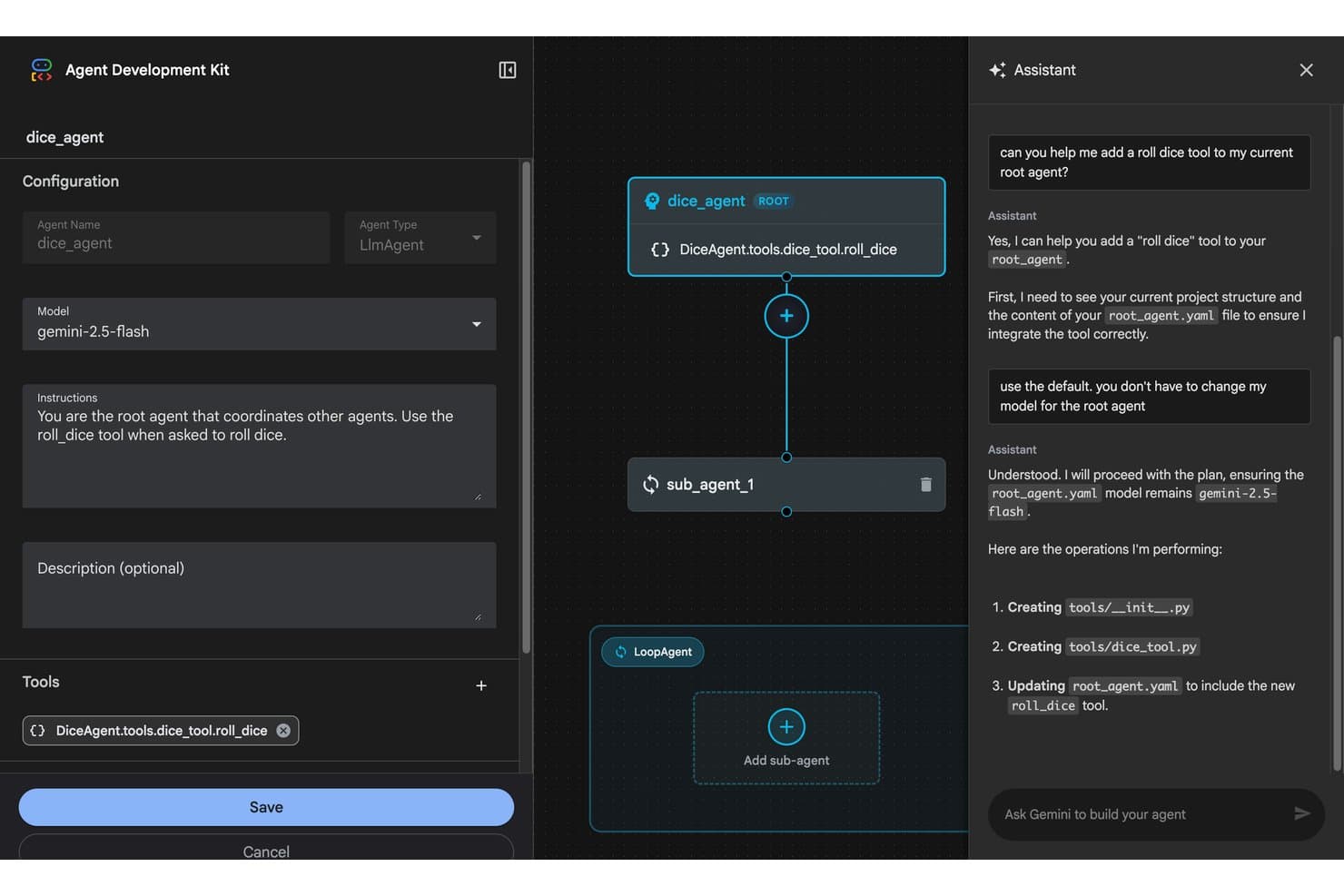
Agent Development Kit (ADK) lets users build agents visually with AI chat assistance. Google ADK is an open-source, code-first AI agent framework with multi-language SDKs (Python, TypeScript, Go, Java, and Kotlin) for building, evaluating, and deploying single agents, multi-agent pipelines, and graph-based workflows with built-in support for MCP, A2A protocol, and sandboxed code execution.
Who Is Agent Development Kit (ADK) Best For?
ADK is a strong fit for engineering teams already running infrastructure on Google Cloud who need to build and orchestrate production-grade multi-agent systems at scale.
Why I Picked Agent Development Kit (ADK)
ADK earns its spot on my shortlist because of how naturally it handles multi-agent orchestration on Google Cloud infrastructure. I love that ADK 2.0 introduced graph-based and collaborative workflow patterns, where a coordinator agent dynamically delegates tasks to specialized sub-agents, letting teams decompose complex IT and DevOps pipelines across purpose-built agents. Per-agent model assignment means each sub-agent runs the right model for its task, and native A2A protocol support lets those agents talk across frameworks without custom plumbing.
Agent Development Kit (ADK) Key Features
- Multi-language SDK support: Build agents in Python, TypeScript, Go, Java, or Kotlin using consistent APIs across all five languages.
- ADK Eval framework: Run test files, evalset, and conformance evaluations with LLM-as-judge scoring, hallucination detection, and automated user simulation for production agent reliability testing.
- Human-in-the-loop controls: Pause and resume agent execution mid-workflow using
RequestedInputevents and tool confirmation flows before high-risk actions execute. - Sandboxed code execution: Run agent-generated code and shell commands in isolated server-side sandboxes via the Code Execution Tool, Daytona integration, or Bash Tool.
Agent Development Kit (ADK) Integrations
Agent Development Kit offers native integrations with Gemini, Claude, BigQuery, Firestore, Datadog, Jira, Confluence, Cloud Run, and GKE. An API is available for custom integrations.
Pros and Cons
Pros:
- Native support for open agent communication protocols
- Interprets local shell commands safely
- Multi-language SDKs for Python, Go, Java, TypeScript, Kotlin
Cons:
- Most production deployments remain Google Cloud-only
- State management in multi-turn agents is complex
Learn more about Agent Development Kit (ADK):
Alte platforme pentru agenți AI
Iată câteva opțiuni suplimentare de platforme pentru agenți AI care nu au ajuns pe lista mea scurtă, dar care merită totuși analizate:
- 11LangChain LangSmithBest for agent observability and eval workflows
- 12NiCE Cognigy.AIBest for enterprise CX agent deployments at scale
- 13Amazon Bedrock AgentCoreBest for AWS-native multi-agent deployments
- 14RasaBest for self-hosted conversational agents
- 15WriterBest for enterprise knowledge-work agent governance
- 16AgentforceBest for Salesforce-native enterprise agent deployment
- 17Microsoft Copilot StudioBest for Microsoft 365-native multi-agent workflows
- 18Botpress StudioBest for visual and code-based multi-agent builds
- 19VellumBest for version-controlled agent evaluation
- 20Sema4.aiBest for back-office agents on Snowflake data
Related Reviews
How I Evaluate AI Agent Platforms
To make this list, a platform has to deliver real, measurable AI value—whether that means autonomously resolving IT incidents, orchestrating multi-step DevOps workflows, or coordinating specialized agents across business functions. I split my evaluation into two layers: core functionality every platform must meet to qualify, and the differentiating factors that separate the best from the rest.
Core Functionality (Table Stakes For This List)
When I'm selecting tools for my list, I rank each one on a scale from 0 (does not offer the functionality) to 5 (excels in this area) for each core functionality listed below. I then calculate the tool's total score as a percentage, using 75% as a benchmark to help assess its overall fit for the list.
- Agent building framework: I evaluate whether a platform offers SDK-based, visual, or hybrid agent design with support for defining roles, goals, and multi-agent hierarchies.
- LLM orchestration: I look for flexibility across model providers, including per-agent model routing and the ability to swap between proprietary and open-source LLMs at runtime.
- Tool and API integration: The connector ecosystem matters here—I check for native integrations, custom function calling, and secure auth handling for enterprise systems like databases and internal APIs.
- Memory and context management: I evaluate how each platform handles short-term and long-term memory, including RAG pipelines, vector store support, and shared context across agents.
- Multi-step reasoning and autonomy: Platforms need to go beyond simple prompt chains. I look for autonomous planning, self-correction loops, and the ability to handle long-running, multi-step tasks without constant human input.
- Agent observability and governance: I check for tracing, evaluation tooling, cost and token tracking, guardrails, and audit controls that let you monitor and govern agent behaviour in production.
Once I have a list of tools that meet the criteria, I consider what sets each platform apart.
Differentiating Factors (What Sets Vendors Apart)
Here's how I compare and contrast different vendors:
Standout Features
I look for human-in-the-loop controls that go beyond simple approval buttons—things like staged escalation workflows and intervention points before high-risk actions like production deployments or database writes. Prompt and agent versioning is equally important; I check whether a platform supports git-style rollback and A/B testing so teams can iterate safely. I also evaluate each platform's evaluation and simulation harness, since replaying production traces against golden datasets before shipping changes catches failures that unit tests miss.
Beyond Features
I evaluate each platform's deployment model and data residency options, since teams in regulated industries need self-hosted or VPC deployments where agent traces and LLM traffic stay within controlled boundaries. Pricing transparency matters just as much—autonomous agents can generate unpredictable compute costs, so I check for built-in token budgets and rate limits that prevent runaway loops in production. I also look at ecosystem maturity, including SDK quality, documentation depth, and community activity, because a platform with strong CI/CD integration and pre-built agent templates gets your team to production faster.
Cum să alegeți o platformă pentru agenți AI
Atunci când alegeți o platformă pentru agenți AI, concentrați-vă asupra priorităților operaționale și a domeniilor în care automatizarea agenților va avea cel mai mare impact asupra afacerii dumneavoastră:
| Dacă prioritatea dumneavoastră este… | Căutați… |
|---|---|
| Dacă prioritatea dumneavoastră este…Vizibilitate completă și conformitate pentru agenți | Căutați…Urmărire, jurnale de audit și versionare |
| Dacă prioritatea dumneavoastră este…Guvernanță la nivelul întregii organizații pentru agenți | Căutați…Politici și control al accesului centralizate |
| Dacă prioritatea dumneavoastră este…Cerințe privind rezidența datelor în cloud sau local | Căutați…Opțiuni de implementare în VPC sau cu găzduire proprie |
| Dacă prioritatea dumneavoastră este…Orchestrare cu mai mulți agenți pentru fluxuri de lucru IT | Căutați…Conectori nativi pentru ITSM, RPA și API-uri |
| Dacă prioritatea dumneavoastră este…Adoptare fără cod de către utilizatorii din companie | Căutați…Instrumente de creare prin glisare și fixare sau pentru fluxuri de lucru |
Cum să evaluați lista scurtă
- Testați urmărirea agenților în timp real: Lansați un flux de lucru și examinați artefactele de audit și urmărire pentru jurnale complete privind raționamentul și acțiunile agentului.
- Solicitați o carte albă privind securitatea: Cereți cea mai recentă documentație, inclusiv informații despre rezidența datelor, subprocessatorii terți și fluxul traficului LLM.
- Testați funcțiile de evaluare a agenților: Rulați o suită de teste folosind propriile conversații sau fluxuri de lucru eșantion și examinați capabilitățile infrastructurii de evaluare.
- Verificați opțiunile de implementare: Solicitați o copie a instrucțiunilor pentru găzduire proprie sau configurarea VPC ori programați o prezentare în termen de două săptămâni.
- Compromis — integrare nativă în stivă versus ecosistem deschis: Decideți dacă o compatibilitate profundă cu sistemele cloud/RPA existente este mai valoroasă decât SDK-uri extinse și flexibilitatea de a crea extensii personalizate.
Ce sunt platformele pentru agenți AI?
Platformele pentru agenți AI sunt sisteme software care vă permit să proiectați, să implementați și să gestionați echipe de agenți AI autonomi pentru automatizarea și coordonarea proceselor de afaceri complexe. Aceste platforme oferă cadre pentru crearea fluxurilor de lucru cu mai mulți agenți, conectarea la API-uri și gestionarea memoriei, contextului și vizibilității. Echipele le folosesc pentru a menține controlul, a aplica guvernanța și a extinde în siguranță automatizarea bazată pe AI în întreaga infrastructură și în cadrul operațiunilor lor.
Funcțiile platformelor pentru agenți AI
Atunci când selectați o platformă pentru agenți AI, urmăriți următoarele funcții esențiale:
- Cadru pentru construirea agenților: Vă permite să creați agenți personalizați definindu-le rolurile, comportamentele și logica de interacțiune. Acceptă SDK-uri, constructori vizuali sau abordări hibride, astfel încât să puteți proiecta echipe de agenți simple sau complexe, adaptate nevoilor dumneavoastră.
- Orchestrarea LLM-urilor: Oferă instrumente pentru rutarea interogărilor între diferite modele lingvistice de mari dimensiuni, inclusiv suport pentru înlocuirea modelelor în timpul rulării. Astfel, puteți optimiza costurile și acuratețea și vă puteți asigura că agenții folosesc cel mai potrivit model lingvistic pentru fiecare scenariu.
- Integrarea API-urilor și a instrumentelor: Oferă conectori integrați și cadre de integrare securizate pentru conectarea agenților la baze de date, platforme SaaS și sisteme interne. Permite agenților să întreprindă acțiuni reale, să acceseze date de afaceri și să declanșeze automatizări în întregul dumneavoastră ecosistem.
- Gestionarea memoriei și a contextului: Acceptă păstrarea contextului pe termen scurt și lung folosind baze de date vectoriale, generarea augmentată prin regăsire (RAG) sau sisteme de memorie personalizate. Astfel, agenții pot purta conversații continue, pot consulta date anterioare și își pot îmbunătăți procesul decizional în timp.
- Orchestrarea fluxurilor de lucru cu mai mulți agenți: Vă permite să coordonați grupuri de agenți pentru a aborda sarcini în mai multe etape, a delega activități și a partaja informații. Este utilă pentru implementarea agenților care gestionează procese de afaceri complexe sau care trebuie să colaboreze la proiecte de amploare.
- Observabilitate și guvernanță: Include funcții precum jurnale de urmărire, piste de audit, instrumente de evaluare și controale de acces. Vă oferă vizibilitate asupra acțiunilor agenților, permite respectarea cerințelor de conformitate și vă ajută să monitorizați performanța AI în mediile de producție.
- Planificarea autonomă a sarcinilor: Le oferă agenților capacități de planificare, autocorectare și raționament iterativ. Sprijină agenții în abordarea sarcinilor de lungă durată sau complexe fără solicitări umane constante.
- Versionare și revenire: Vă permite să urmăriți, testați și anulați modificările aduse solicitărilor agenților, logicii sau fluxurilor de lucru — esențial pentru actualizări sigure, testarea A/B și cerințele de conformitate.
- Flexibilitate la implementare: Oferă opțiuni pentru implementări în cloud, găzduite propriu sau în VPC. Este esențială pentru echipele cu cerințe privind rezidența datelor, securitatea sau reglementările, care au nevoie de control deplin asupra infrastructurii și traficului agenților.
- Cadru de evaluare și testare: Oferă instrumente de simulare, funcții de redare sau evaluări pe seturi de date etalon pentru a testa riguros agenții înainte de lansare. Vă ajută să identificați erorile de logică și să asigurați fiabilitatea înainte ca agenții să interacționeze cu date sau utilizatori reali.
Beneficiile platformelor pentru agenți AI
Implementarea platformelor pentru agenți AI oferă mai multe beneficii echipei și companiei dumneavoastră. Iată câteva dintre avantajele de care vă puteți bucura:
- Automatizare îmbunătățită în cadrul fluxurilor de lucru: Coordonați sisteme cu mai mulți agenți pentru a automatiza procese complexe de afaceri și IT, reducând sarcinile manuale și erorile umane.
- Observabilitate și guvernanță îmbunătățite: Accesați funcții precum piste de audit, jurnale de urmărire și instrumente de evaluare pentru a monitoriza acțiunile agenților și a menține conformitatea cu politicile interne.
- Integrare directă cu sistemele întreprinderii: Conectați agenții la API-uri, baze de date și platforme SaaS folosind conectori integrați și autentificare securizată, permițându-le agenților să opereze cu date de afaceri reale.
- Implementare flexibilă și rezidența datelor: Alegeți între implementări în cloud, găzduite propriu sau în cloud privat virtual pentru a îndeplini cerințele de securitate și reglementare ale organizației dumneavoastră.
- Controlul versiunilor și capacități de revenire: Iterați în siguranță cu ajutorul versiunilor integrate pentru solicitări și fluxuri de lucru, astfel încât să puteți testa, aproba și anula modificările după cum este necesar.
- Control uman în buclă: Introduceți pași de aprobare, escaladări sau puncte de intervenție înaintea acțiunilor cu risc ridicat, asigurând supravegherea atunci când este cel mai important.
- Gestionare avansată a memoriei și a contextului: Permiteți agenților să păstreze memoria pe termen scurt și lung folosind depozite vectoriale sau generarea augmentată prin regăsire, făcând interacțiunile mai relevante și mai conștiente de context în timp.
Costurile și prețurile platformelor pentru agenți AI
Selectarea platformelor pentru agenți AI necesită înțelegerea diferitelor modele de tarifare și planuri disponibile. Costurile variază în funcție de funcții, dimensiunea echipei, suplimente și alți factori. Tabelul de mai jos prezintă planurile obișnuite, prețurile medii ale acestora și funcțiile incluse de regulă în soluțiile pentru platforme de agenți AI:
Tabel comparativ al planurilor pentru platformele de agenți AI
| Tipul planului | Preț mediu | Funcții obișnuite |
|---|---|---|
| Tipul planuluiPlan gratuit | Preț mediu$0 | Funcții obișnuiteInstrumente de bază pentru construirea agenților, fluxuri de lucru limitate, asistență din partea comunității și acces la integrări standard. |
| Tipul planuluiPlan personal | Preț mediu$20–$40/utilizator/lună | Funcții obișnuiteConstructori vizuali, implementarea unui singur agent, șabloane pentru fluxuri de lucru, asistență pentru clienți și instrumente de bază pentru observabilitate. |
| Tipul planuluiPlan pentru companii | Preț mediu$50–$150/utilizator/lună | Funcții obișnuiteOrchestrarea mai multor agenți, conectori avansați, gestionarea memoriei și a contextului, versionare și controale de acces bazate pe roluri. |
| Tipul planuluiPlan pentru întreprinderi | Preț mediu$200+/utilizator/lună | Funcții obișnuiteOpțiuni de implementare personalizate, VPC sau găzduire proprie, guvernanță avansată, jurnale de audit, SLA-uri și asistență dedicată pentru integrare. |
Întrebări frecvente despre platformele de agenți AI
Iată câteva răspunsuri la întrebările frecvente despre platformele de agenți AI:
Cum gestionează platformele de agenți AI securitatea și conformitatea?
Platformele de agenți AI oferă, de obicei, funcții de securitate a datelor, precum jurnale de audit, controlul accesului bazat pe roluri și criptarea datelor. Pentru echipele cu cerințe stricte de conformitate, căutați platforme cu opțiuni de implementare găzduită intern sau într-un VPC și cu documentație detaliată privind rezidența datelor. Este important să verificați compatibilitatea cu SOC 2, HIPAA, GDPR sau cu standardele specifice industriei dacă afacerea dumneavoastră are cerințe de reglementare.
Puteți integra platformele de agenți AI cu sistemele IT existente?
Da, o platformă bună de automatizare a fluxurilor de lucru vă oferă conectori sau cadre API pentru integrarea agenților AI. Puteți conecta agenții la instrumente ITSM, platforme RPA, surse de date sau aplicații SaaS. Unele platforme au integrări native, în timp ce altele vă permit să creați conexiuni personalizate folosind apeluri de funcții, execuție de cod sau webhook-uri pentru a alimenta fluxuri de lucru automatizate. Verificați întotdeauna existența unor metode sigure de autentificare și autorizare.
Ce modele de implementare acceptă platformele de agenți AI?
Veți găsi opțiuni pentru implementări în cloud, găzduite intern și în cloud privat virtual (VPC). Modelele cloud oferă cea mai rapidă obținere a valorii, însă implementările găzduite intern și în VPC sunt mai potrivite dacă aveți nevoie de un control strict al rețelei pentru modelele AI și LLM-uri. Solicitați un cadru cu sursă deschisă sau documente tehnice pentru a vă asigura că infrastructura îndeplinește cerințele platformei.
Cum pot evalua echipele performanța agenților înainte de implementarea în producție?
Majoritatea platformelor de top includ cadre de evaluare, jurnale de trasare și un editor vizual pentru controlul versiunilor. Puteți testa prompturile de sistem, rula agenți personalizați pe seturi de date de testare și utiliza mecanisme de protecție cu implicarea factorului uman înainte de lansare. Astfel puteți identifica erorile de logică, evalua acuratețea și testa fiabilitatea în scenarii din lumea reală — aspecte esențiale pentru mediile de producție.
Care sunt semnele obișnuite că aveți nevoie de o platformă de agenți AI în locul instrumentelor tradiționale de automatizare?
Dacă echipa dumneavoastră are nevoie de fluxuri de lucru bazate pe agenți, delegarea sarcinilor și luarea autonomă a deciziilor în sisteme complexe cu mai mulți agenți, o platformă de agenți AI este mai potrivită decât instrumentele tradiționale de automatizare. Platformele sunt utile și atunci când aveți nevoie de memorie, gestionarea contextului sau observabilitate, funcții pe care chatboturile de bază și automatizarea tradițională a fluxurilor de lucru nu le pot oferi.