

No mundo tecnológico acelerado de hoje, gerir vários inícios de sessão pode ser uma dor de cabeça. É provável que tenha de lidar com inúmeras palavras-passe, o que pode representar um risco de segurança e prejudicar a sua produtividade. É aqui que entram as soluções de início de sessão único (SSO), oferecendo uma forma de simplificar o acesso sem comprometer a segurança.
Testei e analisei vários programas para lhe apresentar as melhores opções disponíveis. Na minha experiência, uma boa solução de SSO pode poupar-lhe tempo e reduzir as preocupações relacionadas com a segurança, proporcionando-lhe tranquilidade.
Neste artigo, partilharei as minhas principais escolhas. Terá uma visão imparcial das funcionalidades, das vantagens e dos aspetos que distinguem cada ferramenta. Quer trabalhe em TI, desenvolvimento ou qualquer outra área tecnológica, encontrará aqui algo que ajudará a sua equipa a trabalhar de forma mais inteligente.
Why Trust Our Software Recommendations
6,700+
Reviews
20
Industry experts
16+
Evaluation factors
14
Years
Our team has been testing and reviewing software since 2012. As tech leaders ourselves, we know how difficult—and important—it is to choose the right software.
For this guide, we evaluated tools using hands-on testing and independent research, scoring tools using our selection criteria.
Our reviews reflect our human editorial judgment, not a sales pitch.
Expert reviewers:
- Paulo Gardini MiguelTech Director
 Tim FisherVP of AI
 Gabriel RosasTech Lead & Software Architect
 Christhian GruhnTech Lead & Platform Architect

Tabela comparativa de soluções de início de sessão único
Esta tabela comparativa resume os detalhes de preços das minhas principais escolhas de soluções de SSO:
| Tool | Best For | Trial Info | Price | ||
|---|---|---|---|---|---|
| 1 | Best for HR-driven app access lifecycle | 14-day free trial | From $8/user/month (billed annually) | Website | |
| 2 | Best for conditional SSO across devices & apps | 14-day free trial | From $4/device/month (billed annually) | Website | |
| 3 | Best for multiple SSO protocols support | Free version available (up to 50 domain users) | From $595 (500 domain users) | Website | |
| 4 | Best for directory-as-a-service | 30-day free trial | From $9/user/month (billed annually) | Website | |
| 5 | Best for SaaS platform integrations | 30 Days Free Trial | From $99/month for up to 10 multi-user accounts and 1,000 users. | Website | |
| 6 | Best for multi-factor integrations | 30-day free trial | From $3/user/month (billed annually) | Website | |
| 7 | Best for IP-based access rules | 30-day free trial | From $2/user/month | Website | |
| 8 | Best for password management integration | From $6/user/month (billed annually) | Website | ||
| 9 | Best for Azure integration | 30-day free trial | From $7.00/user/month | Website | |
| 10 | Best for workforce-specific use cases | 30-day free trial + free demo available | From $6/user/month (billed annually) | Website |


Análises das melhores soluções de início de sessão único
Seguem-se os meus resumos detalhados das melhores soluções de início de sessão único que entraram na minha lista restrita. As minhas análises apresentam uma visão detalhada das principais funcionalidades, vantagens & desvantagens, integrações e casos de utilização ideais de cada ferramenta, para o ajudar a encontrar a melhor opção para si.
 Best for HR-driven app access lifecycle
- 14-day free trial
- From $8/user/month (billed annually)
Visit WebsiteCustomer Rating:4.7/5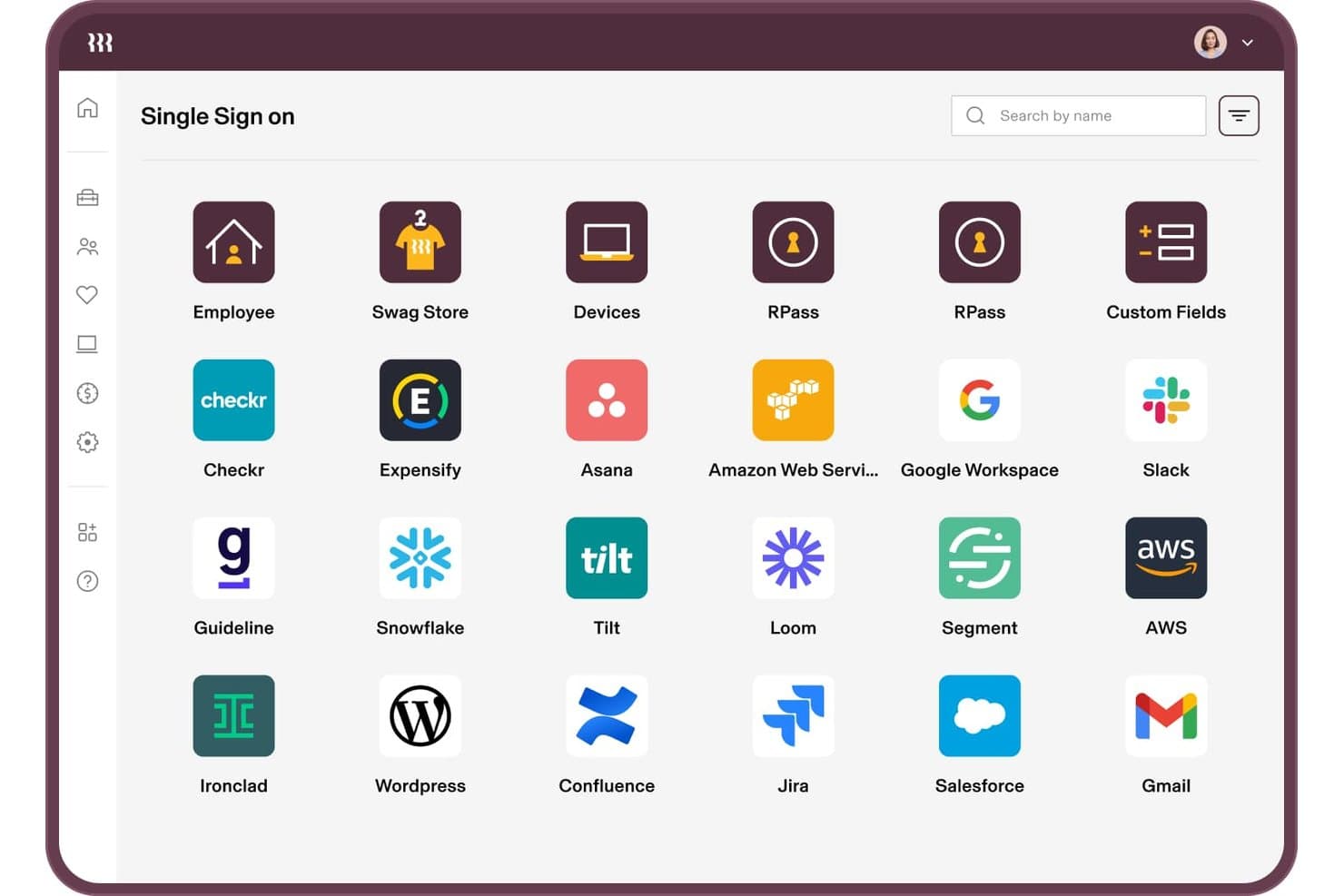
Rippling IT supports SSO connections to 20+ apps like Slack, AWS, and Jira. Rippling IT is an SSO and identity access management solution built into a unified HR-IT platform, combining federated authentication, automated lifecycle provisioning, MFA policy enforcement, device trust, and directory management.
Who Is Rippling IT Best For?
Rippling IT is a strong fit for IT teams that want app access tied directly to HR data, so onboarding and offboarding happen automatically without manual intervention.
Why I Picked Rippling IT
I picked Rippling IT as one of the best because it ties SSO directly to your HR data, so app access updates automatically when someone's role changes or they leave. Supergroups and RQL let you build self-updating access groups based on attributes like department, location, or tenure. Device Trust adds another layer by restricting logins to devices holding a Rippling-issued certificate, keeping phishing-resistant access in place without extra configuration.
Rippling IT Key Features
- Virtual LDAP directory: Lets older apps and network equipment authenticate against Rippling credentials without requiring modern protocol support.
- Cloud RADIUS server: Enables staff to log in to WiFi and VPN using their Rippling identity, centralizing network access alongside app access.
- RPass password manager: Covers apps that don't support SSO, so users have a single credential store for the full app stack.
- Shadow IT and Shadow AI detection: Surfaces unauthorized app usage and OAuth grants so you can see and manage access risks across your environment.
Rippling IT Integrations
Rippling IT offers 600+ pre-built SSO and provisioning integrations, including Microsoft 365, Google Workspace, Slack, Salesforce, GitHub, Jira, AWS, Zoom, Asana, and HubSpot. Its API and custom SAML and SCIM apps support additional integrations.
Pros and Cons
Pros:
- Passkeys reduce password-related support requests
- Device Trust blocks untrusted-device logins
- HR changes trigger automatic access updates
Cons:
- Support responses can frustrate administrators
- Complex policies require careful setup
Learn more about Rippling IT: Best for conditional SSO across devices & apps
- 14-day free trial
- From $4/device/month (billed annually)
Visit WebsiteCustomer Rating:4.7/5
Scalefusion OneIdP organization setup screen for entering company details and configuring login settings. Scalefusion OneIdP is a conditional access and identity management platform that integrates single sign-on (SSO) with device authentication to enhance organizational security. It ensures that both the user identity and the device’s compliance status are verified before access is granted to corporate applications.
Why I Picked Scalefusion OneIdP: I picked Scalefusion OneIdP because it prioritizes device-based authentication and real-time conditional access, which adds a valuable layer of security beyond traditional SSO. This approach helps organizations ensure that only trusted, policy-compliant devices can log in, significantly reducing security risks. I also appreciate its just-in-time admin access, which provides temporary elevated privileges only when needed, minimizing the window for potential misuse.
Standout features & integrations:
Features include its continuous access evaluation, which dynamically monitors device compliance and can revoke access if security conditions change. This helps organizations enforce Zero Trust principles throughout the entire user session. Scalefusion OneIdP also integrates multi-factor authentication (MFA) to strengthen security further. The platform integrates with Google Workspace, Microsoft Entra, Amazon Web Services (AWS), Cisco Duo, Okta, Salesforce, Bamboo HR, Slack, Notion, HubSpot, Figma, Zoom, and Asana.
Pros and Cons
Pros:
- Strong device-based security enforcement
- Supports multi-factor authentication (MFA)
- Broad third-party integration support
Cons:
- Higher pricing for some users
- Limited advanced customization options
Learn more about Scalefusion OneIdP: Best for multiple SSO protocols support
- Free version available (up to 50 domain users)
- From $595 (500 domain users)
Visit WebsiteCustomer Rating:4.4/5
The single sign-on (SSO) feature in ManageEngine ADSelfService Plus offers various settings for managing SSO across various applications. ManageEngine ADSelfService Plus is a self-service password management tool designed to enhance user experience and security. It allows users to reset their passwords and unlock accounts without needing IT assistance.
Why I Picked ManageEngine ADSelfService Plus: It offers support for multiple SSO protocols, including SAML, OAuth, and OpenID Connect. This flexibility ensures that organizations can integrate a wide range of applications, both cloud-based and on-premises, into a single authentication framework. By leveraging Active Directory credentials, ADSelfService Plus eliminates the need for multiple usernames and passwords. The use of organizational unit (OU) and group-based policies to control access further ensures that only authorized users can access specific applications, adding an extra layer of security.
Standout features & integrations:
Another notable feature is the Application Access Audit Report, which records all user activities during SSO access. This feature is crucial for maintaining compliance and auditing purposes, as it provides a detailed log of who accessed what and when. Additionally, the integration of Multi-Factor Authentication (MFA) with SSO adds an extra layer of security. The tool integrates with Spiceworks Cloud Help Desk, ManageEngine ServiceDesk Plus, and ManageEngine ADManager Plus.
Pros and Cons
Pros:
- Easy-to-navigate interface
- Supports MFA
- Offers effective password synchronization
Cons:
- For larger teams, the licensing costs can add up
- User enrollment process can be time-consuming
Learn more about ManageEngine ADSelfService Plus: Best for directory-as-a-service
- 30-day free trial
- From $9/user/month (billed annually)
Visit WebsiteCustomer Rating:4.6/5
Image 10: JumpCloud User Portal screenshot JumpCloud modernizes directory services for cloud-based environments with a directory-as-a-service solution. This simplifies user and system management for organizations across platforms and locations.
Why I Picked JumpCloud: In the process of selecting the most impactful tools, JumpCloud stood out because of its robust yet flexible directory capabilities, specially tailored for diverse and dispersed IT environments. After judging and comparing it against other platforms, it became evident that its commitment to modernizing directory services was unparalleled. Based on this, I chose JumpCloud, convinced that it is best suited for those in need of a directory-as-a-service solution.
Standout features & integrations:
JumpCloud’s standout features include its ability to manage users across various platforms like Mac, Linux, and Windows from a single console. Furthermore, it provides fine-grained control over system policies and security configurations. When it comes to integrations, JumpCloud easily connects with a plethora of IT resources, including cloud providers, legacy applications, and on-premises networks.
Pros and Cons
Pros:
- Modern approach to traditional directory services
- Comprehensive integrations with a myriad of IT resources
- Cross-platform user and system management from a centralized location
Cons:
- Migration from legacy systems may require careful planning and execution
- Certain advanced features might be available only in higher-tier plans
- Might have a learning curve for those familiar with traditional directory systems
Learn more about JumpCloud: Best for SaaS platform integrations
- 30 Days Free Trial
- From $99/month for up to 10 multi-user accounts and 1,000 users.
Visit WebsiteCustomer Rating:4.8/5
Image 6: Frontegg login box and admin portal overview Frontegg offers a suite of pre-built functionalities to accelerate SaaS platform development. It emphasizes integration features, specially designed for SaaS platforms, making it an optimal choice for businesses that prioritize deep and reliable integrations.
Why I Picked Frontegg: In the landscape of tools that cater to SaaS platforms, Frontegg distinguished itself in my selection process due to its emphasis on integrations. Through comparing and judging several tools, I steadily gravitated towards Frontegg because of its comprehensive integration capabilities. I chose it as the best for SaaS platform integrations based on its adeptness at linking various platforms together cohesively.
Standout features & integrations:
Frontegg is renowned for its authentication & authorization capabilities, allowing SaaS platforms to have granular control over user roles and access. Additionally, it introduces event-driven notifications, which provide businesses with real-time insights. Crucially, Frontegg integrates deeply with popular SaaS platforms like Salesforce, Slack, and HubSpot, ensuring a broad compatibility spectrum for businesses of all types.
Pros and Cons
Pros:
- Real-time, event-driven notifications
- Strong authentication & authorization functionalities
- Comprehensive integration with popular SaaS platforms
Cons:
- Focus on SaaS platforms may not cater to every business need
- Advanced features could be overwhelming for some users
- Might present a learning curve for beginners
Learn more about Frontegg: Best for multi-factor integrations
- 30-day free trial
- From $3/user/month (billed annually)
Visit WebsiteCustomer Rating:4.5/5
Image 5: Ping Identity applications summary dashboard Ping Identity is a top-notch IAM solution that offers strong multi-factor integration capabilities. It's a popular choice for businesses that prioritize layered security through multiple authentication measures.
Why I Picked Ping Identity: After comparing different tools for multi-factor integrations, I chose Ping Identity for its wide range of integration choices and commitment to being the best. It clearly stood out in my assessment and is a critical aspect of modern security frameworks.
Standout features & integrations:
One of Ping Identity's major strengths is its adaptive multi-factor authentication, which enables businesses to set policies that prompt users for additional verification when necessary. The tool also boasts a user-centric design, ensuring that even with multiple layers of authentication, the user experience remains fluid. On the integration front, Ping Identity is compatible with various applications and platforms, ensuring businesses can set up multi-factor authentication across their entire digital ecosystem.
Pros and Cons
Pros:
- Extensive application compatibility for integrations
- Policy-driven adaptive authentication
- Comprehensive multi-factor authentication options
Cons:
- Initial setup and customization can be intensive
- Annual billing may deter some potential users
- Might be complex for smaller organizations
Learn more about Ping Identity:

miniOrange IDP login screen highlighting secure username-based authentication with built-in social login options for centralized access control. For businesses looking to improve security and simplify authentication, miniOrange IDP provides a practical Single Sign-On solution. It’s designed for organizations that manage multiple applications and want to reduce the burden of handling separate credentials. With support for existing identity sources and multiple authentication protocols, miniOrange IDP helps organizations maintain secure access and consistent user management across varied IT environments.
Why I Picked miniOrange IDP
I chose miniOrange IDP for its strong focus on secure, efficient Single Sign-On. It supports widely used protocols such as SAML, OAuth, and OpenID Connect, making it compatible with a broad range of applications. It also includes solid security controls like Multi-Factor Authentication (MFA) and IP-based access rules to limit unauthorized access. Together, these features make miniOrange IDP a dependable option for organizations that want better security without adding complexity to user access.
miniOrange IDP Key Features
In addition to its protocol support and security measures, I also found the following features to add to its value:
- Identity Source & Protocol Support: Connects with Active Directory, LDAP, Google Workspace, and Microsoft Entra ID, and supports SAML, OAuth, OpenID Connect, JWT, and WS-Federation (WS-Fed) for compatibility across SaaS, cloud, and legacy applications.
- Adaptive & Passwordless Authentication: Adjusts authentication requirements based on user context, such as device or location, and supports MFA as well as passwordless login options, including biometrics and push notifications.
- Automated Provisioning & Access Controls: Enables automated user provisioning across applications, IP-based access rules, and centralized user access management.
- Legacy & Custom Application Support: Includes connectors, APIs, and reverse proxy options to secure legacy and in-house applications.
miniOrange IDP Integrations
Integrations include Salesforce, Google Workspace, Microsoft 365, AWS, Atlassian, ServiceNow, Zoom, Dropbox, and WordPress. The platform supports over 6,000 pre-built integrations across SaaS, cloud, on-prem, and legacy applications. Connectors and APIs are available for custom or in-house application integrations.
Pros and Cons
Pros:
- Customizable UX and automated provisioning
- Strong security (MFA, adaptive SSO)
- Broad protocol support (SAML, OAuth, OpenID)
Cons:
- Setup/configuration can be complex for non-technical users
- Fewer native integrations than some competitors
Learn more about miniOrange: Best for password management integration
- From $6/user/month (billed annually)

Image 9: LastPass Single Sign-On solutions LastPass SSO combines Single Sign-On with trusted password management to provide a comprehensive solution for easier and more secure access to business applications. It's a leading choice for organizations looking to streamline their password and access control procedures.
Why I Picked LastPass Single Sign-On (SSO): I recommend LastPass SSO as the top choice for password management. Its credibility comes from its origins in a trusted management system. LastPass SSO's integration of password management into a Single Sign-On solution sets it apart, making it the best tool for effective integration.
Standout features & integrations:
LastPass SSO stands out for its adaptive authentication, which adjusts security based on user behavior and location, adding a layer of protection. Moreover, its centralized dashboard provides clear insights into user activities and potential security risks. As for integrations, LastPass SSO supports a wide range of applications, from cloud-based solutions like Salesforce and Slack to on-premises applications, ensuring a broad scope of coverage.
Pros and Cons
Pros:
- Comprehensive integrations with both cloud-based and on-premises applications
- Adaptive authentication enhances security based on context
- Strong pedigree from a recognized leader in password management
Cons:
- Initial setup and configuration might require some time and expertise
- Larger organizations might find scalability challenging
- Might be perceived as just a password manager by some users
Learn more about LastPass Single Sign-On (SSO):

Image 12: Microsoft Entra ID single sign-on solution Microsoft Entra ID is a secure and efficient identity management platform designed for Azure users. It simplifies tasks for organizations that have invested in Microsoft's ecosystem and integrates seamlessly with Azure.
Why I Picked Microsoft Entra ID: In my quest for an identity management tool, Microsoft Entra ID's native Azure integration set it apart from other contenders. After judging and comparing various platforms, it was evident that for businesses already harnessing the power of Azure, Microsoft Entra ID offers a harmonized solution. I chose this because it is tailor-made for easy integration with Azure, making it especially valuable for Azure-centric enterprises.
Standout features & integrations:
Key features of Microsoft Entra ID encompass single sign-on, multi-factor authentication, and advanced security reporting. As expected, its integration strengths lie in its bond with Microsoft tools. Not only does it flawlessly mesh with Azure, but it also ties with other Microsoft services, from Microsoft 365 to Dynamics 365.
Pros and Cons
Pros:
- Built by Microsoft, it offers a consistent user experience for those familiar with the Microsoft ecosystem
- Provides comprehensive security features ensuring robust user identity protection
- Deep-rooted integration with Azure and other Microsoft tools
Cons:
- Potentially a steeper learning curve for those transitioning from non-Microsoft solutions
- The user interface may seem complex to those unfamiliar with Microsoft platforms
- Might not be the ideal choice for businesses not using Microsoft products
Learn more about Microsoft Entra ID: Best for workforce-specific use cases
- 30-day free trial + free demo available
- From $6/user/month (billed annually)

Image 11: Okta Workforce Identity single sign-on feature Okta Workforce Identity manages user authentication, provisioning, and lifecycle management for employees, providing secure and efficient access to the tools and data they need. It's tailored for employee use cases and ideal for workforce-specific scenarios.
Why I Picked Okta Workforce Identity: During my selection process, Okta Workforce Identity caught my attention because of its in-depth focus on the unique challenges that modern workforces face. After comparing it with other platforms, it was clear that Okta had sculpted a solution specifically addressing the nuanced needs of today's employees. I chose Okta Workforce Identity because it demonstrates a clear understanding of and caters to workforce-specific use cases better than most other platforms.
Standout features & integrations:
Key features of Okta Workforce Identity include adaptive multi-factor authentication, centralized user management, and automated provisioning. The platform’s integration capabilities are equally commendable, effortlessly connecting with numerous enterprise tools, from communication platforms like Slack to productivity suites such as Microsoft 365.
Pros and Cons
Pros:
- Advanced security features like adaptive MFA protect user identities effectively
- Offers a vast range of integrations with major enterprise applications
- In-depth focus on workforce challenges ensures specialized solutions
Cons:
- For very small businesses, the platform might offer more features than required, potentially complicating the user experience
- Integration with less popular tools might require additional configurations
- Some features may necessitate technical know-how for implementation
Learn more about Okta Workforce Identity:
Outras soluções de início de sessão único
Eis algumas opções adicionais de soluções de SSO que não entraram na minha lista restrita, mas que vale a pena conhecer:
- 11miniOrangeBest for cross-platform compatibility
- 12ForgeRockBest for scalability in large enterprises
- 13SecureAuthBest for adaptive authentication
- 14GluuBest for open-source deployments
- 15RipplingBest for centralized employee management
- 16ScalefusionBest for zero-trust access
- 17OneLoginGood for streamlined enterprise access
- 18Duo SecurityBest for combining SSO with security
- 19DashlaneGood for user-friendly password management
- 20Auth0Good for developers seeking customization
- 21CyberArk IdentityGood for layered enterprise security
- 22IBM Security VerifyGood for robust identity analytics
- 23Google Cloud IdentityGood for Google Cloud Platform integrations
- 24WSO2 Identity ServerGood for API-driven identity management
- 25Thales SafeNet Trusted AccessGood for adaptive authentication
How I Evaluate Single Sign-On Solutions
I look at every SSO platform across two layers: the core capabilities—protocol support, MFA, and provisioning—that qualify it for the list, and the differentiators that set the best options apart.
Core Functionality (Table Stakes For This List)
When I'm selecting tools for my list, I rank each one on a scale from 0 (does not offer the functionality) to 5 (excels in this area) for each core functionality listed below. Then, I calculate the tool's total score into a percentage. Each tool needs to achieve a minimum total score of 75% to be considered for inclusion.
- Federated Authentication Protocols: I check which SSO standards each tool supports—SAML 2.0, OAuth 2.0, OIDC—and whether configuring them for apps like Salesforce or AWS is straightforward.
- Pre-Built App Integrations: The size and depth of the integration catalog matters. I evaluate whether major SaaS apps, cloud platforms, and on-prem systems have ready-made connectors.
- Multi-Factor Authentication: I look for the range of MFA methods available—push notifications, TOTP, hardware keys, biometrics—and whether admins can enforce them per app or user group.
- User Directory & Provisioning: Automated provisioning and deprovisioning through SCIM or directory sync with AD and LDAP is a key area. Manual-only user management is a red flag.
- Access Policies & Conditional Access: Granular, context-aware rules are what I evaluate here—can admins restrict access by device trust, location, or user role across connected apps?
- Audit Logging & Reporting: Detailed authentication logs with filtering, export options, and SIEM forwarding are what I look for to support incident response and compliance audits.
Once I have a list of tools that meet this criteria, I consider what sets each platform apart.
Differentiating Factors (What Sets Vendors Apart)
Here's how I compare and contrast different vendors:
Standout Features
Passwordless authentication is a big differentiator. Platforms that support FIDO2/WebAuthn and biometric login remove the biggest attack vector while giving users a faster experience. I also evaluate adaptive risk scoring, where the platform uses behavioral signals to trigger step-up authentication only when something looks unusual—like a login from an unfamiliar device. For teams building custom apps, developer-friendly SDKs and APIs matter a lot. I check whether the platform offers embeddable auth components that fit into existing CI/CD workflows.
Beyond Features
Compliance certifications are one of the first things I check. If your organization needs SOC 2 Type II, HIPAA, or FedRAMP attestation, the SSO vendor itself needs to hold those certifications. Pricing transparency matters just as much—I evaluate whether per-user costs stay predictable as you scale from a few hundred to tens of thousands of identities. I also look at ecosystem depth, specifically whether the platform connects to HRIS tools like Workday and SIEM platforms like Splunk for full lifecycle automation and security visibility.
Como escolher uma solução de início de sessão único
É fácil perder-se em listas extensas de funcionalidades e estruturas de preços complexas. Para o ajudar a manter-se concentrado enquanto avança no seu processo específico de seleção de software, eis uma lista de verificação dos fatores a ter em conta:
| Fator | O que considerar |
|---|---|
| FatorEscalabilidade | O que considerarA solução acompanhará o crescimento da sua equipa? Tenha em conta os limites de utilizadores, o desempenho sob carga e as necessidades de expansão futuras. |
| FatorIntegrações | O que considerarÉ compatível com as suas ferramentas atuais? Verifique a existência de integrações nativas e a disponibilidade de API para evitar soluções manuais. |
| FatorPersonalização | O que considerarPode adaptá-la aos seus fluxos de trabalho? Procure flexibilidade nas definições, opções de marca e funções de utilizador. |
| FatorFacilidade de utilização | O que considerarÉ fácil de utilizar pela sua equipa? Avalie a interface, a curva de aprendizagem e o feedback de utilizadores com necessidades semelhantes. |
| FatorImplementação e integração inicial | O que considerarCom que rapidez pode começar? Tenha em conta o tempo de configuração, os recursos de formação disponíveis e o apoio durante a transição. |
| FatorCusto | O que considerarEnquadra-se no seu orçamento? Compare os níveis de preços, as taxas ocultas e os custos com os benefícios. Tenha atenção a cobranças adicionais por utilizadores ou funcionalidades extra. |
| FatorMedidas de proteção da segurança | O que considerarAs medidas de proteção de dados são suficientes? Procure normas de encriptação, controlos de acesso e conformidade com os regulamentos de segurança. |
| FatorRequisitos de conformidade | O que considerarCumpre as normas do setor? Certifique-se de que está em conformidade com quaisquer requisitos legais ou regulamentares que a sua organização tenha de seguir. |
O que são soluções de início de sessão único?
As soluções de início de sessão único são ferramentas que permitem aos utilizadores aceder a várias aplicações com um único conjunto de credenciais de início de sessão. Os profissionais de TI, os especialistas em segurança e os gestores de equipas utilizam normalmente estas ferramentas para simplificar a gestão de utilizadores e reforçar a segurança. Funcionalidades como a autenticação multifator, a gestão de utilizadores e a transmissão segura de dados ajudam a integrar sistemas de forma segura e eficiente. No geral, estas ferramentas permitem às organizações poupar tempo e reduzir os riscos de segurança.
Funcionalidades
Ao selecionar soluções de início de sessão único, tenha em atenção as seguintes funcionalidades principais:
- Acesso de início de sessão único: Permite aos utilizadores iniciar sessão uma vez e aceder a várias aplicações, reduzindo a fadiga associada às palavras-passe e melhorando a segurança.
- Autenticação multifator: Adiciona uma camada extra de segurança ao exigir uma verificação adicional para além de uma simples palavra-passe.
- Gestão de utilizadores: Simplifica o processo de adicionar, remover e gerir o acesso dos utilizadores em várias aplicações.
- Transmissão segura de dados: Garante que todos os dados trocados entre os utilizadores e as aplicações são encriptados e protegidos.
- Capacidades de integração: Liga-se de forma integrada às ferramentas e aplicações existentes para proporcionar uma experiência de utilizador unificada.
- Páginas de início de sessão personalizáveis: Permitem às organizações aplicar a sua marca às interfaces de início de sessão, proporcionando uma aparência e uma experiência consistentes.
- Relatórios avançados: Fornecem informações sobre os padrões de acesso dos utilizadores e potenciais ameaças à segurança através de análises detalhadas.
- Suporte para conformidade: Garante o cumprimento dos regulamentos e padrões específicos do setor, minimizando os riscos legais.
- Compatibilidade entre plataformas: Funciona em diferentes dispositivos e sistemas operativos, garantindo a acessibilidade a todos os utilizadores.
- Deteção de ameaças baseada em IA: Utiliza inteligência artificial para identificar e responder a potenciais ameaças à segurança em tempo real.
Benefícios
A implementação de soluções de início de sessão único proporciona vários benefícios à sua equipa e à sua empresa. Eis alguns dos benefícios que pode esperar:
- Segurança reforçada: Ao utilizar a autenticação multifator e a transmissão segura de dados, pode proteger a sua organização contra acessos não autorizados.
- Maior produtividade: O acesso de início de sessão único reduz o tempo dedicado à gestão de vários inícios de sessão, permitindo à sua equipa concentrar-se no trabalho.
- Gestão de utilizadores simplificada: As funcionalidades de gestão de utilizadores facilitam o controlo do acesso nas aplicações, poupando tempo às equipas de TI.
- Experiência de utilizador melhorada: As páginas de início de sessão personalizáveis e as capacidades de integração criam uma experiência consistente e intuitiva.
- Poupança de custos: Ao consolidar os processos de autenticação, pode reduzir os custos associados à gestão de vários sistemas.
- Garantia de conformidade: O suporte para conformidade ajuda a sua organização a cumprir os regulamentos do setor, minimizando os riscos legais.
- Deteção de ameaças em tempo real: A deteção de ameaças baseada em IA ajuda a identificar e a atenuar rapidamente as ameaças à segurança, protegendo os seus dados e sistemas.
Custos & preços
A seleção de soluções de início de sessão único requer uma compreensão dos vários modelos de preços e planos disponíveis. Os custos variam consoante as funcionalidades, a dimensão da equipa, os complementos e outros fatores. A tabela abaixo resume os planos comuns, os respetivos preços médios e as funcionalidades normalmente incluídas nas soluções de início de sessão único:
Tabela de comparação de planos para soluções de início de sessão único
| Tipo de plano | Preço médio | Funcionalidades comuns |
|---|---|---|
| Tipo de planoPlano gratuito | Preço médio$0 | Funcionalidades comunsGestão básica de utilizadores, acesso de início de sessão único e integrações limitadas. |
| Tipo de planoPlano pessoal | Preço médio$5-$15/utilizador/mês | Funcionalidades comunsAutenticação multifator, páginas de início de sessão personalizáveis e transmissão segura de dados. |
| Tipo de planoPlano empresarial | Preço médio$15-$25/utilizador/mês | Funcionalidades comunsRelatórios avançados, suporte para conformidade e capacidades de integração melhoradas. |
| Tipo de planoPlano empresarial de grande escala | Preço médio$25-$50/utilizador/mês | Funcionalidades comunsDeteção de ameaças baseada em IA, suporte dedicado e opções de personalização completas. |
Perguntas frequentes sobre soluções de início de sessão único
Aqui encontrará algumas respostas a perguntas comuns sobre soluções de início de sessão único:
Quais são os requisitos básicos de uma solução SSO típica?
Uma solução SSO típica requer uma autenticação robusta, comunicações seguras e segurança dos tokens. Também precisará de uma gestão eficaz das sessões e de um controlo de acesso. O registo de auditoria e a proteção contra ataques comuns são igualmente cruciais. Estes elementos garantem uma experiência de início de sessão único segura e eficiente
Como funciona o SSO passo a passo?
O SSO funciona redirecionando os utilizadores para uma ferramenta de início de sessão central. Depois de introduzirem as credenciais, o sistema autentica-os e gera um token. Este token concede acesso a várias aplicações sem ser necessário iniciar sessão repetidamente. Trata-se de um processo simplificado que aumenta a conveniência para os utilizadores, mantendo simultaneamente a segurança.
Qual é a principal preocupação com o início de sessão único?
A principal preocupação com o início de sessão único é a segurança. Se um atacante obtiver acesso, poderá conseguir aceder a várias aplicações. Deve dispor de medidas para detetar acessos não autorizados e desativar rapidamente contas comprometidas. Certifique-se sempre de que a sua solução SSO inclui uma autenticação robusta e funcionalidades de monitorização.
O SSO é seguro?
O SSO pode ser seguro se for implementado corretamente. Reduz a fadiga causada pelas palavras-passe e centraliza a autenticação, mas deve garantir a implementação de medidas de segurança robustas. Utilize a autenticação multifator e monitorize atentamente os acessos para mitigar os riscos associados a um ponto único de falha.